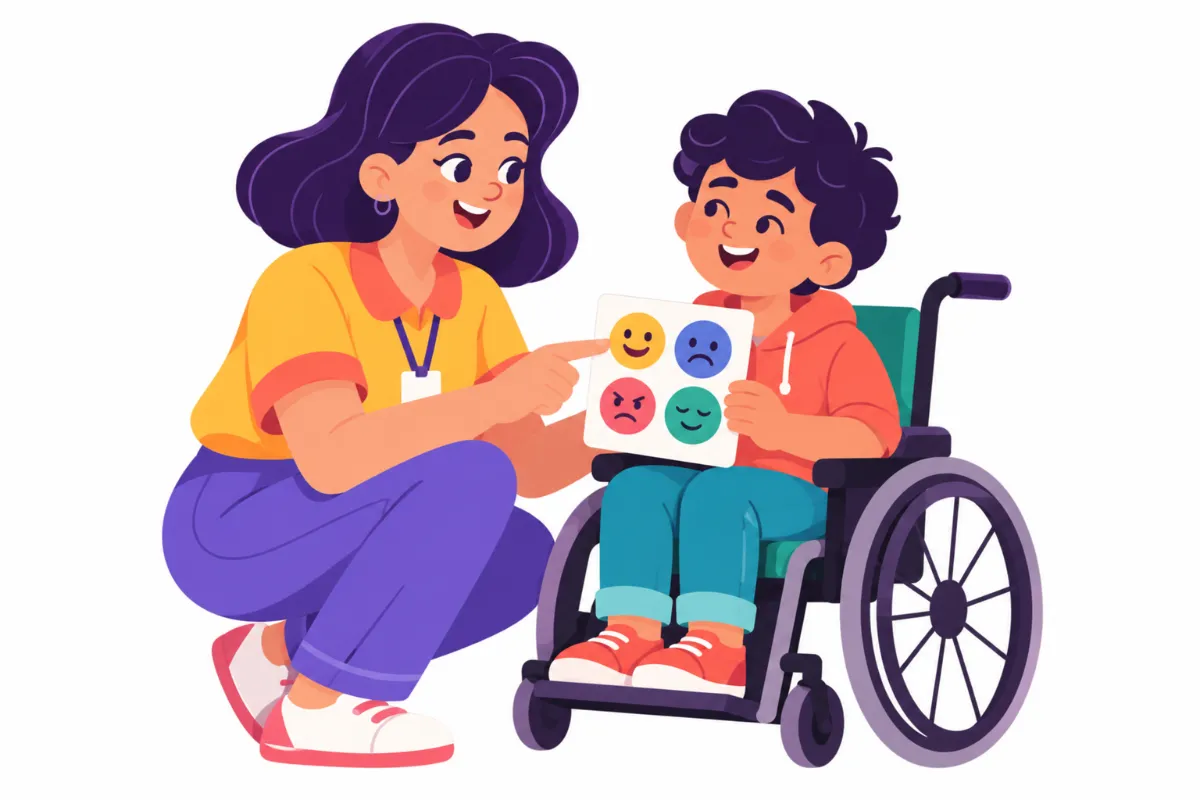

Physical disability emotional support starts with noticing the feelings that sit behind a hard moment: frustration, fatigue, pain, or worry about being different. Picture a fifth grader in a wheelchair who pushes her worksheet away and says “I’m done” ten minutes before the end of the day. It looks like defiance. Often, it is a tired body and a full emotional cup.
This guide gives you a five-step process for school and home. You will learn the common emotional loads, spot early signs, teach an accessible feelings check-in, adapt calming tools to the student’s body, and build coping language with the team. Each step follows one fictional student so you can see the plan in action.
Examples are fictional. Adapt to the student’s goals and agreed supports. This is guidance, not a diagnosis.
At a glance
- Frustration, fatigue, pain, and social worry often show up as behavior.
- Log when hard moments happen before you choose a strategy.
- Offer a feelings check-in the student can use with their own body and voice.
- Adapt breathing and relaxation tools to the student’s range of movement.
- Teach coping statements and review progress with the family and therapists.
1. Understand the emotional load behind physical disability emotional support
First, remember that students with physical disabilities carry more than the physical task in front of them. Under IDEA, orthopedic impairment is one of the disability categories, and it includes a wide range of conditions, such as cerebral palsy, spina bifida, muscular dystrophy, and limb differences. Each student’s experience is different.
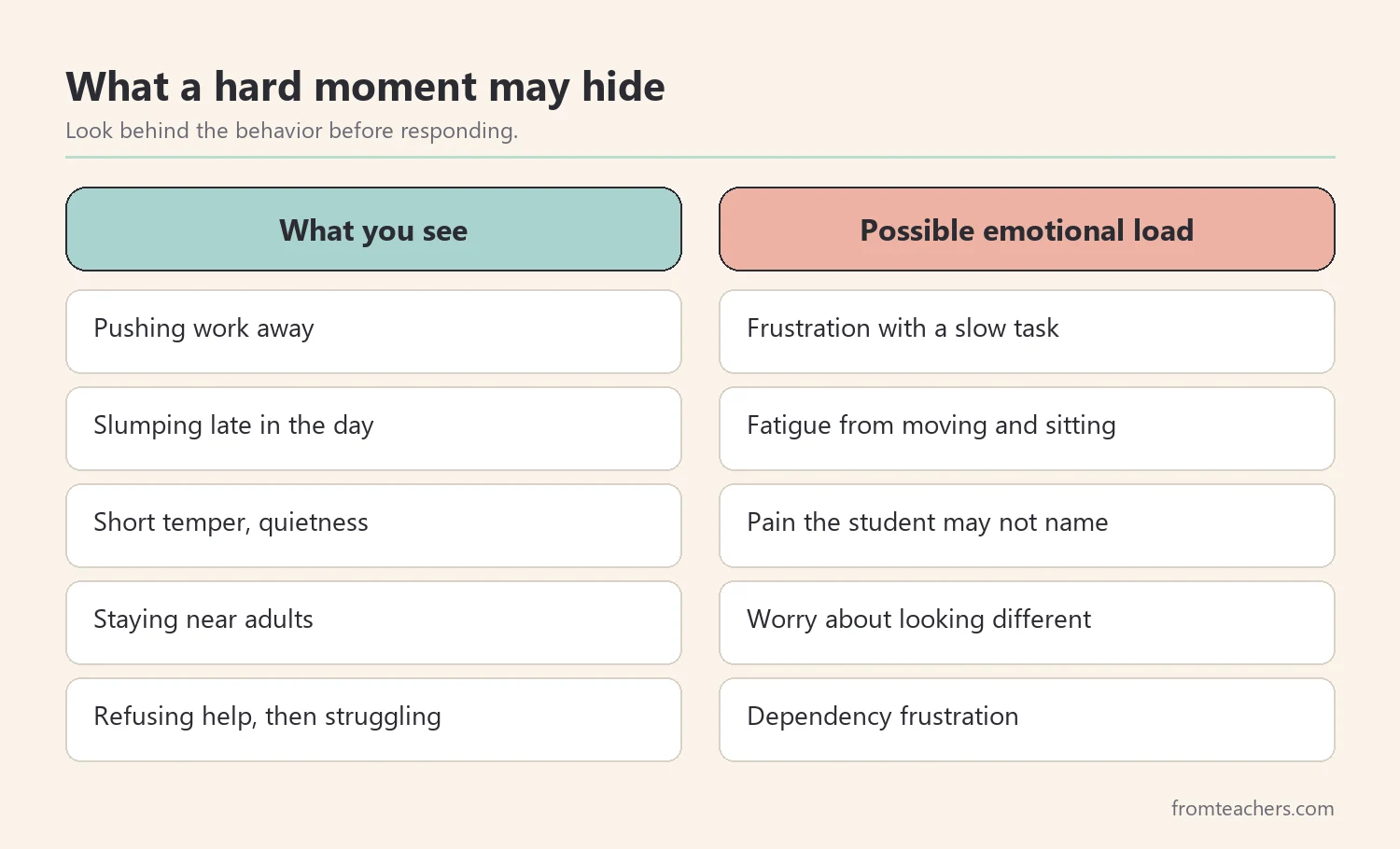
However, several emotional loads come up often. Frustration builds when a task takes longer or needs help that other students do not need. Fatigue can arrive earlier in the day because moving, sitting, or writing takes more energy. Some students live with chronic pain, which can shorten patience. Others feel anxious about medical appointments or about looking different from peers.
| Emotional load | What it may look like |
|---|---|
| Frustration | Pushing work away, saying “I can’t” |
| Fatigue | Slumping, slower answers late in the day |
| Pain | Irritability, quietness, avoiding movement |
| Social worry | Staying near adults, avoiding group work |
| Dependency frustration | Refusing help, then struggling alone |
For example, meet Sofia, a fictional fifth grader with cerebral palsy who uses a wheelchair. She is bright and funny, and she loves art. Lately, her teacher has noticed short outbursts near the end of the day, especially on days with physical therapy.
Good physical disability emotional support begins by asking what Sofia’s body and feelings might be telling us, rather than what rule she broke. That shift changes everything about the plan that follows.
In addition, think about the whole day, not only the moment. A student may arrive already tired from a long bus ride or a morning routine that takes extra effort. Physical disability emotional support works best when adults see the full picture of the student’s energy across the day.
2. Notice early signs and patterns
Before choosing a strategy, collect a little information. A short log for two weeks shows when hard moments happen and what came before them. It also keeps the team from guessing.
Keep the log simple. Record the day, the time, what was happening, and what you saw. Also note anything physical you know about, such as a therapy session, a long transfer, or a change in seating. If pain or health concerns come up, share them with the school nurse and the family rather than interpreting them yourself.
Here is a two-week summary for Sofia.
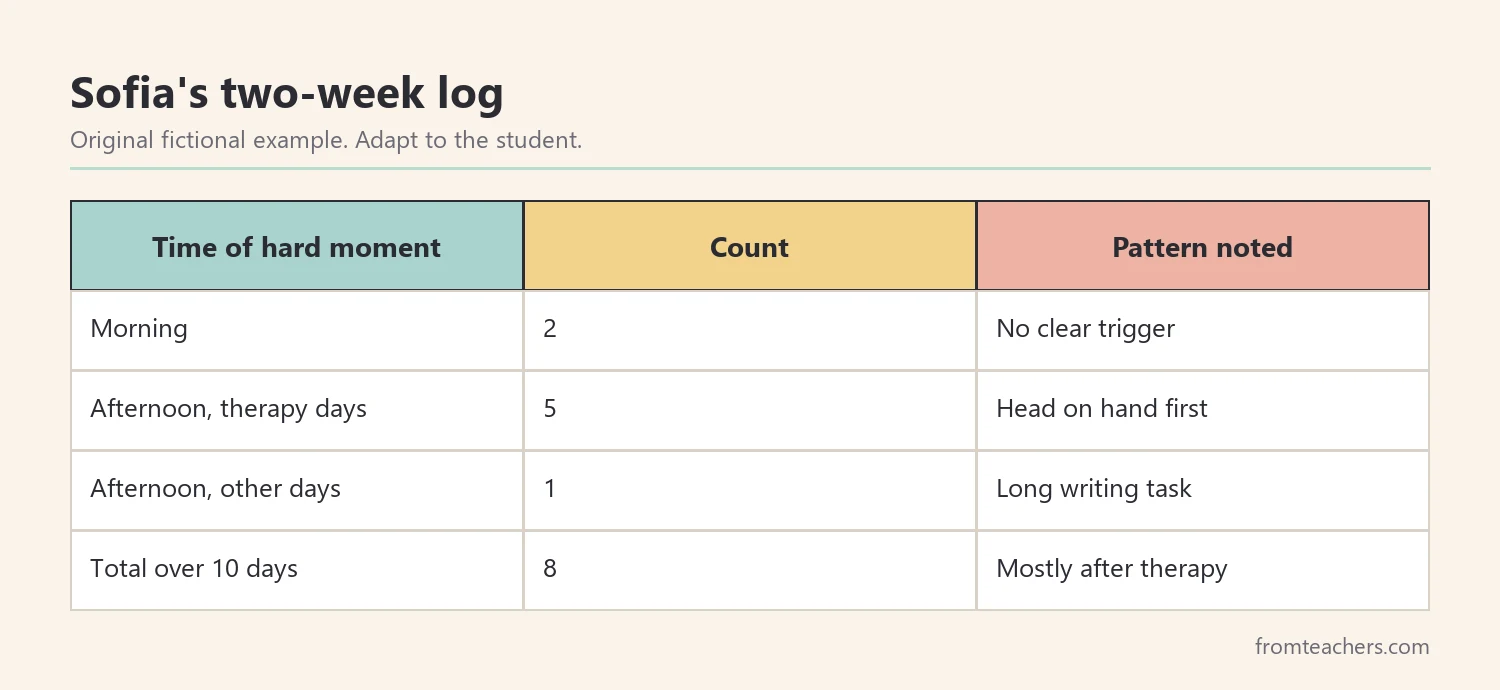
Over ten school days, Sofia had 8 hard moments. Six happened in the afternoon, and 5 of those 6 came on days with physical therapy. Only 2 happened in the morning. So the pattern points to fatigue after therapy, not to a dislike of the afternoon subject.
Next, look for the earliest signs. Sofia’s teacher notices that before an outburst, Sofia goes quiet and rests her head on her hand. That small sign becomes the cue for support. Catching it early is the heart of practical physical disability emotional support, because calming is easier before feelings peak.
Also, ask the student. Many students can tell you what hard moments feel like if you ask at a calm time. Sofia says, “My arms feel heavy and I’m tired of trying.” That sentence is valuable data.
Meanwhile, share the log with the people who know the student best. Families can tell you about sleep, medical appointments, or changes at home. Therapists can tell you which sessions are most demanding. Putting these views together turns a simple log into strong physical disability emotional support.
3. Teach a feelings check-in as physical disability emotional support
Students need a way to say how they feel before feelings turn into behavior. A feelings check-in gives them that way. The key is making it accessible for the student’s body and communication.
Start with a small set of feelings. Four zones or colors work well for many students, for example calm, tired, worried, and upset. Use pictures with words. Then decide how the student will show their choice. Some students point, some use eye gaze, some tap a switch, and some say the word.
For Sofia, the check-in sits on her wheelchair tray. She taps one of four picture cards at three points in the day: arrival, after lunch, and after therapy. If she taps “tired” or “upset,” her teacher offers a choice of two supports.
| Check-in choice | Support offered |
|---|---|
| Calm | Continue the task |
| Tired | Short rest or a shorter task |
| Worried | Quick talk or a written plan |
| Upset | Breathing tool or a quiet spot |
In addition, model the check-in yourself. When adults name their own feelings, such as “I’m a little tired after lunch too,” students learn that feelings are normal and safe to share.
Then keep the check-in short and predictable. It should take less than a minute. If it becomes a long conversation every time, students may stop using it. The goal of this kind of physical disability emotional support is a quick signal that leads to a quick, helpful response.
For a ready set of tools, the emotional regulation guide for orthopedic impairment and physical disability includes an adapted version of the Zones of Regulation, breathing and body-aware activities for limited mobility, and coping statement ideas.
4. Adapt calming tools for physical disability emotional support
Many calming strategies assume the student can stand, stretch, or walk away. That is not true for every student. So adapt the tools to the student’s range of movement and energy.
Breathing tools are a strong place to start because they need little movement. Box breathing uses a slow count of four in, hold, out, and hold. Belly breathing asks the student to feel a hand or a small object rise and fall. Straw breathing slows the breath by breathing out through a straw. Each can be done seated or lying down.
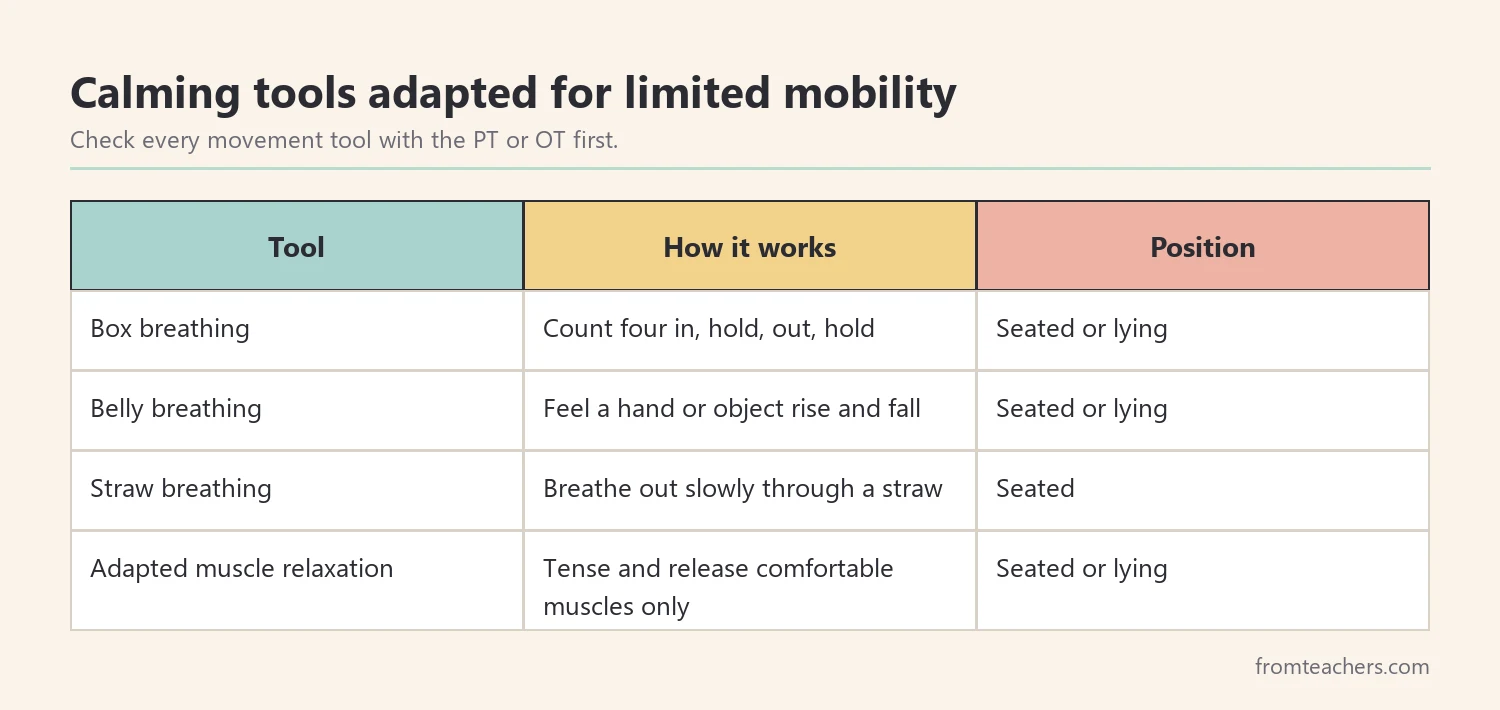
Next, consider body-aware relaxation. Progressive muscle relaxation can be adapted to the muscles the student can comfortably tense and release, such as hands, shoulders, or face. Check with the student’s physical or occupational therapist before adding any movement-based tool, so it fits their plan and comfort.
Also, consider sensory supports. A weighted lap pad, a textured object to hold, soft music, or dimmed light can help some students settle. Again, ask the student and the therapy team which supports feel good.
For Sofia, the team chooses straw breathing and a short hand-squeeze relaxation. Her OT confirms that both suit her. She practices them at calm times first, twice a day for a week, so they are familiar when she needs them. Practicing when calm is a core rule of effective physical disability emotional support.
Finally, build rest into the schedule. If fatigue drives hard moments, a planned five-minute rest after therapy may prevent more outbursts than any calming tool used afterward.
Similarly, consider the social side. Students with physical disabilities sometimes feel left out of games or group work. Planning accessible roles in group activities, and asking the student how they would like to take part, is a quiet but powerful form of physical disability emotional support. Belonging lowers anxiety for many students.
5. Build coping language and review physical disability emotional support
Calming the body is half of the work. The other half is helping the student think about hard moments in a kinder way. Coping statements and simple reframing help with that.
Coping statements are short sentences a student can say or read, such as “This is hard, and I can take a break,” or “I can ask for help and still be in charge.” Let the student choose or write their own. Self-written statements tend to feel more real.
Next, teach reframing gently. When Sofia says “I’m bad at this,” her teacher responds, “This takes your hands more energy. Let’s find a way that works for your body.” Over time, students learn to separate their worth from their physical effort.
Then review progress. Here are Sofia’s hard afternoon moments across four weeks, after the plan started.
| Week | School days | Hard afternoons | Change made |
|---|---|---|---|
| 1 | 5 | 3 | Check-in card added |
| 2 | 5 | 2 | Rest after therapy |
| 3 | 5 | 2 | Straw breathing practiced |
| 4 | 5 | 1 | Coping statement on tray |
Across 20 school days, Sofia had 8 hard afternoons, compared with 6 in only 10 days before the plan. The trend is moving in the right direction. Even so, the team keeps reviewing, because needs change with growth, surgery, or new equipment.
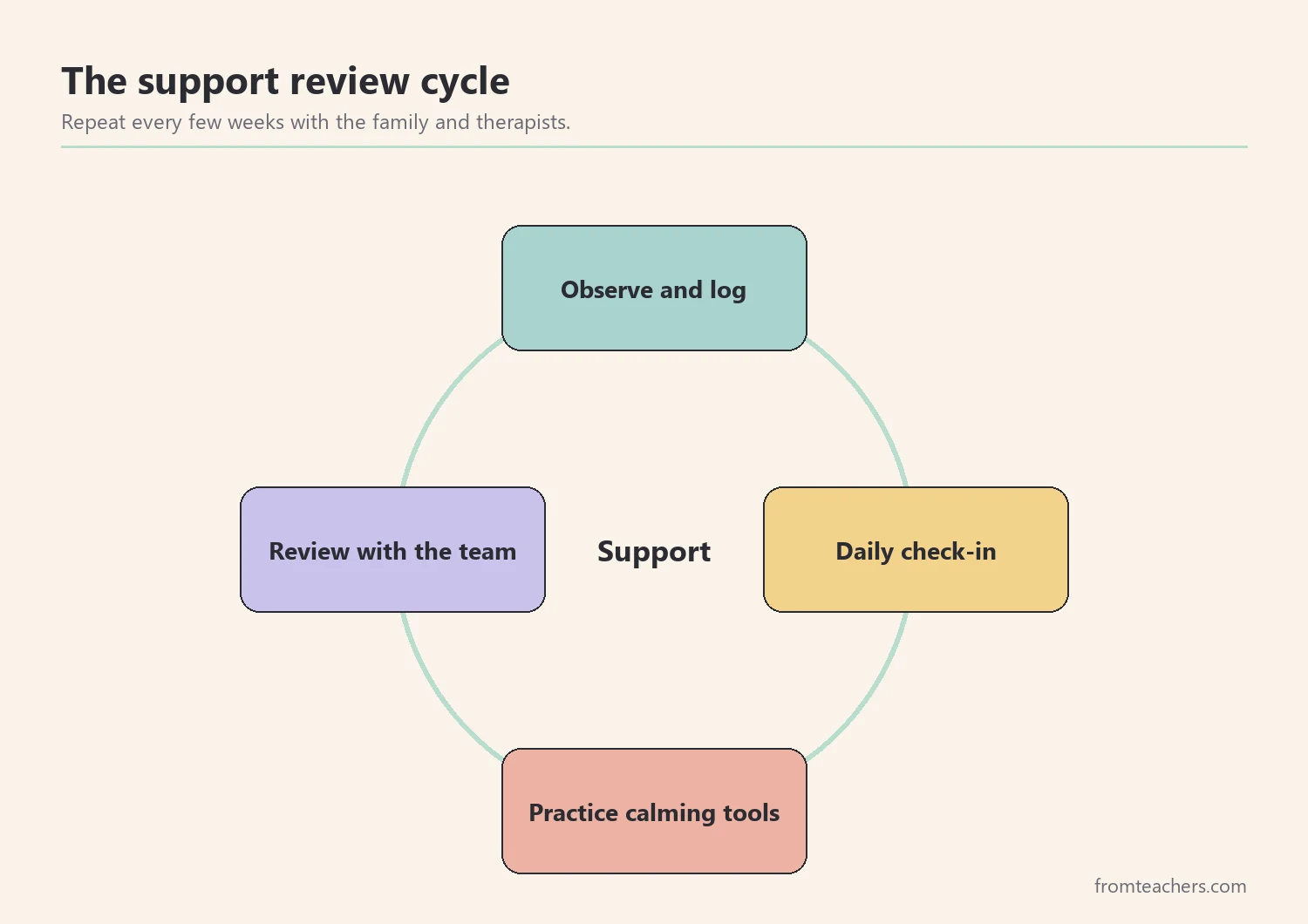
Finally, share the plan with the family. When Sofia uses the same check-in card and coping statement at home, the skills grow faster. Strong physical disability emotional support is a team effort between school, home, and therapists.
Above all, keep the student at the center. Ask what helps, what does not, and what they would like adults to do differently. Physical disability emotional support that includes the student’s own voice is more respectful and usually more effective.
Common mistakes and how to avoid them
- Treating outbursts as defiance. This misses fatigue or pain. Fix: log patterns before choosing consequences.
- Using tools that need full mobility. The student cannot use them. Fix: adapt tools with the PT or OT.
- Introducing calming tools during a meltdown. New skills are hard to learn when upset. Fix: practice at calm times first.
- Doing everything for the student. This can increase frustration. Fix: offer choices and ask before helping.
- Interpreting pain yourself. This is outside the teacher’s role. Fix: share concerns with the nurse and family.
Questions teachers and parents ask about physical disability emotional support
Who should be involved in physical disability emotional support?
Teachers, paraprofessionals, the school counselor, therapists, and the family all play a role. The student should be involved too. Shared tools and language make support consistent across settings.
How do I know if behavior is linked to fatigue?
Keep a short log of when hard moments happen. If they cluster after therapy, long transfers, or late in the day, fatigue may be a factor. Discuss the pattern with the team and family.
Can the Zones of Regulation work for students with physical disabilities?
Yes, with adaptations. Students can show their zone by pointing, eye gaze, a switch, or speech. Calming strategies within each zone should match the student’s movement and energy.
What if the student does not want to talk about feelings?
Offer non-verbal options like picture cards or drawing. Respect the student’s pace. Trust often grows through small, predictable check-ins.
How can parents support this at home?
Use the same check-in cards and coping statements the school uses. Practice calming tools together at calm times. Share what you notice at home with the school team.
Related reading: Meltdowns vs Tantrums: Understanding the Difference, Best Assistive Technology for Special Education Classrooms, and Parent and Teacher Collaboration in Special Education.
A companion resource for physical disability emotional support:
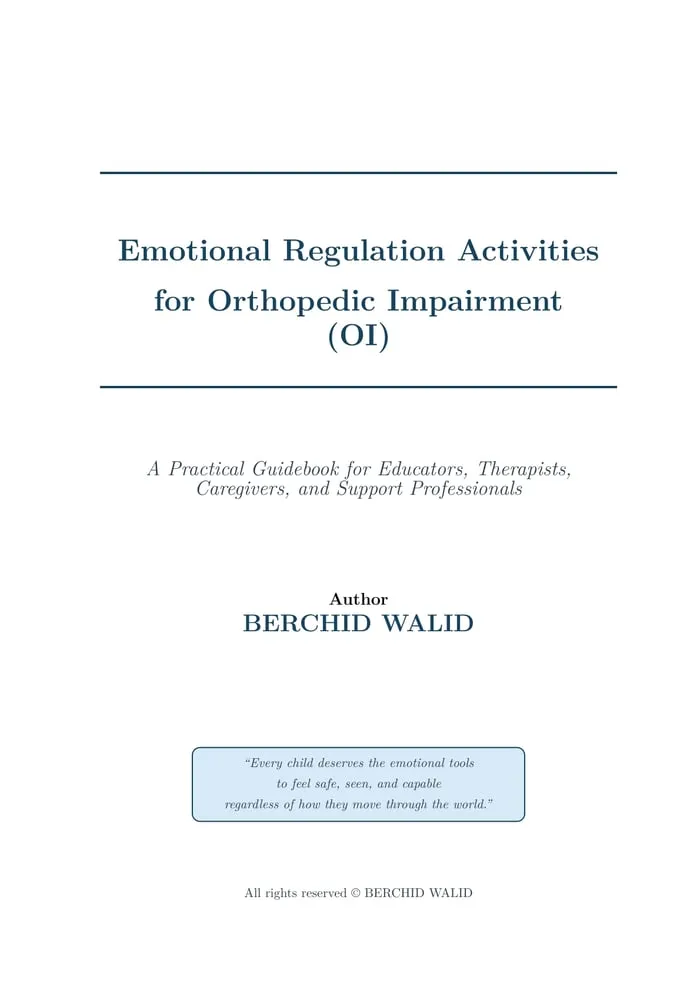
Emotional Regulation Guide for Orthopedic Impairment and Physical Disability: a 60-page practical guide covering the emotional landscape of physical disability, the pain and fatigue connection, adapted Zones of Regulation, breathing and body-aware activities for limited mobility, sensory tools, coping statements, and creative activities.
Sources and scope
- IDEA, U.S. Department of Education: the law that defines disability categories, including orthopedic impairment.
- Centers for Disease Control and Prevention (CDC): general information on cerebral palsy, spina bifida, and children’s mental health.
- IRIS Center, Vanderbilt University: free modules on behavior support and accommodations.
- CAST UDL Guidelines: a framework for flexible ways to engage and express learning.
This guide covers everyday emotional support strategies for school and home. It does not cover medical care, pain management, or therapy plans, which belong to qualified health professionals and the student’s team.
Key takeaways
- Physical disability emotional support starts by looking behind the behavior.
- Log patterns before choosing a strategy.
- Offer an accessible feelings check-in at set times.
- Adapt calming tools with the therapy team and practice them when calm.
- Teach coping language and review progress with the family.








Leave a Comment