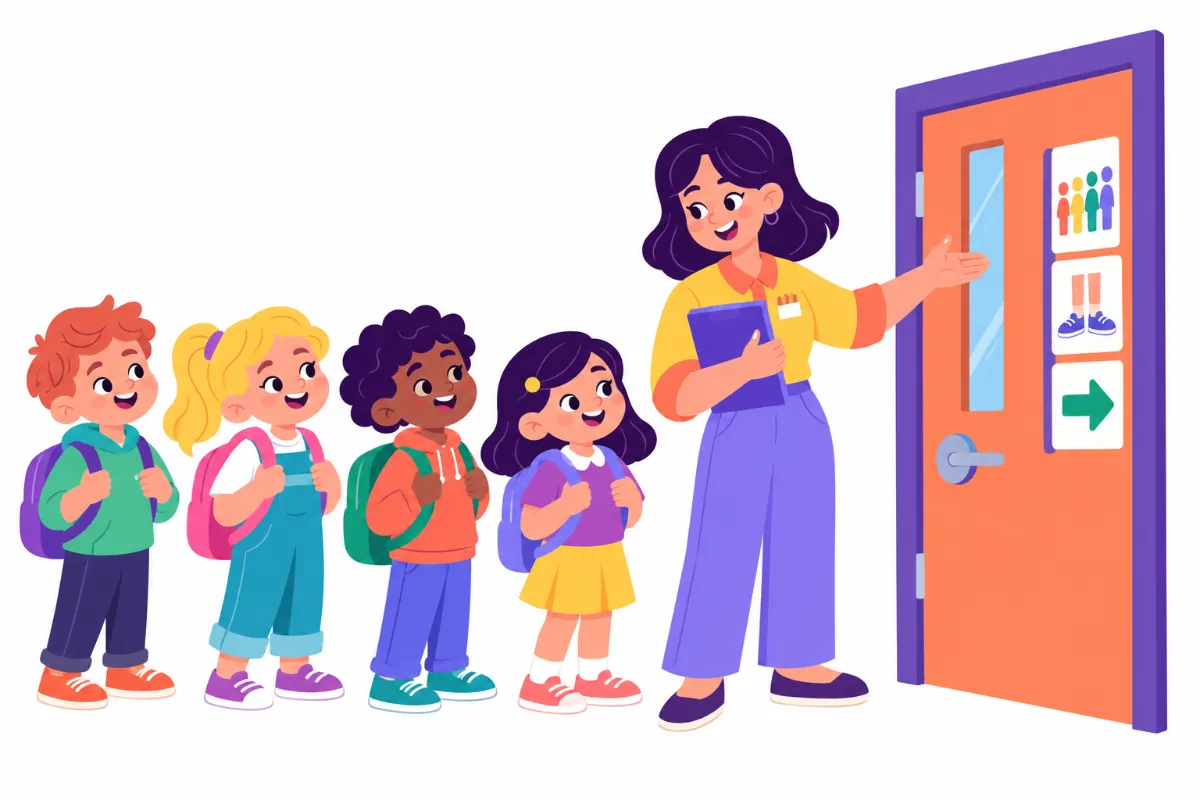

The first month of school sets the tone for the whole year in a special education classroom. Picture the second morning: one student is pacing by the door, another is asking when lunch is, and a paraprofessional is waiting for directions you have not had time to give. Nobody is doing anything wrong. The room simply does not have its routines yet.
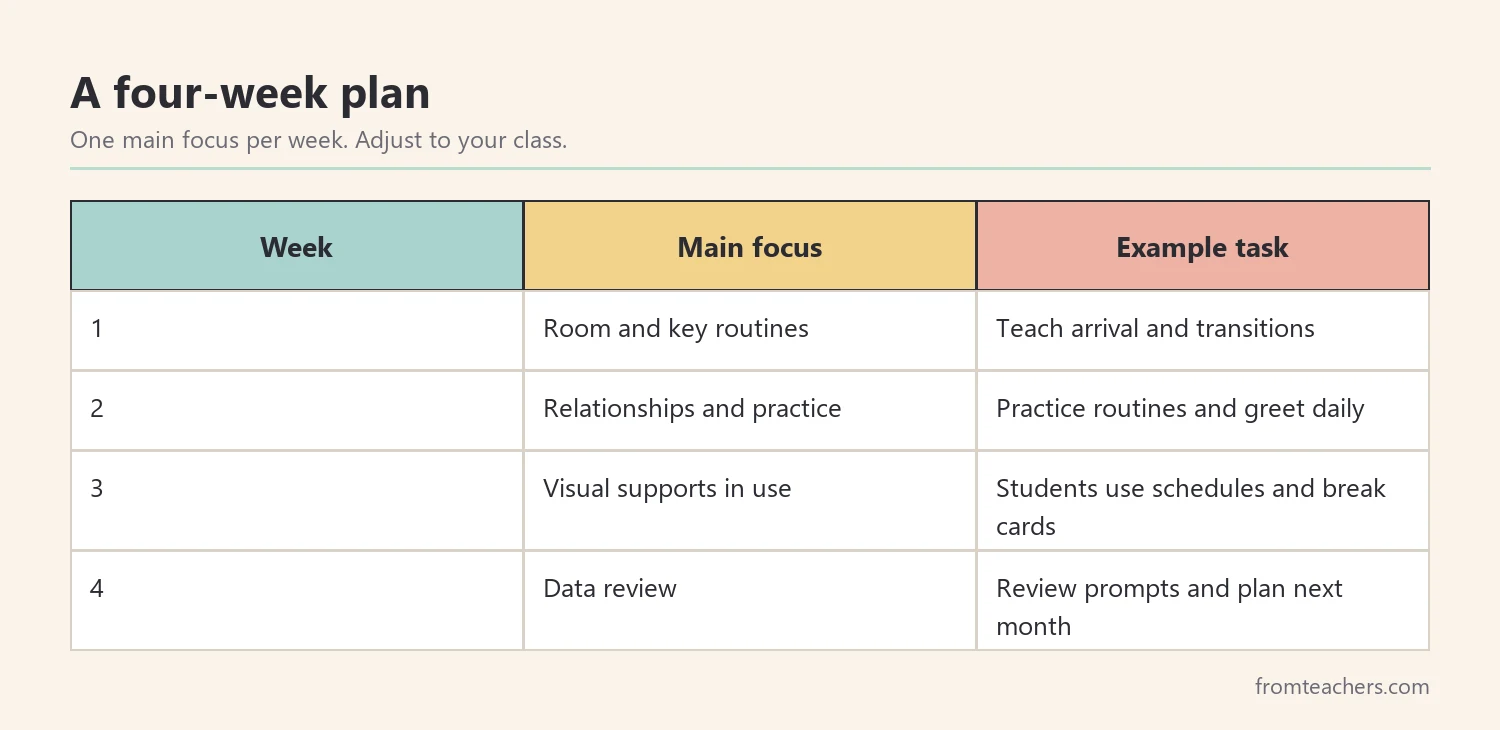
This guide gives you a five-step plan for the first month of school: prepare the room, teach routines like lessons, build relationships, put visual supports and IEPs to work, and collect simple data to review at the end of each week. By the end, you will have a four-week sequence you can adapt to a self-contained or resource classroom.
Examples are fictional. Adapt to the student’s goals and agreed supports. This is guidance, not a diagnosis, and your school’s policies come first.
At a glance
- Set up the room so it teaches students where things go and what happens there.
- Teach each routine like a skill: model, practice, give feedback, repeat.
- Invest in relationships early, with students, staff, and families.
- Use visual supports and each student’s IEP from day one.
- Collect a little data every week and adjust before habits harden.
1. Prepare the room before the first month of school begins
Your classroom layout is your first teacher. A clear room tells students where to work, where to wait, and where to calm down, before you say a word. Therefore, the first month of school really starts with the space.
Start by defining areas. Most special education classrooms need a whole-group area, a small-group or teacher table, independent work stations, a calm-down space, and a place for belongings. Then, use furniture, rugs, tape, or labels to make the edges of each area easy to see.
Next, think about traffic and sightlines. Can you see every student from the teacher table? Is the calm-down space away from the busiest path? Are materials stored where students can reach the ones they need and not the ones they do not?
For example, Ms. Ortiz is a fictional teacher with 8 students in a self-contained grade 2 to 4 classroom and 2 paraprofessionals. She labels 4 areas with pictures and words, sets up 3 independent work stations, and places the calm-down corner in the quietest spot, away from the door.
| Area | Purpose | Visual cue |
|---|---|---|
| Group rug | Morning meeting | Picture label and spots |
| Teacher table | Small-group lessons | Name cards |
| Work stations | Independent tasks | Bins with a finish tray |
| Calm corner | Regulation breaks | Calm-down choice board |
Finally, walk the room as a student would. Enter, put away a backpack, and find your seat. If any step is confusing for you, it will be harder for them.
In addition, keep decorations calm. Bright, busy walls can be overwhelming for some students. During the first month of school, a few clear visuals that students actually use are worth more than a fully decorated room.
2. Teach routines and procedures like lessons
Routines are the heart of the first month of school. However, posting rules is not the same as teaching them. Students learn routines the same way they learn reading or math: through clear models, guided practice, and feedback.
First, choose the few routines that matter most. Arrival, transitions, asking for help, using the bathroom, lining up, and dismissal are a strong starting set. Then, break each routine into small steps and teach one or two each day.
Next, model the routine yourself, then let students practice while you give specific feedback. For example, say “You put your folder in the bin. That is exactly right,” rather than a general “good job.” Practice again later the same day, and again the next morning.
Then, fade your support on purpose. Move from doing the routine with the student, to standing nearby, to checking from across the room. Each step back shows students that they can manage the routine on their own, which is the real goal of all this practice.
A routine in action
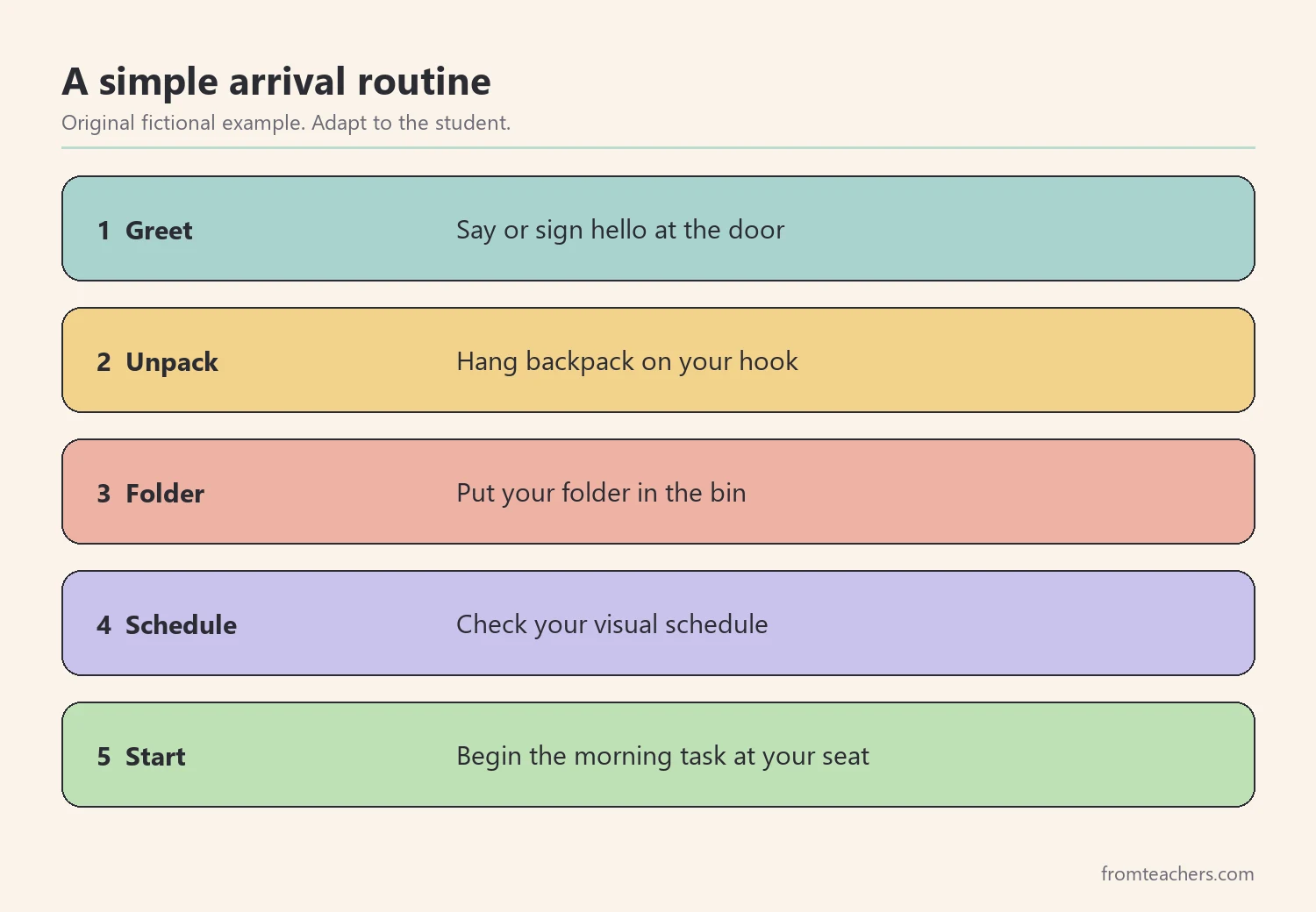
For instance, Leo is a fictional third grader in Ms. Ortiz’s class. During the first week, he needs adult prompts for every step of arrival. Ms. Ortiz teaches the routine with a picture strip on his desk. By the end of week two, he needs a prompt only for the last step.
Also, make sure every adult teaches routines the same way. Give paraprofessionals the steps in writing and agree on the exact words and prompts to use. Consistency across adults is what makes routines stick.
Moreover, expect some routines to fall apart after a long weekend or a schedule change. That is normal. Simply reteach the steps the next morning, with the same model and practice, and the routine usually returns quickly.
A step-by-step special education classroom management guide for the first month can help here, with sections on routines and procedures and a 30-day action plan.
3. Build relationships during the first month of school
Routines work best when students trust the adults who teach them. Therefore, plan relationship building as carefully as you plan lessons, especially during the first month of school.
Start with students. Learn each student’s interests, preferred ways to communicate, and what helps them feel calm. Then, build short, positive moments into each day: a greeting at the door, a two-minute chat about a favorite topic, or a shared game during free time.
Next, connect with families. A short welcome note or call in the first week sets a positive tone. Ask families what works at home and what their hopes are for the year. In addition, share one positive update about each student before any concern comes up.
Finally, build your team. Meet with paraprofessionals before students arrive if possible, and set a short weekly check-in. Explain the plan, assign clear roles, and invite their observations. They often notice things you miss.
Also, protect relationship time when the schedule gets busy. It is tempting to cut greetings and chats once academics begin. However, these small moments are what make the first month of school feel safe, and safety is what lets students learn.
For example, Ms. Ortiz learns that Leo loves trains. She adds a small train picture to his visual schedule and uses train talk during morning greetings. Meanwhile, she calls each of the 8 families in the first week, completing 3 calls on Monday, 3 on Tuesday, and 2 on Wednesday.
4. Use visual supports and IEPs from day one
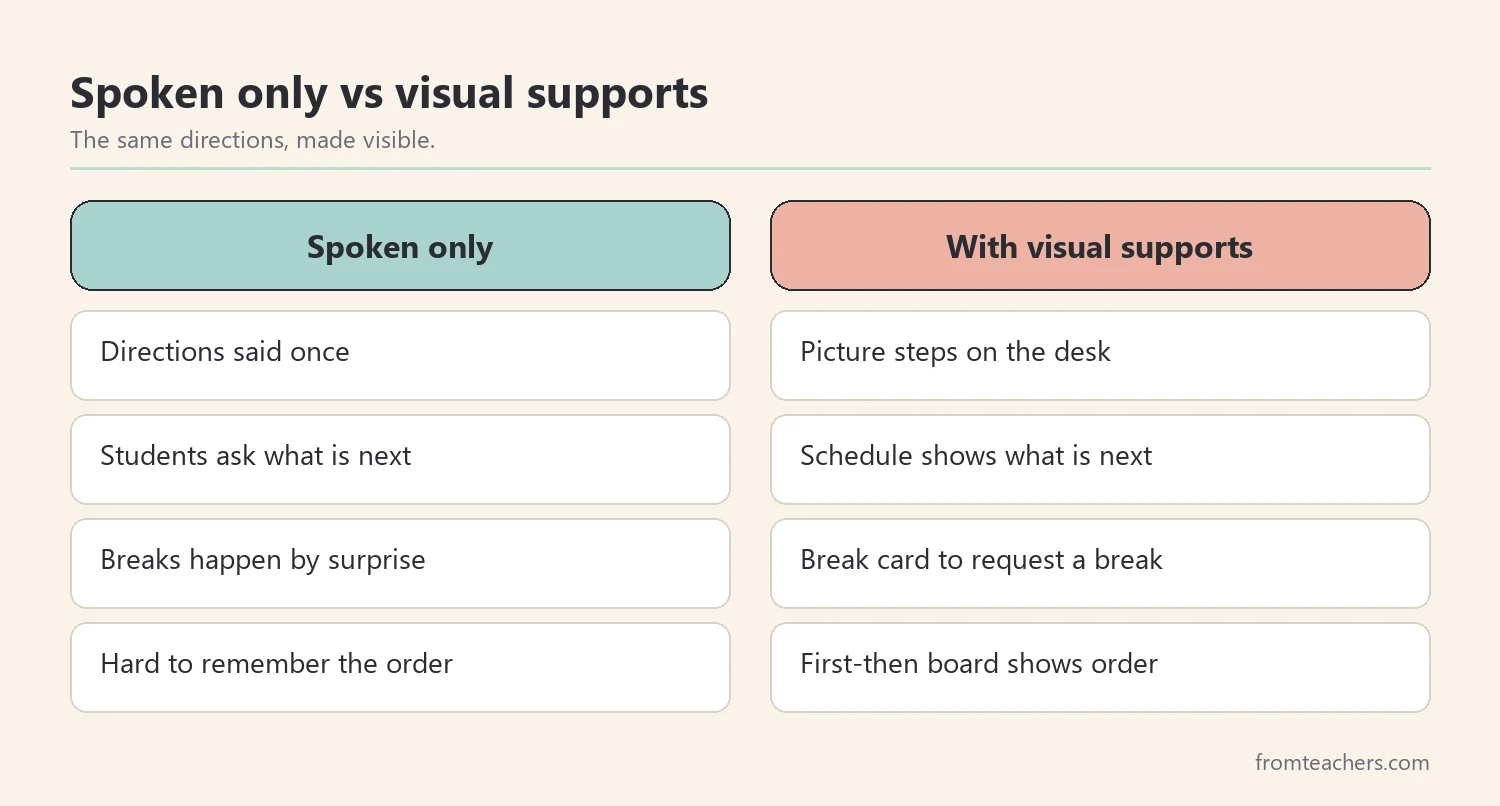
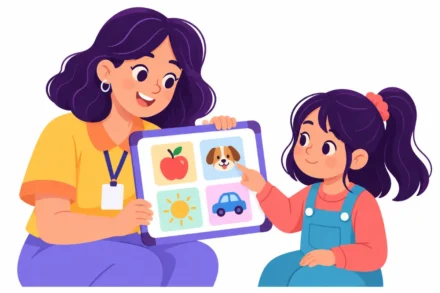
Visual supports make routines and expectations visible, which helps many students in special education understand what is happening and what comes next. Moreover, each student’s IEP and any behavior plan should guide your supports from the first day, not after the first month of school.
First, read every IEP before students arrive, focusing on goals, accommodations, and any behavior plan. Make a one-page summary for each student that adults can use quickly. Then, set up the matching supports, such as visual schedules, first-then boards, choice boards, and timers.
Next, teach students how to use each visual. A schedule only helps if a student knows how to check it, move a card, and see what comes next. Practice this like any other routine.
In addition, plan for hard moments. Positive behavior support starts with prevention: clear routines, predictable schedules, and taught calm-down options. Also, know each student’s de-escalation plan, and make sure every adult knows it too.
Furthermore, keep the one-page IEP summaries where adults can find them quickly, such as a private binder at the teacher table. When a substitute arrives, these summaries help keep supports consistent during the first month of school and beyond.
For instance, Leo’s IEP lists a visual schedule and planned breaks. Ms. Ortiz sets up his schedule on day one and teaches him to request a break with a card. In week one, he uses the card once with help. By week three, he uses it on his own.
5. Collect data and review the first month of school each week
Simple data tells you whether your routines are working. Without it, you rely on how the week felt, which is not always accurate. Therefore, choose one or two measures and track them all month.
Useful measures include the number of prompts a student needs for a routine, how many minutes a transition takes, or how often a student uses a taught break request. Keep the tracking quick, such as tally marks on a clipboard.
Then, review the data every Friday with your team. Ask what is working, what is not, and what one change you will make next week. Small adjustments now prevent bigger problems in October.
Also, write a one-line note next to any unusual day, such as a fire drill or a substitute. These notes explain dips in the data and stop you from changing a routine that is actually working.
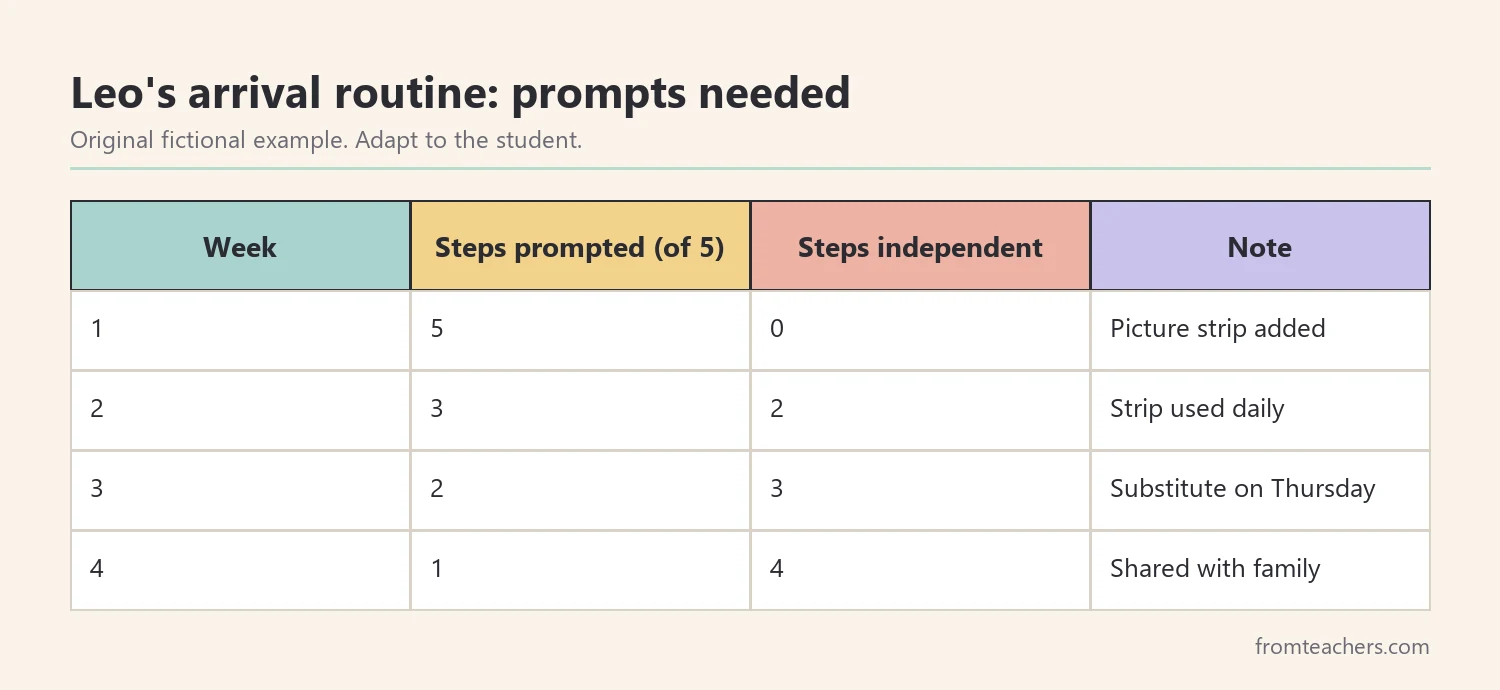
For example, Ms. Ortiz tracks how many of the 5 arrival steps Leo needs a prompt for. In week 1, he needs prompts for 5 of 5 steps. By week 2, that drops to 3 of 5, then to 2 of 5 in week 3 and 1 of 5 in week 4. That steady drop tells the team the routine is working.
Finally, share progress with families. A short note about what improved this month builds trust and keeps everyone working toward the same goals.
At the end of week four, take thirty minutes to look back at the whole month. Which routines are steady, and which still need daily teaching? Use the answers to plan your next month with the same simple cycle of teaching, practice, and review that carried you through the first month of school.
Common mistakes and how to avoid them
- Posting rules without teaching them. Fix: model, practice, and give feedback on each routine.
- Teaching too many routines at once. Fix: start with arrival, transitions, and help requests, then add more.
- Leaving paraprofessionals to guess. Fix: give written steps and agree on the same words and prompts.
- Waiting to read IEPs. Fix: read every IEP before day one and set up supports right away.
- Judging the week by feel. Fix: track one simple measure and review it every Friday.
Questions teachers and parents ask about the first month of school
How many routines should I teach in the first week?
Start with the few routines students use most, such as arrival, transitions, and asking for help. Teach one or two per day and practice them often. Add more once the first ones are steady.
What if a student is not following a routine after two weeks?
Look at your data first. Then, check whether the routine has too many steps, whether every adult teaches it the same way, and whether the visual support fits the student. Adjust one thing at a time.
How can parents help during the first month of school?
Parents can share what works at home, use similar words for routines, and talk positively about school. A short note back and forth each week helps adults stay on the same page.
Is it too late to fix routines after the first month?
No. Routines can be retaught at any time. It simply takes more practice to change a habit than to build one, which is why the first month of school matters so much.
Do these steps work in a resource room as well?
Yes. Resource rooms often have shorter sessions and more groups, so routines for arriving, starting work, and leaving become even more important. Keep each routine short and the same for every group.
Related reading: Moving Beyond Shame and Behavior Charts, How Teachers Communicate With Parents in Special Education, and The Power of Data Tracking in Special Education.
A companion resource for the first month of school:
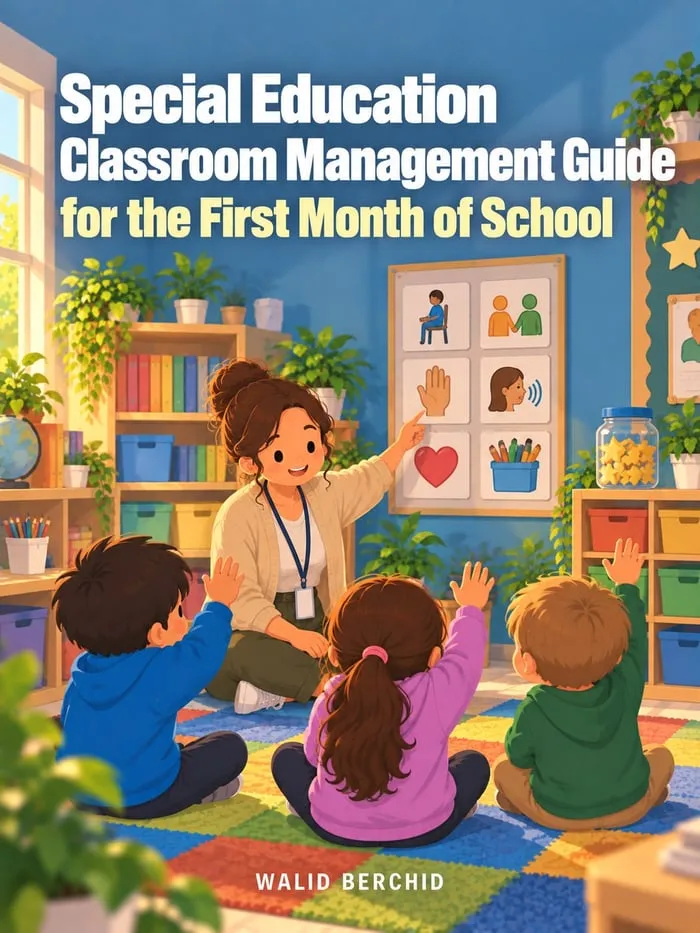
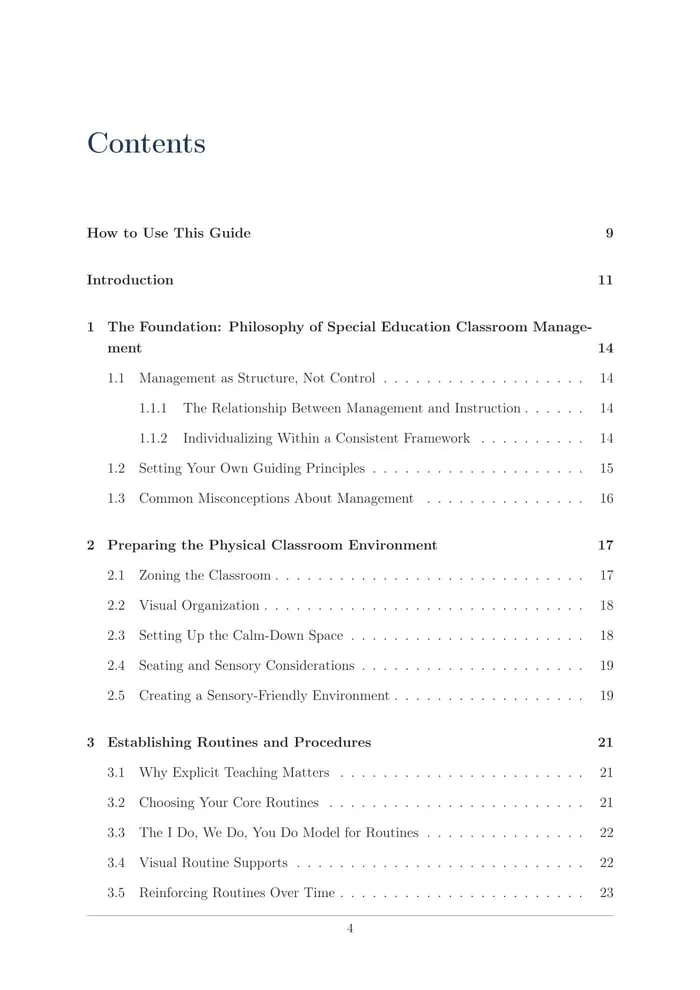
Special Education Classroom Management Guide for the First Month of School: a 101-page guidebook on the classroom environment, routines, relationships, IEPs and behavior plans, visual supports, data collection, and a 30-day action plan, with printable templates and checklists.
Sources and scope
- IRIS Center, Vanderbilt University: free modules on classroom behavior management and routines.
- Center on PBIS: information on positive behavioral interventions and supports.
- IDEA, U.S. Department of Education: the law behind IEPs and special education services.
- Council for Exceptional Children: a professional organization for special educators.
This guide covers practical setup, routines, and data habits for the start of the year. It does not replace your school’s policies, crisis procedures, or individual behavior plans written by the student’s team.
Key takeaways
- The first month of school starts with a room that shows students where things happen.
- Teach routines like lessons, with models, practice, and feedback.
- Build relationships with students, families, and staff early.
- Put visual supports and IEPs to work from day one.
- Track one simple measure and review it every Friday.






Leave a Comment