

ADHD organization systems matter most at the moment a student opens a backpack and cannot find the worksheet that was finished last night. Picture a sixth grader digging through crumpled papers while the class moves on. She did the work. However, the work never made it from the kitchen table to the teacher’s tray.
This guide walks you through five steps to build organization systems for materials, time, and tasks that a student can actually keep up with. By the end, you will have a short self-check, a simple paper flow, a visible plan for time, a way to start and break down tasks, and a weekly review that shows whether the system is working.
Examples are fictional. Adapt to the student’s goals and agreed supports. This is guidance, not a diagnosis.
At a glance
- Start with a quick self-check so you fix the biggest problem first.
- Give every paper one home and one path from school to home and back.
- Make time visible with a simple planner and a daily look-ahead.
- Break tasks into small, named steps with a clear first action.
- Review one or two numbers each week and change one thing at a time.
1. Start ADHD organization systems with a quick self-check
First, find out where things actually break down. Many students with ADHD and executive function challenges are told to “be more organized,” but that advice is too big to act on. A short self-check is the first step in building ADHD organization systems, because it turns it into specific, fixable problems.
Next, sit with the student for ten minutes and rate a few areas together. Keep the scale simple: “works well,” “sometimes,” or “hard right now.” Ask about materials, time, starting tasks, and remembering what to do. Then, add your own observations and, if possible, a quick note from the family.
In our fictional example, Nora is in grade 6. She is bright and enjoys science, yet she often turns in homework late or not at all. Her self-check looked like this:
| Area | Nora’s rating | What adults noticed |
|---|---|---|
| Papers and binder | Hard right now | Loose sheets in every pocket |
| Knowing what is due | Sometimes | Writes some tasks, not all |
| Starting homework | Hard right now | Waits until late evening |
| Long projects | Sometimes | Starts the night before |
Finally, pick one area to start. Good ADHD organization systems grow in layers, so choose the problem that causes the most daily stress. For Nora, the team chose papers first, because lost homework was costing her points even when the work was done. Time and task supports came next, once the paper system was steady.
Importantly, include the student in every choice. When students help design ADHD organization systems, they are far more likely to use them. Ask, “What would make this easier for you?” and write down the answer, even if it seems small.
2. Build a materials system with one home for every paper
Most lost work is not really lost. Instead, it is somewhere without a clear home. The goal of this step is simple: every paper has one place to live and one path to travel.
Strong ADHD organization systems start with fewer containers, not more. Several folders, a binder, and a backpack with six pockets give a student too many choices. In contrast, a single binder with a few clear sections cuts down on decisions. Many teachers like one “take home” pocket and one “turn in” pocket at the front of the binder.
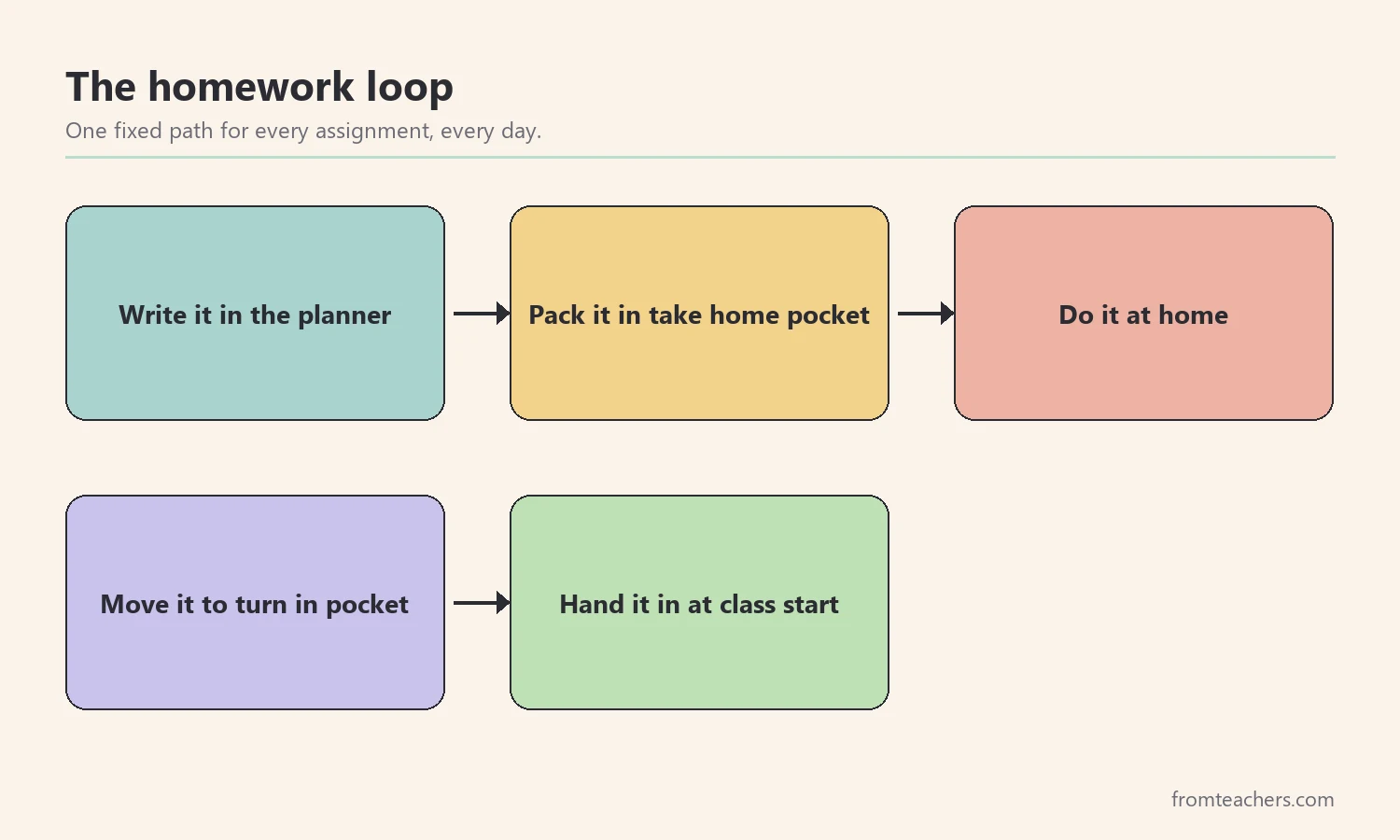
Then, teach the homework loop as a fixed path. The paper moves the same way every time: written in the planner, packed in the take home pocket, done at home, moved to the turn in pocket, and handed in at the start of class. Because the path never changes, the student does not have to remember where things go.
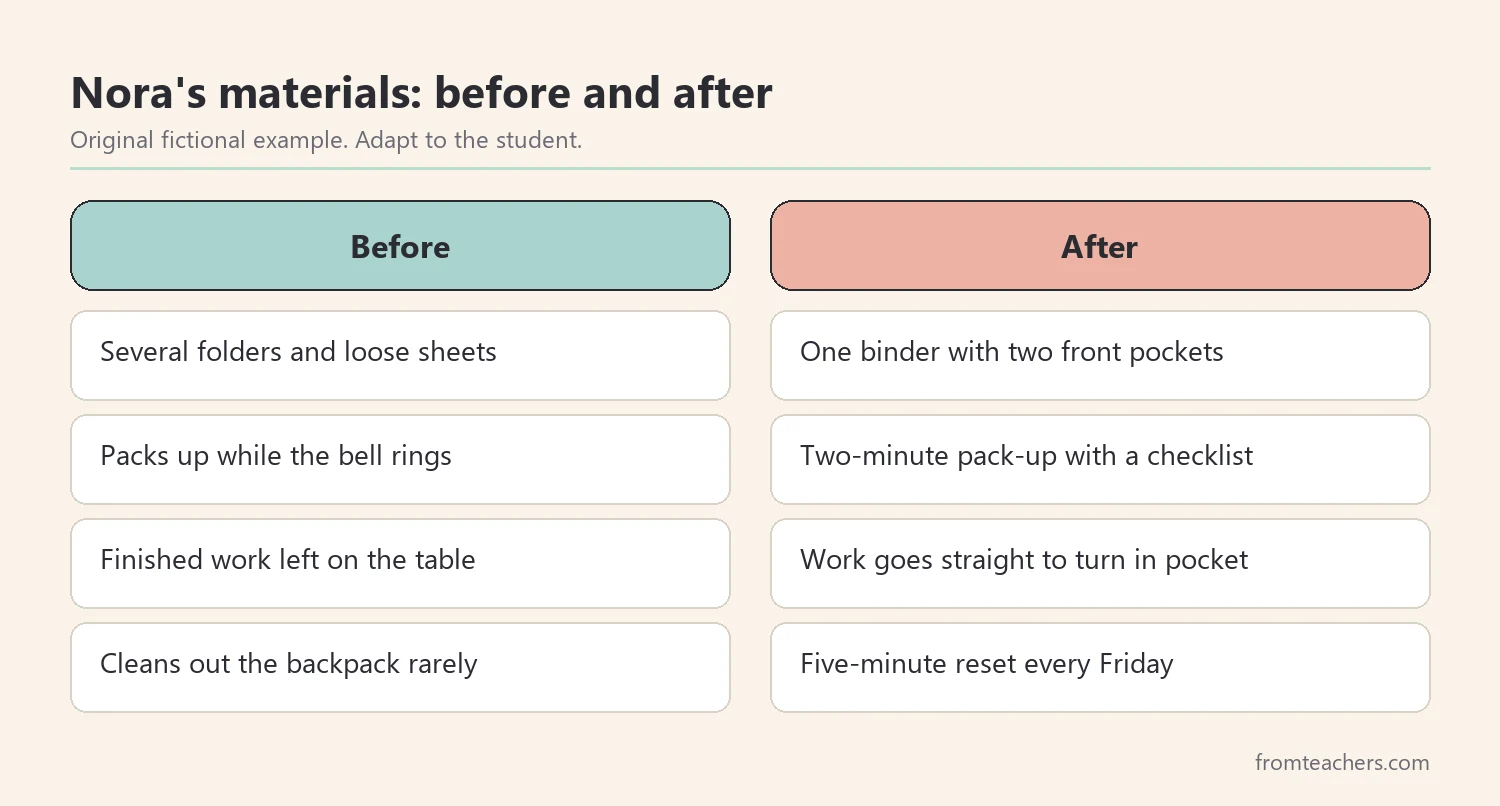
For Nora, the team made three changes. Her many folders became one binder with two front pockets. Her teacher added a two-minute pack-up at the end of class, with a short checklist on the inside cover. Also, her family agreed that finished homework goes straight into the turn in pocket at the kitchen table, before anything else happens.
Lockers, desks, and backpacks follow the same rule in ADHD organization systems. Clean them out on a set day each week, such as Friday, and keep the routine short. A five-minute weekly reset is easier to keep than a big cleanup once a month. If you would like ready-made checklists and planner pages for these routines, the Organization Skills Guide for ADHD with printable tools covers backpacks, lockers, paper management, and the homework loop.
3. Make time visible in your ADHD organization systems
Many students with ADHD find it hard to sense how much time has passed or how long a task will take. This is often called time blindness. As a result, a project due “next week” can feel far away until the night before.
In ADHD organization systems, the answer is to move time out of the student’s head and onto paper or a screen. A planner helps, but only if it is used the same way every day. Keep it simple: one line per subject, a box for “nothing due,” and a spot to check off when work is packed.
Next, add a daily look-ahead. At the start or end of the day, the student spends two minutes reading what is due tomorrow and this week. A teacher or aide can initial the planner for the first few weeks. Then, as the routine becomes automatic, the adult check can fade to a few times a week.
Also, help the student estimate time. Before starting homework, ask, “How long do you think this will take?” Write the guess, then write the real time after. Over a few weeks, students begin to see their own patterns. For instance, Nora guessed her math took 10 minutes, but it usually took 20. That one fact helped her start earlier.
| Tool | What it does | When to use |
|---|---|---|
| Paper planner | Lists what is due | End of every class |
| Visual timer | Shows time passing | During homework |
| Weekly calendar | Shows tests and projects | Sunday or Monday |
| Phone reminder | Prompts a start time | After school |
Finally, choose low-tech or digital tools based on the student, not the trend. Some students do better with paper they can see on the desk. Others prefer an app with alarms. ADHD organization systems work when the tool fits the student’s habits, so try one for two weeks before switching.
4. Break tasks down so starting feels possible
Even with a clean binder and a planner, many students freeze at the start. Task initiation is often the hardest part. A big, vague task like “study for the test” gives no clear first move.
So, as part of ADHD organization systems, teach the student to break each task into small, named steps. Each step should start with a verb and take about 10 to 15 minutes. Then, circle the first step and make it tiny: “open the notebook to page 12,” not “review chapter 4.”
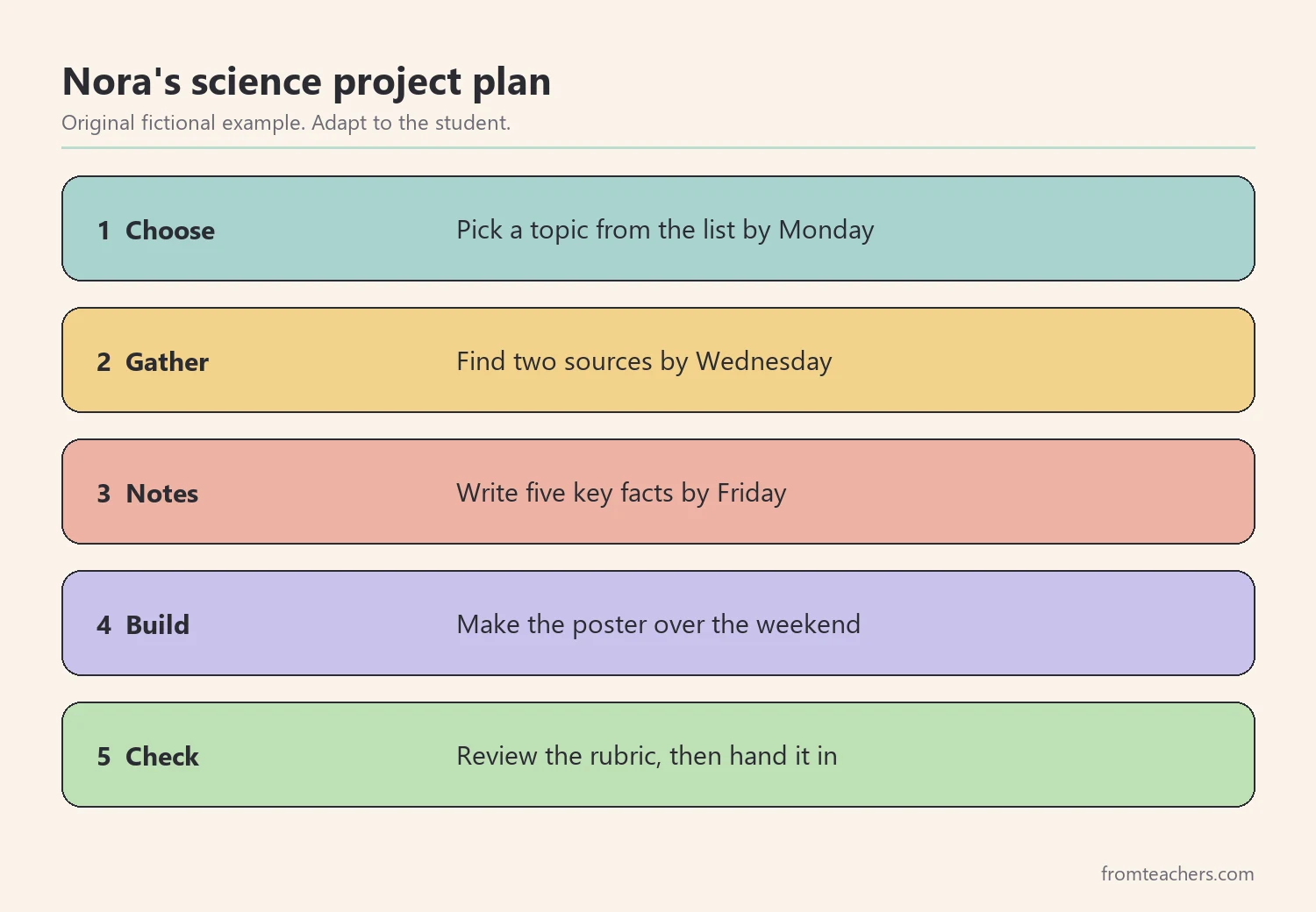
For Nora, a science project due in two weeks felt overwhelming. Together, she and her teacher split it into five steps and gave each a date. Here is how her plan looked:
Next, support working memory. Students with ADHD may forget a direction partway through a task. Therefore, put directions in writing, keep them short, and number them. A sticky note with the next step on the desk can act as a quiet reminder. Simple note-taking systems, such as a two-column page with “key idea” and “example,” also reduce what the student has to hold in mind.
When there are several tasks, teach a simple way to prioritize. Ask two questions: “What is due first?” and “What is worth the most?” Start with the task that answers yes to both. This takes guessing out of the evening and gives the student a clear place to begin.
Above all, praise starting, not only finishing. A student who opens the binder and begins step one has already done the hardest part. Notice it out loud, and let the student see that ADHD organization systems are there to make starting easier.
5. Track progress and adjust ADHD organization systems over time
ADHD organization systems only help if they keep working. Because routines can slip after the first few weeks, plan a short weekly review. Pick one or two numbers that match your goal, and keep the tracking quick.
For Nora, the team tracked two things each week: homework turned in on time, out of 5 school days, and the number of times she said a paper was lost. Here is her four-week record:
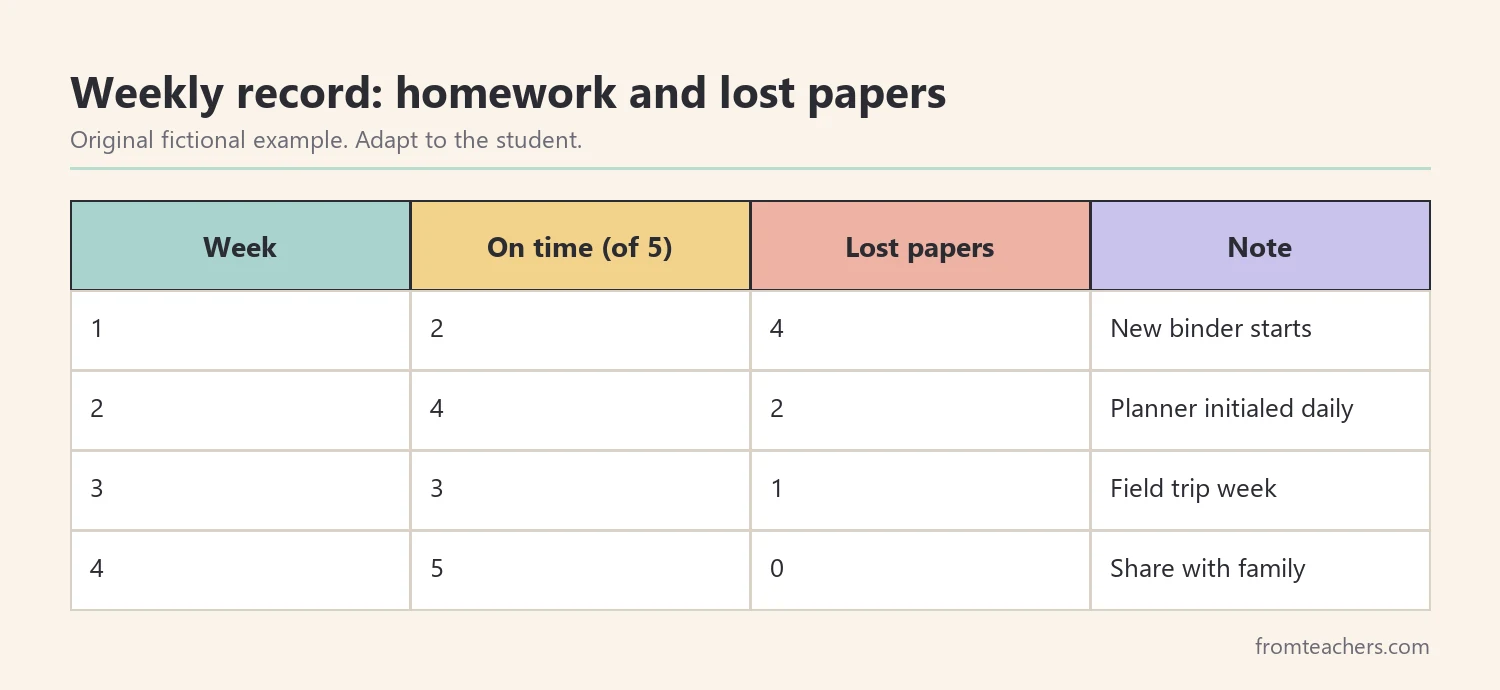
In week 1, Nora turned in homework on 2 of 5 days and reported 4 lost papers. By week 4, she turned in homework on 5 of 5 days with no lost papers. Week 3 dipped to 3 of 5 because of a field trip that broke the routine. That dip was useful information, not a failure. It showed the team that Nora needed a backup plan for unusual days.
Next, teach self-monitoring. Give the student a simple checklist to mark each day: planner filled in, binder packed, homework in the turn in pocket. Over time, the student does the checking and the adult only reviews. This shift is how ADHD organization systems move from adult-run to student-run.
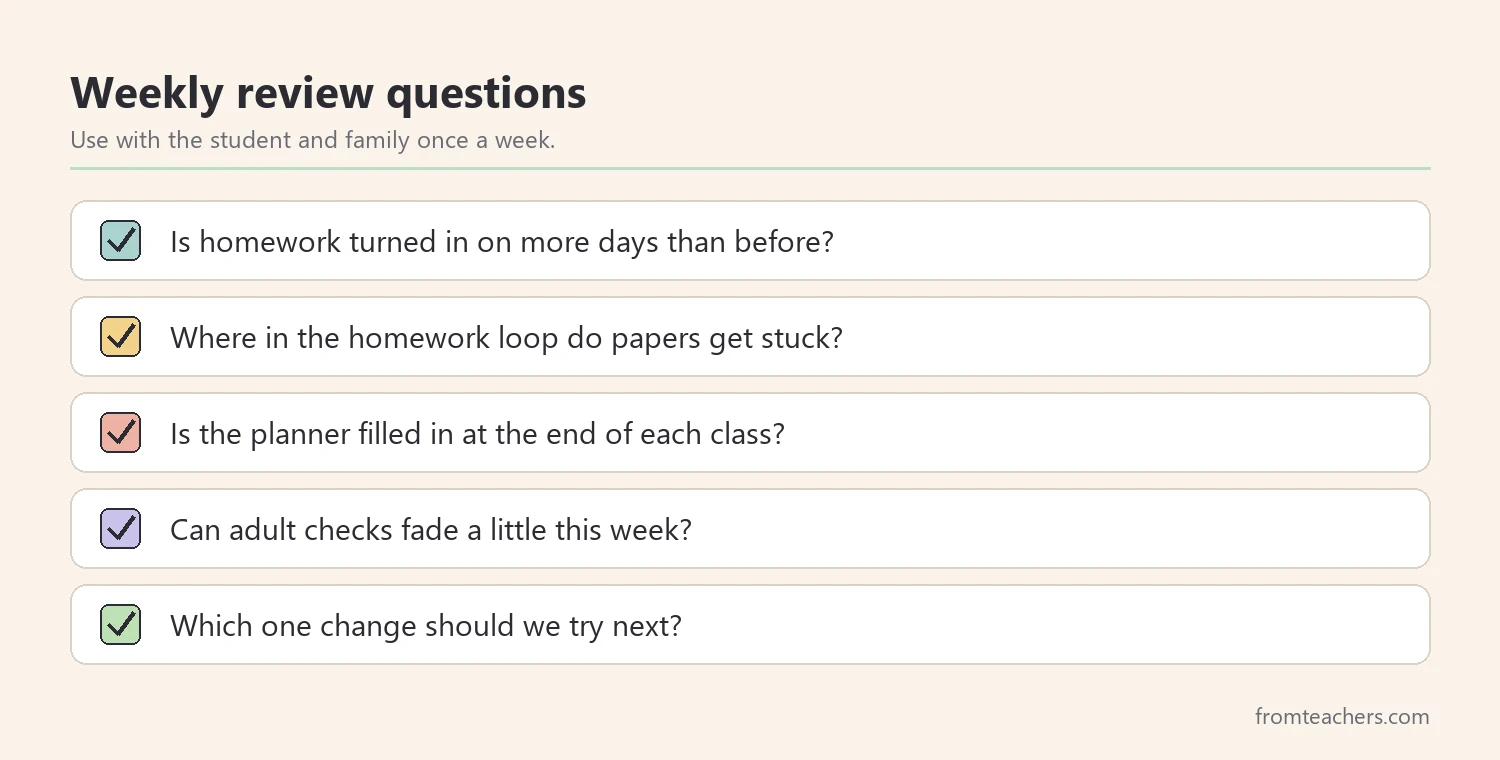
Finally, change one thing at a time. If homework is still missing, look at the loop step by step and find where it breaks. Is it written down? Packed? Done but left at home? Fix only that step, then check again next week. Small, steady repairs keep ADHD organization systems useful all year.
Common mistakes and how to avoid them
- Too many containers. ADHD organization systems with several folders and binders create more places to lose things. Instead, start with one binder and two clear pockets.
- Adult-only systems. A plan the student did not help design rarely sticks. Ask for the student’s ideas and use at least one of them.
- Changing everything at once. New binder, new planner, and new app in one week can overwhelm anyone. Add one layer, let it settle, then add the next.
- Skipping the practice. Students need to rehearse routines, not just hear about them. Practice the pack-up and the homework loop several times in class.
- Removing support too fast. When things improve, adults often stop checking. Fade support slowly, from daily to a few times a week, while the data stays steady.
- Treating a dip as failure. A bad week usually points to a gap, such as an unusual schedule. Use it to plan a backup, not to drop the system.
Questions teachers and parents ask about ADHD organization systems
How long does it take for ADHD organization systems to work?
It depends on the student and the routine. Many students need several weeks of daily practice before a routine feels automatic. Track one or two numbers so you can see small gains early, even before the habit is fully set.
Should we use paper or digital tools?
Either can work. Paper is visible and does not depend on a device, while digital tools offer alarms and reminders. Choose based on what the student already uses and try it for two weeks before switching.
What should parents do at home?
Keep the home part of the homework loop simple and consistent. Pick one homework spot, one start time, and one place the finished work goes. A quick look at the planner each evening helps more than a long nightly check.
How do we keep ADHD organization systems going after the first month?
Build in a short weekly reset, such as a Friday binder and backpack clean-out. Keep tracking one number so everyone notices if things slip. When the routine weakens, re-teach it instead of starting a new system.
What if the student refuses to use the system?
First, ask what feels hard or annoying about it. Often a small change, such as fewer steps or a different planner layout, solves the problem. Students are more willing to use a system they helped shape.
Related reading: ADHD in Children: A Guide to Effective Classroom and Home Support, Effective ADHD Classroom Strategies to Support Student Success, and The Power of Data Tracking in Special Education.
A companion resource for ADHD organization systems:
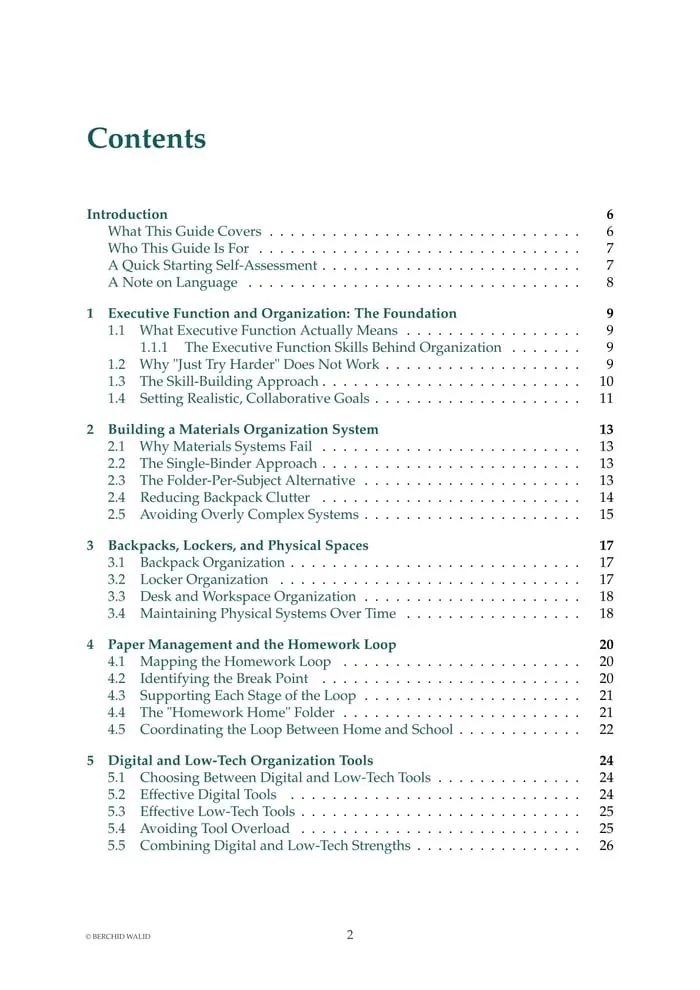
Organization Skills Guide for ADHD: Practical Systems for Materials, Time and Tasks: a step-by-step guidebook covering a starting self-assessment, materials and paper systems, planners and time blindness, task initiation, working memory supports, homework routines, and self-monitoring, with printable checklists, planners, and tracking forms.
Sources and scope
- CDC ADHD information: general background on ADHD in children, including support at school and home.
- IRIS Center, Vanderbilt University: free learning modules on classroom routines, behavior, and evidence-based practices.
- Understood.org: practical articles for families and teachers on ADHD, executive function, and learning differences.
- IDEA, U.S. Department of Education: the law behind special education services and IEPs.
This guide covers everyday organization routines for materials, time, and tasks at school and home. It does not cover diagnosis, medication, or formal evaluation, which belong to qualified professionals and the student’s team.
Key takeaways
- ADHD organization systems work best when they start with one clear problem.
- Give every paper one home and teach the homework loop as a fixed path.
- Make time visible with a planner, a daily look-ahead, and time estimates.
- Break tasks into small steps with a tiny, clear first action.
- Track one or two numbers weekly and change one thing at a time.










Leave a Comment