

Special education checklists can turn a scattered week of sticky notes into data your whole team can use. Picture a resource room on a Thursday afternoon: one aide has notes on a clipboard, another kept them in her head, and the IEP meeting is on Monday. Everyone worked hard, yet nobody can say for sure how often the student met his goal.
This guide shows you how to choose, write, and use checklists in five steps, from picking the right target to reviewing the results with the team and family. By the end, you will have a simple system that keeps data consistent across adults and saves time before meetings.
Examples are fictional. Adapt to the student’s goals and agreed supports. This is guidance, not a diagnosis.
At a glance
- Match each checklist to one clear purpose: a skill, a routine, or a team task.
- Write items as observable actions anyone can see and check.
- Train every adult to use the checklist the same way.
- Keep checklists where the work happens, not in a binder across the room.
- Review totals every week or two and change one thing at a time.
1. Decide What Your Special Education Checklists Should Track
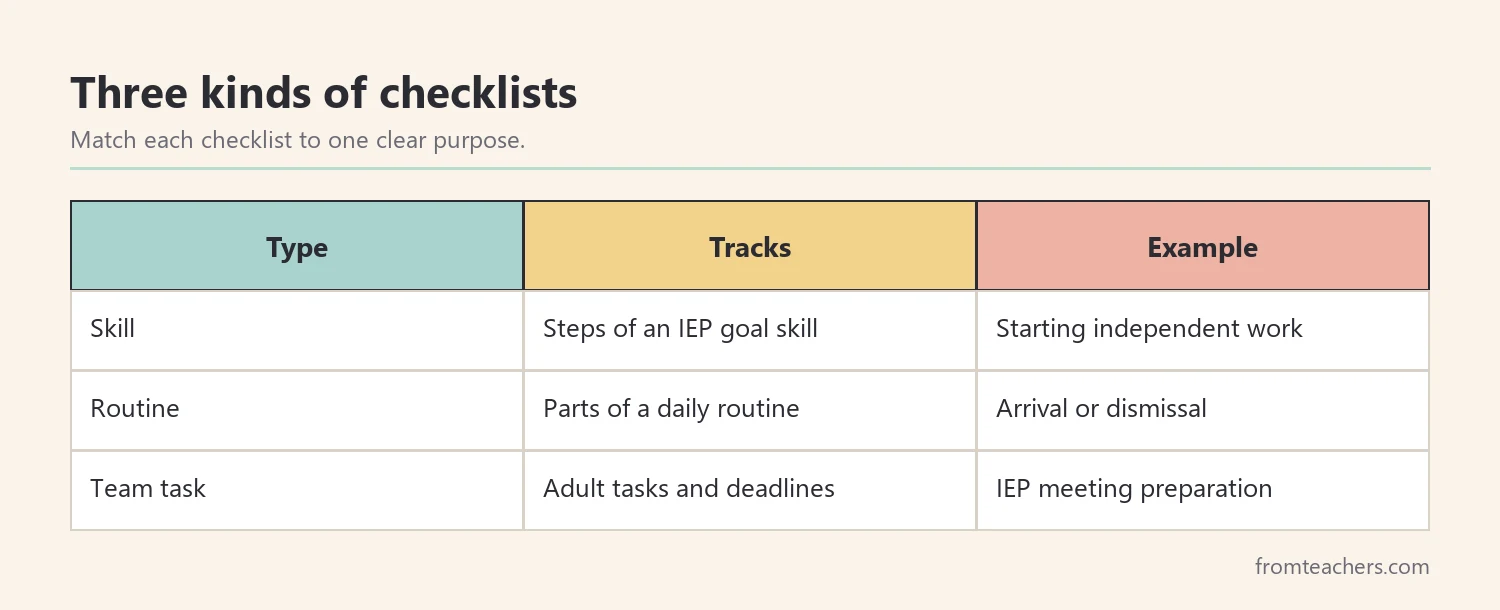
A checklist is a tool, not a goal, and special education checklists work best when they answer one question. So, before you print anything, decide exactly what you want to know. Most special education checklists fall into three groups.
| Type | Tracks | Example |
|---|---|---|
| Skill checklist | Steps of a skill linked to an IEP goal | Steps for starting independent work |
| Routine checklist | Parts of a daily routine | Arrival or dismissal steps |
| Team task checklist | Adult tasks and deadlines | IEP meeting preparation |
First, start with one student and one need. Trying to track everything at once usually means tracking nothing well. Then, check the IEP so that the checklist connects to an actual goal or service.
Consider Leo, a fictional third grader with an IEP goal about starting independent work. His team agreed that the main question was simple: does Leo begin a task without extra prompts? That question shaped every item on his checklist.
Also, think about who will use the checklist. A checklist for a paraprofessional during math needs to be quick. Meanwhile, a checklist for the case manager before an annual review can be longer, because it is completed at a desk.
In addition, check whether a checklist already exists. Many teams have old forms in shared drives. Updating one of them is often faster than starting over, as long as the items still match the current goal and the way the classroom runs today.
Finally, write the purpose at the top of the page in one sentence. When anyone picks up the sheet, they will know why it exists.
2. Write Clear, Observable Items
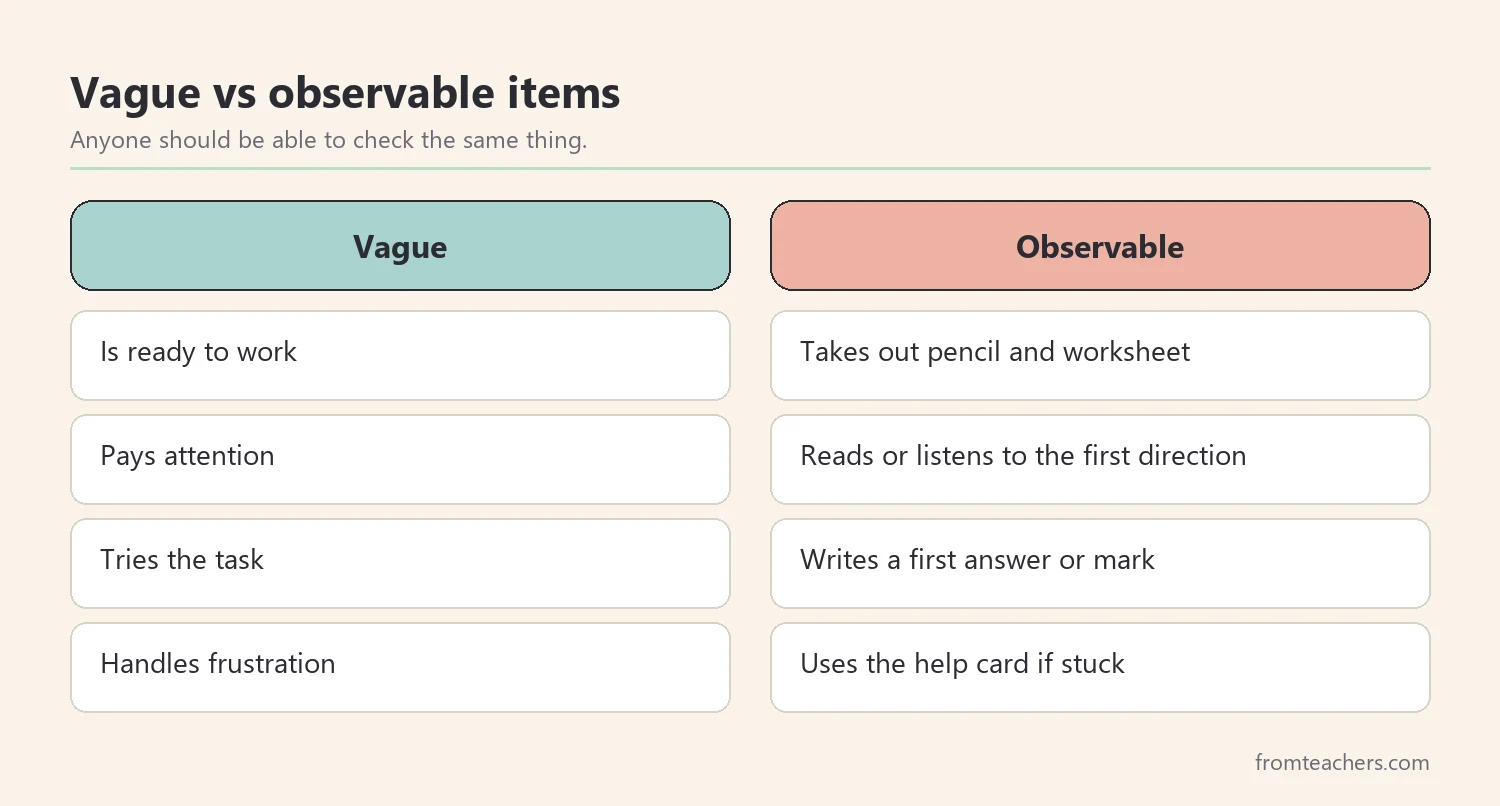
The quality of special education checklists depends on their items. Vague items lead to different adults checking different things. Therefore, write each item as an action someone could see or hear.
Compare these two versions. “Is ready to work” means different things to different people. On the other hand, “Takes out pencil and worksheet” can be checked the same way by anyone.
Next, keep the list short. Five to seven items is enough for most daily special education checklists. If you need more, the task may be better split into two checklists.
Then, put the items in the order they usually happen. This helps adults complete the sheet quickly and helps the student if they use a version of the checklist themselves.
Here is Leo’s skill checklist. His team wrote five items, all linked to starting independent work.
- Sits at desk within one minute of the direction.
- Takes out pencil and worksheet.
- Reads or listens to the first direction.
- Writes a first answer or mark.
- Asks for help using the help card if stuck.
Each item is a visible action. As a result, the aide, the classroom teacher, and the special education teacher all check the same behaviors.
If you would rather start from ready-made templates, a special education checklists bundle can give your team a set of printable formats to adapt instead of building each one from a blank page.
3. Train Every Adult to Use Special Education Checklists the Same Way
Even well-written special education checklists give poor data if adults use it differently. One person may check an item after a reminder, while another checks it only when the student acts alone. So, agree on the rules before the first day.
First, decide what counts as a check. For Leo, the team agreed: check the item only if he did it without an extra verbal prompt. If an adult had to prompt, they wrote a small “P” instead.
Next, practice together. Watch a short task or role-play one, and have each adult fill out the checklist. Then, compare the sheets. Differences show where the rules need to be clearer.
Also, decide when the checklist is completed. Some special education checklists are filled out during the task, while others are completed right after. Either way works, as long as everyone does it the same way.
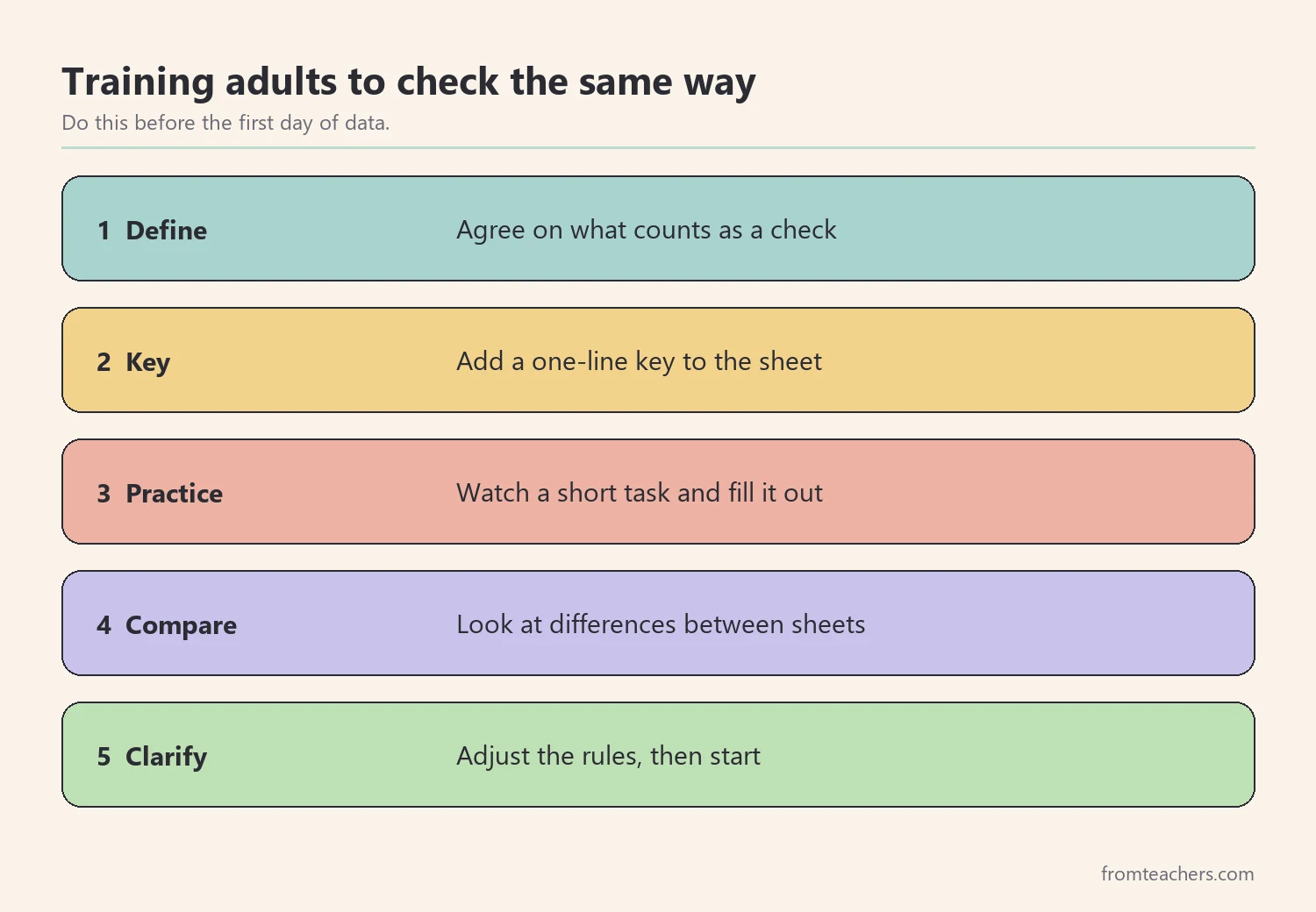
Finally, keep a one-line key at the bottom of the sheet, such as “Check = did it alone. P = needed a prompt.” Substitutes and new staff can then use the checklist on their first day.
4. Keep Checklists Where the Work Happens
A checklist in a binder across the room rarely gets completed on time. Instead, place it where the task happens. As a result, adults can mark it in seconds and get back to teaching.
Simple placement ideas
- A clipboard at the small group table.
- A half-sheet taped inside a folder the student uses.
- Laminated card with a dry-erase marker, photographed at the end of the day.
- A shared digital form on a tablet, if your school allows it.
Then, decide how often to collect data. Daily data is not always needed. For many goals, two or three planned sessions a week give a clear picture without overwhelming staff.
Moreover, think about what happens on busy days. Assemblies, testing, and staff absences can interrupt any plan. Agree in advance on a backup, such as the classroom teacher completing the checklist when the aide is out, or simply marking the session as “not collected” rather than guessing later. Honest gaps in the data are far more useful than filled boxes nobody is sure about, and they help the team see when the schedule itself is the problem.
For Leo, the team used his checklist during math independent work on Monday, Wednesday, and Friday. Each session had five possible checks, so a week had 15 possible checks in total.
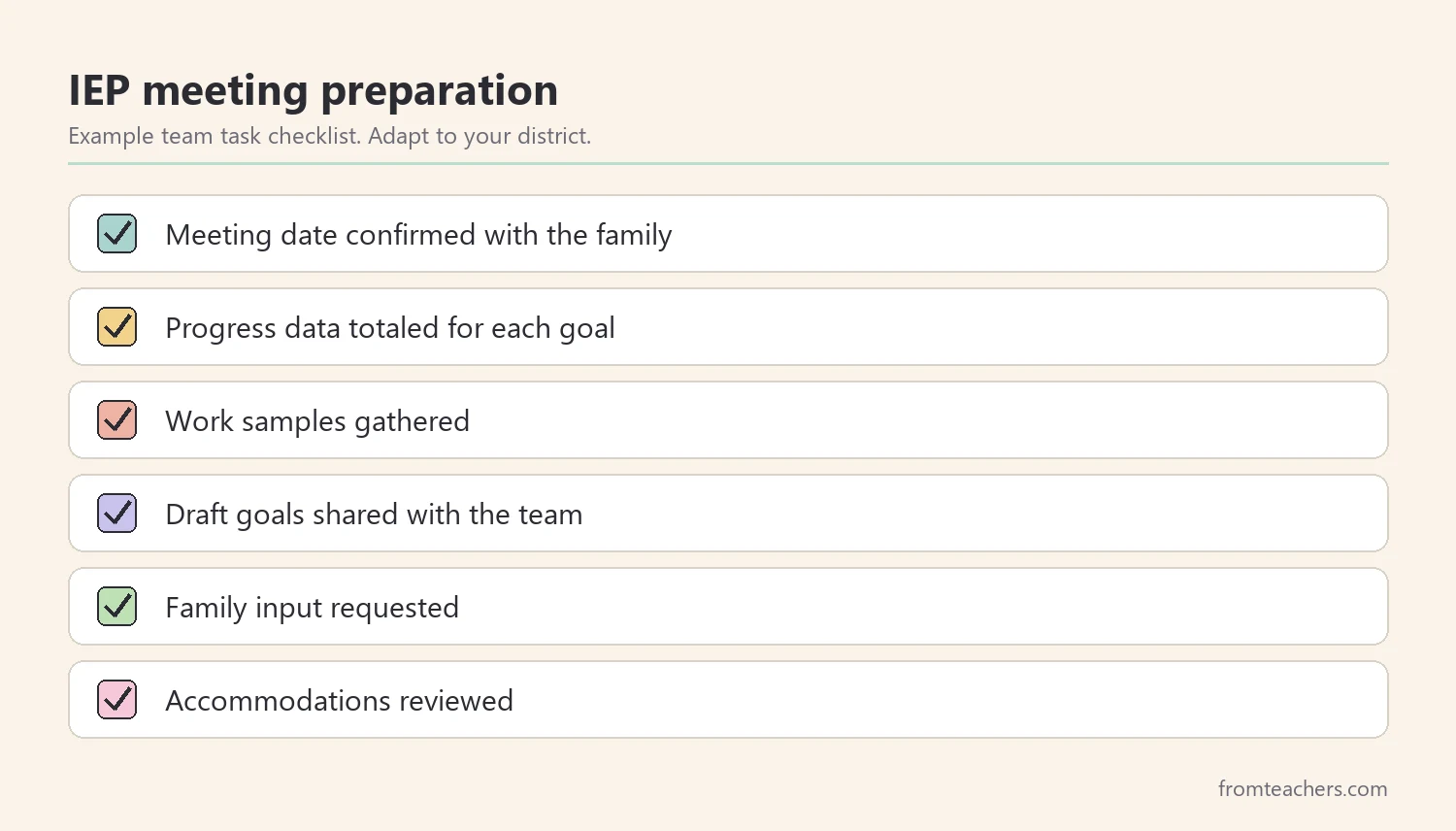
In addition, special education checklists for team tasks deserve a home too. An IEP meeting checklist can sit at the front of the student’s working file, so the case manager sees what is done and what is still needed.
5. Review Special Education Checklists and Adjust
Data from special education checklists is only useful if someone looks at it. So, set a short review every one or two weeks. Ten minutes at a team meeting is often enough.
First, total the checks. Then, compare the total with the number of possible checks. Here is Leo’s fictional record for four weeks, with 15 possible checks each week.
| Week | Checks without prompt | Prompted or missed | Possible |
|---|---|---|---|
| 1 | 6 | 9 | 15 |
| 2 | 8 | 7 | 15 |
| 3 | 10 | 5 | 15 |
| 4 | 12 | 3 | 15 |
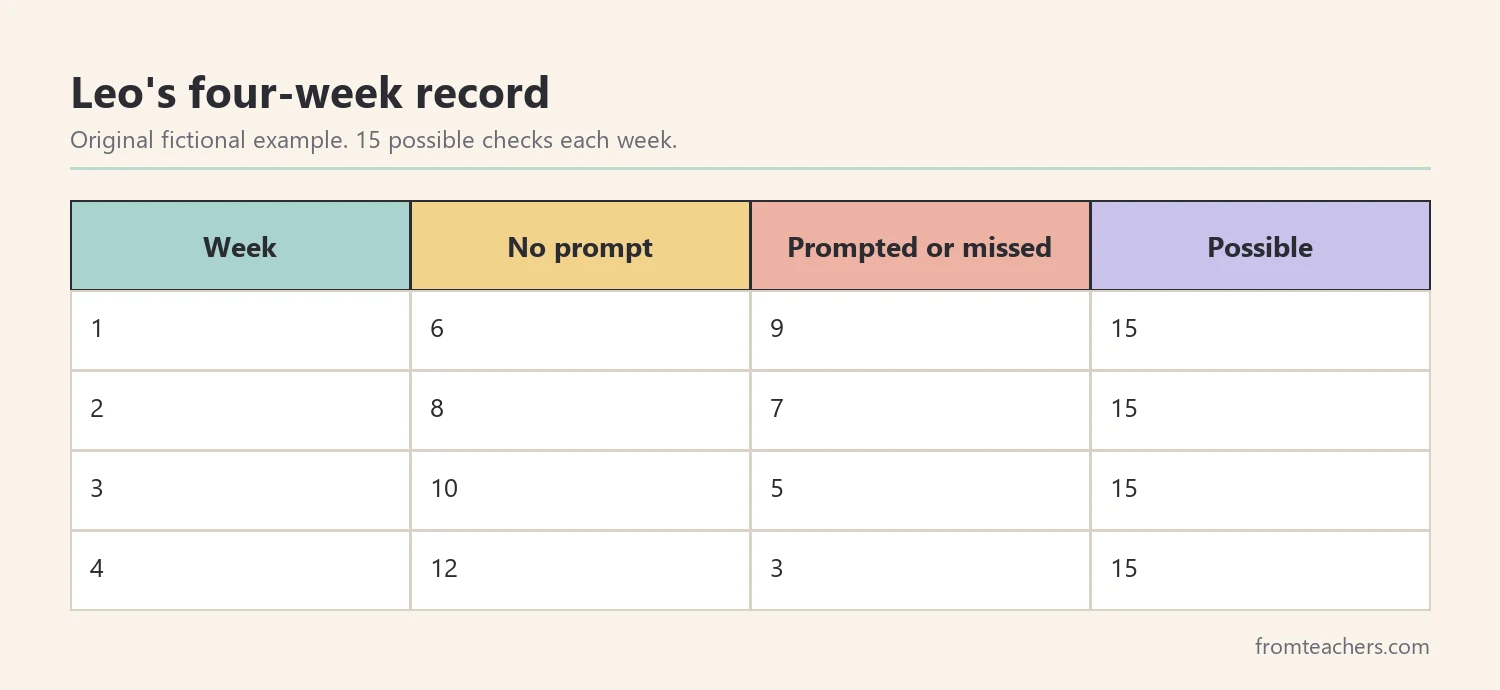
Next, look at which items were missed most. For Leo, item 3, reading or listening to the first direction, needed the most prompts. So, the team added a short picture cue to his worksheet for that step and kept everything else the same.
Then, share the results with the family in plain language. For example: “Leo started work on his own for 12 of 15 checks this week, up from 6 in the first week.” Families can also share what they see at home with similar tasks.
Finally, decide what happens next. If the student meets the goal steadily, the team may fade prompts or move to a new skill. If progress stalls, review the items, the training, and the supports before changing the goal.
6. Build a Simple System for the Whole Year
One checklist for one student is a good start. However, most teams support many students and many goals at once. So, once the first checklist works, turn it into a small system.
First, keep a master list of every active checklist: the student, the goal, who collects data, and on which days. A single page is enough. This list shows at a glance whether any goal has no data plan.
Next, use the same layout for every checklist. When the purpose line, the items, the key, and the weekly totals always sit in the same place, adults learn the format once and fill out each new sheet faster.
Then, store completed sheets in one place per student, in date order. Before a progress report or IEP meeting, the case manager can total the weeks in minutes instead of searching through several folders, because all of the special education checklists for that student are already together.
| Student | Checklist | Collected by | Days |
|---|---|---|---|
| Leo | Starting independent work | Aide | Mon, Wed, Fri |
| Leo | IEP meeting preparation | Case manager | Before meeting |
| Student B | Arrival routine | Classroom teacher | Tue, Thu |
Also, plan a short check-in at the start of each grading period. Retire special education checklists for goals that are met, update items for goals that changed, and add new ones only when the team has time to use them well. A smaller set of checklists that adults actually complete is worth more than a large set that sits unused.
Finally, ask staff what slows them down. If a checklist takes too long, shorten it. If a format confuses substitutes, simplify the key. Small fixes like these keep the whole system running through the year.
Common mistakes and how to avoid them
- Tracking too many things at once. Fix: start with one student, one goal, and one checklist.
- Vague items. Fix: rewrite each item as an action anyone can see.
- Different rules for different adults. Fix: agree on what counts as a check and add a key to the sheet.
- Checklists stored far from the task. Fix: keep them on a clipboard or folder where the work happens.
- Keeping old special education checklists running. Fix: retire checklists for goals that are met.
- Collecting data nobody reviews. Fix: schedule a ten-minute review every one or two weeks.
Questions teachers and parents ask about special education checklists
How many items should a checklist have?
Most daily checklists work well with five to seven items. Longer lists slow adults down and make data less reliable. If a task needs more, split it into two checklists.
Can students use special education checklists themselves?
Yes, many students benefit from a simple self-check version. It can build independence and self-monitoring. Keep the language and pictures at the student’s level.
How often should we collect checklist data?
It depends on the goal and the IEP. For many skills, two or three planned sessions a week are enough. Follow any data requirements written into the student’s plan.
Are checklists enough for progress monitoring?
Checklists are one useful tool. However, some goals also need work samples, rate data, or formal assessments. The IEP team decides which measures fit each goal.
How do we share checklist data with families?
Use short, plain summaries with numbers that add up, such as “12 of 15.” Add one example of what the student did well. Then, invite the family to share what they notice at home.
Related reading: The Power of Data Tracking in Special Education, Special Education Accommodation and Modification Tracker, and How Teachers Communicate With Parents in Special Education: Building a Strong Partnership.
A companion resource for special education checklists:
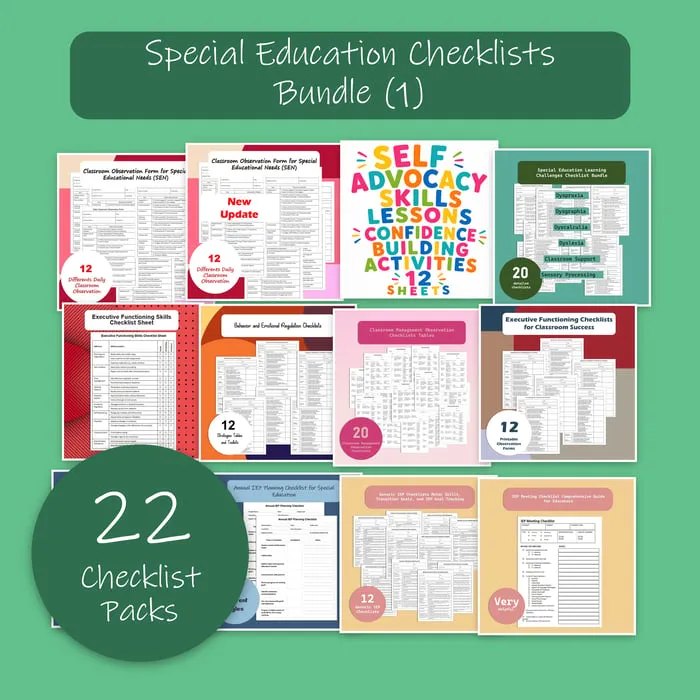
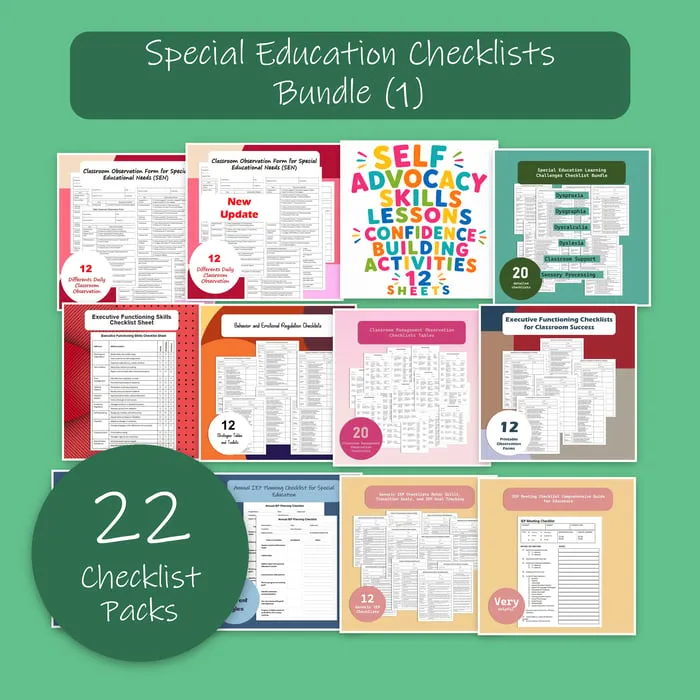
Special Education Checklists Bundle: a collection of checklist resources for special education teams, useful as a starting point for organizing student and team tasks.
Sources and scope
- IDEA, U.S. Department of Education: the law behind special education services, IEPs, and progress reporting.
- IRIS Center, Vanderbilt University: free modules on progress monitoring, data collection, and evidence-based practices.
- National Center on Intensive Intervention: resources on data-based decision making and progress monitoring.
- Understood.org: practical articles for families and teachers about IEPs and learning differences.
This guide covers designing and using simple checklists for skills, routines, and team tasks. It does not replace formal assessment, IEP team decisions, or state and district data requirements.
Key takeaways
- Give special education checklists one clear purpose linked to a goal.
- Write short lists of observable actions.
- Agree on what counts as a check and train every adult.
- Keep checklists where the work happens.
- Review totals regularly and change one thing at a time.









Leave a Comment