

Developmental delay activities work best when they look and feel like ordinary play. Picture a three-year-old at the block corner who points instead of talking, wanders off after a minute, and watches other children from the edge of the rug. A worksheet will not reach this child. A short, playful routine built into the day often will.
After reading this guide, you will be able to observe one child closely, choose a small target, plan play-based activities for communication, motor, thinking, and social skills, fold them into daily routines, and track progress with the family and support team. The steps fit preschool classrooms, early intervention visits, and home.
Examples are fictional. Adapt to the student’s goals and agreed supports. This is guidance, not a diagnosis.
At a glance
- Developmental delay activities should start from what the child already enjoys.
- Pick one small, observable target per area, not a long list.
- Embed practice in play and daily routines, many times a day, for a few minutes each.
- Communication, motor, thinking, social, and self-care skills can grow in the same play.
- Record briefly, share with the family, and adjust with the support team.
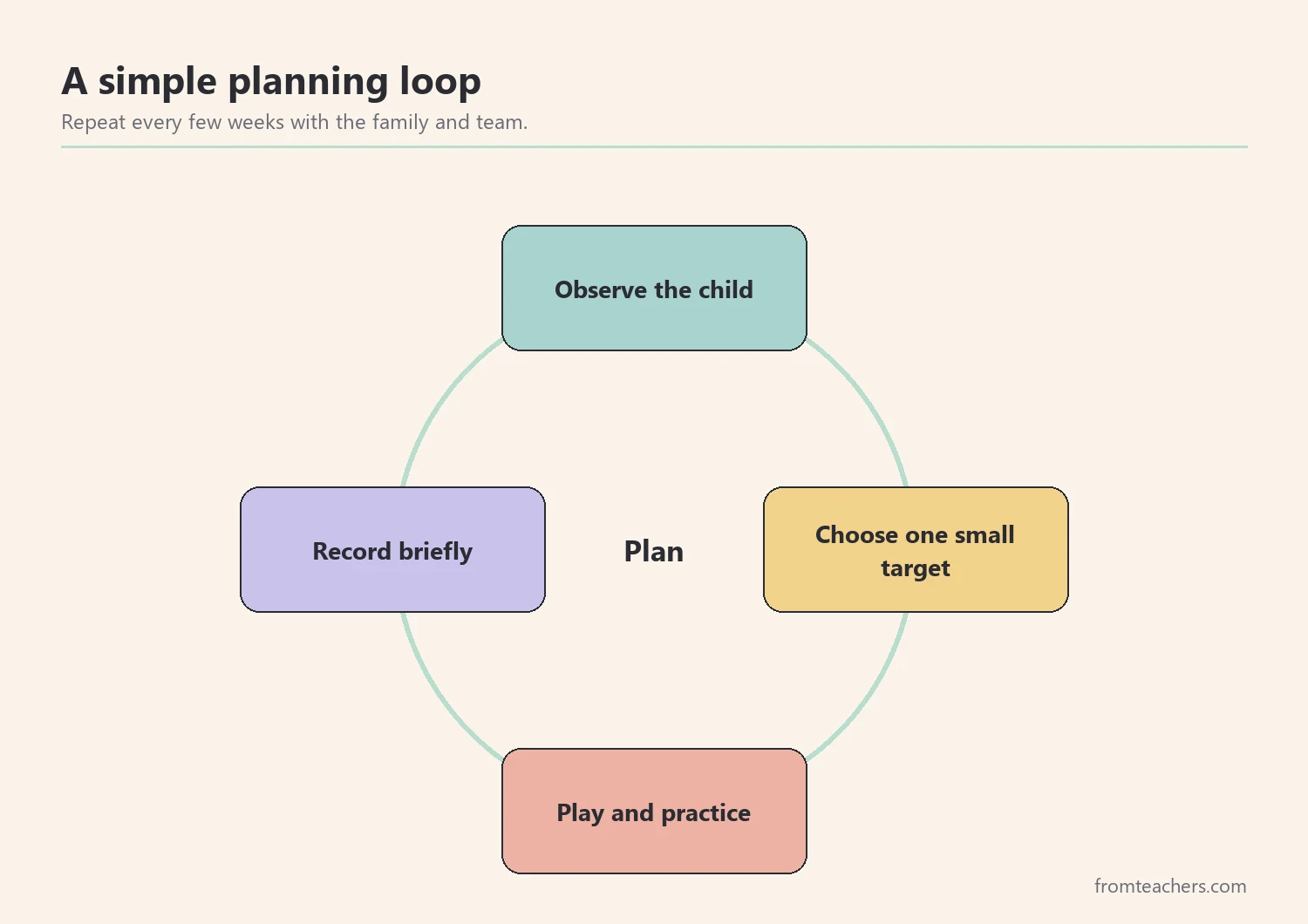
1. Observe the child and choose one target
First, watch before you plan. Spend a few days noticing what the child does, enjoys, and avoids. Note where they go during free play, how they ask for things, and how long they stay with one toy.
Meet Mia, age 3, a fictional preschooler with a developmental delay identified by her early childhood team. Mia loves cars and water play. She uses about ten single words, often points or pulls an adult’s hand, and usually plays alone. She can walk and run, but stairs and jumping are hard for her.
Next, choose one small target per area. A good target is something you can see and count, and something the child is close to doing already. For example, “Mia will use a word or sign to ask for more during play” is clear. “Mia will improve language” is too broad.
| Area | What we saw | Small target |
|---|---|---|
| Communication | Points or pulls hand | Uses a word or sign for “more” |
| Motor | Avoids jumping | Jumps off a low step with a hand held |
| Social | Plays alone | Takes 2 turns with one peer |
Then, check your targets with the people who know the child. If the child has an IFSP or IEP, your developmental delay activities should support those goals, not compete with them. Ask the family and specialists which targets matter most right now.
Also, keep the first round of developmental delay activities small. Three targets are plenty for the first month. You can always add more once the child shows steady success.
Finally, write down what the child loves. Mia’s list was short: cars, water, bubbles, and one song about a bus. Every activity in the next steps used something from that list, because developmental delay activities built on real interests keep a child engaged far longer.
2. Build communication with developmental delay activities
Children talk more when they have a reason to talk. Therefore, the best communication activities create small, natural moments where the child wants something and needs to ask.
First, use “pause and wait.” During bubble play, blow bubbles twice, then stop and wait with the wand ready. Look at the child expectantly. Many children will try a sound, a sign, or a word to make it happen again. Count silently to five before you help.
Next, model short words. Instead of long sentences, say one or two words that match what the child is doing: “Car. Go. Car go fast.” This makes language easy to copy. For Mia, her teacher, Ms. Reyes, chose three words for the month: more, go, and open.
Then, offer choices during developmental delay activities. Hold up two cars and ask, “Red car or blue car?” Even pointing to choose is communication, and you can name the choice back: “Blue car.”
- Bubbles: pause before each blow and wait for “more.”
- Car ramp: hold the car at the top and wait for “go.”
- Snack containers: keep the lid on and wait for “open.”
- Songs: stop before a familiar word and let the child fill it in.
In addition, accept every way of communicating. A sign, a picture card, or a sound all count. Speech-language pathologists on the team can suggest which ways fit the child. Over two weeks, Mia began signing “more” during bubbles, and then said “mo” at snack time.
Finally, keep it fun. If the child gets frustrated, give the item and try again later. Developmental delay activities lose their value if they turn into a test.
3. Plan motor developmental delay activities
Motor skills grow through movement the child enjoys. Both big movements, like climbing and jumping, and small hand movements, like picking up and stacking, can fit into play.
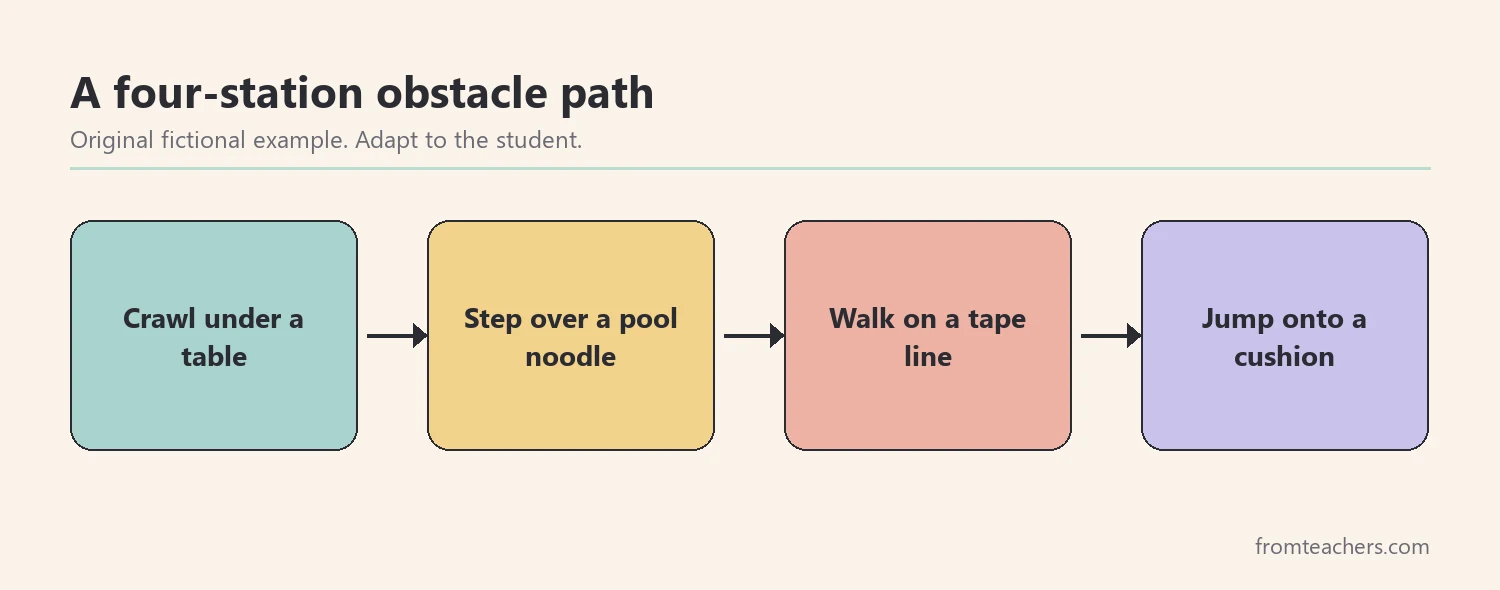
First, think gross motor. Set up a short obstacle path: crawl under a table, step over a pool noodle, walk on a tape line, and jump off a low step onto a cushion. Keep it to three or four stations so it stays quick. Use a favorite object as the goal; Mia’s path ended with a car parked in a “garage” box.
Next, think fine motor. Small hand activities can use the same interests. For instance, Mia pushed small cars through playdough to make tracks, picked up pom-poms with tongs to “wash” in water, and opened and closed containers to find hidden cars.
| Activity | Skill | How to make it easier |
|---|---|---|
| Obstacle path | Balance, jumping | Hold a hand, lower the step |
| Playdough car tracks | Hand strength | Softer dough, bigger car |
| Tong pick-up | Pinch and release | Large tongs, big pom-poms |
| Container hunt | Twist and pull | Loose lids first |
Then, repeat often. Children with delays usually need many more practice turns than peers. Two or three short rounds a day can be more helpful than one long session. If you want ready routines for each area, the play-based Developmental Delay Toolkit includes fine and gross motor activities along with communication, thinking, and social sections.
Finally, ask for input from the occupational or physical therapist if the child has one. They may suggest positions, equipment, or ways to adapt an activity safely. Developmental delay activities are most useful when they match the therapy plan.
4. Use developmental delay activities for thinking, social, and self-care skills
Thinking, social, and self-care skills often grow together in the same activity. A simple game of hiding a car under a cup builds memory and problem solving. Taking turns with a peer builds social skills. Washing hands after water play builds self-care.
First, add simple thinking games. Hide a car under one of two cups and ask, “Where is it?” Sort cars by color into two bins. Match animal pictures to toy animals. Keep each game short and repeat it many times. Mia liked the cup game so much that she started hiding the car for her teacher to find, which turned a thinking game into a social one too.
Next, build social skills with one peer. Large groups can feel overwhelming. Instead, pair the child with one calm classmate. Use a turn-taking toy, like a car ramp, and say, “Mia’s turn. Leo’s turn.” In Mia’s case, she first watched, then held the car while Leo pushed it, and later pushed it herself on her turn.
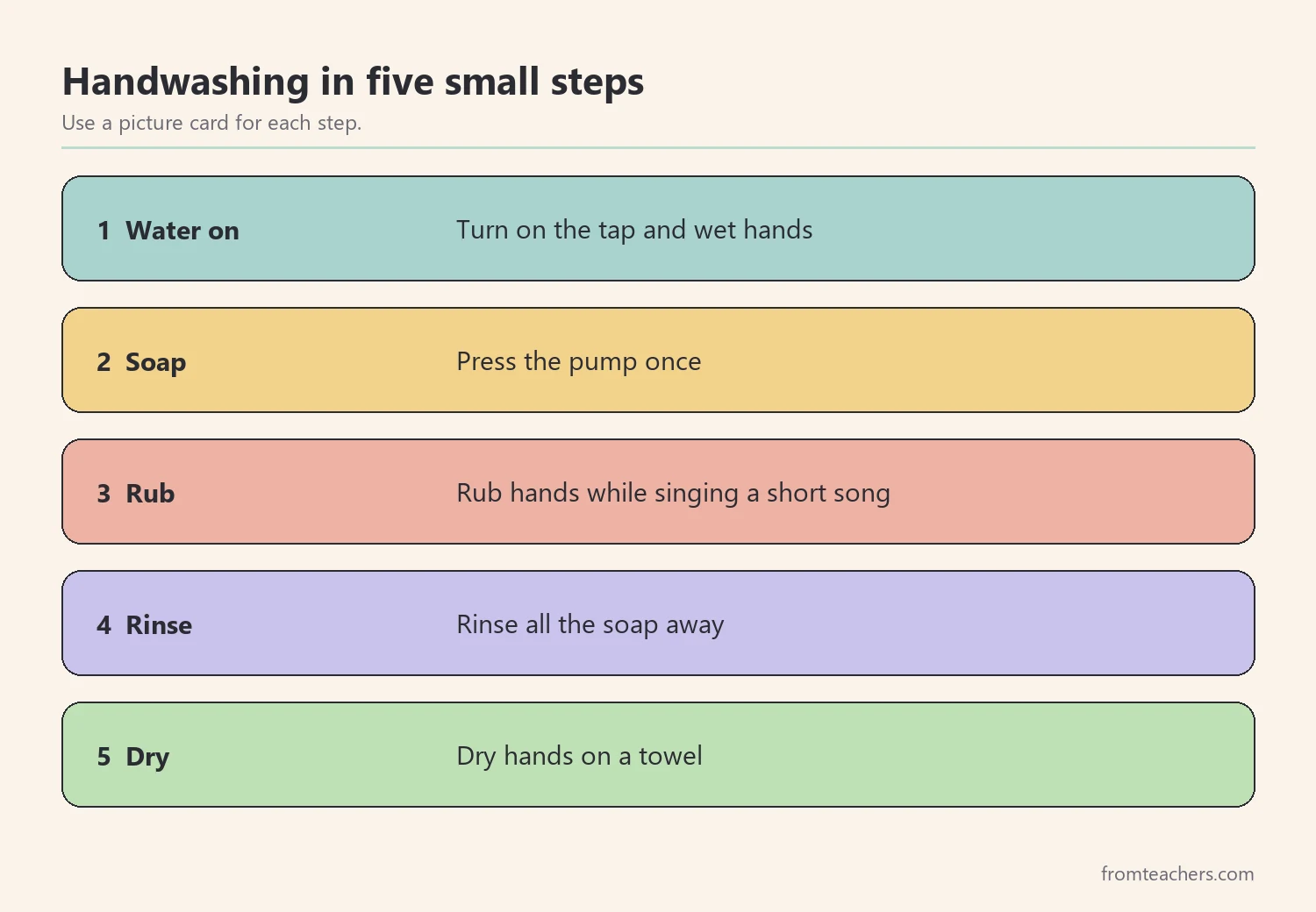
Then, use daily routines as practice. Snack, cleanup, handwashing, and getting dressed happen every day. Each one is a chance for developmental delay activities that build independence. Break each routine into small steps and use picture cards.
Also, help with emotions. Children with delays may get upset more quickly when they cannot say what they want. Name feelings simply (“You are sad. The bubbles stopped.”) and offer a calm way to ask again.
Finally, step back slowly. Help the child at first, then give less help as they succeed. For handwashing, Ms. Reyes first guided Mia’s hands, then only pointed to the picture card, and later just said, “Next?”
5. Track progress and work with the family and team
Short records help you see whether developmental delay activities are working. They also give families and specialists useful information.
First, keep a simple tally. For each target, count how often the child did it during a set time. Ms. Reyes counted Mia’s requests for “more” (word or sign) during one 10-minute bubble or snack session, three days a week.
| Week | Sessions | Requests for “more” (total) | Average per session |
|---|---|---|---|
| 1 | 3 | 3 | 1 |
| 2 | 3 | 6 | 2 |
| 3 | 3 | 9 | 3 |
| 4 | 3 | 12 | 4 |
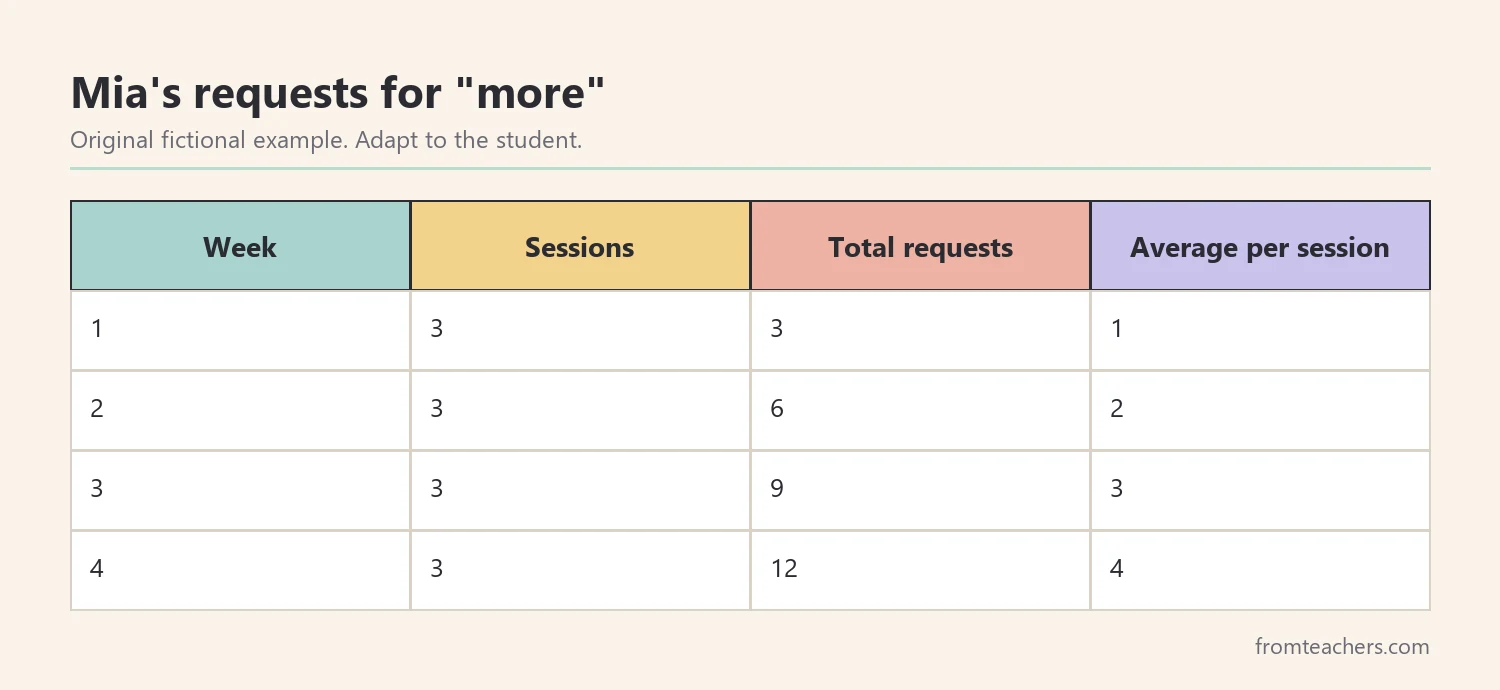
In this example, the total for each week divided by three sessions gives the average. Mia went from about one request per session to about four. That kind of simple math helps everyone on the team see the same picture.
Next, share with the family. Send home one activity a week that matches the classroom target. For instance, Mia’s parents tried “pause and wait” at bath time with a toy boat. They reported that Mia said “go” at home, which the team had not heard before.
Then, meet with the team regularly. Bring your tallies to meetings with therapists and the early childhood special education teacher. Together, review which developmental delay activities are working and decide whether to keep the target, make it harder, or try a new approach.
Finally, remember that progress is rarely a straight line. A child may do well one week and struggle the next, especially after illness or a change in routine. Look at trends over several weeks. Developmental delay activities are a long game, and small, steady gains add up. If you notice new concerns, talk with the family and the support team rather than guessing.
Common mistakes and how to avoid them
- Mistake: Choosing too many targets at once. Fix: Pick one small target per area and add more as the child succeeds.
- Mistake: Relying on worksheets and table time. Fix: Build practice into play and daily routines.
- Mistake: Helping too fast. Fix: Pause and wait a few seconds before stepping in.
- Mistake: Counting only spoken words. Fix: Accept signs, pictures, and gestures as real communication.
- Mistake: Planning without the family or specialists. Fix: Check targets and activities with the team and IFSP or IEP goals.
Questions teachers and parents ask about developmental delay activities
What are good developmental delay activities for preschoolers?
Good options include bubble play with pauses, car ramps, simple obstacle paths, playdough, hide-and-find games, and turn-taking with one peer. The best ones use what the child already enjoys.
How long should each activity last?
Short is fine. Most developmental delay activities need only a few minutes, repeated several times a day, often works better than one long session. Stop while the child is still engaged.
Can these activities replace therapy?
No. Play-based activities in the classroom and at home support therapy goals but do not replace services from qualified professionals. Share what you do with the child’s team.
What if the child does not respond to an activity?
Try changing one thing: the toy, the place, the time of day, or the amount of help. Also, check whether the target is too hard and make it smaller. Developmental delay activities should feel just a little challenging, never impossible.
How can families use developmental delay activities at home?
Families can pick one activity that matches a classroom target and use it during bath, meals, or play. Using the same words at home and school helps the child connect the skills.
Related reading: How Parents and Teachers Can Team Up for Special Education Success, Special Education: A Complete Guide for Parents and Educators, and The Power of Data Tracking in Special Education.
A companion resource for developmental delay activities:
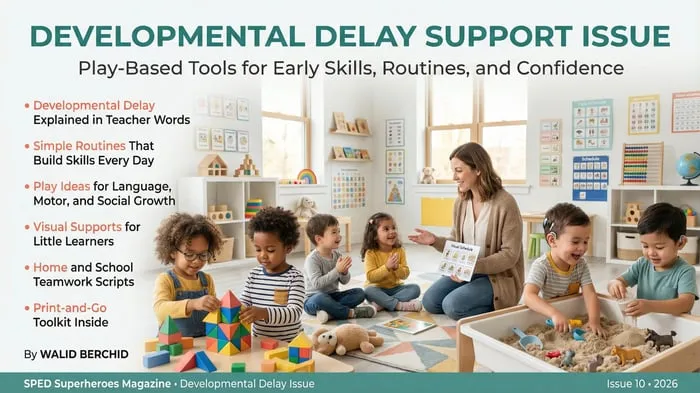
Developmental Delay Toolkit: Play-Based Early Skills: a 50-page guide for preschool and early childhood teachers with play-based routines for communication, motor, cognitive, social-emotional, and adaptive skills, plus classroom scenarios and guidance on progress monitoring.
Sources and scope
- IDEA, U.S. Department of Education: the law behind early intervention and preschool special education services.
- CDC Learn the Signs. Act Early.: general information on developmental milestones and what to do if there is a concern.
- ASHA: the American Speech-Language-Hearing Association, with information on communication development.
- IRIS Center, Vanderbilt University: free modules on early childhood and evidence-based practices.
This guide covers everyday play-based activities for preschool and home. It does not cover evaluation, eligibility, or therapy, which belong to qualified professionals and the child’s team.
Key takeaways
- Developmental delay activities work best when they start from the child’s interests.
- Choose one small, observable target per area.
- Use pause and wait, short words, and choices to build communication.
- Embed motor, thinking, social, and self-care practice in play and routines.
- Track briefly and review with the family and support team.





Leave a Comment