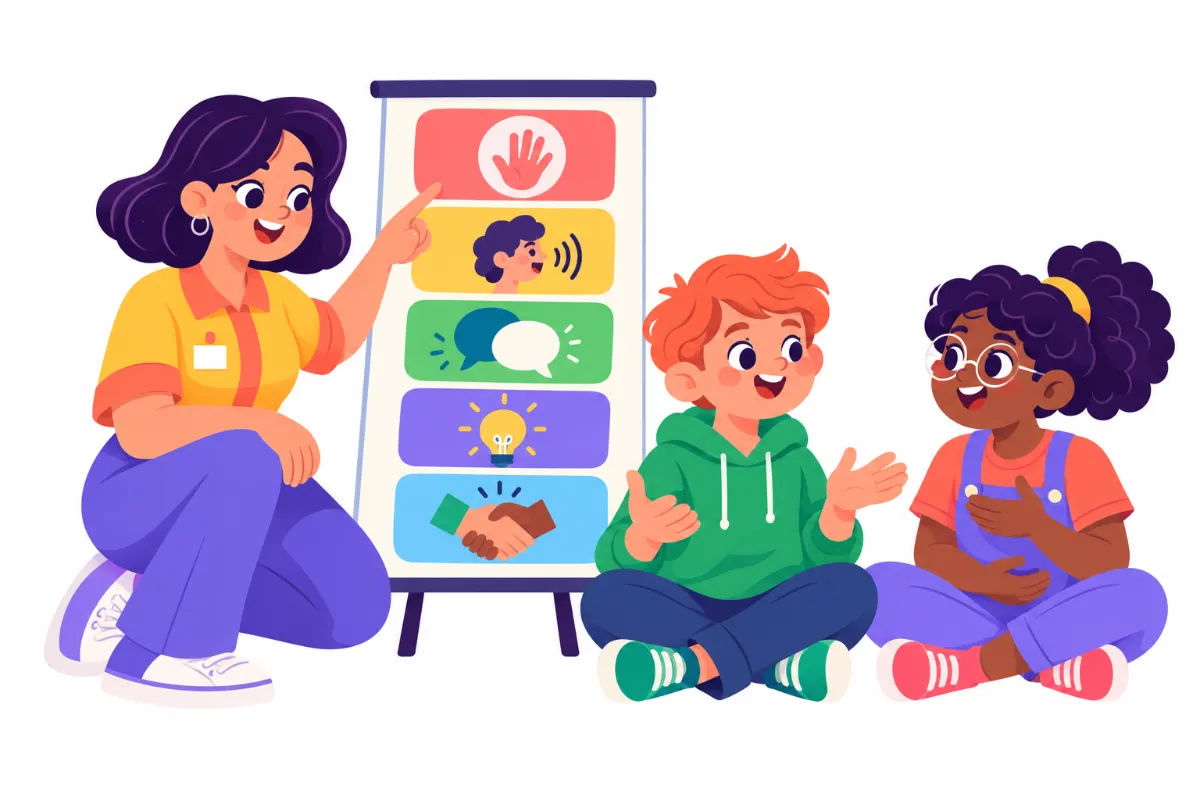

Problem solving strategies for students matter most in the moments when a child gets stuck. A fifth grader stares at a word problem and erases the same line three times. Later, at recess, the same child storms off after an argument over a ball. In both cases, the student does not lack effort. Instead, they lack a clear, practiced way to slow down and work through the problem.
After reading this guide, you will be able to teach one simple problem solving model, match it to social, emotional, and academic problems, practice it in short lessons, and track whether students actually use it. The steps fit general education, SEL blocks, small groups, and counseling settings.
Examples are fictional. Adapt to the student’s goals and agreed supports. This is guidance, not a diagnosis.
At a glance
- Good problem solving strategies for students start with naming the problem clearly.
- One shared five-step model works for math, friendships, and big feelings.
- Different problem types need slightly different tools inside the same model.
- Short, frequent practice with real examples beats one long lesson.
- Track whether students use the steps on their own, not only whether they can recite them.
1. Define the problem before solving it
First, teach students that many problems feel bigger because they are fuzzy. “Everything is going wrong” is hard to solve. “I do not know which operation to use in question 4” is much easier. Naming the problem is the first and most important skill.
Meet Theo, a fictional fifth grader. Theo is bright and verbal, but he shuts down when work gets hard. He often says, “I just don’t get it.” His teacher, Mr. Hale, wants Theo to say what exactly is hard.
Next, give students sentence starters. These lower the effort of putting a problem into words:
- “The problem is that …”
- “I am stuck on the part where …”
- “I feel … because …”
- “What I want to happen is …”
Then, model it out loud. When Mr. Hale gets stuck himself, for example when the projector will not connect, he says, “The problem is that the laptop is not showing on the screen. What I want is for the class to see the slide.” Students hear that even adults name the problem first.
| Fuzzy statement | Clear problem statement |
|---|---|
| “I can’t do math.” | “I don’t know what question 4 is asking.” |
| “Sam is mean.” | “Sam took the ball without asking.” |
| “This is too much.” | “I have three tasks and don’t know where to start.” |
In short, clear naming is the base layer that all other problem solving strategies for students build on. Finally, praise the naming itself. When Theo said, “I don’t know which numbers to use,” Mr. Hale answered, “That is a clear problem. Now we can work on it.” That small win matters more than the right answer.
2. Teach one model of problem solving strategies for students
Students learn faster when every adult uses the same model. If the math teacher, the counselor, and the family all use different steps, students have to learn three systems. Instead, choose one short model and use it everywhere.
In addition, most problem solving strategies for students share the same core moves, so a simple five-step model works well for most grades:
- Stop: pause and take a breath.
- Name: say the problem clearly.
- Think: list two or three possible solutions.
- Try: pick one and do it.
- Check: did it work? If not, go back to Think.
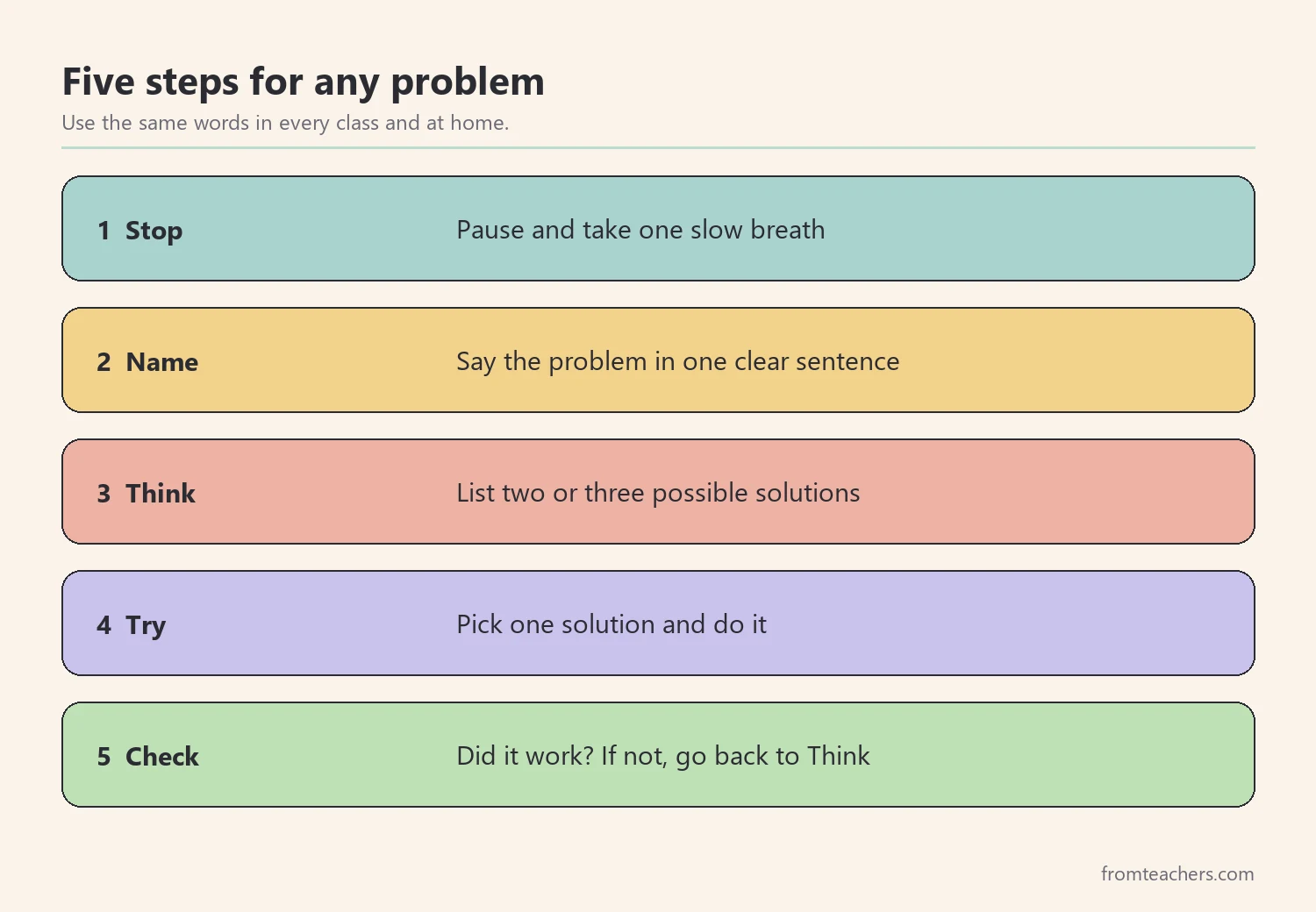
Next, make the model visible. Post it near the board, tape a small copy to desks, and add it to student folders. A visual reminder helps students use problem solving strategies for students on their own, without waiting for an adult.
Then, teach each step separately before putting them together. Spend one short lesson on “Stop,” with breathing and a count to five. Spend another on “Think,” where students list as many solutions as they can in two minutes, even silly ones. Over a week or two, the whole model comes together.
Put this step into practice
For Theo, the hardest step was “Stop.” He wanted to jump straight to “This is impossible.” So Mr. Hale gave him a small card with a stop sign on it. When Theo touched the card, he took one breath before saying anything.
Finally, keep the language identical across settings. Problem solving strategies for students only become habits when the words never change. For instance, if the counselor says “Pause” and the teacher says “Stop,” students may think these are different steps. Small details like this decide whether a model sticks.
3. Match problem solving strategies for students to the type of problem
The five-step model stays the same, but the “Think” step changes with the type of problem. A math problem needs different tools than a friendship problem. Therefore, teach students a small toolkit for each area. This is where problem solving strategies for students become specific instead of general advice.
| Problem type | Example | Useful tools at “Think” |
|---|---|---|
| Math | Word problem feels confusing | Draw it, underline the question, try a smaller number |
| Social | A classmate took a turn | Use an I-statement, take turns, ask an adult |
| Emotional | Feeling angry or worried | Breathe, take a short break, name the feeling |
| Organization | Too many tasks | List tasks, pick the smallest first, set a timer |
For example, Theo’s math problem read: “A class has 24 students. They split into groups of 4. How many groups are there?” Theo first said, “I don’t get it.” With the model, he stopped, named the problem (“I don’t know if I add or divide”), and then thought of tools. He chose to draw it. Then he drew 24 dots and circled groups of 4. He counted 6 groups, and the check matched: 6 groups of 4 is 24.
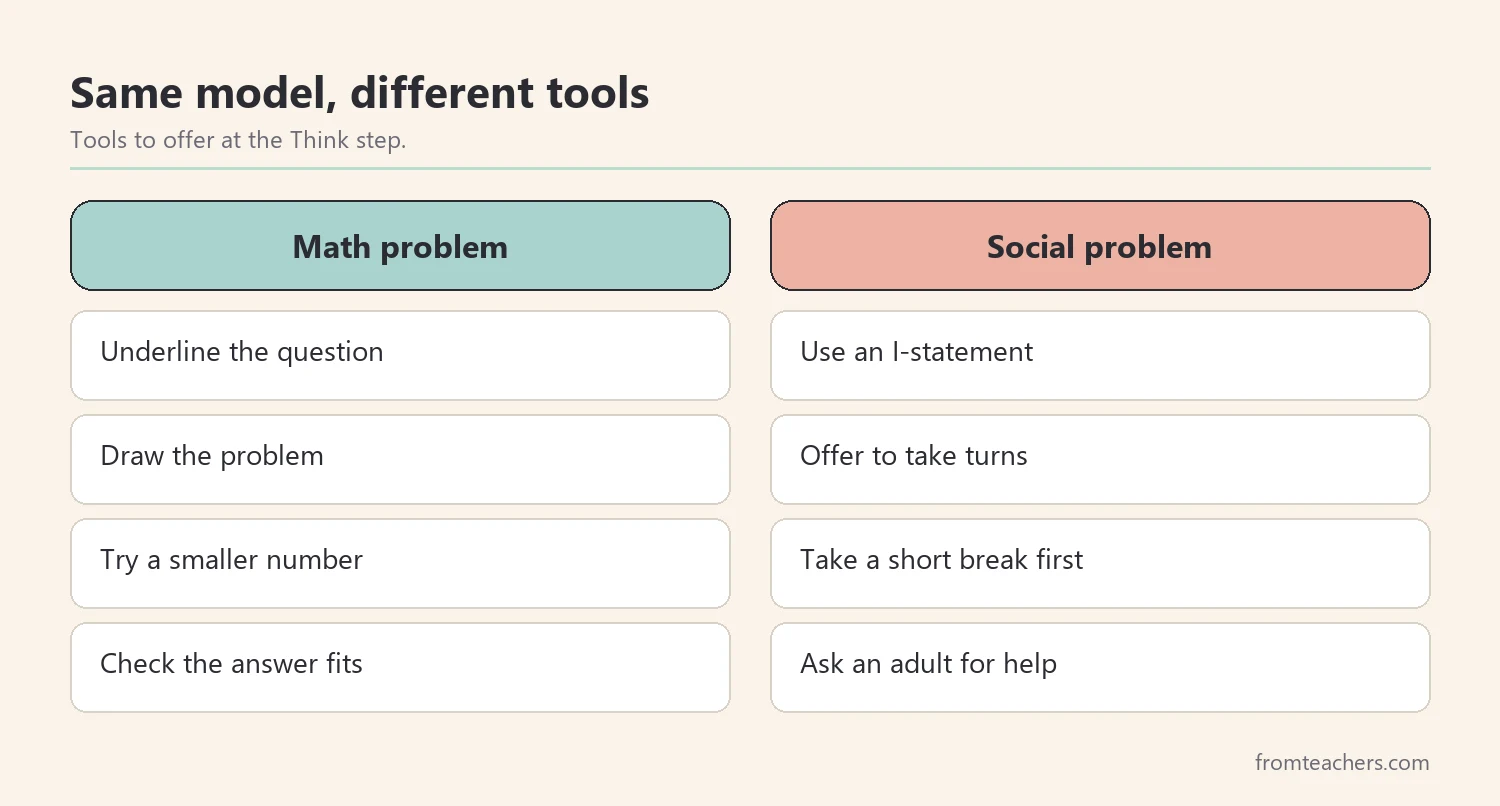
Later that day, Theo and a classmate argued over who would hold the class iPad. This time, the tools were social: an I-statement and taking turns. Theo said, “I feel frustrated because I didn’t get a turn. Can we switch after five minutes?” The classmate agreed.
If you want ready examples for each area, the 12 life and academic problem solving strategy tables break each skill into a tip, a plain description, how it helps, and an example application. That makes it easier to plan a mini-lesson for any one area without starting from a blank page.
4. Practice problem solving strategies for students in short lessons
Knowing the steps is not the same as using them under stress. Students need many short practice rounds while they are calm, so the steps are ready when they are upset.
First, use think-alouds. Solve a problem in front of the class and say each step out loud. “Stop. Okay, the problem is that I have two tests on the same day. Think: I could study a little each night, ask for help, or make a schedule. Try: I will make a schedule. Check: tomorrow I will see if it worked.”
Next, try role play for social problems. Give pairs a short scenario card, such as “Someone cuts in line” or “Your partner is not helping on the project.” Students act it out twice: once with no plan, once with the five steps. Then the class discusses the difference.
Then, practice problem solving strategies for students inside real academic work. At the start of a math lesson, pick one problem and solve it together with the model. In reading, use it when a passage is confusing: “The problem is that I don’t know what this word means.”
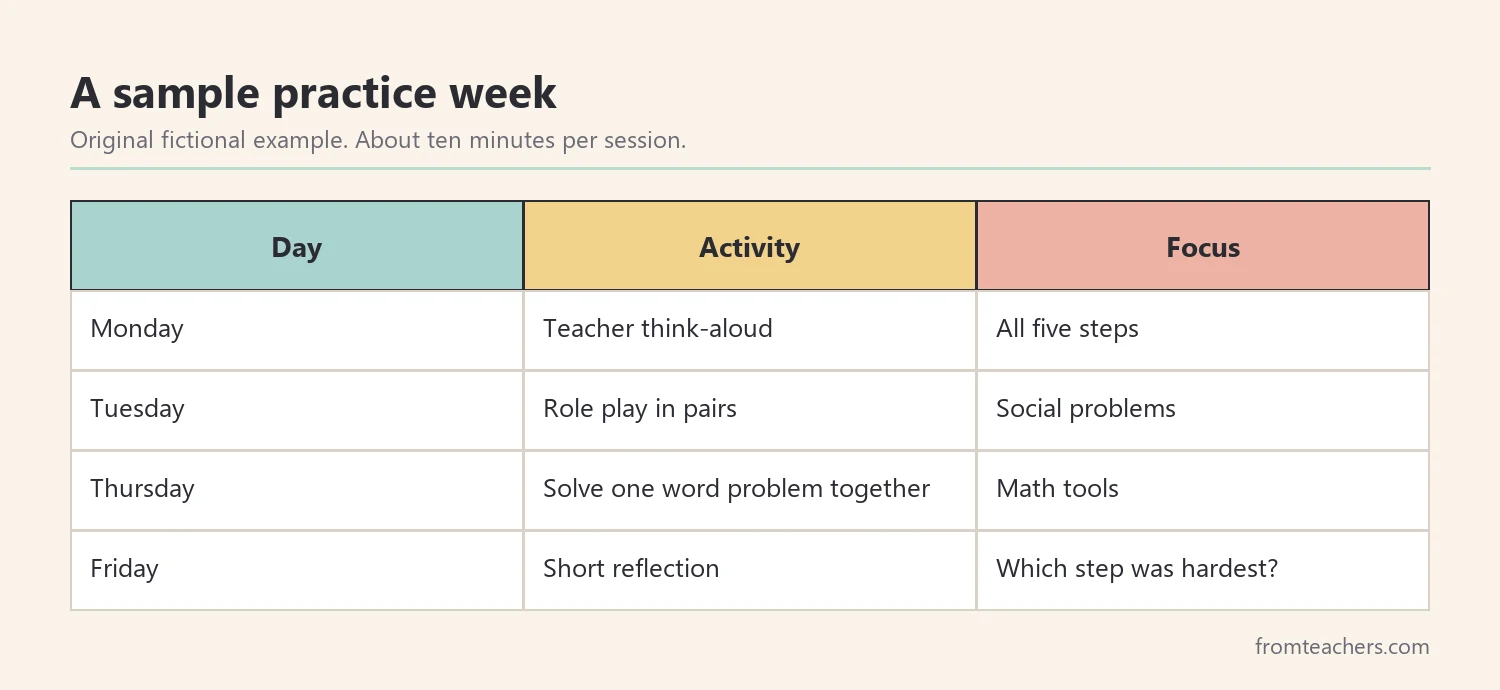
In addition, keep sessions short. About ten minutes, three or four times a week, is usually more effective than one long lesson. Short practice also fits easily into morning meeting or the start of a class.
For Theo, Mr. Hale added one more piece: a private signal. When Theo started to shut down, Mr. Hale tapped the desk twice. That meant “Use your steps.” It avoided calling Theo out in front of peers, and over time, Theo began starting the steps on his own.
Finally, celebrate attempts. Problem solving strategies for students are meant to be tried, adjusted, and tried again. A student who tries a solution that does not work and goes back to “Think” is showing exactly the skill you want.
5. Record and review problem solving strategies for students
Without a record, it is hard to know if the model is working. Students may recite the steps perfectly but never use them. Therefore, track one thing: how often the student uses the steps without a prompt.
First, decide what counts. For Theo, Mr. Hale counted a “use” when Theo named the problem and tried one solution. He recorded each time Theo got stuck in class and whether he used the steps with no prompt, with a prompt, or not at all.
Here is Theo’s four-week record. The number in brackets is how many times he got stuck that week, and the three other columns in each row add up to it.
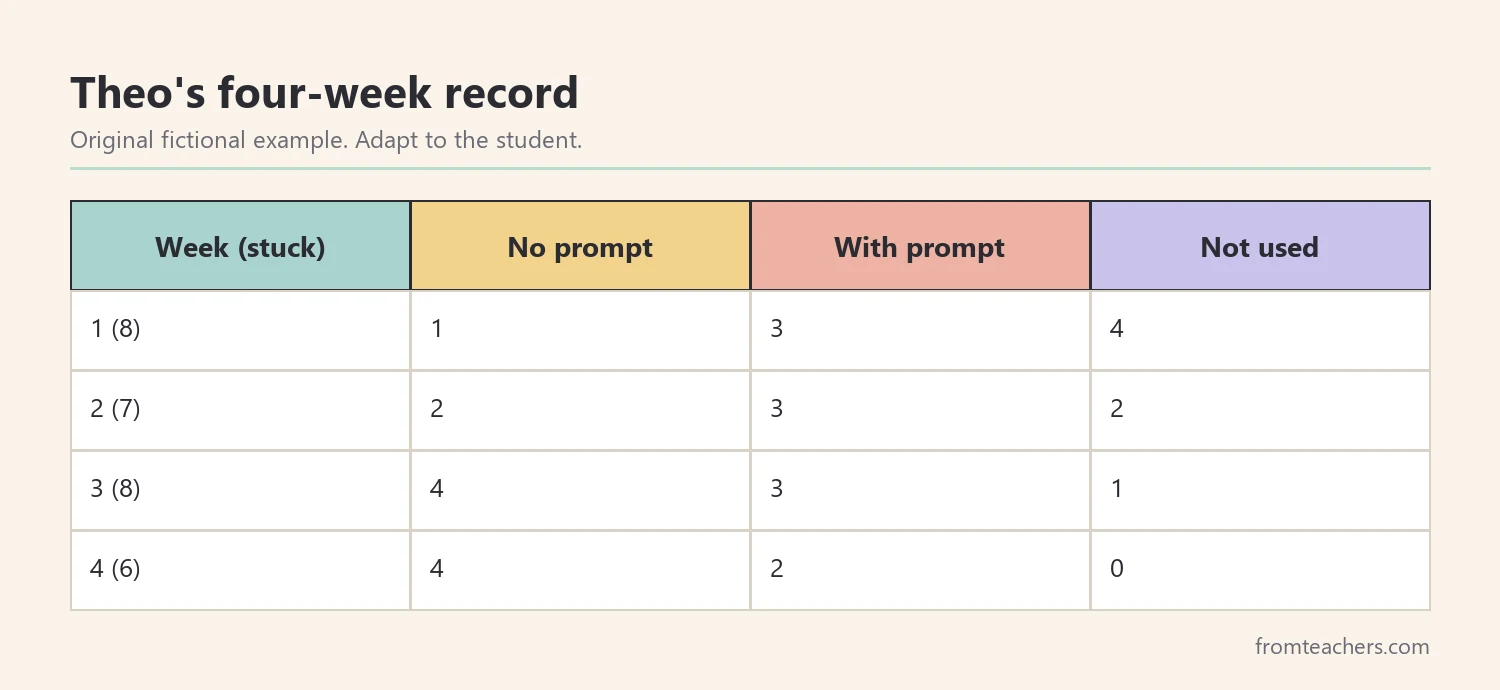
| Week (stuck moments) | No prompt | With prompt | Not used |
|---|---|---|---|
| 1 (8) | 1 | 3 | 4 |
| 2 (7) | 2 | 3 | 2 |
| 3 (8) | 4 | 3 | 1 |
| 4 (6) | 4 | 2 | 0 |
Next, review the record with the student. Show Theo his own numbers. In week 1, he used the steps on his own once out of 8 times. By week 4, he did it 4 times out of 6. Students are often surprised and proud to see their own progress.
Then, ask reflection questions. “Which step is easiest for you now? Which one is still hard?” Theo said “Think” was easiest and “Stop” was still hard when he was angry. That told Mr. Hale where to focus next. Reviewing data like this keeps problem solving strategies for students focused on real use, not only on memorizing steps.
Finally, share with the family. A short note home with the five steps lets parents use the same words. When home and school match, problem solving strategies for students carry over into homework, sibling conflicts, and everyday decisions. If a student keeps struggling a great deal with emotional problems, talk with the school counselor or support team.
Common mistakes and how to avoid them
- Mistake: Teaching the model once and moving on. Fix: Practice in short sessions several times a week.
- Mistake: Using different words in different classes. Fix: Agree on one model and one set of words across the team and with families.
- Mistake: Solving the problem for the student. Fix: Ask, “What is the problem?” and “What could you try?” before offering ideas.
- Mistake: Practicing only during conflict. Fix: Rehearse when students are calm, so the steps are ready later.
- Mistake: Tracking only right answers. Fix: Track whether students use the steps on their own.
Questions teachers and parents ask about problem solving strategies for students
What age can students start learning problem solving strategies?
Even young children can learn a simple version, such as “Stop, think, try.” Older students can use the full five steps and more tools at the Think step. Adjust the words to the age group.
Should social and math problems use the same model?
Yes. One shared model is easier to remember. The tools inside the Think step change, but the steps themselves stay the same.
How long until students use the steps on their own?
It varies by student. Problem solving strategies for students take time to become automatic, and many need several weeks of short, regular practice. Tracking prompts and independent use helps you see progress even when it is slow.
What if a student is too upset to use the steps?
Start with calming first. A short break or a few slow breaths can come before “Name.” Once the student is calmer, return to the model together.
How can parents support problem solving strategies for students at home?
Parents can post the same five steps at home and use the same words. Meanwhile, asking “What is the problem?” and “What could you try?” during everyday moments builds the habit.
Related reading: Moving Beyond Shame and Behavior Charts: Positive Alternatives for Effective Classroom Management, School Counseling Strategies: Empowering Students to Dream Big and Achieve Success, and 5 Practical Teaching Tips to Boost Classroom Focus and Learning.
A companion resource for problem solving strategies for students:
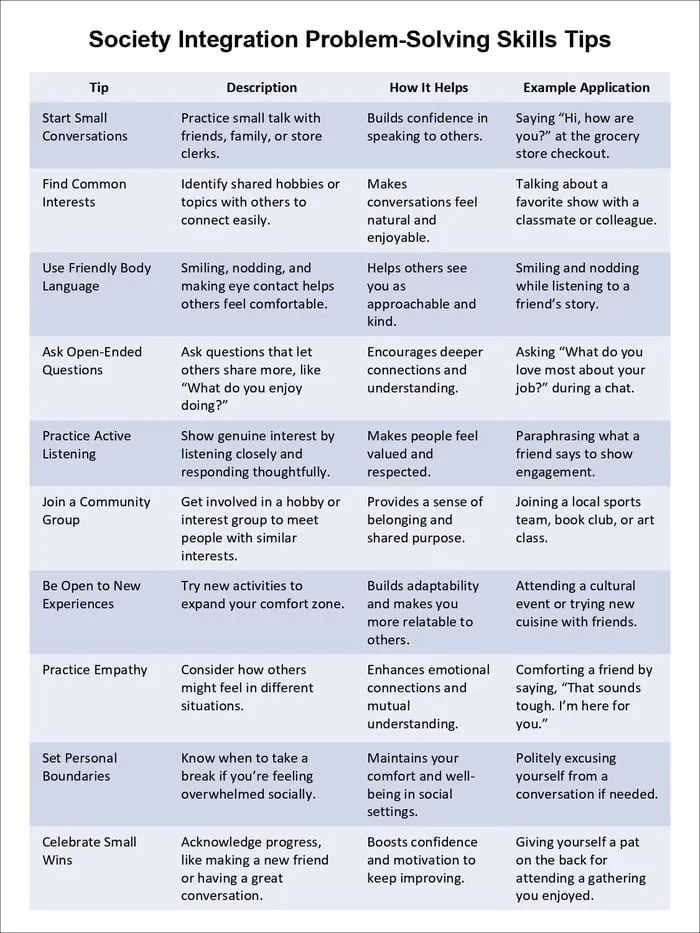
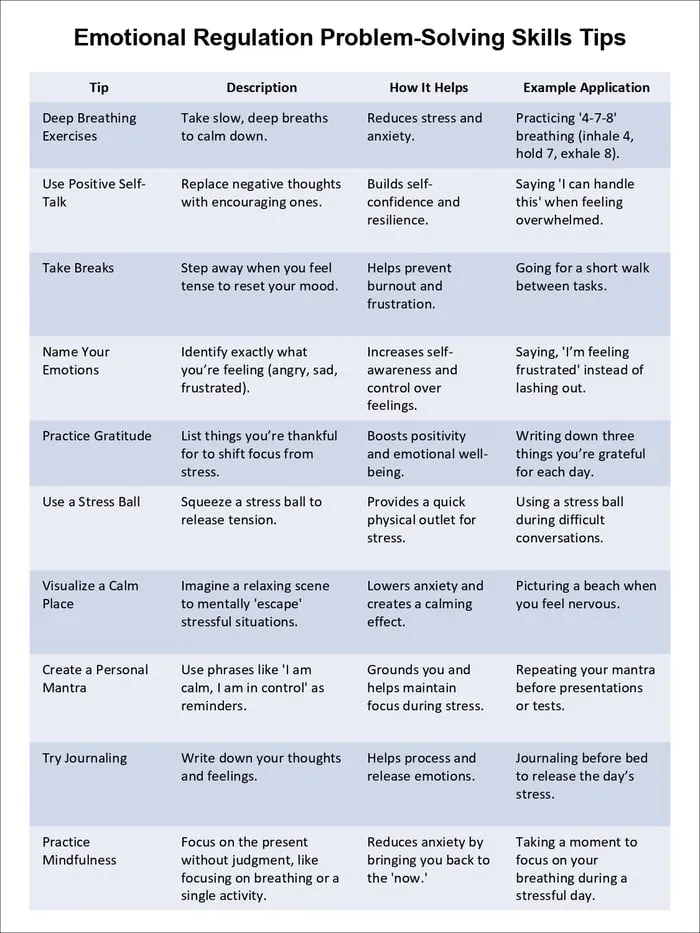
Problem Solving Skills for Students: 12 Life and Academic Strategy Tables: twelve editable tip tables covering social interaction, emotional regulation, math, reading comprehension, executive functioning, conflict resolution, decision-making, and more, each with a tip, description, and example application.
Sources and scope
- CASEL: the Collaborative for Academic, Social, and Emotional Learning, with frameworks for social and emotional skills including responsible decision-making.
- National Council of Teachers of Mathematics: resources on teaching mathematics, including problem solving in the classroom.
- What Works Clearinghouse: reviews of education research and practice guides from the U.S. Institute of Education Sciences.
- Understood.org: practical articles for families and teachers on learning and thinking differences.
This guide covers everyday classroom teaching of a problem solving routine. It does not cover clinical support for anxiety, behavior disorders, or crises, which belong to qualified professionals and the student’s team.
Key takeaways
- Problem solving strategies for students begin with naming the problem clearly.
- Use one five-step model across classes and at home: stop, name, think, try, check.
- Change the tools at the Think step to fit math, social, emotional, or organization problems.
- Practice in short sessions while students are calm.
- Track independent use and review progress with the student and family.










Leave a Comment