
An IEP skills checklist helps you see a student’s growth across every area of the plan, not just the goal you happened to work on today. Picture a Thursday afternoon: your reading probes are up to date, but you suddenly realize nobody has looked at the student’s self-care or social goals in over a month.
This guide is a short course on building and using an IEP skills checklist that covers the whole child. By the end, you will be able to map every area of an IEP, write clear checklist items, choose a simple rating scale, gather input from the whole team, and turn checks into a summary you can share at meetings. Examples are fictional. Adapt to the student’s goals and agreed supports. This is guidance, not a diagnosis.
At a glance
- An IEP skills checklist gives a quick, whole-child view between formal goal probes.
- Build it directly from the areas and goals already written in the IEP.
- Write items as observable skills with a simple, shared rating scale.
- Let every team member add dated checks and short notes.
- Summarize the checks before meetings so patterns are easy to see.
1. Map every area your IEP skills checklist must cover
First, open the student’s IEP and list every area it addresses. Many plans include academics, behavior, communication, and daily living, plus accommodations or related services. Some also include social skills, emotional regulation, attention, motor skills, or transition goals for older students.
Next, give each area its own short section. A good IEP skills checklist reflects the plan as written, so it should not add areas the team has not agreed on. In addition, note which goals already have a formal measurement method, because the checklist supports that data rather than replacing it.
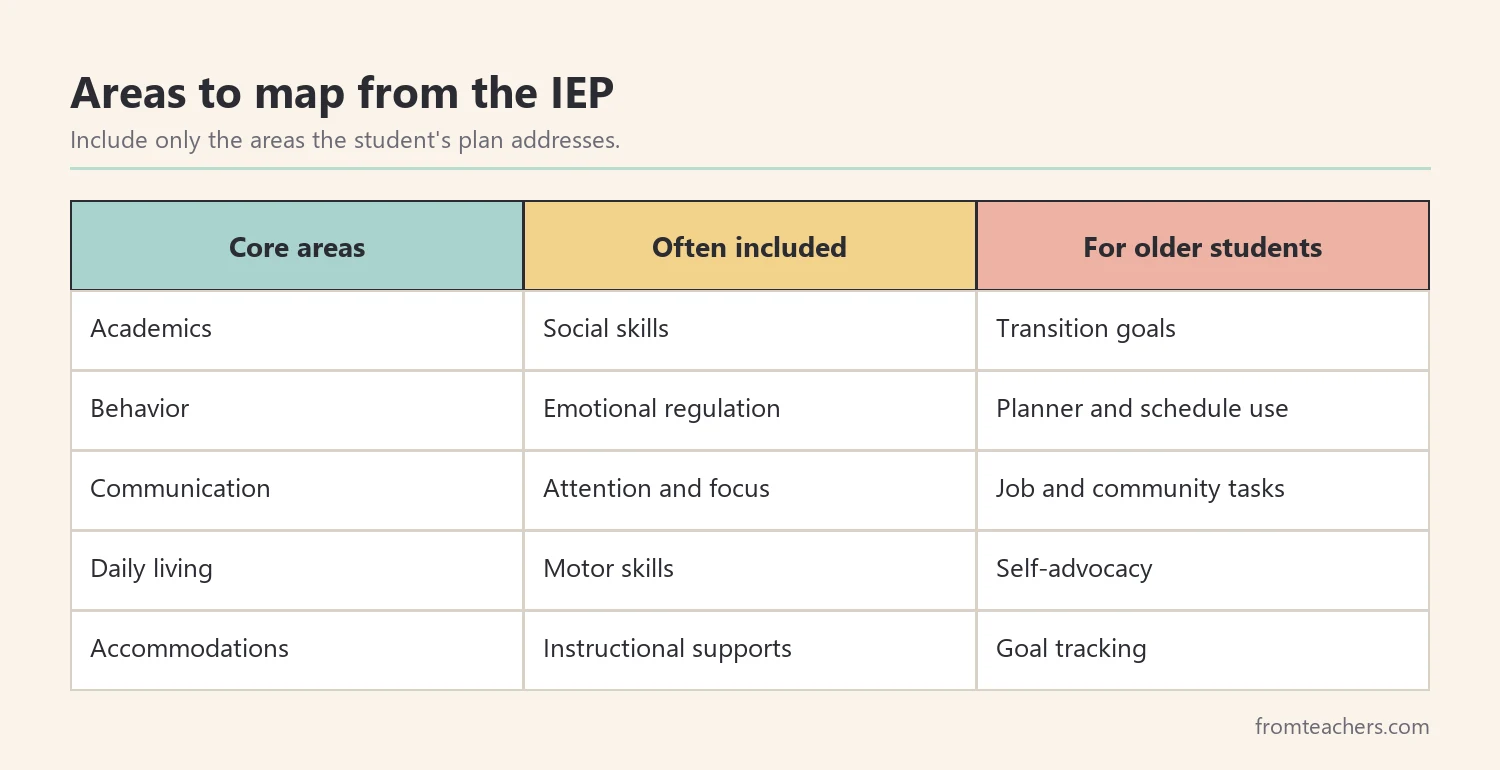
Worked example. Maya is a fictional third grader. Her IEP includes goals in reading, communication, and daily living, plus classroom accommodations. Her teacher, Mr. Okafor, sets up four sections: Academics, Communication, Daily Living, and Accommodations. Each section lists only what the plan already includes.
Also, keep the map on one page if you can, since an IEP skills checklist is meant to be fast. When the whole plan fits on a single sheet, you can scan it in a minute and spot any area that has gone quiet. Meanwhile, keep the full IEP nearby for details such as criteria and timelines.
In addition, think about the student’s age. For a younger child, the IEP skills checklist may focus on routines such as arrival, snack, and asking for help. For an older student, it may include transition items, such as using a planner, checking a schedule, or practicing a job task. In both cases, the sections still come from the plan, but the items reflect what the student is working on right now.
Finally, check the map with the case manager or team. A second pair of eyes catches missing areas, especially accommodations and related services that are easy to overlook.
2. Write observable items for each IEP skills checklist section
Once the areas are mapped, write the items for your IEP skills checklist. Each item should describe a skill you can see or hear, not a feeling or a guess. For example, “asks for help using a phrase or card” is observable, while “feels more confident” is not.
Moreover, keep each item short and tied to the student’s actual goals. Three to six items per area is usually enough. If you write twenty items for one section, the checklist becomes too slow to use and adults stop filling it in.
| Area | Vague item | Observable item |
|---|---|---|
| Academics | Better at reading | Reads a short passage and answers 3 questions |
| Communication | Talks more | Asks for help using a phrase or card |
| Daily living | More independent | Unpacks and hangs up backpack without prompts |
| Accommodations | Gets support | Uses extra time on written tasks |
Worked example. For Maya’s communication section, Mr. Okafor writes three items: “asks for help using a phrase or card,” “answers a yes or no question about her day,” and “greets a peer by name during morning arrival.” Each item matches language from her communication goal.
In addition, a ready-made set can save hours here. The IEP student skills progress monitoring checklists include separate checklists for areas such as academics, behavior, communication, daily living, and accommodations, so you can pick the pages that match the plan and adapt the items.
Finally, read each item aloud and ask, “Could a substitute check this?” If the answer is no, rewrite it until the skill is clear.
3. Choose a simple rating scale and a schedule
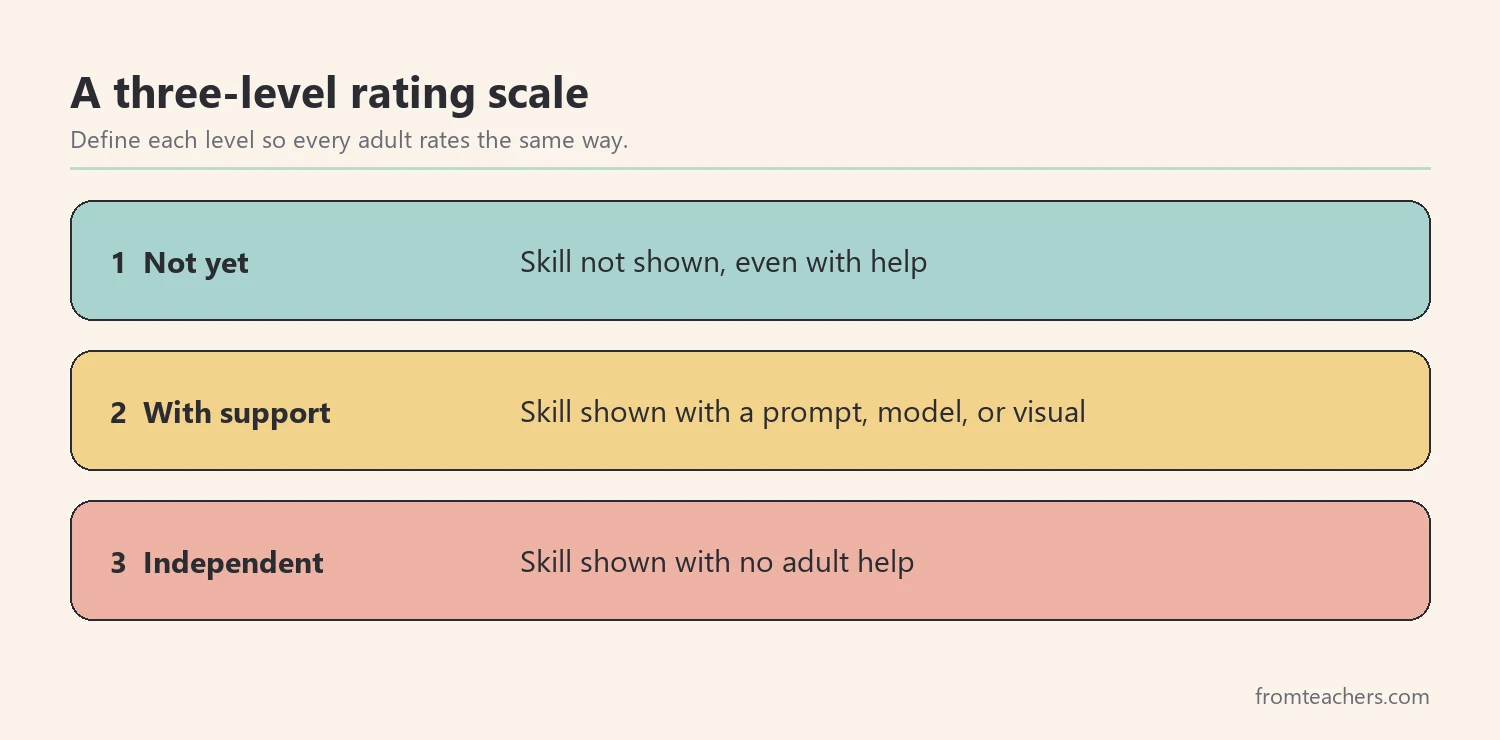
Next, decide how adults will mark each item on the IEP skills checklist. A simple scale keeps ratings consistent across people. For instance, many teams use three levels: not yet, with support, and independent.
Then define each level in a sentence. “With support” might mean the student needed a prompt, a model, or a visual. “Independent” might mean the student completed the skill with no adult help. Without definitions, two adults can rate the same moment very differently.
After that, set a schedule. Some areas need a weekly check, while others can be reviewed every two weeks. The goal is a steady rhythm where every area gets attention, not daily paperwork for every skill.
Worked example. Mr. Okafor checks Maya’s academic and communication items every Friday. Daily living and accommodations are checked every other Friday. As a result, each section is reviewed at least twice a month, and no area goes unnoticed for long.
Moreover, keep the schedule realistic for your caseload. If you support many students, stagger the reviews so you complete a few checklists each day instead of all of them on Friday. A short, steady routine is easier to keep than a big weekly push, and it spreads the work across the team.
Also, add a date and initials to every check. Dates show trends over time, and initials tell you whom to ask if a rating looks surprising.
4. Collect IEP skills checklist data with the whole team
An IEP skills checklist works best when everyone who sees the student can add to it. Paraprofessionals notice daily living skills during arrival. Specialists see communication in therapy sessions. Families see skills at home that may not appear at school.
Therefore, make the checklist easy to reach. Keep a printed copy in a binder or use a fillable PDF on a shared device, following your school’s privacy rules. Then show each adult which sections they are responsible for, so ratings do not overlap or contradict each other.
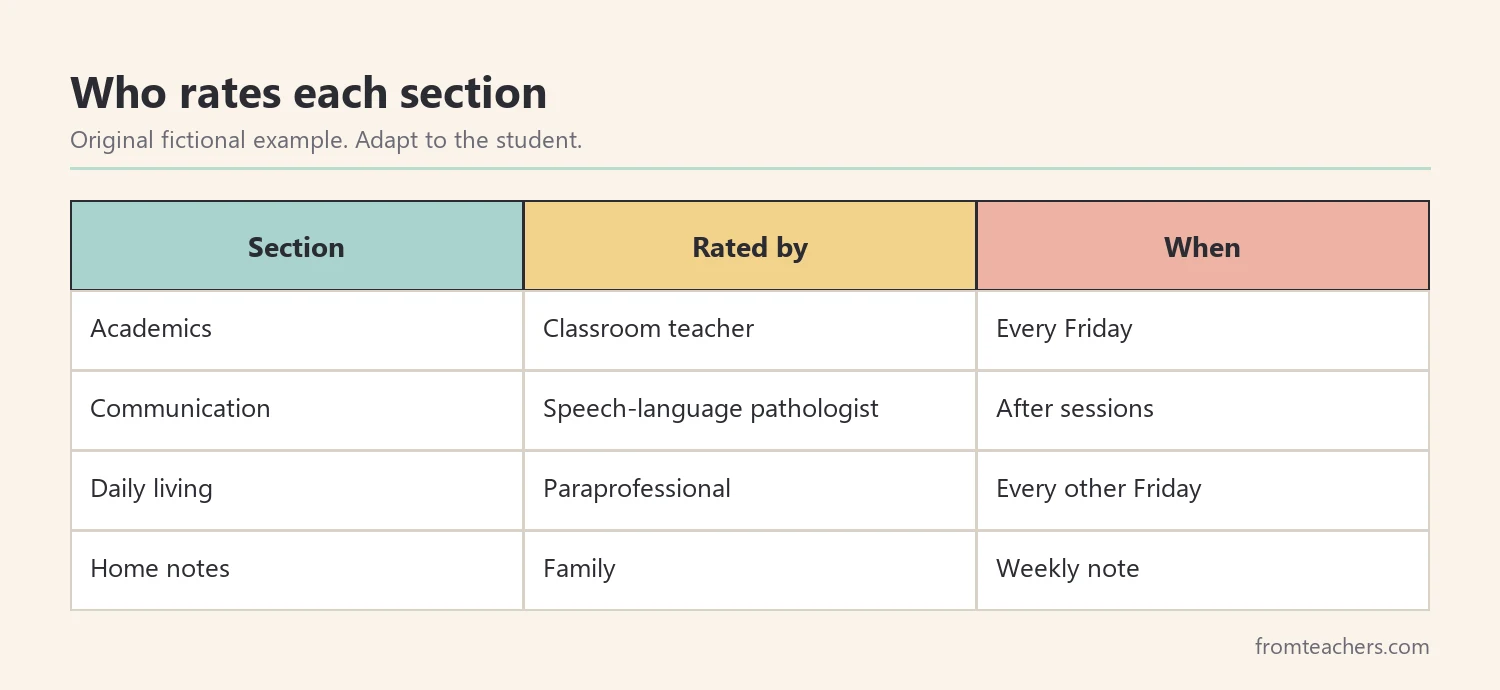
Worked example. In Maya’s case, Mr. Okafor rates academics. The paraprofessional rates daily living during arrival and lunch. The speech-language pathologist rates communication after sessions. Maya’s family sends a short weekly note about greetings and requests at home, which Mr. Okafor adds as a comment.
Moreover, keep notes brief and factual. “Asked for help with a card twice in math” is useful. “Had a bad day” is not, because it does not describe a skill.
Finally, hold a short calibration chat early on. Rate the same activity together once, compare results, and agree on what each level looks like. This step makes the whole IEP skills checklist more reliable.
5. Summarize checks and spot patterns
Raw checks on an IEP skills checklist only help if you look at them together. So, every few weeks, count how many items in each area are rated “independent.” Then compare the counts over time to see which areas are moving and which are stuck.
A simple summary table works well. List each area, the number of items, and how many are independent at each review. Because the numbers are small, you can do this by hand in a few minutes.
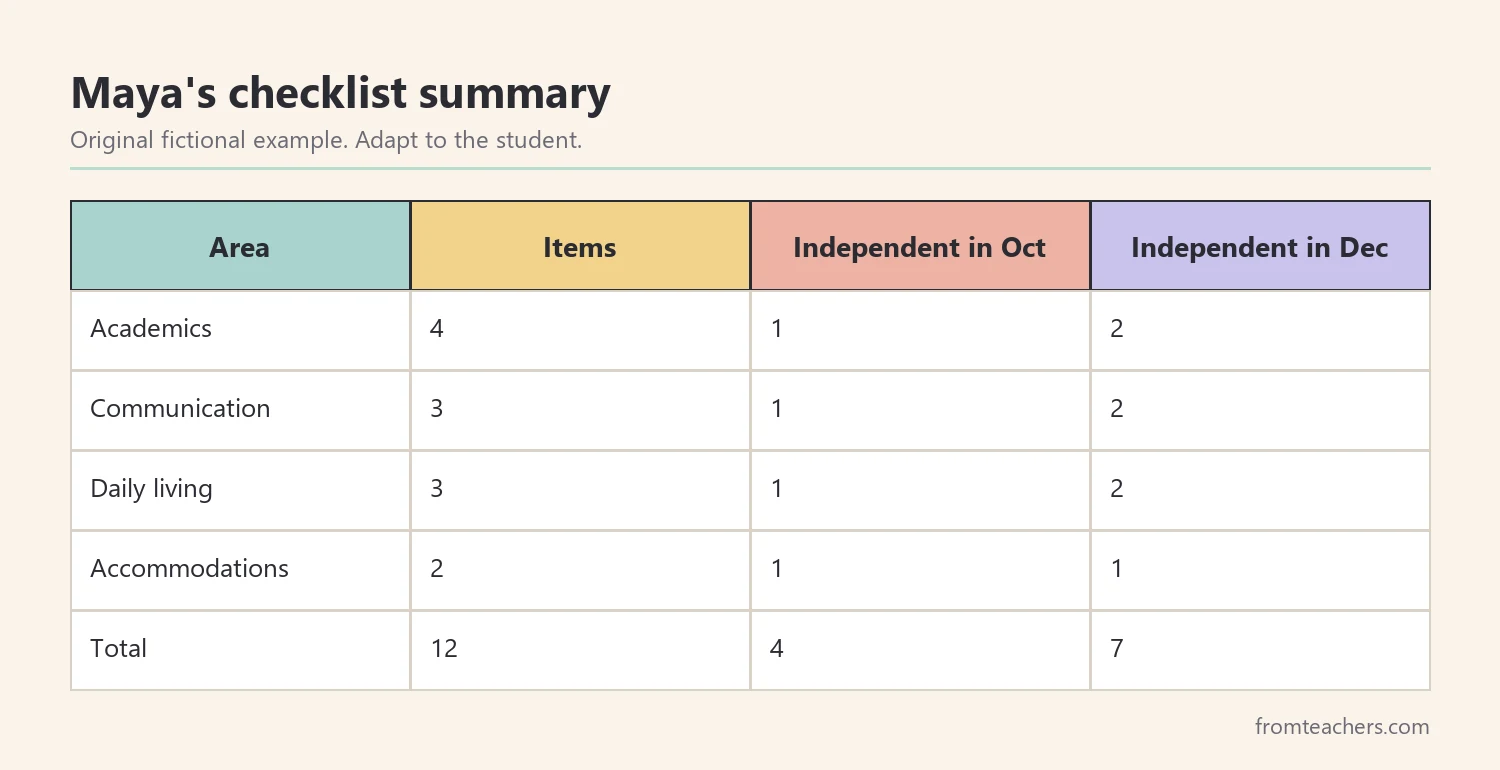
Worked example. Maya’s checklist has 12 items in total: 4 in academics, 3 in communication, 3 in daily living, and 2 in accommodations. At the October review, 4 of 12 items are independent. By December, 7 of 12 are independent.
| Area | Items | Independent in October | Independent in December |
|---|---|---|---|
| Academics | 4 | 1 | 2 |
| Communication | 3 | 1 | 2 |
| Daily living | 3 | 1 | 2 |
| Accommodations | 2 | 1 | 1 |
| Total | 12 | 4 | 7 |
In this fictional example, academics, communication, and daily living each gained one independent item, while accommodations stayed the same. That pattern raises a useful question for the team: is the extra time accommodation being offered consistently, or does Maya need a different way to use it?
However, remember that an IEP skills checklist is a quick screen. When a pattern appears, look at the formal goal data before making decisions.
6. Review results and share them with the team
Finally, use the summary to guide conversations. Before a progress report or an IEP meeting, bring the one-page summary and a few dated notes. As a result, the discussion starts from shared information instead of memory.
Then agree on next steps for each area of the IEP skills checklist. Some skills may be ready for less support. Others may need a new strategy, more practice, or a closer look at the goal itself. In addition, update the checklist items when goals change, so the tool always matches the current plan.
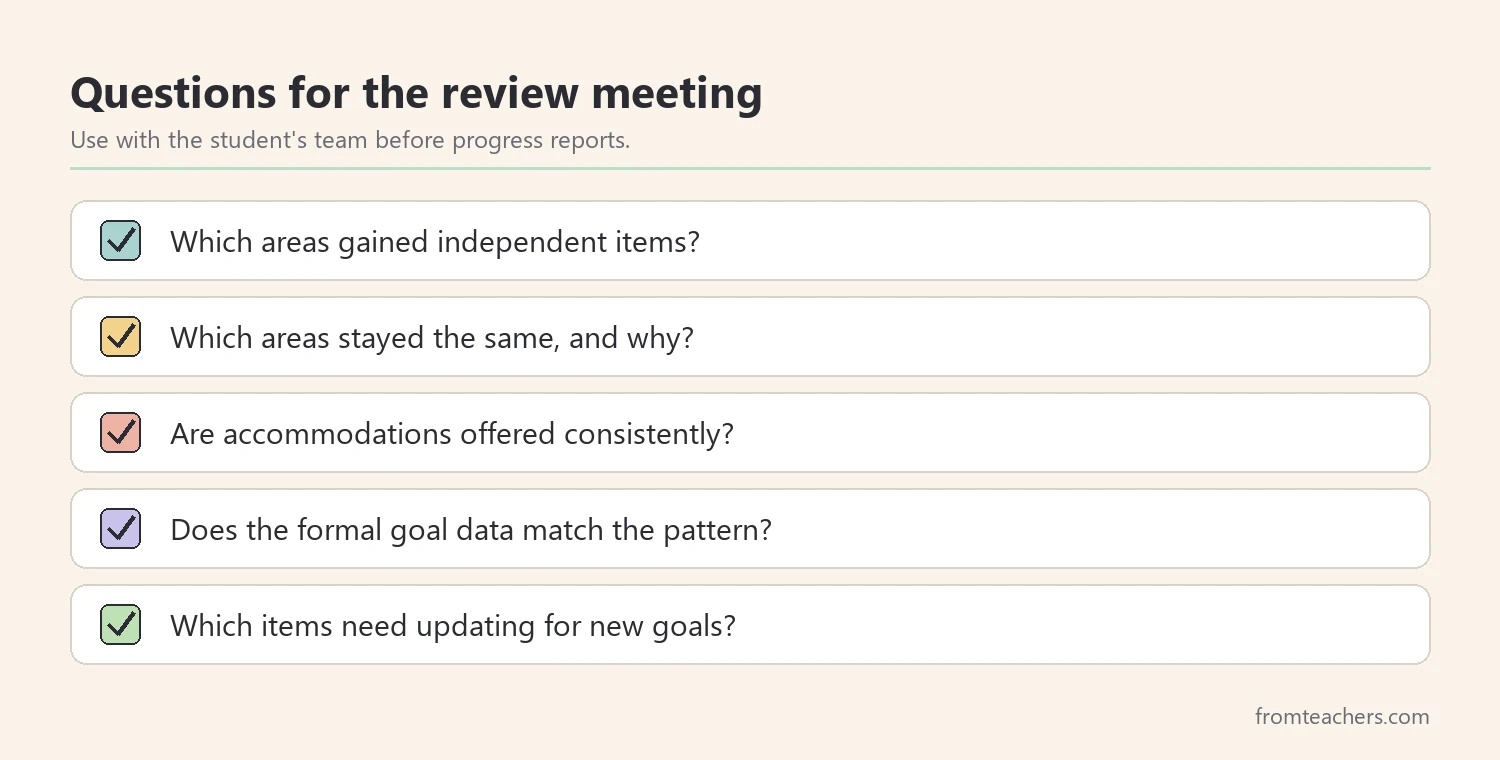
Worked example. At the December meeting, Mr. Okafor shares Maya’s summary. The team celebrates her progress in greetings and backpack routines. They also agree to check that extra time is offered on every written task and to review that area again in January.
In addition, keep a copy of each summary with the date. Over a full school year, these snapshots show the arc of the student’s growth across every area. They also help a new teacher or case manager understand the student quickly if a transition happens mid-year.
Also, share results with the family in plain language. A short note such as “Maya now asks for help with a card on most days” is clear and encouraging.
Common mistakes and how to avoid them
- Adding areas the IEP does not include. Fix: build the checklist directly from the written plan.
- Writing vague items. Fix: describe skills you can see or hear, using the goal’s own language.
- Using different rating meanings. Fix: define each level and rate one activity together to calibrate.
- Checking only favorite areas. Fix: set a schedule so every section gets reviewed at least twice a month.
- Treating the checklist as formal goal data. Fix: use it to spot patterns, then confirm with the goal’s measurement method.
- Letting the checklist go stale. Fix: update items whenever goals or accommodations change.
Questions teachers and parents ask about an IEP skills checklist
Does an IEP skills checklist replace progress monitoring data?
No. It complements the measurement method written for each goal. The checklist gives a quick, whole-child view, while formal data shows progress toward specific criteria.
How many items should each section have?
Three to six items per area is usually manageable. More items take longer to rate, and adults may stop using the checklist if it feels like extra paperwork.
Can families contribute to the checklist?
Yes. Families can share brief notes about skills they see at home, such as greetings, self-care, or requests. The teacher can add those notes to the relevant section with a date.
How often should I update the items?
Update items whenever goals, services, or accommodations change. Many teams also review the items briefly at each progress reporting period to keep them current.
Is a digital or printed checklist better?
Either can work for an IEP skills checklist. Printed copies are easy to grab during a lesson, while fillable forms are easier to share and store. Choose the format your team will actually use, and follow your school’s privacy rules.
Related reading: The Power of Data Tracking in Special Education, Special Education Accommodation and Modification Tracker, and Accommodations vs Modifications in Special Education: The Difference Explained.
A companion resource for your IEP skills checklist:
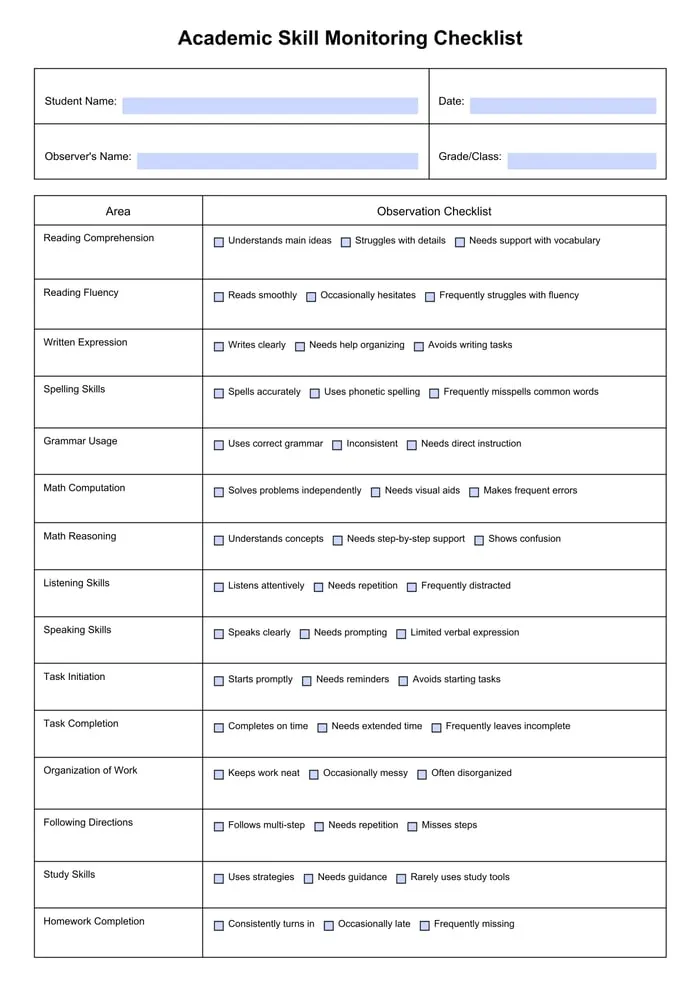
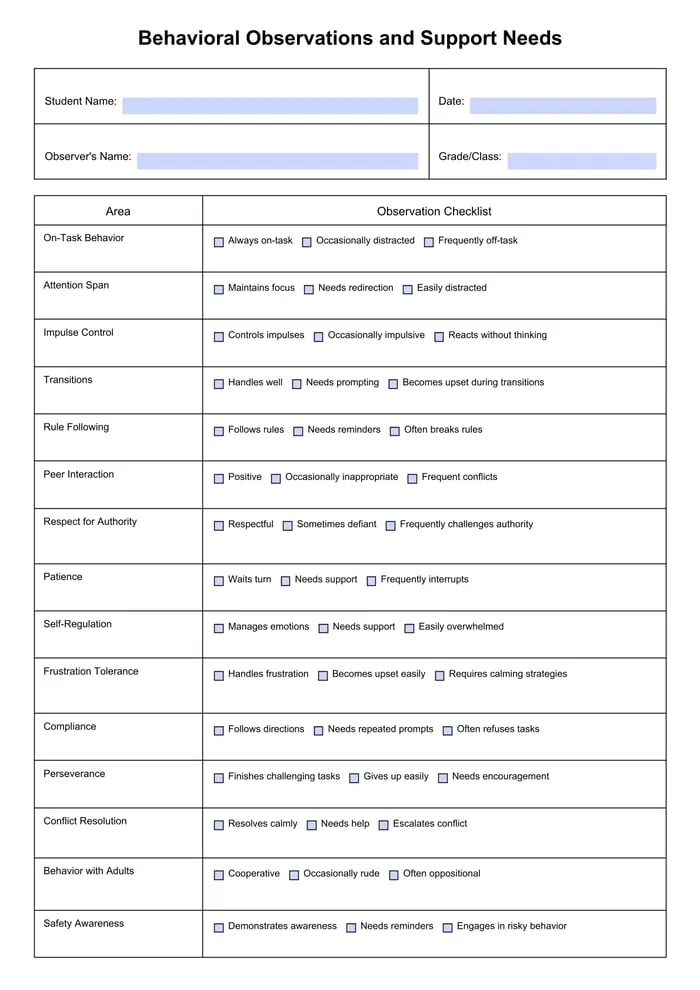
Comprehensive IEP Student Skills Support Progress Monitoring Checklists: twelve fillable PDF checklists covering academics, behavior, communication, daily living, accommodations, social skills, emotional regulation, instructional supports, attention, motor skills, transition goals, and an overall IEP goals tracking form.
Sources and scope
- Individuals with Disabilities Education Act (IDEA): the U.S. Department of Education site on the law that governs IEPs and progress reporting.
- IRIS Center at Vanderbilt University: free modules on IEPs, progress monitoring, and evidence-based practices.
- Center for Parent Information and Resources: plain-language information for families about IEPs and the special education process.
- National Center on Intensive Intervention: resources on data-based decision making and progress monitoring.
This guide explains how to build and use a practical checklist alongside an IEP; it does not replace the goal measurement methods, legal requirements, or team decisions written in a student’s plan.
Key takeaways
- Build your IEP skills checklist by mapping every IEP area first, and add nothing the plan does not include.
- Write short, observable items tied to each goal’s language.
- Use a defined three-level scale and a steady review schedule.
- Share sections across the team and keep notes factual and dated.
- Summarize checks before meetings and confirm patterns with goal data.







Leave a Comment