

Deaf and hard of hearing students need access to the lesson, not just a seat in the room. Picture a fourth grader during a noisy cleanup: the teacher calls out the next step from the back of the class, and by the time he looks up, everyone else is lining up. He is present, but he missed the direction.
This guide gives you a clear, practical process for including deaf and hard of hearing students in daily teaching. By the end, you will be able to set up the room, adjust your communication habits, work well with interpreters and specialists, support friendships, and track whether access is really happening. Examples are fictional. Adapt to the student’s goals and agreed supports. This is guidance, not a diagnosis.
At a glance
- Access means the student can receive and take part in every part of the lesson.
- Room setup matters: seating, lighting, acoustics, and captions come first.
- Teacher habits, like facing the class and writing key directions, help everyone.
- Interpreters and specialists work best when they get materials early.
- Track missed moments and adjust one support at a time.
1. Set Up the Classroom for Deaf and Hard of Hearing Students
Before you change any lesson, look at the room. Many barriers for deaf and hard of hearing students are physical: a seat with a poor view, a window behind the teacher, or a hard floor that bounces sound. Fixing these first makes every later strategy work better.
First, think about sight lines. Students who use speechreading, sign language, or visual cues need a clear view of the speaker and of classmates during discussion. A horseshoe or small group layout often works better than straight rows. However, ask the student where they see and hear best, because preferences differ.
Next, check the lighting. Light should fall on the speaker’s face, not behind it. Standing in front of a bright window turns your face into a silhouette. In addition, reduce background noise where you can: soft surfaces, rugs, and closed doors all help.
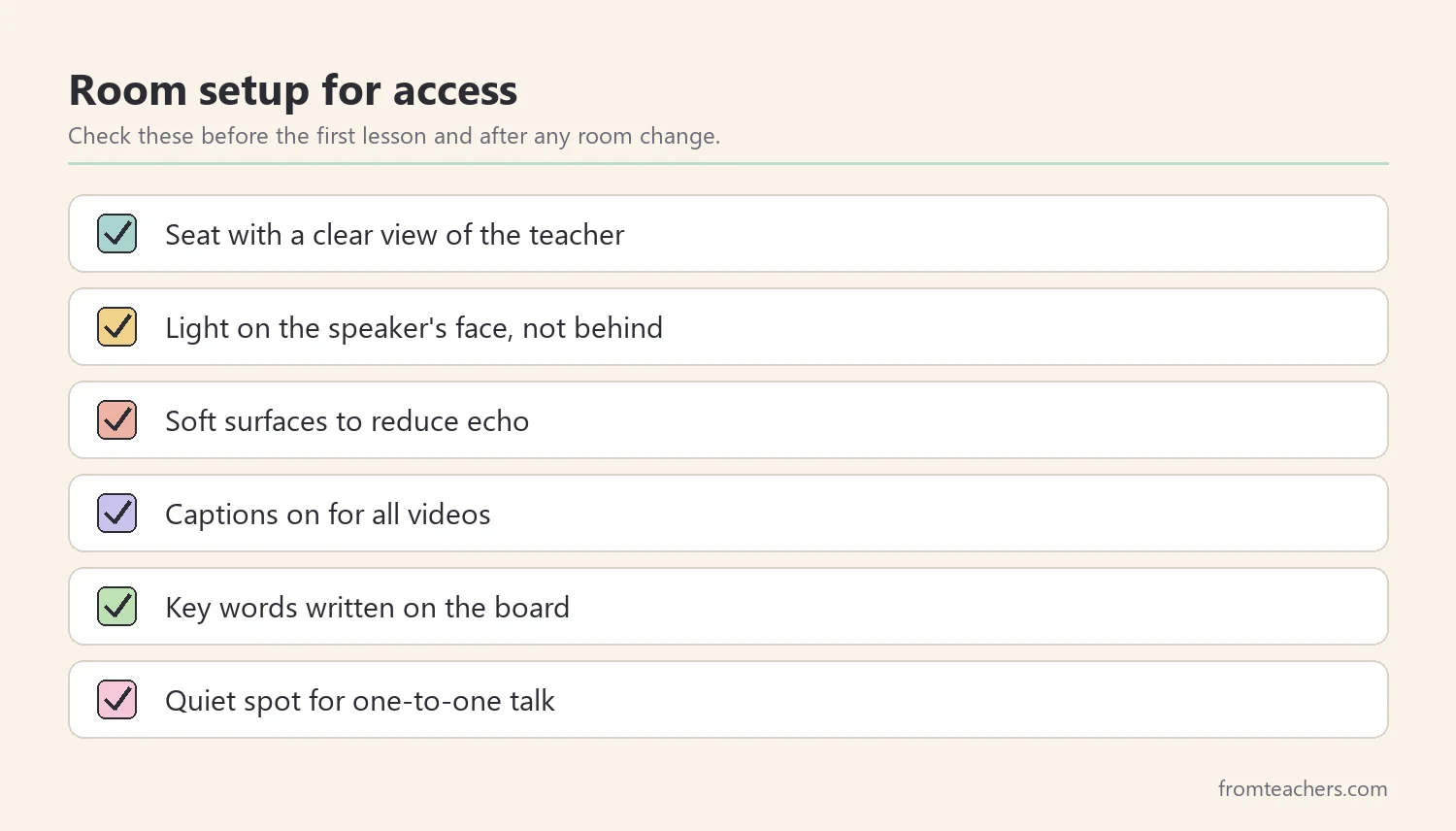
For example, meet Leo, a fictional fourth grader who is hard of hearing and uses hearing aids. His team notices three things in the first week. He sits near the window, the teacher often speaks from the back of the room, and the class videos have no captions. The team moves Leo to a seat with a clear view of the front and of most classmates, the teacher moves her usual standing spot away from the window, and captions are turned on for every video.
Put this step into practice
Also, think beyond the main classroom. Assemblies, the lunchroom, the gym, and field trips often have the poorest access. As a result, a short room check before each new setting can prevent missed information.
Finally, keep a simple note of the setup that works. When a substitute teacher arrives, that note helps them keep the same access for deaf and hard of hearing students without starting over.
2. Use Clear Communication Habits
Small teacher habits make a big difference. Most of them cost nothing, and many help the whole class, including students with attention or language needs. Therefore, clear communication is one of the most useful supports you can offer deaf and hard of hearing students.
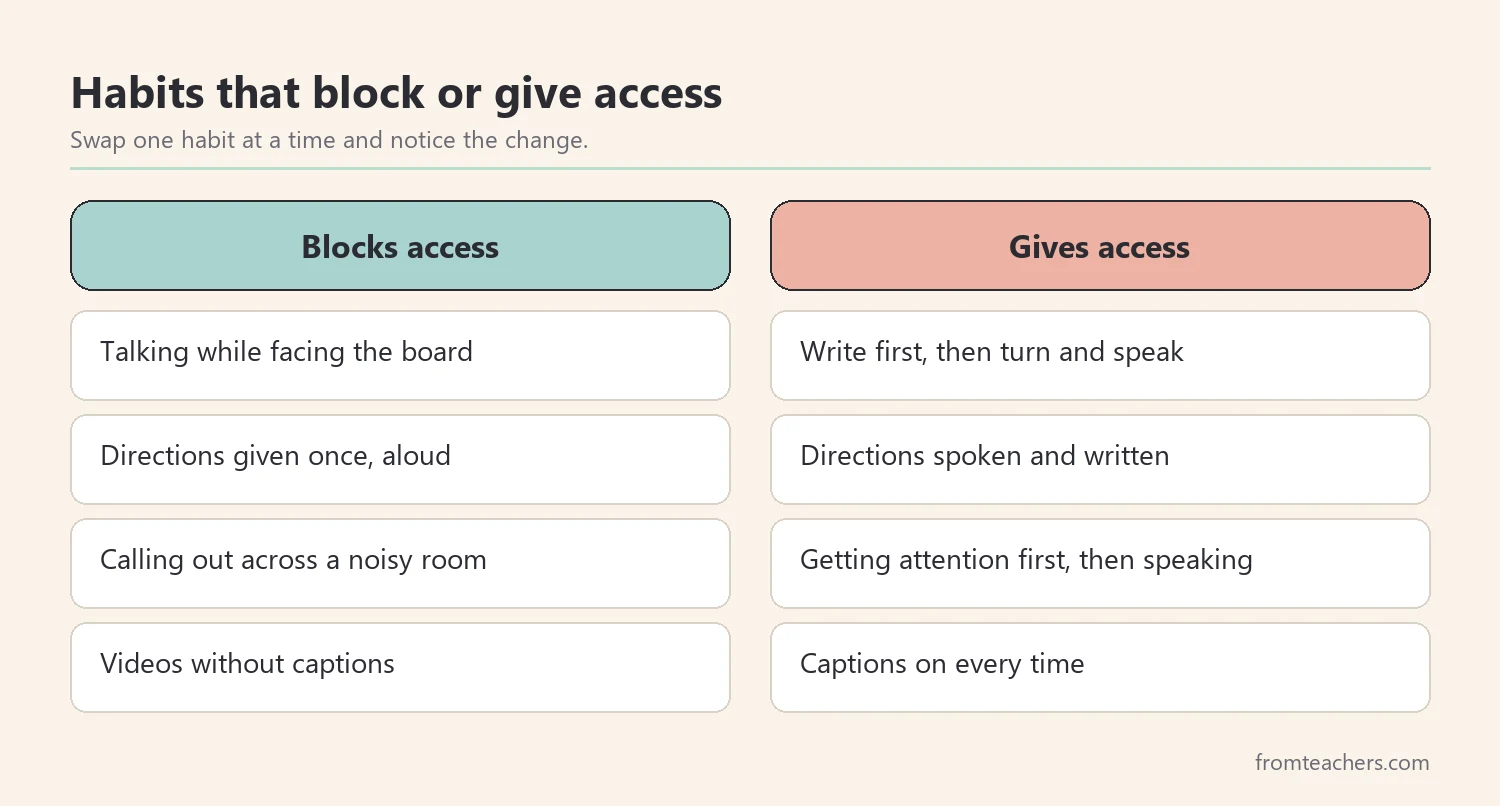
- Face the class when you speak: write on the board first, then turn and explain.
- Get attention before speaking: use an agreed visual signal, such as flicking the lights or raising a hand.
- Repeat classmates’ answers: student comments from across the room are often hard to catch.
- Write key directions and vocabulary: put the main steps and new words where everyone can see them.
- Check understanding without “Do you understand?”: ask the student to show or tell the next step instead.
Moreover, respect the student’s communication choices. Some deaf and hard of hearing students use spoken language, some use sign language, and many use a mix depending on the setting. Your job is not to choose a method. Instead, follow the plan agreed by the team and the family.
A quick classroom example
For example, Leo’s teacher used to give directions only aloud during transitions. Now she writes the next step on a small card on the board before every transition. She also waits until the class is looking at her before she speaks. These two changes take less than a minute each, and they help several other students too.
In addition, pre-teach new vocabulary. When a student already knows a word, it is much easier to catch it in speech or recognize its sign. A short word list sent home before a unit gives the family a chance to practice it too.
3. Work Well With Interpreters and Specialists
Many deaf and hard of hearing students have a team around them: a Teacher of the Deaf, a speech-language pathologist, an audiologist, and sometimes an educational interpreter. However, a team only helps when it works together. Good coordination is the classroom teacher’s most useful contribution.
When an interpreter is part of the plan, remember that the interpreter’s role is to make communication accessible. You remain the teacher. As a result, speak directly to the student, not to the interpreter, and avoid saying “tell him” or “ask her.”
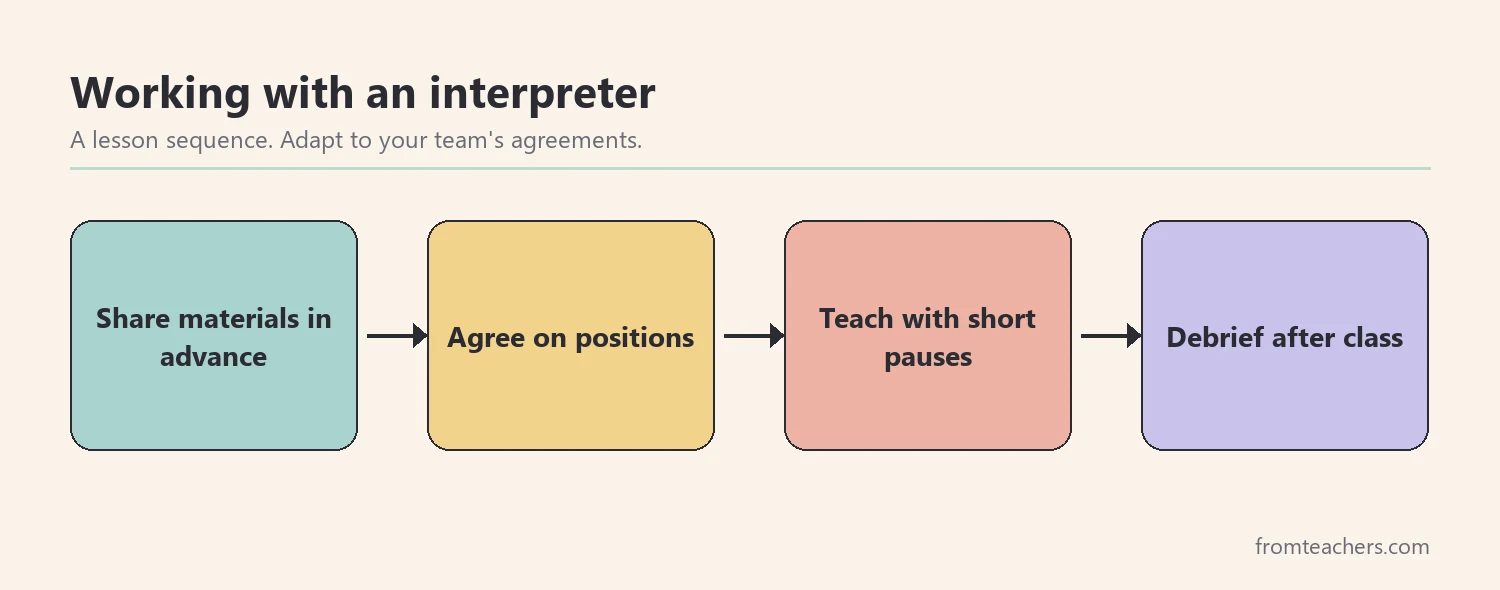
First, share materials in advance. Slides, vocabulary lists, and video links help the interpreter prepare signs for new terms. Next, agree on positions so the student can see both you and the interpreter. Then, during the lesson, build in short pauses. Interpreting has a small time lag, so a pause after a question gives the student a fair chance to answer.
Make it stick
Finally, hold a short debrief. Two minutes after class can reveal which words were difficult or which moments moved too fast.
Specialists add a different kind of help. A Teacher of the Deaf can suggest strategies for language and access, while an SLP may work on speech, language, or listening goals. If you need a structured way to plan these conversations, the DHH support toolkit for classroom access and communication includes guidance on interpreter work, Teacher of the Deaf collaboration, SLP goals, and assistive technology.
For example, Leo does not use an interpreter, but he does see a Teacher of the Deaf once a week. His classroom teacher sends her the upcoming science vocabulary each Friday. As a result, Leo meets the new words before the lesson, not during it.
4. Build Social Inclusion for Deaf and Hard of Hearing Students
Access is not only about lessons. Group work, recess, and lunch are where friendships form, and they are also where deaf and hard of hearing students can feel most left out. Fast conversations, background noise, and overlapping voices make social moments harder to follow.
First, structure group work. Small groups of three or four are easier to follow than large ones. In addition, simple rules help: one person speaks at a time, and speakers face the group. A talking object, such as a marker that passes from person to person, makes turn taking visible.
Next, teach the class about communication in a positive, neutral way. With the student’s and family’s agreement, classmates can learn how to get attention politely, why facing someone matters, and a few useful signs if the student signs. Keep the focus on how everyone communicates, not on the student as different.
What this looks like day to day
Moreover, plan for misunderstandings and teasing. A student who misses part of a joke may laugh late or not at all, and peers may misread that. Therefore, have a calm script ready for adults to step in, repair the moment, and talk privately with the students involved.
For example, Leo’s teacher sets up a lunch club twice a week in a quieter room. Four students eat together, and they take turns choosing a game. Over time, Leo has a smaller group of friends he can follow easily, and he joins the larger group at recess more often.
- Use small groups with clear turn-taking rules.
- Offer quieter spaces for social time.
- Teach respectful communication habits to the whole class.
- Step in early when a misunderstanding happens.
5. Partner With Families and Track Access
Families know their child’s communication history, preferences, and frustrations better than anyone. Because of that, a strong home-school partnership is a core support for deaf and hard of hearing students. Keep communication simple, regular, and two-way.
First, agree on how you will share information. A short weekly note, a shared notebook, or a brief message works well. Include what went well, one thing that was hard, and any new vocabulary coming up. In addition, invite the family to tell you what they notice at home.
Next, track access with simple data. Notice the moments when the student missed information, such as directions during transitions, announcements, or discussions. Then count them across a week. Numbers make patterns visible and help the team decide whether a change is working.
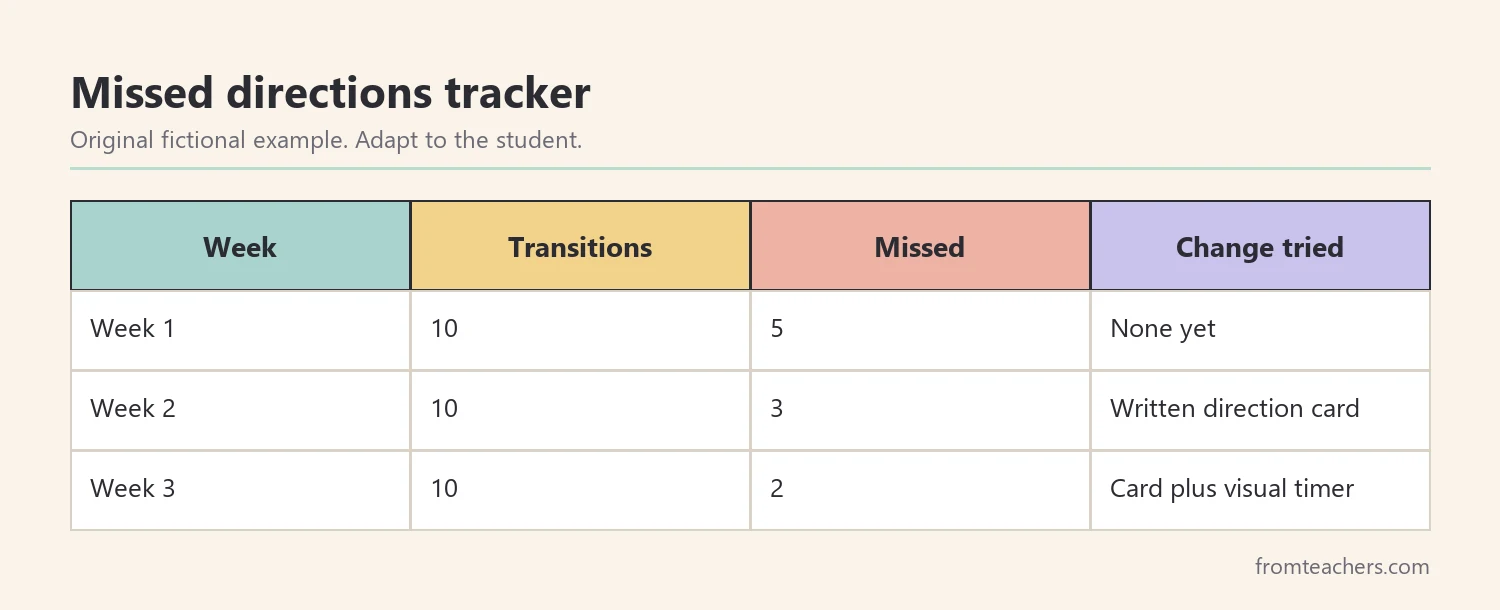
For example, Leo’s teacher counts ten transitions a week. In week one, he missed the direction in five of them. By week two, after the written direction card was added, he missed three of ten. In week three, with the card plus a visual timer, he missed two of ten. The trend is clear, so the team keeps both supports and looks at the two remaining moments.
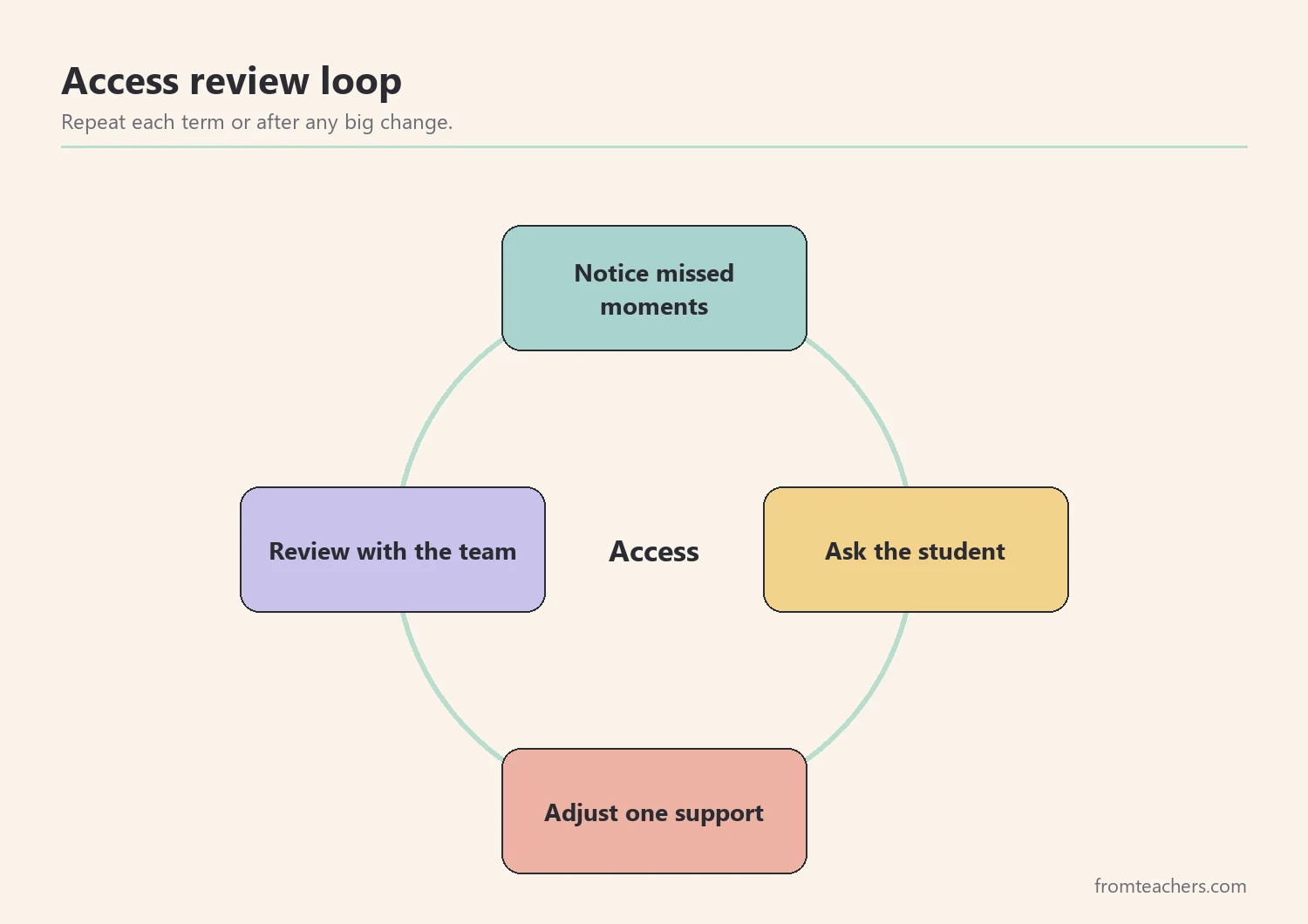
Finally, review access with the whole team each term or after a big change, such as a new classroom or a new teacher. Ask the student first. Deaf and hard of hearing students are often the best experts on what is and is not working for them.
Common mistakes and how to avoid them
- Assuming a seat at the front solves everything: also check lighting, noise, and the view of classmates.
- Talking while writing on the board: write first, then turn and speak.
- Speaking to the interpreter instead of the student: address the student directly.
- Forgetting captions: turn captions on for every video, every time.
- Only checking understanding with yes or no: ask the student to show or tell the next step.
- Ignoring social time: plan group work and lunch with access in mind.
Questions teachers and parents ask about deaf and hard of hearing students
Where should deaf and hard of hearing students sit?
Usually where they have a clear view of the teacher and most classmates, away from noise sources and with good light on speakers’ faces. However, the best seat depends on the student. Ask them and try a few options.
Do I need to learn sign language?
Not necessarily. Follow the communication plan agreed by the team and family. If the student signs, learning a few classroom signs is a kind and useful step, but it does not replace a qualified interpreter when one is part of the plan.
How can I tell if the student is missing information?
Watch for late responses, copying peers, or frequent requests for repetition. Then count missed moments across a week. Simple data shows patterns better than impressions.
Who should I talk to for specialist advice?
Start with the student’s case manager or Teacher of the Deaf, if there is one. The SLP and audiologist can also advise on their areas. Bring specific examples to make the conversation useful.
How do I explain hearing differences to the class?
Only with the student’s and family’s agreement. Keep it positive and focused on how everyone communicates. Many students like to share their own explanation.
Related reading: Accommodations vs Modifications in Special Education, Best Assistive Technology for Special Education Classrooms, and How Teachers Communicate With Parents in Special Education.
A companion resource for deaf and hard of hearing students
Ready-to-use resource:
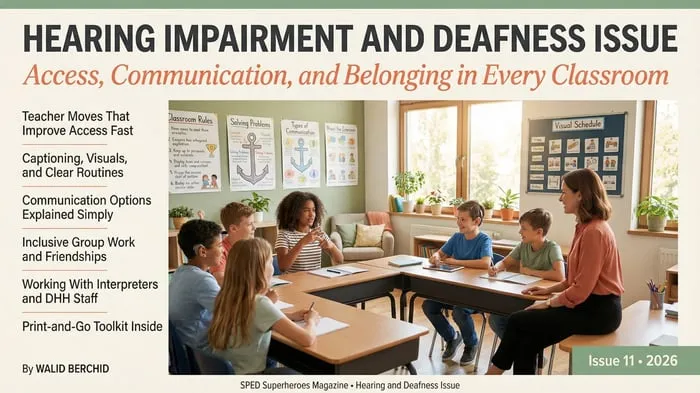
DHH Support Toolkit: Classroom Access & Communication: a 49-page guide with classroom setup, communication supports, interpreter and specialist collaboration, social inclusion strategies, family partnership ideas, and printable data trackers.
Sources and scope
- Individuals with Disabilities Education Act (IDEA): the U.S. Department of Education site for the federal special education law, which includes deafness and hearing impairment as disability categories.
- American Speech-Language-Hearing Association (ASHA): the professional association for audiologists and speech-language pathologists, with family and educator information on hearing.
- Gallaudet University: a university for deaf and hard of hearing students that also shares resources for educators and families.
- Described and Captioned Media Program (DCMP): a source of accessible, captioned educational media.
- IRIS Center: free educator training modules on special education practice.
Scope: this guide covers everyday classroom access and communication practices for teachers. It does not give medical or audiological advice, and it does not replace the student’s individualized plan or specialist assessment.
Key takeaways
- Fix the room first: seating, lighting, acoustics, and captions.
- Use clear habits such as facing the class and writing key directions.
- Share materials early with interpreters and specialists.
- Plan social time so deaf and hard of hearing students can join in.
- Track missed moments and adjust one support at a time.







Leave a Comment