
California facts for kids can turn into a long list that students forget by Friday. Picture a third grade class on the first day of a state unit: the teacher reads ten facts in a row, and by the fifth one, half the room is drawing on their folders. The facts were accurate, but nothing gave students a reason to hold on to them.
This guide shows you how to teach California facts for kids and plan a short, memorable California study in five steps. You will choose a small set of core facts, connect each one to a picture or place, build a simple map routine, give students a small research task, and close with a review that shows what they remember. By the end, you will have a plan you can run in one to two weeks.
Examples are fictional. Adapt them to your grade level, your standards, and your students.
At a glance
- Pick a small core set of California facts for kids first: capital, nickname, symbols, and a few landmarks.
- Pair every fact with an image, a place on the map, or a short story.
- Use the same map routine every day so students build a mental picture of the state.
- Give students one small research job instead of a large report.
- End with a review that checks memory and lets students share what they found.
1. Choose the core California facts for kids
Start smaller than you think. A unit on California facts for kids works best when students know a handful of facts well rather than many facts loosely. Therefore, decide on your core set before you open any slides or books.
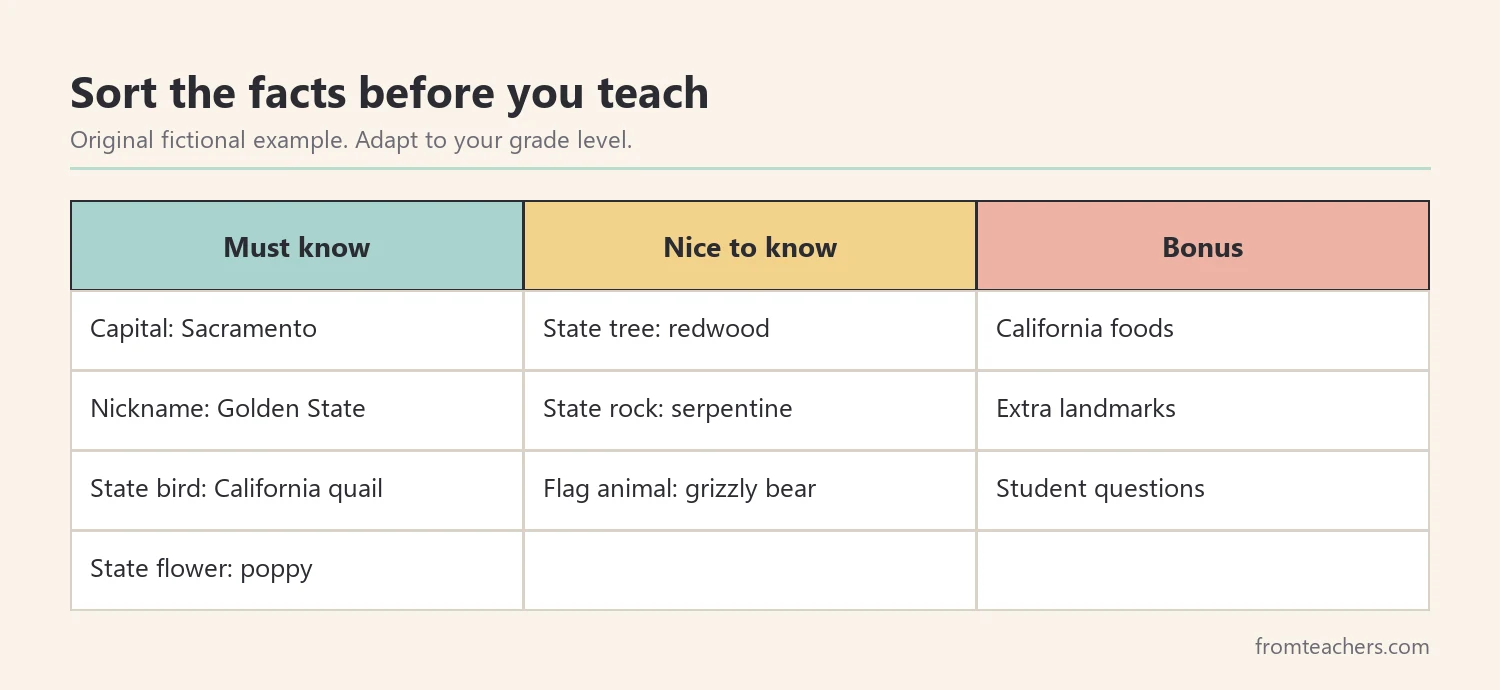
For most elementary classes, a strong core set of California facts for kids includes the capital, the nickname, a few state symbols, and two or three famous places. Sacramento is the capital. California is known as the Golden State. The state bird is the California quail, the state flower is the California poppy, and the state tree is the California redwood. The grizzly bear appears on the state flag, and serpentine is the state rock.
Next, sort your facts into three groups: “must know,” “nice to know,” and “bonus.” Only the first group goes on the review. The other two groups give curious students more to explore without making the unit heavy.
| Group | Example facts | Where it appears |
|---|---|---|
| Must know | Capital, nickname, state bird, state flower | Daily review and final check |
| Nice to know | State tree, state rock, flag animal | Picture cards and map work |
| Bonus | Foods, extra landmarks | Research choices |
For example, Ms. Ortiz teaches grade 3. She chooses four must-know facts, three nice-to-know facts, and keeps foods and extra landmarks as bonus choices. In total, her list has seven core facts, which fits easily on one anchor chart.
Put this step into practice
Above all, write your must-know list in student-friendly language. “Sacramento is the capital of California” is clearer than a paragraph about government buildings. Short sentences also make the facts easier to say aloud, which matters in the next step.
Also, think about your students’ starting point. Some children have visited California or have family there, while others have only seen it in movies. A quick question at the start, such as “What do you already know about California?”, helps you connect new California facts for kids to what students already bring to class. Write their answers on chart paper and return to it at the end of the unit, so students can see how much they have learned.
2. Connect California facts for kids to pictures and places
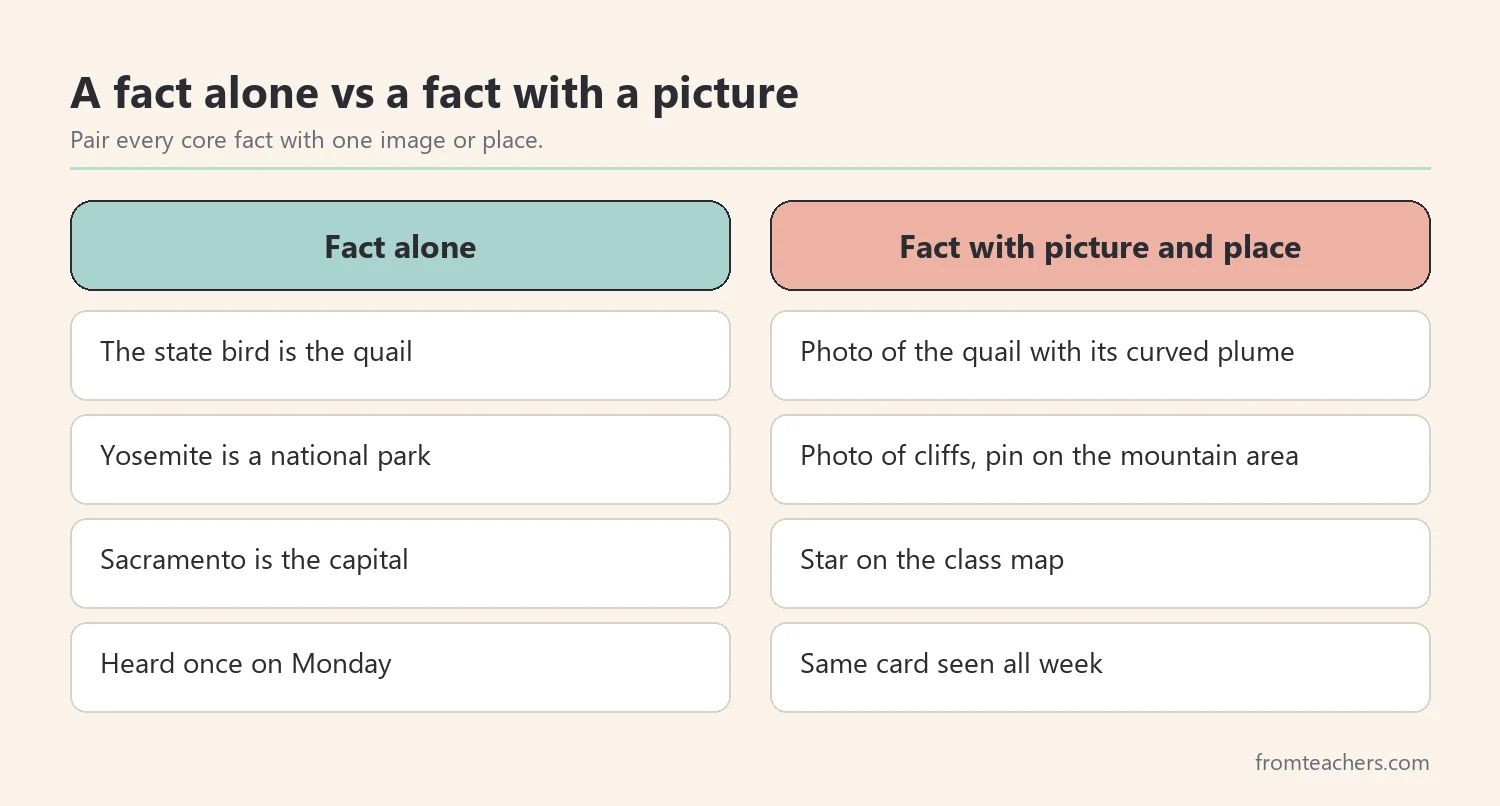
California facts for kids stick when students can see them. A word like “quail” means little to a child who has never seen one, but a picture of a small round bird with a curved head plume is easy to remember. As a result, every core fact in your list should have one image attached to it.
In addition, make simple picture cards: the fact on one side and a photo or drawing on the other. Then, use them for quick daily practice. Hold up the quail and ask, “What is this, and why does it matter to California?” Students answer in a full sentence.
Landmarks work the same way. When you talk about Yosemite, show a photo of its granite cliffs and waterfalls. When you talk about the Golden Gate Bridge, show it against the bay. Similarly, Hollywood can be shown through a photo of the famous hillside sign and a short explanation that many movies have been made there.
For instance, Ms. Ortiz shows one picture card at the start of each morning meeting. On Monday, it is the poppy. On Tuesday, the quail. By Friday, her class has seen five cards and can match each to its fact. Noah, a quiet student in her class, starts calling out the answers before she finishes the question.
A quick classroom example
In addition, try a “sort the cards” game. Mix symbol cards and landmark cards together, then ask small groups to sort them into “things that live or grow in California” and “places people visit.” This simple sort helps students organize California facts for kids into categories they can recall later.
Finally, keep the images consistent. If you use one photo of the redwood on Monday, use the same one on Friday. Familiar images make recall faster.
3. Build a daily map routine for California facts for kids
A map turns a list of California facts for kids into a real place. Students who can point to Sacramento, the coast, and the mountains start to understand California as a real state rather than a set of trivia. Consequently, a short map routine is one of the most useful parts of the unit.
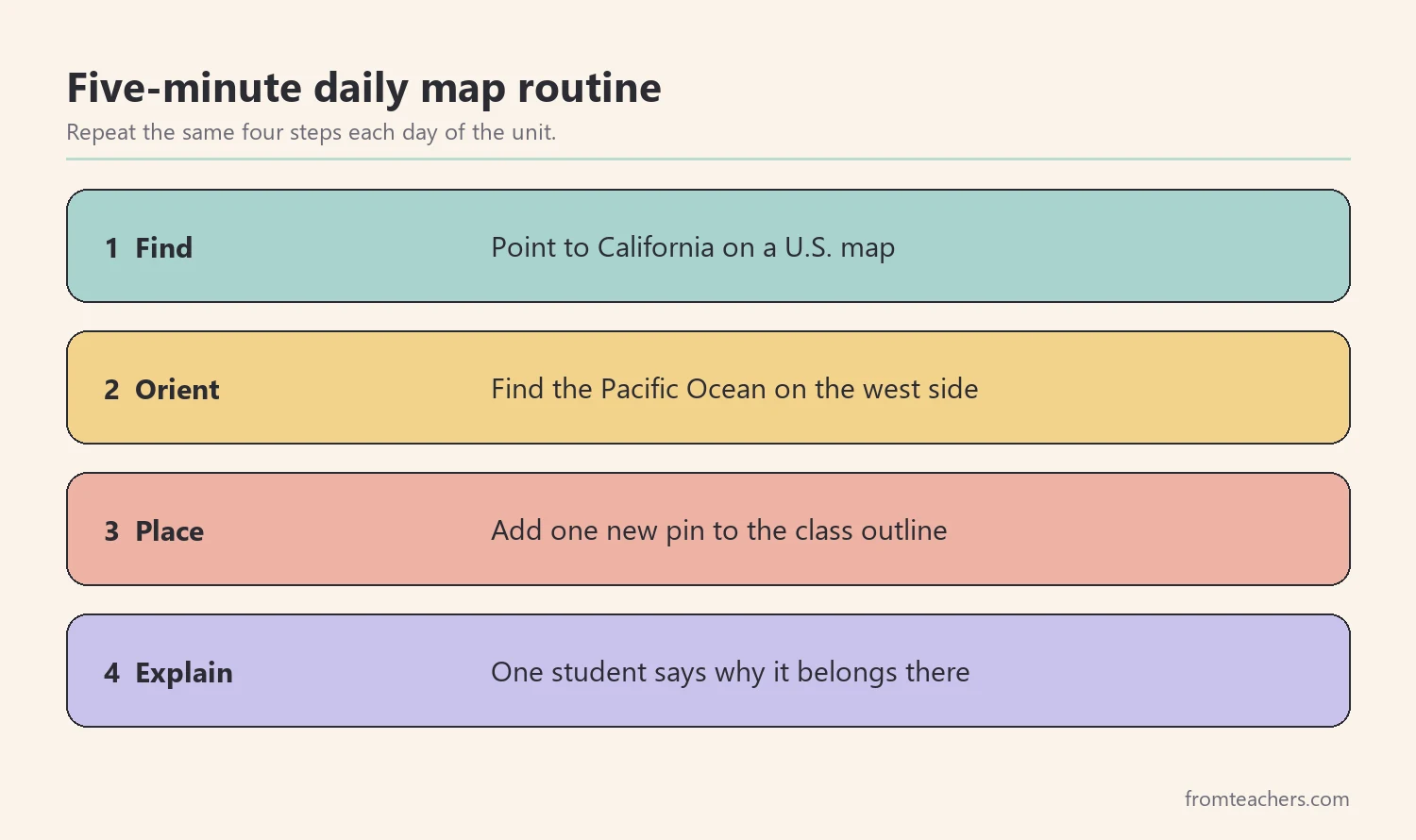
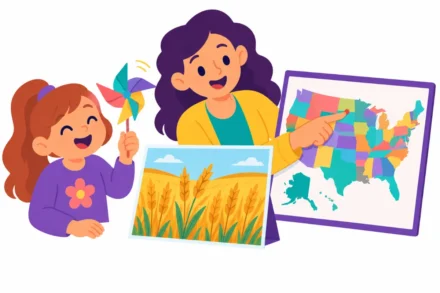
For example, keep the routine to five minutes. First, students find California on a United States map. Next, they find the Pacific Ocean on the west side. Then, they place one new item on a large classroom outline of the state. Last, one student explains why that item belongs there.
Over the unit, the class map fills up. Sacramento goes in the middle north area. Yosemite goes in the Sierra Nevada mountains. The Golden Gate Bridge goes near San Francisco. Hollywood goes in Los Angeles in the south. Each item is one small step, but together they build a picture of the whole state.
For example, in Ms. Ortiz’s class, the map has one new pin each day for five days. By the end of the week, it shows the capital, Yosemite, the Golden Gate Bridge, Hollywood, and a redwood forest on the north coast. That makes five pins in five days, one per day, and every student has placed or explained at least one.
Make it stick
If you want a ready-made sequence to guide this, the California State Study slides with facts, symbols, and famous landmarks walk students through the Golden State one fact at a time, so you can pair each slide with a pin on the map.
Moreover, the map routine supports students who learn best by moving and doing. Placing a pin, pointing to a coast, or tracing a mountain range gives them a physical way to remember.
4. Give students a small research job
Once students know the core California facts for kids, let them go one level deeper. However, keep the task small. A large state report can overwhelm young writers, while a single focused question keeps everyone successful.
Offer a short menu of research choices. Each student picks one item and answers three questions: What is it? Where is it in California? Why is it interesting? Students write one sentence for each question and add a drawing.
| Research choice | Question 1 | Question 2 | Question 3 |
|---|---|---|---|
| Yosemite | What is it? | Where is it? | Why visit? |
| Redwood tree | What is it? | Where does it grow? | What makes it special? |
| California foods | Which food? | Where is it popular? | Why do people like it? |
The foods choice is a favorite in many classes. Sourdough bread, fish tacos, avocados, and California rolls are easy for students to picture, and they open a conversation about how food connects to place. Because these are bonus topics, students can explore them without pressure.
For example, Noah chooses the redwood. His three sentences say that redwoods are very tall trees, that they grow near the northern coast, and that they can live for a very long time. He draws a tree next to a tiny person to show its size. As a result, he has a finished product he is proud to share.
What this looks like day to day
In addition, research jobs are easy to differentiate. Some students can use picture books, while others can use a kid-safe website with an adult. Some can write three sentences, while others can label a drawing. The goal is the same for everyone: learn one California fact deeply and explain it.
Meanwhile, keep a short list of approved sources ready. A state park website, a library book, or a classroom slideshow is enough for this age.
Another option is a “mystery fact” warm-up. Describe one California fact in two or three clues, such as “I am a bright orange flower, and you can see me on many hillsides in spring,” and let students guess. This keeps California facts for kids playful and gives every student a quick win before the main lesson.
5. Review and celebrate California facts for kids
A good review of California facts for kids shows what students remember and gives them a chance to share what they learned. Rather than a long test, use a short check plus a sharing session.
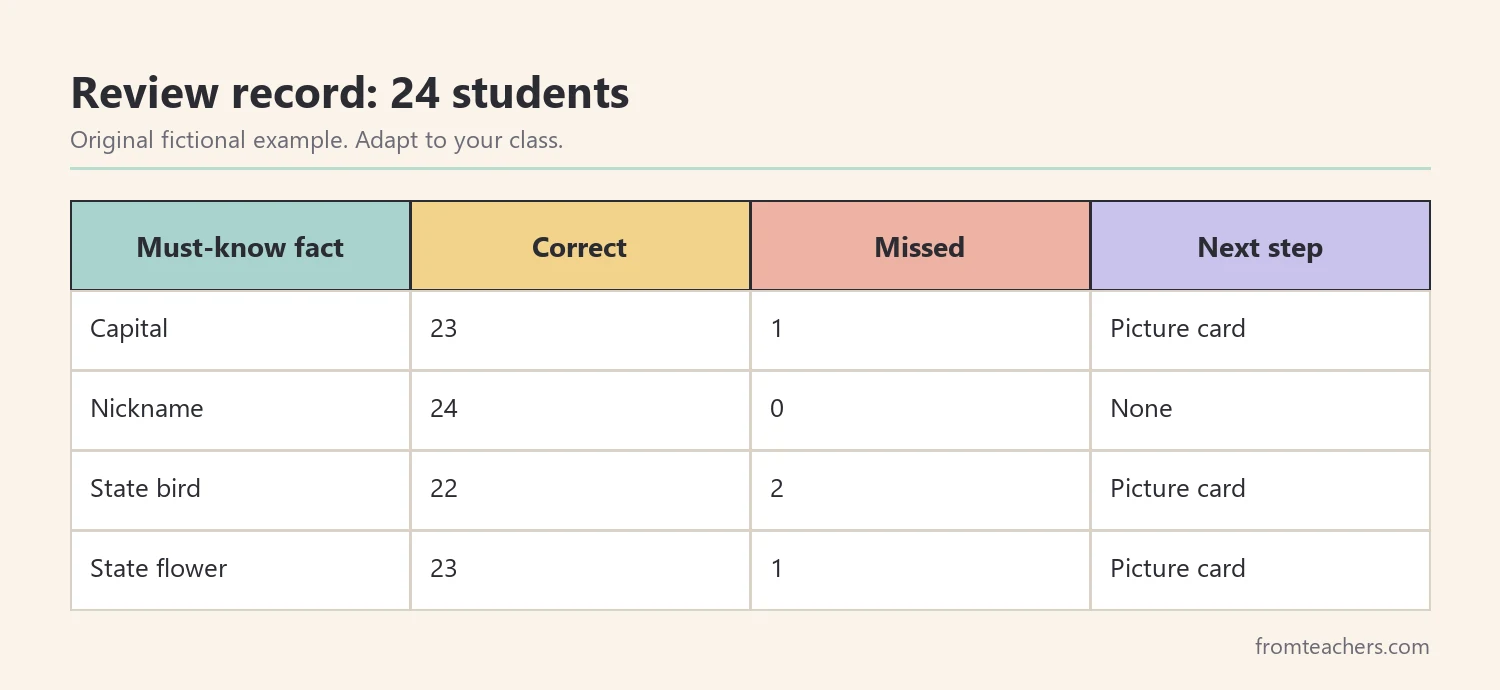
First, run a quick review of the must-know list. Ask four questions: What is the capital? What is the nickname? Which bird is the state bird? What is the state flower? Students answer on a whiteboard or a half sheet. Then, invite students to present their research jobs in small groups.
For example, Ms. Ortiz has 24 students. On the review, 20 students answer all four must-know questions correctly, and 4 students miss one question. Together, that accounts for all 24 students. She reteaches the missed fact the next morning with a picture card, then checks those 4 students again.
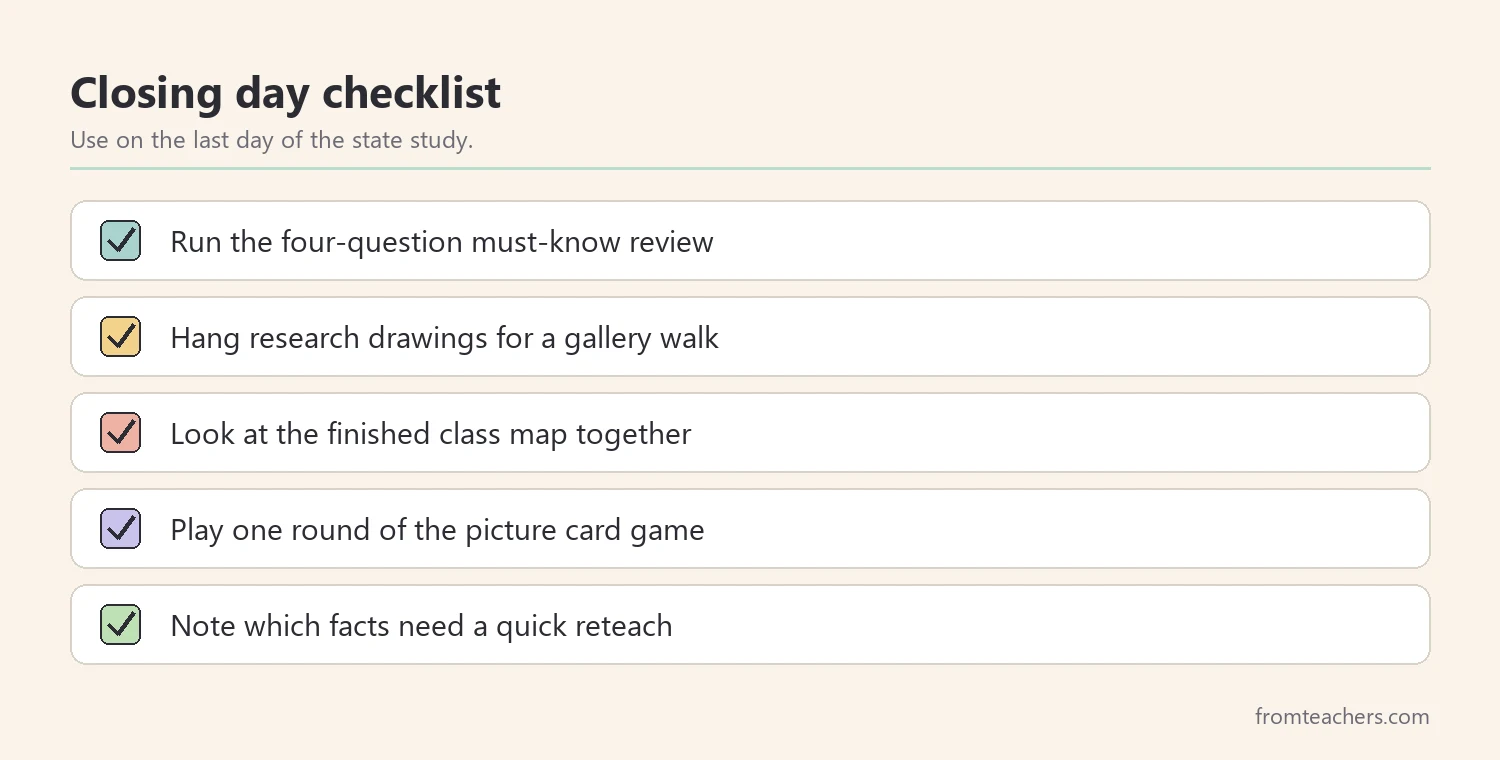
Next, celebrate. A closing “California Day” can include a gallery walk of research drawings, a final look at the class map, and a short game with the picture cards. Students feel the unit has a clear ending, and families can see their work.
Finally, connect the unit to what comes next. If your class studies more states later, the same five steps you used for California facts for kids work for each one. Students already know the routine, so each new state study goes faster.
Common mistakes and how to avoid them
- Teaching too many California facts for kids at once. Fix: choose a must-know list of four to seven facts and keep the rest as bonus material.
- Facts without pictures. Fix: attach one consistent image to every core fact and reuse it all week.
- Skipping the map. Fix: add a five-minute map routine so facts become places students can point to.
- Large reports for young students. Fix: give one small research job with three clear questions.
- Ending without a review. Fix: run a short four-question check, then reteach only what was missed.
Questions teachers and parents ask about California facts for kids
What grade level is a California state study best for?
State studies often appear in the elementary grades, especially in social studies and geography units. Third and fourth grade are common starting points. However, the same core facts work for younger students with more pictures and for older students with deeper research.
How long should a California unit last?
One to two weeks is enough for most classes. Five short lessons can cover the core facts, the map routine, a research job, and a review. If you have more time, add bonus topics such as foods or extra landmarks.
Which California facts for kids should come first?
Start with the capital, Sacramento, and the nickname, the Golden State. Next, add the state bird and flower. Landmarks such as Yosemite and the Golden Gate Bridge work well after students can find California on a map.
Can parents teach this at home?
Yes. Parents can teach California facts for kids with the same picture cards, a printed map, and one research question. Short daily sessions of ten minutes are often more effective than one long session on the weekend.
How do I support students who struggle to remember facts?
Use fewer California facts for kids, more repetition, and consistent images. Let students point, sort, and say facts aloud. Also, check the must-know list more often and celebrate small progress.
Related reading: Learning Styles Student Success Guide, 5 Practical Teaching Tips to Boost Classroom Focus and Learning, and Homeschooling vs. Public Schooling: Which Educational Path Is Right for Your Child?
A companion resource for California facts for kids:
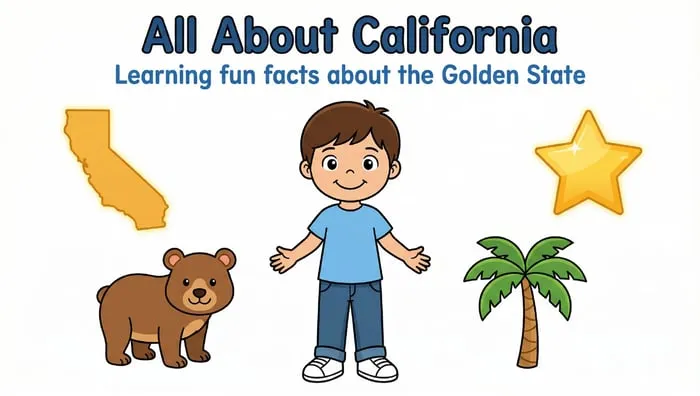
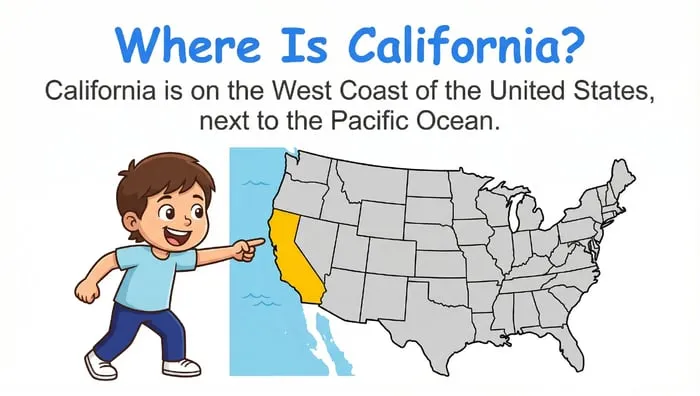
California State Study: Facts, Symbols, and Famous Landmarks: a 31-slide, hand-illustrated resource covering the capital, the nickname, state symbols such as the California quail and serpentine rock, landmarks like Hollywood, Yosemite, and the Golden Gate Bridge, a California foods slide, and a review slide.
Sources and scope
- State of California official website: the state’s own portal, useful for confirming basic state information.
- Yosemite National Park, National Park Service: official information and photos about Yosemite.
- Library of Congress: historical maps, photos, and primary sources about the states.
- National Council for the Social Studies: guidance and resources for teaching social studies in the elementary grades.
This guide covers planning a short elementary state study on California. It does not replace your state or district standards, and it does not cover California history in depth.
Key takeaways
- A small must-know list of California facts for kids is easier to remember than a long one.
- Pair every fact with one consistent picture or place.
- The same plan for California facts for kids works at home and for later state studies.
- A five-minute daily map routine turns facts into a real state in students’ minds.
- One small research job builds depth without overwhelming young writers.
- A short review and a closing celebration give the unit a clear ending.


Leave a Comment