

ODD behavior management starts long before the moment a student slams a book down and says, “I’m not doing it.” Picture Jonah, a fifth grader, refusing a math page while the class watches and the adult feels the pressure to win. That scene repeats in many classrooms and kitchens, and it usually ends with everyone more upset than before.
By the end of this guide, you will be able to spot the pattern behind repeated defiance, set limits that stay calm and consistent, offer real choices, de-escalate a tense moment, and track whether your plan is working. Moreover, each step of this ODD behavior management course includes a short worked example you can adapt to your own student or child.
Examples are fictional. Adapt to the student’s goals and agreed supports. This is guidance, not a diagnosis.
At a glance
- Defiance often follows a pattern you can observe and plan for.
- Clear, short expectations reduce arguments before they start.
- Real choices give the student control without giving up the limit.
- In a tense moment, lower your voice, reduce words, and allow time.
- Track a few simple numbers and share them with the family.
1. Observe the pattern before you plan ODD behavior management
First, collect information before changing anything. Students who show frequent defiance rarely refuse at random. Instead, refusals tend to cluster around certain tasks, times, people, or ways of giving directions.
A simple ABC log helps. For each incident, write down the antecedent (what happened just before), the behavior (what the student did, in observable words), and the consequence (what happened right after). After five to ten entries, patterns usually appear.
| Antecedent | Behavior | Consequence |
|---|---|---|
| Teacher says “Start now” from across the room | Pushes page away, says “No” | Teacher repeats louder |
| Partner work announced | Argues about partner | Allowed to work alone |
| Quiet reading time | Reads without issue | None needed |
Also, notice what goes well. Calm periods tell you just as much as hard moments. Similarly, note whether public correction, long tasks, or sudden changes come before refusals.
In addition, involve other adults who see the student, such as specialists or support staff. Each person may notice a different trigger. Together, these notes give your ODD behavior management plan a fuller picture than one adult could gather alone.
Keep the language neutral. For example, write “tore the worksheet” rather than “was disrespectful.” As a result, the log stays useful to the whole team and fair to the student.
Worked example: Over two weeks, Ms. Ortiz logs eight incidents with Jonah. Six of them happen at the start of math, right after a whole-class direction given from the front of the room. In contrast, Jonah rarely refuses during science labs, where he chooses his role. That pattern shapes the rest of her ODD behavior management plan.
2. Set clear expectations for ODD behavior management
Next, make the expectations in your ODD behavior management plan short, visible, and the same every day. Vague rules invite debate, while clear ones leave less to argue about. Therefore, phrase each expectation as an action the student can see themselves doing.
- “Start the first problem within two minutes.”
- “Use a calm voice to disagree.”
- “Ask for a break card when you need space.”
Then, teach the expectations when everyone is calm, not in the middle of a conflict. Practice them, praise them, and post them where the student can see them. In addition, keep consequences predictable and small. A consistent, modest response works better than a large one that changes from day to day.
Consistency across adults matters too. If one adult lets an expectation slide and another enforces it strictly, the student learns that arguing might pay off. So, agree on the same few expectations with everyone who works with the student, including family when possible.
Worked example: Ms. Ortiz writes three math expectations on a small card taped to Jonah’s desk. Before math each day, she quietly points to the card and says, “Same three as yesterday.” She avoids announcing the start of math from the front of the room and instead gives Jonah his direction privately at his desk.
3. Build the relationship and offer real choices
Students who resist adult control often respond better when they feel some control themselves. For this reason, choices are one of the most practical tools in ODD behavior management. A good choice keeps the limit firm while letting the student decide how to meet it.
For example, instead of “Do your math now,” try “Do you want to start with problem one or problem four?” or “Pencil or marker?” Both options lead to the same goal. Meanwhile, the student gets a real decision.
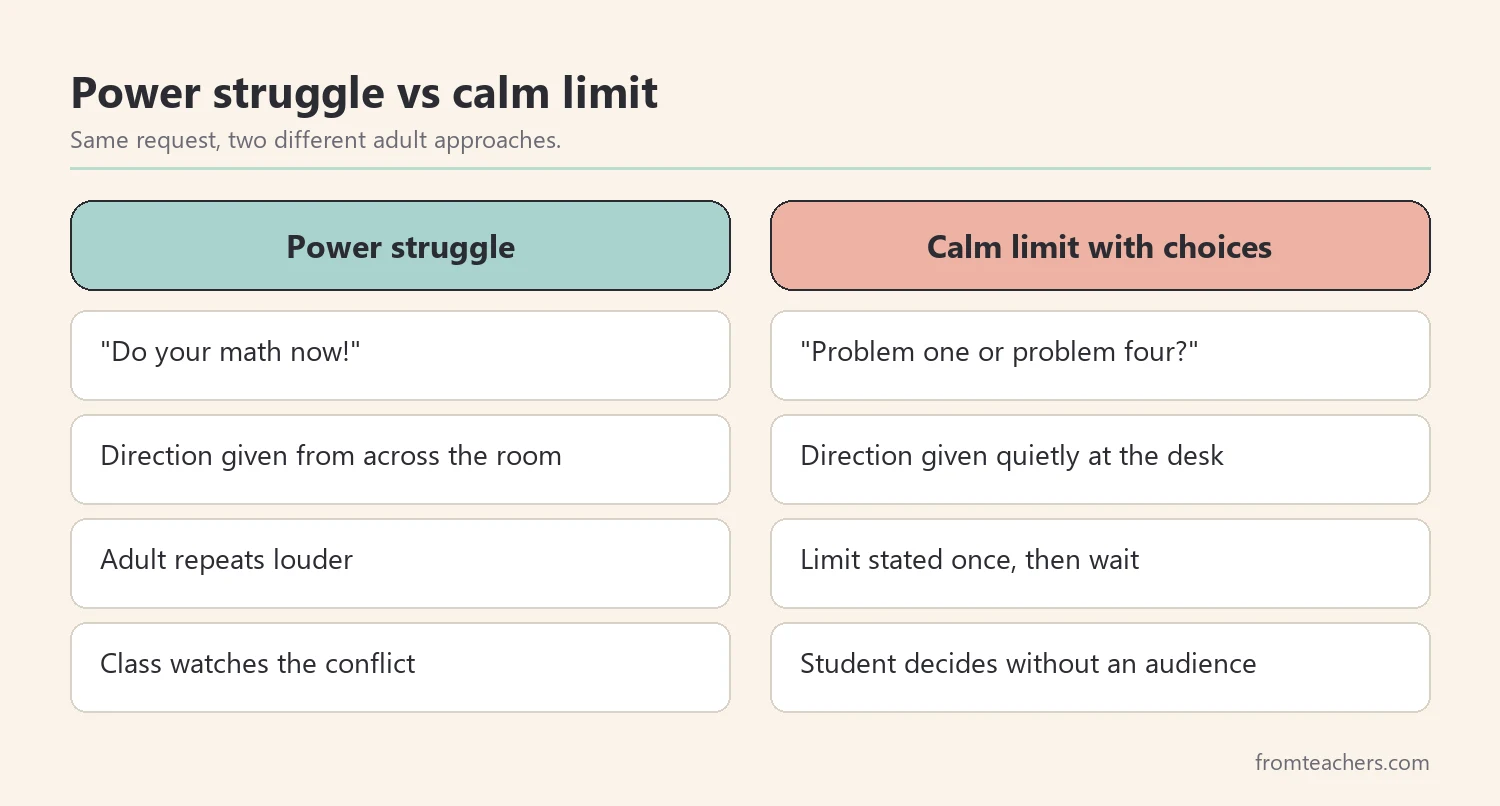
Relationship time also helps, and it is easy to skip when a student feels difficult. However, ODD behavior management works best when the student believes the adult is on their side. Spend two minutes a day with the student on something unrelated to work, such as a shared interest or a quick game. Then, protect that time even on hard days. Because these moments carry no demands, they build trust you can draw on later.
Furthermore, aim for many more positive interactions than corrections. A specific comment such as “You started right away today” means more than a general “Good job.” Over time, the student hears that you notice effort, not only problems.
If you want ready-made wording and plans for this, the Understanding and Managing Oppositional Defiant Disorder strategy tables include sections on building positive relationships and setting clear expectations in a Challenge, Solution, Result format.
Worked example: Each morning, Ms. Ortiz asks Jonah about his favorite basketball team for two minutes. At math time, she offers two choices: which problem to start with, and whether to work at his desk or the side table. Refusals at the start of math drop noticeably in the first week.
4. De-escalate calmly as part of ODD behavior management
Even with good ODD behavior management, hard moments will happen. In those moments, the adult’s calm is the most important tool. Arguing, lecturing, or raising your voice usually adds fuel.
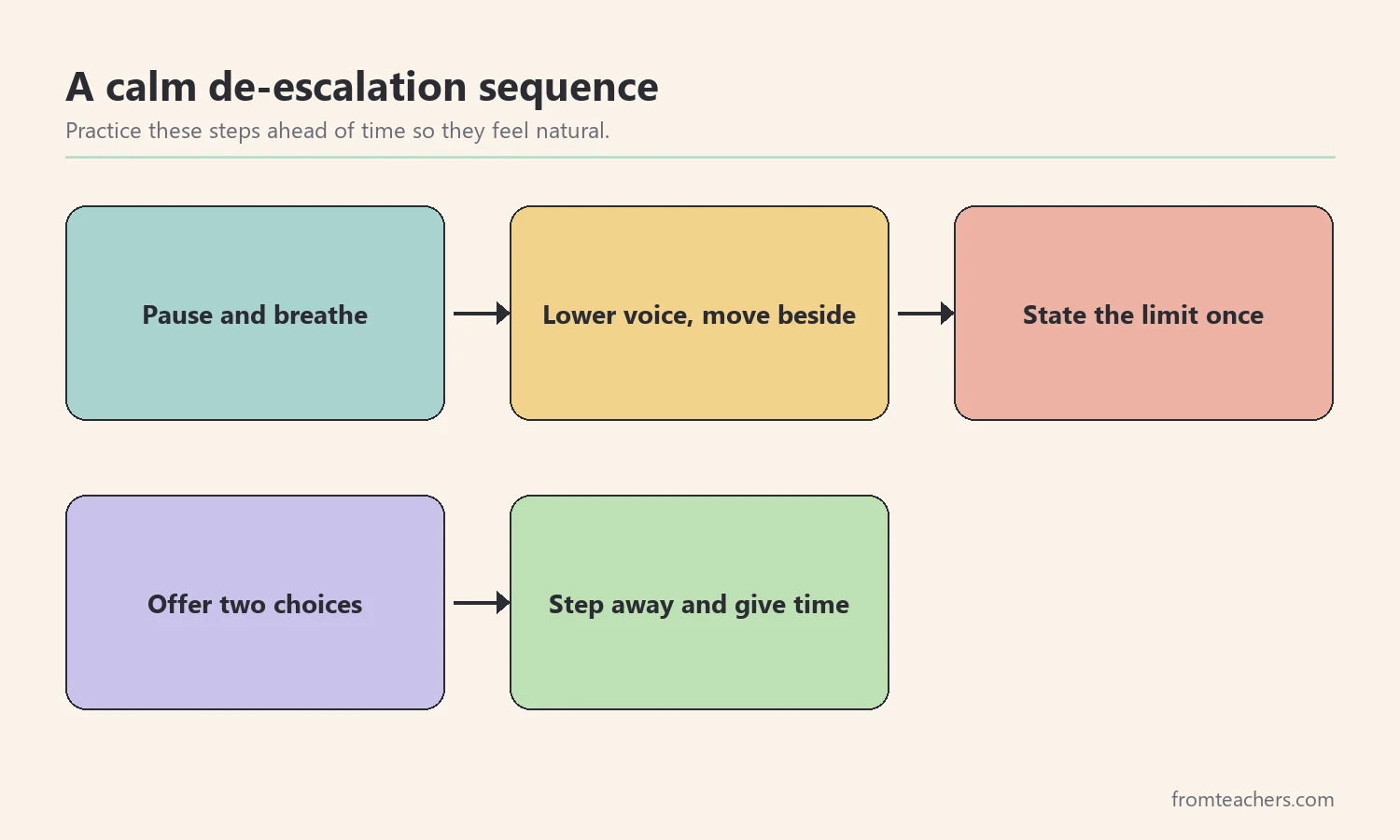
Follow a short sequence. First, pause and take a breath before you respond. Second, lower your voice and move to the student’s side rather than standing over them. Third, state the limit once, in few words. Fourth, offer a choice. Finally, give the student time to decide without an audience.
Avoid a few common traps that undo ODD behavior management. For instance, do not repeat the direction louder, do not threaten a consequence you cannot follow through on, and do not try to teach a lesson in the heat of the moment. Instead, save the problem-solving conversation for later, when everyone is calm.
Also, keep safety first. If a student is at risk of hurting themselves or others, follow your school’s safety plan and involve the right staff. These steps are for everyday defiance, not emergencies.
Worked example: One Tuesday, Jonah pushes his page away and says, “This is stupid.” Ms. Ortiz pauses, kneels beside him, and says quietly, “Math is the job right now. Problem one or problem four?” Then she walks away to help another student. Two minutes later, Jonah starts problem four.
5. Reinforce cooperation and teach coping skills
Strong ODD behavior management does not stop at preventing conflict. It also teaches the skills the student needs to handle frustration differently. Additionally, it makes cooperation worth the effort.
Start with positive reinforcement, which is the engine of most ODD behavior management plans. Notice and name cooperation as soon as it happens. Then, connect it to something the student values, such as a choice of activity, extra relationship time, or a role in class.
Next, teach coping and problem-solving skills during calm times. Useful skills include:
- Naming the feeling: “I’m frustrated because this looks long.”
- Asking for help or a break with a card or a set phrase.
- Thinking of two options before reacting.
- Repairing after a conflict with a short, simple apology or fix.
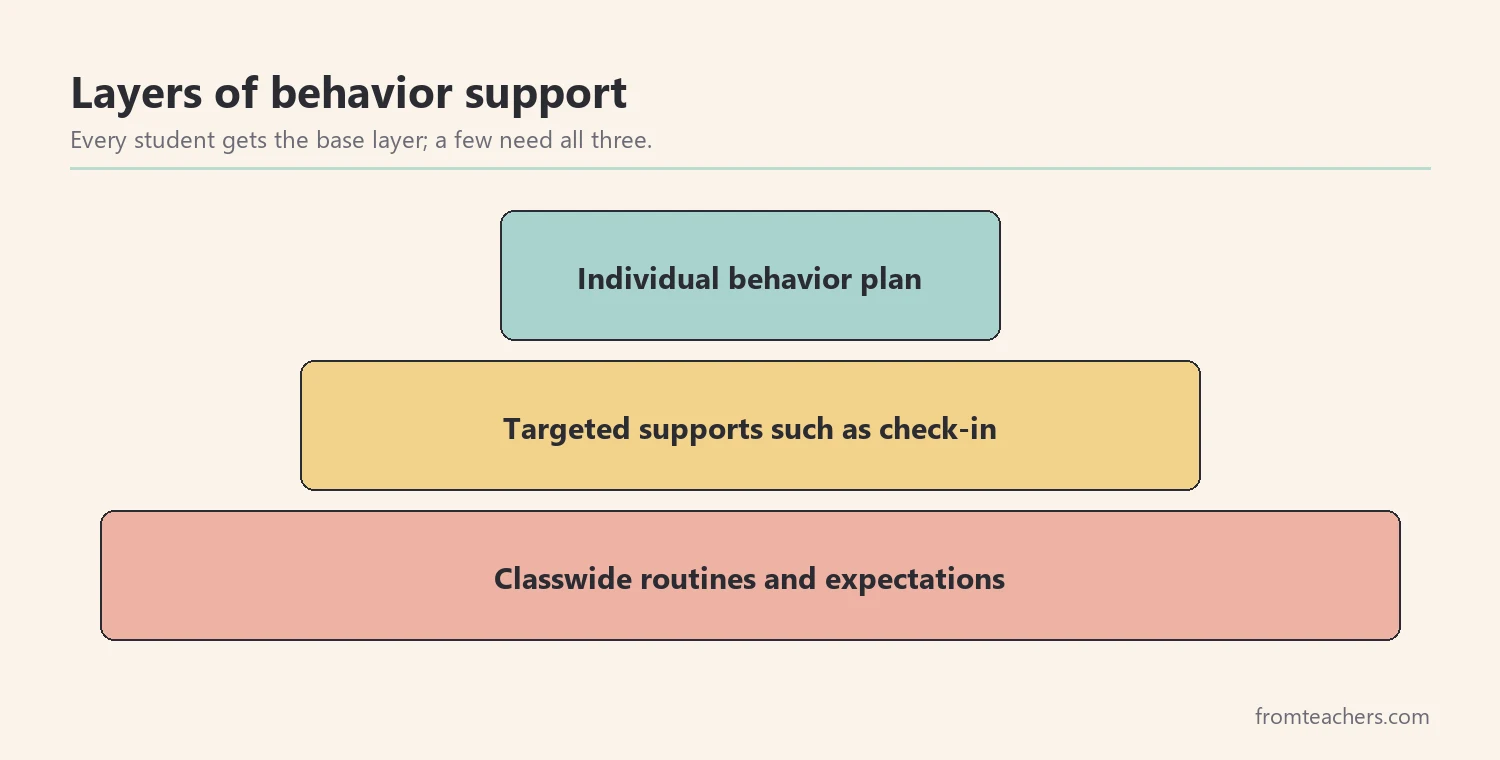
Many schools organize this work in layers. For example, classwide routines and expectations support everyone, targeted supports such as check-in and check-out help some students, and an individual behavior plan serves the few who need more. If the student already has a behavior intervention plan, align your ODD behavior management steps with it rather than creating a separate system.
Worked example: Ms. Ortiz and Jonah practice using a break card twice during calm moments. When he uses it correctly during math, he earns five minutes of choice time at the end of the day. Within two weeks, he uses the card instead of arguing on most hard days.
6. Track progress and work with the family
Finally, measure whether your ODD behavior management plan helps. Without data, it is easy to remember one bad day and forget three good ones. Choose two or three simple measures and record them daily.
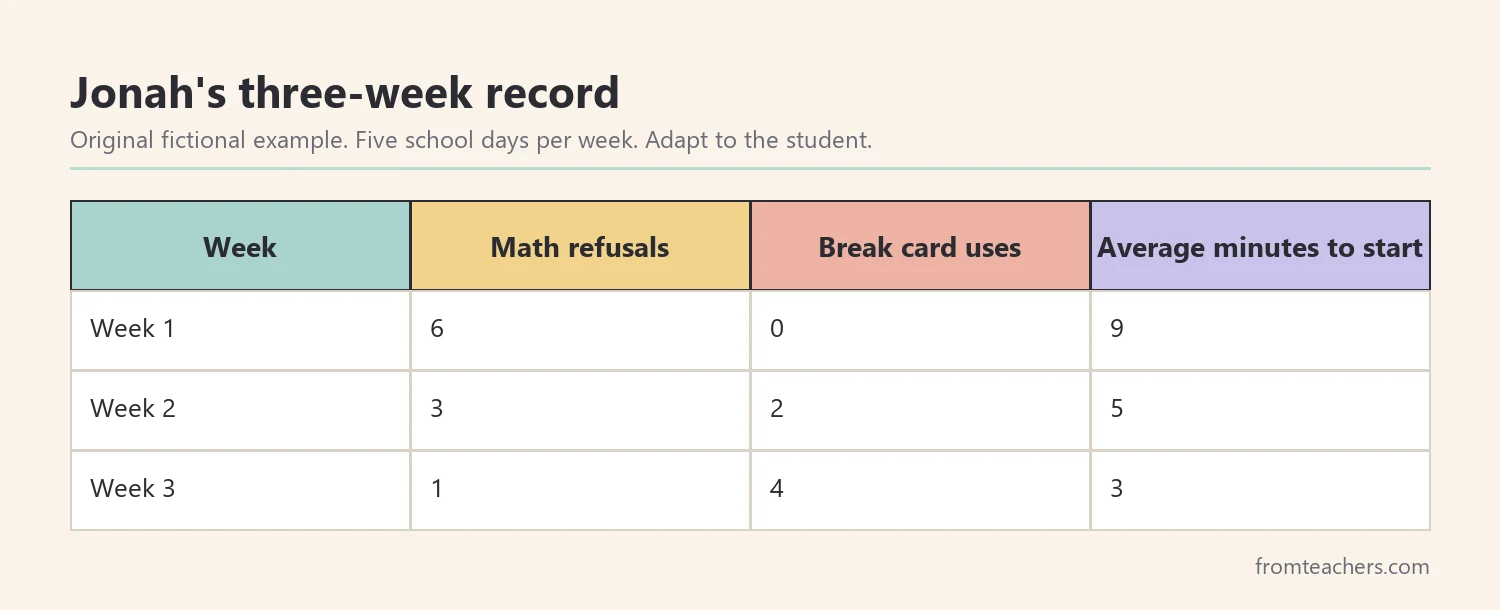
Worked example: Across five school days per week, Ms. Ortiz counts Jonah’s refusals at the start of math. In week one, he refuses 6 times in 5 days. In week two, he refuses 3 times. In week three, he refuses once. Over the same weeks, his break card uses rise from 0 to 2 to 4, and his average time to start work drops from 9 minutes to 5 minutes to 3 minutes.
Share the record with the family in a short, balanced message. Start with a strength, describe one pattern, and ask what works at home. For instance: “Jonah started math within three minutes on four days this week. Choices seem to help. What helps him get started on homework?”
In addition, invite the family to use the same language at home, such as the same break phrase or the same two-choice offer. Consistent words across home and school make ODD behavior management much easier for the student to predict. Then, review the plan together every few weeks and change one thing at a time.
Keep the review meeting short and focused. For example, look at the three numbers, name one thing that is working, and choose one small change to try next. Also, ask the student for input when appropriate. Students who help shape their own plan often feel more ownership and resist it less. As a result, ODD behavior management becomes something done with the student rather than to the student.
Common mistakes and how to avoid them
- Arguing to win. Fix: state the limit once, offer a choice, and step away.
- Correcting in public. Fix: give directions and corrections privately whenever possible.
- Changing consequences daily. Fix: keep responses small, predictable, and agreed across adults.
- Only noticing problems. Fix: name specific cooperation many times a day.
- Teaching skills during a conflict. Fix: practice coping skills when the student is calm.
- Working without data. Fix: track two or three numbers and review them weekly.
Questions teachers and parents ask about ODD behavior management
Is ODD behavior management about punishment?
No. Consequences have a place, but the core work is prevention, relationship, clear limits, and teaching skills. Punishment alone tends to increase power struggles.
Do choices let the student “win”?
Not when the choices lead to the same goal. The limit stays firm, while the student decides how to meet it. In fact, that sense of control often reduces the need to resist.
How long before ODD behavior management strategies show results?
It varies by student and setting. However, many adults notice small changes within a few weeks when the plan is consistent. Track data so you can see gradual progress rather than relying on memory.
Should parents and teachers use the same strategies?
Ideally, yes. Shared language, similar choices, and predictable responses help the student know what to expect. Even a few shared phrases can make a difference.
When should we ask for more help?
If behavior is unsafe, worsening, or affecting learning despite consistent support, talk with the school team, a counselor, or the child’s health care provider. Only qualified professionals can evaluate and diagnose.
Related reading: Moving Beyond Shame and Behavior Charts: Positive Alternatives for Effective Classroom Management, Understanding Demand Avoidance and School Refusal: Strategies for PDA-Style Profiles, and How Teachers Communicate With Parents in Special Education: Building a Strong Partnership.
A companion resource for ODD behavior management:
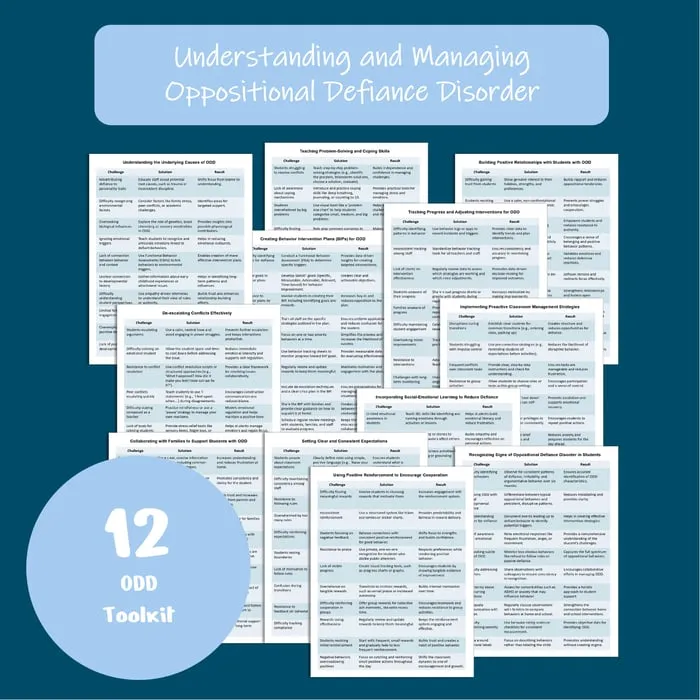
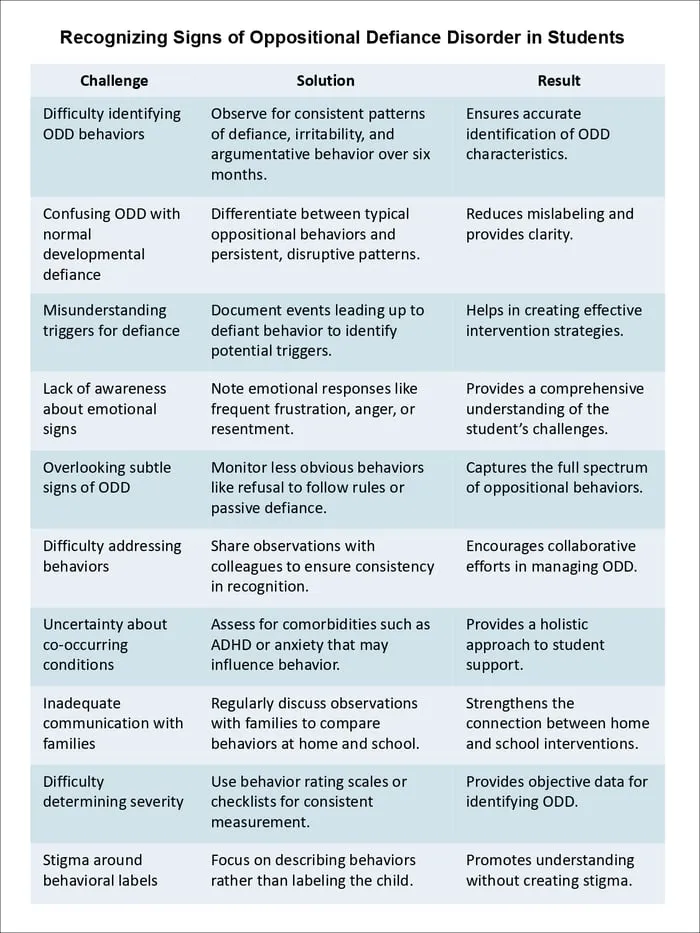
Understanding and Managing Oppositional Defiant Disorder: a printable reference with twelve strategy tables in a Challenge, Solution, Result format, covering causes, signs, de-escalation, behavior plans, progress tracking, positive reinforcement, and family collaboration.
Sources and scope
- IRIS Center: free training modules on classroom behavior management and behavior support.
- Center on PBIS: guidance on positive behavioral interventions and supports, including tiered systems.
- Centers for Disease Control and Prevention: general information on children’s mental health and behavior, including disruptive behavior.
- American Academy of Child and Adolescent Psychiatry: family resources on child behavior and mental health.
- IDEA: the federal site for the Individuals with Disabilities Education Act.
This guide offers everyday classroom and home strategies for defiant behavior; it does not diagnose, replace a functional behavior assessment, or substitute for professional advice.
Key takeaways
- Observe and log the pattern before you plan ODD behavior management.
- Keep expectations short, visible, and consistent across adults.
- Offer real choices that lead to the same goal.
- De-escalate with a calm voice, few words, and time.
- Track simple data and partner with the family.








Leave a Comment