

Educational comic books can turn a reluctant reader into a student who asks for “one more page.” Picture Leo, a third grader who sighs at every chapter book, suddenly leaning over a comic panel and laughing at a character’s face. That moment is the opening you need, and it is worth using on purpose rather than by luck.
By the end of this guide, you will be able to choose comics with a clear learning goal, teach students how to read a comic page, use panels for sequencing, vocabulary, and feelings work, and track simple progress over a few weeks. In short, you will have a repeatable routine for educational comic books you can run in class, in small groups, or at the kitchen table.
Examples are fictional. Adapt to the student’s goals and agreed supports. This is guidance, not a diagnosis.
At a glance
- Pick each comic for one clear goal, such as sequencing, vocabulary, or reading emotions.
- Teach the “grammar” of a comic page before you expect deep comprehension.
- Use short routines: read, talk, draw, and retell.
- Let students build their own comics to show what they understood.
- Record a few simple numbers each week so you can see real growth.
1. Choose educational comic books with a clear goal
First, decide what you want the comic to teach. A comic that is fun but has no target becomes free reading, which is great, yet it is not a lesson. Instead, name one skill for each session, such as putting events in order, learning five new words, or noticing how a character feels.
Next, check the page itself. Good educational comic books for young readers usually have a few features in common:
- Panels that flow in a clear left-to-right, top-to-bottom order.
- Short speech bubbles, often one or two sentences each.
- Faces and body language that show emotion clearly.
- A real-life situation the student can connect to, such as sharing, waiting, or trying something new.
Also, think about the reader. For example, a student who reads slowly may need fewer words per panel, while a confident reader can handle more text and side details. Similarly, an English learner benefits from pictures that clearly match key words.
| Goal | What to look for | Quick check |
|---|---|---|
| Sequencing | Clear beginning, middle, end | Can you cut it into 4 to 6 panels? |
| Vocabulary | New words shown in pictures | Do images explain the word? |
| Feelings | Expressive faces | Can you name the emotion without text? |
| Life skills | Everyday problem and choice | Is the lesson clear by the last panel? |
Worked example: Leo’s teacher, Ms. Grant, sets one goal for the week: “Leo will retell a short story in the right order.” So, she chooses a six-panel comic about a boy who loses his lunch box and asks for help. The story has a clear start, a problem, and a solution, which makes it a good fit for sequencing.
2. Preview the page and the key words
Before reading, spend two or three minutes on a picture walk. Simply point to each panel and ask, “What do you notice?” As a result, students build a mental map of the story before they meet the words.
Then, pick three to five words that matter. Choose words that carry meaning in the story, not every hard word on the page. After that, show the word, say it, and point to the panel where the picture explains it.
In addition, model your thinking out loud. For instance: “I see the boy’s eyebrows are pulled down. I think he is worried. Let me read the bubble to check.” This short think-aloud shows students that pictures and words work together.
Short previews matter most for students who feel anxious about reading. For example, a student who has struggled for years may expect to fail before the first bubble. However, when the preview shows that the pictures will help, that worry often eases. Over time, the student starts the picture walk without prompting, which is a small but meaningful sign of independence. Likewise, educational comic books give these students a quick early win that plain text pages rarely offer.
Keep the preview brief, though. The goal is to lower the barrier to reading, not to give away every event. If students already know the whole plot, the reading has less purpose.
Worked example: Ms. Grant previews the lunch box comic with Leo. Together, they pick four words: search, worried, office, and relieved. Leo points to the panel where the boy looks under a bench for search, and to the big smile in the last panel for relieved. Because each word has a picture anchor, Leo remembers three of the four words at the end of the session.
3. Teach how to read a comic page
Many adults assume children already know how to read educational comic books. In practice, some students jump around the page, skip bubbles, or read only the pictures. Therefore, teach the reading path directly, just as you would teach text features in a nonfiction book.
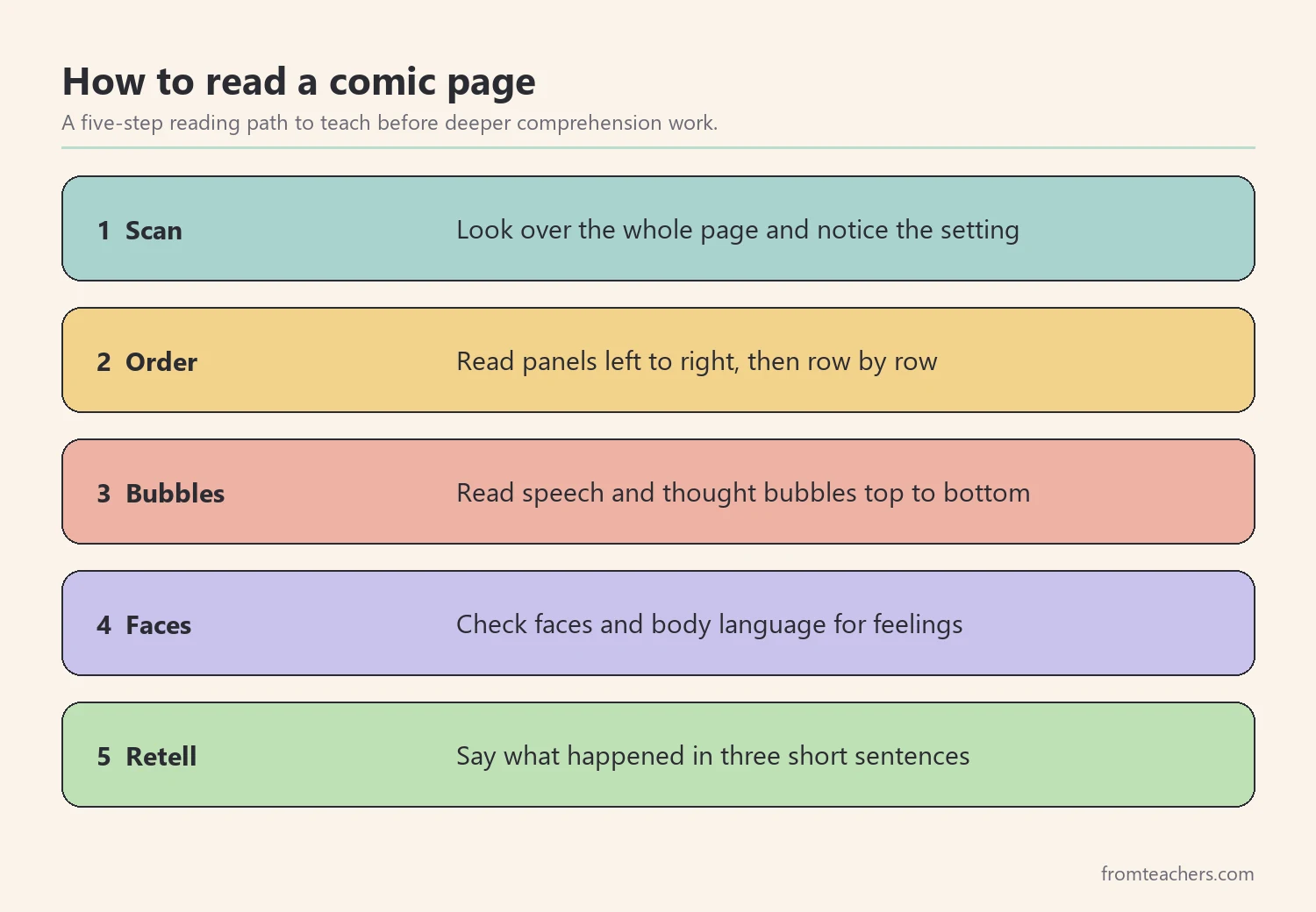
Start with the panel order. Usually, panels go left to right and then down to the next row, like lines of text. Next, explain bubbles: speech bubbles show talking, thought bubbles show thinking, and boxes at the top often tell time or place. Finally, point out sound words and motion lines, which show action.
A quick practice routine helps:
- Number the panels lightly with a pencil.
- Have the student touch each panel as they read it.
- Ask one question per panel: “Who is talking?” or “What changed?”
- At the end, retell the page in three sentences.
If you want ready-made stories for this practice, a bundle of educational comic books with friendly characters and real-life lessons gives you several pages to rotate through without hunting for new material every week.
Worked example: On Monday, Leo reads the panels out of order twice. So, Ms. Grant numbers the panels and asks him to touch each one. By Wednesday, he reads all six panels in order without the numbers.
4. Use educational comic books for sequencing, vocabulary, and feelings
Once students can follow the page, educational comic books become a flexible teaching tool. Here are three short activities you can rotate through the week.
Sequencing strips
Cut a copy of the page into separate panels and mix them up. Then, ask the student to rebuild the story and explain each choice: “This one comes first because he hasn’t lost the lunch box yet.” As a result, you see comprehension and reasoning at the same time.
Vocabulary hunts
Give students a short list of target words. Next, they find each word in a speech bubble and draw a tiny picture next to it on a sticky note. Later, the sticky notes become a word wall for that story.
Feelings detectives
Cover the speech bubbles with paper. After that, ask, “How does this character feel? What clues do you see?” Students point to eyes, mouths, shoulders, and hands. Then you uncover the text and check together.
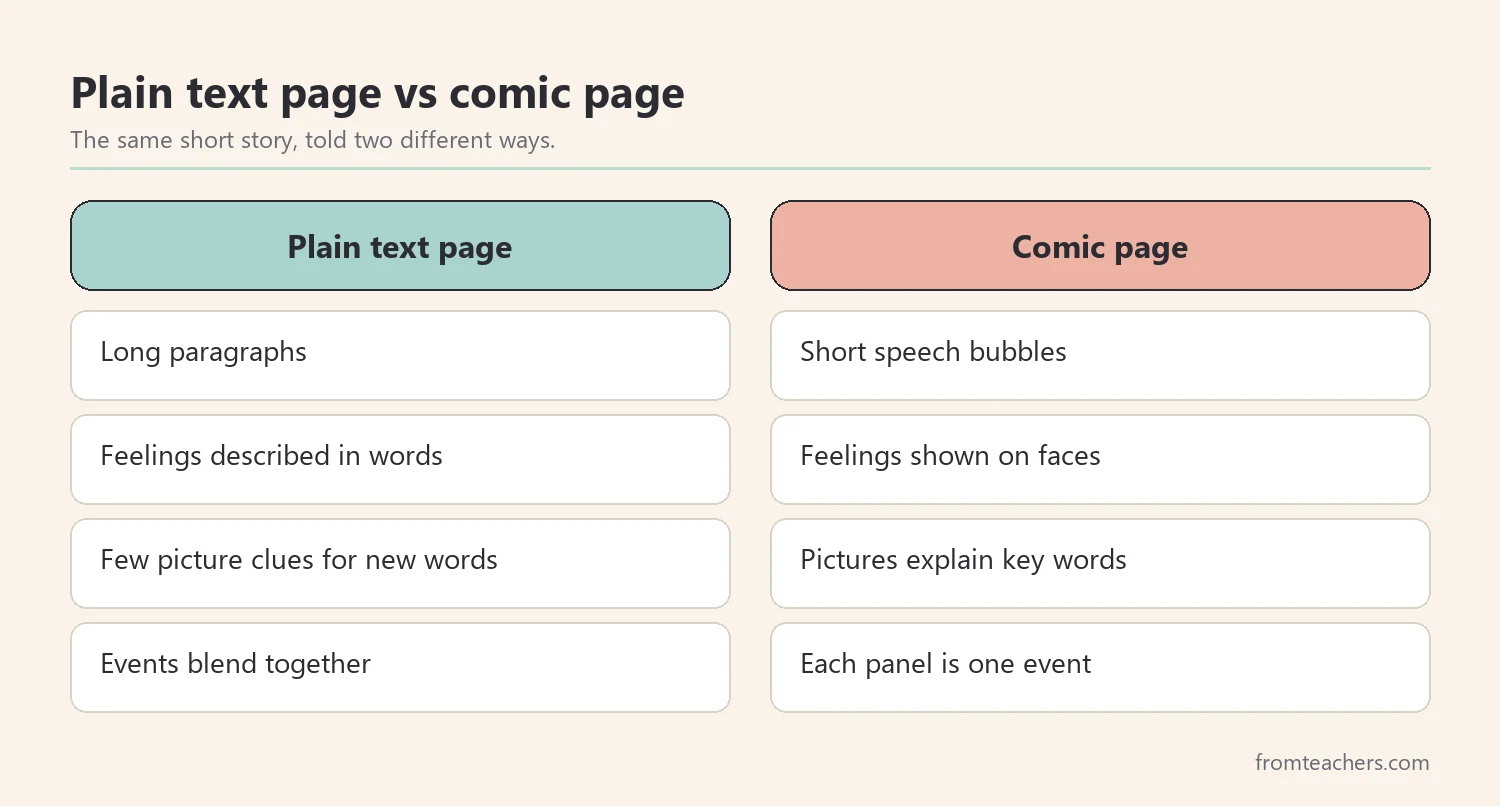
Educational comic books also support social and emotional learning. Because a character can make a choice and face the result in a few panels, students can discuss decisions without talking about their own mistakes. For example, ask, “What else could he have done?” and let students sketch a different panel.
Worked example: Leo rebuilds the six-panel strip on Tuesday. He places four panels correctly on the first try, then fixes the other two after Ms. Grant asks, “What does the boy need to do before he can feel relieved?”
5. Let students create their own comics
Creating a comic after reading educational comic books shows understanding in a way a worksheet rarely does. In addition, it gives quieter students a way to express ideas through drawing first and words second.
Keep the format small. A four-panel strip is enough for most young learners. Similarly, stick figures are perfectly fine, since the goal is the story, not the art.
- Panel 1: Who is in the story and where are they?
- Panel 2: What problem happens?
- Panel 3: What does the character try?
- Panel 4: How does it end, and how does the character feel?
To support writers who freeze at a blank page, offer a frame with the four boxes already drawn and one sentence starter under each. Then, gradually remove the starters as the student gains confidence. In addition, let students talk through the story aloud before drawing, since saying it first often makes the writing easier. Similarly, keep a few favorite educational comic books nearby as models for layout and bubble size.
Furthermore, you can link student comics to any subject. For instance, students can draw the steps of the water cycle, retell a history event, or show a classroom routine such as lining up. Each version still uses the same four-panel frame.
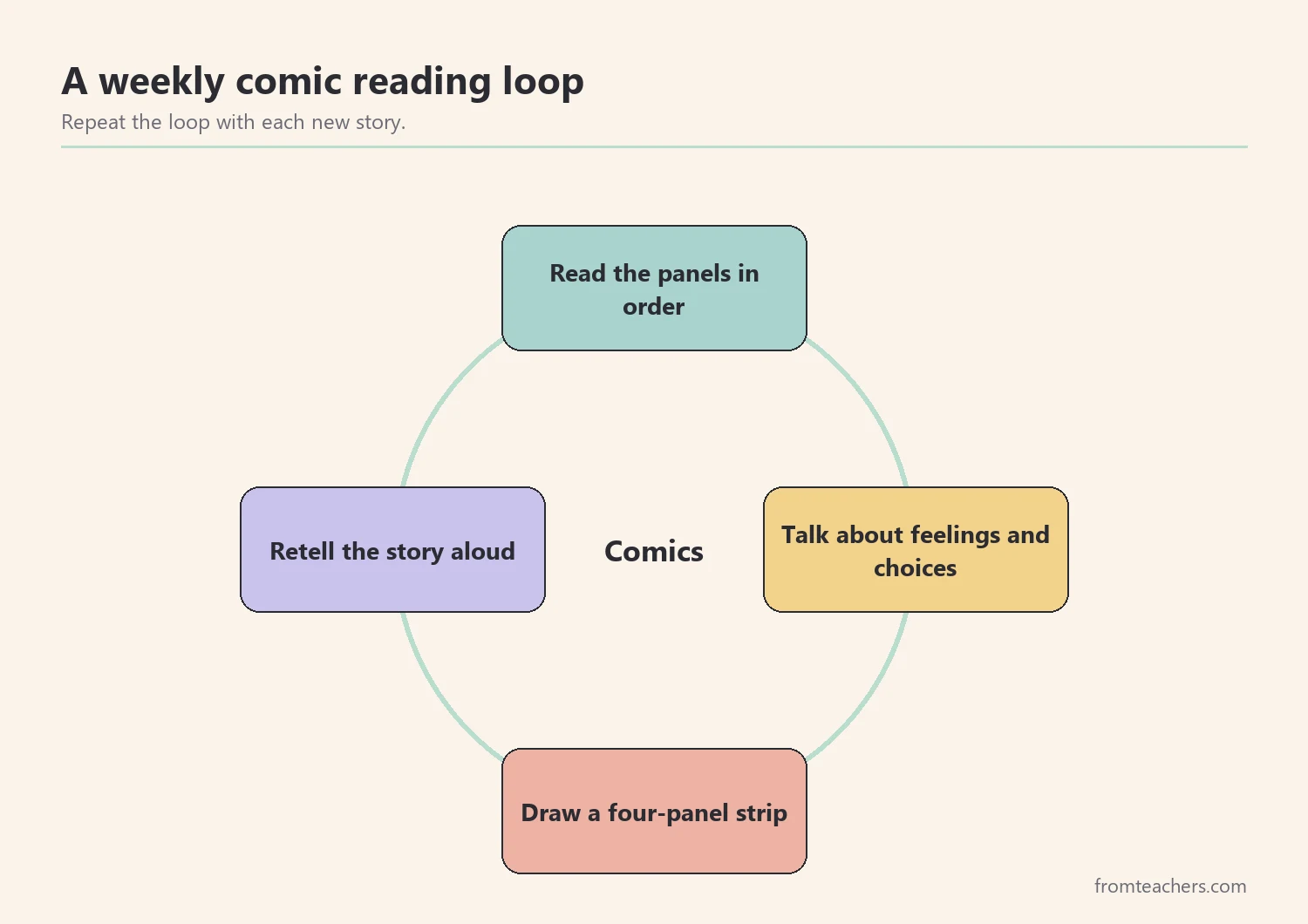
Worked example: On Thursday, Leo draws his own four-panel strip about losing his library book. His last panel shows a smiling face with the word “relieved” in a bubble, one of the words from the preview. That small transfer tells Ms. Grant that the vocabulary is sticking.
6. Record progress with educational comic books each week
Finally, track a few simple measures so you know whether the routine works. Without a record, it is easy to remember only the best or worst day.
Choose two or three numbers you can collect in under a minute. For example, count how many panels the student sequences correctly, how many target words they use, and whether they retell the story in order. Then, review the record at the end of each week and adjust one thing at a time.
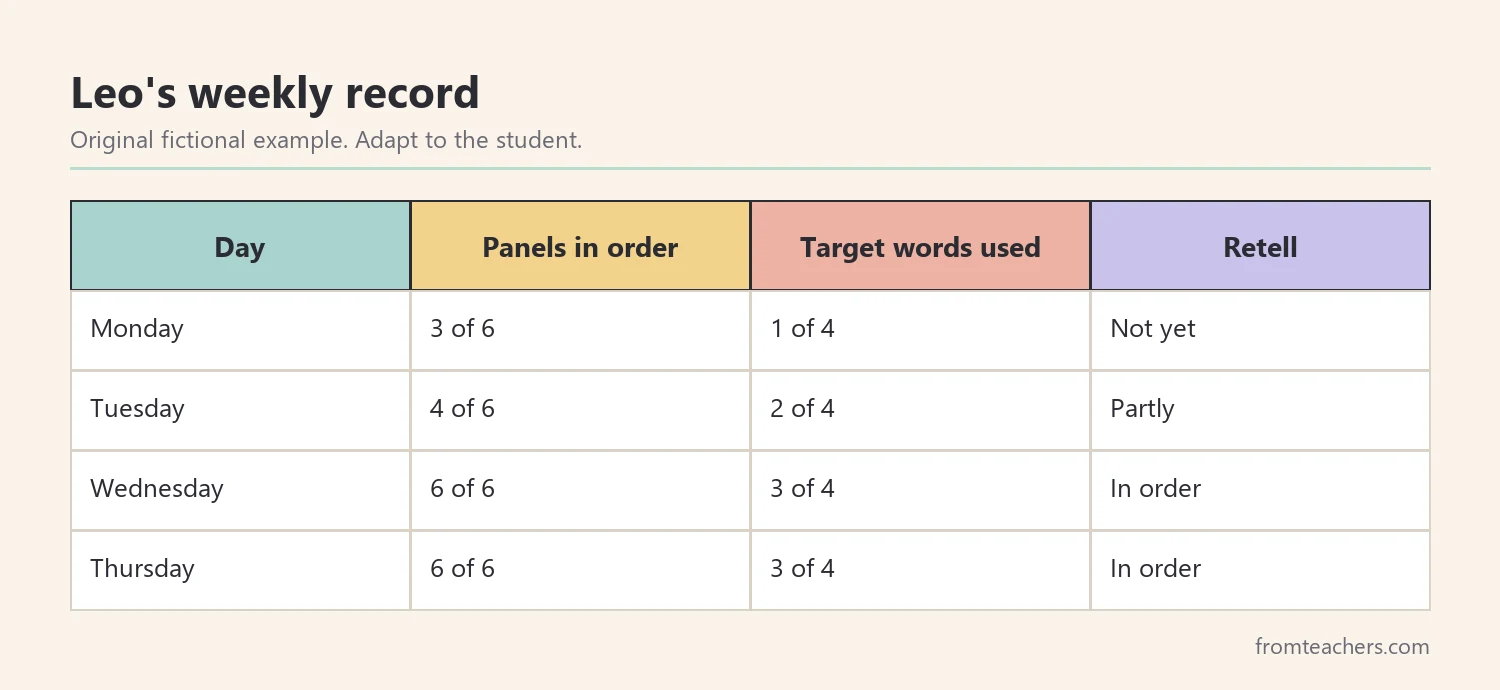
Worked example: Leo’s week looks like this. On Monday, he places 3 of 6 panels in order and uses 1 of 4 target words. On Tuesday, he gets 4 of 6 panels and 2 of 4 words. On Wednesday and Thursday, he reaches 6 of 6 panels, and he uses 3 of 4 words. As a result, Ms. Grant keeps the same routine next week but switches to a new story with more text per bubble.
When progress stalls, look at the educational comic books you chose first. Perhaps the story is too long, or perhaps the pictures do not support the key words. In that case, choose a simpler page and rebuild success before stepping up again.
Common mistakes and how to avoid them
- Treating comics as a reward only. Fix: give each comic session a clear skill goal, then let free reading be the bonus.
- Assuming students know how to read panels. Fix: teach the reading path with numbered panels and a touch-and-read routine.
- Choosing pages that are too busy. Fix: start with clear panels, short bubbles, and expressive faces.
- Pre-teaching too many words. Fix: limit the list to three to five words that carry the story.
- Grading the drawings. Fix: assess the story and language, and accept stick figures.
- Not tracking anything. Fix: record two or three quick numbers each session.
Questions teachers and parents ask about educational comic books
Are educational comic books “real reading”?
Yes. Readers still decode words, follow a plot, and make inferences. In fact, comics ask students to combine pictures and text, which is a skill in its own right.
What age are educational comic books best for?
Educational comic books work from early readers through older students. However, the right page changes with age: younger readers need fewer words and very clear panels, while older students can handle longer stories and more subtle details.
Can educational comic books help struggling readers?
Many struggling readers feel less pressure with short bubbles and picture support. Still, comics are one tool among many, so keep them alongside the student’s regular reading instruction and agreed supports.
How can parents use educational comic books at home?
Read a page together, then take turns retelling it. Also, ask feelings questions like “How do you know she is upset?” and invite your child to draw the next panel.
How often should I use comics in lessons?
A short session with educational comic books two or three times a week works well for many classrooms. Meanwhile, keep a few comics in the classroom library so students can return to favorite stories on their own.
Related reading: Dyslexia Solutions in the Classroom: Evidence-Based Strategies for Success, Autism Social Skills Development: Practical Strategies for Growth, and Learning Styles Student Success Guide.
A companion resource for educational comic books:
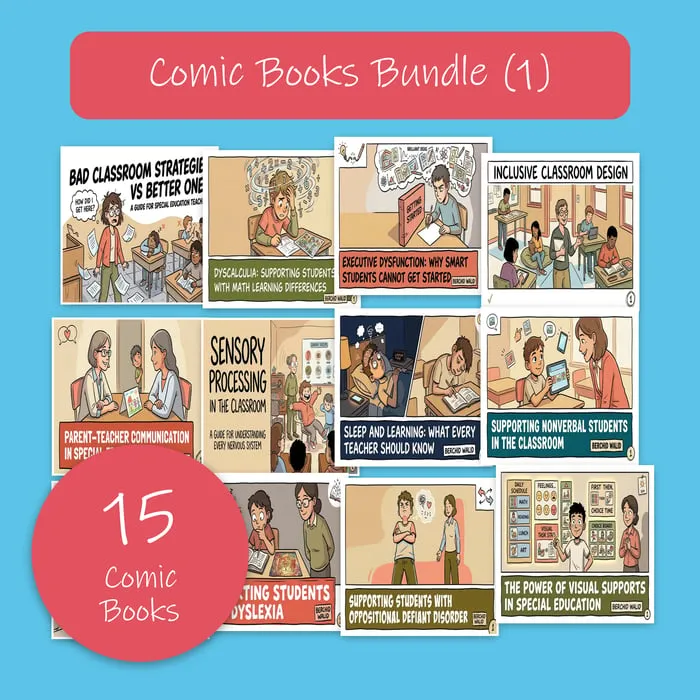
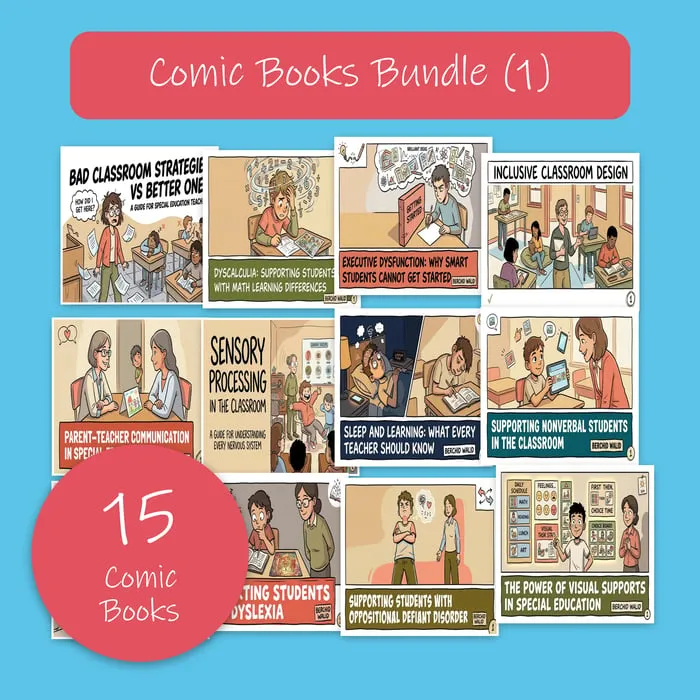
Comic Books Bundle (1): a full bundle of educational comic books that teach real-life lessons through friendly characters and clear visual stories.
Sources and scope
- Reading Rockets: a national literacy initiative with articles and classroom strategies for teaching young readers.
- National Council of Teachers of English (NCTE): a professional organization for literacy educators that publishes guidance on reading and writing instruction.
- American Library Association: the national library association, with resources on children’s reading and graphic formats in libraries.
- Library of Congress: the national library, with collections and teacher resources that include comics and visual storytelling.
- CASEL: a leading organization for social and emotional learning frameworks.
This guide covers practical ways to use comics for reading, vocabulary, and social learning; it does not replace a structured reading program or an evaluation of a student’s reading needs.
Key takeaways
- Give every session with educational comic books one clear skill goal.
- Teach the reading path of a comic page before expecting deep comprehension.
- Rotate sequencing, vocabulary, and feelings activities across the week.
- Use four-panel student comics to show understanding in any subject.
- Track a few quick numbers and change one thing at a time.


Leave a Comment