

Student progress notes are the short, dated entries that tell your team what a student actually did on a goal, and they are often the first thing to slip when the week gets busy. Picture a Friday afternoon: the case manager asks how a student is doing on reading fluency, and all you have is a vague memory and a sticky note that says “better.”
After reading this guide, you will be able to set up a simple log, write a clear note in under three minutes, record numbers that add up, and use your notes to make real decisions at review time. Examples are fictional. Adapt to the student’s goals and agreed supports. This is guidance, not a diagnosis.
At a glance
- Every note links to one written goal, one date, and one observable result.
- A four-part pattern (context, what happened, data, next step) keeps notes short and useful.
- Numbers should be simple counts or percentages that anyone on the team can check.
- A fixed weekly time slot matters more than long, polished entries.
- Notes are only valuable when the team reads them and changes something.
1. Define the goal before you write student progress notes
A note can only be as clear as the goal it describes. Before you write a single entry, copy each goal into the header of the log in plain words. If the goal says “will improve reading,” you cannot write a precise note about it, so talk with the team about what success looks like.
First, check that each goal names a behavior you can see or hear. Next, confirm the condition, such as “given a grade-level passage” or “during independent work.” Finally, note the target, for example “with 90% accuracy” or “in 4 of 5 trials.” When those three parts are present, your student progress notes almost write themselves.
For example, meet Jonah, a fictional fifth grader with three goals. His team wrote them like this:
| Goal area | Goal in plain words | Target |
|---|---|---|
| Reading fluency | Reads a grade-level passage aloud | 100 words correct per minute |
| Math facts | Solves mixed multiplication facts | 18 of 20 correct |
| Work habits | Starts independent work after one prompt | 4 of 5 sessions |
Because each goal has a clear target, every later note can say how close Jonah is. In addition, the header holds the basics: student name, teacher, grade, plan date, service frequency, school year, and case manager. That way anyone who picks up the sheet knows whose story it tells.
Keep the list short. Three goals per sheet is plenty for a weekly log, and it keeps each entry focused. If a student has more goals, start a second sheet rather than squeezing everything onto one page.
2. Write each note with a simple four-part pattern
Most weak student progress notes fail for the same reason: they describe a feeling instead of an event. “Good day” and “struggled” do not help anyone plan. Instead, use the same four parts every time, so your student progress notes look alike and are easy to scan.
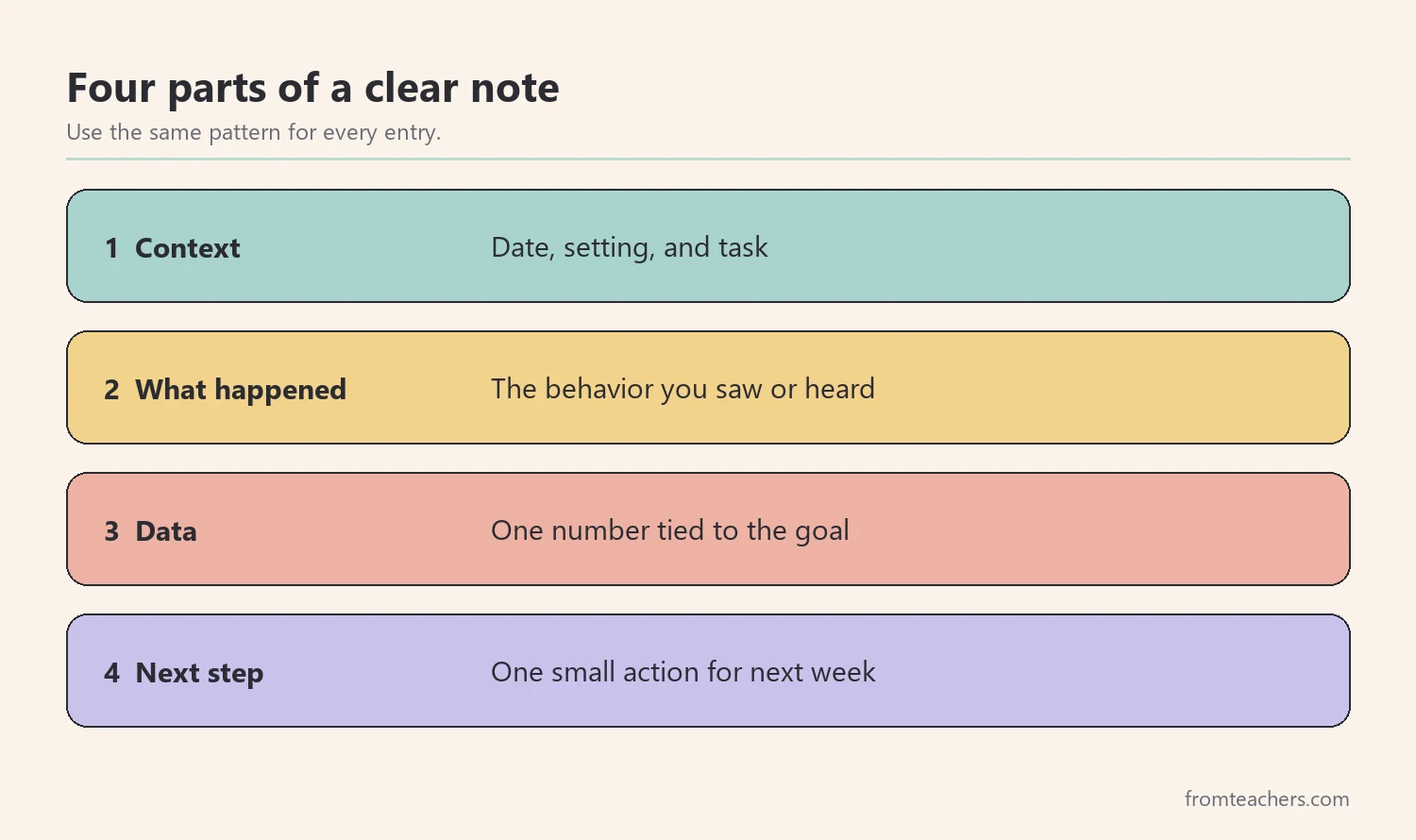
- Context: date, setting, and task. “Oct 6, small group, cold read passage.”
- What happened: the observable behavior. “Read aloud for one minute, self-corrected twice.”
- Data: the number tied to the goal. “84 words correct per minute.”
- Next step: one action. “Repeat passage practice twice this week.”
Here is how one of Jonah’s student progress notes reads in full: “Oct 6. Small group, cold read of a grade 5 passage. Jonah read for one minute, skipped one line, and self-corrected twice. 84 words correct per minute (target 100). Next: two repeated readings this week with a line marker.” That entry takes about two minutes to write, yet a substitute or parent could understand it right away.
Also, keep opinions out of the data field. Words like “lazy” or “unmotivated” are judgments, not observations. If you notice something about effort, describe it: “put head down for about two minutes, then restarted after a prompt.” Descriptions help the team problem-solve, while labels tend to end the conversation.
Finally, write in short sentences. You are not writing a report card comment. The goal is a record that is fast to write and fast to read, so fragments are fine as long as they are clear.
3. Record numbers that add up and mean something
Numbers turn student progress notes into evidence, and evidence is what teams act on. However, they only help if they are simple and consistent. Pick one measure per goal and use it every time: words correct per minute, number correct out of a fixed total, or sessions out of five.
Check your math before you save the note. If Jonah had 20 facts and missed 3, the note should say 17 of 20, which is 85%. If he started work after one prompt in 3 of 5 sessions, he did not meet the target that week, and the note should say so honestly.
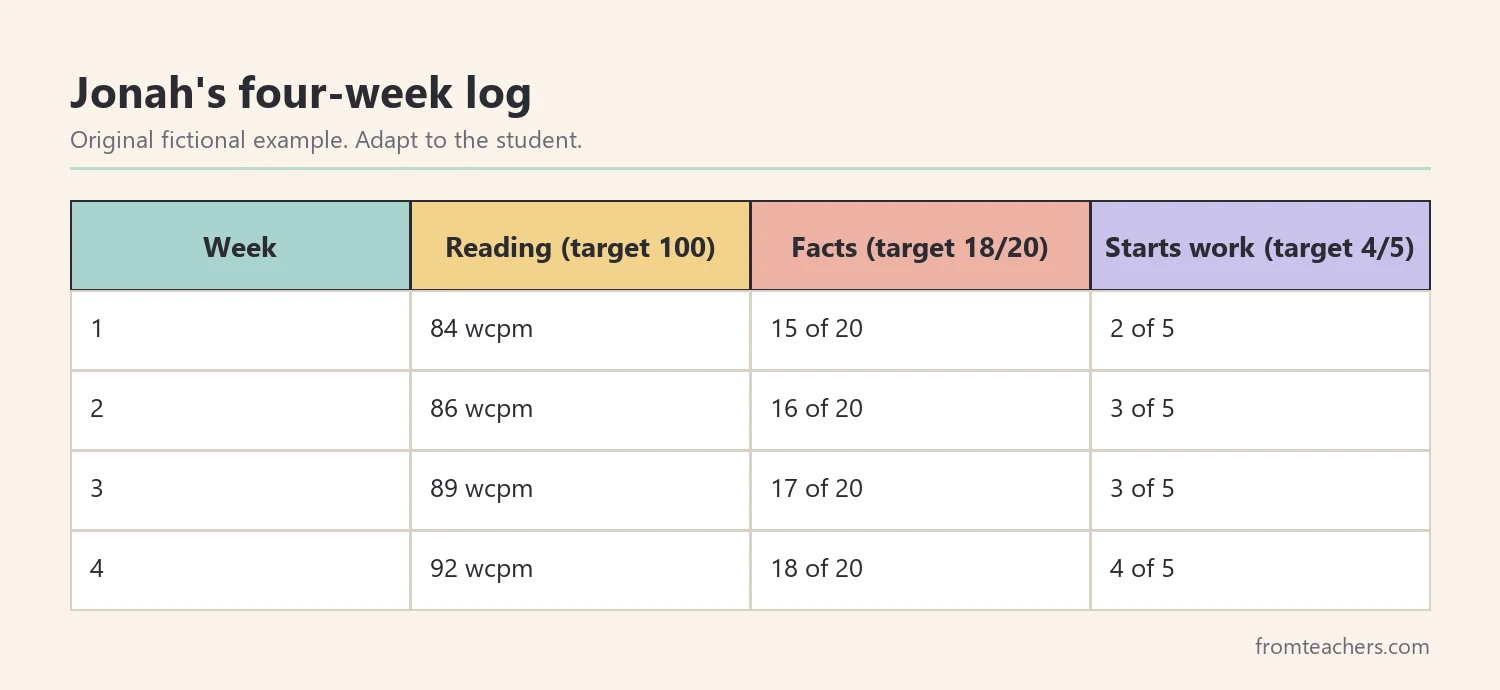
Look at the pattern in the figure. Jonah’s reading moved from 84 to 92 words correct per minute over four weeks, an increase of 8. His math facts went from 15 to 18 of 20, so he reached the target in week four. Work habits moved from 2 of 5 to 4 of 5 sessions. Because each line uses the same measure, the trend is easy to see without a chart.
If you want a ready-made layout with the header fields, a goals section, and a dated log, a student progress monitoring sheet with five label versions can save you from building one in a word processor. It includes a filled-in example, which helps new staff see what a good entry looks like.
One more tip: write the target next to the number. “84 (target 100)” tells the reader the gap at a glance, which saves a second trip to the goal page.
4. Build a weekly routine for student progress notes
The best format in the world will not help if student progress notes only happen when someone asks for them. Consequently, the most important decision is when you write, not how. Choose a fixed slot, such as the last ten minutes of your planning period on Thursdays, and protect it like a meeting.
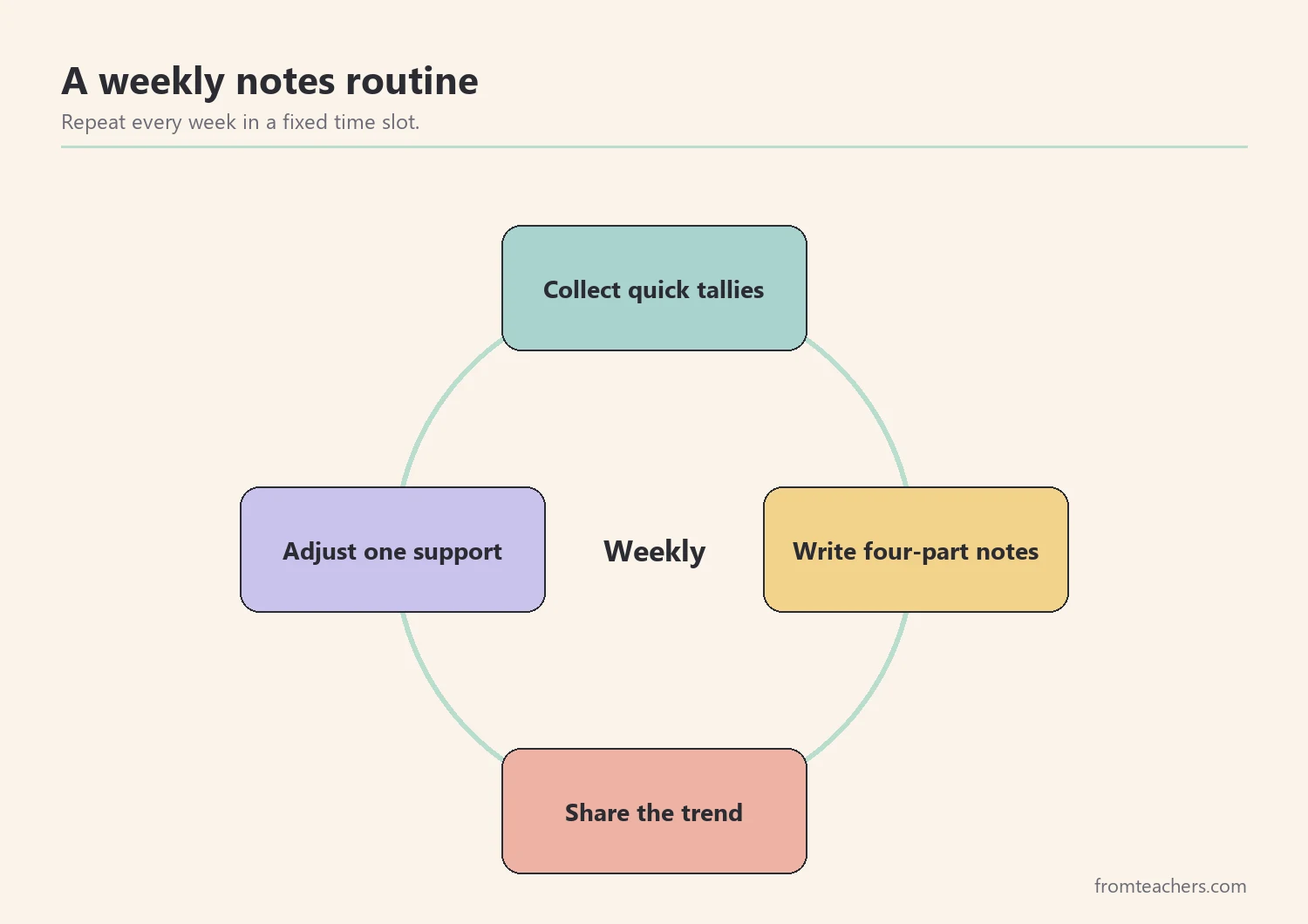
During the week, collect raw data in the quickest way possible. For instance, keep a clipboard with tally marks, or jot numbers on the back of a work sample. Then, in your weekly slot, turn those raw marks into full student progress notes using the four-part pattern.
For Jonah, the routine looks like this. On Monday and Wednesday, his teacher times a one-minute reading and writes the number on a sticky note. On Tuesday, she gives the 20-fact quiz. Each day, she tallies whether he started work after one prompt. On Thursday, she spends about six minutes writing three short entries, one per goal.
- Keep the log in one place, either one binder or one shared folder.
- Use the same pen color or font for each staff member so entries are easy to attribute.
- Initial every entry so the team knows who observed it.
- If you miss a week, write “no data, reason” rather than leaving a blank.
Moreover, a short routine is easier to hand off. If a paraprofessional or related service provider also works with the student, they can add notes in the same slot and the same format, which keeps the record consistent across adults.
5. Share student progress notes with the team and family
Student progress notes are a communication tool, so plan how they travel. Decide with the case manager how often the team will see the log, for example every two weeks by email or at a monthly check-in. Then stick to it.
When you share, lead with the trend, not the details. For example: “Jonah’s math facts reached the target this week, 18 of 20. Reading is rising but still below target, 92 compared with 100. Work habits reached 4 of 5 sessions.” Three sentences give the team the full picture, and anyone who wants detail can open the log.
With families, translate the numbers into everyday language. Instead of “92 WCPM,” say “he read 92 words correctly in one minute, up from 84 a month ago.” In addition, include one thing the family can do at home, such as reading the same short passage aloud twice. Parents tend to respond well when they hear specific progress and one small, doable action.
Be careful with privacy. Use school-approved channels, avoid putting full names in email subject lines, and follow your district’s rules on records. If you are unsure, ask your administrator before sending anything outside the school system.
| Audience | What they need | How often |
|---|---|---|
| Case manager | Trend per goal and concerns | Every two weeks |
| Family | Plain-language progress and one home idea | Monthly or per plan |
| Related service staff | Notes that affect their sessions | As needed |
6. Review the notes and decide what to change
The real payoff comes when you read back through several weeks of student progress notes at once. Set a review point every four to six weeks and ask a few direct questions. Is the student moving toward the target? Is the support being delivered as planned? What one thing should we change?
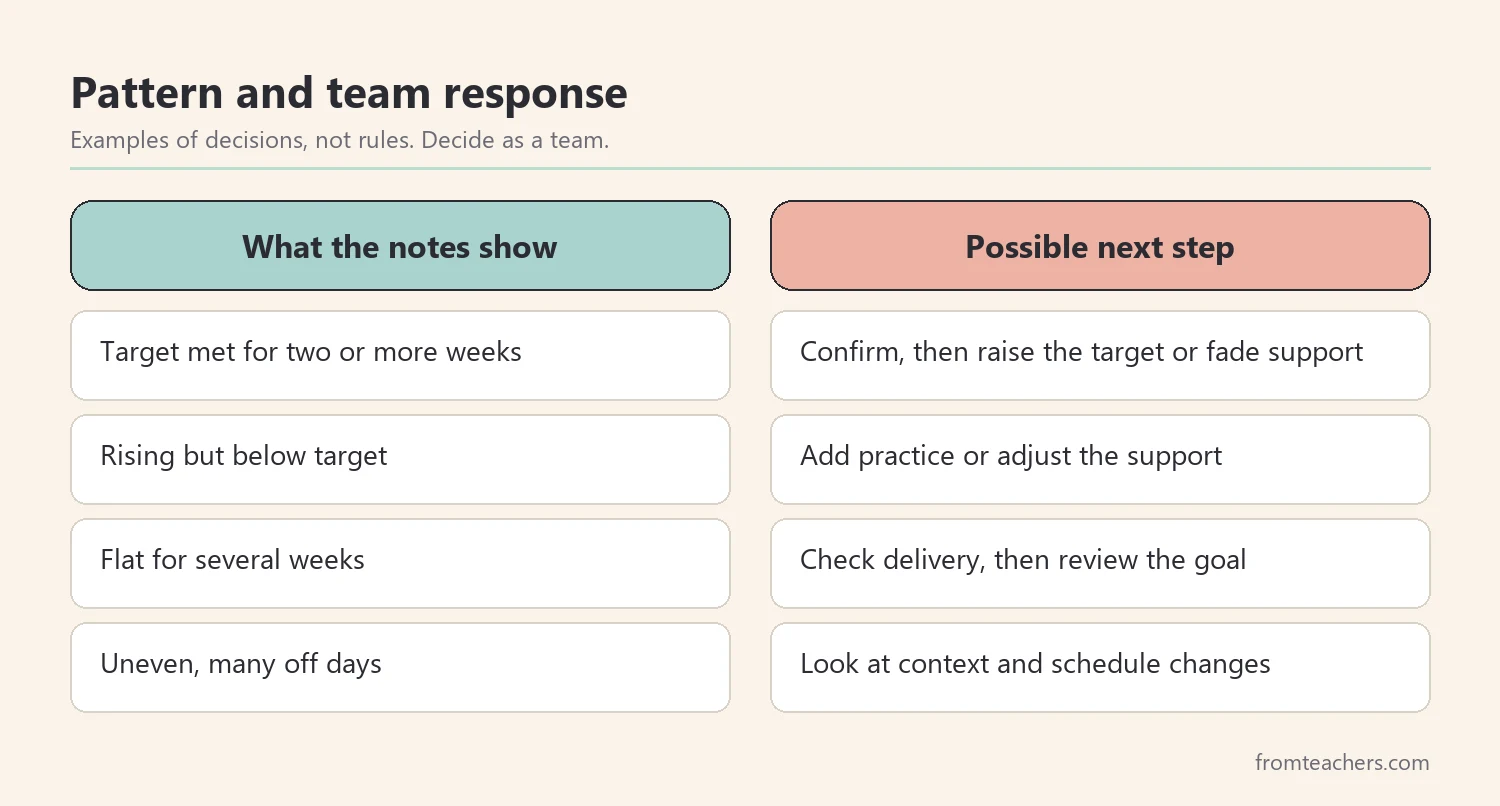
For Jonah, the review is clear. Math facts reached the target, so the team might keep the goal steady for two more weeks to confirm it holds, then raise the bar. Reading is improving but slowly, so the team could add a third repeated-reading session each week. Work habits reached the target, so the team might start fading the prompt.
Above all, write the decision in the log. A line such as “Nov 3 review: add third reading session, fade work prompt” closes the loop. Later, when someone asks why a support changed, the answer is right there with a date.
If your student progress notes keep showing no change after several weeks, that is useful information too. It may mean the support needs adjusting or that the team should talk about the goal itself. Bring the log to that conversation, because dated evidence makes the discussion calmer and more productive.
Common mistakes and how to avoid them
- Writing feelings instead of facts. Fix: describe what you saw and heard, then add a number.
- Changing the measure every week. Fix: choose one measure per goal and keep it until the team agrees to change.
- Waiting until report time. Fix: write student progress notes in a fixed weekly slot, even if each entry is only two lines.
- Leaving out the next step. Fix: end every note with one action, however small.
- Math that does not add up. Fix: double-check totals, and always show “x of y” next to any percentage.
Questions teachers and parents ask about student progress notes
How long should a progress note be?
Most good student progress notes are two to four short sentences. The four-part pattern keeps them tight: context, what happened, data, and next step. Longer is not better if the key number gets buried.
How often should I write student progress notes?
Weekly works well for most classroom goals. Some teams record data more often and summarize once a week. Follow the schedule your plan or district sets, and keep it consistent.
Can a paraprofessional write notes?
Often yes, if your school allows it and the team agrees on the format for student progress notes. Each entry should be initialed so everyone knows who observed it. The case manager usually reviews the log and makes decisions.
What if the student had an off day?
Record it honestly and add brief context, such as “fire drill during session” or “first day back after absence.” One low number is not a trend. Several notes together tell the real story.
Should parents see the actual notes?
Families have rights to their child’s educational records, and many teams share summaries regularly. Write every note as if a parent will read it: respectful, factual, and free of labels. Check your district’s policy on how records are shared.
Related reading: The Power of Data Tracking in Special Education, How Teachers Communicate With Parents in Special Education, and Special Education Accommodation and Modification Tracker.
A companion resource for student progress notes:
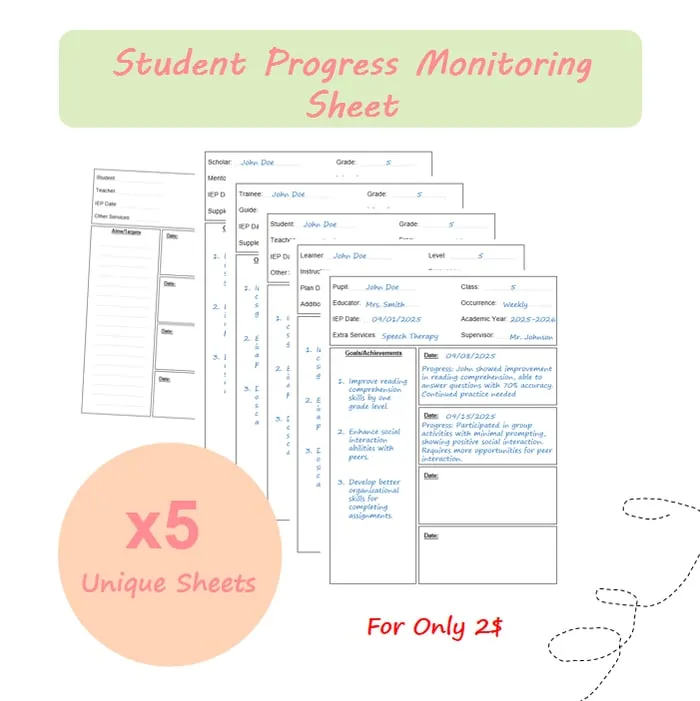
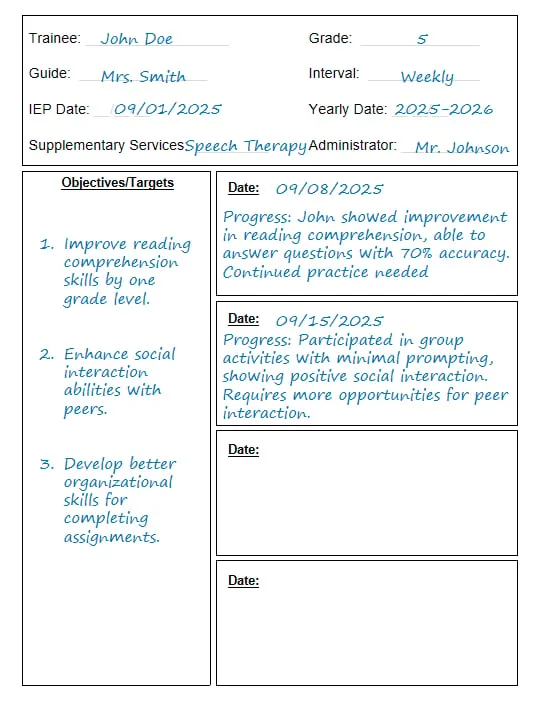
Student Progress Monitoring Sheet: 5 Versions: a dated narrative log with header fields, space for up to three goals, four entries per sheet, a filled-in example, and five label variations to match your team’s terms.
Sources and scope
- IDEA, U.S. Department of Education: the federal law that covers IEPs and reporting progress on goals.
- IRIS Center, Vanderbilt University: free modules on progress monitoring and data-based decisions.
- National Center on Intensive Intervention: tools and guidance on monitoring student progress over time.
- Understood.org: plain-language articles for families about school plans and progress.
This guide covers writing and using classroom progress notes for goals a team has already set. It does not cover writing goals from scratch, formal evaluation, or legal advice about records, which belong to your district and qualified professionals.
Key takeaways
- Clear student progress notes start with a clear, measurable goal.
- Use the same four parts every time: context, what happened, data, next step.
- Keep one measure per goal and make sure the numbers add up.
- Write in a fixed weekly slot and share trends on a set schedule.
- Review every few weeks and write the team’s decision in the log.










Leave a Comment