
Inclusion classroom strategies matter most in the small, fast moments: a student shuts down halfway through a math lesson, another starts tapping loudly when the directions get long, and twenty-five other students are still waiting for you. You want to help without stopping the whole class.
After reading this guide, you will be able to plan lessons with access built in, read the need behind common classroom moments, respond with short scripts that take seconds, repair trust when something goes wrong, and share the work with co-teachers and paraprofessionals. In short, you will have a repeatable routine instead of guesswork.
Examples are fictional. Adapt to the student’s goals and agreed supports. This is guidance, not a diagnosis.
At a glance
- The best inclusion classroom strategies are planned before the lesson, not invented during it.
- Confusion, withdrawal, frustration, and challenging behavior each point to a different need.
- Short, ready scripts help you respond in seconds without pulling a student aside.
- Owning a lesson that did not work repairs trust quickly.
- Clear roles for co-teachers and paraprofessionals keep support steady all day.
1. Plan lessons with inclusion classroom strategies built in
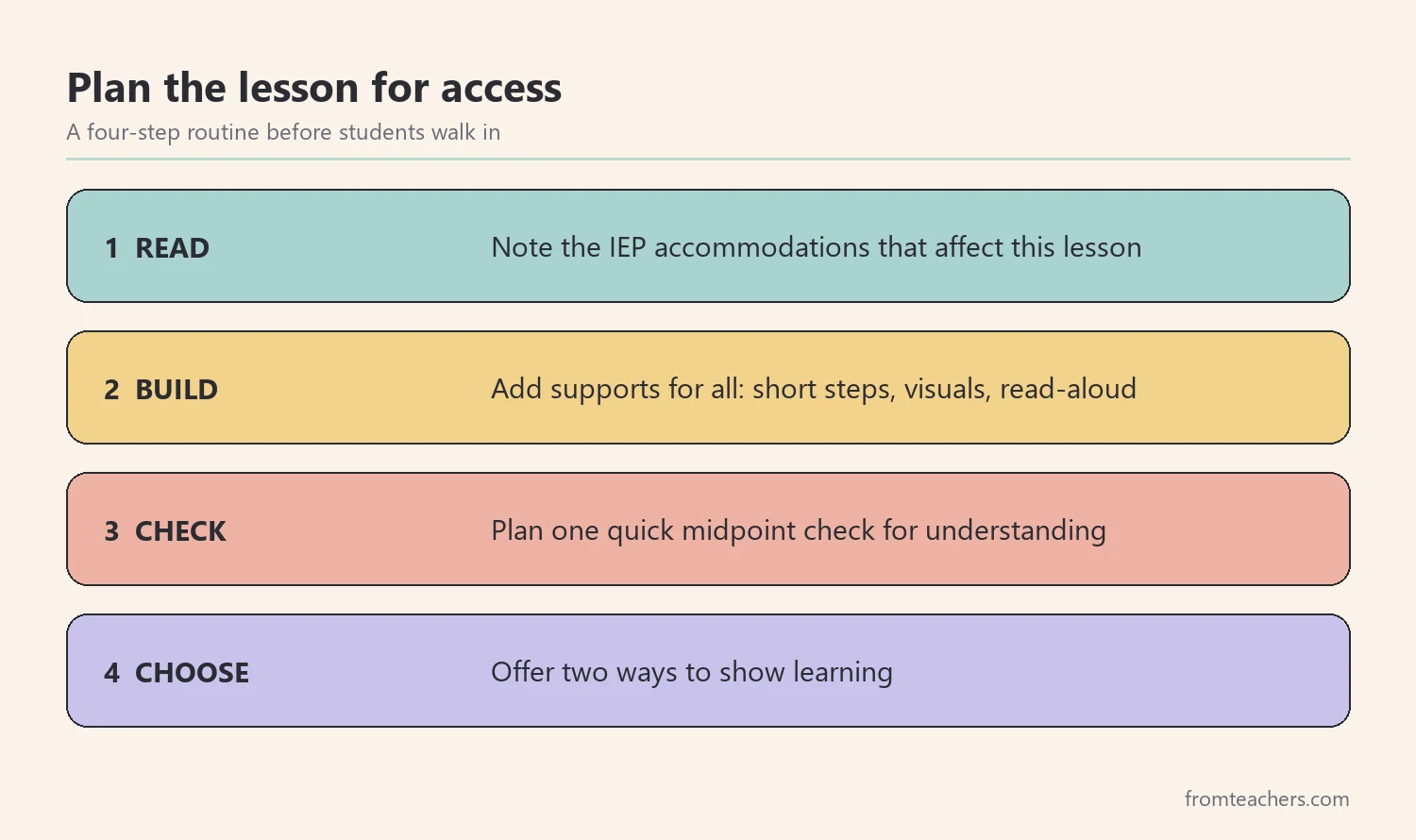
First, strong inclusion classroom strategies start before students walk in. Read each student’s IEP or support plan and note the accommodations that affect this lesson. Then build them into the lesson for everyone, so no one has to ask for something that looks different.
Meet Maya, a fictional grade 5 student with an IEP for reading and attention. Her accommodations include chunked directions, a visual model, and extra time on written work. Her teacher, Mr. Ortiz, plans a science lesson on the water cycle with those needs in mind.
| Lesson part | Built-in support | Who benefits |
|---|---|---|
| Directions | Three short steps on the board | Maya and the whole class |
| Reading | Text read aloud, diagram beside it | Maya and English learners |
| Practice | Partner talk before writing | Most students |
| Output | Label a diagram or write sentences | Students who need choice |
Notice that every support helps more than one student. That is the heart of inclusion classroom strategies that plan for access, an approach closely tied to Universal Design for Learning. As a result, Maya gets what her IEP requires, and it does not single her out.
In addition, plan one quick check for understanding at the midpoint. For example, students hold up one to three fingers to show how sure they feel. This tells you where to go next before anyone falls too far behind.
Also, keep your plan light. A sticky note with each student’s two or three key accommodations is often enough. Over time, these inclusion classroom strategies become habits, and planning takes less time each week.
2. Read the moment: confusion, withdrawal, frustration, or behavior
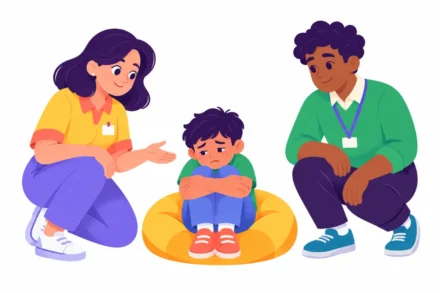
Next, learn to read what a student is telling you. In an inclusion classroom, the same quiet student might be confused one day and overwhelmed the next. Therefore, the response needs to match the need, not just the surface behavior.
Reading the moment is where many inclusion classroom strategies succeed or fail. A fix that helps a confused student can feel like pressure to a student who has withdrawn. So pause for two or three seconds and look before you act.
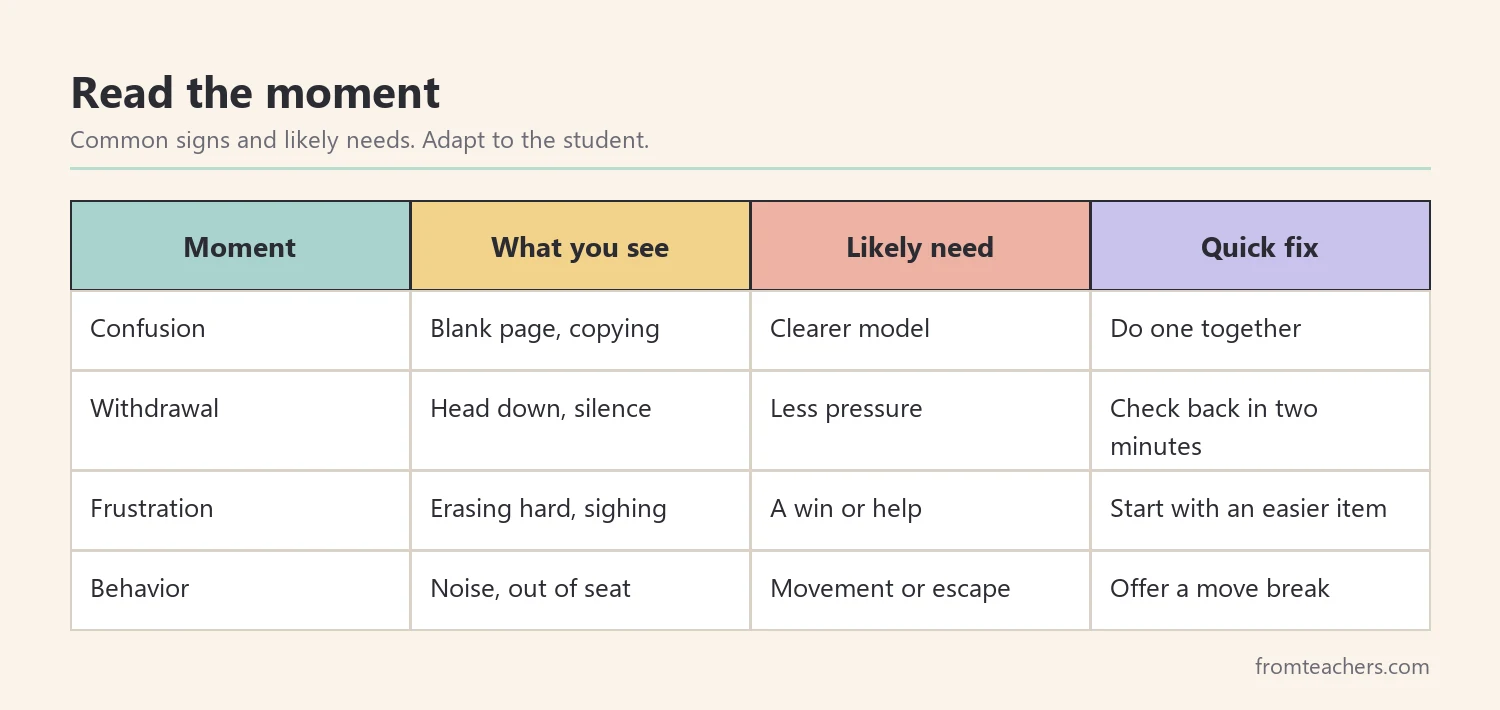
Most everyday moments fall into four groups. Each one has typical signs and a likely need underneath.
| Moment | What you see | Likely need |
|---|---|---|
| Confusion | Blank page, copying a neighbor | Clearer model or smaller step |
| Withdrawal | Head down, hood up, silence | Safety, less pressure |
| Frustration | Erasing hard, sighing, “This is dumb” | A win, a break, or help |
| Challenging behavior | Noise, leaving seat, arguing | Escape, attention, or movement |
For instance, ten minutes into the water cycle lesson, Maya puts her head down. Mr. Ortiz checks the table in his head. She is not loud or arguing, and her page is blank. So he guesses withdrawal after confusion, not defiance.
Of course, you will not always guess right. Still, naming a likely need gives you a starting point. Moreover, it keeps you from treating a quiet student as lazy or a loud one as simply rude.
3. Respond with quick inclusion classroom strategies and scripts
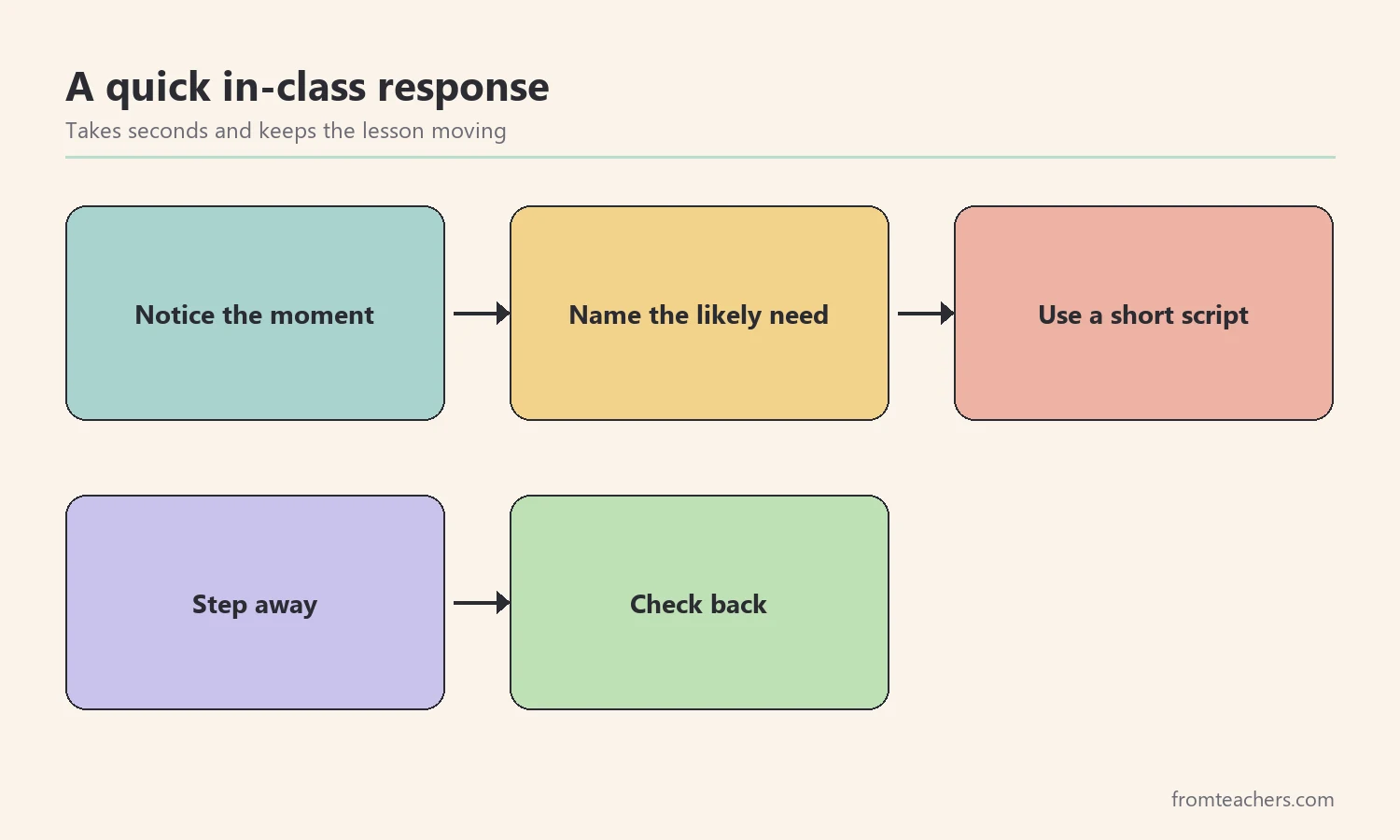
Once you have a guess, respond fast and quietly. The goal is a fix that takes seconds, keeps the class moving, and protects the student’s dignity. In most cases, you do not need to pull the student aside.
Short scripts are among the most practical inclusion classroom strategies, because in the moment it is hard to find the right words. Here are examples you can adapt:
- Confusion: “Let’s do the first one together. You do the next one.”
- Withdrawal: “No rush. I’ll check back in two minutes.”
- Frustration: “This part is hard. Want to start with number 3?”
- Challenging behavior: “Looks like you need a move break. Take this to the office for me?”
For Maya, Mr. Ortiz crouches beside her desk and says, “Let’s label the first arrow together.” They do one label in about thirty seconds. Then he walks away and says, “You’ve got the next two.” When he returns, she has finished both.
That moment is small, yet it adds up. Over a week, these fast responses replace many longer conversations and missed lessons. If you want ready-made language for dozens of moments like this, the Problem, Fix, and Benefit tables for inclusion classrooms include word-for-word scripts for confusion, withdrawal, frustration, and challenging behavior.
Finally, keep your tone neutral. A calm voice and few words lower the stakes for everyone. Similarly, avoid public praise for a student who is fragile, because attention can feel like pressure.
4. Repair trust when a lesson or approach misses
Sometimes the problem is not the student. The directions were too long, the example was confusing, or the pace was too fast. In those moments, saying so out loud is one of the most powerful inclusion classroom strategies you have.
Taking responsibility shows students that mistakes are normal and fixable. In addition, it lowers defensiveness, because the student no longer has to prove the task was unfair. As a result, trust returns faster than it would after a lecture.
Use simple repair language:
- “That explanation did not work. Let me try it a different way.”
- “I went too fast. Let’s slow down.”
- “I should have given you a warning before the change. I’m sorry.”
For example, during the next lesson Mr. Ortiz gives five spoken directions at once. Several students, including Maya, look lost. He stops and says, “That was too many steps. Here are the first two.” Then he writes them on the board. Within a minute, the class is working again.
Afterward, he makes a note to post written steps before every lab. That small change prevents the same problem next time. In addition, Maya sees that adults adjust too, which makes it easier for her to ask for help when she is stuck. Over several weeks, she begins raising her hand instead of putting her head down.
Equally important, repair does not mean lowering expectations. The goal stays the same; only the path changes. Therefore, students learn that the teacher is on their side and still believes they can do the work.
5. Share inclusion classroom strategies with co-teachers and paras
Inclusion classroom strategies work best as a team effort. When the general education teacher, special education teacher, and paraprofessional each know their role, support stays steady all day. Otherwise, adults overlap in some moments and leave gaps in others.
Start by agreeing on a few common co-teaching models and when to use each one. For instance, one teach, one assist works for new content, while station teaching fits practice days. Also, decide who handles quick check-ins, who takes data, and who leads small groups.
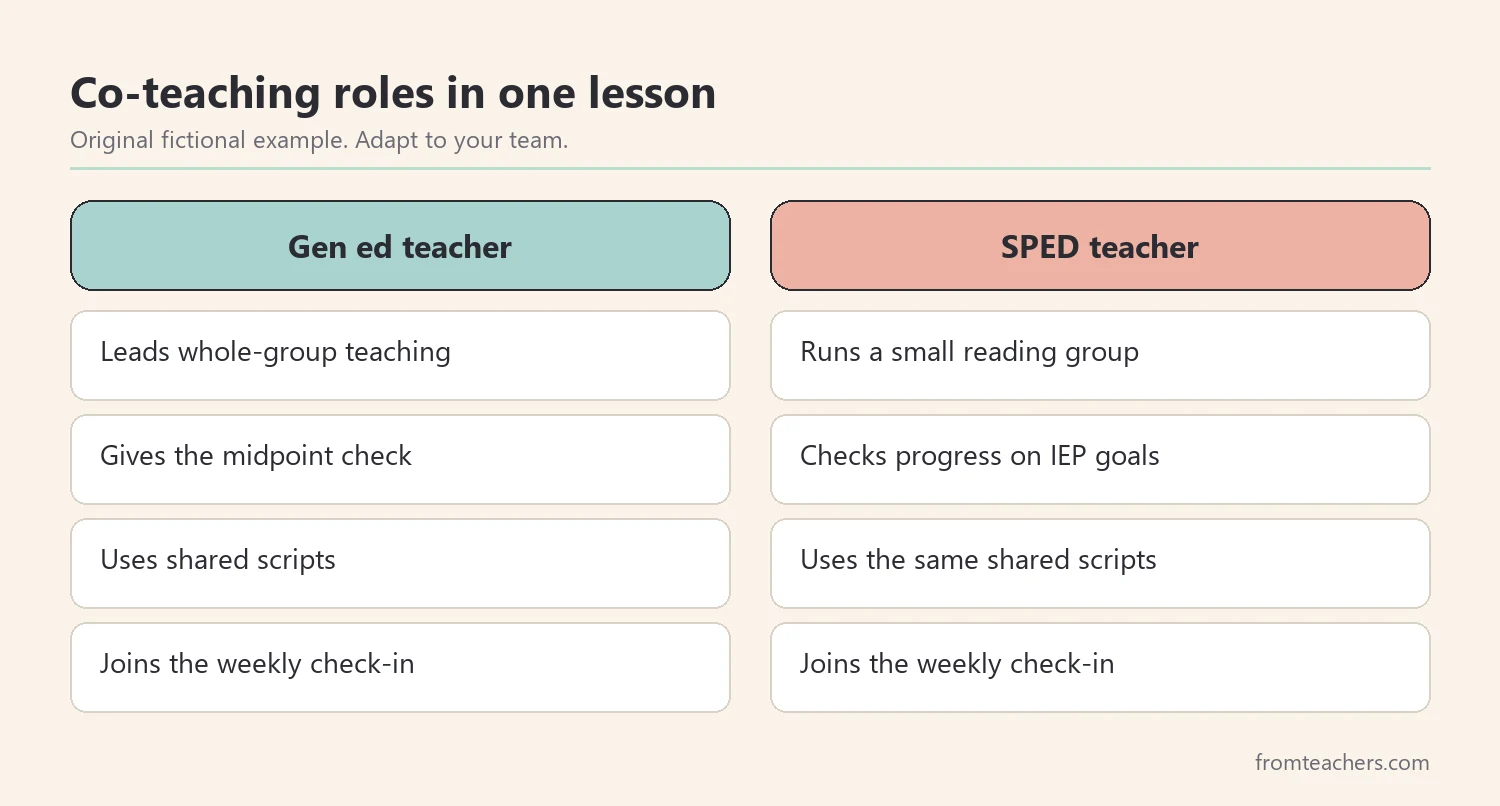
| Adult | Main role in Maya’s science lesson |
|---|---|
| Mr. Ortiz (gen ed) | Leads whole-group teaching and the midpoint check |
| Ms. Lee (SPED) | Runs a small reading group and checks IEP goals |
| Mr. Grant (para) | Circulates, uses agreed scripts, notes when Maya starts work |
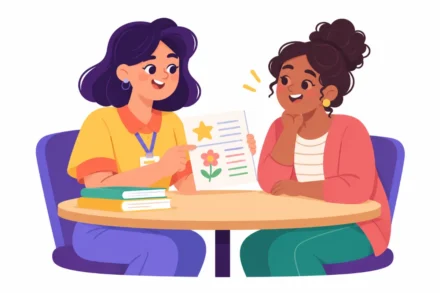
Moreover, share the same scripts across adults. If everyone says “Let’s do the first one together,” Maya hears a familiar message no matter who is near her. Consistency like this is one of the simplest supports a team can give.
Finally, keep a short weekly check-in of ten to fifteen minutes. Review what worked, what did not, and one change for next week. Families can join this loop through a quick note home.
6. Grade fairly and review progress
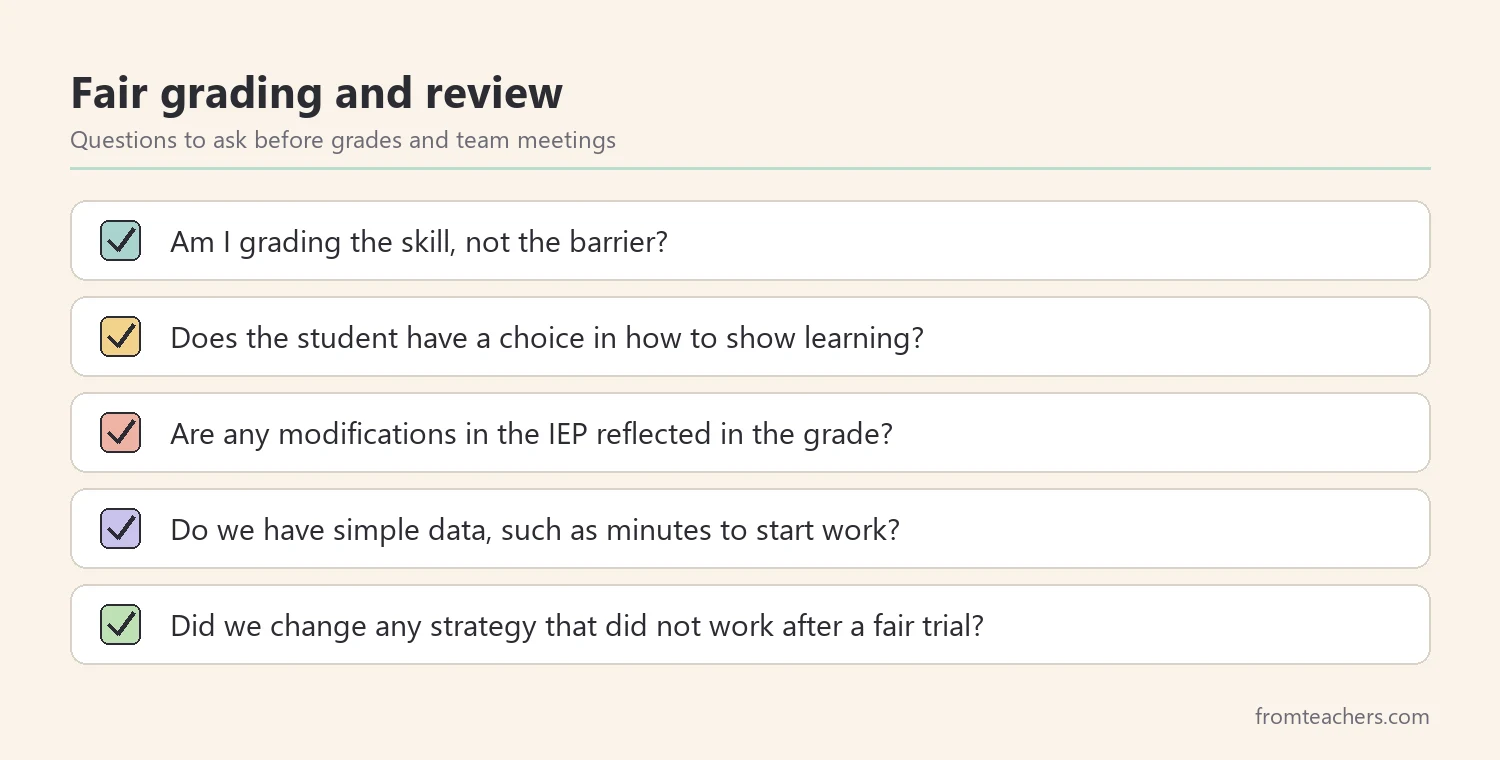
Fair grading is part of inclusion classroom strategies too. It means measuring the skill you are teaching, not the barriers around it. If the goal is understanding the water cycle, Maya can show it by labeling a diagram instead of writing three paragraphs. That is an accommodation; the standard stays the same.
However, if the IEP team has agreed to modify the content, grades should reflect that plan. When in doubt, check the IEP and talk with the special education teacher before report cards go home.
Also, review progress regularly with simple data. For example, the para notes how many minutes pass before Maya starts work after directions. In week one, it averaged 6 minutes. By week four, with chunked directions and the “first one together” script, it dropped to 2 minutes. That change of 4 minutes is easy to see and easy to share with families.
Above all, use the data to adjust your inclusion classroom strategies, not to judge the student. If a strategy is not working after a fair trial, change it and track again.
Common mistakes and how to avoid them
- Mistake: Adding supports only after a student struggles. Fix: Build access into the lesson plan for everyone.
- Mistake: Treating withdrawal as defiance. Fix: Read the moment and guess the need before responding.
- Mistake: Long private talks during class. Fix: Use short scripts and check back later.
- Mistake: Defending a lesson that did not land. Fix: Own it, adjust, and keep the goal.
- Mistake: Leaving the para without a clear role. Fix: Agree on roles and shared scripts every week.
Questions teachers and parents ask about inclusion classroom strategies
Do inclusion classroom strategies slow down other students?
Usually not, when they are planned well. Clear directions, visuals, and partner talk help many learners. Quick in-the-moment fixes also keep the whole class moving instead of stopping for long conversations.
What if I do not have a co-teacher?
Start with planning and scripts, which are inclusion classroom strategies you can use alone. Then ask the special education teacher for a short weekly check-in. Even ten minutes can align goals and strategies.
Is it fair to give some students different supports?
Fair means each student gets what they need to access learning. Accommodations change how a student learns or shows learning, not what they are expected to know. Many teachers explain this to the class simply and early.
How do I handle challenging behavior without stopping the lesson?
Use a calm, short script that offers a way out, such as a move break or an errand. Then follow up privately later. If behavior continues, talk with the IEP team about a behavior plan.
How can parents support inclusion at home?
Parents can share what helps their child focus and calm down, which helps teachers choose inclusion classroom strategies that fit. They can also use the same simple language the school uses. Regular short notes between home and school keep everyone aligned.
Related reading: accommodations vs modifications in special education, how parents and teachers can team up, and ADHD classroom strategies.
A companion resource for inclusion teachers:
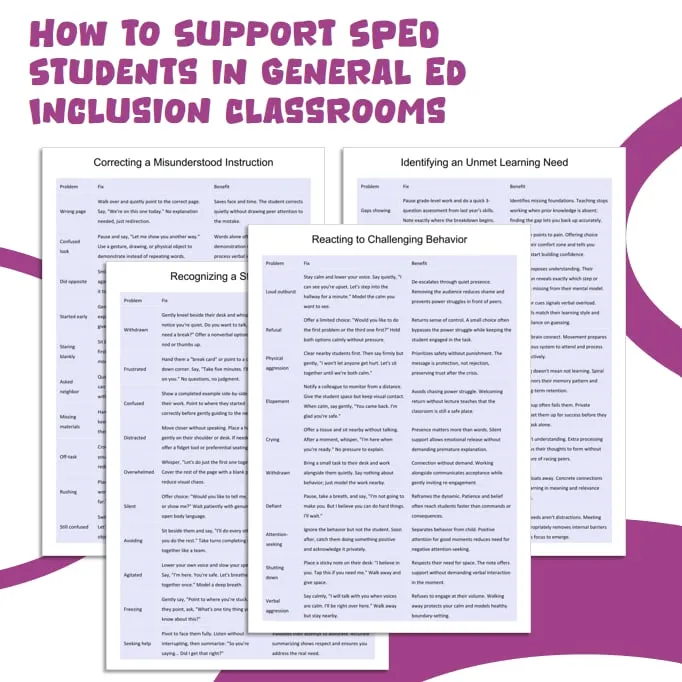
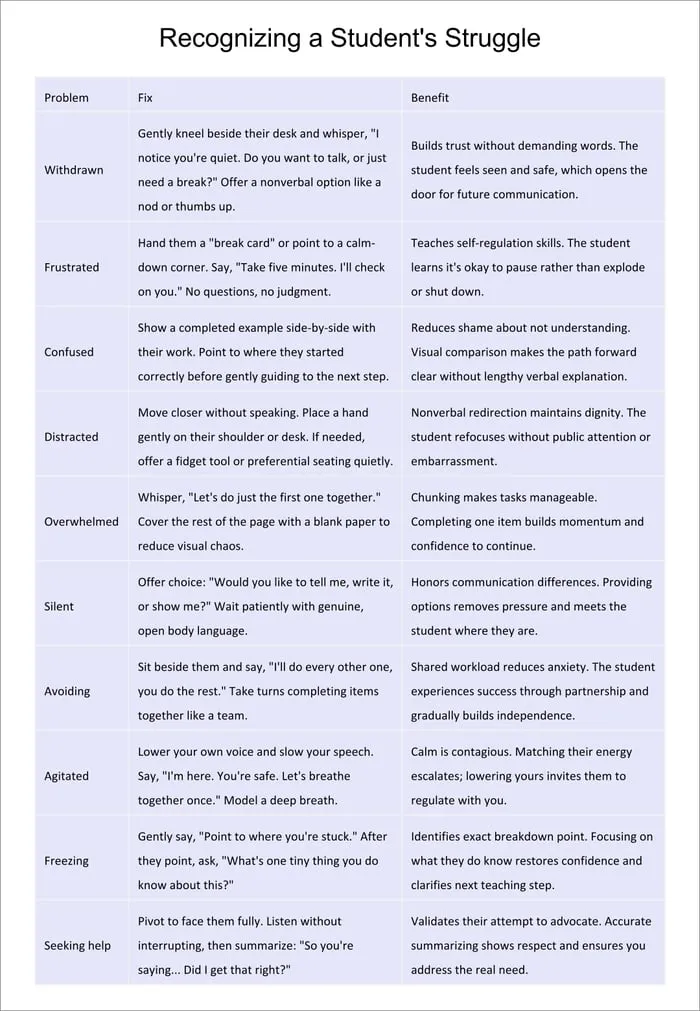
How to Support SPED Students in General Ed Inclusion Classrooms: 12 pages of Problem, Fix, and Benefit tables with word-for-word scripts for confusion, withdrawal, frustration, and challenging behavior, plus repair language for when a lesson does not work.
Sources and scope
- Individuals with Disabilities Education Act (IDEA), U.S. Department of Education: the federal framework for IEPs and the least restrictive environment.
- IRIS Center at Vanderbilt University: free modules on accommodations, differentiated instruction, and co-teaching.
- CAST: the organization behind the Universal Design for Learning framework.
- Understood.org: plain-language guidance for families and teachers on learning and thinking differences.
This guide covers everyday classroom practice for general and special education teachers; it does not replace IEP team decisions, district policy, or individual evaluation.
Key takeaways
- Build inclusion classroom strategies into the plan before the lesson starts.
- Read each moment as confusion, withdrawal, frustration, or behavior, and guess the need.
- Respond with short scripts that take seconds and protect dignity.
- Own lessons that miss, and keep expectations steady.
- Share roles and scripts across adults, and review simple data weekly.




Leave a Comment