

Difficult conversations with parents usually start in an ordinary moment: a pickup line, a short email, a phone call at 3:40 when you are already tired. A parent hears that their child is struggling, and the tone shifts fast. In that moment, the words you choose can either build a partnership or put both of you on the defensive.
This guide walks you through a clear, repeatable process for difficult conversations with parents. By the end, you will be able to prepare for a hard talk, open it calmly, listen without losing the thread, agree on next steps, and follow up so trust actually grows. Examples are fictional. Adapt to the student’s goals and agreed supports. This is guidance, not a diagnosis.
At a glance
- Build trust with small positive contacts long before a problem appears.
- Prepare one clear concern, two or three facts, and one proposed next step.
- Open with the child’s strengths, then describe what you saw in plain words.
- Listen first, name the parent’s concern, and only then problem solve together.
- Close with a written summary, a shared plan, and a date to check in.
1. Build trust before difficult conversations with parents happen
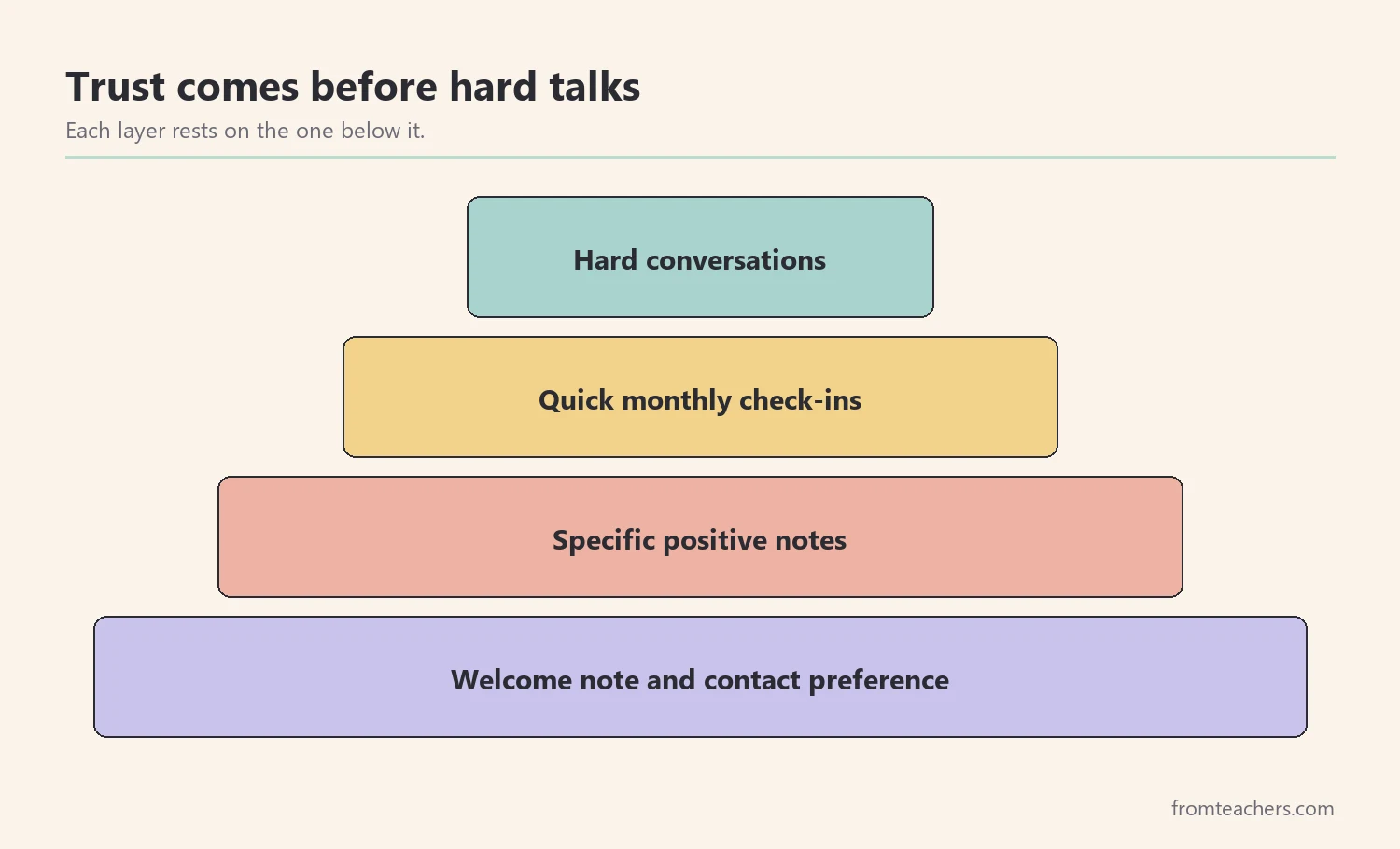
Difficult conversations with parents go better when they are not the first talk. If the only time a family hears from you is when something is wrong, every call feels like bad news. Therefore, the real preparation starts in the first weeks of school.
Start with a short welcome message that introduces you and asks one question about the child. For example, ask what the child enjoys, what works at home, or what the parent wants you to know. Next, send a brief positive note within the first two weeks. Keep it specific, such as “Leo explained his math strategy to a partner today and stayed with it until the end.”
Also, agree early on how the family prefers to communicate. Some parents want a text, some want email, and some want a phone call after work. Write their preference down and use it. Small habits like these send a clear message: you see the whole child, not just the problem.
Consider our fictional student, Leo, grade 3. In September, his teacher, Ms. Reyes, learned from his mother that Leo loves drawing maps and gets anxious when routines change. She sent two short positive notes before October. So when Leo began leaving the room during writing time, his mother already knew Ms. Reyes liked her son and was on his side.
| Trust habit | When | Example |
|---|---|---|
| Welcome note | Week 1 | “Tell me one thing Leo loves.” |
| Positive note | By week 2 | A specific moment of effort |
| Contact preference | Week 1 | Text after 5 p.m. |
| Quick check-in | Monthly | “Anything new at home?” |
2. Prepare your key points
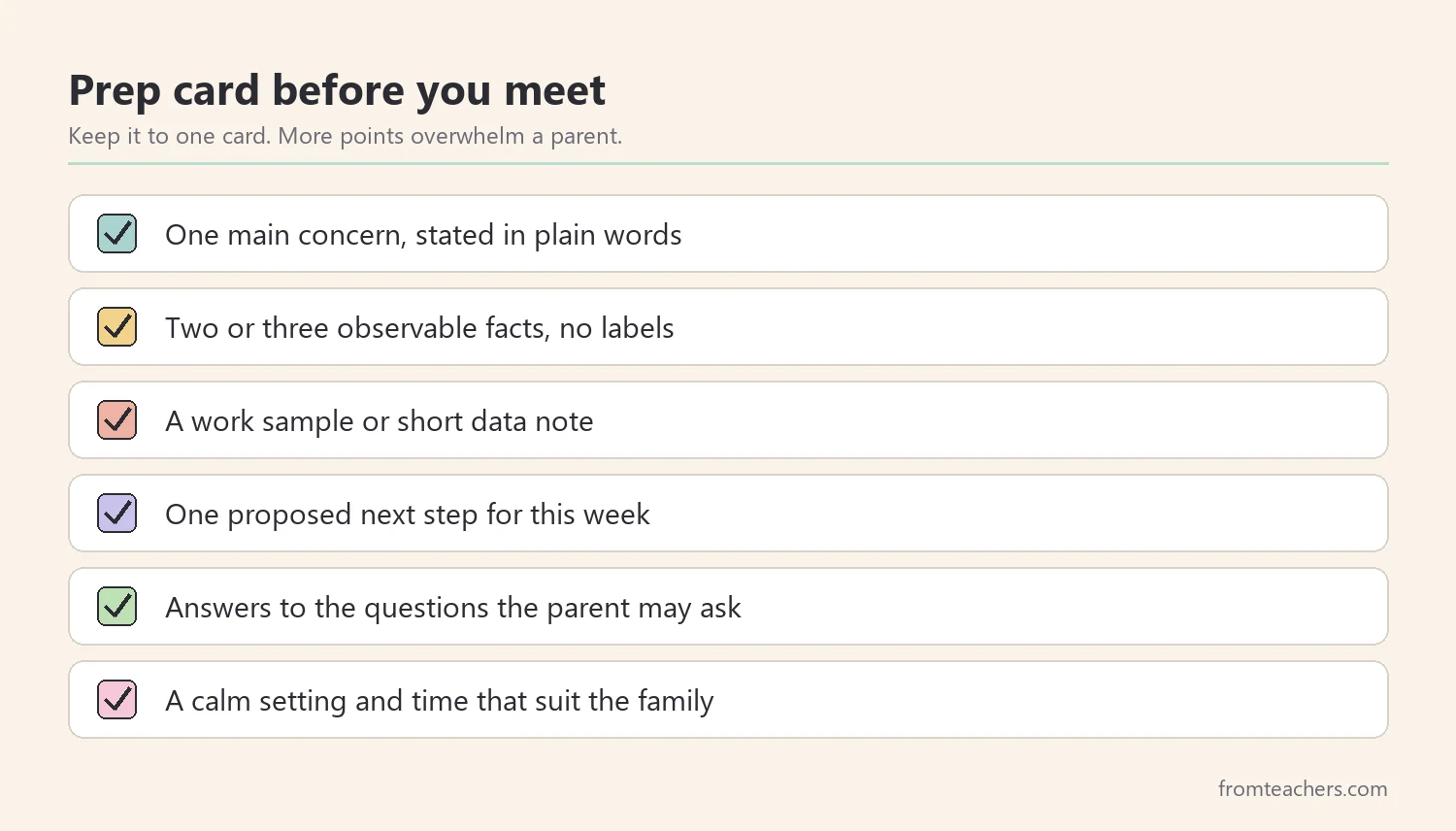
Walking into difficult conversations with parents without a plan invites rambling, and rambling sounds like blame. Instead, write down three things before you meet: one main concern, two or three observable facts, and one proposed next step. That is enough. More than that usually overwhelms a parent.
Facts should describe what you saw and heard, not what you think it means. “Leo left the room four times during writing this week” is a fact. “Leo is defiant” is a label, and labels start arguments. In addition, bring a work sample or a short data note if you have one, because concrete evidence keeps the talk focused on the child, not on opinions.
Next, think about the parent’s likely questions. Will they ask why it is happening, what you have tried, or whether it affects grades? Prepare short, honest answers. If you do not know something, plan to say so and offer to find out.
Finally, choose the setting with care. Difficult conversations with parents rarely belong in a hallway or a long email thread. A scheduled call or a short meeting, at a time that works for the family, shows respect. If the student has an IEP, check whether the case manager or another team member should join.
For Leo, Ms. Reyes’s prep card read: Concern: leaving the room during writing. Facts: four exits this week, all within ten minutes of the writing prompt; he returned each time within five minutes; his drawings during this time were detailed maps. Next step: try a visual plan for writing and check in after two weeks.
3. Open difficult conversations with parents calmly
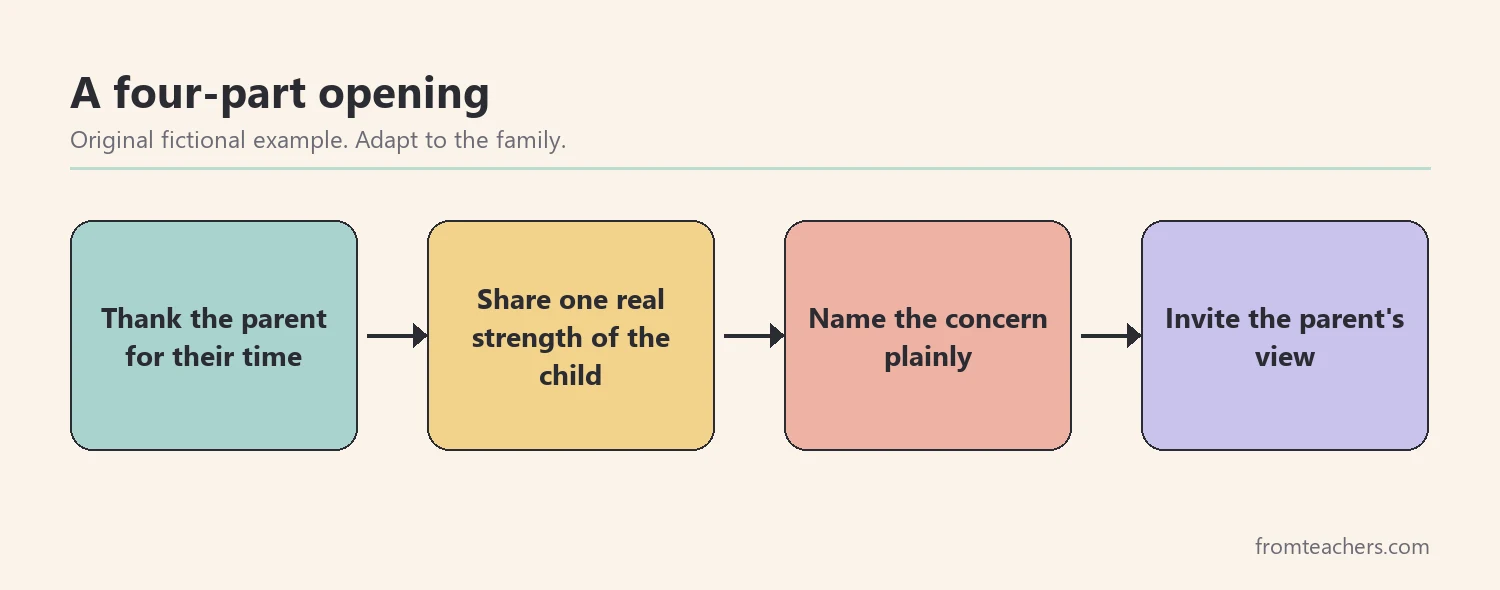
In difficult conversations with parents, the first two minutes set the tone for everything that follows. Start by thanking the parent for their time. Then share one genuine strength about the child, something specific you have seen. This is not a trick to soften the blow. Rather, it shows that you know the child well enough to be trusted with the hard part.
Next, state the purpose plainly. Parents often fear the worst when they hear “we need to talk,” so name the concern early and in calm language. Avoid jargon, acronyms, and hedging that makes the issue sound bigger or smaller than it is.
Here is a simple opening pattern you can adapt:
- Thanks: “Thank you for making time today.”
- Strength: “Leo’s map drawings are some of the most detailed I have seen.”
- Purpose: “I want to talk about writing time, because he has been leaving the room, and I want to understand it with you.”
- Invitation: “Have you noticed anything similar at home?”
Notice the word “with.” It frames the parent as a partner, not an audience. In addition, keep your body language open: sit side by side if you can, keep papers where both of you can see them, and put your phone away.
If you are worried about your own nerves, practice the opening out loud once. Many teachers find that difficult conversations with parents feel easier when the first three sentences are already familiar. For more structured scripts, the Parent-Teacher Communication Guide for Special Education covers how to deliver difficult news and respond to a frustrated parent with care.
4. Listen first and respond to strong emotions
Once you have shared the concern, stop talking. This is the step most of us rush in difficult conversations with parents. A parent may respond with worry, guilt, anger, or silence, and each of those reactions makes sense. After all, they are hearing hard news about the person they love most.
Listen to understand, not to reply. Then reflect back what you heard in one sentence: “It sounds like you are worried he is being singled out.” This simple move lowers the temperature because the parent feels heard. It also checks your understanding before you start problem solving.
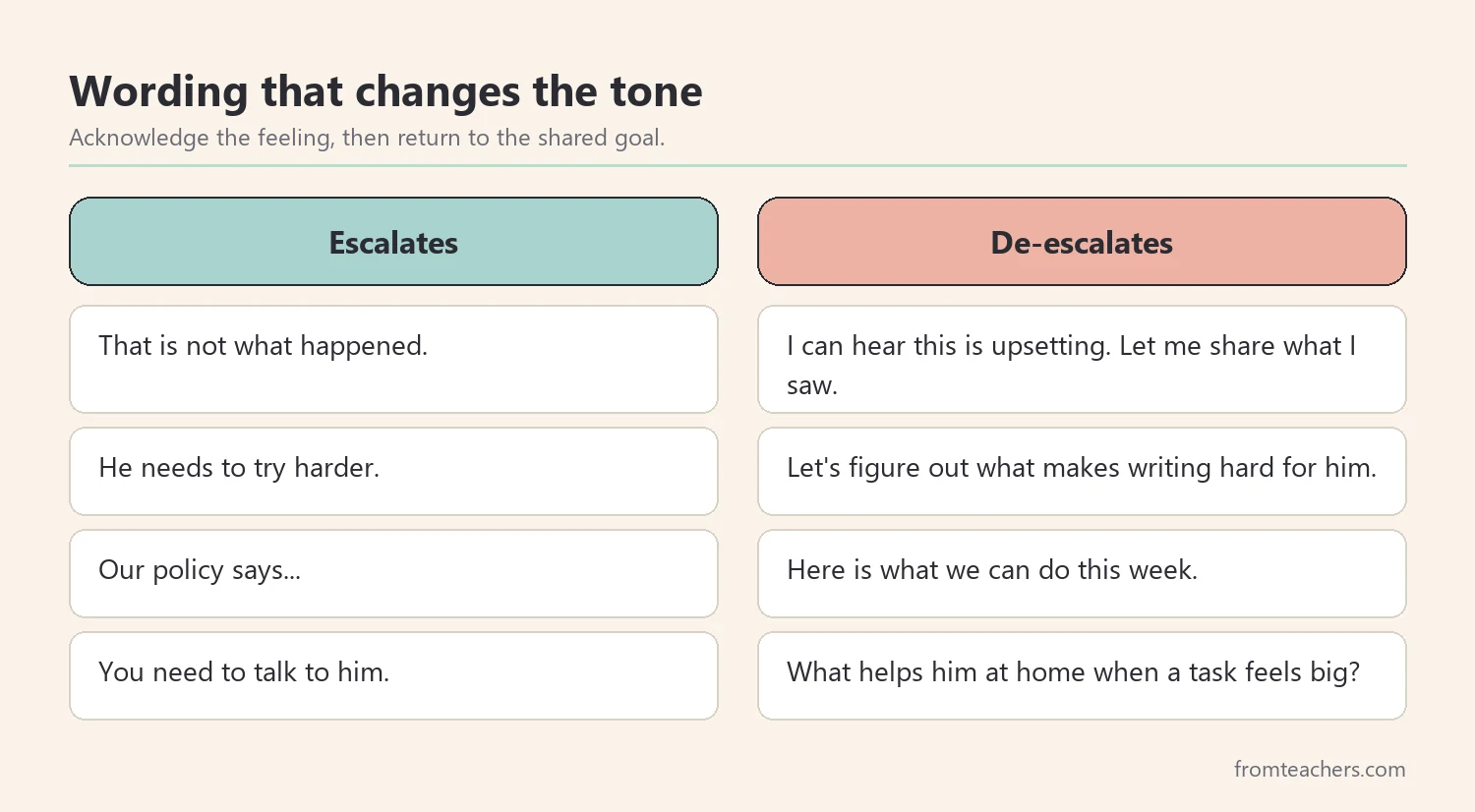
When a parent is frustrated, do not argue with the feeling. Instead, acknowledge it, then return to the shared goal. Compare these two responses:
| Escalates | De-escalates |
|---|---|
| “That is not what happened.” | “I can hear this is upsetting. Let me share what I saw.” |
| “He needs to try harder.” | “Let’s figure out what makes writing hard for him.” |
| “Our policy says…” | “Here is what we can do this week.” |
| “You need to talk to him.” | “What helps him at home when a task feels big?” |
Sometimes a conversation becomes too heated to be useful. In that case, it is fine to pause: “I want to get this right for Leo. Could we take a break and continue tomorrow?” Pausing is not giving up. Rather, it protects the relationship you will need all year.
In Leo’s case, his mother first said, “He never does that at home.” Ms. Reyes reflected it back, and then the mother added that Leo gets stuck when he does not know how to start. That one detail changed the whole plan, and it only surfaced because the teacher listened.
5. Agree on next steps together
Difficult conversations with parents that end without a plan leave everyone anxious. So, before the meeting ends, agree on one or two concrete actions. Keep them small enough to start this week and clear enough that anyone could tell whether they happened.
Good next steps name who does what and by when. For example: “I will give Leo a three-box picture plan for writing starting Monday. You will ask him at dinner which box was easiest. We will talk again in two weeks.” In addition, invite the parent to suggest a step. Families often know strategies that already work at home.
If the student has an IEP or a 504 plan, check whether the concern relates to a goal or an agreed support. If it does, mention that the team may need to review it, and explain how that process works in plain language. Avoid promising changes that the full team has not discussed.
Leo’s plan looked like this:
| Action | Who | When |
|---|---|---|
| Three-box picture plan for writing | Ms. Reyes | Starting Monday |
| Ask Leo which box was easiest | Mother | Daily at dinner |
| Count exits during writing | Ms. Reyes | Two weeks |
| Check-in call | Both | In two weeks |
Notice that every action is observable. Two weeks later, the team can look at the count of exits and decide together whether the plan is working. That shared evidence makes the next conversation much easier.
6. Follow up after difficult conversations with parents
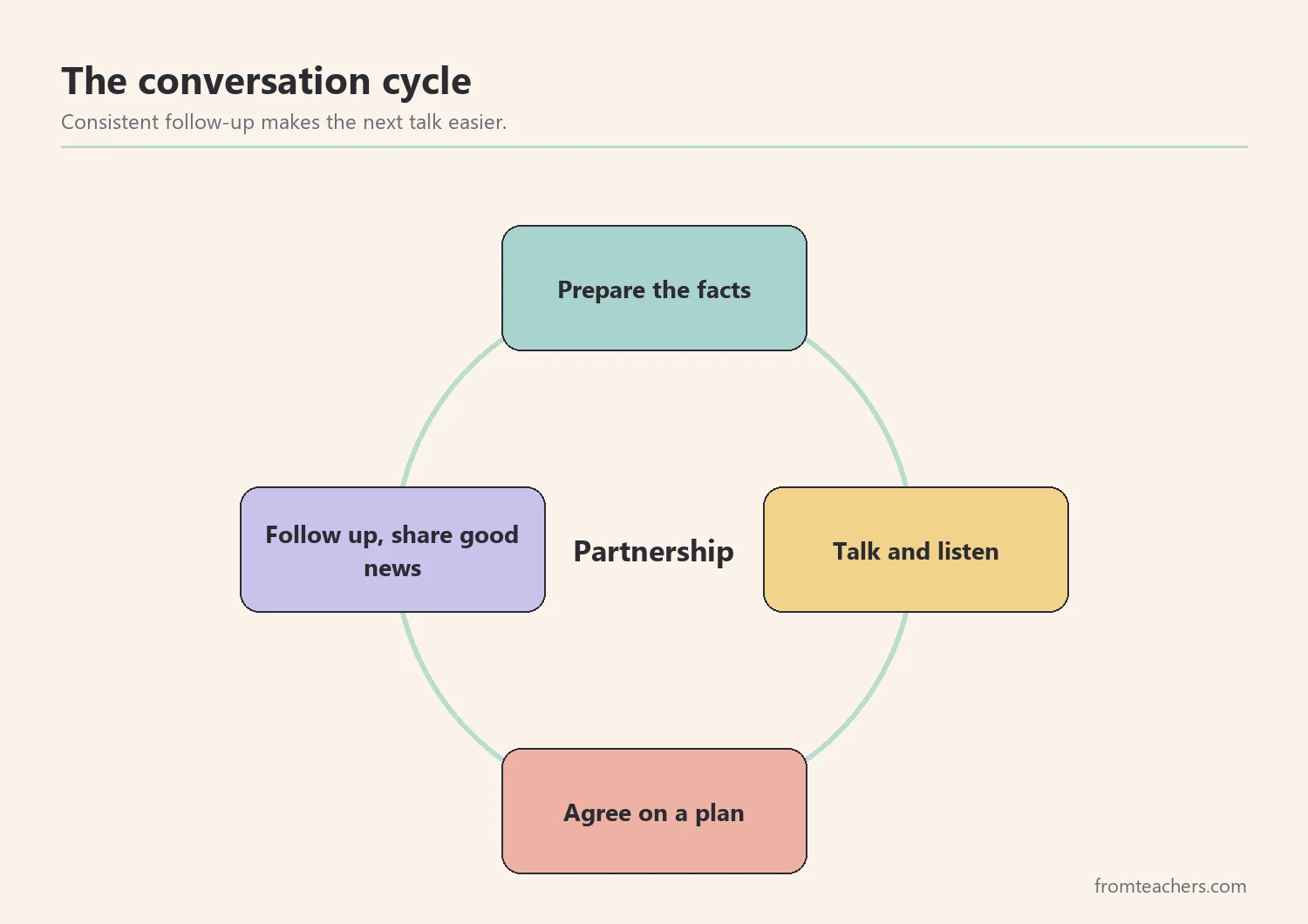
In difficult conversations with parents, the talk itself is only half the work. Within one school day, send a short written summary: what you discussed, what you agreed, and when you will talk next. Keep it brief, neutral, and in the family’s preferred format. This protects both of you from misremembering and shows that you meant what you said.
Then do what you promised, on time. Trust grows less from what you say in the meeting and more from whether the follow-up actually happens. If something changes, tell the parent before they find out another way.
At the check-in, share the evidence first. For Leo, Ms. Reyes reported that exits during writing dropped from four in the first week to one in the second week, so the total was five across the two weeks. She also shared one of his finished picture plans. His mother said Leo had started describing the boxes at dinner. Both agreed to keep the plan and add a fourth box later.
Finally, return to positive contact. After a hard conversation, a quick good-news note a few days later reminds the parent that you still see their child’s strengths. Over time, this rhythm of concern, plan, evidence, and good news turns difficult conversations with parents into routine teamwork.
Common mistakes and how to avoid them
Most difficult conversations with parents go wrong for a few predictable reasons.
- Waiting until the problem is big. Fix: share small concerns early, while they are still easy to solve together.
- Leading with labels. Fix: describe what you saw and heard, and let the facts speak.
- Sending hard news by long email. Fix: use email to schedule, then talk by phone or in person.
- Talking too much. Fix: share your concern in under two minutes, then listen.
- Ending without a plan. Fix: agree on one or two actions with names and dates.
- Forgetting the follow-up. Fix: send a written summary within one school day and keep the check-in date.
Questions teachers and parents ask about difficult conversations with parents
Should I invite another staff member?
It can help in difficult conversations with parents when the topic is sensitive or the student has an IEP, because a case manager or counselor can answer specific questions. However, too many staff can feel intimidating. Let the parent know in advance who will attend and why.
What if the parent disagrees with what I observed?
Disagreement is normal in difficult conversations with parents, since children often behave differently at home and school. Acknowledge their view, share your notes or work samples, and suggest collecting a little more information together before deciding anything.
How do I handle a parent who raises their voice?
Stay calm, lower your own voice, and acknowledge the feeling. If the conversation stops being productive, offer to pause and reschedule. Follow your school’s guidance if you ever feel unsafe.
Is it better to call or email?
For difficult conversations with parents, a call or meeting is usually better, because tone is easy to misread in writing. Email works well for scheduling and for the follow-up summary.
How can parents prepare for a hard talk with a teacher?
Parents can write down their main question, one thing that works at home, and what they hope will change. Bringing that short list keeps the meeting focused and makes the family an equal partner in the plan.
Related reading: How Teachers Communicate With Parents in Special Education, How Parents and Teachers Can Team Up for Special Education Success, and Essential Trauma-Informed Teaching Strategies.
A companion resource for hard conversations with families:

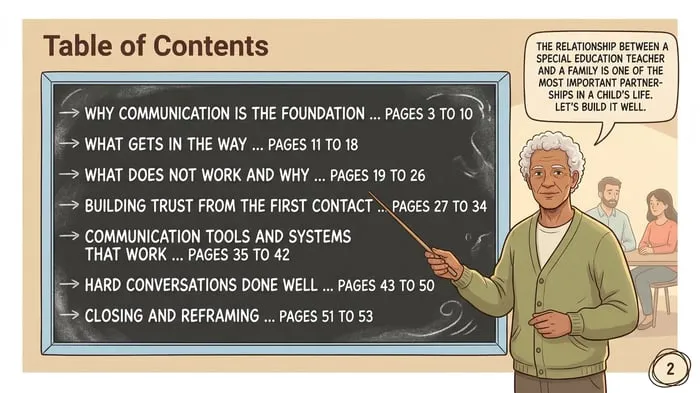
Parent-Teacher Communication Guide for Special Education: a 53 page comic style guide on building trust from the first contact, communication tools that work, and navigating hard conversations with care, including those tied to the IEP process.
Sources and scope
- Individuals with Disabilities Education Act (IDEA), U.S. Department of Education: the law and guidance on parent participation in special education.
- IRIS Center, Vanderbilt University: free training modules, including materials on working with families.
- Center for Parent Information and Resources: resources for families and the parent centers that support them.
- Understood.org: practical guidance for parents and educators of children who learn and think differently.
This guide covers difficult conversations with parents in everyday school settings. It does not replace legal advice, formal dispute resolution, or your district’s policies on safety and reporting.
Key takeaways
- Trust built through small positive contacts makes difficult conversations with parents easier.
- Prepare one concern, a few facts, and one next step, nothing more.
- Open with a real strength and a plain statement of purpose.
- Listen and reflect before you problem solve.
- Agree on observable actions, follow up in writing, and keep your promises.










Leave a Comment