

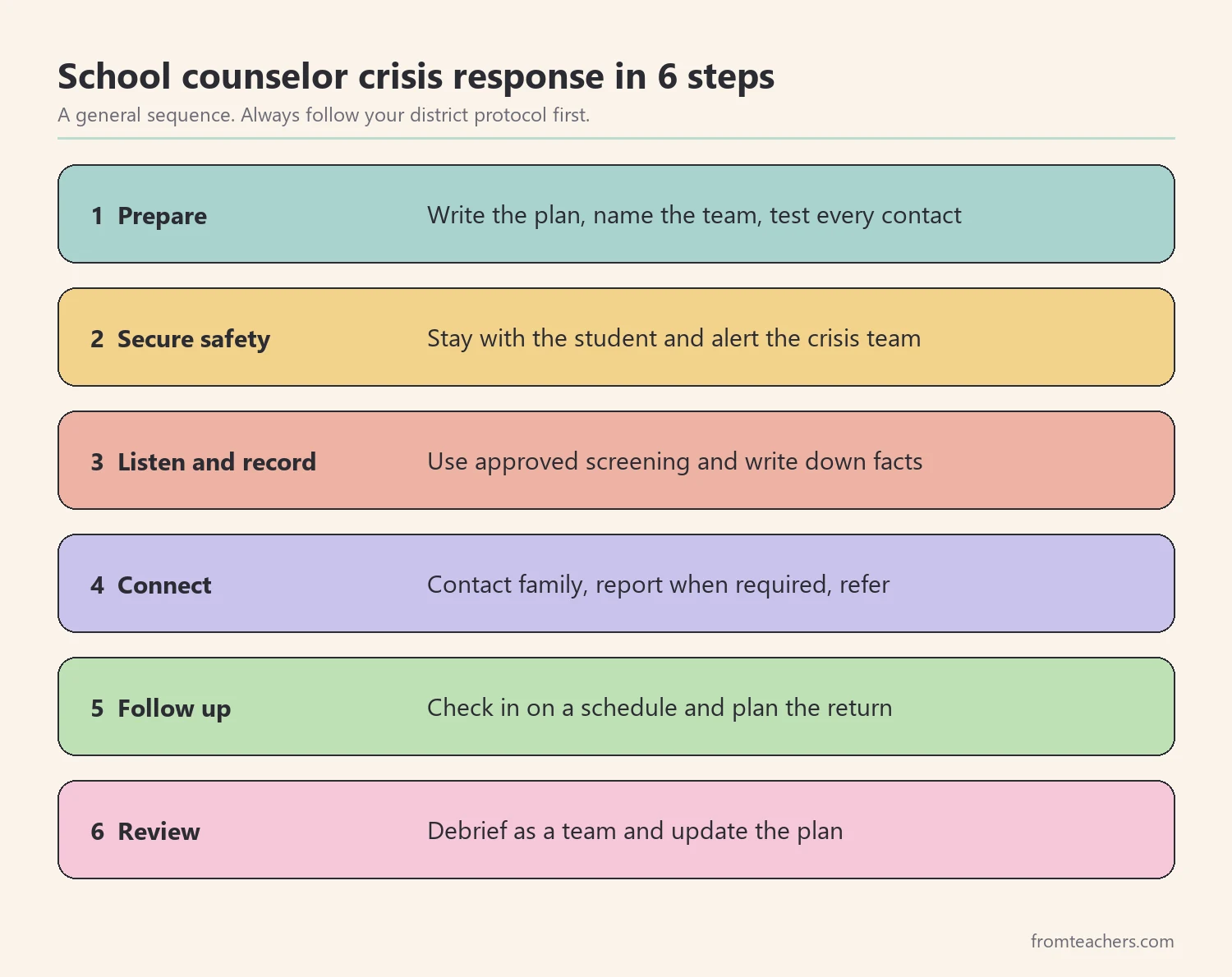
A school counselor crisis response starts long before a student walks into your office in tears, because the steps you follow in that moment are the steps you prepared on a quiet day. When a student shares thoughts of self-harm, discloses abuse, or reacts to a sudden loss, there is no time to invent a process. You need a calm, practiced sequence that keeps the student safe and keeps the right adults informed.
By the end of this guide, you will be able to prepare a school counselor crisis response plan, act in the first minutes, gather and record information, connect the student to family and outside help, and follow up until the student is steady again. Each step includes one fictional example that runs through the whole post, plus short tables and figures you can adapt.
Examples are fictional. Adapt to the student’s goals and agreed supports. This is guidance, not a diagnosis.
At a glance
- Prepare the school counselor crisis response plan, the team, and the contact list before any crisis happens.
- In the first minutes, safety comes first: stay with the student and alert your crisis team.
- Listen without judgment, use your district’s approved screening process, and write down facts.
- Notify families and make referrals according to policy and your legal reporting duties.
- Follow up on a set schedule, then debrief so the next response is smoother.
1. Prepare your school counselor crisis response before it is needed
Preparation is the part of a school counselor crisis response most counselors skip, simply because daily work fills every hour. However, a school counselor crisis response plan written in advance turns panic into a checklist. Start by reading your district crisis policy, your suicide prevention protocol, and your mandated reporting procedures. Then write a one-page summary in your own words.
Next, name your crisis team. Usually this includes an administrator, the school nurse, a school psychologist or social worker, and a front office contact. Agree on who calls families, who calls emergency services, and who stays with the student. In addition, decide where a student in distress can sit privately, away from hallways and windows.
Also, build a contact list and keep it in two places: printed in a sealed folder and saved where the team can reach it. Include district crisis staff, local mental health providers, child protective services, and the 988 Suicide and Crisis Lifeline.
| Item | Who owns it | Where it lives |
|---|---|---|
| Crisis team roles | Counselor and principal | Sealed folder, shared drive |
| Contact list | Counselor | Folder, office wall, phone |
| Screening form | District mental health lead | Counselor office |
| Documentation template | Counselor | Secure records system |
Worked example. Ms. Rivera, a fictional high school counselor, spends one August afternoon with her principal. Together they confirm four roles, test every phone number on the list, and choose a small conference room as the calm space. That hour later saves her many anxious minutes.
If you want a ready-made reference for these roles, the School Counselor Handbook on crisis management and at-risk student support walks through identifying student crises and building safety and intervention plans, so you are not starting from a blank page.
2. Secure safety in the first minutes
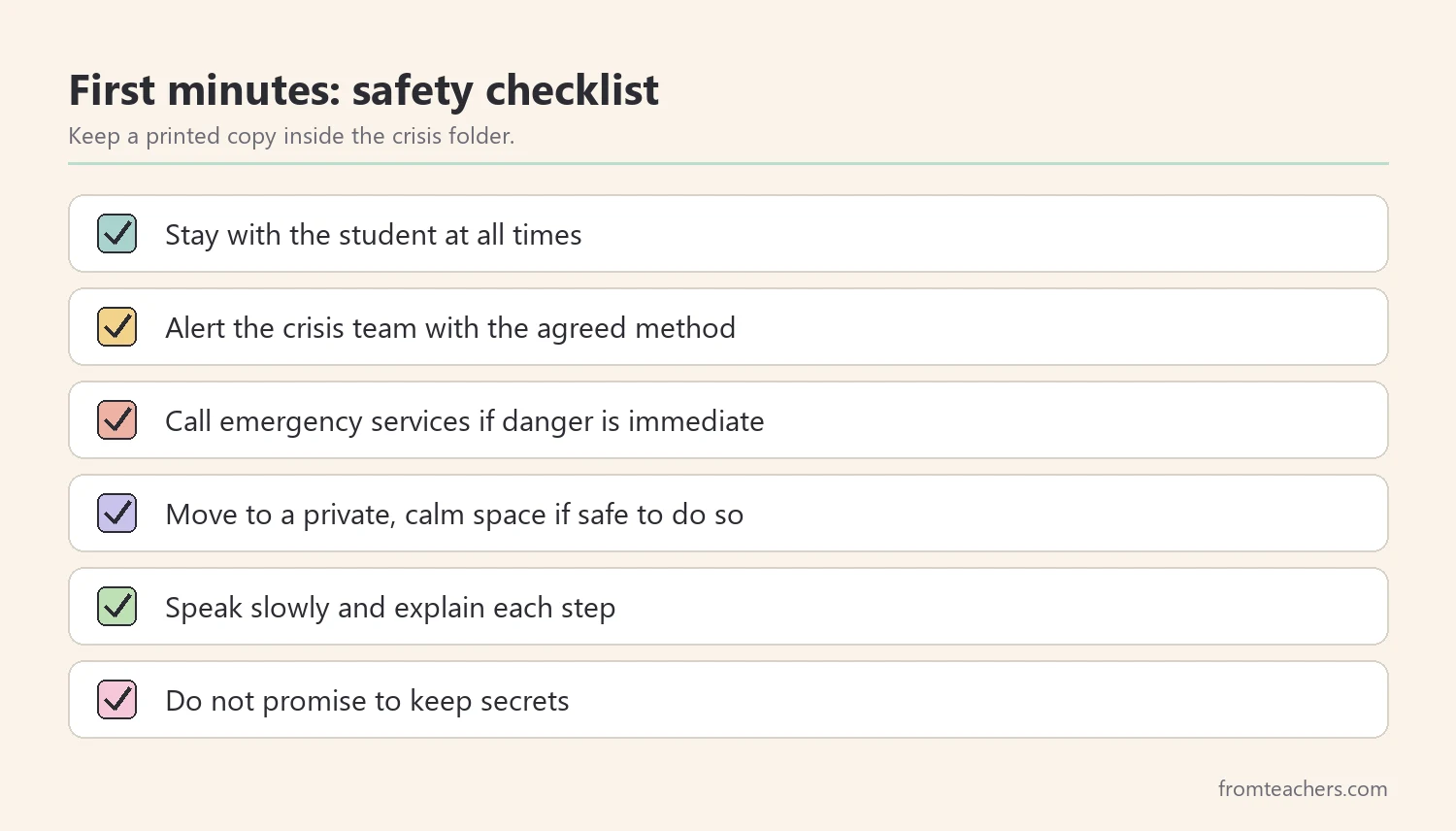
When a crisis begins, the first goal of any school counselor crisis response is simple: keep the student and others safe. Therefore, never leave a student alone if you believe they may be at risk of harm. Move to a private, quiet space if you can do so safely, and keep the door within reach.
Then, alert your crisis team using the agreed method, such as a call to the office or a short code phrase. If there is immediate danger, contact emergency services right away. Your school protocol always comes before any general advice, including this guide.
Meanwhile, stay calm in your voice and body. Sit at the student’s level, speak slowly, and use short sentences. Remove objects that could be used for harm if your protocol allows it. Above all, tell the student what you are doing and why, so they do not feel trapped or tricked.
Worked example. During third period, a teacher walks Jordan, a fictional grade 10 student, to Ms. Rivera’s office. Jordan says, quietly, that “nothing matters anymore.” Ms. Rivera calls the office using the agreed phrase, asks the assistant principal to join, and stays seated beside Jordan. Within a few minutes, two trained adults are present and the door stays open to the inner office.
Notice what she does not do. She does not send Jordan back to class to “think about it,” and she does not promise to keep the conversation secret. Instead, she explains gently that keeping Jordan safe means bringing in other caring adults.
3. Listen, assess, and document in your school counselor crisis response
Once the student is safe, the next job in your school counselor crisis response is to understand what is happening. Start by listening. Use open questions such as “Can you tell me more about what has been going on?” and reflect back what you hear. Avoid arguing with feelings or rushing to solutions.
Next, use the screening or risk assessment process your district has approved. Many districts adopt a specific tool and require training before use. Ask direct questions when your protocol calls for them, including whether the student is thinking about suicide. Asking clearly and kindly shows the student you can handle the answer.
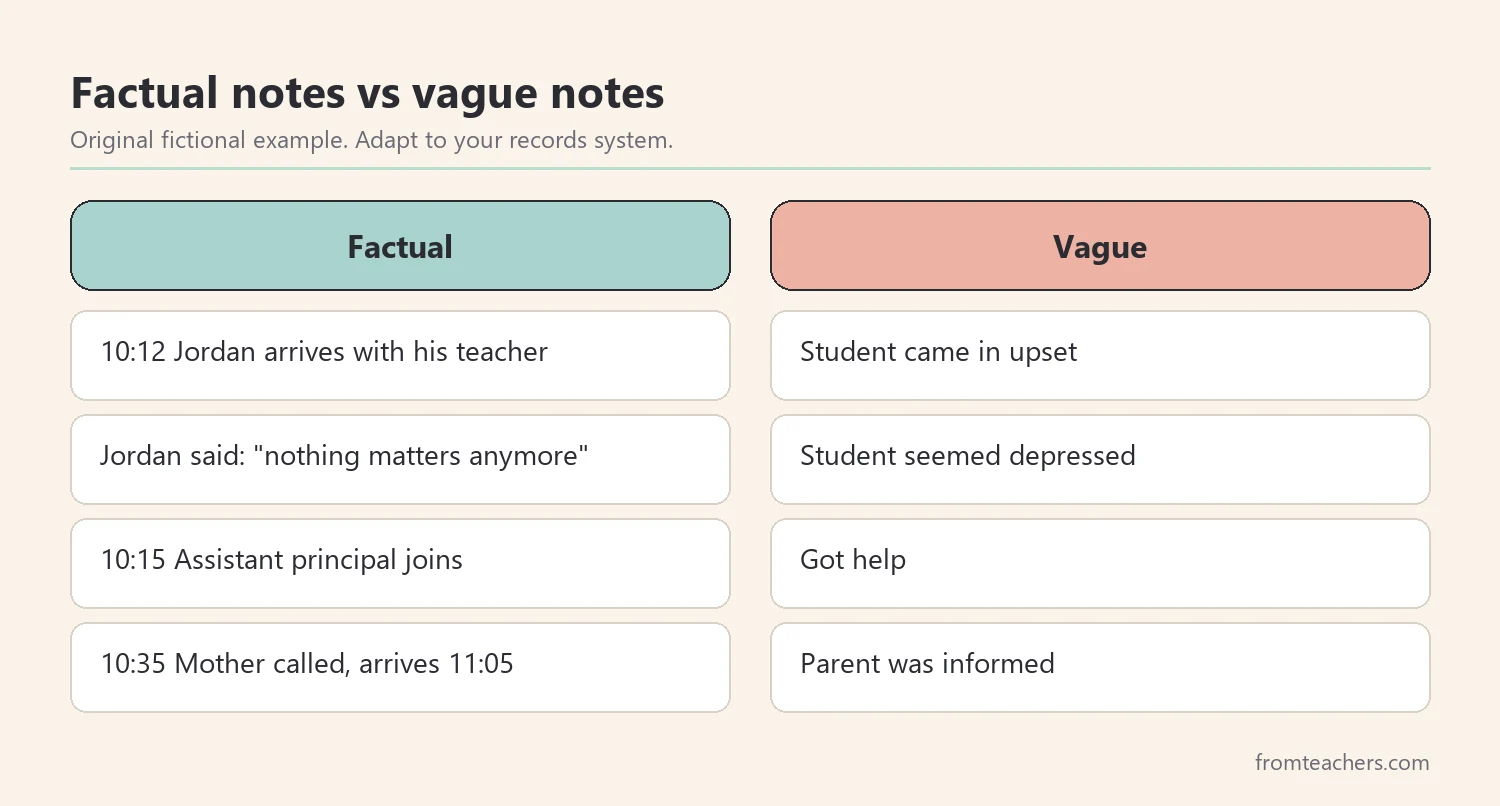
At the same time, document your school counselor crisis response with facts, not interpretations. Record the time, who was present, the student’s own words in quotation marks, and each action taken. Short, accurate notes protect the student and help every adult who joins later.
| Time | What happened | Action |
|---|---|---|
| 10:12 | Jordan arrives with teacher | Office alerted by code phrase |
| 10:15 | Assistant principal joins | Two adults present |
| 10:20 | Screening questions asked | Answers recorded word for word |
| 10:35 | Screening complete | Family contact started |
Worked example. Ms. Rivera asks Jordan the district screening questions and writes Jordan’s answers in his own words. She notes that his grandfather died two weeks ago and that he has not been sleeping well. She avoids labels such as “depressed” in her notes, because her role is to describe, not diagnose.
4. Connect the student to family and support
Strong school counselor crisis response never ends with the counselor alone. After the screening, follow your protocol to contact a parent or guardian. Explain what you observed, what the school has done, and what happens next. Use plain language and keep the tone calm and supportive.
However, there is one key exception. If you suspect abuse or neglect at home, follow your mandated reporting law and district procedure first. In that case, child protective services or law enforcement, not the counselor, decide how and when families are contacted.
Then, make referrals. These may include a community mental health provider, the student’s doctor, or a district clinician. Give the family written contact information, including the 988 Suicide and Crisis Lifeline, and confirm that someone will pick the student up when your protocol requires it.
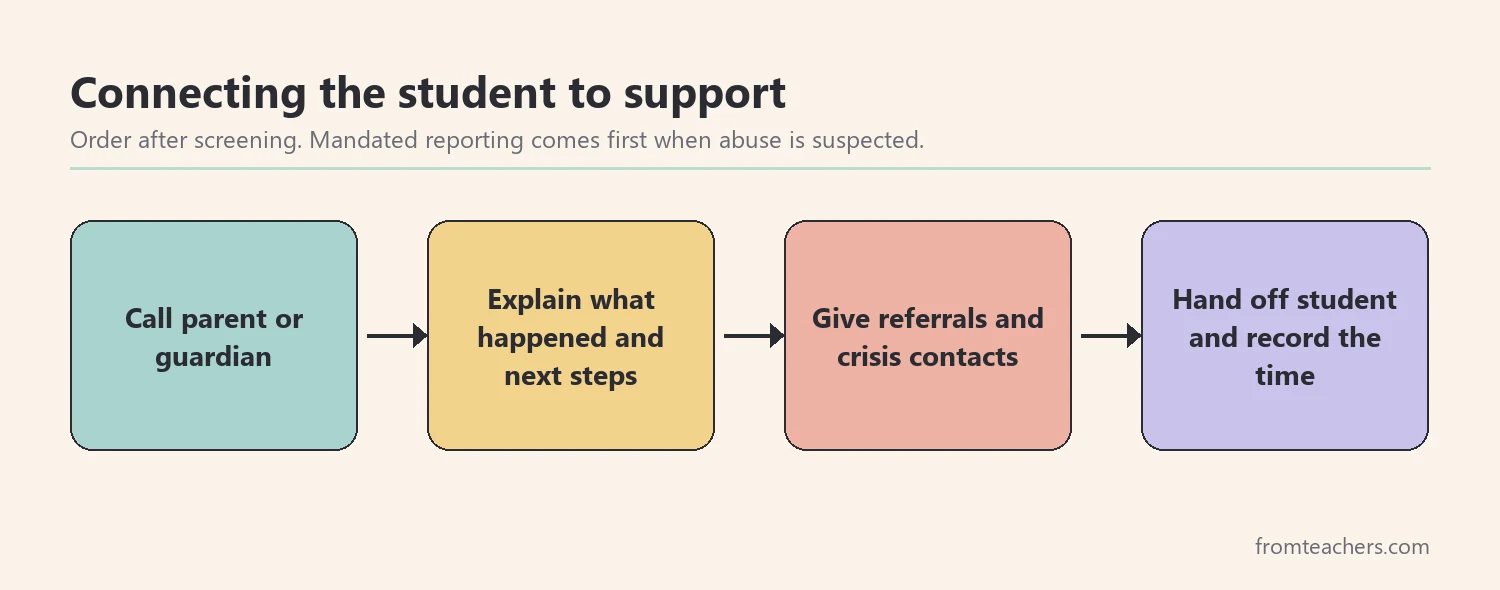
Worked example. Ms. Rivera calls Jordan’s mother, explains the morning in short sentences, and asks her to come to school. When she arrives, the assistant principal and Ms. Rivera meet with both of them together. Ms. Rivera gives Jordan’s mother a printed sheet with a local provider, the 988 Lifeline, and her own office number. Jordan leaves with his mother, and the time of the hand-off goes into the notes.
In addition, agree on a simple safety plan with the student and family before they leave, if your protocol includes one. A safety plan lists warning signs, coping steps, trusted adults, and crisis contacts in the student’s own words.
5. Follow up and plan the return to class
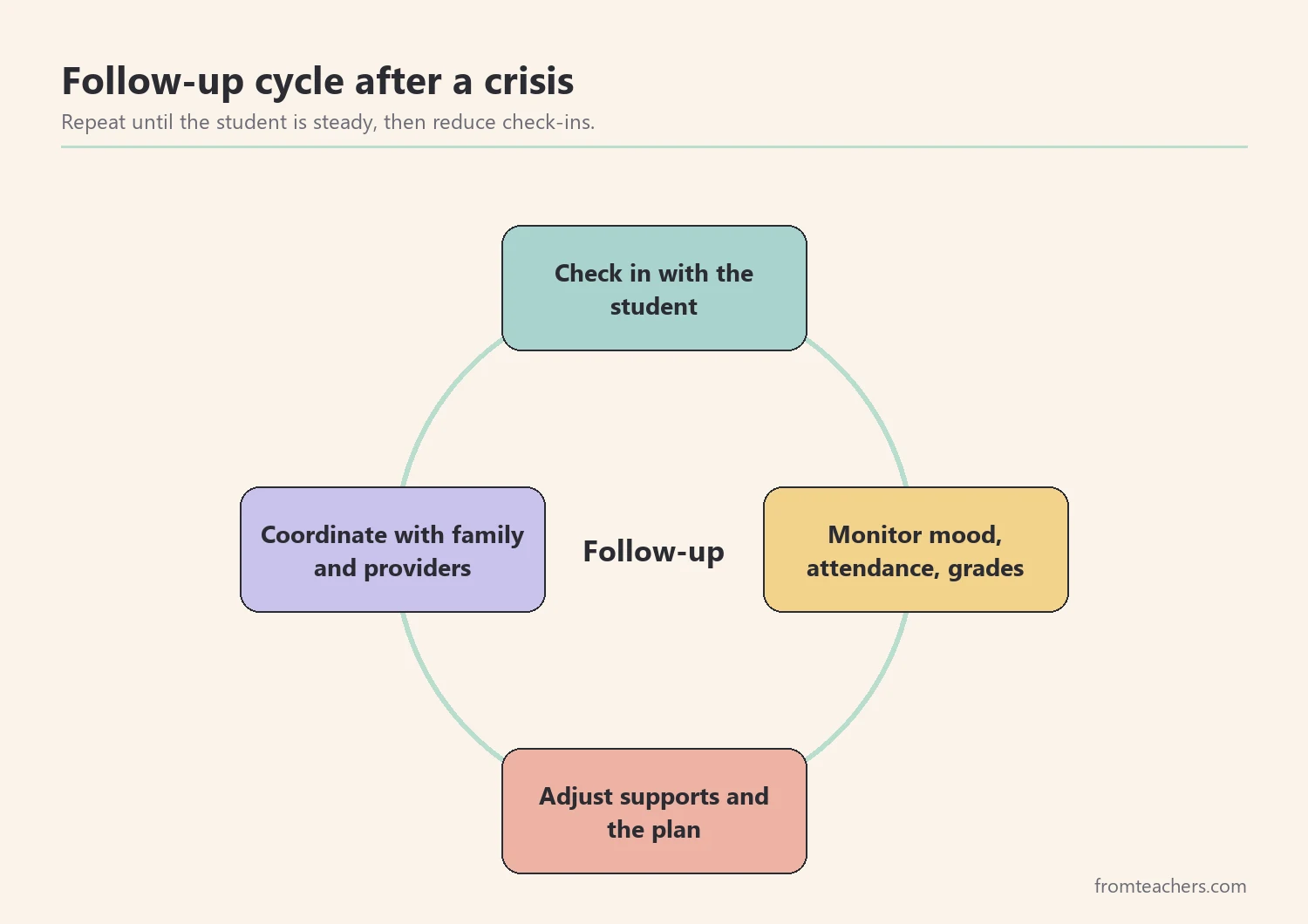
The days after a crisis matter as much as the school counselor crisis response itself. For this reason, schedule a check-in for the student’s first morning back. Ask how they are feeling, review the safety plan, and agree on a quiet signal or pass the student can use when they need a break.
Also, share only what teachers need to know. A teacher may need to know that the student can step out to see the counselor, but not the details of what was said. Confidentiality builds trust, and trust keeps students coming back when they struggle again.
Then, keep checking in on a set schedule. Many counselors start with daily check-ins, then move to weekly as the student stabilizes. Adjust supports when grades, attendance, or mood change, and stay in touch with outside providers when the family has given permission.
| Week | Check-ins | Focus |
|---|---|---|
| 1 | 5 (daily) | Safety plan, break pass, sleep |
| 2 | 3 | Missed work, friendships |
| 3 and 4 | 2 (weekly) | Grief support, routines |
| Total | 10 | Review with family at week 4 |
Worked example. Jordan returns two days later. Ms. Rivera meets him at the front door and walks him to first period. She emails his teachers a short note that he may use a break pass to visit her office. Over four weeks, they meet ten times, and Jordan joins a small grief group the school already runs.
6. Review the school counselor crisis response as a team
Finally, every school counselor crisis response is a chance to improve the system. Within a week, meet with your crisis team for a short debrief. Ask three questions: What worked? What slowed us down? What will we change?
Keep the debrief focused on process, not blame. For example, a phone number that was out of date is a system fix, not a personal failure. Update your plan, your contact list, and your training schedule based on what you learn.
In addition, take care of yourself. Crisis work is demanding, and counselors who rest and seek support stay effective longer. Talk with a supervisor or colleague, and use your district employee assistance program if one is offered.
Worked example. In the debrief, Ms. Rivera’s team notices that the code phrase worked well, but nobody knew who would drive if the family could not come. They add that role to the plan and test it at the next staff meeting.
Common mistakes and how to avoid them
- Leaving the student alone “for a minute.” Fix: decide in advance who stays with the student while others make calls.
- Promising confidentiality. Fix: explain early that you keep most things private, but safety concerns must be shared with the adults who can help.
- Writing opinions instead of facts. Fix: record times, names, actions, and the student’s exact words.
- Skipping the follow-up. Fix: put check-ins on your calendar before the student leaves the building.
- Working outside your role. Fix: screen and refer according to policy; leave diagnosis and treatment to licensed clinicians.
- Never updating the plan. Fix: debrief after each school counselor crisis response and review the plan at the start of every school year.
Questions teachers and parents ask about school counselor crisis response
What should a teacher do if a student shares thoughts of self-harm?
Stay with the student, stay calm, and contact the counselor or administrator right away using your school’s process. Do not promise to keep it secret. Walk the student to the counselor rather than sending them alone.
Will the school call parents after a crisis?
In most cases, yes, following district policy. The main exception is a suspected abuse situation, where mandated reporting rules guide who contacts the family and when. Families can ask the counselor to explain the process.
Is the counselor diagnosing my child?
No. A school counselor crisis response focuses on safety, screening, and connecting families with qualified providers. Diagnosis and treatment come from licensed medical or mental health professionals.
How long does follow-up usually last?
Follow-up after a school counselor crisis response depends on the student and the situation. Many counselors check in daily at first, then move to weekly meetings as the student settles. The plan is reviewed with the family and adjusted as needed.
How can parents support a child after a school crisis?
Keep routines steady, listen without judgment, and keep crisis contacts handy. Stay in touch with the counselor and share changes in sleep, mood, or behavior. Follow the outside provider’s guidance closely.
Related reading: Building Stronger School Counseling Programs, Trauma-Informed Teaching Strategies, and School Counseling Strategies for Student Success.
A companion resource for school counselors:


School Counselor Handbook: Crisis Management and At-Risk Student Support: practical guidance across 19 counselor roles, including identifying student crises, building safety and intervention plans, conflict mediation, and advocating for at-risk students.
Sources and scope
- American School Counselor Association (ASCA): professional standards, ethics, and position statements for school counselors.
- National Association of School Psychologists (NASP): school safety and crisis resources for educators and families.
- 988 Suicide and Crisis Lifeline: free, confidential crisis support by call, text, or chat in the United States.
- SAMHSA: federal mental health and substance use resources, including prevention materials for schools.
- Centers for Disease Control and Prevention (CDC): public health information on youth mental health and suicide prevention.
This guide offers a general process for school counselor crisis response; it does not replace your district policy, state law, professional training, or the judgment of licensed clinicians and emergency services.
Key takeaways
- Write and test your school counselor crisis response plan before you need it.
- Safety first: never leave an at-risk student alone, and alert your team at once.
- Listen, use approved screening, and document facts in the student’s own words.
- Connect families and outside providers, following reporting laws and policy.
- Follow up on a schedule and debrief as a team after every crisis.




Leave a Comment