
Supporting ELL students with disabilities starts with one of the hardest questions in education: is this student struggling because they are still learning English, or because of a learning need that would show up in any language? Picture a fourth grader who has been in the country for a year and a half. He chats with friends at recess but cannot retell a short story in class, forgets new words from one day to the next, and has started refusing to speak during lessons.
This guide gives you a careful, step-by-step way to think about that question. After reading, you will be able to gather the right information, compare language patterns with learning patterns, try targeted supports, respond to frustration with respect, and work well with specialists and families before any decision about evaluation is made.
Examples are fictional. Adapt to the student’s goals and agreed supports. This is guidance, not a diagnosis.
At a glance
- Language learning and disability can look similar, so avoid quick conclusions either way.
- Gather information from home, the first language, and several settings.
- Compare the student with peers who have similar language backgrounds.
- Try targeted supports and track the response before deciding on next steps.
- Work with ESL staff, specialists, and families, and repair trust when misunderstandings happen.
1. Understand why the question is so hard
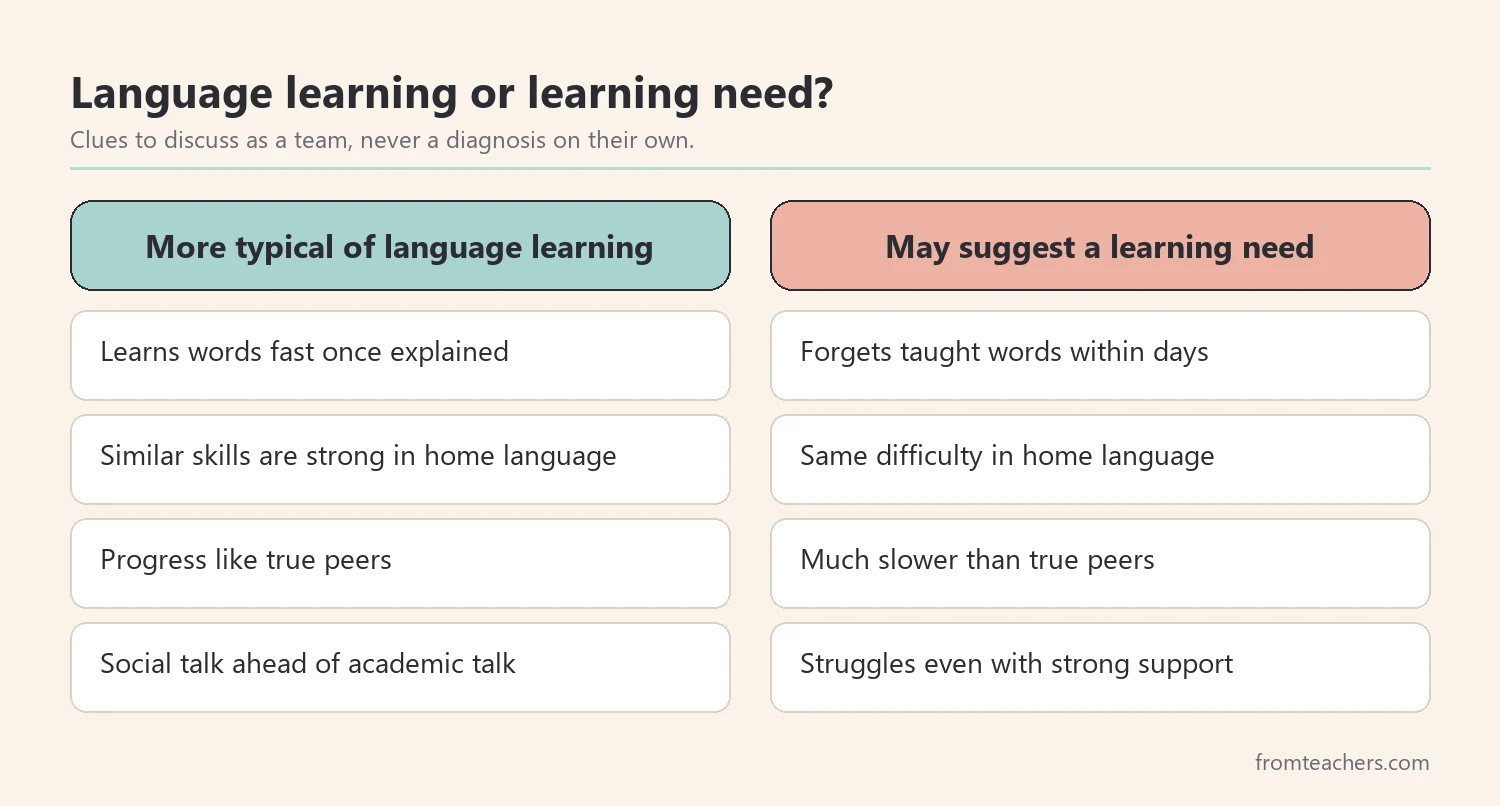
Many signs of second language learning overlap with signs of a learning disability. Both groups of students may have trouble following directions, remembering new vocabulary, reading with understanding, or writing organized paragraphs. As a result, schools can make two opposite mistakes.
The first mistake is over-identification: treating normal language learning as a disability. The second is under-identification: waiting too long because “he is still learning English,” while a real learning need goes unsupported. Both mistakes can affect a student for years.
It also helps to remember that social language usually develops faster than academic language. A student may speak easily on the playground while still finding textbook language very hard. That gap is expected and is not, on its own, a sign of disability.
Under federal law, a student should not be identified with a disability if the main reason for difficulty is limited English proficiency. In addition, evaluations must be fair and, where feasible, given in the language most likely to give accurate information. Therefore, careful information gathering comes before any referral decision.
Worked example: Luis, grade 4
Luis arrived 18 months ago and speaks Spanish at home. He is friendly at recess and loves soccer. In class, his teacher notices that he forgets new words quickly, struggles to retell stories even with pictures, and recently stopped answering questions aloud. She wonders whether this is language learning or something more.
2. Gather information about ELL students with disabilities
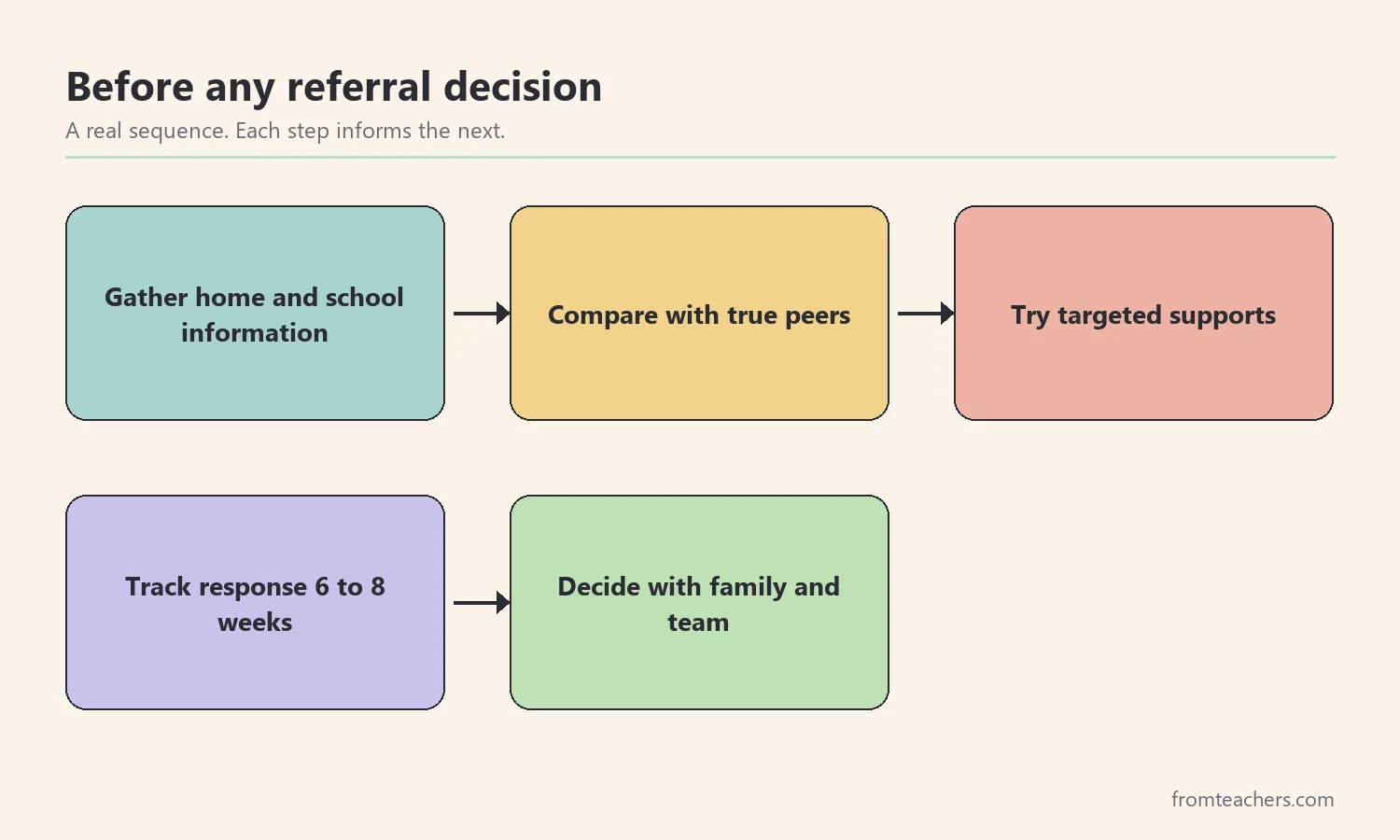
Good decisions depend on good information. Collect it from several sources before drawing conclusions about ELL students with disabilities.
Key information to gather:
- Language history: languages spoken at home, age of first exposure to English, and time in English instruction.
- Prior schooling: years of school, any interruptions, and the language of instruction.
- First language skills: does the student have similar difficulties in the home language? Families and bilingual staff can help answer this.
- English proficiency data: results from your state’s English language proficiency assessment.
- Classroom work: samples across subjects, including math where language demands may be lower.
- Health and development: vision and hearing checks, and any developmental concerns the family has noticed.
The home language question is especially important. If a student learns new words easily in Spanish but not in English, language learning is the more likely explanation. If the same difficulty shows up in both languages, a learning need is more likely. However, this is a clue, not a conclusion.
Also, look at the student’s strengths. Luis, for instance, solves math problems quickly when they are shown with numbers and pictures. Strengths like this help the team plan supports and remind everyone that the student is capable, whatever the final explanation turns out to be.
Worked example: what Luis’s team learned
| Source | Finding |
|---|---|
| Family interview | Luis also forgets new Spanish words and struggled to read in Spanish |
| Prior schooling | Two years of school before arrival, with a gap of several months |
| ESL teacher | Slower progress than peers with similar backgrounds |
| Vision and hearing | Both screened, no concerns |
3. Compare with true peers
A fair comparison looks at students with similar language backgrounds, similar time in the country, and similar prior schooling. Comparing an English learner with native English speakers will almost always make the learner look behind.
Ask the ESL or bilingual teacher how the student’s progress compares with true peers. If most students with similar backgrounds are making steady progress and this student is not, despite good instruction, the difference is worth exploring.
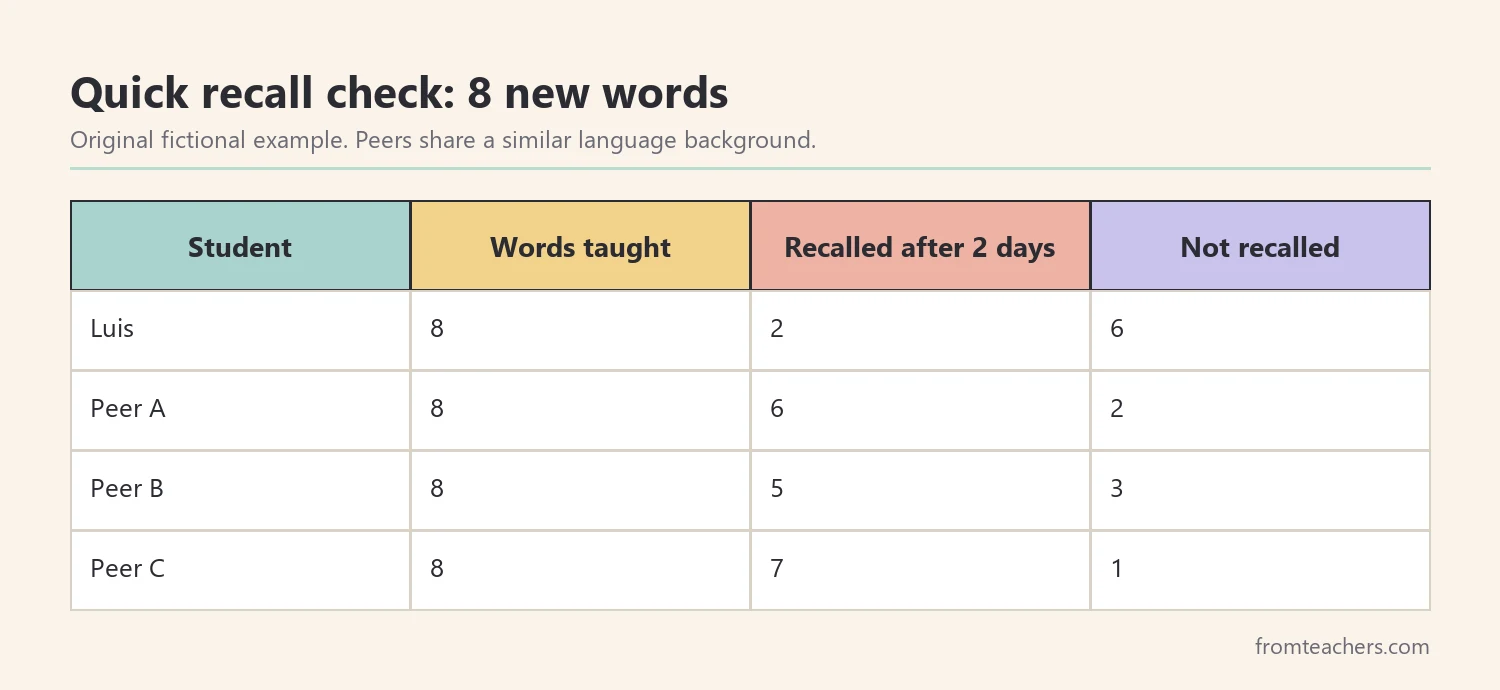
Moreover, look closely at specific skills. For example, compare language confusion with memory gaps:
- Language confusion: the student does not understand a word but learns it quickly once it is explained or translated.
- Memory gaps: the student understands the word when taught, but forgets it again within a day or two, even with practice.
To test the difference, teach a small set of new words with pictures and home language support, then check recall after two days. Students who retain the words probably needed language support. Students who forget most of them, even with strong support, may need further investigation.
For a ready reference of these comparisons, the ELL with disabilities Need, Strategy, and Why tables cover identifying the type of learning barrier, including language confusion versus memory gaps and how to check for each.
4. Try targeted supports for ELL students with disabilities
Before any referral, provide strong, targeted instruction and watch how the student responds. This step protects students from being identified only because they did not get enough language support. At the same time, it shows whether the student needs more than good language teaching.
Effective supports include:
- Visuals and gestures: pictures, real objects, and demonstrations for new words.
- Home language bridges: cognates, bilingual glossaries, or a peer who shares the language.
- Sentence frames: “The character felt ___ because ___.”
- Small group instruction: short, focused practice on specific skills.
- Reduced language load: fewer words on a page and one direction at a time, without lowering the learning goal.
Track progress weekly with a simple measure that matches the concern, such as words retained after two days or retelling with key story elements. Run the support for long enough to see a pattern, often six to eight weeks.
Worked example: Luis’s support period
| Week | Words retained after 2 days (of 8) | Story parts retold (of 5) |
|---|---|---|
| 1 | 2 | 1 |
| 3 | 3 | 2 |
| 5 | 3 | 2 |
| 7 | 4 | 2 |
Luis made some progress, but much less than his peers with similar backgrounds. Together with the family’s report of similar difficulties in Spanish, the team decided to discuss a referral for a full evaluation.
5. Respond to frustration with respect
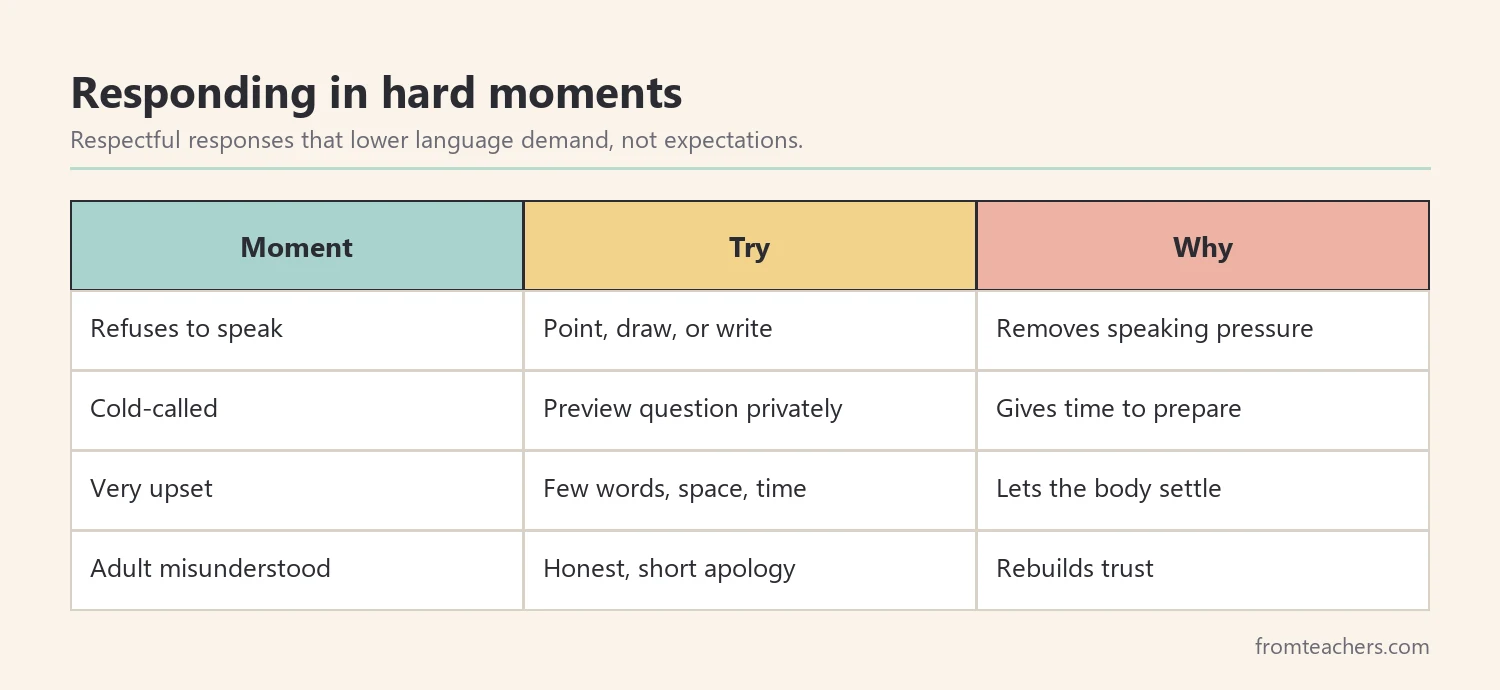
Students who struggle in two languages often feel frustrated, embarrassed, or anxious. Some stop speaking in class. Others become angry or melt down when demands feel impossible. These reactions are understandable, and how adults respond can either rebuild trust or deepen avoidance.
When a student refuses to speak:
- Lower the language demand in the moment: allow pointing, drawing, or a written answer.
- Offer a partner who shares the language for low-pressure practice.
- Avoid calling on the student without warning; preview the question privately first.
When a student becomes very upset:
- Use few words and a calm voice.
- Give space and time to settle.
- Talk later, privately, using simple language or an interpreter.
Sometimes adults misunderstand a student or family, for example by assuming laziness or misreading a cultural norm. When that happens, take responsibility. A short, honest repair, such as “I misunderstood what was happening. I am sorry, and I want to help,” can rebuild trust with both the student and the family.
Worked example: repairing trust with Luis
Luis’s teacher had told him to “try harder” with vocabulary before she understood the pattern. After the team meeting, she spoke to him privately with the bilingual aide: “I thought you were not trying. I was wrong. We are going to find better ways to help you remember.” Luis began answering in class again within a week, using picture cards at first.
6. Plan next steps for ELL students with disabilities as a team
Decisions about ELL students with disabilities should never rest with one person. Bring together the classroom teacher, the ESL or bilingual teacher, the school psychologist, the speech-language pathologist when relevant, and the family.
When an evaluation is considered:
- Use evaluators with experience assessing bilingual students when possible.
- Assess in the student’s home language as well as English, where feasible.
- Provide interpreters for family meetings and translated documents.
- Share all the information gathered, including the response to supports.
Moreover, listen to specialist feedback with an open mind. If an evaluator suggests a different explanation than you expected, ask what they saw and how you can adjust your teaching. Learning from that feedback improves support for this student and future students.
Worked example: Luis’s team meeting
The meeting included Luis’s parents, a Spanish interpreter, the classroom teacher, the ESL teacher, and the school psychologist. The team shared the family interview, the recall checks, and the support data. His parents agreed to an evaluation that would include Spanish testing, and they asked for written updates in Spanish. Everyone left knowing the next step and who was responsible for it.
Finally, remember that a student can be both an English learner and a student with a disability. If the student qualifies for special education, they still need English language development services. The two kinds of support should work together.
Common mistakes and how to avoid them
- Waiting years “until English is better.” Fix: gather information and try targeted supports early.
- Referring too fast. Fix: compare with true peers and track response to strong language support first.
- Ignoring the home language. Fix: ask families and bilingual staff about skills in the first language.
- Testing only in English. Fix: request bilingual evaluation where feasible.
- Dropping language services after identification. Fix: provide both special education and English language development.
Questions teachers and parents ask about ELL students with disabilities
How long should we wait before considering a disability?
There is no fixed waiting period. If a student is making much less progress than true peers despite strong, targeted support, the team can discuss next steps. Waiting only because the student is an English learner is not appropriate.
Can a student receive both ESL and special education services?
Yes. A student who qualifies for special education still has the right to English language development services. The two teams should coordinate.
Should testing be done in the home language?
Federal law requires evaluations to be given in the language and form most likely to give accurate information, where feasible. Many evaluations for English learners include the home language.
How can families help the team?
Families can share how the child learns at home, in the home language, and how they developed as a young child. That information is often one of the best clues the team has. Ask for an interpreter if you need one; schools should provide it.
What if a student refuses to speak in class?
Lower the language demand, allow other ways to respond, and build trust with low-pressure practice. Silent periods are common in language learning, but combined with other concerns they are worth discussing with the team.
Related reading: Teacher-Parent Communication in Special Education, Accommodations vs Modifications, and Special Education Challenges and Strategies.
A companion resource for ELL students with disabilities:
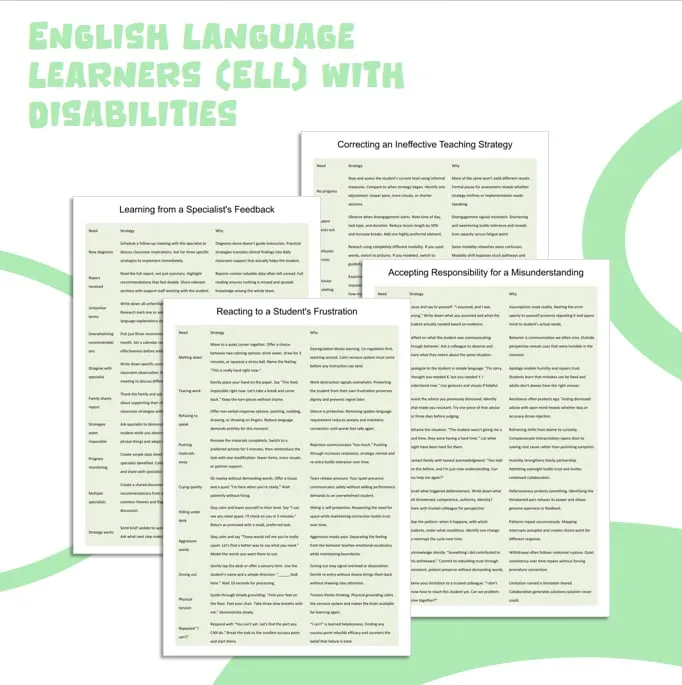
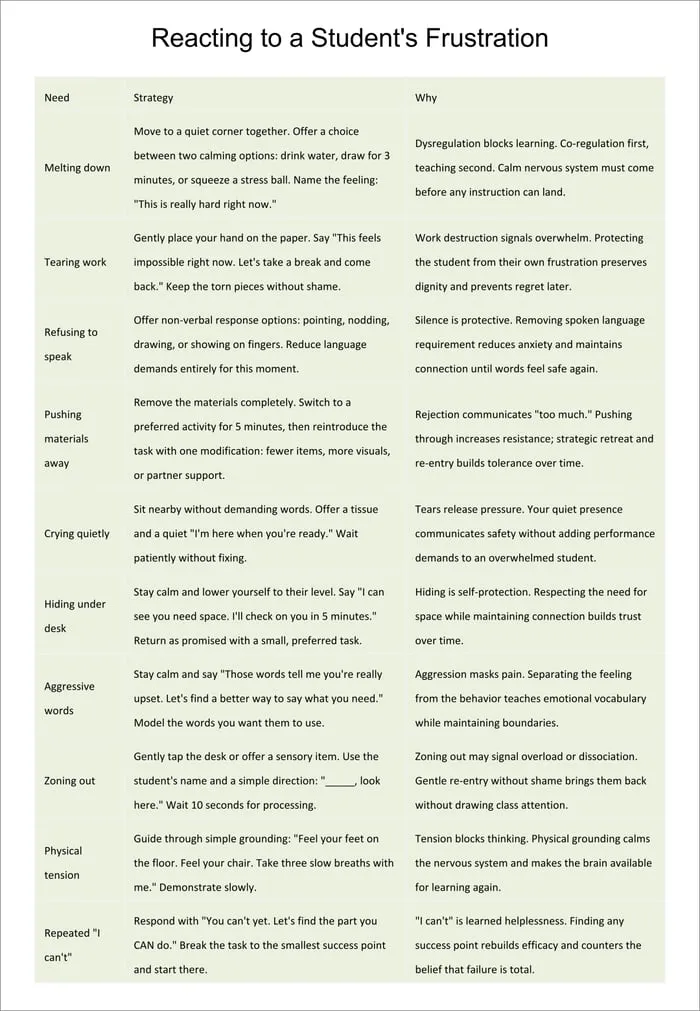
English Language Learners (ELL) with Disabilities: 12 pages of Need, Strategy, and Why tables on identifying the type of learning barrier, reacting to a student’s frustration, learning from specialist feedback, accepting responsibility for misunderstandings, and reducing language demands without lowering expectations.
Sources and scope
- Individuals with Disabilities Education Act (IDEA): federal requirements for fair, non-discriminatory evaluation.
- National Clearinghouse for English Language Acquisition (NCELA): federal resources on English learners, including the English Learner Tool Kit.
- Colorin Colorado: resources for educators and families of English language learners.
- IRIS Center, Vanderbilt University: modules on culturally and linguistically diverse learners.
Scope: this guide helps teachers think carefully about language learning and possible disability. It does not replace a formal evaluation by qualified professionals or legal guidance on identification.
Key takeaways
- Language learning and disability can look alike, so gather information first.
- Check skills in the home language and compare with true peers.
- Provide strong, targeted supports and track the response.
- Respond to frustration calmly and repair misunderstandings honestly.
- Decide as a team, and keep language services in place either way.






Leave a Comment