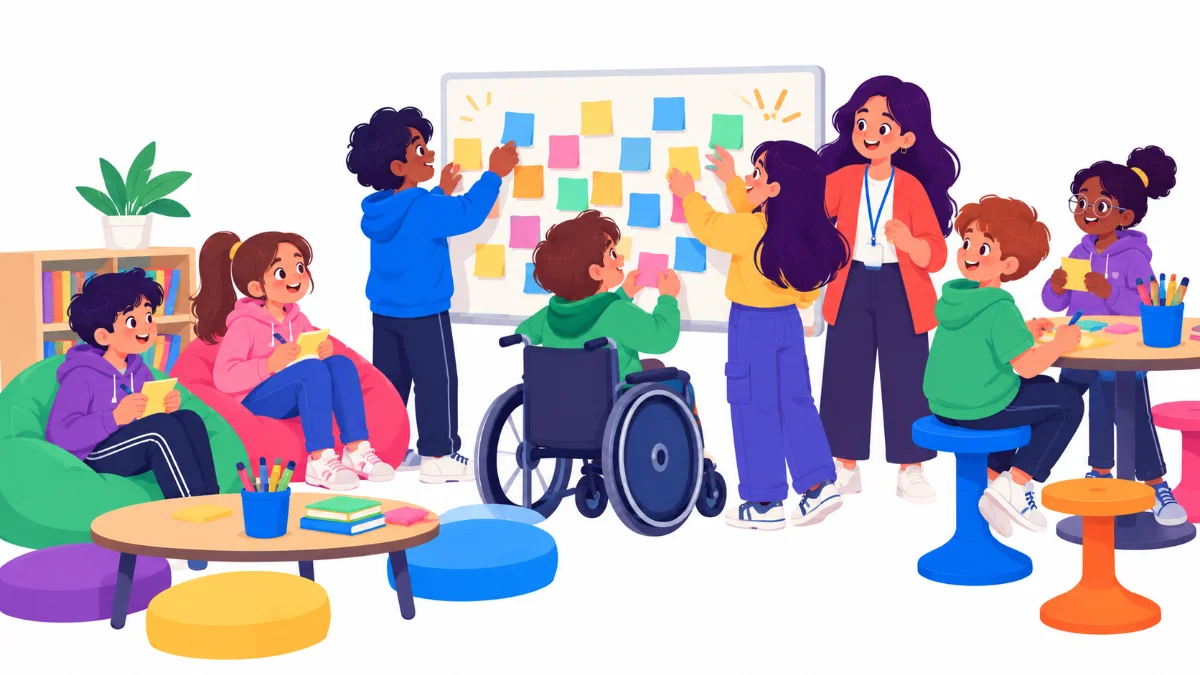

Classroom belonging activities matter more in middle school than many teachers expect, because this is the age when students notice who sits where, who gets picked and who is left out. Picture Sam, a seventh grader with a physical disability who uses a wheelchair and joins a general education science class for the first time. The ramp is in place and the desks are spaced, yet Sam still eats lunch alone and rarely speaks in group work.
This list is for middle school teachers and inclusion specialists who want every student to feel part of the class, not just present in the room. It ranks ten activities from quick daily routines to longer projects. Each activity explains what it is, why it supports belonging, how to run it and how it worked in Sam’s class. You will also find a sample plan and a checklist to see whether the activities are working.
Examples are fictional. Adapt to the student’s goals and agreed supports. This is guidance, not a diagnosis.
At a glance
- Access gets students into the room; belonging keeps them engaged.
- Small daily routines matter more than one big event.
- Give every student a visible role and a voice.
- Design activities so all students can take part from the start.
- Ask students how included they feel, and listen.
How we ranked these activities
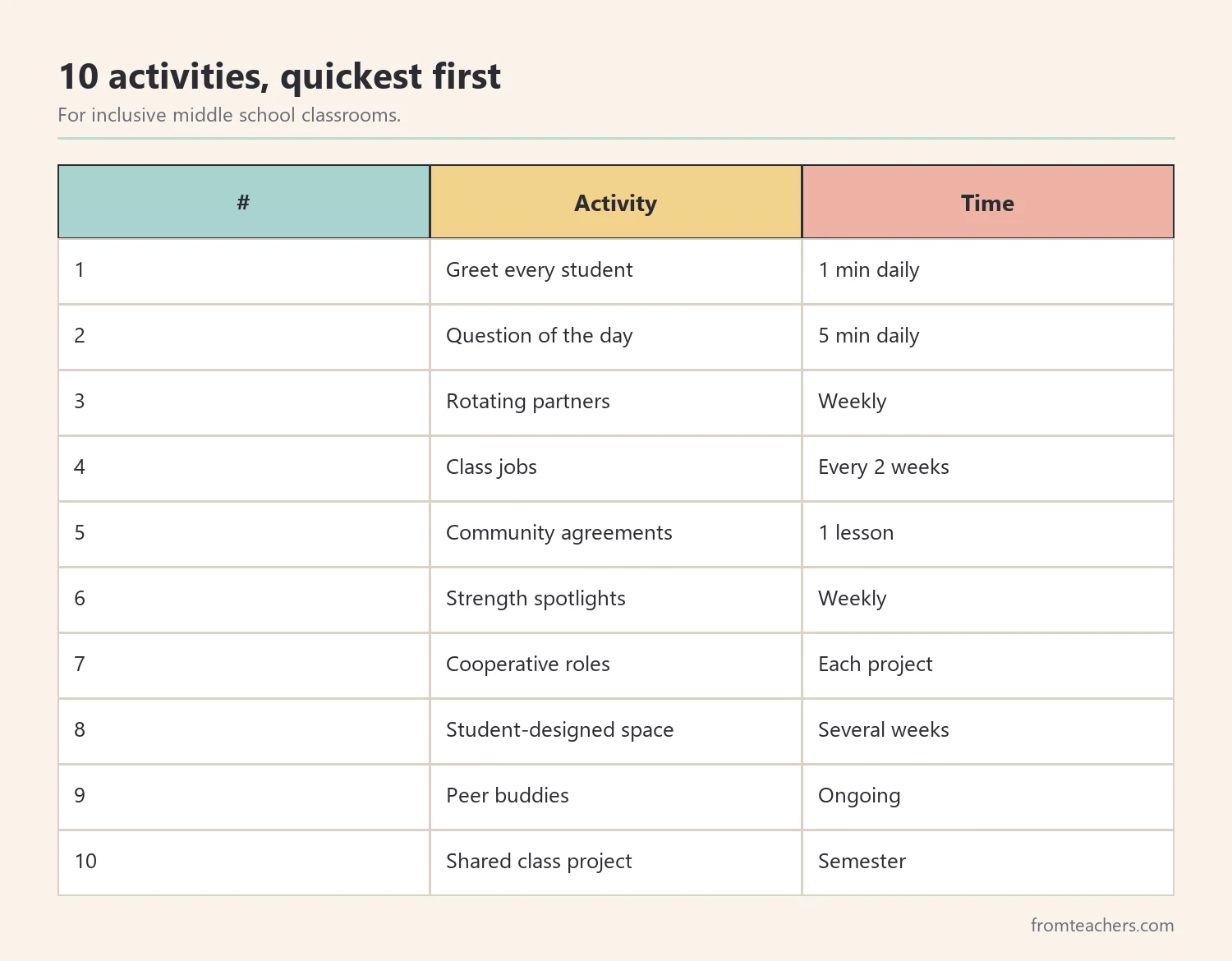
We ranked the ten classroom belonging activities by the time they need. Activities 1 to 3 take five minutes or less. Activities 4 to 7 fit into a single lesson or a weekly routine. Also, activities 8 to 10 run across several weeks or a semester. Figure 1 shows the full ranking.
Every activity here follows one principle from Universal Design for Learning: plan from the start so all students can take part, instead of adding a special version for one student later.
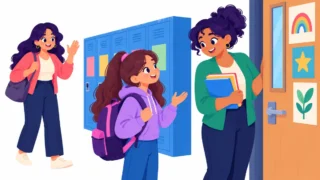
1. Greeting every student by name
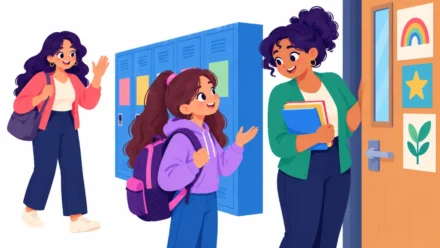
What it is: a personal greeting at the door each day, with a choice of wave, fist bump or a simple hello.
Why it supports belonging: being seen and named every day tells students they matter.
How to run it: position yourself so every student, including those using mobility aids, passes you comfortably.
Example: Sam chose a fist bump. Within a week, classmates began greeting him in the hallway too.
2. A daily question of the day
What it is: a light question on the board, such as “What is your favorite snack?” Students answer on a sticky note or out loud.
Why it supports belonging: students discover shared interests quickly.
How to run it: offer several ways to answer: speaking, writing or pointing to options.
Example: Sam and two classmates all wrote “spicy chips.” That small match started a conversation.
3. Rotating partners
What it is: students work with a different partner each week, chosen by the teacher.
Why it supports belonging: it prevents fixed cliques and makes sure no one is always picked last.
How to run it: use a simple chart and make sure every partner station is accessible.
Example: Sam worked with four different classmates in a month, more than in the whole previous year.
4. Class jobs with real responsibility
What it is: jobs such as materials manager, timekeeper or tech helper, rotating every two weeks.
Why it supports belonging: having a role shows the class depends on you.
How to run it: make sure every job can be done by every student, with simple adjustments if needed.
Example: Sam became the timekeeper for labs. Classmates started asking him, “How long do we have?”
5. Community agreements written together
What it is: the class writes its own agreements for how to treat each other.
Why it supports belonging: students follow rules they helped make, and everyone’s voice is included.
How to run it: gather ideas in small groups, then vote. Post the agreements where everyone can see them.
Example: Sam suggested “Save a spot at the table for everyone.” The class added it.
6. Strength spotlights
What it is: a short weekly moment when a student shares something they are good at or enjoy.
Why it supports belonging: classmates see each other as whole people, not just by their needs.
How to run it: let students choose the format: a talk, a photo, a demonstration or a slide.
Example: Sam showed his drawings of space probes. Several classmates asked him to draw for their project.
7. Structured cooperative learning
What it is: group work with clear roles, such as reader, recorder, materials and reporter.
Why it supports belonging: clear roles stop stronger students from taking over and make room for everyone.
How to run it: rotate roles and design tasks with several ways to contribute.
Example: Sam was the reporter for his group’s lab and presented their findings to the class.
8. A student-designed class space
What it is: students help plan part of the room, such as a calm corner or a display wall.
Why it supports belonging: students feel ownership of a space they shaped.
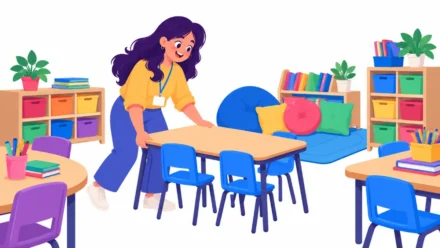
How to run it: discuss accessibility and sensory needs as design criteria. The Inclusive Classroom Design comic guide on UDL and flexible seating walks through layout, visual environment, flexible seating and classroom culture with before and after examples you can share with students as they plan.
Example: Sam’s group designed a reading nook with a table height that worked for his wheelchair.
9. Peer buddy or mentor program
What it is: students volunteer to buddy up for lunch, transitions or projects.
Why it supports belonging: regular contact builds real friendships. Buddies should be partners, not helpers.
How to run it: frame it as two-way: both students share interests and spend time together.
Example: Sam and his buddy started eating lunch together twice a week, then every day.
10. A class project with a shared goal
What it is: a project the whole class works on, such as a science fair display or a school garden.
Why it supports belonging: working toward one goal builds a sense of “us.”
How to run it: include tasks for different strengths: research, design, building, presenting.
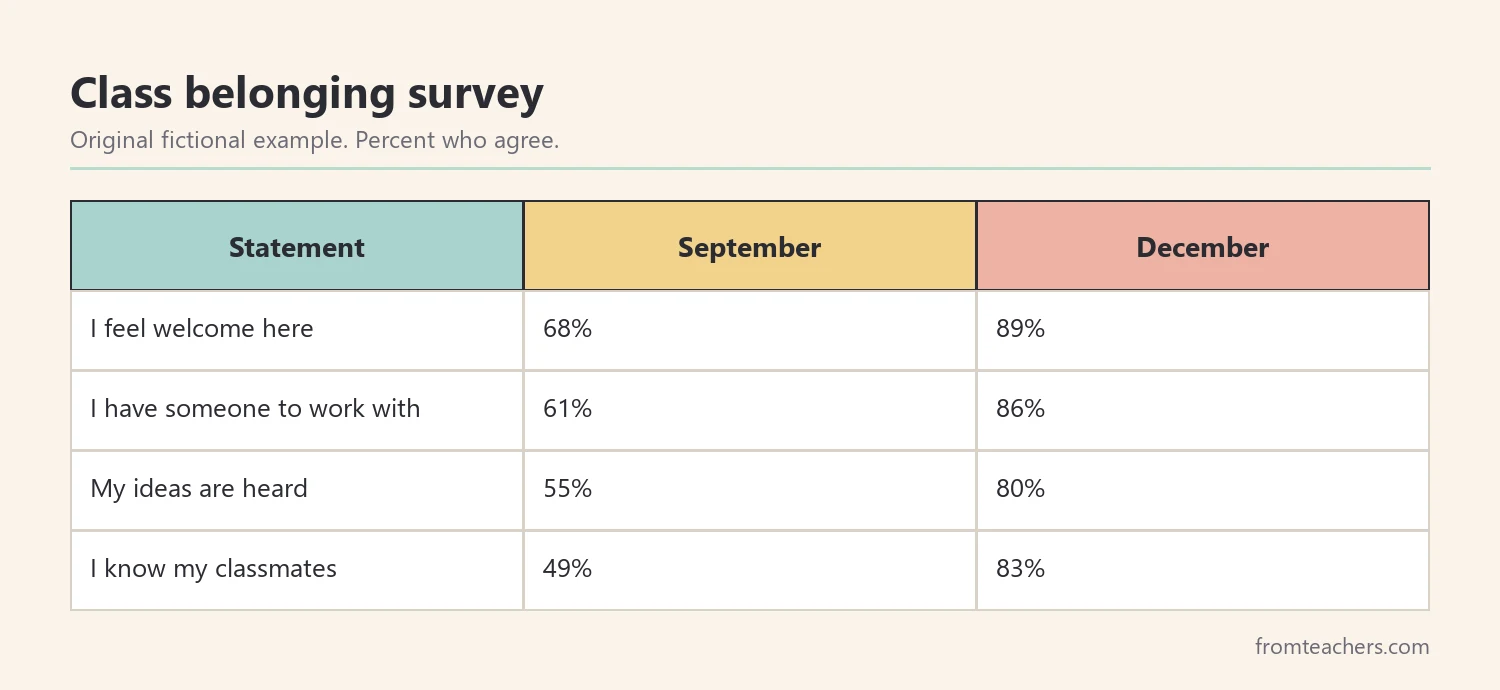
Example: Sam designed the poster layout for the class science display. Figure 2 shows how class survey results changed during the semester.
Access versus belonging
Access and belonging are not the same. Ramps, spacing and materials make it possible for students to be in the room. Belonging is whether they feel part of it. Figure 3 compares the two.
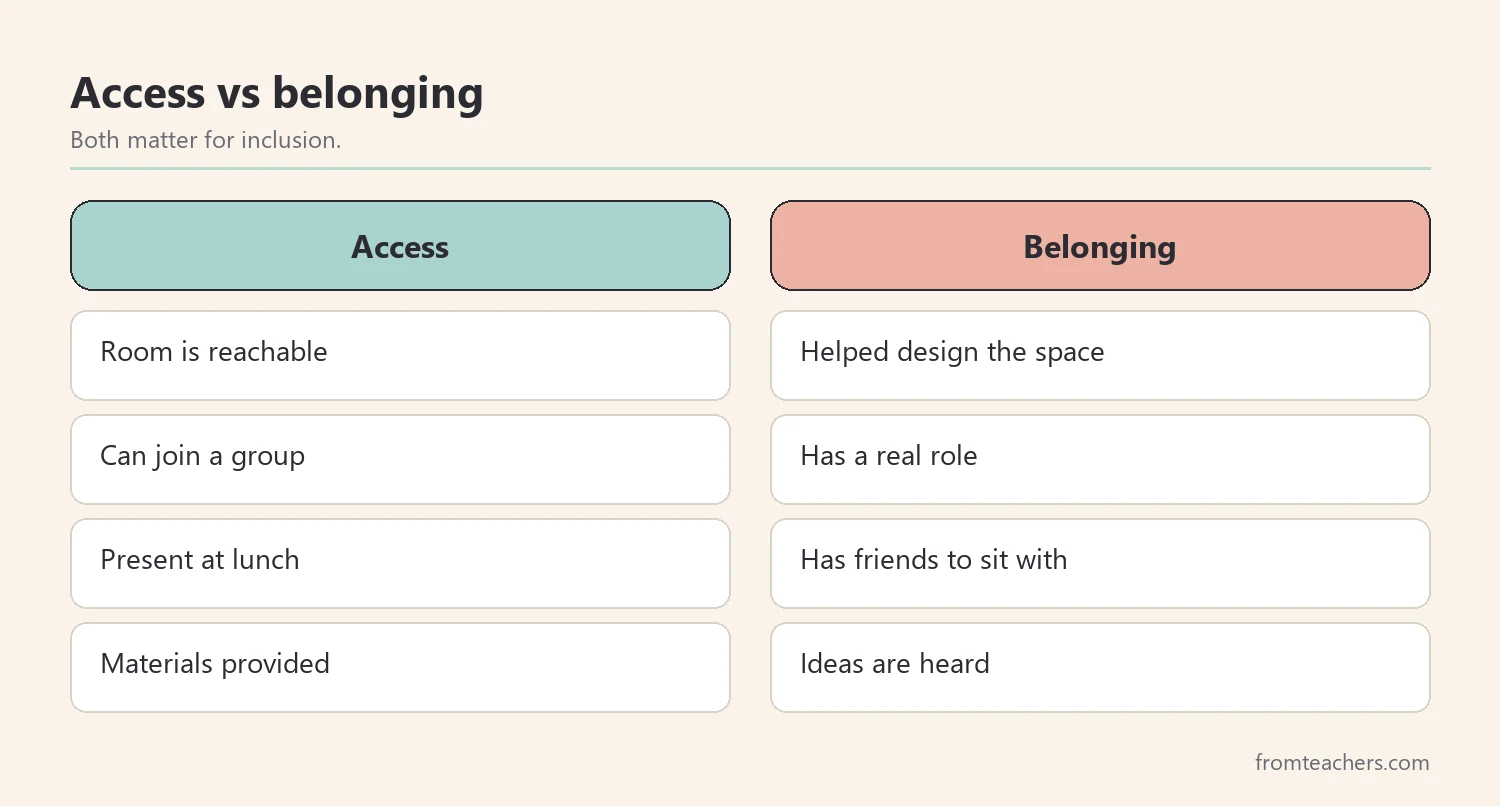
| Area | Access | Belonging |
|---|---|---|
| Space | Room is reachable | Student helped design it |
| Group work | Student can join | Student has a real role |
| Social time | Student is present | Student has friends to sit with |
A sample semester plan
Build classroom belonging activities step by step instead of all at once. Figure 4 shows a four stage plan Sam’s teacher used across a semester.
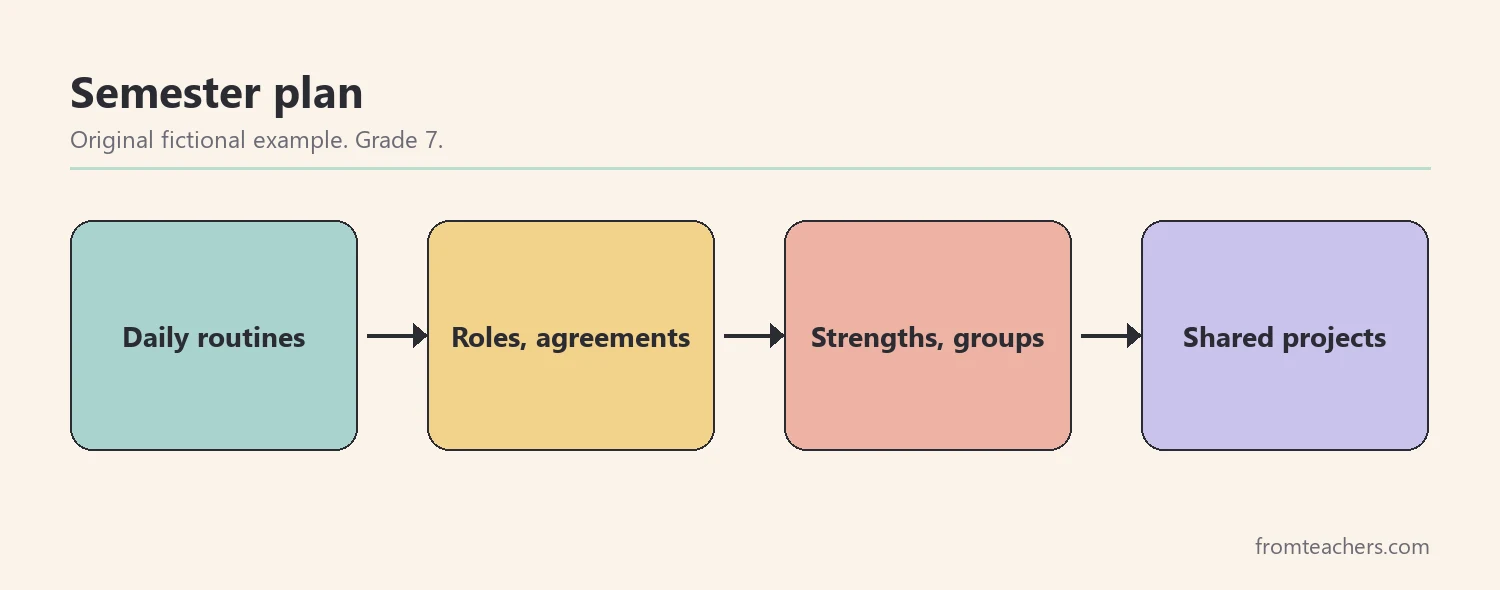
Start with daily routines in the first weeks, add roles and agreements next, then strengths and cooperative work, and finally longer projects. This order lets trust grow before bigger shared work.
Checking whether it is working
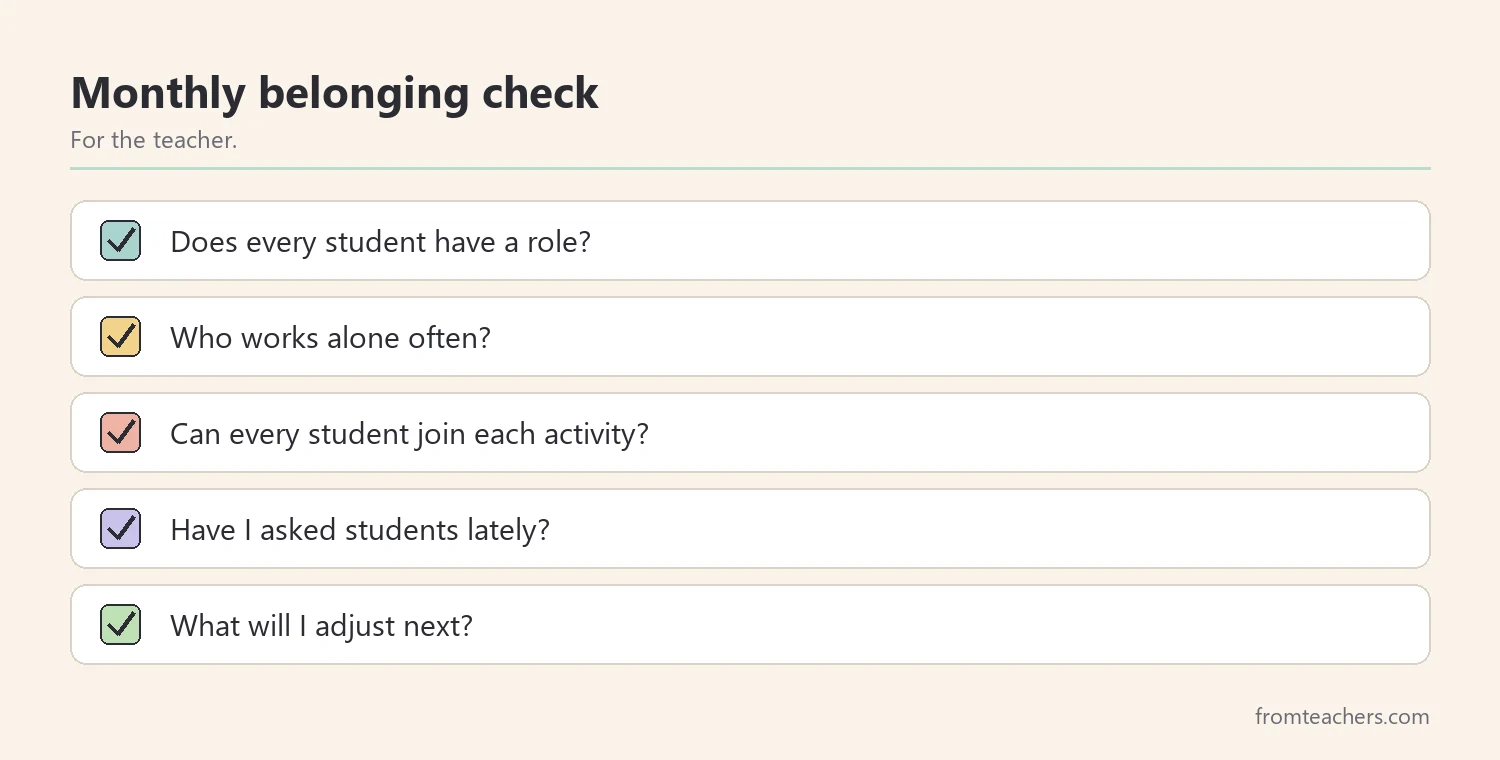
The best way to know whether students feel they belong is to ask them. A short anonymous survey every few weeks, with three or four simple statements, gives useful information. Also watch for signs, such as who sits with whom and who speaks in groups.
Share what you learn with the class and adjust. Figure 5 lists five questions to ask yourself each month.
Working with the special education team
Inclusion works best when general and special education staff plan together. Before the semester, meet with the case manager, therapists and any paraprofessionals who support students in your class. Share your plans for routines, group work and projects, and ask what adjustments might help specific students take part fully.
For example, an occupational therapist might suggest a different grip for art materials, while a speech-language pathologist might suggest picture choices for the question of the day. Small adjustments like these often help several students, not only the one they were designed for.
Paraprofessionals play a key role too. When an aide sits beside one student all the time, peers may hesitate to approach. Instead, ask the aide to support small groups or the whole class, so the student is part of the group rather than set apart from it.
Sam’s teacher met with his case manager and physical therapist in August. They agreed on desk heights, lab station placement and a plan for the aide to circulate. As a result, Sam joined groups naturally from the first week.
Common mistakes and how to avoid them
- Stopping at physical access. Fix: plan for social belonging too.
- Making one student the “project.” Fix: design activities for the whole class.
- Buddy programs that feel like charity. Fix: make partnerships two-way.
- One big event, then nothing. Fix: build small daily routines.
- Never asking students. Fix: use short surveys and listen.
Questions teachers ask about classroom belonging activities
Are belonging activities a waste of instructional time?
Most take only a few minutes and can be built into lessons. Students who feel they belong are often more willing to take part in learning.
How do I include students with significant disabilities?
Plan activities with several ways to take part, and ask the special education team for ideas that fit each student.
What if some students resist working with others?
Use structured roles and short tasks. Over time, positive experiences reduce resistance.
Should I talk about disability openly with the class?
Only with the student’s and family’s agreement. Focus on strengths and shared interests.
How do I know if a student feels excluded?
Watch social patterns and ask privately. The counselor can help if a student seems isolated.
Related reading: Special Education Strategies Guide, Trauma-Informed Teaching Strategies, and Autism Social Skills Development.
You may also need: Behavior Contracts and Individual Behavior Plans Toolkit.
A companion resource for teachers planning classroom belonging activities:
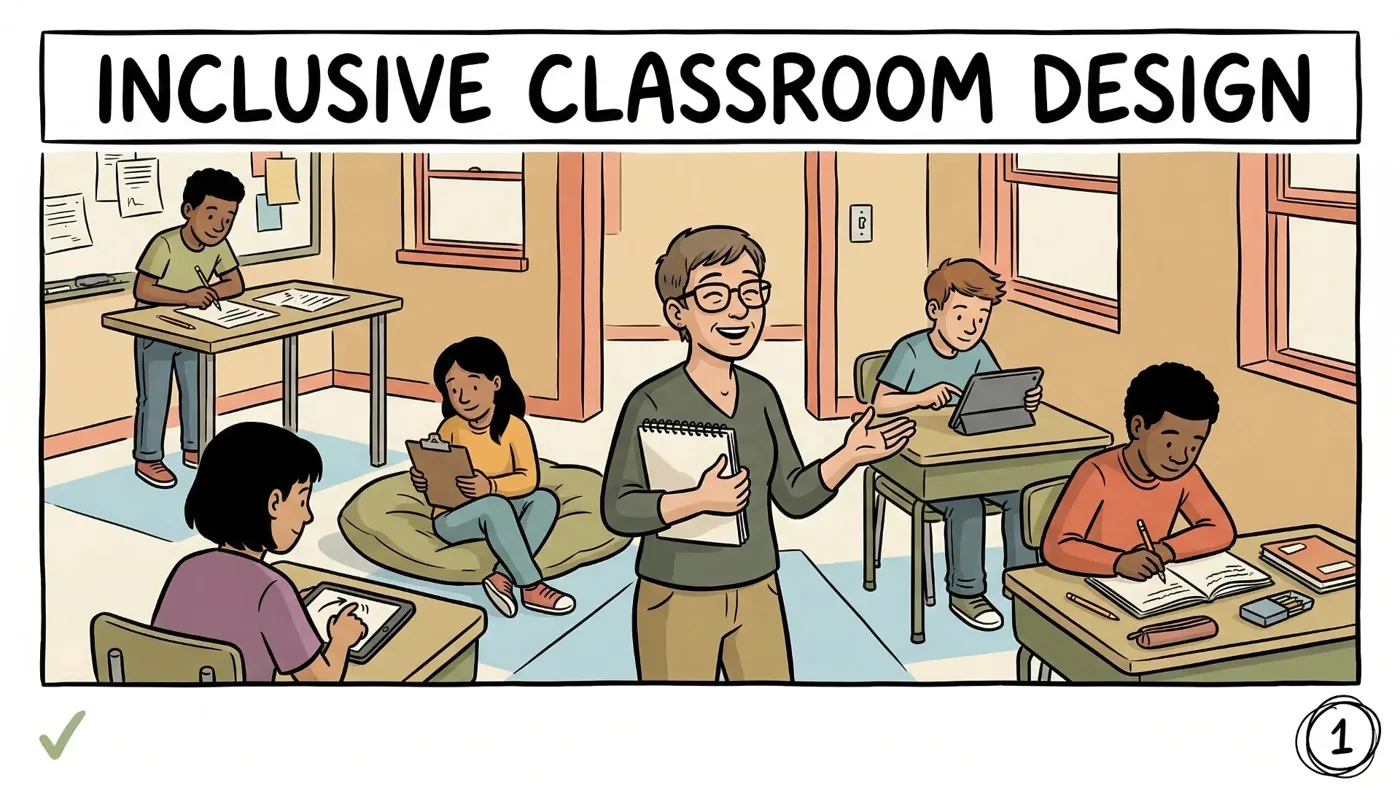
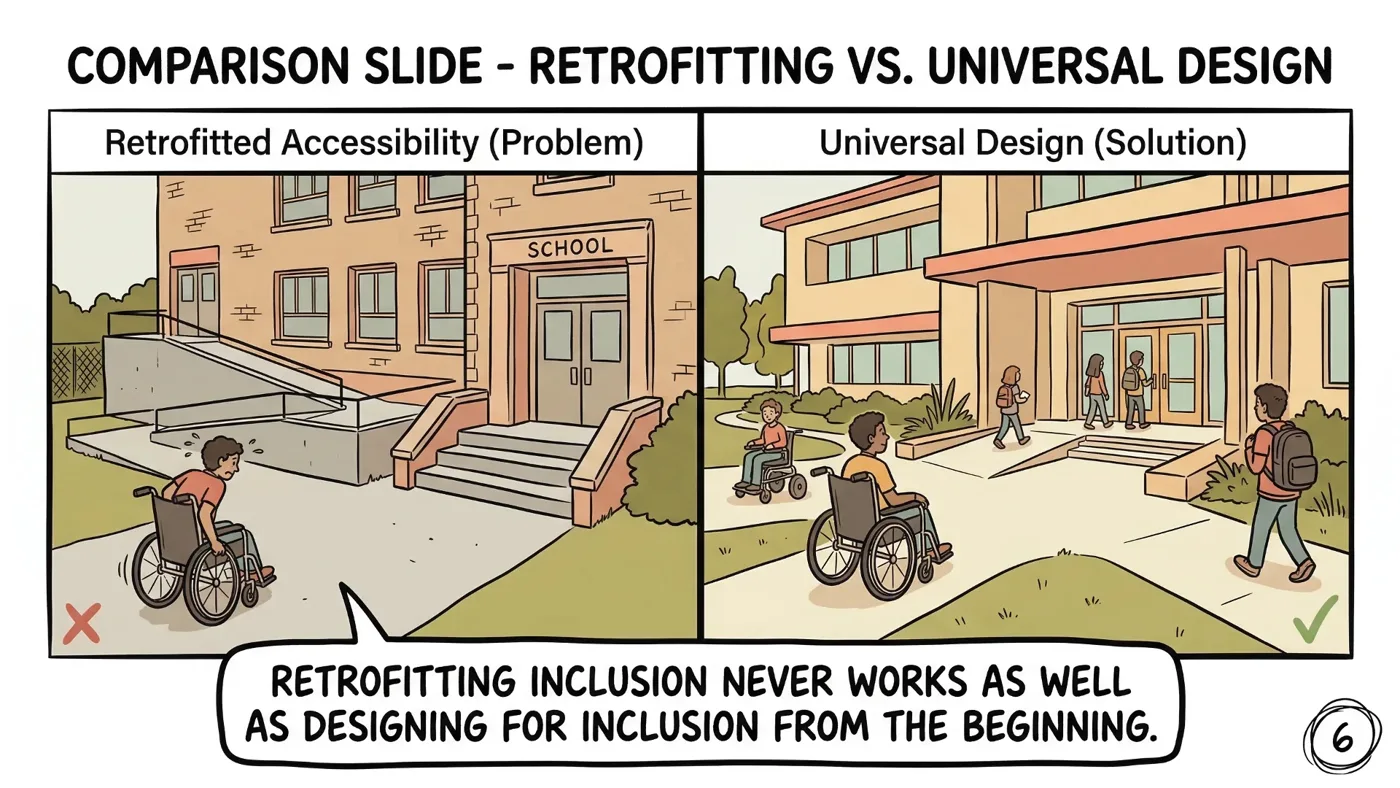
Inclusive Classroom Design Guide: UDL & Flexible Seating: a 53 page comic style guide covering what inclusion really means, physical space and layout, visual environment and displays, flexible seating and movement, Universal Design for Learning and building belonging through classroom culture, with before and after comparisons for elementary through high school classrooms.
Sources and scope
- CAST: the organization behind the Universal Design for Learning framework.
- CASEL: the social and emotional learning framework, including relationship skills and supportive classrooms.
- Center on PBIS: resources on positive, predictable classroom environments.
- Understood.org: plain-language guidance on inclusive classrooms for teachers and families.
This list covers everyday activities that build belonging in inclusive middle school classrooms. It does not replace individual plans, accessibility requirements or school counseling support for students who need more.
Key takeaways
- Classroom belonging activities go beyond physical access.
- Start with greetings, questions and rotating partners.
- Give every student a real role and a voice.
- Build to shared projects across the semester.
- Ask students how included they feel and adjust.



Leave a Comment