

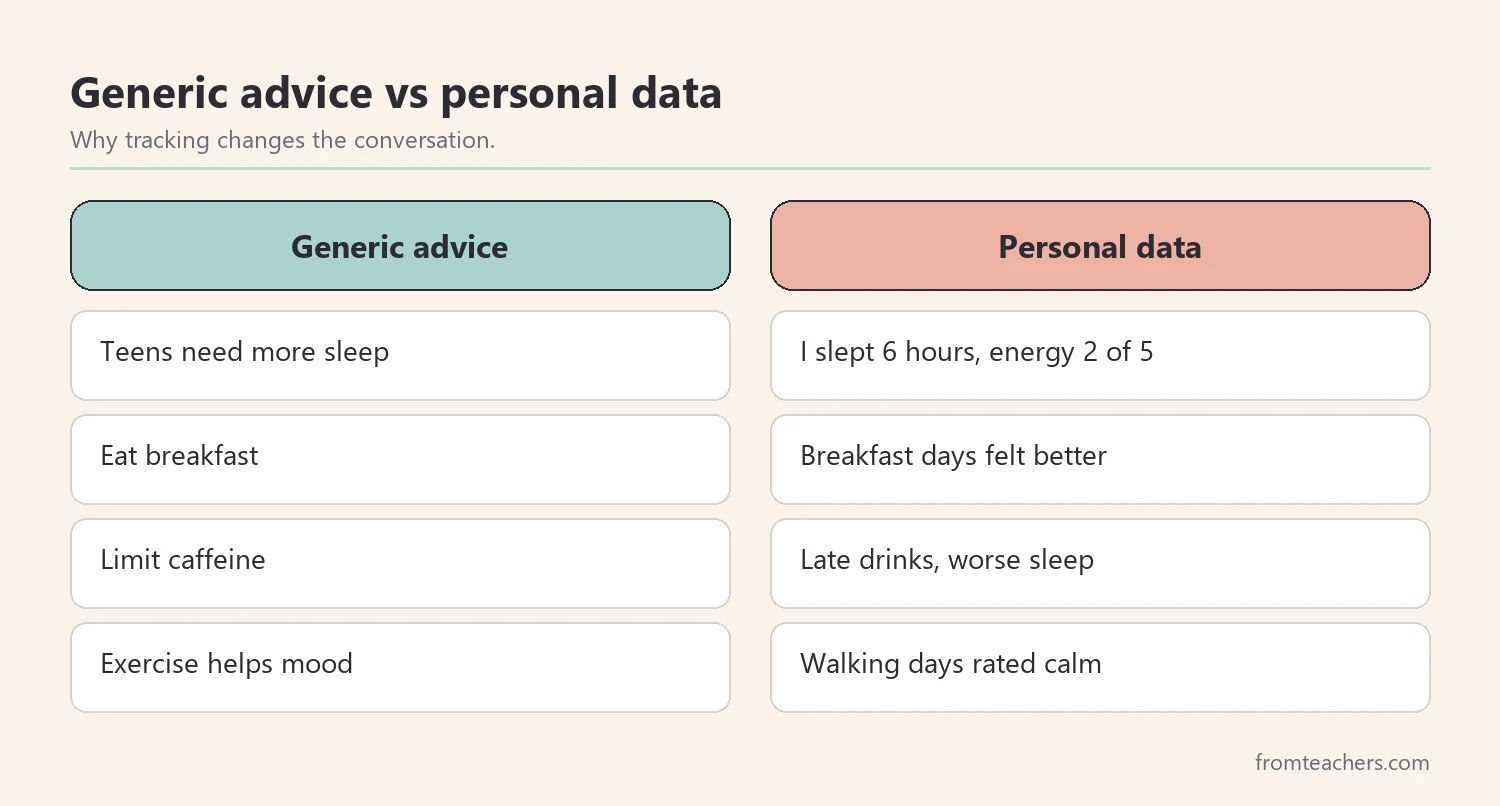
High school wellness unit ideas often stall at the same point: students nod along to advice about sleep and water, then change nothing. The problem is that general advice feels like it is about someone else. Picture Mr. Alvarez, a tenth grade health teacher, and Jasmine, age 15, who says she is “always tired in second period.” She does not connect it to her 1 a.m. bedtime, her skipped breakfast or her two energy drinks a day, until she sees her own data.
This list is for high school health teachers, advisory leaders and wellness coordinators. It ranks eight high school wellness unit ideas from the ones that need the least class time to the ones that run across two weeks. Every idea uses simple personal tracking of energy, sleep, mood and habits, so students learn from their own patterns. Jasmine appears as the fictional example throughout.
Examples are fictional. Adapt to the student’s goals and agreed supports. This is guidance, not a diagnosis.
At a glance
- Personal data makes wellness lessons feel relevant to teens.
- Track energy several times a day, not just once.
- Look for patterns over days, not one bad day.
- Keep tracking private and optional to share.
- Refer ongoing concerns to the nurse or counselor.
How we ranked these ideas
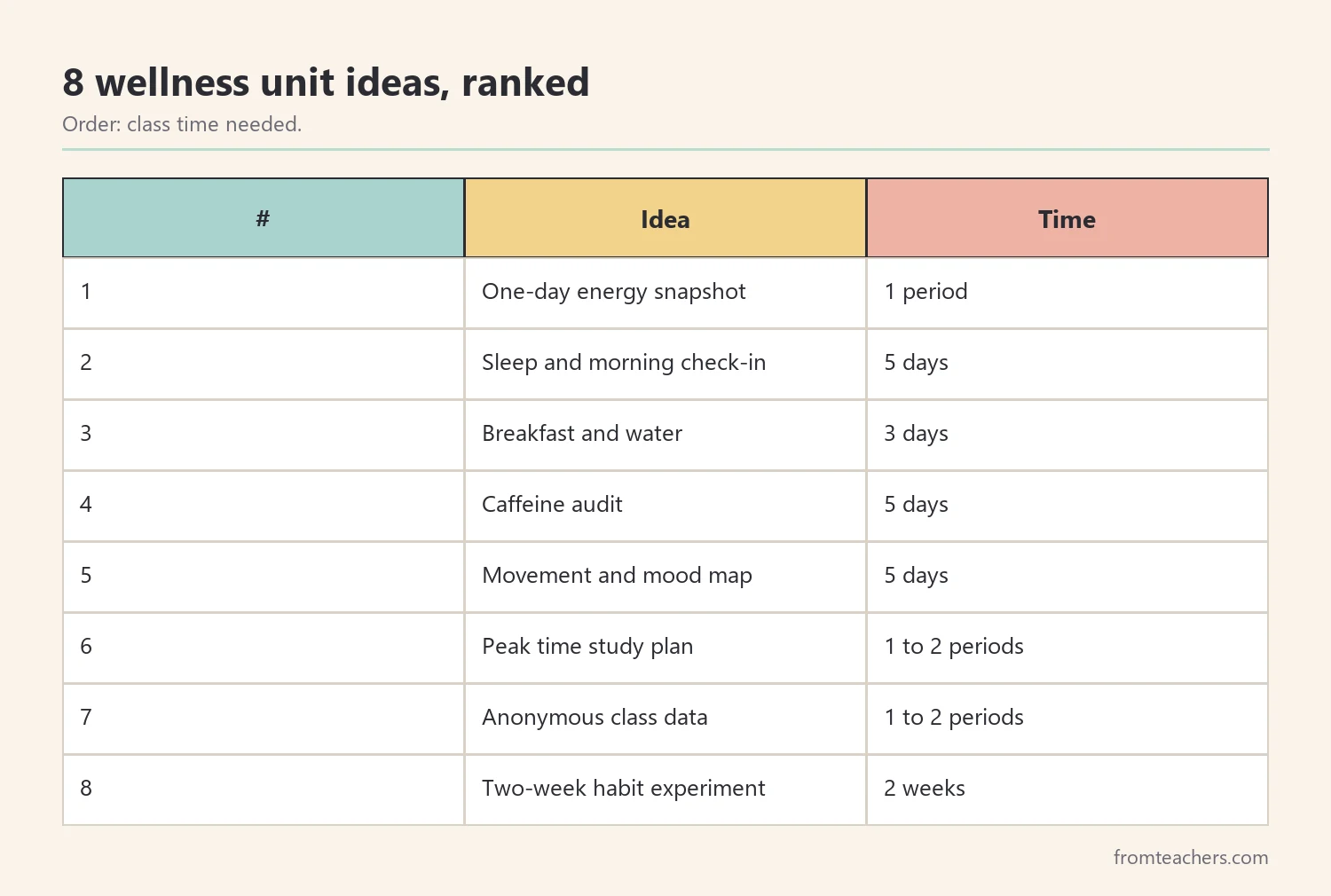
We ranked the eight ideas by class time needed, from a single period to a two-week project. You can use one idea as a quick warm-up or combine several into a full unit. The ranking reflects planning effort, not which idea is most important.
All eight ideas rely on one simple tool: a daily sheet where students rate their energy and mood at several points in the day and note sleep, food, water, caffeine and exercise. Figure 1 shows the ranking.
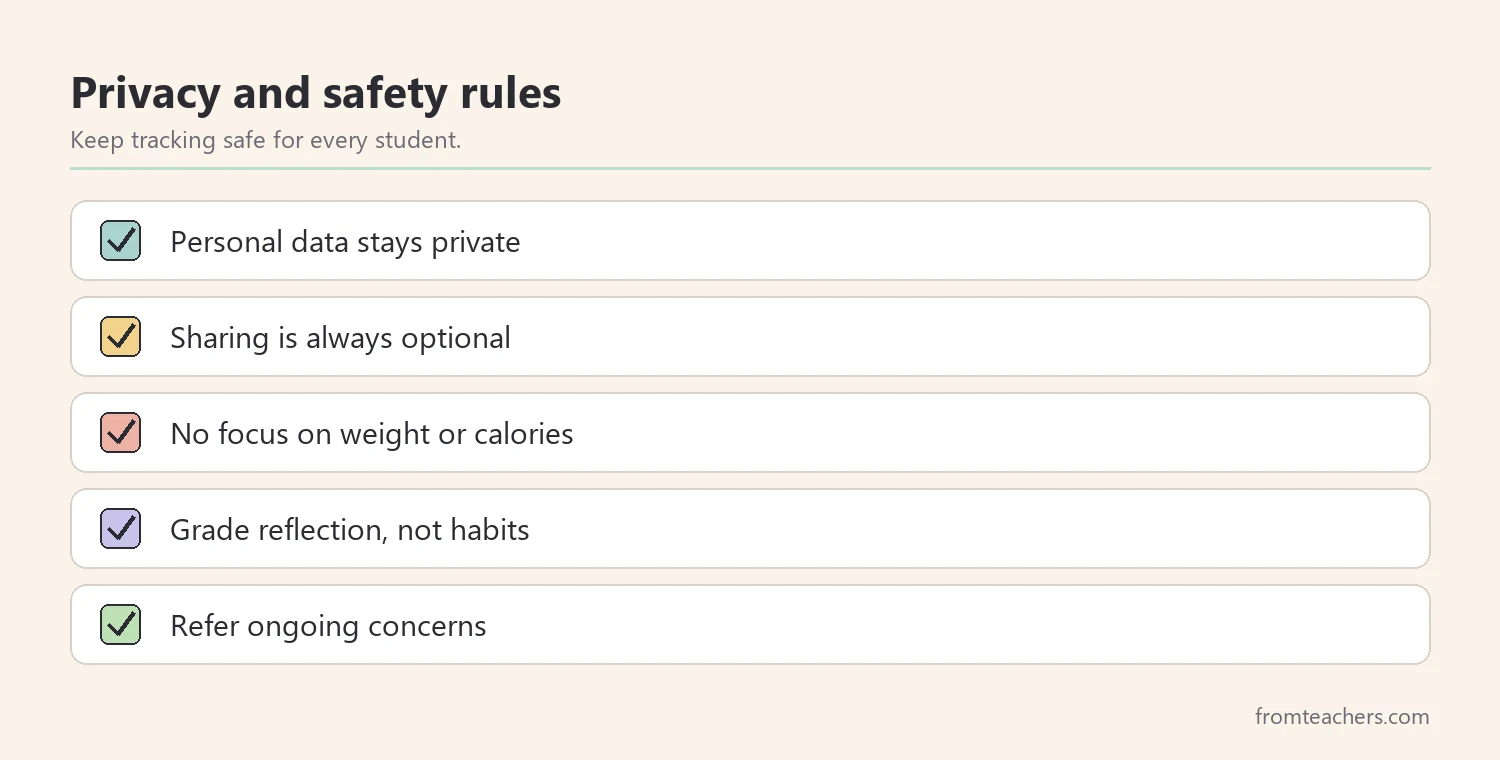
Before you start, tell students clearly why you are tracking: to notice patterns, not to judge anyone. Explain that their sheets stay private, that sharing is always optional and that the grade comes from reflection and effort. This short introduction prevents most worries and makes honest tracking far more likely.
1. The one-day energy snapshot
What it is: students track their energy and mood for one school day, at six points from early morning to night.
Why it works: a single day already shows that energy rises and falls. It opens the unit with a personal question: “When was I at my best today?”
How to run it: introduce the sheet on Monday, ask students to fill it in through Tuesday and discuss on Wednesday.
Example: Jasmine’s lowest point was second period and her highest was 9 p.m. She said, “That explains a lot about my homework at night.”
2. Sleep and morning check-in comparison
What it is: students record wake-up time, sleep quality and morning energy for five days, then compare.
Why it works: sleep is one of the habits teens are most likely to underestimate. Health organizations commonly recommend about 8 to 10 hours of sleep a night for teenagers, and seeing their own numbers next to that range is eye-opening.
How to run it: add a class discussion on why teen sleep patterns shift and what small changes are realistic.
Example: Jasmine averaged about six hours on school nights. On the one night she slept eight hours, her morning energy rating doubled.
3. The breakfast and water experiment
What it is: for three days, students note breakfast and water intake and compare with their late morning energy.
Why it works: it is a concrete, low-cost change that many students can try right away.
How to run it: remind students that this is not a diet project. Focus on regular meals and water, not on weight or calories, and be sensitive to food access differences among students.
Example: On days Jasmine ate breakfast and brought a water bottle, her late morning energy was higher. She decided to keep a granola bar in her bag.
4. The caffeine audit
What it is: students record every caffeinated drink and when they had it, then compare with sleep quality and afternoon energy.
Why it works: many teens use caffeine to fix tiredness without seeing how late caffeine may affect sleep, which can lead to more tiredness the next day.
How to run it: discuss the cycle of poor sleep, caffeine and energy crashes, using reputable teen health sources.
Example: Jasmine’s second energy drink was usually after 4 p.m. On those nights, she rated her sleep quality lower. She tried moving it earlier, then dropping it.
5. Movement and mood mapping
What it is: students note exercise or active time each day and compare with mood and energy ratings.
Why it works: many people notice better mood and energy after movement. Seeing it in personal data is more convincing than a poster.
How to run it: include all kinds of movement, such as walking the dog, dancing or sports, so every student can participate.
Example: On the two days Jasmine walked home instead of taking the bus, her late afternoon energy was higher, and she rated her mood as “calm” instead of “stressed.”
6. Peak time study planning
What it is: students use their tracking to find their personal high-energy windows and plan study time around them.
Why it works: it connects wellness to academic success, which many teens care about.
How to run it: students create a simple weekly plan that puts hard tasks in high-energy times and easy tasks in low-energy times.
Example: Jasmine moved math homework to right after school, when her energy was fairly high, instead of late at night. A one-page daily energy level tracker for sleep, mood and habits made her peaks and dips easy to see.
7. Class data, anonymously
What it is: students submit anonymous summary numbers, such as average sleep hours or lowest energy period, and the class builds a group chart.
Why it works: students see that they are not alone and learn basic data skills, such as averages and charts.
How to run it: use an anonymous form or paper slips. Never display individual data.
Example: Mr. Alvarez’s class found that second period was the most common low point. The class discussed reasons, including early start times and skipped breakfast.
8. The two-week personal habit experiment
What it is: each student chooses one habit to change, such as bedtime, water or caffeine timing, and tracks energy for one week before and one week during the change.
Why it works: it teaches the basic logic of an experiment and gives students ownership of a real change.
How to run it: students write a hypothesis, track, compare and present a short reflection on what they learned, not whether they “succeeded.”
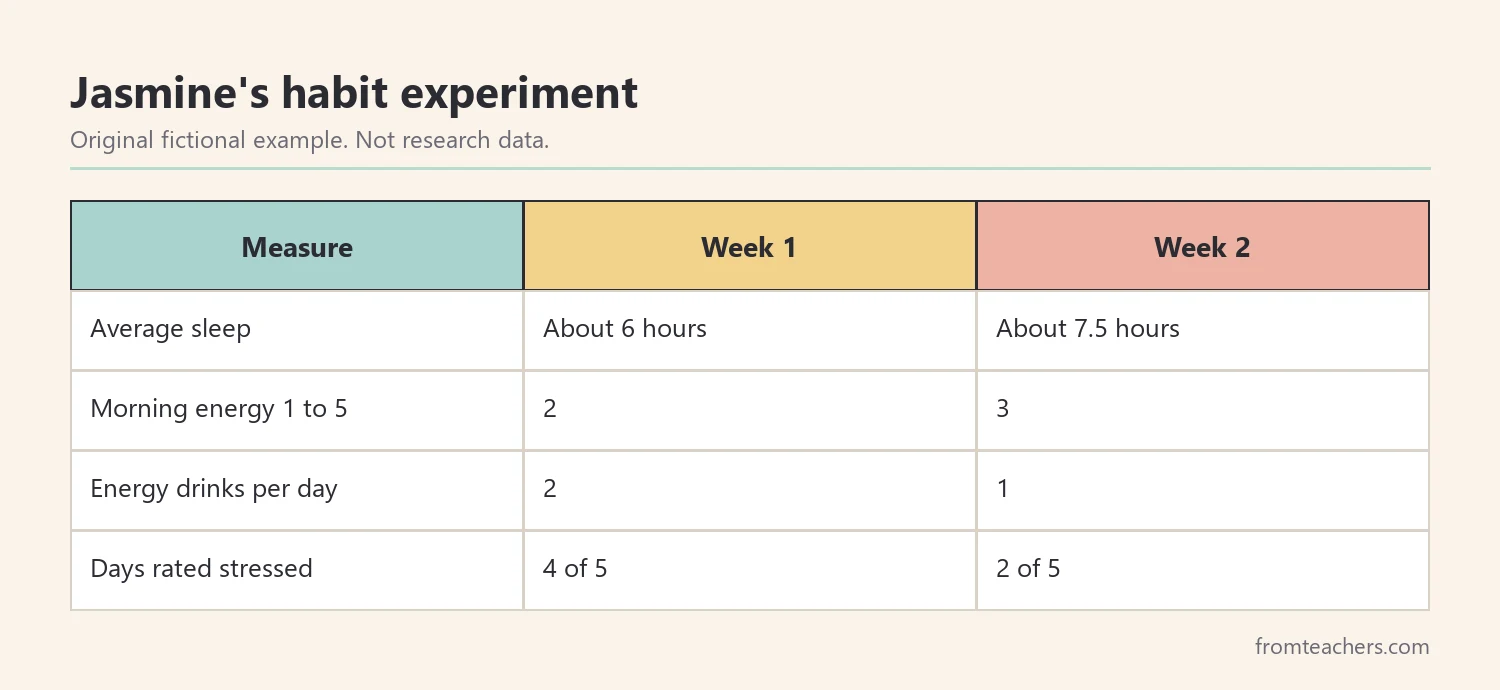
Example: Jasmine chose an 11:30 p.m. bedtime on school nights. Her results are summarized below.
A sample student data table
The table below shows Jasmine’s fictional before and after data for her habit experiment. It shows the format, not real research results.
| Measure | Week 1 | Week 2 |
|---|---|---|
| Average sleep | About 6 hours | About 7.5 hours |
| Morning energy (1 to 5) | 2 | 3 |
| Energy drinks per day | 2 | 1 |
| Days rated “stressed” | 4 of 5 | 2 of 5 |
Jasmine’s reflection said that the bedtime was hard on two nights, but she felt better on most mornings. That honest reflection is the real learning goal.
A simple unit flow
Figure 4 shows how many of these high school wellness unit ideas fit into a four-part flow: track, notice, change and reflect.
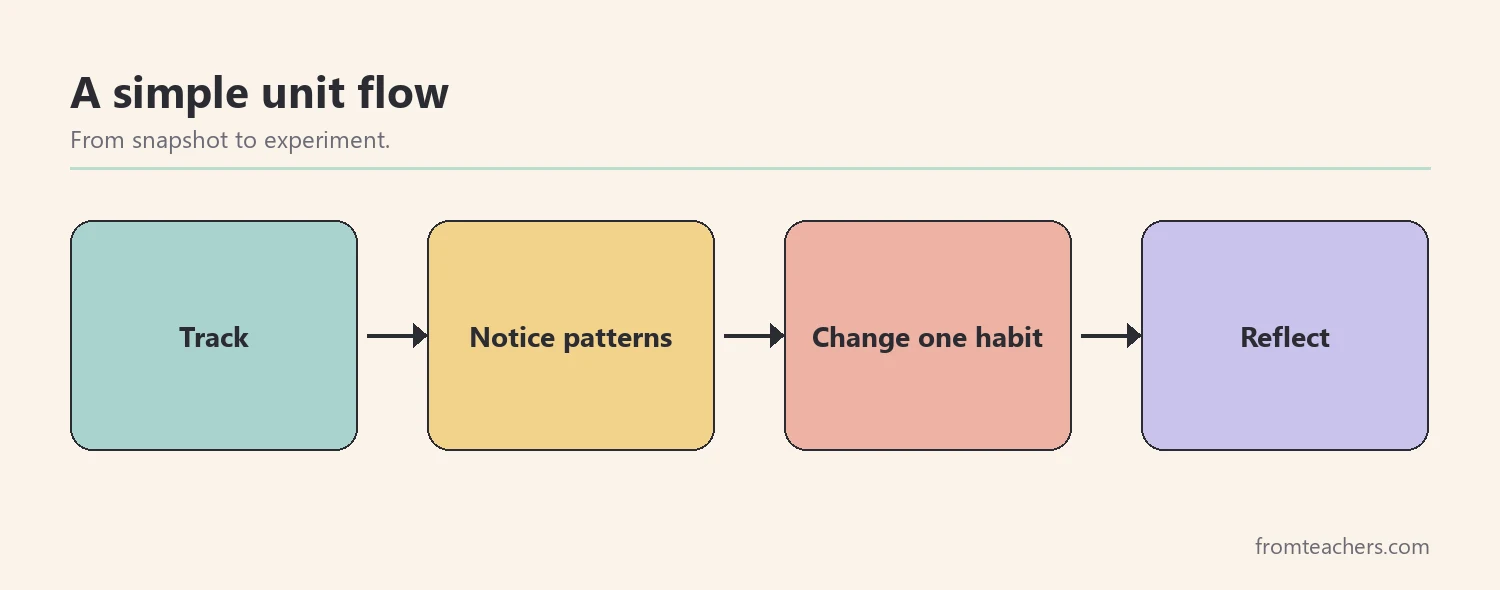
Start with a snapshot, add one or two focused trackers and end with the personal experiment. Also, connect the unit to your school’s health standards and SEL goals, especially self-awareness and self-management.
Privacy matters. Students should never be required to share personal data with peers. Make sharing optional, use anonymous class data and watch for sensitive topics, such as food access, family schedules, mood or eating concerns. Figure 5 lists simple privacy and safety rules.
Common mistakes in wellness units
- Lecturing without data. Fix: let students discover patterns in their own tracking.
- Shaming habits. Fix: stay curious and non-judgmental.
- Focusing on weight or calories. Fix: focus on energy, sleep and routines.
- Requiring public sharing. Fix: keep personal data private.
- Ignoring warning signs. Fix: follow school procedures and refer concerns.
Questions teachers ask about high school wellness unit ideas
How long should students track?
Even one day is useful for a first lesson. For patterns, five school days work well. For an experiment, two weeks gives a clearer picture.
What if students do not fill in the sheet honestly?
Explain that the data is for them, not for a grade. Grade the reflection and effort, not the habits themselves.
Can I use this in advisory instead of health class?
Yes. A shorter version works well in advisory, for example the one-day snapshot and the peak time study plan.
What if a student reports very little sleep or low mood every day?
Check in privately and follow your school’s procedures for referring students to the nurse or counselor.
Does this work for students with ADHD or other needs?
Often, yes. Tracking can support self-awareness. Some students may need reminders, a simplified sheet or support from staff.
Related reading: School Counseling Programs, The Power of Data Tracking in Special Education, and Building Essential Life Skills for Adulthood.
You may also need: Healthy Habits for Kids: Sleep, Nutrition and Routines.
A companion resource for high school wellness unit ideas:
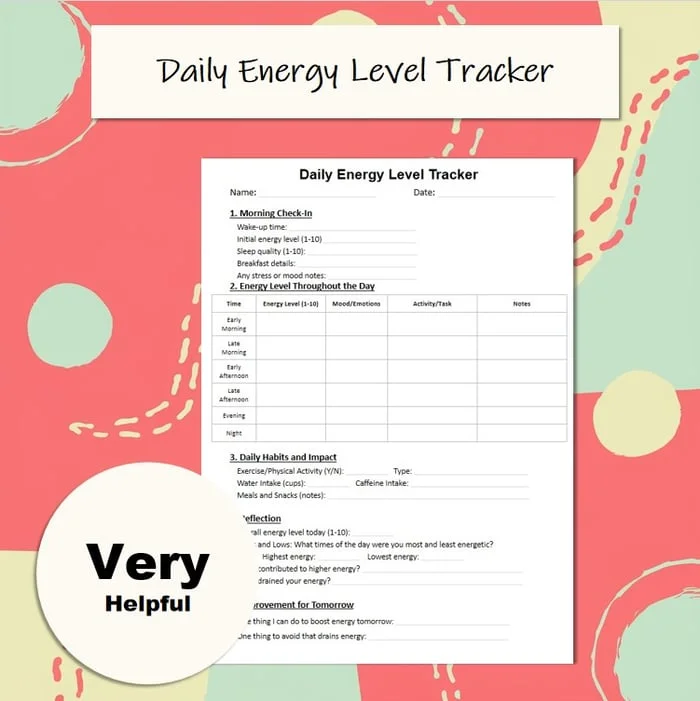
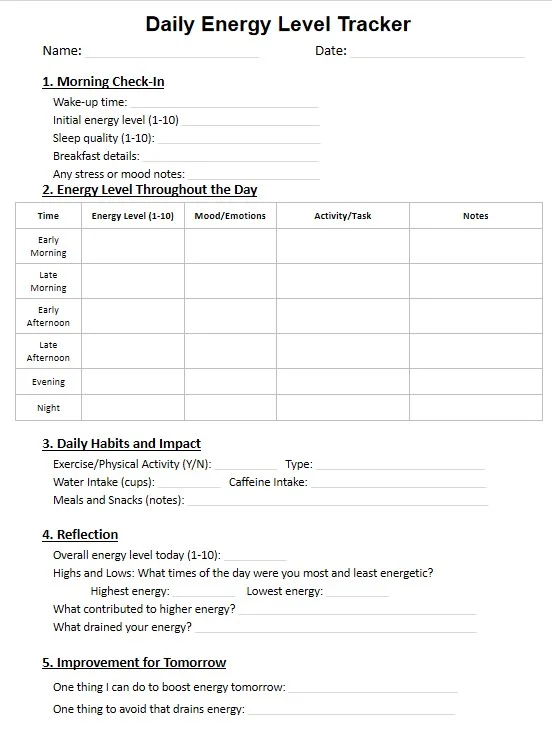
Daily Energy Level Tracker Sleep Mood and Habit Reflection Worksheet: a one-page tracker with name and date, a morning check-in for wake-up time, energy, sleep quality, breakfast and mood, an energy, mood and activity table from early morning to night, daily habits for exercise, water, caffeine and meals, a reflection on highs, lows and drains, and one improvement for tomorrow.
Sources and scope
- National Heart, Lung, and Blood Institute: Sleep Deprivation and Deficiency: information on how much sleep people need and how sleep affects health.
- Sleep Foundation: plain-language articles on teen sleep, sleep hygiene and daily energy.
- KidsHealth for Teens (Nemours): teen-friendly articles on sleep, nutrition, stress and fitness.
- CASEL: the social and emotional learning framework, including self-awareness and self-management.
These ideas are for general health and wellness education. They are not medical advice, and self-tracking is not a screening tool. Refer students with ongoing concerns about sleep, mood or eating to the school nurse, counselor or a health professional, following school procedures.
Key takeaways
- High school wellness unit ideas work best when students use their own data.
- Track energy and mood several times a day, along with sleep and habits.
- Start with a one-day snapshot and build to a two-week experiment.
- Keep data private and focus on curiosity, not judgment.
- Refer ongoing concerns to the nurse or counselor.







Leave a Comment