

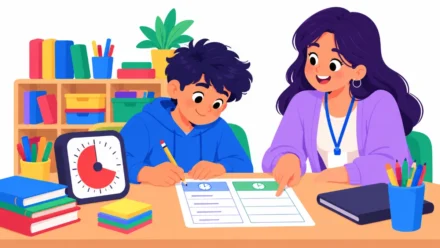
AAC activities for middle school need to feel like real teenage life, not like a primary classroom with older students in it. Picture Theo, a grade 7 student who uses a speech-generating app on a tablet. His teacher, Ms. Ruiz, notices that most of his AAC practice involves naming pictures and answering “what color is it?” Theo answers, then turns the tablet face down.
This list is for middle school special education teachers, inclusion teachers and the paraprofessionals who support AAC users in grades 6 to 8. It ranks seven activities from the quickest to set up to the ones that need more planning. For each activity, you will see what it is, why it fits this age group, how to run it and how it went with Theo. In the end, you will have a short menu of activities that give your student real reasons to communicate.
Examples are fictional. Adapt to the student’s goals and agreed supports. This is guidance, not a diagnosis.
At a glance
- Choose activities with real reasons to talk: opinions, jokes, plans and choices.
- Keep topics age-respectful: music, sports, games, current events.
- Model on the device yourself instead of only asking questions.
- Plan one or two target messages per activity, not ten.
- Write activities and targets in one shared plan so every adult is consistent.
How we ranked these activities
We ranked the seven activities by setup time, from “ready in under a minute” to “needs a lesson plan.” We did not rank them by value, because the best activity depends on the student and the goals the team has chosen. As a result, you can start with the quick ones tomorrow and build toward the bigger ones over a few weeks.
Each activity was chosen because it gives a teenager a genuine reason to communicate. Figure 1 shows the full ranking with the main communication function each activity practices.

Why middle school AAC needs a different approach
Teenagers want to be seen as teenagers. Activities that feel childish can reduce motivation, even when the vocabulary is useful. In addition, middle school brings new demands: changing classes, group projects, more peers and more independence.
Many AAC professionals encourage adults to model language on the student’s own system and to create real communication opportunities across the day. That idea shapes every item below. Instead of quizzing, you create moments where the student has something to say and someone who wants to hear it.
1. Would you rather questions
The quickest of all AAC activities for middle school is a “would you rather” question. “Would you rather have no homework for a year or no tests for a year?” Every student has an opinion, and there is no wrong answer.
Why it works: it practices choosing, giving an opinion and, with support, giving a reason. It is also fun and age-appropriate.
How to use it: post one question as a warm-up. Model your own answer on the student’s device first, then wait.
Example: Ms. Ruiz asked, “Pizza or tacos forever?” She tapped “I like tacos” on Theo’s app. Theo tapped “pizza” and then “funny.” The class laughed with him, not at him.
2. Rate it from 1 to 5
Next, try ratings. Show a song clip, a movie trailer or a sports highlight and ask everyone to rate it from 1 to 5.
Why it works: ratings need only a number and a short comment, so they are easy to start. They also invite agreeing and disagreeing, which are important social functions.
How to use it: make sure numbers and words like “good,” “bad,” “boring” and “awesome” are easy to find on the device.
Example: Theo rated a new song “2” and tapped “boring.” A classmate said, “No way, it’s a 5.” Theo tapped “no” and grinned. That was a real conversation.
3. Daily news or sports check-in
Middle schoolers often care about sports scores, games and school events. A two-minute check-in each morning gives the AAC user a predictable chance to share.
Why it works: it practices commenting and asking questions. Because it repeats every day, vocabulary grows with each use.
How to use it: ask families to share one thing the student did or watched the night before, so the student has something to talk about.
Example: Theo’s dad texted that they watched a basketball game. In the morning, Theo tapped “basketball” and “win.” Ms. Ruiz asked, “Who won?” and Theo found the team name.

4. Partner games with real turns
Card games, simple board games and quick video game discussions all involve turn-taking language. “My turn,” “your turn,” “I win,” “no fair” and “again” are powerful words for a teenager.
Why it works: games are naturally social. Peers model language too, and the student practices requesting, protesting and commenting.
How to use it: choose a game peers actually enjoy. Teach the peer to wait for the student’s message instead of guessing.
Example: Theo played Uno with two classmates at lunch club. He tapped “skip you” and both peers groaned. He laughed and tapped “again” when the round ended.
5. Classroom jobs with a message
Classroom jobs give the AAC user a role that others depend on. For example, taking attendance, announcing the lunch menu or reminding the class about due dates.
Why it works: the message has a real audience and a real purpose. It also builds confidence and visibility among peers.
How to use it: program or locate the message ahead of time, practice it once privately, then let the student deliver it daily.
Example: Theo became the “homework announcer” for science. Each day he played the reminder for the class. After two weeks, he started adding “don’t forget” on his own.
6. Group project roles
Group projects are common in middle school. However, AAC users can end up watching instead of contributing. Assigning a clear role changes that.
Why it works: it practices giving opinions, agreeing, disagreeing and asking for help within an academic task.
How to use it: roles like “fact checker,” “title chooser” or “presenter of slide 3” work well. Plan the key vocabulary with the speech-language pathologist before the project starts.
Example: In a history project, Theo chose the title and presented one slide using his device. His group voted for his title over two others.
7. Interview a staff member
Finally, the activity with the most setup is a short interview. The student prepares three or four questions and interviews a coach, librarian or principal.
Why it works: it practices asking questions, one of the harder functions for many AAC users. It also connects the student with adults across the school.
How to use it: write the questions together, practice them, then schedule a short meeting. Afterward, share what the student learned with the class.
Example: Theo interviewed the PE coach about her favorite sport. He asked, “Why you like soccer?” and recorded her answer. He later shared one fact with the class.
Because this activity spans several days, it helps to write it into a shared plan. An individual student AAC communication plan gives you space for each activity, when it happens, its objective and the target message, so the whole team knows the plan.
Plan the targets before the activity
Even well-chosen classroom activities can drift without clear targets. Pick one or two messages for each activity and decide how the student will access them. Figure 3 shows how Ms. Ruiz wrote Theo’s targets for one week.

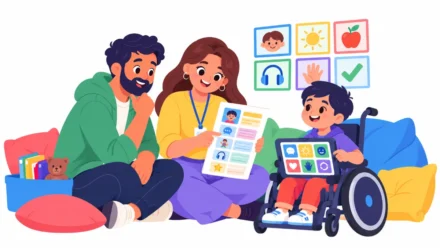
Then share the targets with every adult who works with the student. That includes paraprofessionals, general education teachers and, where possible, the family. When everyone models the same words, the student sees them used again and again.
Track progress without slowing the activity
You do not need to record every message. Instead, keep a simple tally during the activity and add one sentence afterward. Many teams also ask the student how comfortable they felt, using a 1 to 4 scale, which respects the student’s own view.
| Week | Activities run | Messages started by Theo |
|---|---|---|
| 1 | 4 | 3 |
| 2 | 6 | 7 |
| 3 | 7 | 11 |
This fictional table shows the kind of pattern a team looks for. More real opportunities usually mean more chances to start a message. Figure 4 lists quick checks to keep each activity on track, and Figure 5 shows a short weekly routine.


Common mistakes and how to avoid them
- Using childish topics. Fix: choose music, sports, games and school events that peers care about.
- Quizzing instead of talking. Fix: model your own messages and comment more than you ask.
- Too many targets. Fix: choose one or two messages per activity.
- Peers speaking for the student. Fix: teach peers to wait and listen to the device.
- Device left in the backpack. Fix: keep the device charged, visible and within reach all day.
Questions teachers ask about AAC activities for middle school
What if my student’s device has limited vocabulary?
Talk with the speech-language pathologist before changing anything. They can help add or organize vocabulary for the activities you plan. In the meantime, choose activities that fit the words available.
How do I involve general education peers?
Explain briefly that the device is the student’s voice. Then model waiting and listening. Most peers adapt quickly when adults show them how.
Should every activity have data?
No. A quick weekly tally is usually enough for classroom activities. The speech-language pathologist may take more detailed data for IEP goals.
Can these activities work with low-tech AAC?
Yes. Picture boards and communication books can be used for opinions, ratings and games. Simply prepare the needed symbols in advance.
How often should we run AAC activities?
Short activities every day usually work better than one long session a week. Daily repetition builds familiarity with the vocabulary and the routine.
Related reading: Best Assistive Technology for Special Education Classrooms, Autism Social Skills, and Assistive Technology in Special Education.
You may also need: Pragmatic Skills Checklist for social communication.
A companion resource for AAC activities for middle school:


Individual Student Communication Plan AAC Learning Plan for Classrooms: a one-page, ready-to-fill plan with objectives, a communication activities overview (activity, when, frequency, objective, method), AAC communication targets, student progress with comfort ratings, and an evaluation and reflection section.
Sources and scope
- American Speech-Language-Hearing Association (ASHA): professional information on augmentative and alternative communication and the role of speech-language pathologists.
- International Society for Augmentative and Alternative Communication (ISAAC): an international organization focused on AAC users, families and professionals.
- IRIS Center, Vanderbilt University: free modules for educators on supporting students with disabilities in class.
- CAST: Universal Design for Learning guidance on offering multiple ways for students to express what they know.
This list covers classroom activities for middle school students who already use an AAC system chosen with their team. It does not cover AAC assessment, device selection or speech therapy goals, which belong to the speech-language pathologist and the IEP team.
Key takeaways
- The best AAC activities for middle school give teenagers real reasons to talk.
- Start with quick activities like opinions and ratings, then build to projects and interviews.
- Model on the student’s device and keep topics age-respectful.
- Choose one or two target messages per activity and share them with the team.
- Track progress with a quick weekly tally and the student’s own comfort rating.





Leave a Comment