

AAC mistakes in a general education classroom are rarely about bad intentions. Picture Nora, a second grader who uses a speech-generating device. During morning meeting, her teacher asks a question, waits two seconds and moves on. Nora was still finding the right page. Nobody meant to leave her out, but she missed her turn again.
This list is for general education teachers who welcome a student who uses augmentative and alternative communication (AAC). It names nine AAC mistakes that are easy to make in a busy room, ordered from easiest to fix, with simple changes you can try this week. Each item includes a short example from Nora’s class.
Examples are fictional. Adapt to the student’s goals and agreed supports. This is guidance, not a diagnosis.
At a glance
- AAC is the student’s voice, so it should be within reach all day.
- Waiting longer is the easiest change with the biggest effect.
- Adults model on the device; they do not only ask questions.
- Every response counts, including short or unexpected ones.
- One shared plan keeps teachers, aides, specialists and family consistent.
How this list is ordered
We ordered these AAC mistakes by how quickly a classroom teacher can fix them. The first ones need no materials or meetings. Later ones need a short conversation with the speech-language pathologist (SLP) or a shared plan. We did not rank them by importance, because each student and device is different.
Also, keep in mind that AAC covers many tools: picture boards, letter boards, apps on tablets and dedicated devices. The fixes below work across most of them. Figure 1 shows all nine at once.
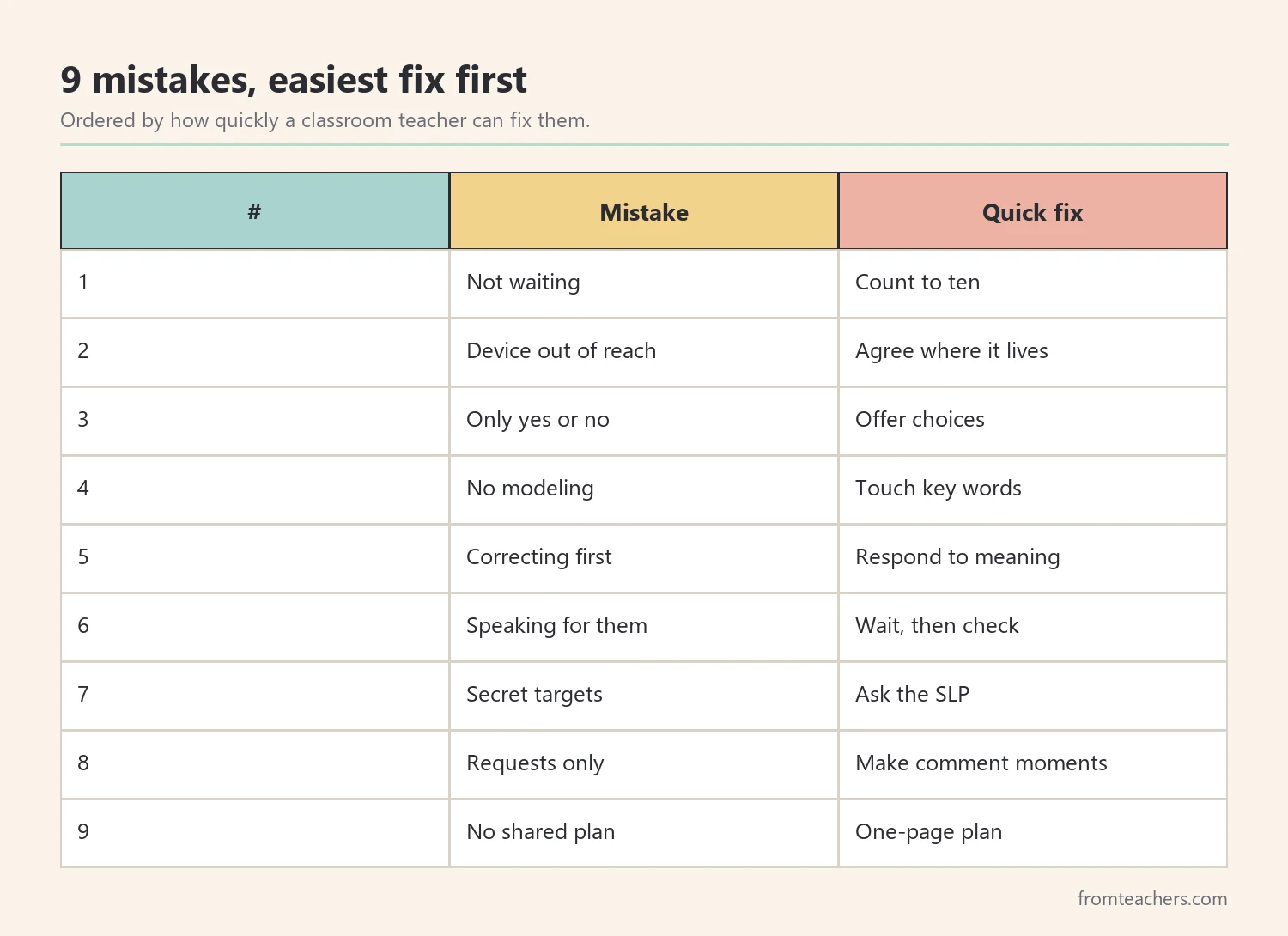
1. Not waiting long enough
First, the most common of all AAC mistakes is moving on too fast. Finding a word on a device takes time: opening a folder, scanning a page, pressing several buttons. A two-second pause is rarely enough.
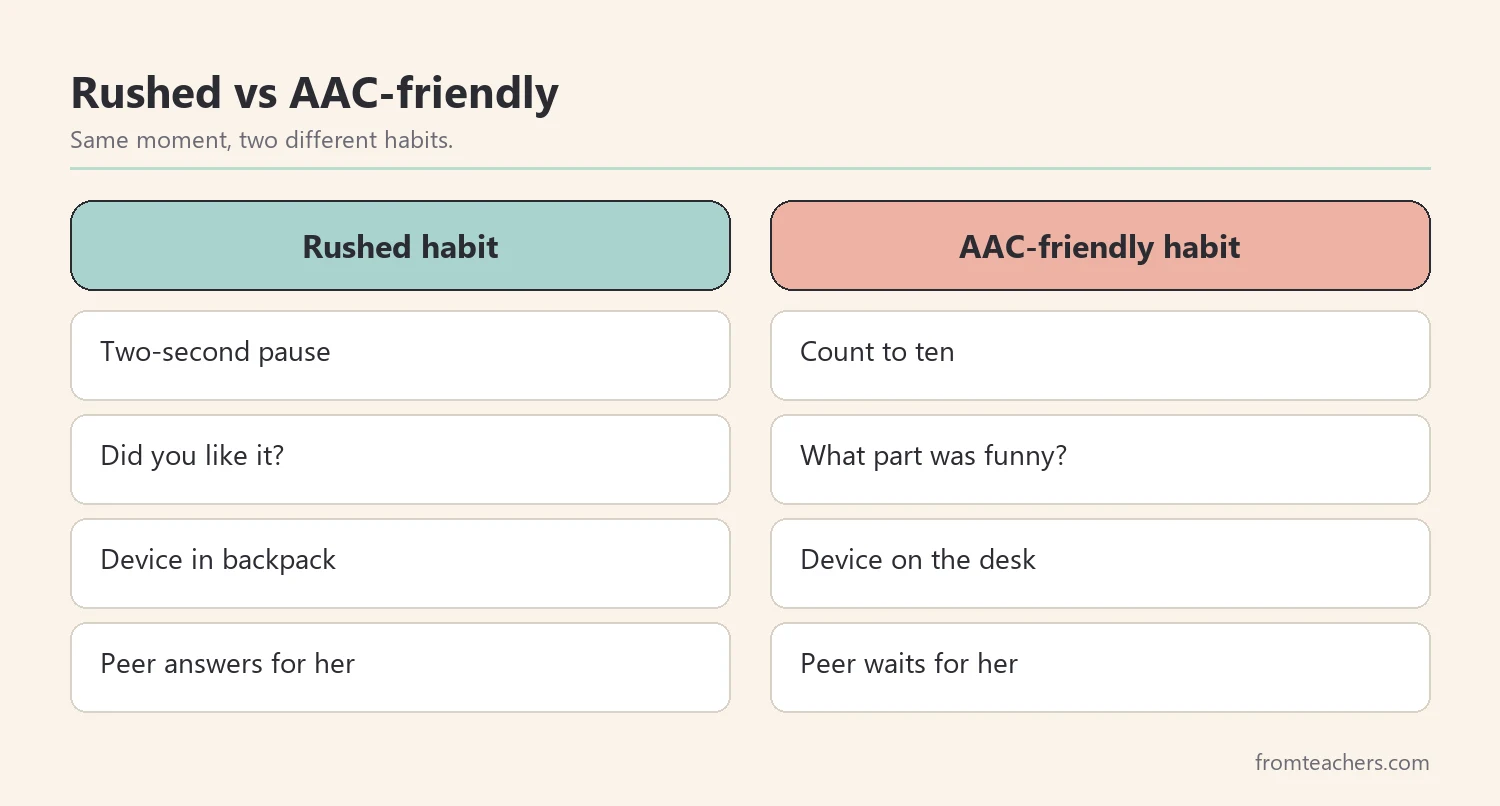
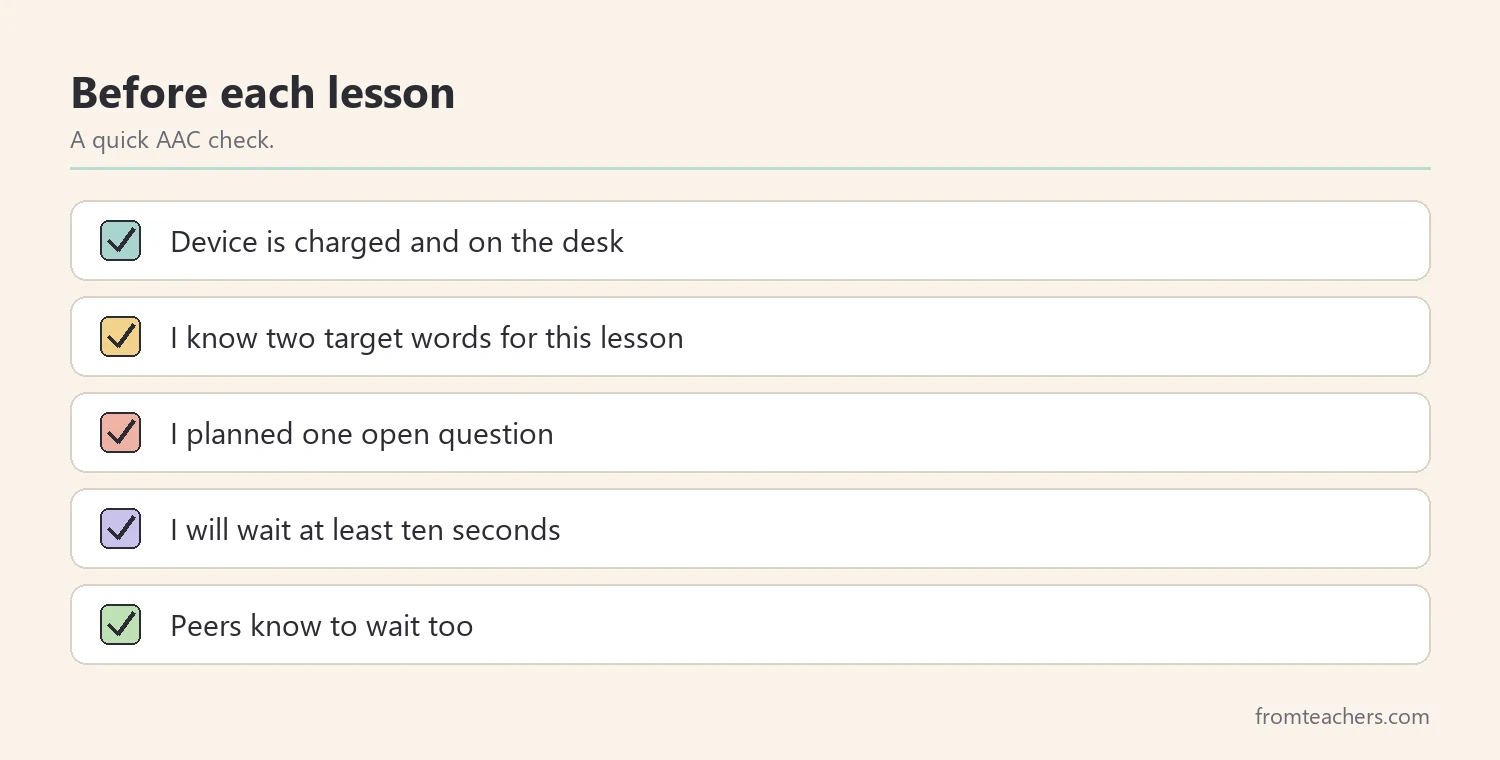
The fix: after you ask Nora a question, count silently to ten or more while looking at her with interest. Tell the class that “thinking time” is for everyone.
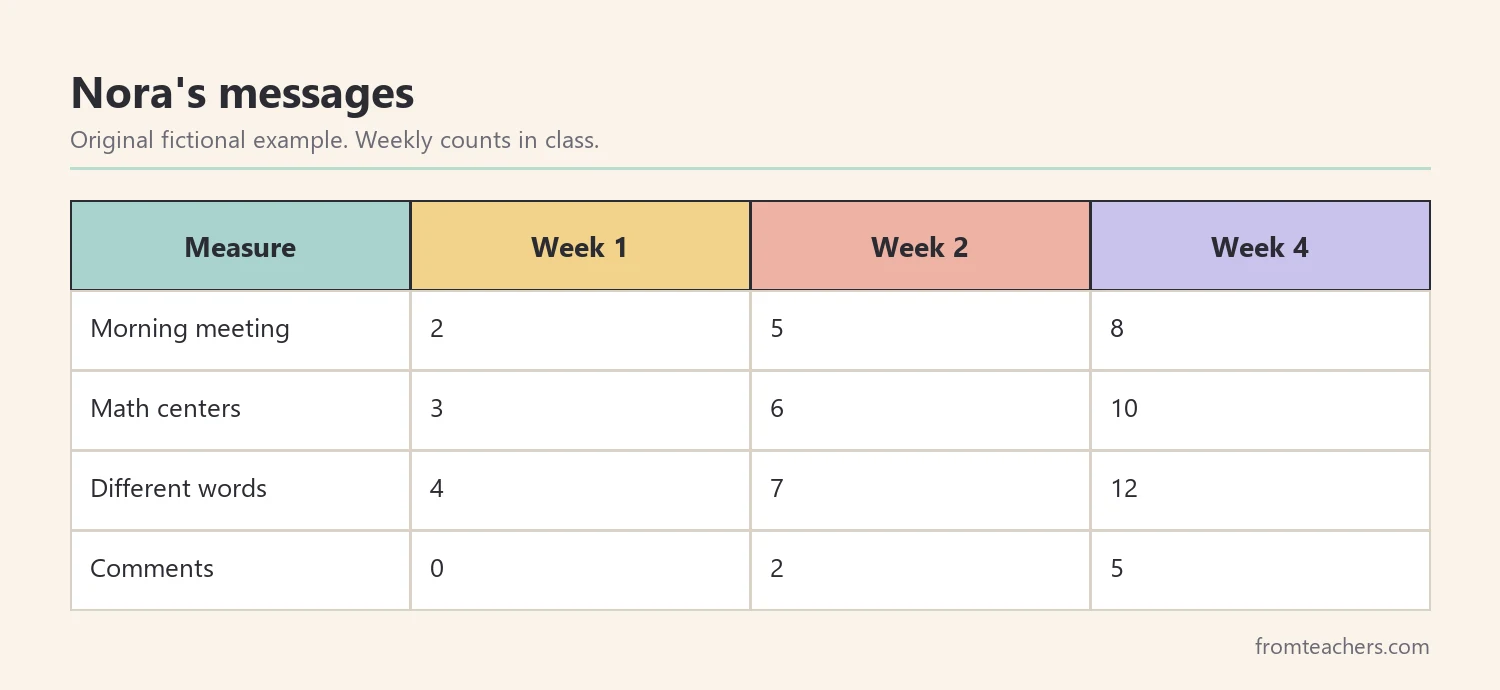
Example: Nora’s teacher, Mr. Ellis, started counting to ten. In week one, Nora answered two morning questions; by week four, she answered most of them.
2. Leaving the device out of reach
Next, a device in a backpack or on a shelf is a voice that is switched off. Students need access during lessons, lunch, recess and specials, not only during “AAC time.”
The fix: agree with the team on where the device lives during each part of the day, and who checks that it is charged and nearby.
3. Asking only yes or no questions
Then look at your questions. Yes or no questions are quick, but they limit what a student can say. Many AAC mistakes come from rushing, and closed questions are a rushed habit.
The fix: mix in open questions and choices, such as “What did you like?” or “Should we read the frog book or the bus book?”
Example: Mr. Ellis changed “Did you like the story?” to “What part was funny?” Nora pressed FROG and JUMP, and the class laughed with her.
4. Not modeling on the device
Students learn spoken language by hearing it thousands of times. In the same way, AAC users learn by seeing others use their system. Expecting a student to use AAC that nobody else uses is one of the AAC mistakes that slows learning the most.
The fix: while you talk, point to or press a few key words on the student’s device or a printed copy of the board. You do not need to model every word.
Example: during math, Mr. Ellis said “We need MORE blocks” and touched MORE on a printed core board. Within days, Nora used MORE during centers.
5. Correcting the message instead of responding
Next, avoid treating AAC answers like a test. If Nora presses DOG during a story about a cat, she may be telling you something real, such as “I have a dog.”
The fix: respond to the meaning first. Say “You have a dog! What is your dog’s name?” and model the target word later if needed.
6. Speaking for the student
Similarly, peers and adults sometimes finish the student’s sentences or answer for them. It feels kind, but it takes away a chance to communicate.
The fix: wait, then ask the student whether a guess is right. Teach classmates to wait and to talk to the student, not about them.
To keep everyone consistent, an individual AAC communication plan for the classroom lists the student’s target words, activities and access methods, so any adult supporting the student knows what to reinforce.
7. Keeping AAC targets a secret
Often the SLP knows the student’s current targets, but the classroom teacher does not. This is one of the quieter AAC mistakes, because nothing looks wrong. Yet the student practices the targets in therapy and never hears them in class.
The fix: ask the SLP for three to five target words or messages for the month, and plan when each one fits your lessons.
| Activity | Target message | How Nora accesses it |
|---|---|---|
| Morning meeting | I feel … | Feelings page |
| Math centers | more, finished | Core page |
| Read aloud | funny, again | Core page |
| Recess | my turn | Core page |
8. Using AAC only for requests
Then think about what students say with their AAC. Requests like “want snack” are useful, but communication also means commenting, asking questions, joking, protesting and telling stories.
The fix: create moments for comments. Ask “What do you think?” during science or “Tell me about your weekend” on Monday mornings.
9. Working without a shared plan
Finally, the hardest fix needs teamwork. When teachers, aides, specialists and family each use AAC differently, the student gets mixed messages. One of the most lasting AAC mistakes is having no single place where the goals are written down.
The fix: use a one-page plan that lists objectives, activities, targets and how progress will be checked. Review it with the SLP and family every few weeks.
Example: Nora’s team met for twenty minutes each month. They chose new targets, checked her comfort level with each one, and shared the plan with her substitute teachers.
How to check whether your fixes are working
Change is easier to see when you count something. Therefore, pick one or two simple measures, such as how many times the student communicates in morning meeting, or how many different words they use in a week.
For example, Mr. Ellis tracked Nora’s messages during morning meeting and centers for four weeks. Figure 3 shows the change after he added wait time and modeling. Her total messages grew, and so did the variety of words she chose.
In addition, ask the student. Some students can rate how comfortable they feel with a target word, for example on a scale from 1 to 4. Their answers tell you which words need more modeling.
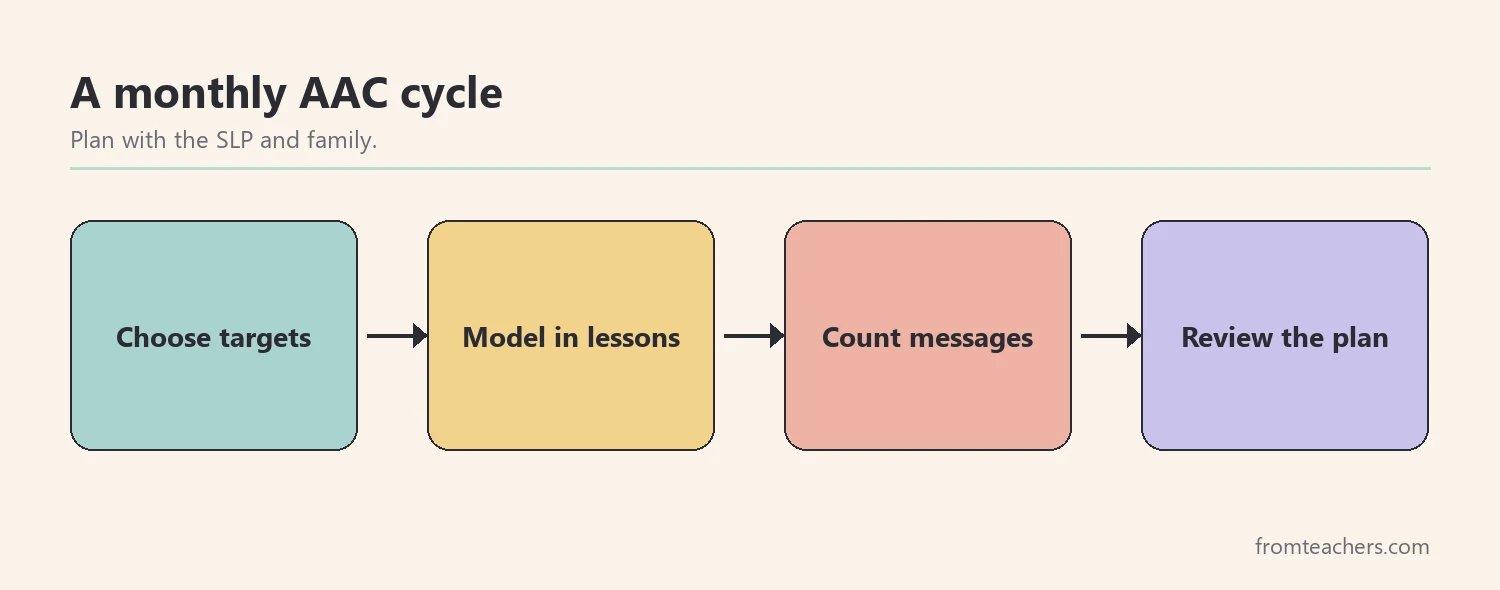
Also, include the family. Parents may notice new words at home before you notice them at school. A short note each week helps everyone celebrate progress together. Figure 5 shows a simple monthly cycle.
Why these AAC mistakes matter for the whole class
Fixing AAC mistakes helps more than one student. Wait time gives every child a chance to think. Choices and open questions help English learners and shy students join in. Modeling with visuals supports students who learn best by seeing.
As a result, many teachers find that a classroom that welcomes AAC is calmer and more patient overall. Classmates learn that people communicate in different ways, and that every voice is worth waiting for.
AAC mistakes outside the classroom
Many AAC mistakes happen in places where the classroom teacher is not present. In art, music and PE, the device may stay behind because “she will not need it.” At lunch, it may sit in a bag because of spills. At recess, adults may worry it will break.
However, these settings are where much of the real talk happens. Children joke, ask to join games and tell each other about their weekend. A student without access to AAC in those moments misses the social side of school.
First, share a short list of target words with each specials teacher, such as PAINT, LOUD, MY TURN or AGAIN. Next, plan simple protection for the device, like a case or a strap, rather than leaving it behind. Then ask lunch and recess staff to wait and to respond to messages, just like in class.
For example, Nora’s PE teacher added THROW, CATCH and MY TURN to her lesson plan. Nora used MY TURN in the first week, and a classmate cheered when she pressed it. Small wins like this spread, because other adults see that avoiding AAC mistakes takes very little time.
Finally, check in with the family about after-school clubs and car rides. Avoiding AAC mistakes at home and in the community follows the same rules: keep it close, wait, model and respond.
Common mistakes and how to avoid them
- Treating the device as a reward. Fix: never remove AAC as a consequence; it is the student’s voice.
- Testing instead of talking. Fix: ask real questions you do not already know the answer to.
- Modeling too much at once. Fix: model one or two key words per sentence.
- Forgetting specials and recess. Fix: share the plan with every adult who works with the student.
- Ignoring a dead battery. Fix: add charging to the daily routine.
Questions teachers ask about AAC mistakes
Will using AAC stop a child from learning to speak?
Research summarized by organizations such as ASHA does not support that worry. Many children use AAC alongside speech. Talk with the SLP about your student’s goals.
Do I need to learn the whole device?
No. Start with the student’s current targets and a few core words. The SLP can show you where they are.
What if classmates play with the device?
Teach the class that the device is the student’s voice, like a mouth. Then give peers a chance to learn and model words respectfully.
How do I avoid AAC mistakes when I am busy?
Pick one habit at a time. Start with wait time, then add one modeled word per lesson.
Who should update the AAC plan?
Usually the SLP leads, with input from the teacher, aides, family and the student. Agree on a review date.
Related reading: Best Assistive Technology for Special Education Classrooms, Boost Access and Independence: An Assistive Technology Toolkit for Special Education, and How Teachers Communicate With Parents in Special Education.
You may also need: Speech & Language Toolkit: AAC, Receptive & Expressive Support.
A companion resource for AAC mistakes:
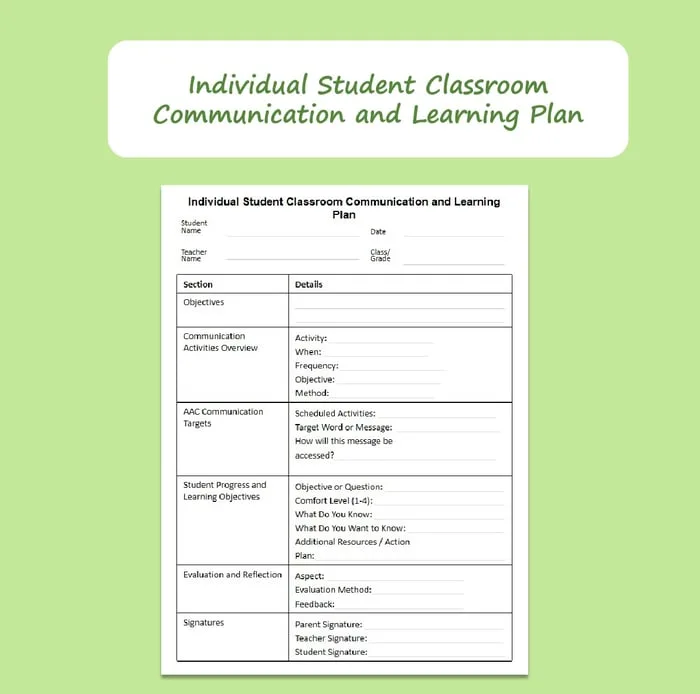
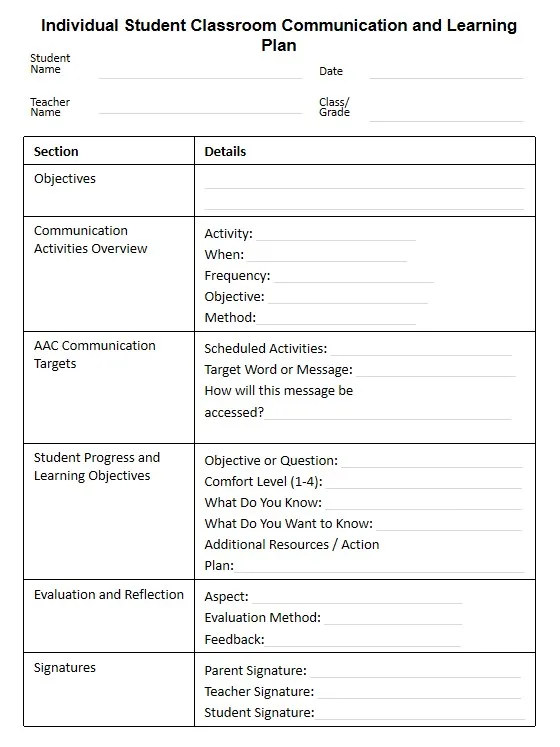
Individual Student Communication Plan AAC Learning Plan for Classrooms: a one-page plan with objectives, a communication activities overview, AAC targets for scheduled activities with access methods, progress and comfort ratings, and evaluation notes, signed by parent, teacher and student.
Sources and scope
- ASHA: Augmentative and Alternative Communication: an overview of AAC for families and educators from the American Speech-Language-Hearing Association.
- ISAAC: the International Society for Augmentative and Alternative Communication.
- IRIS Center at Vanderbilt University: free modules on inclusive instruction and supports.
- CAST UDL Guidelines: a framework for flexible ways to engage, represent and express learning.
This list covers everyday classroom habits around AAC in general education. It does not replace the student’s IEP, the speech-language pathologist’s recommendations or device-specific training.
Key takeaways
- Most AAC mistakes are small habits that are easy to change.
- Wait longer, keep the device close and ask open questions.
- Model key words on the student’s system during real lessons.
- Respond to the message first; correct later, if ever.
- Keep one shared plan with targets and review it regularly.










Leave a Comment