

Knowing the right FBA questions for parents to ask can turn a worrying meeting into a real partnership. Picture a phone call from school: “We would like to do a functional behavior assessment for your son.” You agree, but you are not sure what it involves, how long it takes, or what your role is. At the meeting, the room fills with terms like antecedent, consequence and function.
This list gives families ten clear questions to ask during a functional behavior assessment (FBA), ordered from the start of the process to the behavior plan. For each question, you will see why it matters and what a helpful answer sounds like. You will follow Eli, a fictional second grader, and his father, Marcus.
Examples are fictional. Procedures vary by state and district. This is guidance, not legal advice or a diagnosis.
At a glance
- An FBA looks for the reason behind a behavior, not only the behavior itself.
- Ask what data was collected, where, and by whom.
- Ask how the team decided on the function, and how sure they are.
- Share what you see at home; it is real data too.
- A good FBA leads to teaching a new skill, not only consequences.
What an FBA is, in plain words
An FBA is a process the school team uses to understand why a behavior happens. The team collects information about what happens before the behavior, the behavior itself and what happens after. Then they decide what the behavior most likely does for the child, such as getting attention or escaping a hard task. That “why” is called the function.
The IDEA regulations mention FBAs in certain discipline situations, and many schools also use them whenever behavior gets in the way of learning. The results usually lead to a behavior intervention plan (BIP).
How we ordered these questions
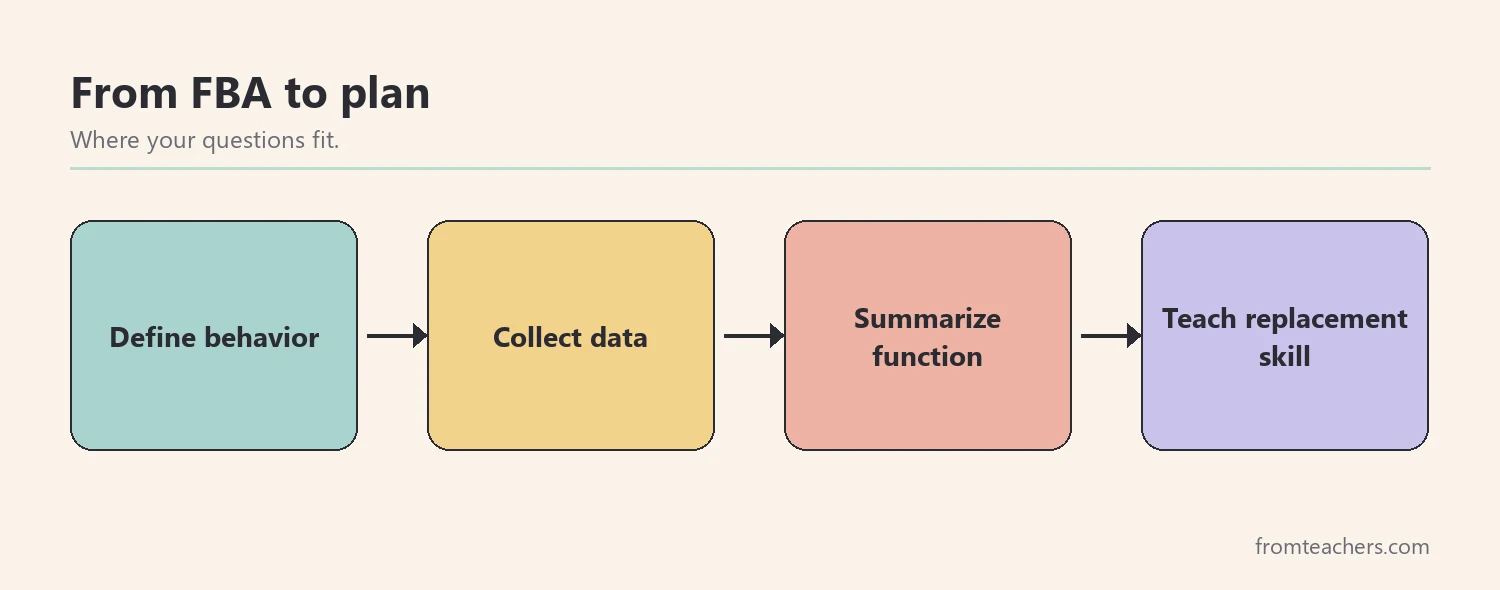
We ordered the questions by when they fit in the process: starting the FBA, collecting data, summarizing results, and planning. You do not need to ask all ten at once. Choose the ones that matter most for your child.
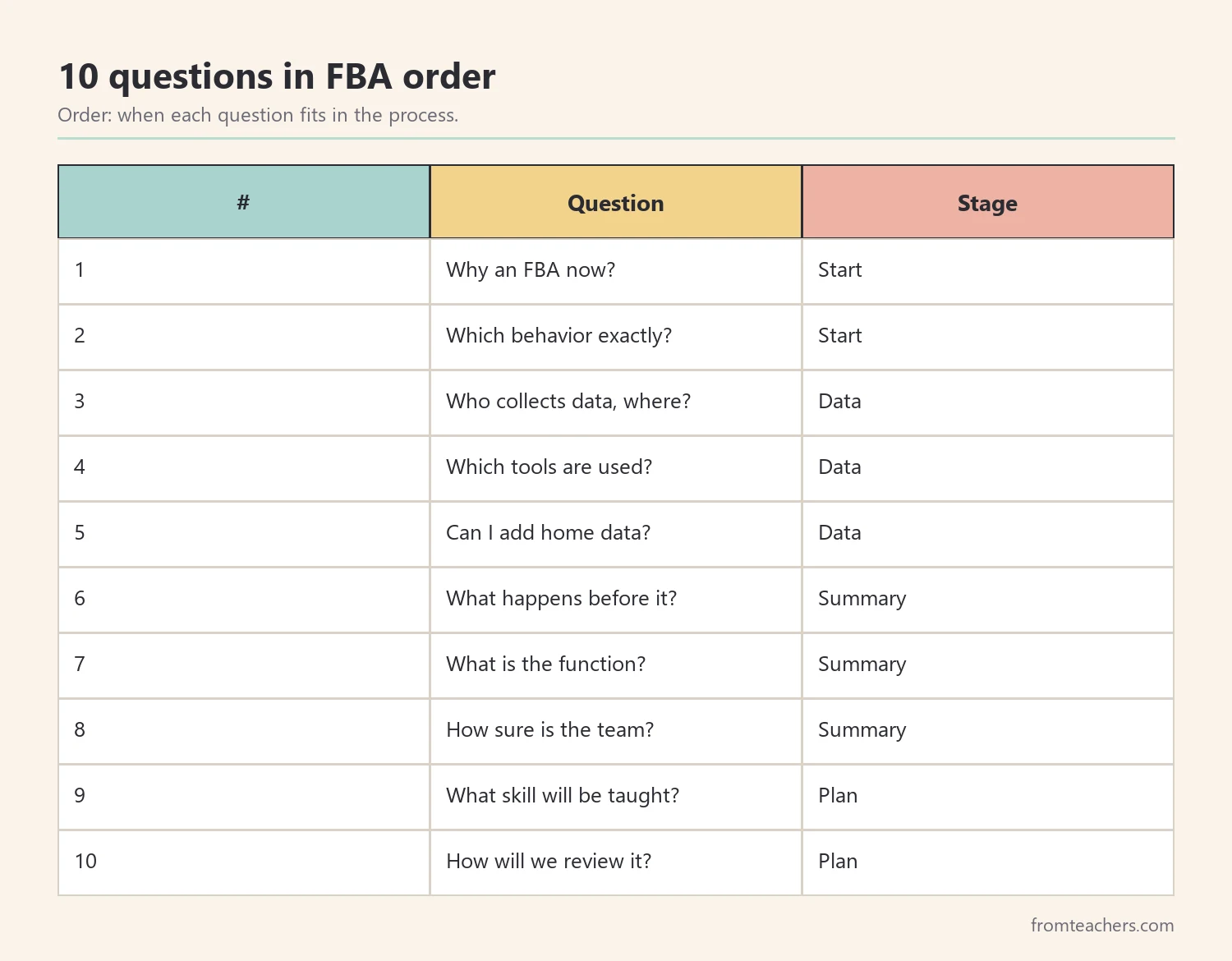
1. “Why are you suggesting an FBA now?”
Why it matters: the answer tells you what the team is worried about and what has already been tried.
A helpful answer: a specific description, such as “Eli has left his seat during writing about ten times a day for three weeks, and our current supports have not helped.”
Example: Marcus learned that the teacher had already tried a seat change and extra breaks. That helped him understand why the team wanted a closer look.
2. “Which behavior exactly are you looking at?”
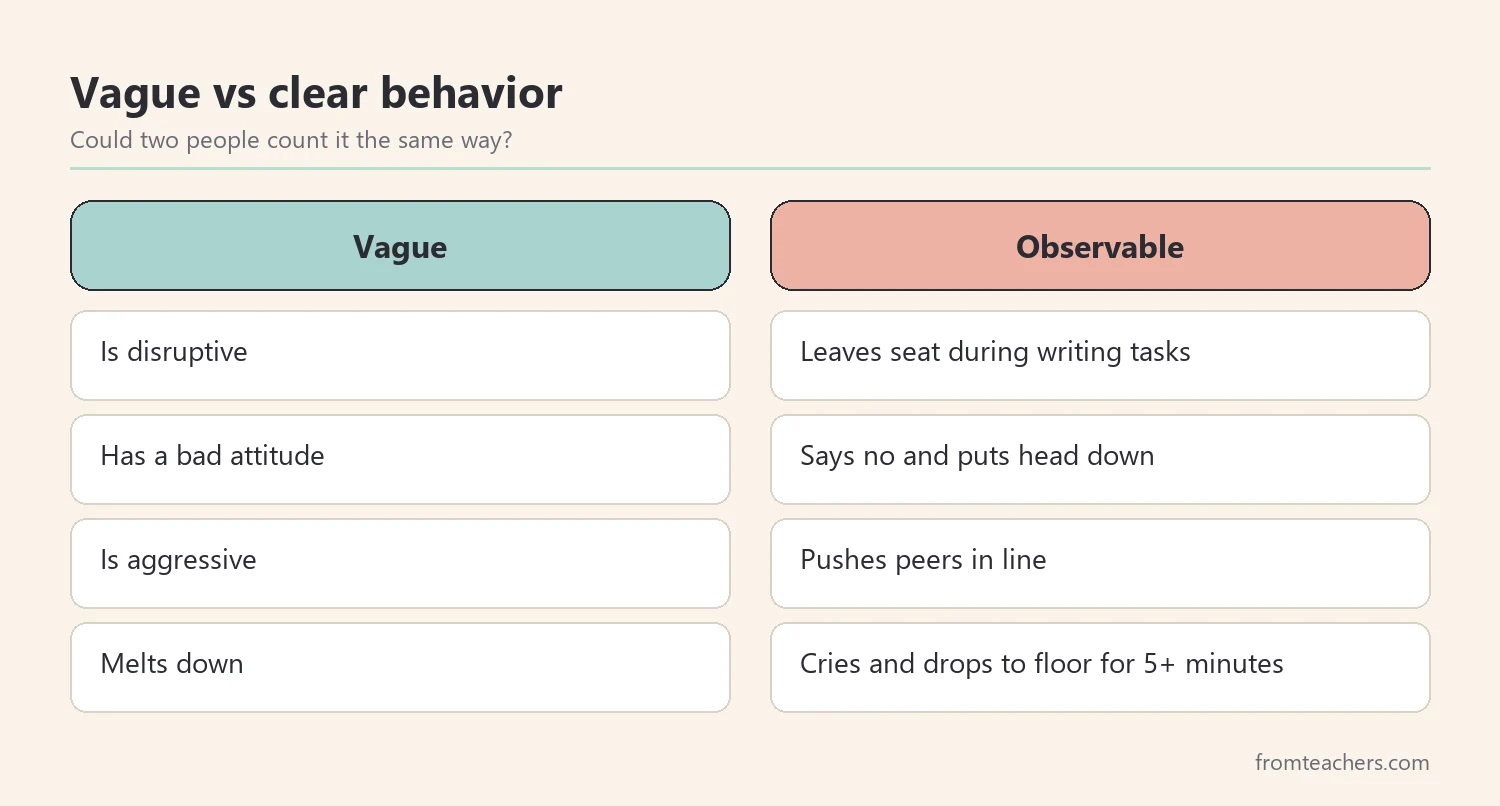
Why it matters: an FBA works best when the behavior is described so clearly that two people could count it the same way.
A helpful answer: “leaves his seat without permission during writing tasks,” rather than “is disruptive.”
Tip: if the description sounds like a label, kindly ask, “What would I see if I were in the room?”
3. “Who will collect data, and where?”
Why it matters: behavior can look different across settings, times and adults. Data from only one class period may miss the bigger picture.
A helpful answer: “The teacher and the behavior specialist will collect data in reading, writing and recess for two weeks.”
Example: Marcus asked whether data would include music and lunch. The team added lunch, because Eli rarely left his seat there, and that contrast turned out to be useful: no writing, almost no leaving.
4. “Which tools will you use?”
Among FBA questions for parents, this one shows you how thorough the assessment will be.
Why it matters: strong FBAs usually combine several sources, such as ABC (antecedent, behavior, consequence) records, interviews with staff, observations and sometimes rating scales.
A helpful answer: the team names at least two or three tools and explains how they will bring the results together. Some teams use an FBA summary form that combines ABC data, interviews and recording forms, so results from each tool appear side by side under the same headings.
5. “Can I share what I see at home?”
Why it matters: parents see patterns the school cannot, such as homework battles, sleep problems or reactions to certain tasks.
A helpful answer: “Yes. Here is a simple form, or tell us during the interview.”
Example: Marcus mentioned that Eli also avoided writing homework and often asked for water or the bathroom when worksheets appeared. That matched the school pattern closely.
6. “What usually happens right before the behavior?”
Why it matters: antecedents, the events just before a behavior, are often the easiest place to make changes.
A helpful answer: clear patterns, such as “Most times, a writing task had just been handed out.” Also ask about setting events, such as hunger, poor sleep or a busy morning, which can make behavior more likely.
Example: the data showed that Eli left his seat most often within two minutes of copying from the board. On mornings after poor sleep, it happened even sooner. Marcus started noting sleep in the daily planner, which gave the team a useful setting event to track.
7. “What do you think the behavior does for my child?”
Why it matters: this is the heart of the FBA. The plan depends on the function the team identifies.
A helpful answer: a plain statement, such as “When writing is hard, leaving his seat helps Eli get away from the task.” Common functions include getting attention, escaping or avoiding something, getting an item or activity, and sensory reasons.
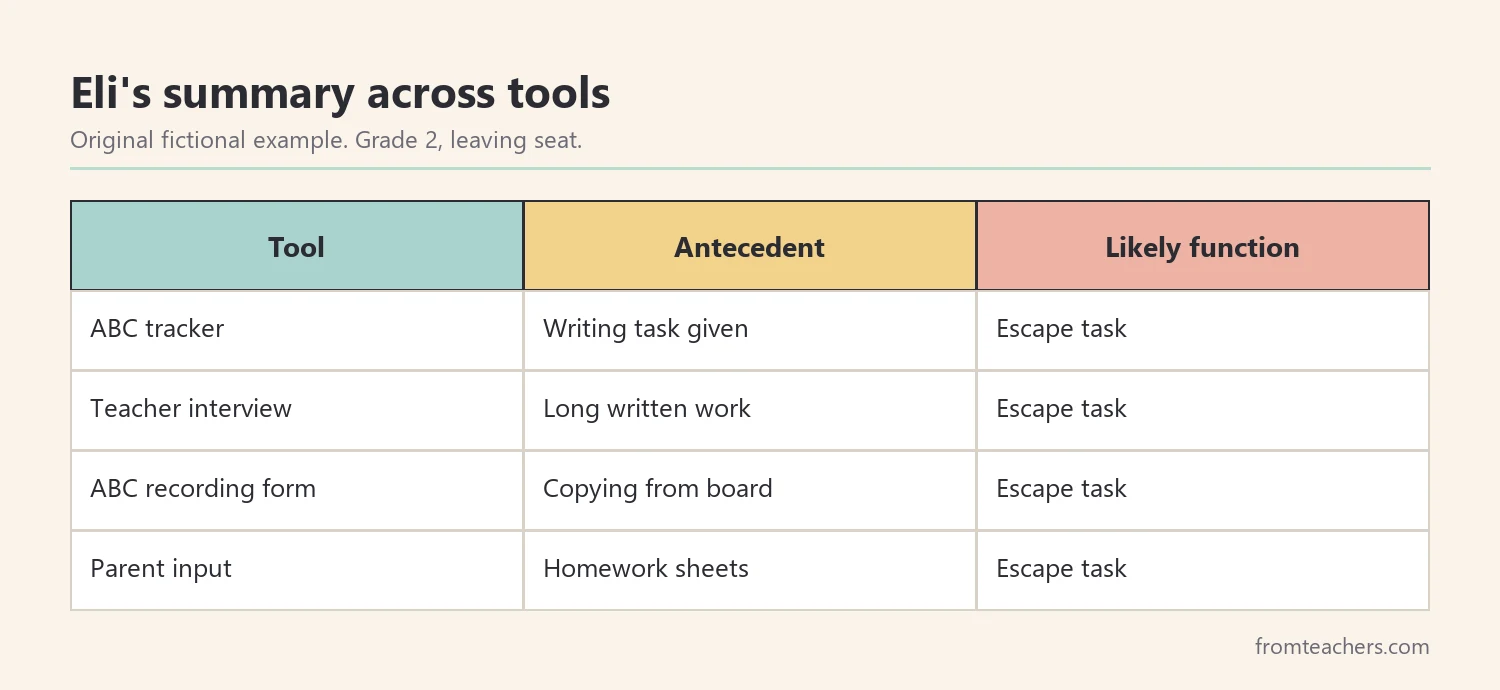
In Eli’s case, every tool pointed to the same function: escaping writing tasks. That consistency gave the team more confidence.
8. “How sure is the team about that function?”
Why it matters: sometimes the data is clear; sometimes it is mixed. Knowing the team’s confidence helps everyone decide whether more data is needed before writing a plan.
A helpful answer: “We are fairly confident because three tools agree,” or “Results are mixed, so we will collect another week of data.”
It is fine to ask what would change the team’s mind. For example, if Eli also left his seat during games he enjoyed, attention or sensory needs might be part of the picture. A team that can explain its reasoning is usually a team that looked carefully.
9. “What new skill will you teach instead?”
Why it matters: a good plan does not only stop a behavior. It teaches a replacement skill that meets the same need in a better way.
A helpful answer: “We will teach Eli to ask for a short break or help using a card, and break writing into smaller parts.”
Example: Marcus asked if Eli could use the same break card at home during homework. The team agreed, so both settings taught the same skill.
10. “How and when will we review progress?”
Why it matters: plans need checking. Without a review date, a plan that is not working can continue for months.
A helpful answer: “We will track how often Eli leaves his seat and how often he uses the break card, and meet again in six weeks.”
Also ask how you will hear about progress between meetings. A short weekly note or a simple chart sent home keeps you informed, and it lets you celebrate small wins with your child at home.
How to prepare in fifteen minutes
You do not need a long document to take part well. A short preparation routine is enough for most meetings.
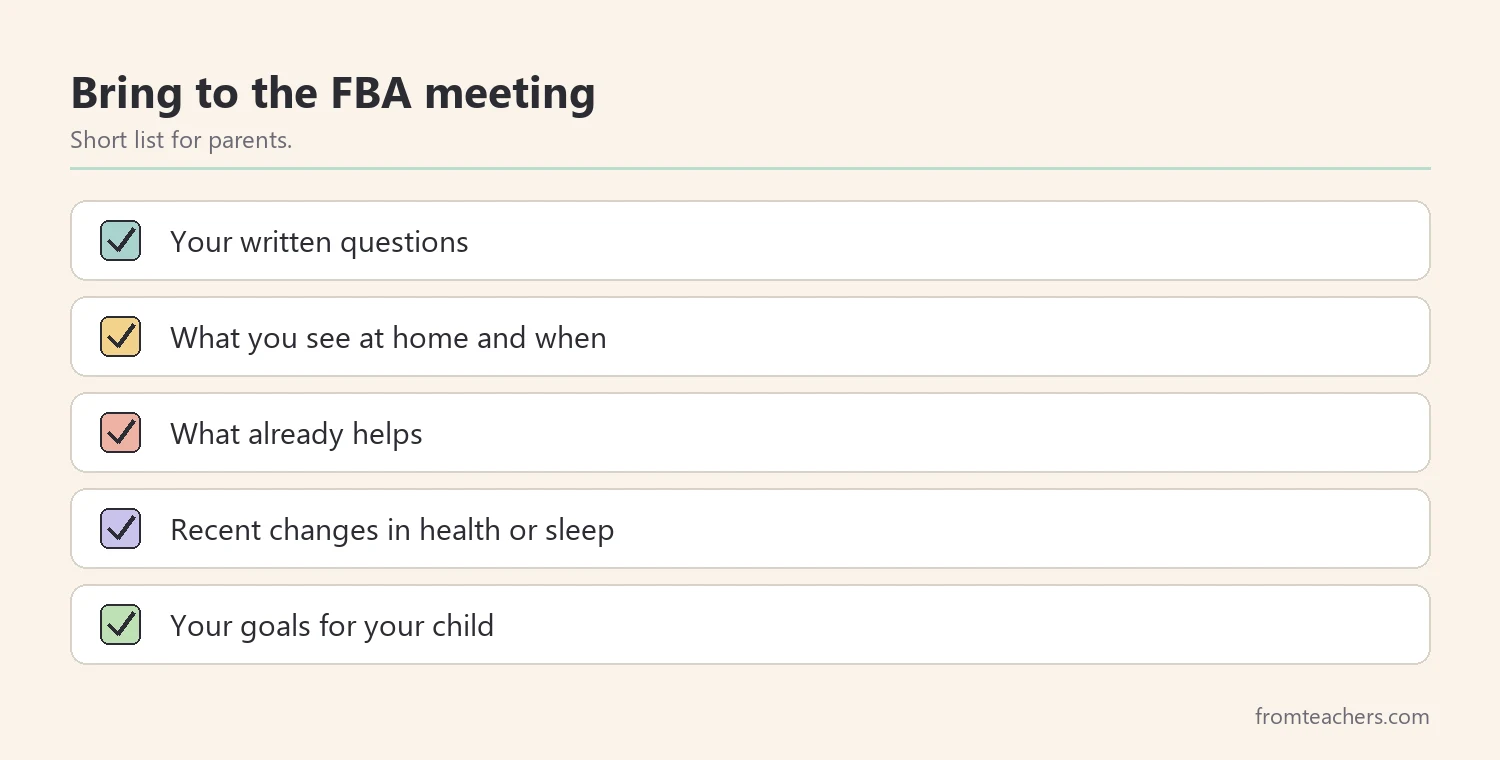
- Pick your questions: choose four or five from this list and write them on a card.
- Note home patterns: when does the behavior happen at home, and what happens right before?
- List what helps: write two or three things that calm or motivate your child.
- Add recent changes: new medicine, sleep problems, family changes or a move.
- Write one goal: what would a good school day look like for your child?
Bring a trusted person if you like, and ask for a pause if you need time to think. Meetings go better when everyone has time to understand each step.
What changed for Eli’s family
Before the meeting, Marcus wrote five of these questions on a card. During the meeting, he asked each one and took notes. He shared what he saw at home, which matched the school data.
Six weeks later, Eli was using his break card several times a day and leaving his seat much less. Writing tasks were shorter, with a checklist for each step. Marcus said the biggest change was that he understood the plan and could support it at home.
Useful words to know
| Term | Plain meaning |
|---|---|
| Antecedent | What happens right before the behavior |
| Consequence | What happens right after the behavior |
| Setting event | Something earlier, like poor sleep, that makes behavior more likely |
| Function | The reason the behavior works for the child |
| Replacement skill | A better way to meet the same need |
Common mistakes and how to avoid them
- Staying silent because the terms are new: ask “What does that mean in plain words?”
- Not sharing home information: your observations are valuable data.
- Accepting a plan with only consequences: ask what skill will be taught.
- Leaving without a review date: agree on when the team will check progress.
- Seeing the FBA as blame: it is a tool to understand your child, not to judge your parenting.
More FBA questions for parents
Do I have to give consent for an FBA?
Rules vary. Often, when an FBA is part of an evaluation, the school asks for parent consent. Ask your school and check your state’s guidance or your Parent Center.
How long does an FBA take?
It depends on the behavior and the school’s procedures. Many take a few weeks, because the team needs enough data across settings.
Can I request an FBA?
Yes, you can ask in writing. Explain the behavior you see and why you think an FBA would help.
Will I get a copy of the results?
Ask for a copy of the FBA summary before or at the meeting, so you have time to read it.
What if I disagree with the function?
Share your reasons and examples. Ask whether more data can be collected, and learn about your procedural safeguards.
Related reading: positive alternatives to behavior charts, meltdowns vs tantrums.
A companion resource for FBA questions for parents:
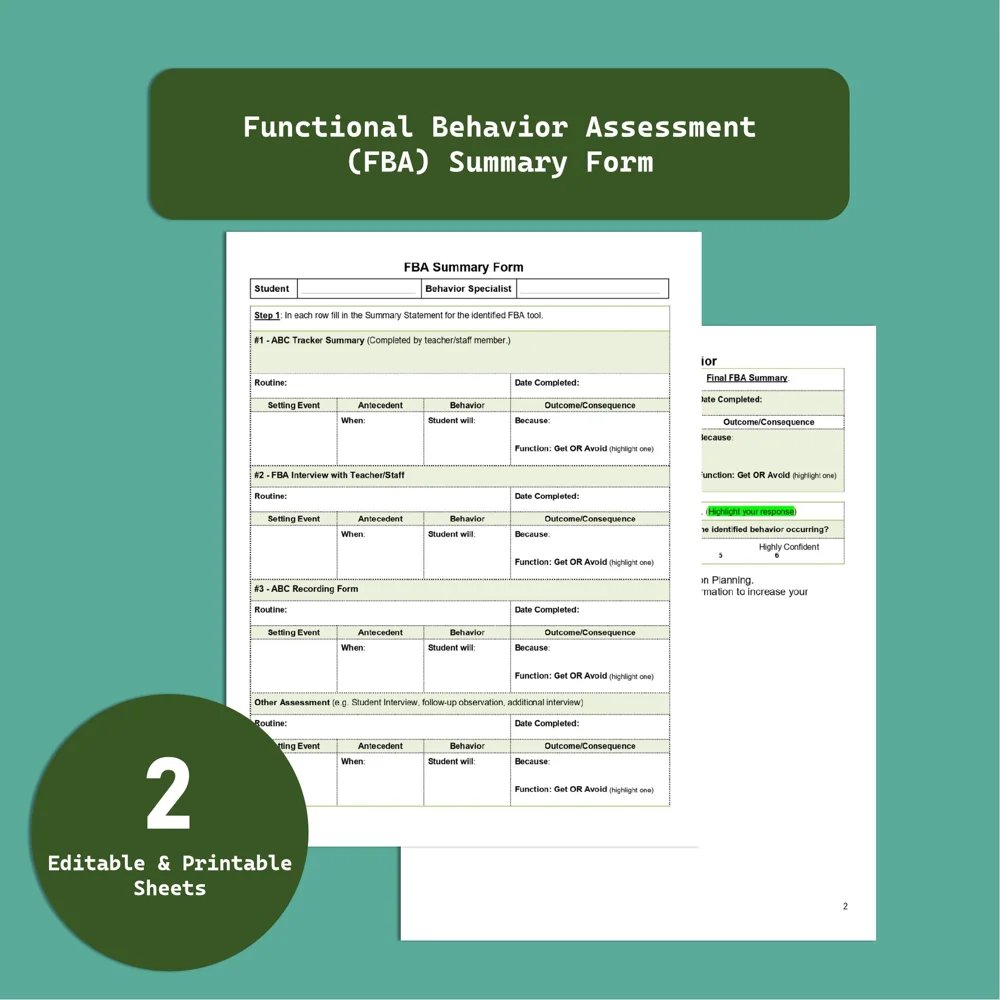
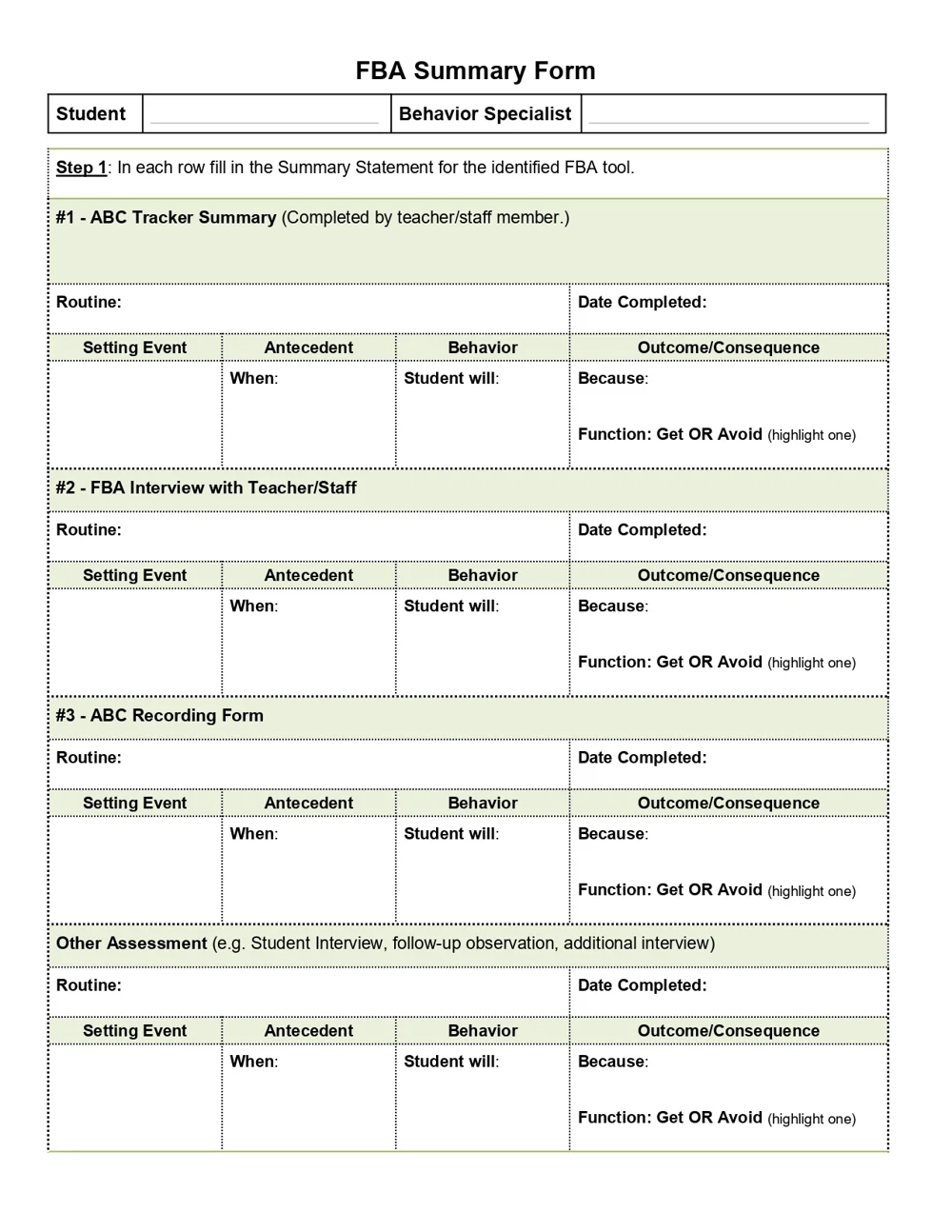
Functional Behavior Assessment Summary Form: Editable FBA and ABC Data Template: a two-page template, editable and printable, that summarizes up to four FBA tools (an ABC Tracker Summary, an interview with teacher or staff, an ABC Recording Form and another assessment) by routine, setting event, antecedent, behavior, consequence and function, then consolidates them into a final FBA summary with a confidence rating so the team can decide if more data is needed.
You may also need: Behavior Intervention Plan (BIP) Template with Function-Based Strategies.
Sources and scope
- IDEA (U.S. Department of Education): the federal law and regulations, including discipline provisions that mention FBAs.
- IRIS Center: free modules on functional behavioral assessment.
- Center on PBIS: resources on positive behavior support and function-based plans.
- Center for Parent Information and Resources: help for families, including state Parent Centers.
This list helps parents take part in an FBA. It does not replace district procedures, professional assessment or legal advice.
Key takeaways
- Good FBA questions for parents focus on the behavior, the data and the function.
- Ask which tools are used and whether several sources agree.
- Share what you see at home; it strengthens the assessment.
- Make sure the plan teaches a replacement skill.
- Agree on a review date before you leave the meeting.










Leave a Comment