

ADHD tips for substitute teachers matter because a cover day removes almost everything that helps a student with ADHD: the familiar adult, the usual routine and the small signals that keep the day on track. Picture Eli, a grade 4 student with ADHD, walking in on a Thursday morning and seeing an unfamiliar face at the teacher’s desk. Within ten minutes, he is out of his seat, asking three questions at once and drumming on the table.
This list is written for substitute teachers, cover staff and the regular teachers who prepare for them. It covers seven common mistakes in the order they tend to happen across a school day, with a calm fix for each. By the end, you will know how to set up the first ten minutes, how to give directions that stick, and how to keep a hard moment from becoming a hard day.
Examples are fictional. Adapt to the student’s goals and agreed supports. This is guidance, not a diagnosis.
At a glance
- Predictability matters most on a day when the adult is new.
- Read the sub plan for supports before students arrive.
- Give short, written directions and check in early.
- Plan movement instead of fighting it.
- Stay calm and private when redirecting, and leave clear notes.
How this list is ordered
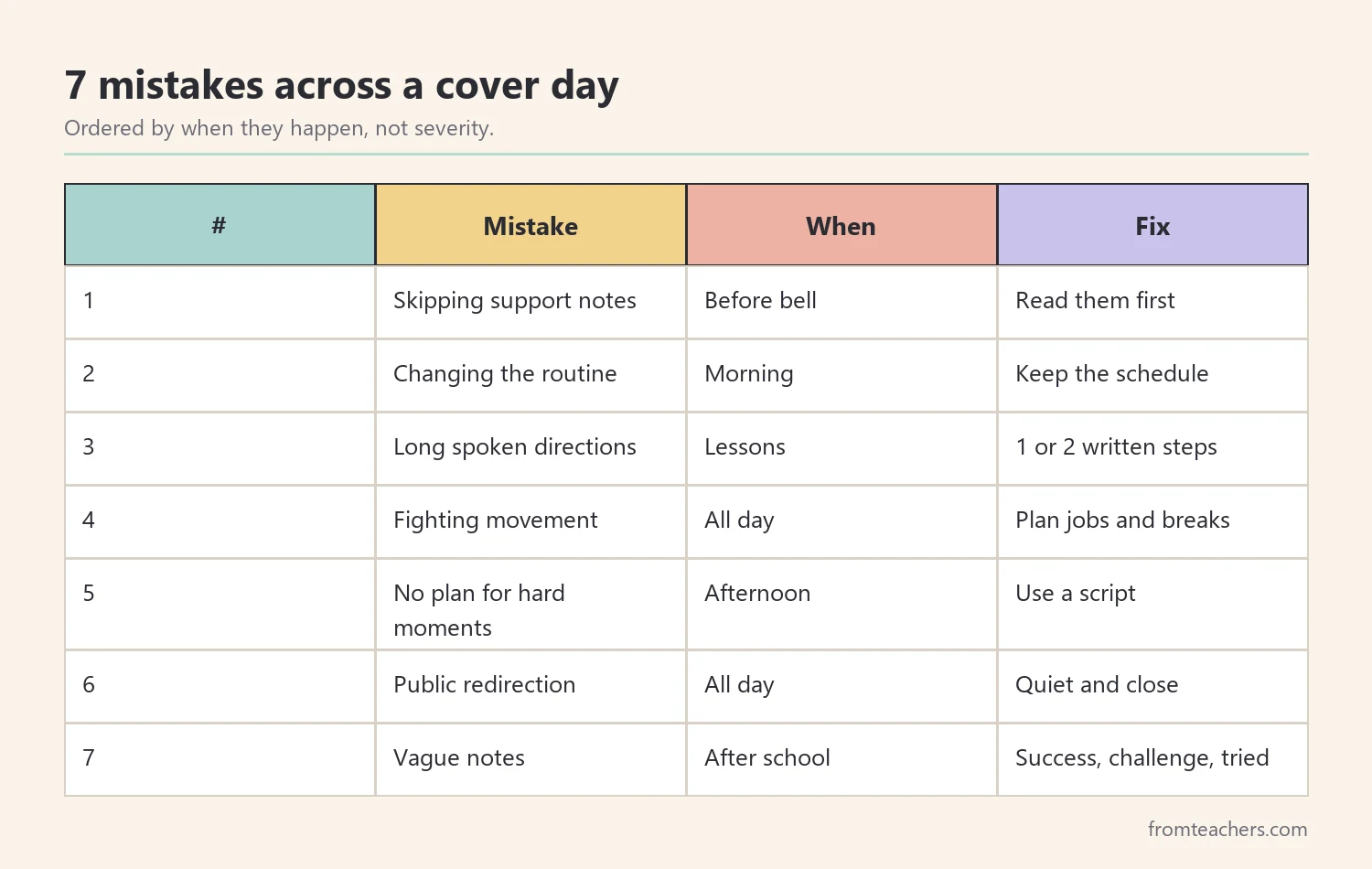
We did not rank these mistakes by severity, because every class is different. Instead, they follow the clock: mistake 1 happens before students arrive, and mistake 7 happens after they leave. As a result, you can read the list like a timeline of your cover day.
Keep in mind that ADHD affects attention, impulse control and executive function in different ways for different students. Therefore, these tips are general starting points, and the student’s own plan always comes first. Figure 1 gives a one-page overview.
1. Skipping the sub plan notes about supports
The first of these ADHD tips for substitute teachers starts before the bell. Many subs scan the lesson plan and skip the notes about individual students. Yet those notes often contain the most useful information of the day.
Why it matters: students with IEPs or 504 plans may have agreed accommodations, such as preferential seating, movement breaks or extra time. A sub is still expected to follow them.
The fix: look for a student support page, a seating chart with notes or a “who needs what” list. If you cannot find one, ask the office or a neighboring teacher before students arrive.
Example: Mr. Ramos, the substitute, found a note that Eli used a fidget tool and a break pass. He placed both on Eli’s desk before the bell, which saved an argument later.
2. Changing the routine on day one
New adults often bring their own way of doing things. However, for a student with ADHD, a new routine on top of a new adult can be too much change at once.
Why it matters: familiar routines reduce the number of decisions a student has to make. When routines change, students spend energy figuring out the day instead of learning.
The fix: follow the class schedule and routines as closely as you can. Ask a reliable student, “How does Ms. Carter usually start the morning?” Then post the day’s schedule on the board.
Example: The class always started with silent reading. Mr. Ramos kept it, and Eli settled faster once he saw the familiar first activity on the board.
3. Giving long spoken directions
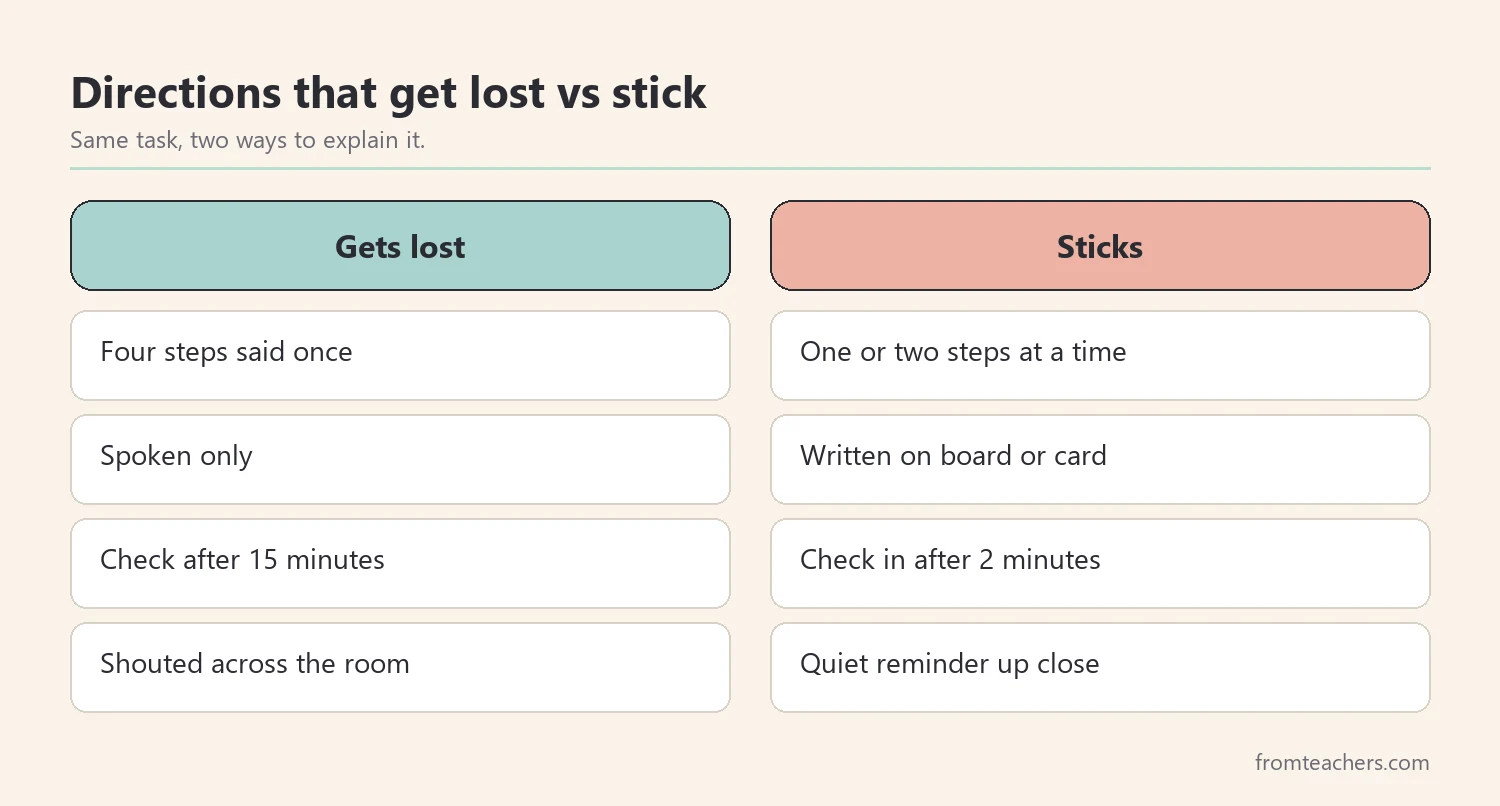
Next comes one of the most common mistakes. A sub explains a whole task out loud, with four steps and two exceptions, then says “Go.” Many students with ADHD catch the first step and lose the rest.
Why it matters: working memory is often a challenge with ADHD. Long spoken directions ask students to hold too much at once.
The fix: give one or two steps at a time, write them on the board and check in with likely strugglers within the first two minutes. In addition, a short written card on the desk helps.
Example: Mr. Ramos wrote “1. Read page 42. 2. Answer questions 1 to 3.” on a sticky note for Eli. He started on time instead of asking what to do.
4. Treating movement as misbehavior
Many students with ADHD need to move. Fidgeting, standing or tapping can help them focus. When a sub treats every movement as defiance, a power struggle starts fast.
Why it matters: fighting movement often creates more disruption than the movement itself.
The fix: plan movement into the day. Use jobs like handing out papers, a quick class stretch between lessons and the student’s agreed break pass. As long as movement is safe and not disturbing others, let it go.
Example: Mr. Ramos asked Eli to collect the reading books. Eli enjoyed the job, and the drumming stopped for most of the next lesson.
5. Arriving without a ready-made plan for hard moments
Hard moments happen on cover days, especially after lunch or during transitions. Without a plan, a sub has to improvise under pressure, which rarely goes well.
Why it matters: a calm, predictable response protects the student and the class. Improvised reactions can escalate a small moment.
The fix: keep a short set of strategies and scripts ready. Regular teachers can leave a page in the sub folder with what works for each student. A ready-made ADHD support toolkit with classroom and home strategies is a good source for that page: it includes routines for transitions, directions and movement breaks, regulation strategies and scripts for meltdown moments.
Example: Ms. Carter had copied a one-page “calm moment” script into her sub folder. When Eli became frustrated during math, Mr. Ramos used it word for word.
6. Redirecting in public
When a student is off task, it is tempting to call out across the room. “Eli, sit down, now!” Unfortunately, public correction often embarrasses the student and invites an audience.
Why it matters: students with ADHD often receive more correction than their peers. Public redirection can add shame and make the next moment harder.
The fix: move closer, use a quiet voice and give a short, positive direction. “Eli, pencil on question 2, please.” Then walk away and give a thumbs-up when he starts.
Example: Mr. Ramos used quiet, close-up reminders all day. Eli needed reminders, but he never got into a public standoff.
7. Leaving no notes for the regular teacher
Finally, the day ends and the sub leaves a short note: “Class was fine.” That tells the regular teacher almost nothing, and useful information is lost.
Why it matters: the regular teacher needs to know what worked, what did not and whether anything should be followed up with the family.
The fix: write a few specific notes. Include one success, one challenge and what you tried. Keep it factual and respectful.
Example: Mr. Ramos wrote: “Eli started reading on time with a written card. Hard moment in math at 1:20, calmed with break pass after 4 minutes. Book job helped a lot.”
A cover day in numbers
Here is how Eli’s two cover days compared, one without a prepared plan and one with the supports above. The numbers come from the substitute’s notes.
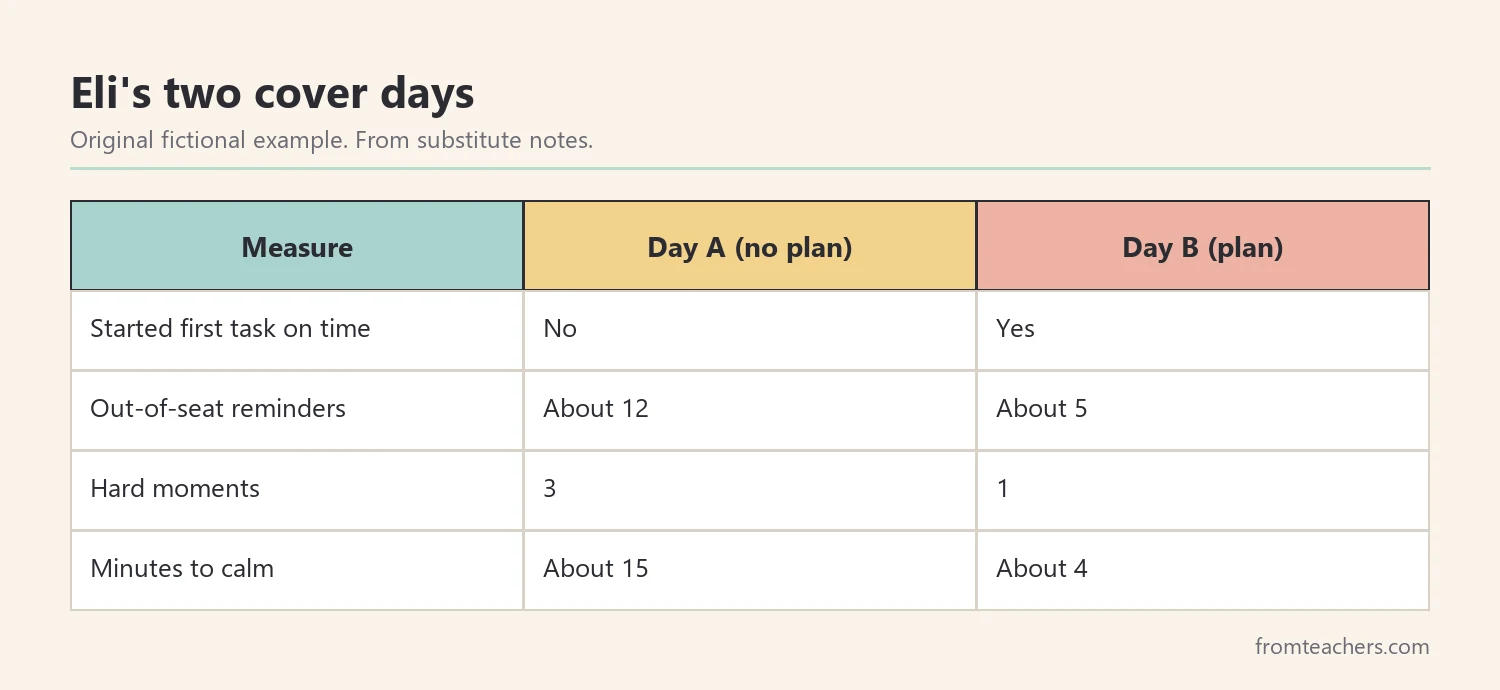
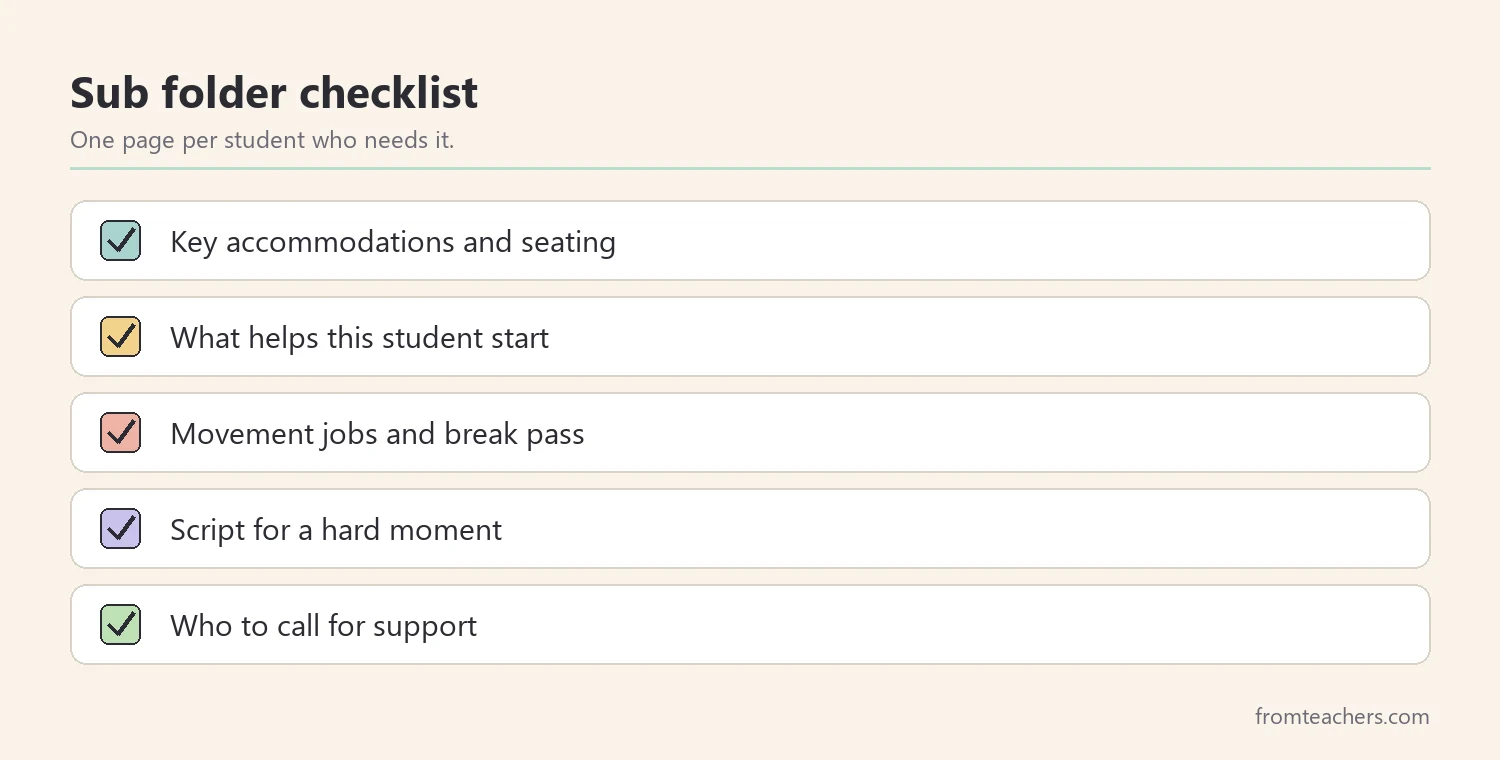
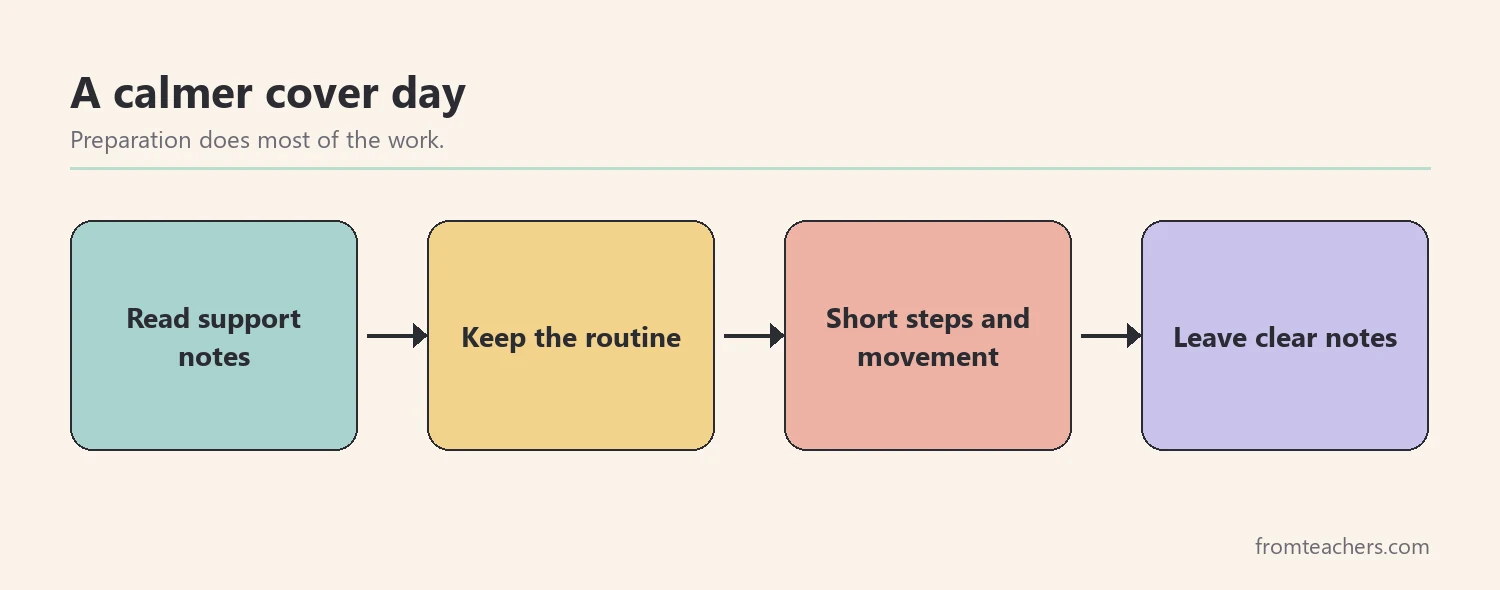
The difference was not a new rule or a stricter tone. Instead, it was preparation: a schedule on the board, written directions, planned movement and a script for hard moments. Figure 4 shows a checklist regular teachers can put in the sub folder, and Figure 5 shows the simple flow of a calmer cover day.
For regular teachers: preparing the sub folder
Most of these ADHD tips for substitute teachers work best when the regular teacher prepares ahead. Keep a short page per student with key supports, what helps, what to avoid and who to call for help. Update it each term.
Also, tell students in advance when you know you will be away. A quick “Tomorrow Mr. Ramos will be here, and our schedule stays the same” can lower worry for many students, not only those with ADHD.
In addition, think about the hardest part of your usual day. If transitions after lunch are often difficult, leave a simple plan for that exact moment, such as a read-aloud or a quiet drawing task while students settle. Likewise, if a student has a trusted adult in the building, such as a counselor or a paraprofessional, write that name clearly in the folder.
Finally, ask your substitute for feedback when you return. A two-minute conversation about what worked often improves the next sub folder more than any template. Over a year, those small updates turn a thin folder into a reliable plan that protects your students’ routines, even on the days you cannot be there.
Common mistakes and how to avoid them
- Reading the student plan after a problem. Fix: read support notes before the bell.
- Using the whole class as an audience. Fix: redirect privately and briefly.
- Taking away recess for restlessness. Fix: follow school policy and plan movement instead.
- Assuming a student is being rude. Fix: assume a skill gap first and support it.
- Leaving vague notes. Fix: note one success, one challenge and what you tried.
Questions teachers and parents ask about ADHD tips for substitute teachers
Do substitute teachers have to follow IEP and 504 accommodations?
Generally, yes. Accommodations apply in the classroom whoever is teaching. Schools usually share key information through sub plans, so ask the office if it is missing.
What if there is no sub plan at all?
Ask a neighboring teacher or the office for the schedule and any student support notes. Meanwhile, keep the day simple and predictable, and post the schedule.
Should I ask students who has ADHD?
No. Student information is private. Use the notes provided by the school and treat all students with the same calm, clear structure.
How can parents help on cover days?
Parents can mention planned absences at home and remind their child that the routine stays the same. Some families also ask the teacher how sub days are planned.
What should I do if a student becomes unsafe?
Follow the school’s safety procedures and call for support right away. These tips are for everyday moments, not emergencies.
Related reading: Effective ADHD Classroom Strategies to Support Student Success, Meltdowns vs Tantrums: A Guide to Understanding and Responding, and Moving Beyond Shame and Behavior Charts.
You may also need: Classroom Management Strategies: Dos and Don’ts for SPED Teachers.
A companion resource for ADHD tips for substitute teachers:
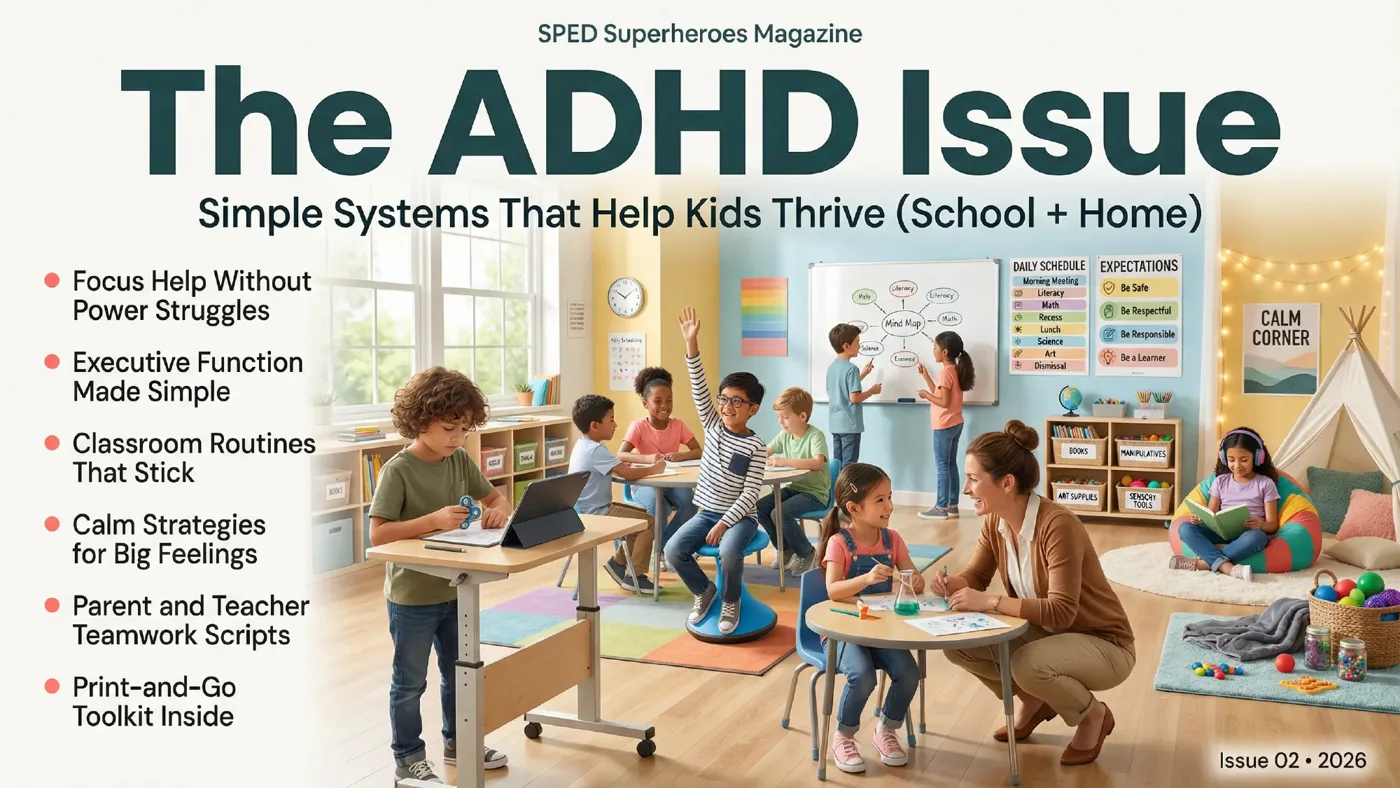
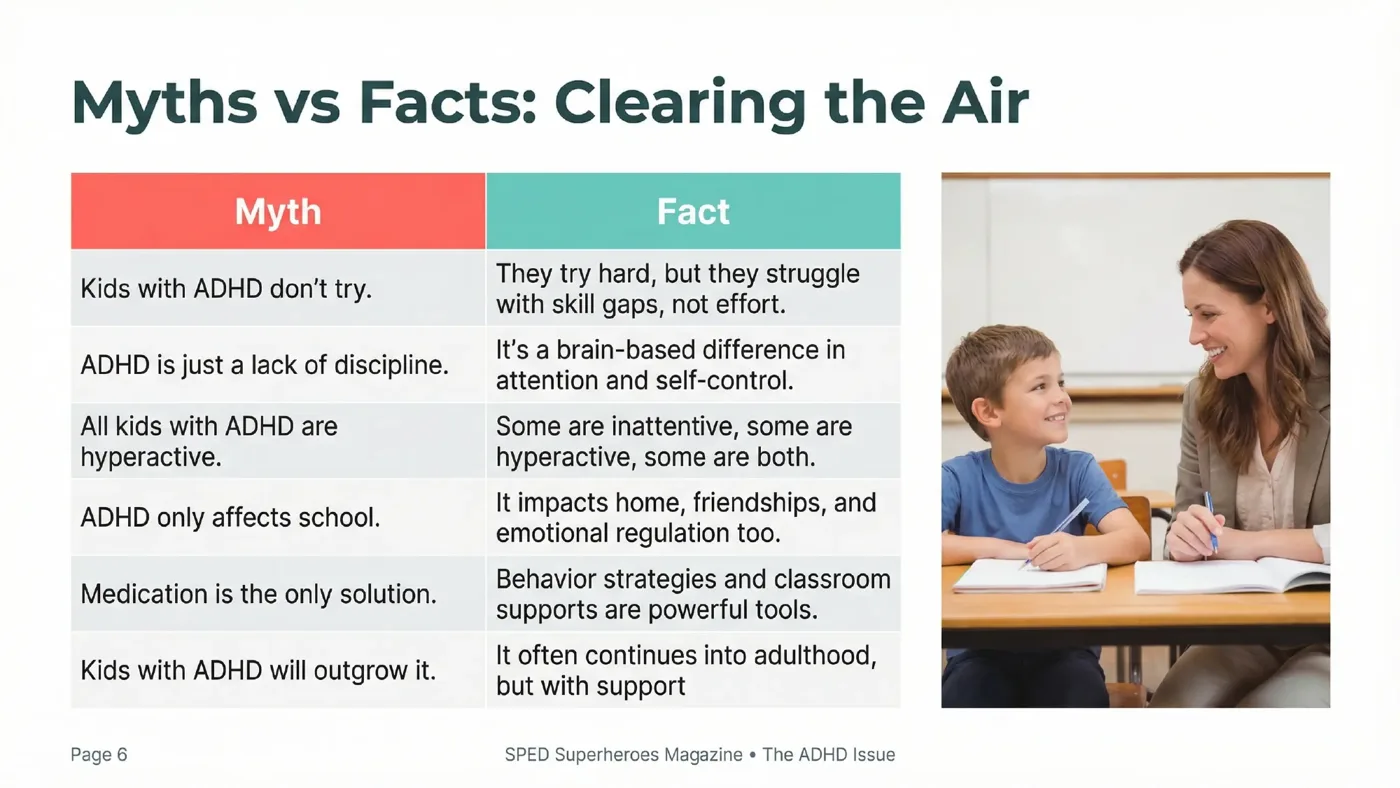
ADHD Support Toolkit: Classroom And Home Strategies: a 49-page guide for teachers and parents with the “Big 5” classroom supports, routines for transitions, directions and movement breaks, executive function and regulation strategies, scripts for hard moments, home routines and a printable toolkit with data trackers.
Sources and scope
- CHADD (Children and Adults with Attention-Deficit/Hyperactivity Disorder): educator and family resources about ADHD at school.
- National Institute of Mental Health: ADHD: an overview of ADHD signs, causes and support.
- Understood.org: practical articles for teachers on attention and classroom supports.
- Center on PBIS: resources on predictable routines and positive behavior support.
This guide covers everyday classroom practice for substitute and cover teachers working with students who have ADHD. It does not replace a student’s IEP or 504 plan, school safety procedures or advice from the student’s regular teacher and support team.
Key takeaways
- ADHD tips for substitute teachers start with reading the support notes.
- Keep the usual routine and post the schedule.
- Give short, written directions and plan movement.
- Redirect privately and use a prepared script for hard moments.
- Leave specific, respectful notes for the regular teacher.









Leave a Comment