

Disagreeing with your principal is part of professional life, but it rarely feels comfortable. Picture a special education teacher whose planning period has been used for lunch coverage three times this week. At 3:10 p.m., she spots the principal in the hallway and blurts out, “This keeps happening, and nobody cares.” The principal, rushing to a meeting, says, “Let’s talk later.” Later never comes, and she feels worse.
Disagreement is not the problem. How it is raised often decides whether anything changes. This list covers seven common mistakes teachers make when they disagree with a school leader, ordered from before the conversation to after it. For each one, you will find why it backfires and a calm script to use instead. You will follow Ms. Patel, a fictional resource teacher, and her principal, Dr. Hayes.
Examples are fictional. Follow your school’s policies and, where relevant, your union or contract guidance. This is general guidance, not legal or HR advice.
At a glance
- Timing and setting shape the outcome as much as the words you choose.
- Bring facts, the impact on students, and one clear request.
- Neutral language keeps the focus on the problem, not on people.
- Confirm agreements in writing the same day.
- Follow up calmly if commitments are not met.
How we ordered these mistakes
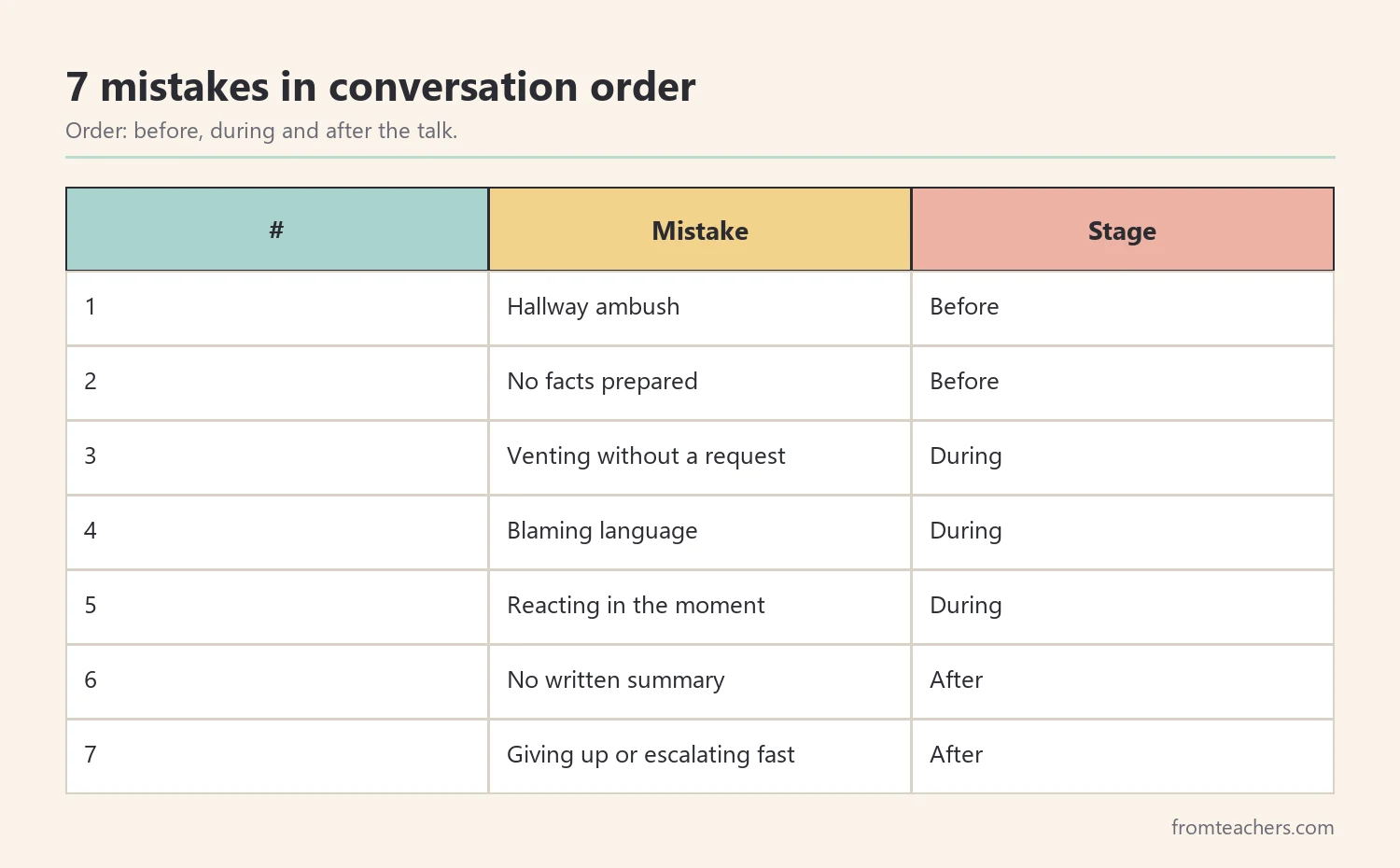
We did not rank these mistakes by how common they are, because there is no reliable data on that. Instead, we ordered them by when they happen: mistakes 1 and 2 happen before you speak, 3 to 5 during the conversation, and 6 and 7 afterward. Read in order, the list works as a plan for your next difficult conversation.
The ideas reflect widely shared principles of professional communication, such as those discussed by educator organizations like ASCD and Edutopia: prepare, focus on impact, and agree on next steps.
1. The hallway ambush
The mistake: raising a serious concern in a hallway, at dismissal, or in front of others.
Why it backfires: the principal is distracted, others may be listening, and nobody has time to think. Even a fair concern can sound like an attack.
Instead, say: “I have a concern about my schedule that I would like to talk through. Could we find 15 minutes this week?”
Also, choose the time well. Monday mornings, testing weeks and the last minutes before a board meeting are hard moments for any leader. A calmer slot gives your concern the attention it deserves.
Example: after the hallway moment, Ms. Patel sent a short email asking for a meeting. Dr. Hayes offered Thursday morning.
2. Arriving without facts
The mistake: describing the problem with feelings and general words, such as “always” and “never.”
Why it backfires: general statements are easy to dispute. Specific facts are much harder to ignore.
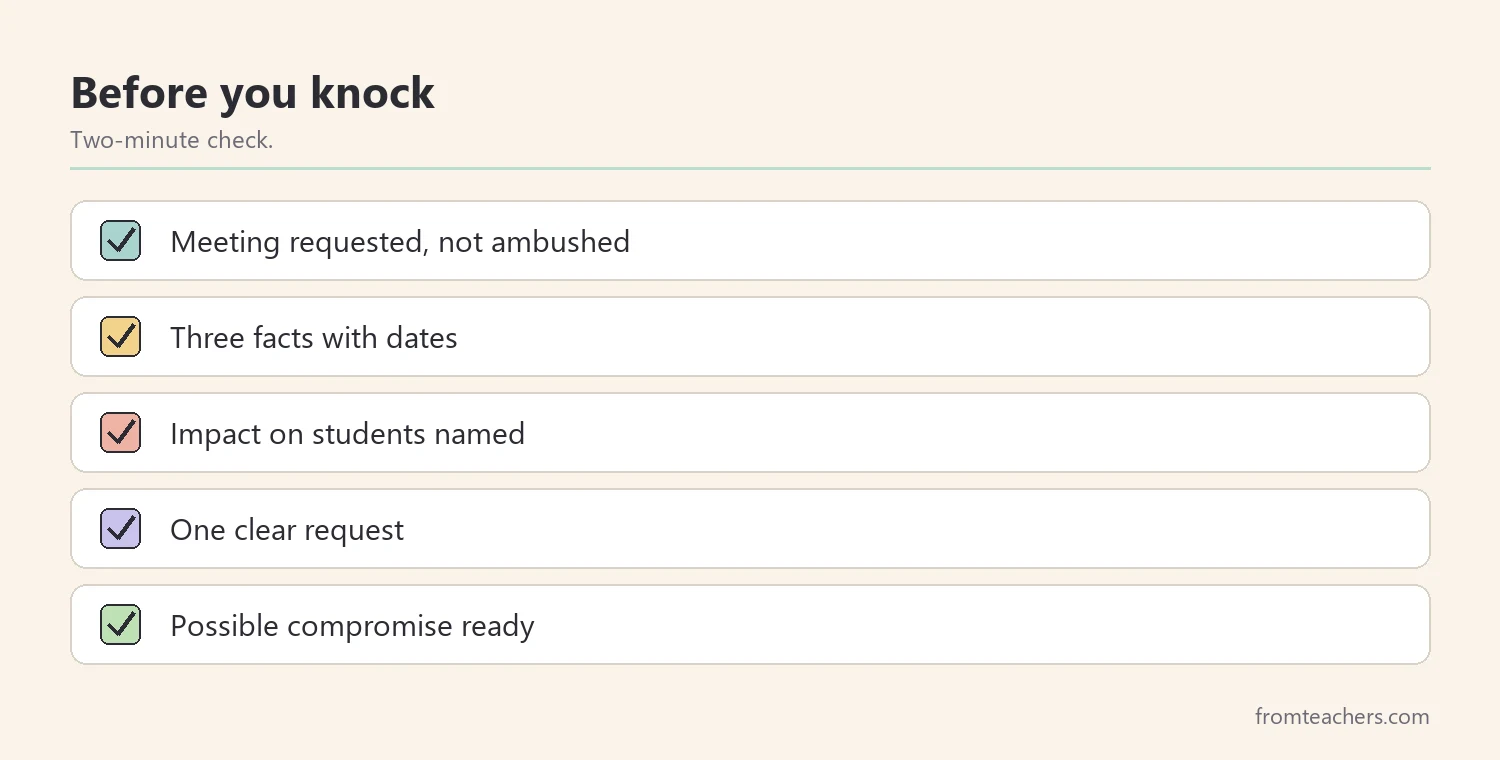
Instead: write down three facts with dates, such as “Planning used for coverage on October 2, 4 and 7.” Add the impact on students: “Two reading groups were shortened.”
A structured tool can help you prepare. The toolkit for communicating with administration without escalation includes a pre-meeting strategy and documentation prep page, so you can organize facts, goals and evidence calmly before you walk in.
3. Venting without a clear request
The mistake: describing everything that is wrong but not saying what you want.
Why it backfires: the principal may listen sympathetically and then do nothing, because no specific action was requested.
Instead, say: “My request is that my planning time is not used for coverage more than once a week. Is that possible?”
Example: Ms. Patel came with one request and one compromise: if coverage was unavoidable, she asked to be told the day before.
4. Blaming language
Among mistakes made when disagreeing with your principal, this one turns a problem into a personal conflict fastest.
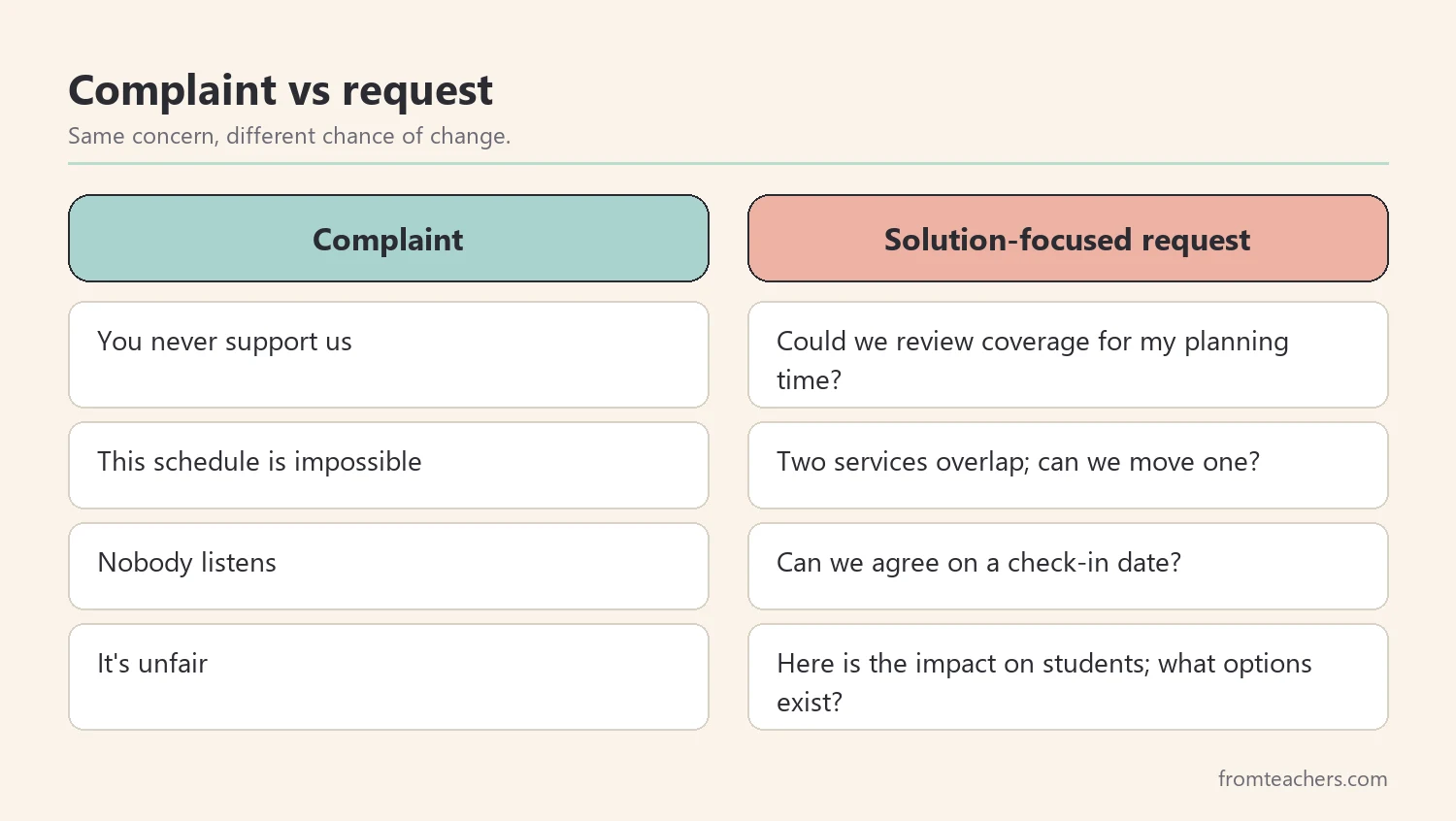
The mistake: phrases like “You never support us” or “This administration doesn’t care.”
Why it backfires: people defend themselves when they feel accused. The conversation shifts from the problem to who is right.
Instead: describe the situation and its impact, then ask for options. “When planning is used for coverage, IEP paperwork moves to evenings, and students’ services get shortened. What options do we have?”
5. Reacting in the moment
The mistake: answering a surprising “no” with frustration, tears or a sharp comment.
Why it backfires: strong reactions are human, but they can become the story people remember, instead of your concern.
Instead, say: “I would like to think about that. Could we continue this on Monday?” Taking a pause is a professional skill, not a weakness.
Example: when Dr. Hayes first said coverage was “just how things are,” Ms. Patel took a breath and asked, “Can we look at the coverage list together to see if there are other options?” That question opened the door.
6. No written summary
The mistake: leaving the meeting with only a verbal agreement.
Why it backfires: memories differ, and busy leaders forget. Without a record, agreements quietly disappear.
Instead: send a short, friendly email the same day: “Thank you for meeting. To confirm, we agreed that… We will review on…”
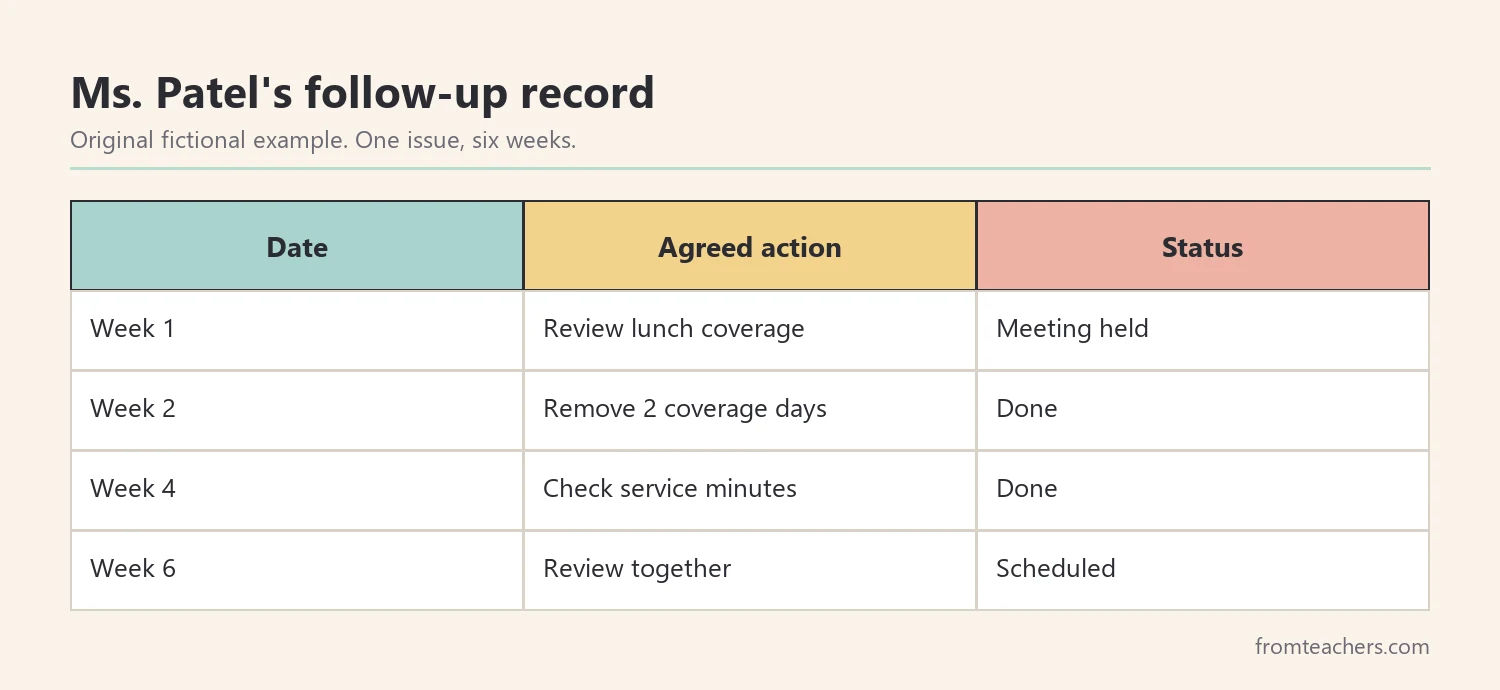
Example: Ms. Patel’s email confirmed two coverage days removed and a check-in in six weeks. Dr. Hayes replied, “Yes, thanks for the summary.”
7. Giving up, or escalating too fast
The mistake: either dropping the issue after one conversation, or going straight to the district office.
Why it backfires: giving up teaches everyone that the problem can be ignored. Escalating too fast can damage trust and may skip steps your school expects.
Instead: follow up calmly on the agreed date. If commitments are still not met after a clear follow-up, ask about the appropriate next step under your school’s policies or contract.
Instead, say: “We agreed to review this today. Coverage has dropped, but it happened twice last week. Can we look at that together?”
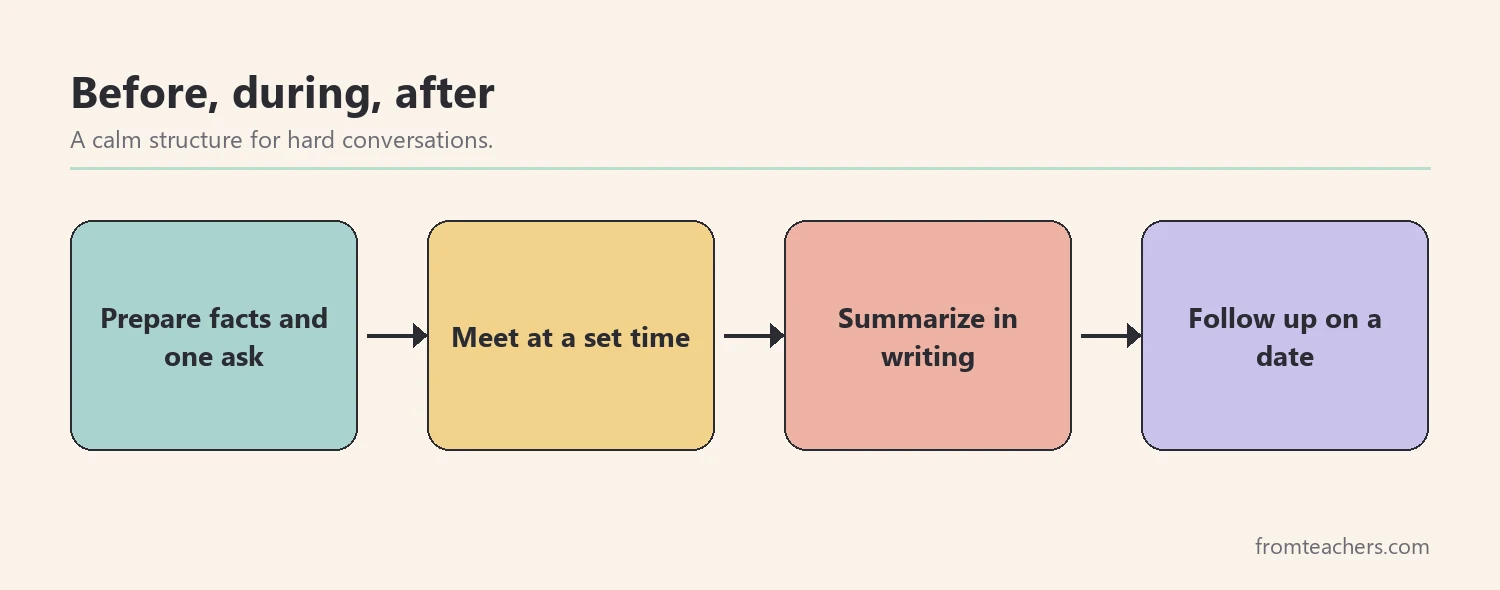
What changed for Ms. Patel
Ms. Patel’s first attempt, in the hallway, changed nothing. Her second attempt was different: a scheduled meeting, three dated facts, one request, one compromise and a written summary.
Over the next six weeks, her planning time was used for coverage only once. Her students’ service minutes were delivered as written. More importantly, she and Dr. Hayes now had a simple, respectful way to raise problems. Disagreement had become a conversation, not a conflict.
When the disagreement is about students’ services
For special educators, many disagreements involve IEP services: minutes cut by scheduling, staff pulled for coverage, or materials that never arrive. These conversations carry extra weight, because the IEP describes services the school has agreed to provide.
In these cases, keep the focus on the student and the document. Bring the relevant service page and a simple log of what was delivered. Then say, “The IEP lists 30 minutes of reading support daily. Over the last two weeks, students received about 20. How can we close that gap?”
This approach removes personal tension. You are not criticizing the principal; you are asking the team to meet a shared obligation. In addition, it gives the principal clear information to take to the district if staffing is the real issue.
What to do after a “no”
Sometimes the answer is no, at least for now. That does not mean the conversation failed. First, ask what the constraint is: budget, staffing, a district rule or timing. Knowing the reason often reveals a smaller change that is possible.
Next, ask what would need to change for the answer to be yes, and when it would make sense to revisit. Finally, write it down in your summary email. A respectful “not now” with a review date is far better than a silent “no” that nobody remembers.
Ms. Patel heard “no” to her first idea, a full stop to coverage. However, by asking about the constraint, she learned that two specific days were the problem, and those were the days that changed.
Managing nerves before a hard conversation
Many teachers feel anxious before meeting with a principal, especially early in their careers. That is normal. A little preparation lowers the stress.
- Write your opening sentence: knowing exactly how you will start helps you begin calmly.
- Practice once aloud: say your facts and request to a trusted colleague or to yourself.
- Plan for “no”: decide in advance what compromise you could accept.
- Breathe before you enter: a few slow breaths can steady your voice.
Additionally, remember the goal: not winning, but finding a workable solution for you and your students.
Useful phrases at a glance
| Situation | Try saying |
|---|---|
| Opening | “I want to find a solution that works for both of us.” |
| Sharing facts | “Here is what I have noticed over the last three weeks.” |
| Naming impact | “This affects students’ services in these ways.” |
| Making a request | “Would it be possible to…?” |
| Pausing | “Can I think about that and get back to you?” |
Common mistakes and how to avoid them (quick review)
- Hallway ambush: request a meeting at a set time.
- No facts: bring three dated examples and the impact on students.
- No request: state one clear ask and one possible compromise.
- Blame: describe situations and impact, not people.
- No record: send a short summary email the same day.
Questions teachers ask about disagreeing with your principal
Is it unprofessional to disagree with my principal?
No. Respectful disagreement, raised at the right time and with facts, is part of professional practice. How you raise it matters more than the fact that you disagree.
Should I bring a colleague to the meeting?
For most everyday issues, a one-to-one meeting works best. For serious concerns, check your contract or union guidance about bringing a representative.
What if my principal reacts badly?
Stay calm, pause the conversation if needed, and follow up in writing. If problems continue, ask about next steps under your school’s policies.
How do I disagree about a student’s services?
Focus on the IEP and student data. Explain what the IEP requires and how the current situation affects it, then ask how the team can meet those requirements.
Should I put everything in email instead of meeting?
Email is good for requesting meetings and summarizing agreements. Difficult conversations usually go better face to face, followed by a written summary.
Related reading: practical approaches to special education difficulties, how teachers communicate with parents in special education.
A companion resource for disagreeing with your principal:
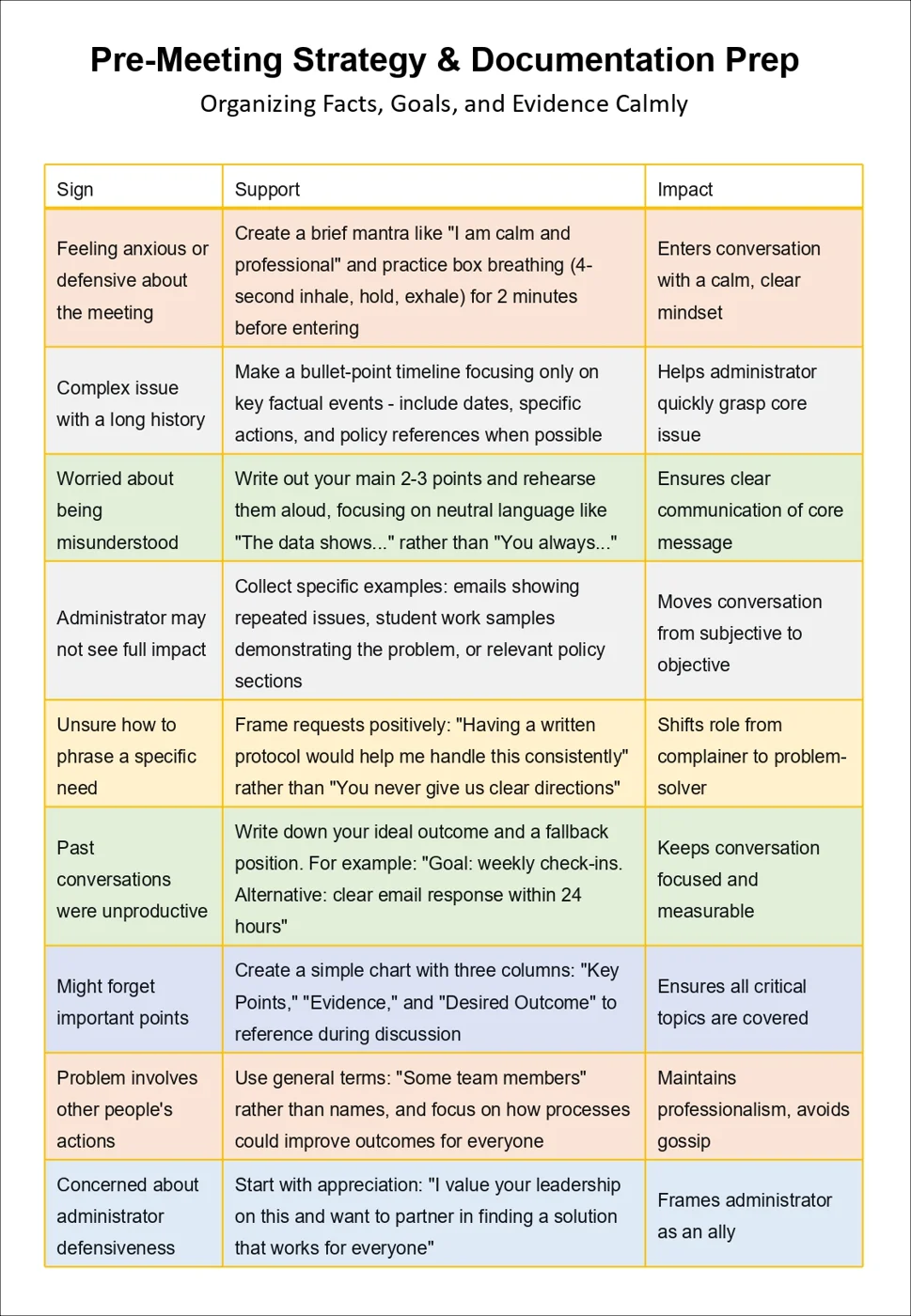
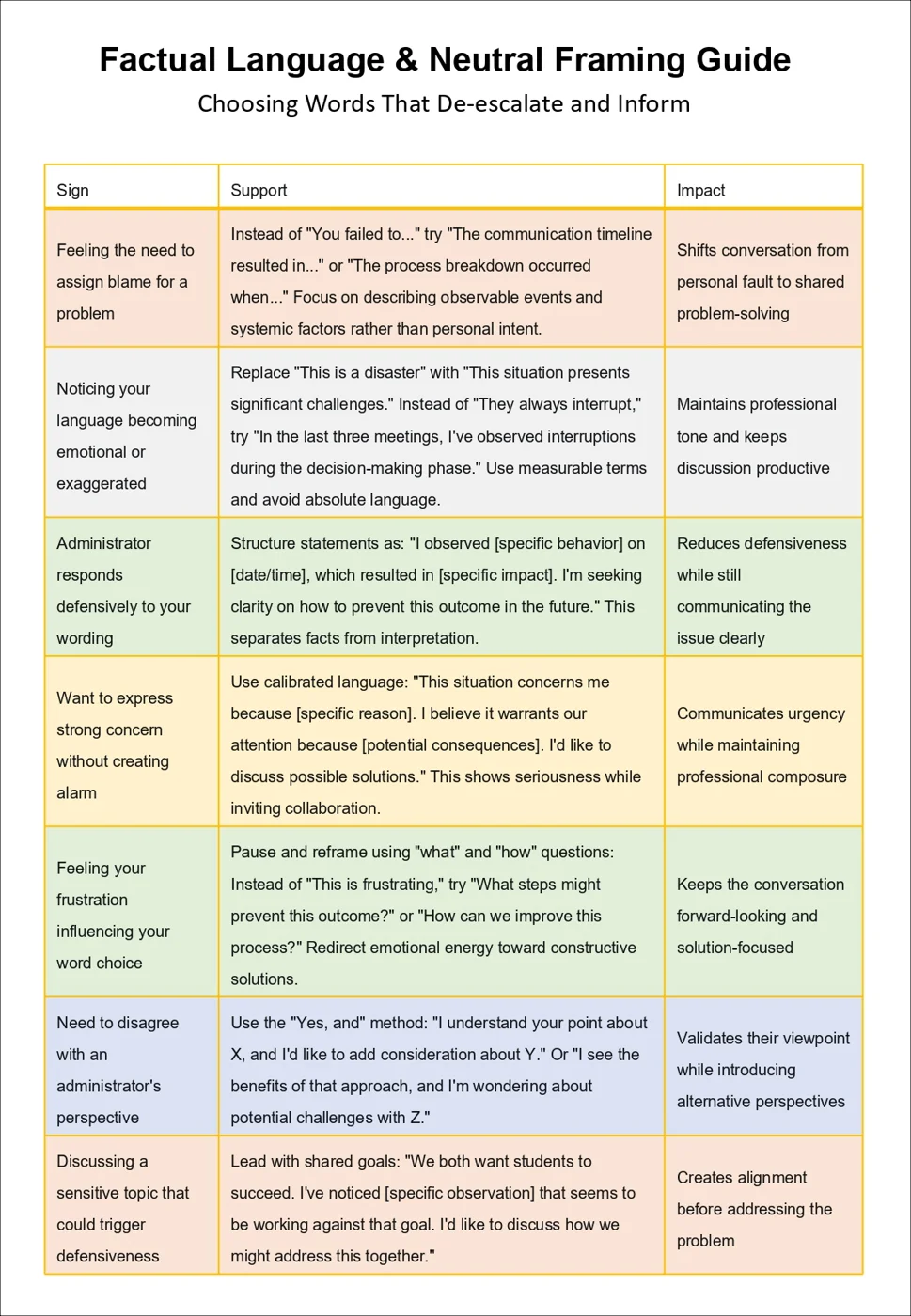
Communicating with Administration Without Escalation: a 12-page Sign, Support, Impact toolkit with pre-meeting strategy and documentation prep, a follow-up and accountability record, neutral language scripts that turn complaints into solution-focused requests, strategies for staying calm on sensitive or recurring issues, guidance on documenting verbal agreements and tracking unmet commitments, and techniques for managing anxiety before high-stakes conversations.
You may also need: Parent Communication Log: Student Contact Info and Call Log Template.
Sources and scope
- ASCD: articles for educators and school leaders on professional collaboration and leadership.
- Edutopia: practical articles on teacher communication and school culture.
- Council for Exceptional Children: professional resources for special educators, including advocacy.
- IDEA (U.S. Department of Education): the federal law on IEP services, useful when disagreements involve students’ services.
This list covers everyday professional disagreements with school leaders. It does not replace contract terms, union guidance, grievance procedures or legal advice.
Key takeaways
- When disagreeing with your principal, timing and setting matter as much as words.
- Bring dated facts, the impact on students and one clear request.
- Use neutral, solution-focused language instead of blame.
- Confirm agreements in a short email the same day.
- Follow up calmly on the agreed date before considering next steps.








Leave a Comment