

Homeschool check-in ideas help close the school day with a moment of calm instead of a sudden switch to chores and screens. Picture Maya, age ten, homeschooled with her younger brother. Lessons end at two, and by dinner she is either cheerful or upset, and her parents often do not know why. A five-minute check-in at the kitchen table changes that.
This list is for homeschool parents who want a simple daily routine for feelings, wins and goals. It shares twelve homeschool check-in ideas, sorted from quickest to deepest, so you can start with one and add more as your child grows comfortable. Each idea includes how to do it and a short example with Maya.
Examples are fictional. Adapt to the child’s age and needs. This is guidance, not a diagnosis.
At a glance
- A check-in works best at the same time every day, in the same short format.
- Start with one quick idea, such as a feelings scale, before adding deeper prompts.
- Listen more than you advise; the goal is reflection, not a lecture.
- One small goal for tomorrow builds a habit of follow-through.
- A written page lets you and your child see patterns over weeks.
How this list is sorted
We sorted these twelve homeschool check-in ideas from quickest to deepest. The first ideas take under a minute and suit young or tired children. Later ideas invite more thinking and work well for older kids or calmer days. We did not rank them by value, because the right idea depends on your child.
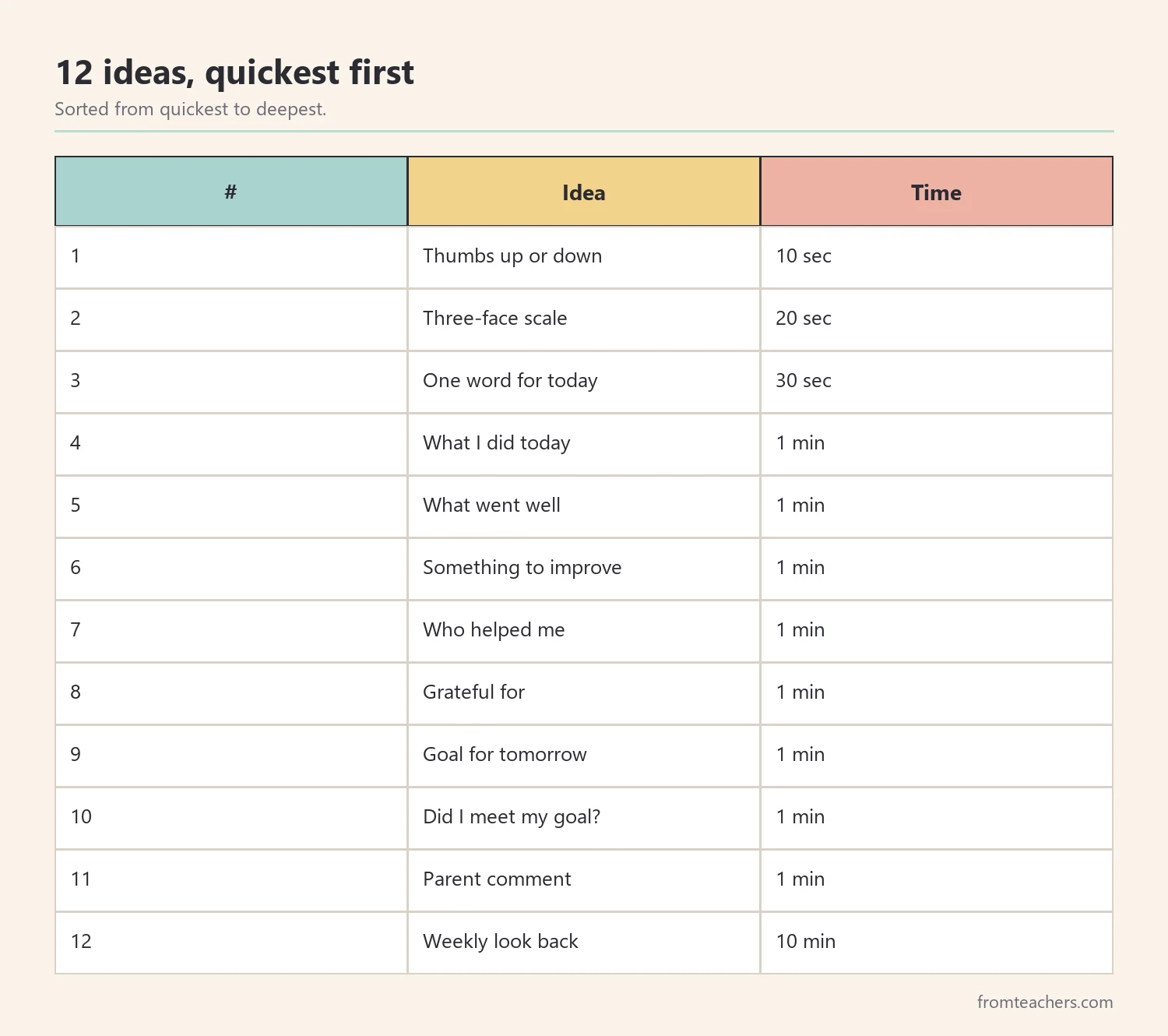
Also, mix and match. Many families use two or three ideas each day, such as a feeling, a win and a goal. Figure 1 shows the full list with the time each idea needs.
1. Thumbs up, sideways or down
First, the fastest of all homeschool check-in ideas: ask your child to show a thumb for how the day went. No words needed.
Example: Maya gave a sideways thumb. Her dad asked, “Want to tell me one part?” She said math was frustrating.
2. A three-face feeling scale
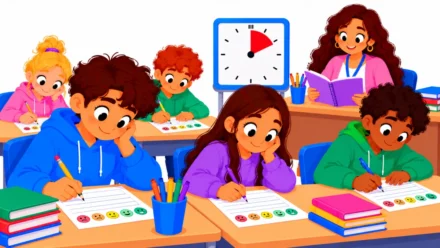
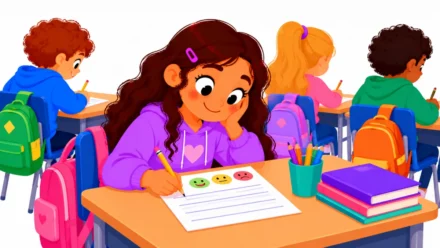
Next, use three simple faces: happy, okay and sad. Children circle one. A scale gives words to feelings without pressure to explain.
Why it works: many children cannot name a feeling right away, but they can point to a face.
3. One word for today
Then ask for a single word that sums up the day: “busy,” “fun,” “long,” “proud.” One word is easy and often opens a longer chat.
4. What I did today
Next, a quick recap. Your child lists two or three things they did. This helps children notice that a homeschool day had real accomplishments, even when it felt slow.
Example: Maya wrote “fractions, read chapter 5, baked bread.” Seeing the list, she smiled and said, “That was a lot.”
5. What went well
Then celebrate one positive moment. Among all homeschool check-in ideas, this one builds the habit of noticing success, which many children skip.
Example: “I finished my reading without help.” Her mom wrote “Great focus!” next to it.
6. Something I can improve
Next, invite one gentle reflection about what was hard. Keep it low pressure: “What is one thing you would do differently?”
Why it works: children practice looking at mistakes as information, not failure. Keep your response short and kind.
7. Who helped me today
Then ask who helped. In a homeschool, the answer may be a sibling, a parent, a grandparent, a library worker or a friend on a video call. Noticing help builds gratitude and connection.
Example: Maya wrote “my brother found my pencil.” He looked very proud when she read it out loud.
8. What I’m grateful for
Similarly, a short gratitude prompt ends the day on a warm note. It can be big or small: “the rain,” “my cat,” “pancakes.”
A ready page makes these homeschool check-in ideas easy to repeat. The daily reflection journal with feelings, goals and gratitude prompts puts a feeling scale, what went well, something to improve, a goal for tomorrow, who helped and gratitude on one printable page.
9. My goal for tomorrow
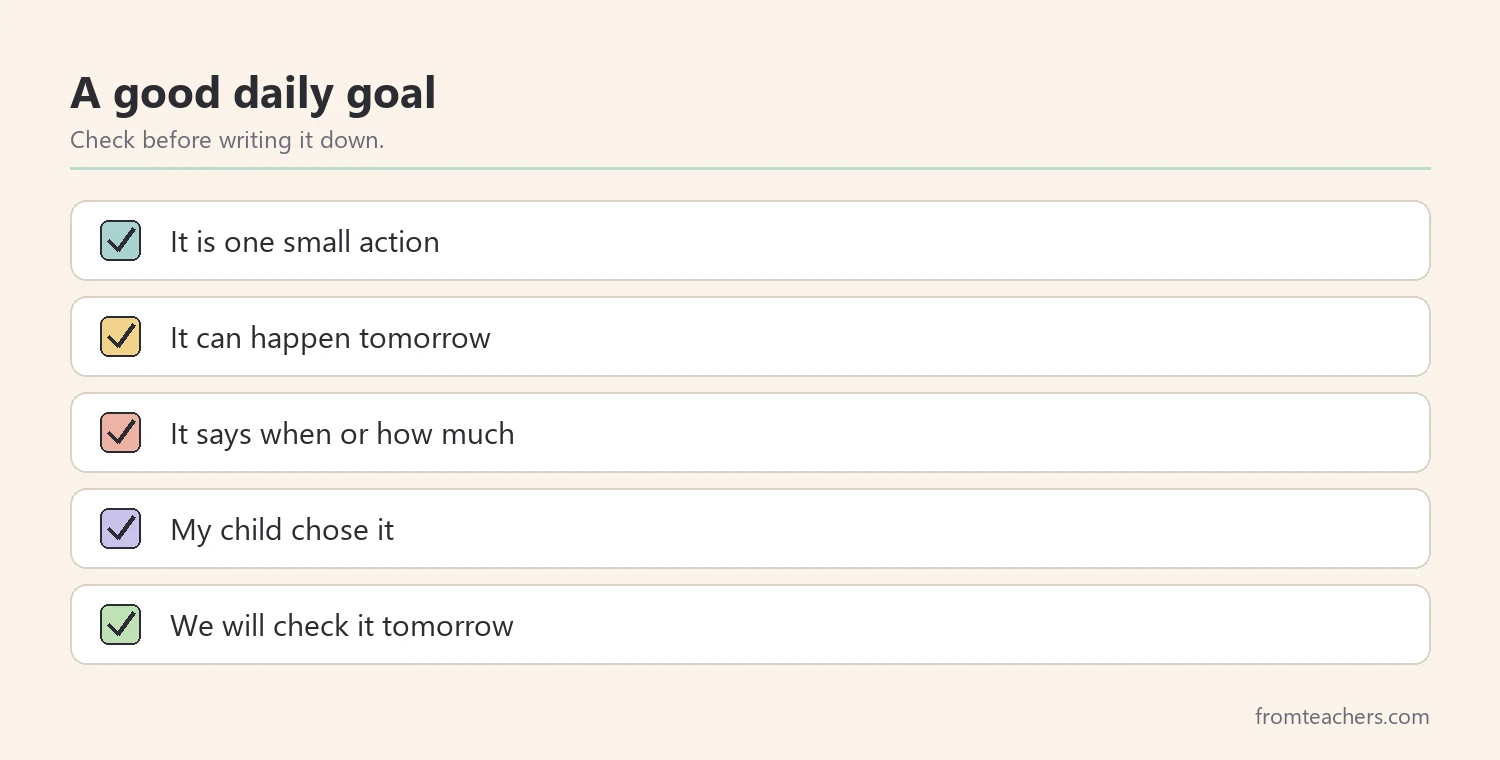
Next, set one small, specific goal, the most practical of the homeschool check-in ideas. “Start math before snack” is better than “be better at math.” Small goals are easy to check the next day.
| Vague goal | Clear goal |
|---|---|
| Be good at math | Do 5 problems before snack |
| Read more | Read 10 pages after lunch |
| Be nicer | Ask my brother to play once |
10. Did I meet yesterday’s goal?
Then close the loop. Each day, ask whether yesterday’s goal happened: yes, partly or not yet. This is where homeschool check-in ideas turn into real habits.
Example: Maya met her math goal three days in a row. On the fourth day, she chose a new goal herself.
11. A comment from the parent-teacher
Next, add one sentence of encouragement in writing. In a homeschool, you are both parent and teacher, and a written note feels special. Children often reread these notes.
Example: “I noticed how you kept trying with fractions today. That is what learning looks like.”
12. A weekly look back
Finally, the deepest idea: once a week, look at the week’s pages together. Which feelings came up most? Which goals were met? What patterns do you see?
Example: Maya noticed that her sad faces were mostly on Mondays. Together, the family moved her hardest subject to Tuesday mornings.
Choosing homeschool check-in ideas by age
Younger children, around ages five to seven, do best with quick ideas: thumbs, faces, one word and one thing that went well. Keep it to two minutes and let them draw instead of write.
In contrast, children around eight to eleven can handle a full page, including a goal for tomorrow and a gratitude prompt. Many enjoy writing, especially when the format is the same each day.
Older children and teens may prefer privacy. Offer a journal they fill alone, with one shared item, such as their goal. Respect their choice; reflection still helps when it is private.
Fitting check-ins into a homeschool day
Timing matters. The best moment is usually right after the last lesson, before free time. Therefore, put the check-in on your daily schedule, just like math or reading. When it is on the schedule, it happens.
Also, keep the setting calm and the same each day: the same table, the same pen, the same page. Predictability helps children open up. For siblings, try separate check-ins or a shared one with turns.
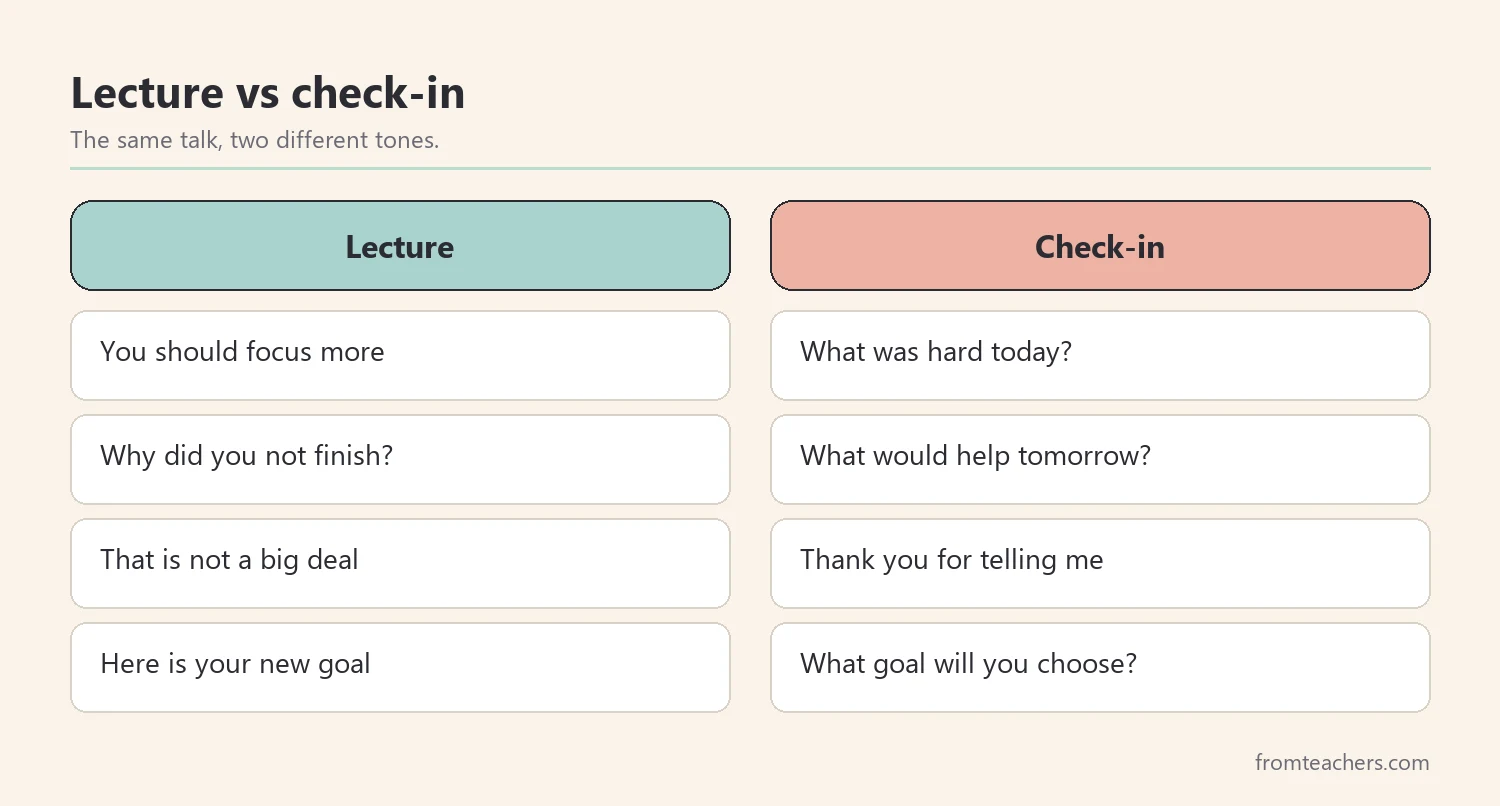
In addition, notice your own tone. If every check-in turns into advice, children stop sharing. Try responding with a simple “Thank you for telling me” before saying anything else.
Finally, protect the routine on field trip days, co-op days and holidays. A thirty-second version on the car ride home still counts, and it keeps the habit alive until your regular schedule returns.
Homeschool check-in ideas for siblings
Many homeschool families teach more than one child at the same table. Check-ins can still work, but they need a little planning so the youngest does not copy the oldest and the loudest does not take all the time.
First, try short turns. Each child shares one feeling and one win while the others listen. Next, let each child write or draw their own page before sharing. Then keep goals private if a child prefers; competition between siblings can turn a goal into a race.
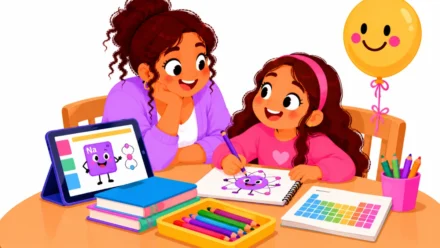
For example, Maya and her seven-year-old brother each filled in a page. He drew his win, a tower of blocks, while she wrote hers. They traded pages, and Maya wrote “cool tower!” on his. These homeschool check-in ideas became a small moment of kindness between them.
Making homeschool check-in ideas visual
Some children find writing tiring at the end of a long day. Visual options keep the routine going without extra effort. Feeling faces, color choices, stickers and simple drawings all count as reflection.
Also, a printed page with the same boxes every day acts as a visual routine. Children know what comes next, so they spend less energy figuring out the task and more energy thinking. Many parents find that visual homeschool check-in ideas suit children who struggle to put feelings into words.
In addition, keep finished pages in a folder or binder. Flipping through a month of pages is a visual record of growth that children are often proud to show grandparents.
Tracking patterns over time
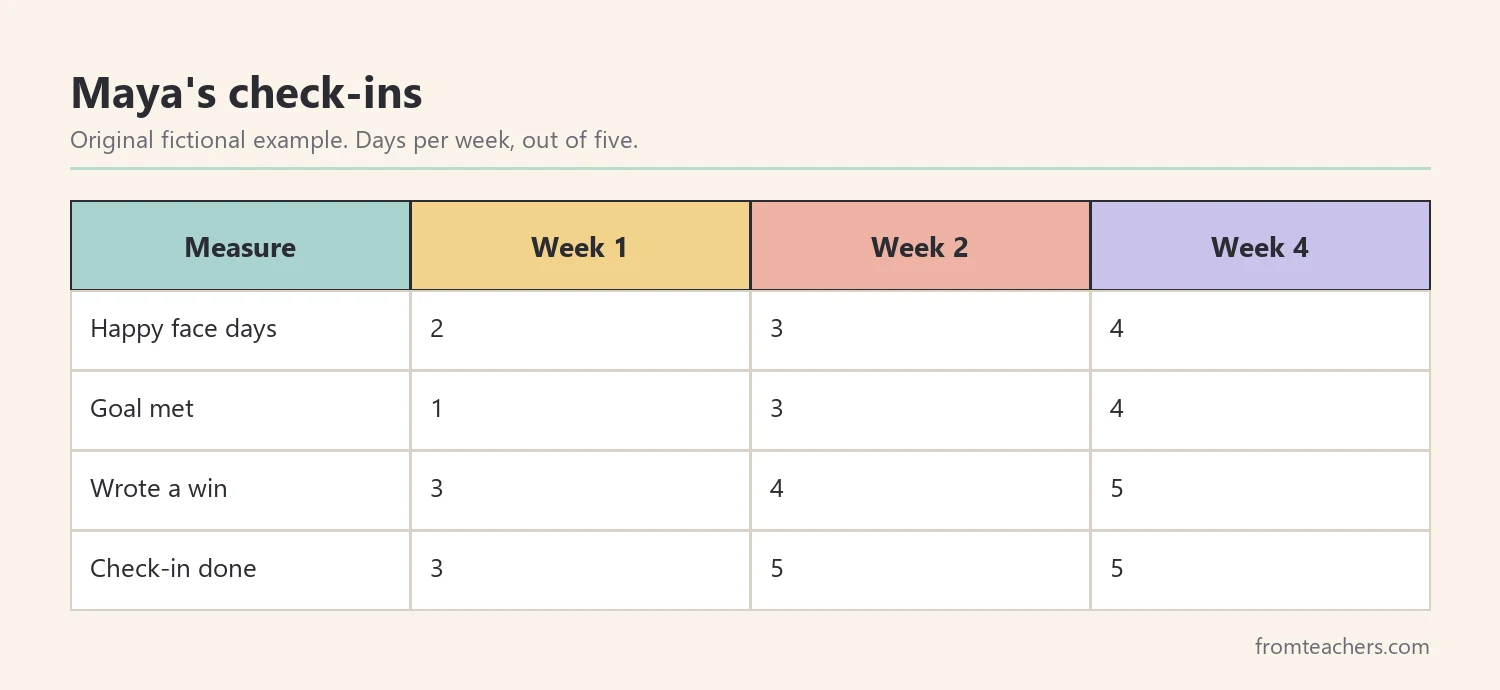
Daily pages become more useful over weeks. For example, Maya’s parents counted her feeling faces and goals for four weeks. Figure 3 shows more happy faces and more goals met as the routine settled. They also noticed which subjects matched the hard days.
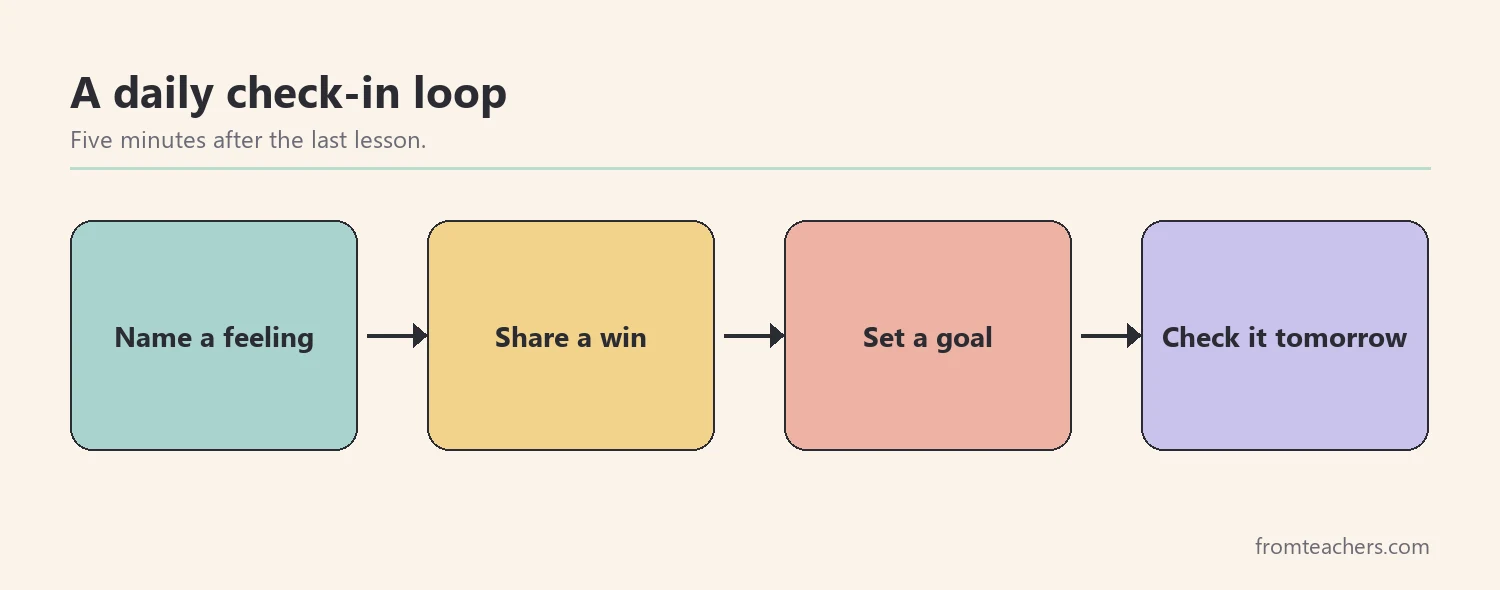
If you notice a long stretch of sad or worried days, talk with your child and, if needed, a pediatrician or counselor. Homeschool check-in ideas support everyday reflection, but they are not a substitute for professional help when a child is struggling. Figure 5 shows a simple daily loop.
Common mistakes and how to avoid them
- Making it too long. Fix: start with two quick ideas and stop at five minutes.
- Turning it into a lecture. Fix: listen first and thank your child for sharing.
- Skipping on busy days. Fix: use the one-minute thumbs check instead.
- Setting big goals. Fix: choose one small action for tomorrow.
- Never looking back. Fix: review the week’s pages every Friday.
Questions parents ask about homeschool check-in ideas
How long should a daily check-in take?
Usually five minutes or less. On busy days, a thumbs check or one word is enough to keep the habit.
What if my child says “fine” every day?
Offer choices instead of open questions, such as three faces or a list of feeling words. Also, share your own day first as a model.
Should I read my child’s journal?
Agree on this together. Many families share some items, like the goal, and keep others private, especially with older children.
Do homeschool check-in ideas work for children with ADHD or autism?
Many families find a short, visual, predictable format helpful. Adapt the length and the prompts to your child, and use pictures if writing is hard.
When is the best time for a check-in?
Right after the last lesson works for many families. The key is the same time every day.
Related reading: Homeschooling vs. Public Schooling: Which Educational Path Is Right for Your Child?, Understanding Autistic Burnout and School Exhaustion, and Managing Sensory Overload: Practical Strategies for Autism and ADHD.
You may also need: Daily Routine Journal for Students – Structured SEL Workbook.
A companion resource for homeschool check-in ideas:
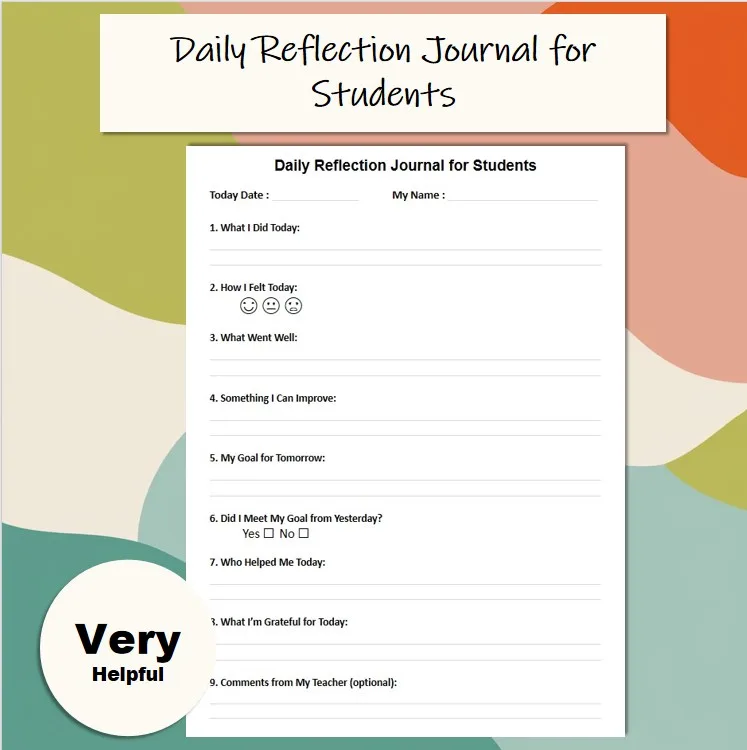
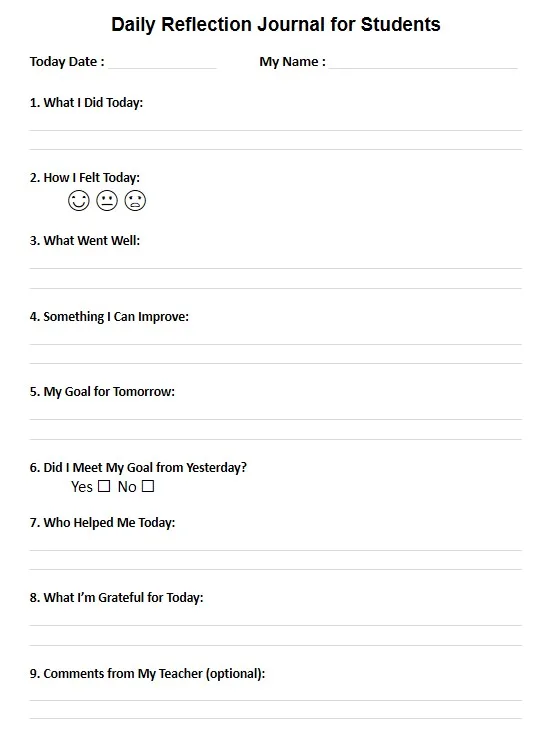
Daily Reflection Journal for Students: SEL Check-In and Goal Setting Sheet: a one-page daily journal with a three-face feeling scale, what went well, something to improve, a goal for tomorrow with a yesterday check, who helped me, a gratitude prompt and a space for adult comments, in editable and print versions.
Sources and scope
- CASEL: the Collaborative for Academic, Social, and Emotional Learning and its framework of core SEL skills.
- HealthyChildren.org: parenting information from the American Academy of Pediatrics on emotions and routines.
- Understood: articles for families on emotions, self-awareness and learning differences.
- Child Mind Institute: family guides on children’s emotional health.
This list covers simple daily reflection habits for homeschooled children. It does not assess or treat anxiety, depression or other conditions; talk with a qualified professional if you are worried about your child.
Key takeaways
- Homeschool check-in ideas work best as a short daily routine at the same time.
- Start with quick ideas like faces or one word, then add goals and gratitude.
- Listen more than you advise.
- Set one small goal and check it the next day.
- Review the week’s pages to spot patterns and adjust your schedule.




Leave a Comment