

Noticing the habits that affect student energy helps teenagers understand why some school days feel easy and others feel like walking through mud. Picture a grade 9 student named Leah in second period. She is yawning by 9:30, sharp and chatty by lunch, and exhausted again by 2:00. She assumes she is “just a tired person,” but she has never looked at what happens before those dips.
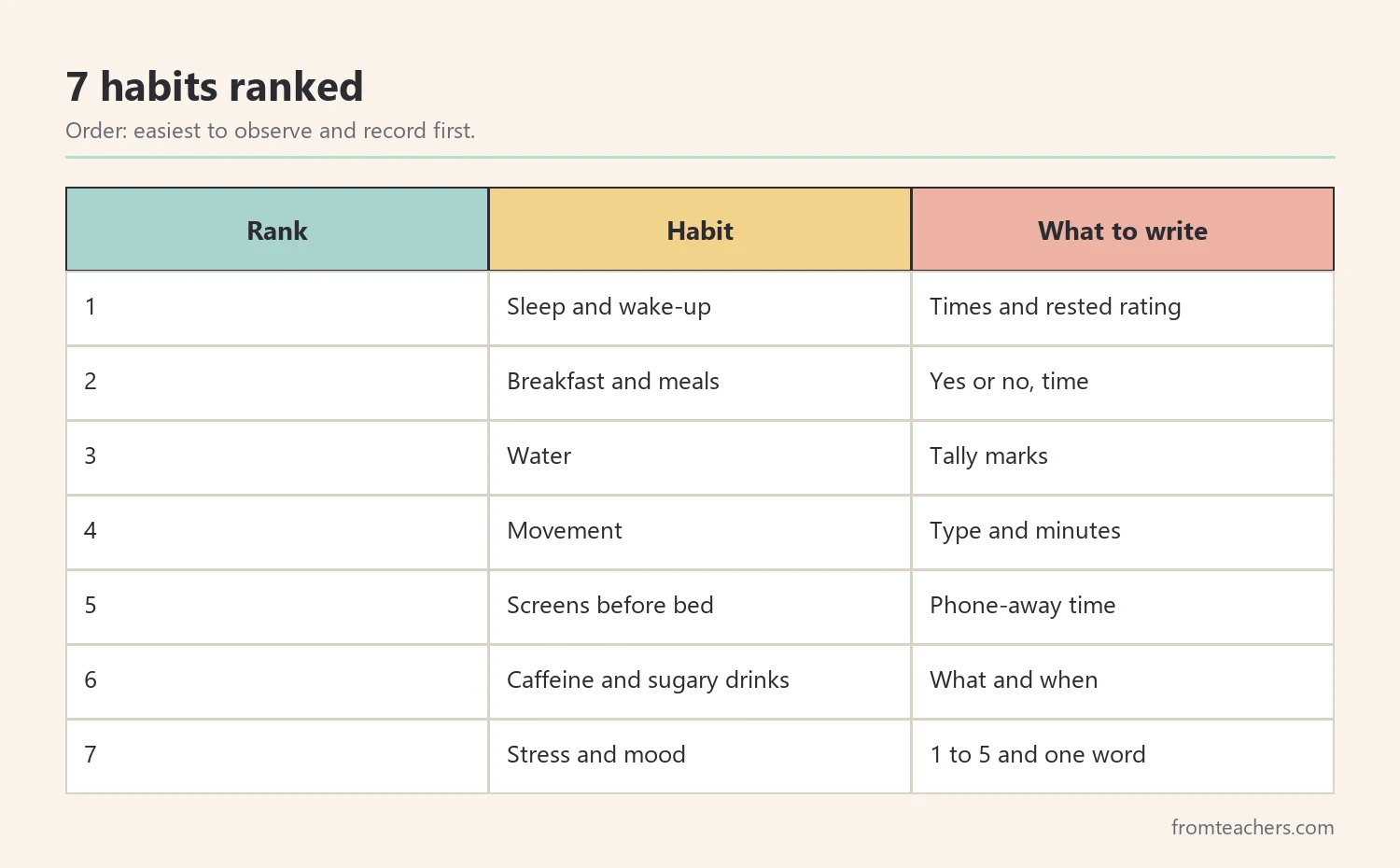
This list ranks seven everyday habits by how easy they are for a student to notice and record on a simple daily sheet. By the end, you will know what to track, how to spot patterns over two weeks, and how to turn those patterns into one small, realistic change.
Examples are fictional. This is educational guidance about self-awareness, not medical advice. Ongoing tiredness, low mood, or sleep problems should be discussed with a doctor or school nurse.
At a glance
- Write habits down daily; memory is unreliable.
- Start with sleep, breakfast and water.
- Look for patterns over one to two weeks.
- Change one specific habit at a time.
- Tracking builds self-awareness; it is not a diagnosis.
How we ranked these habits
We did not rank these habits by how strongly they affect energy, because that differs from person to person and is a question for health professionals. Instead, the order follows one practical rule: how easy each habit is for a student to observe and write down every day. Habits near the top, such as wake-up time, are simple facts. Habits lower down, such as stress, take more reflection to rate.
Therefore, the list also works as a starting plan. Begin with the first two or three, then add more once tracking feels routine.
The ready-made option: a daily energy level tracker
If you want one sheet that covers all of this, the daily energy level tracker with sleep, mood and habit reflection is a one-page printable. It includes a morning check-in with wake-up time, initial energy level, sleep quality, breakfast, and stress or mood notes, then a table tracking energy, mood, activity, and notes across early morning, late morning, early afternoon, late afternoon, evening, and night.
It also has sections for daily habits such as exercise, water, caffeine, and meals, and a reflection on the highest and lowest energy points of the day.
1. Sleep and wake-up time
What to record: bedtime, wake-up time, and a quick rating of how rested you feel.
Why it matters: sleep is one of the most discussed factors in how alert people feel. Health organizations such as the Sleep Foundation publish guidance on sleep for teenagers, and many teens sleep less than recommended on school nights.
How to use it: write times down each morning, not from memory at night.
Example: Leah noticed that on nights she went to bed after midnight, her morning energy rating was usually a 1 or 2 out of 5.
2. Breakfast and meals
What to record: whether you ate breakfast, what time, and roughly what.
Why it matters: many students notice they feel different on days they skip breakfast or eat lunch very late.
How to use it: keep it simple: “yes, toast at 7:10” is enough. The goal is pattern spotting, not calorie counting.
Example: Leah skipped breakfast on three of five school days. Those were the mornings she rated lowest, especially during first and second period.
3. Water
What to record: a rough count of glasses or bottles during the day.
Why it matters: students often forget to drink during busy school days, and some notice they feel sluggish when they drink very little.
How to use it: make tally marks on the sheet each time you refill a bottle.
Example: Leah’s tally showed she drank almost nothing between breakfast and lunch.
4. Movement and exercise
What to record: any physical activity: walking to school, PE, sports practice, or a dance break.
Why it matters: many people report feeling more alert after moving, and long periods of sitting can feel draining.
How to use it: record type and length, such as “walked 15 minutes.”
Example: On PE days, Leah rated early afternoon energy higher than on days with no movement.
5. Screens before bed
What to record: what time screens went off at night.
Why it matters: late-night scrolling can push bedtime later and is commonly linked with shorter sleep.
How to use it: record the time your phone was put away, honestly. No one is grading it.
Example: Leah’s “phone away” time ranged from 10:30 to 12:45. Later times matched lower morning energy.
6. Caffeine and sugary drinks
What to record: energy drinks, soda, coffee, or tea, with the time.
Why it matters: some students use caffeine to push through dips, then notice it affects their sleep or causes a slump later. Guidance on caffeine for teenagers is best discussed with a doctor or school nurse.
How to use it: just record it. Patterns matter more than single days.
Example: Leah had an energy drink after school twice a week. Both nights, she went to bed later than usual.
7. Stress and mood
What to record: a 1 to 5 stress rating and one word for mood, at two or three points in the day.
Why it matters: stress and mood are closely connected with how energetic people feel.
How to use it: rate quickly, then add a short note if something stood out, such as “test today.”
Example: Leah’s lowest afternoon energy came on the day of a big presentation, when her stress rating was 5.
Spotting patterns in the habits that affect student energy
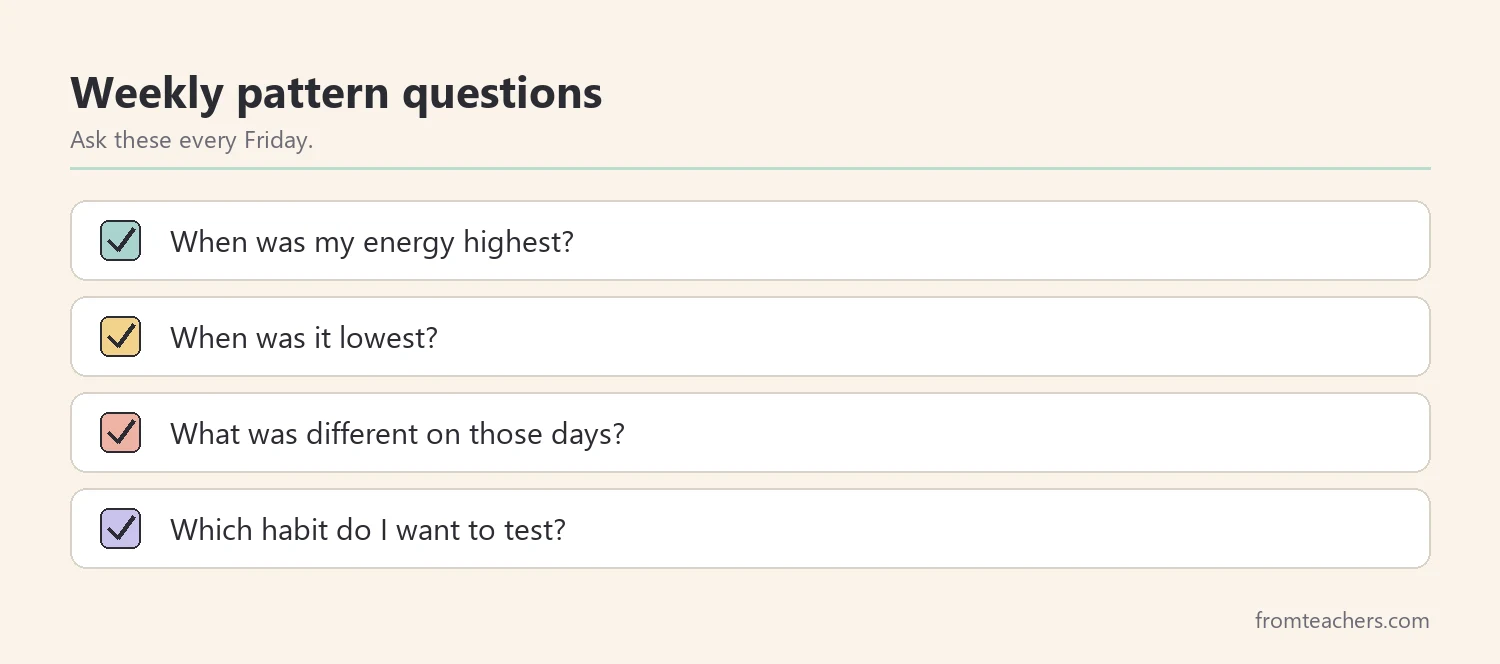
One day tells you very little. Two weeks start to tell a story. At the end of each week, look across the sheets and ask three questions: When was my energy highest? When was it lowest? What was different on those days?
Here is a summary of Leah’s first two weeks, with averages calculated from her daily sheets.
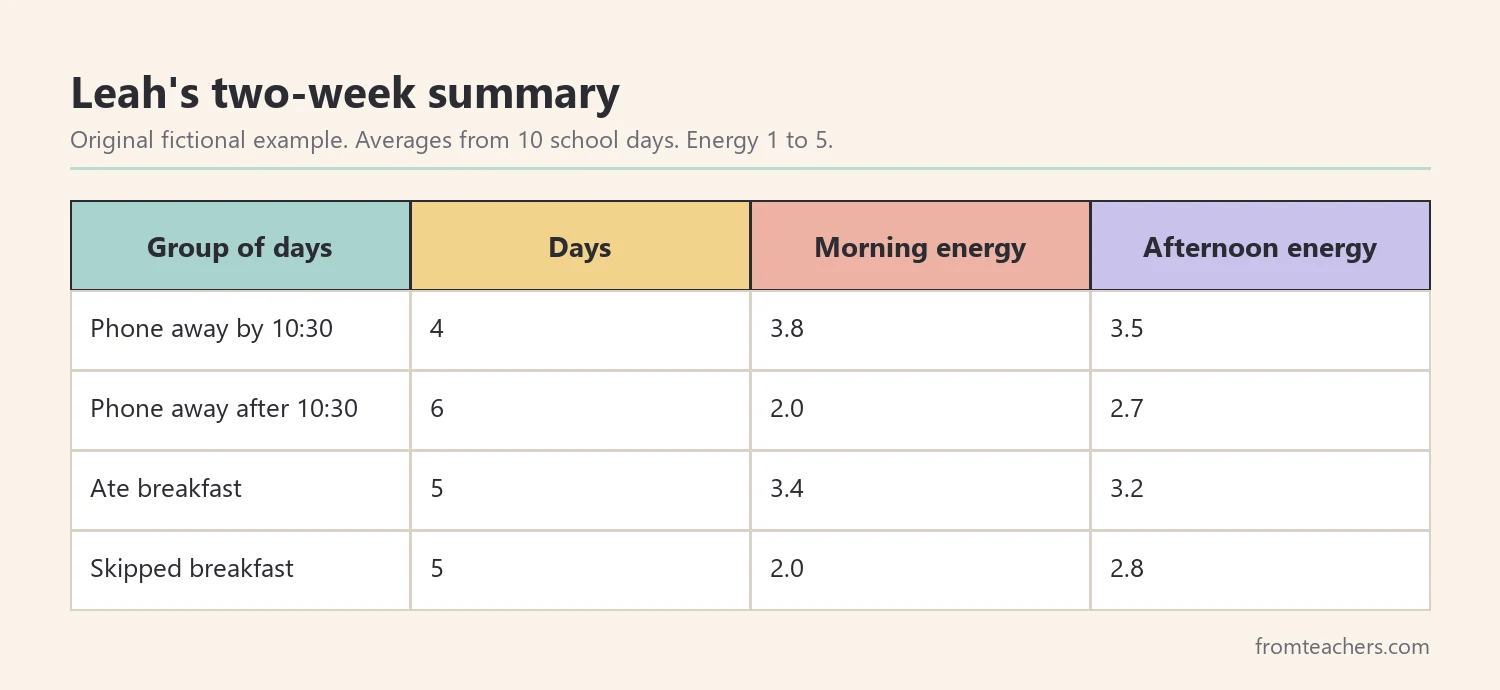
The pattern was clear enough to act on. Earlier phone-away times and eating breakfast went together with higher morning energy. As a result, Leah chose one change for week three: phone on the charger in the kitchen by 10:30.
Turning patterns into one small change
Changing everything at once rarely lasts. Instead, pick one habit, make one small change, and keep tracking. After two weeks, compare.
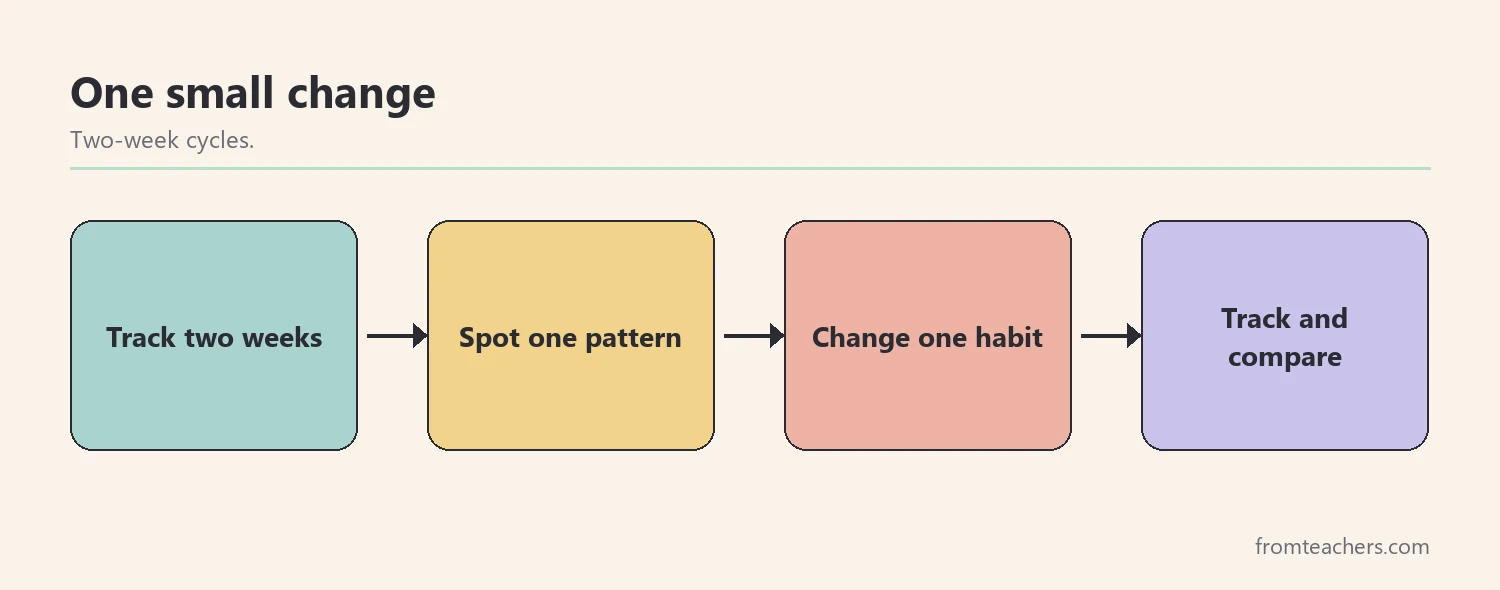
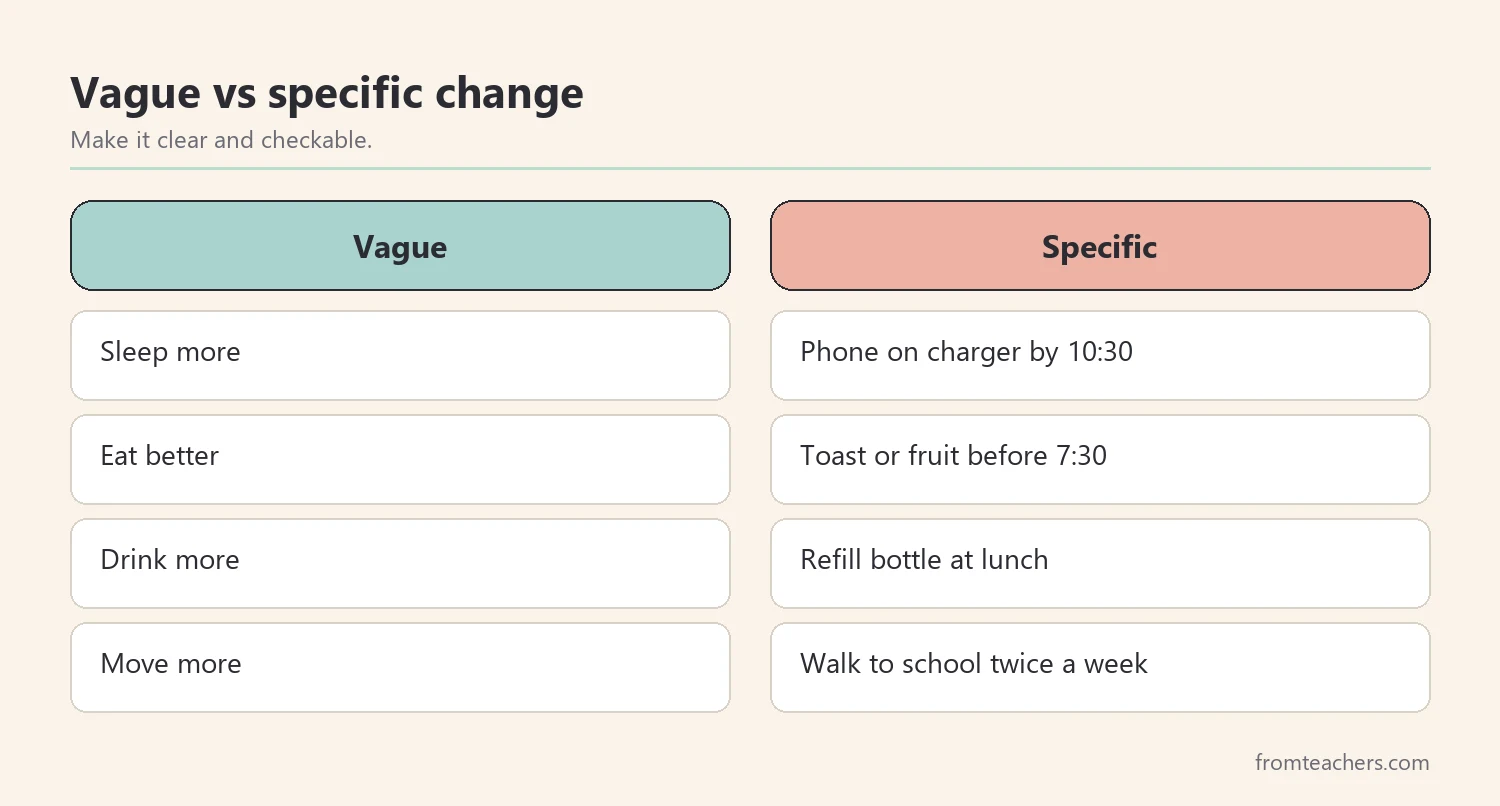
In addition, make the change specific. “Sleep more” is vague. “Phone on the charger by 10:30 on school nights” is clear and checkable.
Also, involve trusted adults. A parent, teacher, or school counselor can help with practical barriers, such as a noisy home at night or no time for breakfast.
Moreover, be kind to yourself. Tracking is about learning, not judging. Some days will be messy, and that is normal.
Making tracking stick
Most tracking projects fade after a few days. A few simple habits help the sheet survive the busy weeks.
First, link recording to things that already happen. Fill in the morning check-in at breakfast, the midday row at lunch, and the evening row while packing your bag for tomorrow. When tracking rides on an existing routine, it takes seconds instead of willpower.
Next, keep the sheet where you will see it. A clipboard on the desk, a photo of the sheet on your phone, or a copy folded inside a planner all work better than a sheet buried in a backpack.
In addition, accept gaps. Missing one row or one day does not ruin the data. Simply leave it blank and continue. Two weeks with a few gaps still show patterns, while trying to fill in old rows from memory usually makes the data less accurate.
Also, find a tracking partner if that helps. Some students like checking in with a friend or family member at the end of the week to compare what they noticed. Others prefer to keep everything private. Both approaches are fine, as long as the student chooses.
Finally, celebrate the learning, not the numbers. Discovering “I crash every day after lunch” is a real result, even if nothing has changed yet. It gives you something specific to test next.
Using energy tracking in class or advisory
Teachers and counselors can use energy tracking as part of an advisory, health, or SEL unit. Students track privately for two weeks, then reflect on patterns in writing or small groups, sharing only what they are comfortable sharing.
For students with ADHD, anxiety, or other needs, energy tracking can also support self-awareness goals. However, keep the focus on learning about oneself, and refer health concerns to the school nurse or family.
Finally, respect privacy. Energy, sleep, and mood can be sensitive topics. Never require students to share their sheets with classmates.
Common mistakes and how to avoid them
- Tracking too many things at once. Fix: start with two or three habits.
- Filling in sheets from memory days later. Fix: record at fixed times, such as morning and after school.
- Judging a single bad day. Fix: look at patterns over a week or two.
- Changing several habits at once. Fix: change one thing and keep tracking.
- Treating tracking as a diagnosis. Fix: talk to a health professional about persistent concerns.
Questions students, parents and teachers ask about habits that affect student energy
How long should a student track energy?
Two weeks is often enough to see first patterns. After a change, track another two weeks to compare.
What if the sheet shows no pattern?
That happens. Try adding a different habit, or rate energy at more times of day. Some patterns take longer to see.
Is this suitable for younger students?
Younger children can use a simpler version with pictures and adult help. The full tracker suits older students and teens best.
Can energy tracking help students with ADHD?
It can support self-awareness by showing when focus is easier or harder. It is not a treatment, and any medical questions belong with the family’s healthcare provider.
Should teachers see students’ sheets?
Only if students choose to share. Privacy builds trust and leads to more honest tracking.
Related reading: Understanding Autistic Burnout and School Exhaustion, 5 Practical Teaching Tips to Boost Classroom Focus and Learning, and Building Stronger School Counseling Programs.
You may also need: Healthy Habits for Kids: Sleep, Nutrition & Routines.
A companion resource for habits that affect student energy:
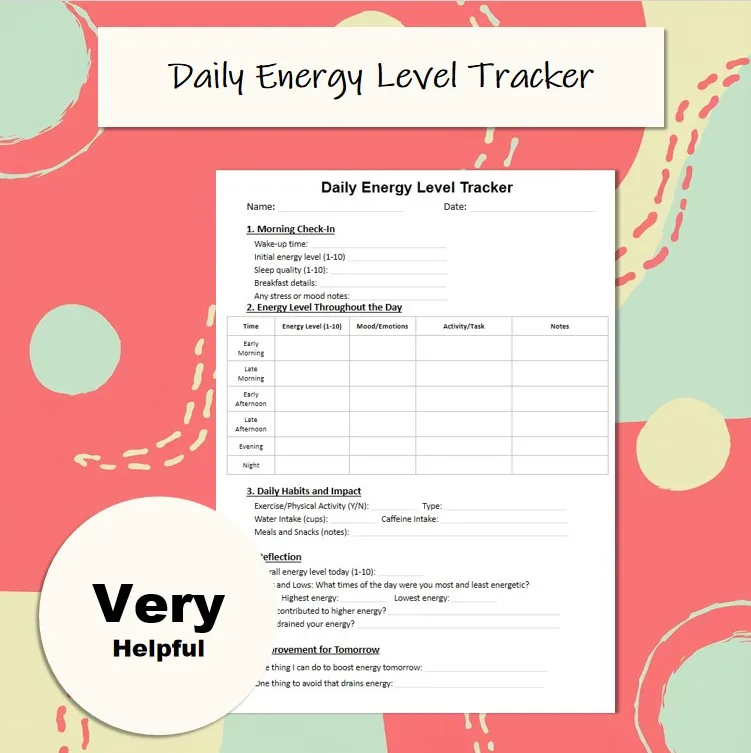
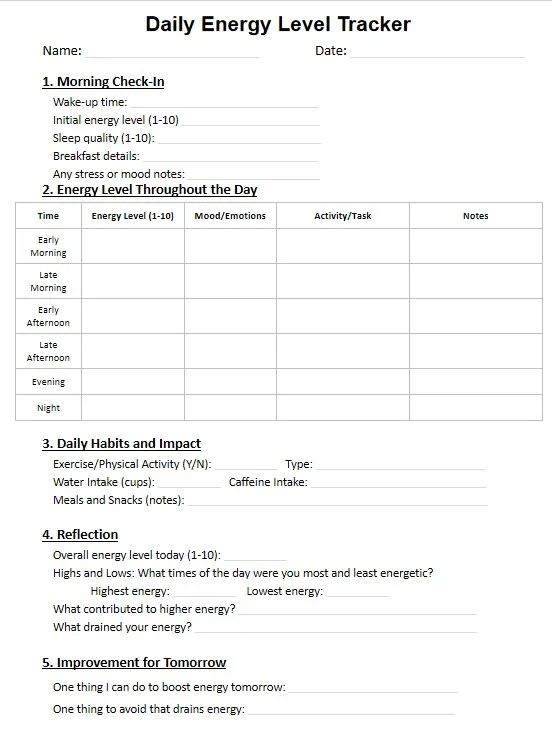
Daily Energy Level Tracker Sleep Mood and Habit Reflection Worksheet: a one-page tracker with a morning check-in for wake-up time, sleep quality, breakfast and mood, an energy and mood table across six times of day, daily habits such as exercise, water, caffeine and meals, and a reflection on high and low points.
Sources and scope
- Sleep Foundation: general information about sleep, including sleep for teenagers.
- CASEL: a widely used framework for social and emotional learning, including self-awareness and self-management.
- Understood.org: practical guidance for families and students on focus, routines and learning differences.
- National Institute of Mental Health: general information about mental health topics, including stress.
This list covers simple self-tracking of everyday habits for students. It does not give medical, nutrition or sleep advice; persistent tiredness, low mood or sleep problems should be discussed with a doctor or school nurse.
Key takeaways
- The habits that affect student energy are easiest to see when written down daily.
- Start with sleep, breakfast, and water, then add more.
- Look for patterns over one to two weeks, not single days.
- Change one specific habit at a time and keep tracking.
- Respect privacy and refer health concerns to professionals.










Leave a Comment