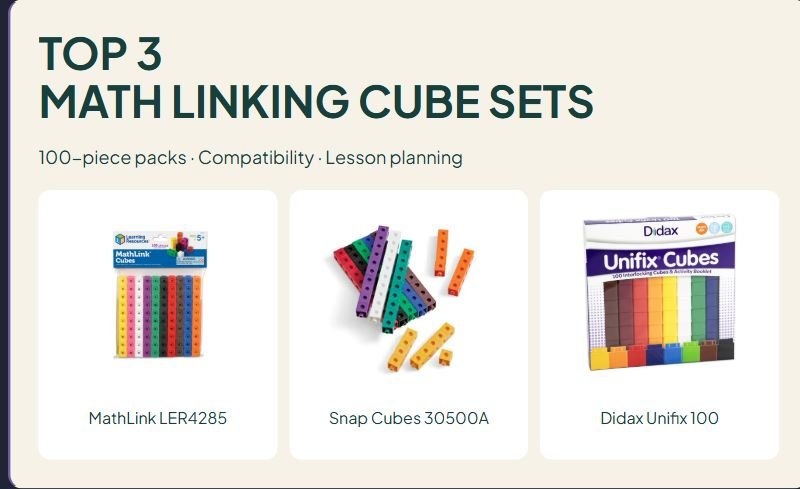

TOP 3
MATH LINKING CUBE SETS
100-piece packs · Compatibility · Lesson planning

MathLink LER4285

Snap Cubes 30500A

Didax Unifix 100
Affiliate disclosure: As an Amazon Associate I earn from qualifying purchases. Purchases through our links may earn a commission at no additional cost to you.
Math linking cubes give students a way to build and rearrange a number model. Before choosing a set, check the connectors, the materials your lessons already use, and how many cubes each learner needs. A matching piece count does not establish that different brands connect to each other.
This guide compares three 100-piece starter sets from manufacturer information. We have not tested connection force, wear, cleaning, or cross-brand fit. These are alternatives for different existing classroom systems rather than a measured quality ranking.
Three 100-piece sets to compare
| Set | Manufacturer details | Important check |
|---|---|---|
| MathLink LER4285 | 100 cubes, 10 colors, ¾-inch cubes connecting on all sides | Basic set rather than the separate activity-card bundle |
| hand2mind Snap Cubes 30500A | 100 cubes, 10 colors, ¾-inch cubes connecting on six sides | Manufacturer does not guarantee other-brand compatibility |
| Didax Unifix 2-25W | 100 cubes in 10 standard colors | Match the Unifix accessories and exact package |
Learning Resources MathLink Cubes LER4285
The basic LER4285 set has one hundred cubes in ten colors. Learning Resources describes three-quarter-inch cubes that connect on all sides and have geometric cutouts. The set is labeled for ages five and up.
Limitation and buying check: Check the model rather than assuming every MathLink listing includes activity cards. LER4299 is a separate activity set. A basic cube pack can suit teacher-created tasks, while a card bundle needs its own comparison of contents.
Manufacturer product details and photo source
Check MathLink 100 cubes on Amazon.com →
hand2mind Snap Cubes 30500A
The 30500A set contains one hundred three-quarter-inch cubes in ten colors. hand2mind describes connectors on all six sides and provides teaching resources for number models, measurement, and other math tasks.
Limitation and buying check: The manufacturer says compatibility with other cube brands is not assured. If you are adding to an existing collection, verify the exact system before purchasing. Shared nominal size is not proof of connector fit.
Manufacturer product details and photo source
Check hand2mind Snap Cubes 100 on Amazon.com →
Didax Unifix Cubes 2-25W
Didax lists one hundred Unifix cubes in ten standard colors and identifies the set for kindergarten through grade six. The manufacturer offers separate Unifix tools and teaching resources for activities such as number comparison and operations.
Limitation and buying check: Match the exact set and any accessory you intend to use. Do not assume a reseller’s illustrated booklet, tray, or other materials are included in the basic manufacturer pack. Keep this system distinct from an unverified mixed-brand collection.
Manufacturer product details and photo source
Check Didax Unifix 100 cubes on Amazon.com →
Work out how many cubes the lesson needs
Start with the student model, not the total in the box. If each student needs two trains of ten, that is twenty cubes per student. A group of four needs eighty cubes for those models, leaving twenty from a hundred-piece set for demonstration or other uses. This is a planning example, not a claim about the best group size.
Color requirements can become the constraint before the total count does. Check the exact distribution if every student needs the same color. Do not assume a listing provides equal numbers of each color unless its package information says so.
Three clear lesson examples
Show more and less
Give each learner a small collection to count. Arrange the collections so their quantities can be compared, then ask which has more and how they know. Keep the focus on the number represented rather than the height or appearance of an accidental structure.
Represent parts and a whole
Use two distinguishable groups, such as four cubes and three cubes. Count the combined quantity, then record the matching number sentence. Ask students to explain what each part of the model represents. Keep the quantities and arrangement appropriate for the current lesson.
Investigate equal groups
Build three equal groups of four cubes. Count the cubes in each group and the total. Invite students to describe the relationship before writing a matching equation. The cubes are a representation to discuss, not a substitute for explaining the mathematical idea.
Check everyday usability
Try the connection action
Before ordering a class set, check whether intended users can connect and separate a sample comfortably. We have not compared grip force or assigned an easiest-to-use rating. Where the connection action distracts from the math, a different way of representing the same idea may be useful.
Keep sets identifiable
Label containers with the brand and model. Store unverified systems separately so a lesson does not begin with students trying to join pieces that do not fit. A simple inventory card can record the intended quantity without requiring every activity to use the entire set.
Follow age and care guidance
All three manufacturer pages carry small-parts warnings and say the pieces are not for children under three. That warning is not the same as the recommended starting age for every set. Follow the exact product guidance and classroom supervision arrangements. Use manufacturer care instructions rather than assuming any cleaning method is suitable.
For keeping activity containers identifiable, see our label maker comparison. For working through a number model on a surface students can erase, compare our classroom dry erase lapboards.
What to look for in customer feedback
Look for the exact model and comments about repeated connecting, separating, and storage. A review of an activity-card kit may not describe a basic cube pack. We have not reproduced customer excerpts or assigned review scores.
Math linking-cube questions
Can I mix different brands?
Do not assume they interlock. Match the existing system or verify compatibility before buying a mixed collection.
Is a hundred-piece set enough for a class?
It depends on the number of simultaneous models. Calculate the pieces needed per learner or group, including any teacher demonstration model. One hundred pieces is a pack count, not a guaranteed class allocation.
Which set should I shortlist?
Compare the exact set that matches your existing materials, connector needs, and planned activity. If you are starting from scratch, check one sample and the complete package before purchasing multiple packs.







Leave a Comment