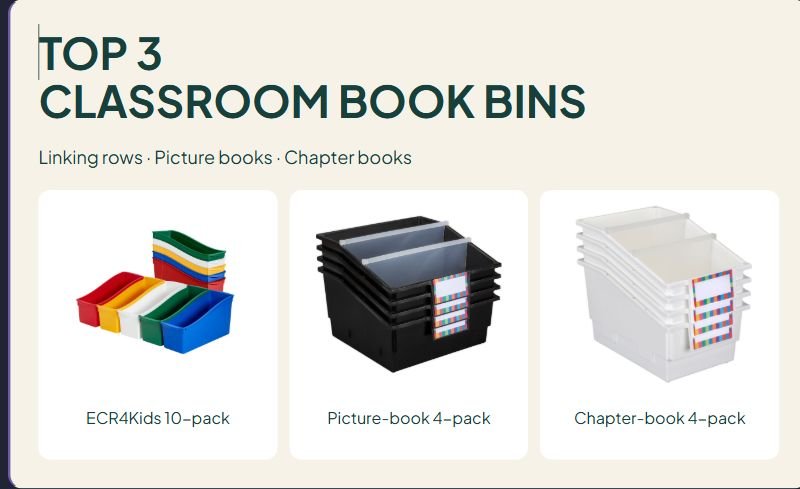

TOP 3
CLASSROOM BOOK BINS
Linking rows · Picture books · Chapter books
ECR4Kids 10-pack

Picture-book 4-pack

Chapter-book 4-pack
Affiliate disclosure: As an Amazon Associate I earn from qualifying purchases. Purchases through our links may earn a commission at no additional cost to you.
Classroom book bins work best when they fit both the shelf and the books. A narrow magazine-style holder, a wide picture-book basket, and a divided chapter-book bin organize books differently. Start with one real shelf and a representative stack of books before choosing a class set.
This comparison uses manufacturer product information. We have not tested load capacity, drop resistance, tipping, or classroom durability. The three formats address different storage tasks; their order does not represent a measured quality ranking.
Three classroom book-bin formats at a glance
| Design | Potential fit | Check first |
|---|---|---|
| Linking narrow bins | Individual book sets or a row of categories | Shelf depth and room to disconnect a bin |
| Wide divided picture-book bins | Face-forward picture-book collections | 13½-inch outside width and shelf depth |
| Wider bin with dividers | Face-forward chapter-book browsing | Interior width, book dimensions, and total shelf capacity |
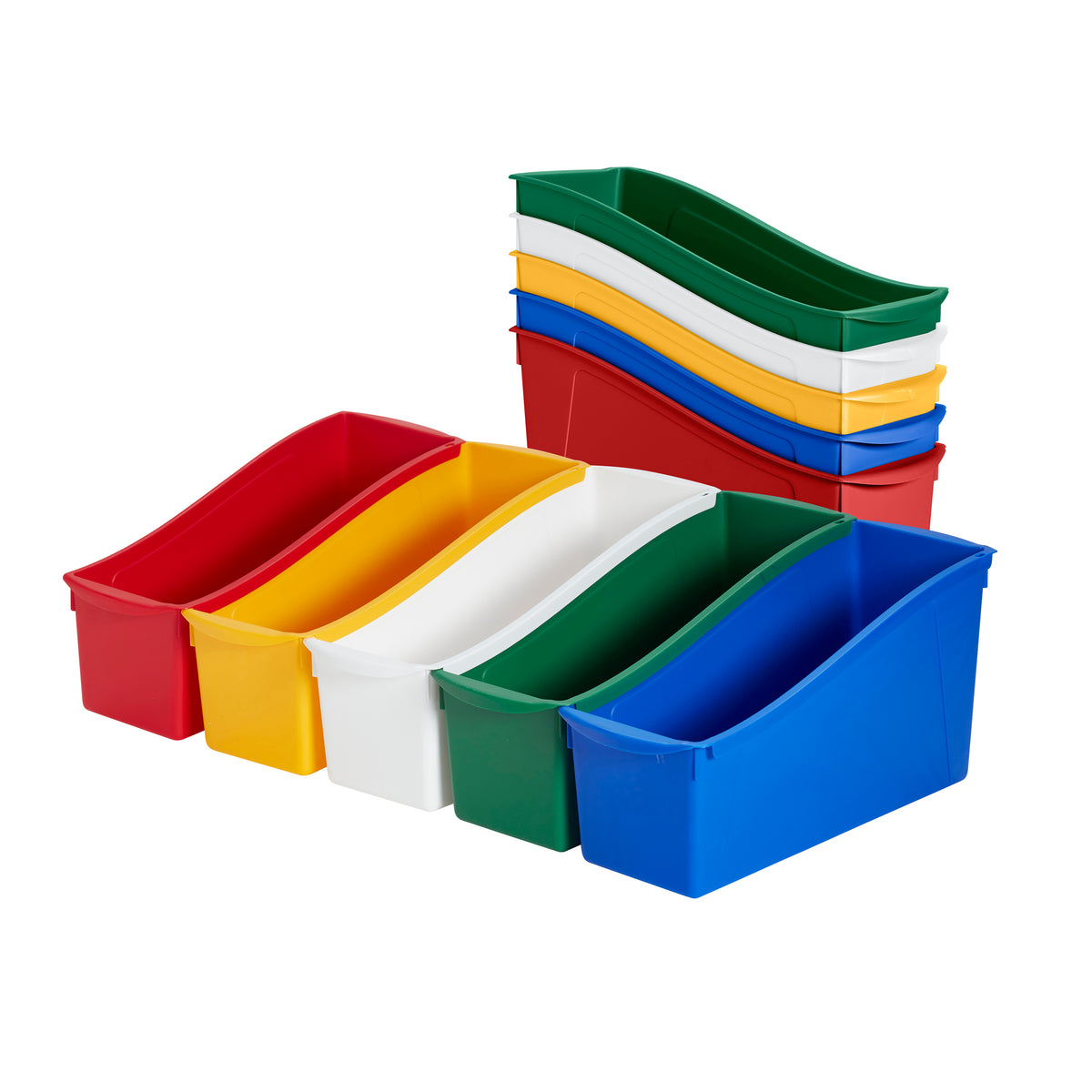
ECR4Kids Linking Book Bins: narrow connected storage
The assorted ELR-20520-AS set has ten bins, each measuring 15 inches long, 5¼ inches wide, and 7.2 inches tall. The sides connect, handles support carrying, and empty bins nest. The manufacturer lists pocket labels as a separate purchase.
Advantage: Ten connecting narrow bins can organize separate book sets, and handles let you move one set to a reading area. Empty bins nest for storage.
Limitation: A long exterior dimension can be a problem on a shallow shelf. Measure the usable shelf depth rather than relying on the shelf unit’s overall size.
Manufacturer specifications and photo source
Check ECR4Kids assorted 10-pack on Amazon.com →
Really Good Stuff picture-book bins: room for larger covers
The black 165165BK set includes four bins, eight clear dividers, eight blank labels, and four protective label covers. Each bin measures 13½ inches wide by 13½ inches deep by 7¾ inches high overall. The lower interior tapers to 11¼ inches wide by 10½ inches deep by five inches high. The dividers create one, two, or three sections.
Advantage: The wider opening suits face-forward browsing of picture books and larger reference books that may not fit a chapter-book bin.
Limitation: A wide bin consumes shelf space quickly. Three bins already require 40½ inches of width before adding clearance; measure your books against the tapered interior rather than the outside size.
Manufacturer specifications and photo source
Check Really Good Stuff black picture-book 4-pack on Amazon.com →
Really Good Stuff divided chapter-book bins: a wider browsing layout
The white 161996WH package includes four bins, eight clear dividers, eight blank labels, and four protective label covers. Each bin measures 8¾ inches wide, 13½ inches deep, and 7¾ inches high. The stated interior is 6¾ inches wide by 10½ inches deep by five inches high.
Advantage: Two dividers per bin help separate small collections without requiring a separate bin for every category.
Limitation: Check the interior width against the books you plan to display. A chapter-book layout does not automatically accommodate oversized picture books, and dividers affect how you arrange the available space.
Manufacturer specifications and photo source
Check Really Good Stuff white chapter-book 4-pack on Amazon.com →
Measure the shelf before buying a class set
Use the available opening
Measure between the shelf supports and from the front edge to any back panel. Check the clear height beneath the shelf above. A manufacturer’s overall cabinet measurements may include side panels, trim, and other space that a bin cannot use.
Separate outside fit from inside fit
Exterior dimensions tell you whether the bin fits the shelf. Interior dimensions tell you whether the books fit the bin. A tapered base, curved wall, or divider can reduce usable space. Check the largest book in a proposed set, not just the smallest paperback.
Leave room for hands
A tightly packed row can look neat while being awkward to use. Make room to grip the handle, separate linking sides, or browse a cover without pulling out the entire row. Consider access from a seated position and the reach of the people using the shelf.
Test the filled weight
Fill a sample bin with the intended books before buying many more. Make sure the intended user can move it comfortably, or arrange the shelf so books can be removed without carrying the bin. Follow the product instructions; we have not established load limits for these models.
Plan a library that is easy to reset
- Start with a small number of clear categories. Choose topics or another system that matches how readers will find books.
- Label the bin and its home. Use consistent words and any picture cues that help your users.
- Keep categories flexible. Leave room for returns and new books without forcing books against the sides.
- Model the return routine. Show where a book goes and how to keep covers or spines visible.
- Check the arrangement after real use. If books repeatedly land in the wrong place, simplify the categories or improve the label.
For example, “ANIMALS” and “SPACE” may be easier to browse than a collection of small categories that overlap. A temporary returns basket can help when readers are unsure where to put a book. Choose your system to serve your readers rather than making every bin visually identical.
Compare the complete package
Check the count, color, model, dividers, labels, and protective covers on the actual listing. Product photos may show filled shelves or accessories that are not included. Compare the cost of the number of bins you need, including any separately sold labels, rather than comparing the headline price of a four-pack with a twelve-pack.
Coordinate storage labels with our teacher label maker comparison. If you need mobile supply storage as well, see the teacher rolling cart guide.
What customer feedback can tell you
Useful feedback identifies the exact model, book sizes, shelf depth, and how the bin is used. Look for accounts of carrying filled bins, connecting and separating them, and cleaning the material. A comment about an empty bin’s appearance does not establish loaded stability. We have not reproduced customer excerpts or assigned ratings.
Classroom book-bin questions
How many bins do I need?
Count the categories or individual book sets you intend to maintain. Check the usable shelf space before converting that count into a purchase. A small pilot arrangement can reveal whether categories need combining or splitting.
Are linking bins tip-proof?
Do not assume so. Linking is a design feature, not a guarantee against every load, pull, or placement. Follow the product instructions and check the actual arrangement under ordinary use.
Can I stack filled bins?
Empty nesting and loaded stacking are different. Do not stack filled bins unless the manufacturer explicitly allows that configuration. Keep books accessible and follow the storage unit’s instructions as well.
Which style should I shortlist?
Consider linking bins for a coordinated narrow row, wide picture-book bins for larger covers, and divided chapter-book bins when a narrower face-forward layout fits your collection. Confirm measurements with one representative book set before buying in quantity.





Leave a Comment