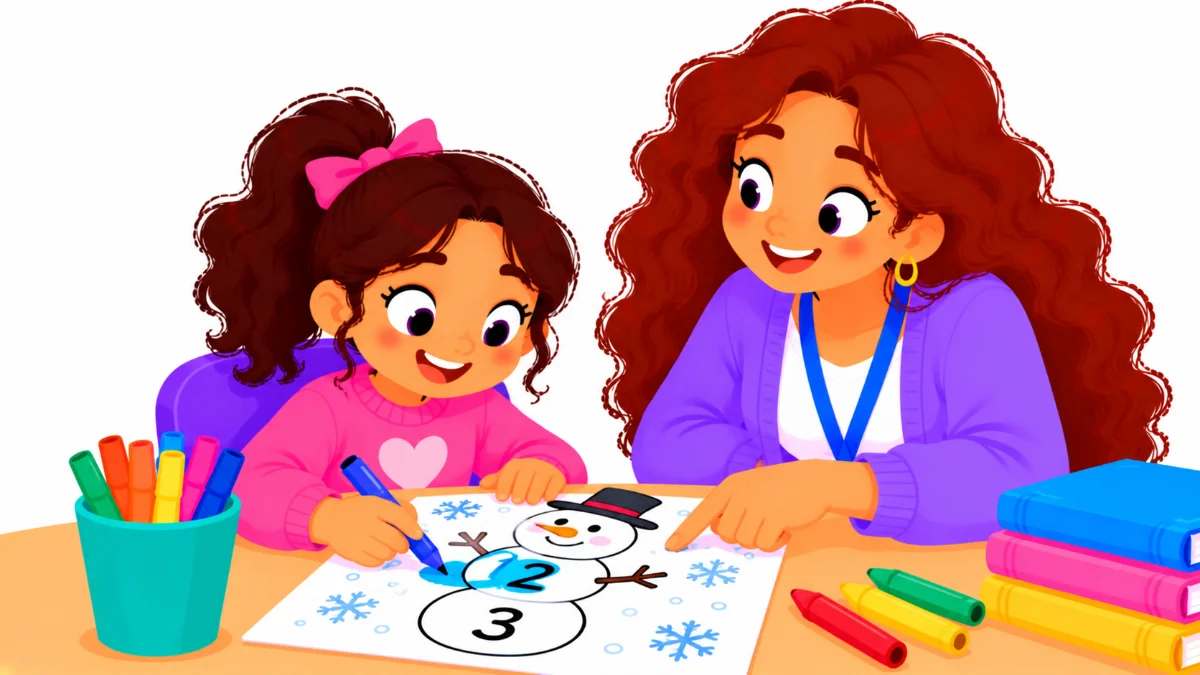

Number recognition worksheets can look simple, yet they solve a real problem in early math. Picture a kindergartner who counts to ten out loud with confidence, then hesitates when you point to a printed 6 and calls it a 9. She knows the counting words. What she does not yet have is a quick, reliable link between each written numeral and its name.
This guide gives you a five-step routine for teaching numbers 1 to 9: check what the child already knows, teach one number at a time, use search-and-find pages well, practice the tricky look-alike pairs, and track progress while connecting numerals to real quantities. By the end, you will know exactly how to turn a stack of worksheets into short, focused practice that actually builds recognition.
Examples are fictional. Adapt to the child’s age, needs, and goals. This is guidance, not a diagnosis.
At a glance
- Start with a two-minute check so practice targets the numbers a child does not know yet.
- Teach one numeral at a time, using sight, sound, and movement together.
- Search-and-find pages build visual discrimination when children say the number as they color.
- Give extra practice to look-alike pairs such as 6 and 9.
- Always connect the numeral to a real quantity, not just a shape on paper.
1. Check what the child already knows
Before you print anything, find out which numerals the child already recognizes. This saves time, because practice on known numbers feels easy but teaches little. In contrast, practice on unknown numbers is where growth happens.
First, write the numerals 1 to 9 on separate cards. Then, mix them up and show one at a time. Ask, “What number is this?” Sort the cards into two piles: named quickly and correctly, or not yet. Keep it light and stop after one pass, so the check feels like a game rather than a test.
Next, try the reverse task. Lay out three or four cards and say, “Show me 4.” Some children can point to a number before they can name it, and that tells you they are close.
Worked example. Lena is a fictional kindergartner. In her first check, she names 1, 2, 3, 4, 5, and 8 quickly. She calls 6 a “nine,” hesitates on 9, and says “I don’t know” for 7. That gives a clear picture: 6 of 9 numerals are secure, and 3 need practice (6, 7, and 9).
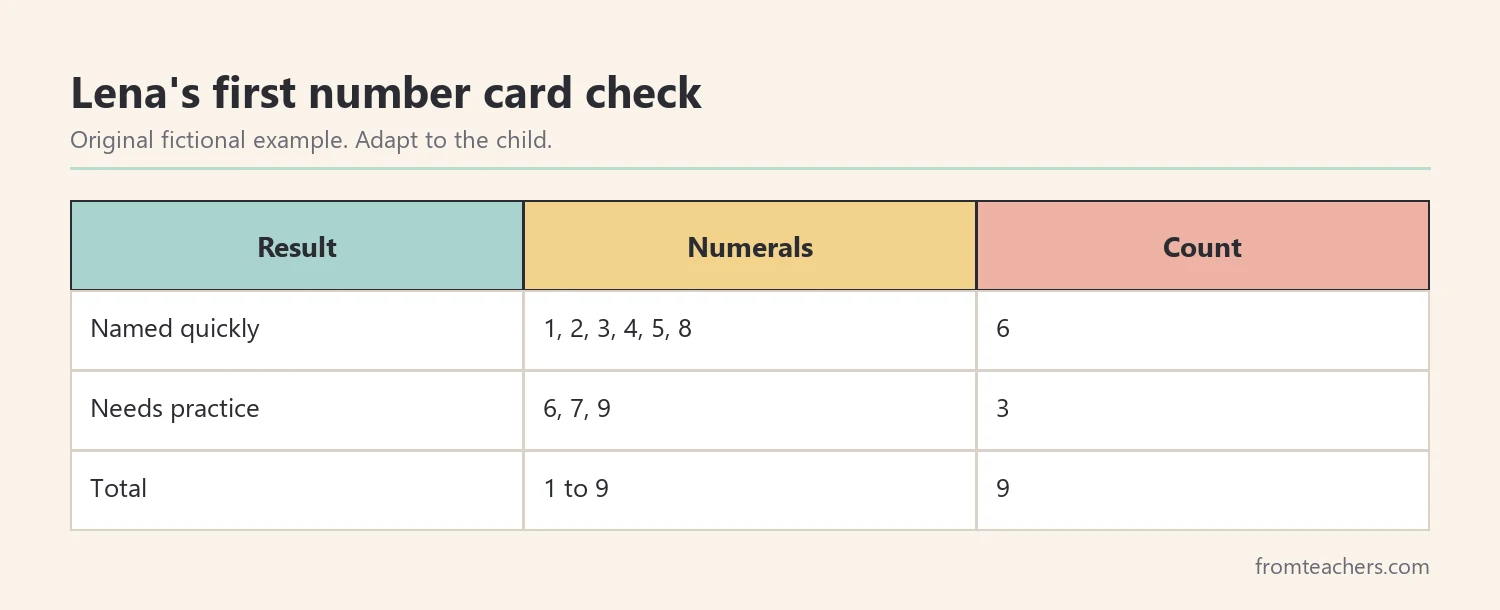
Finally, record the result with a date. This record decides which number recognition worksheets you use first. A simple line such as “Known: 1, 2, 3, 4, 5, 8. Practice: 6, 7, 9” is enough to plan the next two weeks.
2. Teach one number at a time
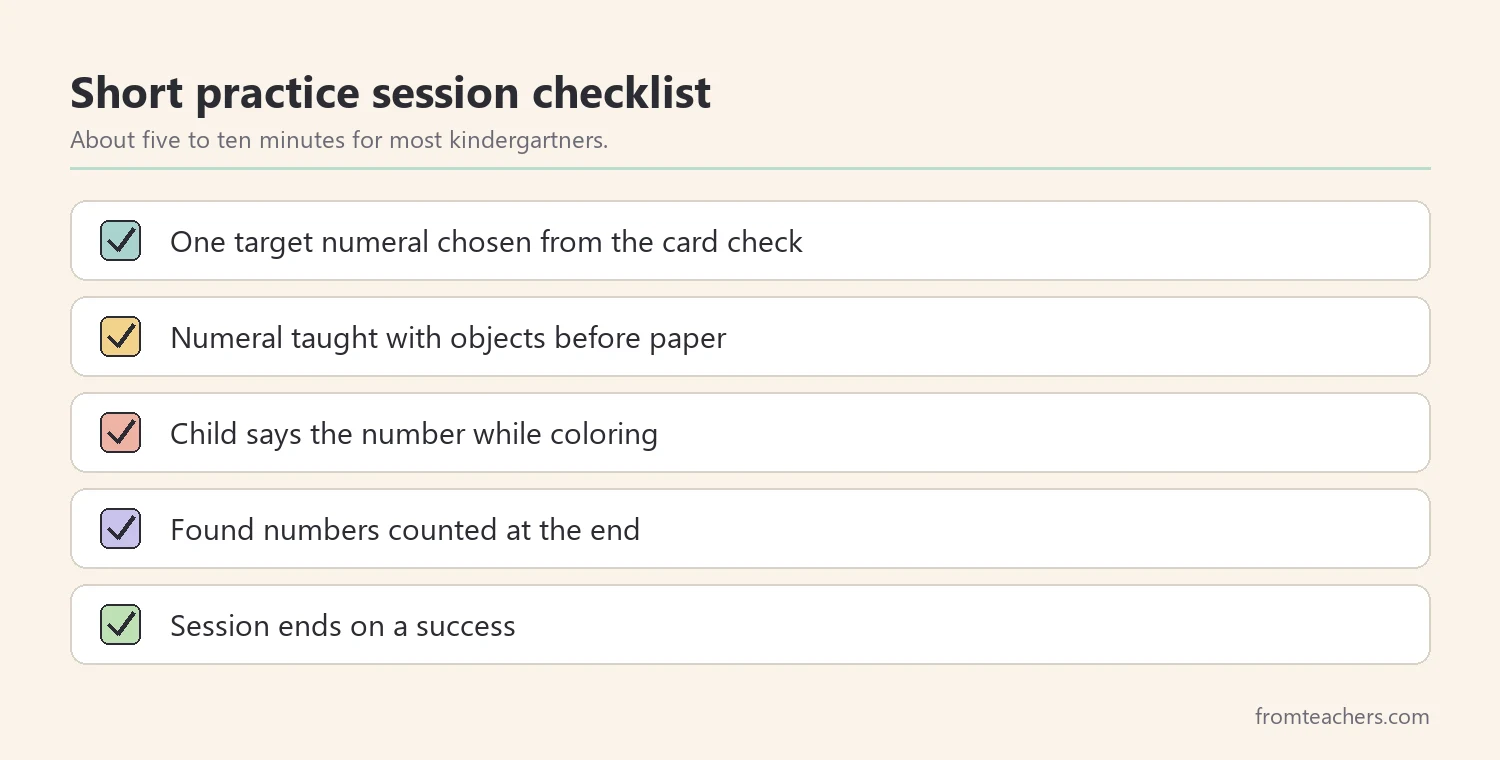
Young children learn numerals best in small, clear doses. Therefore, introduce one target number in a session, and keep sessions short, about five to ten minutes for most kindergartners.
Use a short, repeatable sequence. First, show the numeral and say its name. Next, have the child say it back and trace it in the air or on a textured surface, such as sand or a salt tray. Then, count out that many objects together. Finally, ask the child to find the numeral among two or three others. Each step links the shape, the name, and the amount.
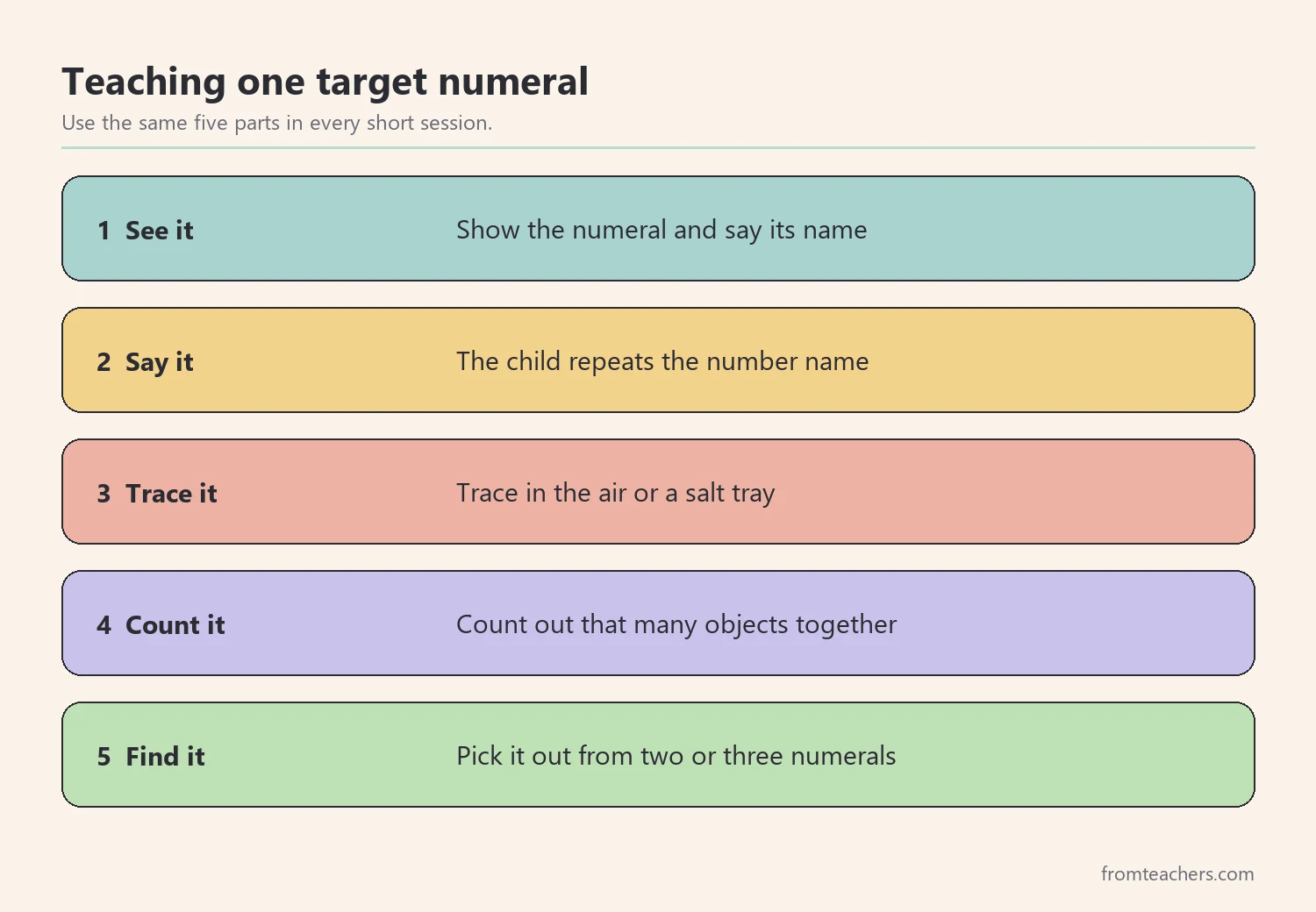
Also, add a short phrase for the shape if it helps. For example, “7 has a line across the top and a slide down.” Keep the phrase the same every time, so it becomes a reliable cue rather than a new puzzle.
Worked example. On Monday, Lena’s teacher introduces 7. Lena says “seven,” traces it in a salt tray three times, counts seven small blocks, and then picks 7 out of a group of 1, 4, and 7. She gets it right on her second try. Her teacher notes “7: found with one prompt.”
Moreover, do not rush to the next number. If a child still mixes up a numeral the next day, repeat the same routine before adding a new one. Short daily practice tends to work better than one long session.
Meanwhile, keep the same routine at home if you can. A parent who uses the same words and the same tracing cue gives the child twice as many short, consistent practice moments without adding new rules.
3. Use number recognition worksheets for focused practice
Once a child has met a numeral in hands-on ways, number recognition worksheets give focused, independent practice. Search-and-find pages are especially useful. The child looks across rows of different numerals and colors only the target one, which trains careful looking and quick recognition at the same time.
To get the most from these pages, add one simple rule: say the number every time you color it. This keeps the link between name and shape active, instead of turning the page into pattern matching. Next, ask the child to count how many target numbers they found and write or say the total.
Choose number recognition worksheets that focus on one numeral per page with clear, short directions. For example, the Snowman Number Hunt number recognition worksheets include nine pages, one for each number from 1 to 9, each with a snowman holding the target number, rows of number circles, and the direction “Find and color number ___.” Because they are black and white, children can color them with any crayon, and they are easy to reproduce.
Decide where the pages fit
Then, think about where the pages fit. They work well as a math center, morning work, or a short homeschool task. Importantly, use them after teaching, not instead of it. A worksheet practices a skill; it does not introduce one.
Worked example. On Tuesday, Lena completes the page for 7. She colors each 7 while saying “seven,” then counts the colored circles with her teacher. She also colors one 1 by mistake, says “oops, that’s a one,” and moves on. That self-correction is a good sign: she is looking closely at the shape.
You can also vary how children mark the pages. Some enjoy using dot markers, small stickers, or counters placed on top of each target number before coloring. Because the task stays the same, these small changes make number recognition worksheets feel new without adding confusion.
Finally, keep pages short and successful. If a child becomes tired, stop at one row and finish another day. In short, a half page done with focus is better than a full page done by guessing.
4. Practice the tricky look-alike numbers
Some numerals are easy to confuse because they share parts or look like each other turned around. The most common pairs are 6 and 9, 1 and 7, and 2 and 5. Number recognition worksheets that mix these pairs in the same rows are helpful, because the child must check each shape carefully.
First, teach the difference out loud. For 6 and 9, you might say, “6 has its circle at the bottom. 9 has its circle at the top.” Next, practice the pair side by side with cards, asking the child to point to each one when you say it. Then, use a search-and-find page where both numbers appear and only one is the target.
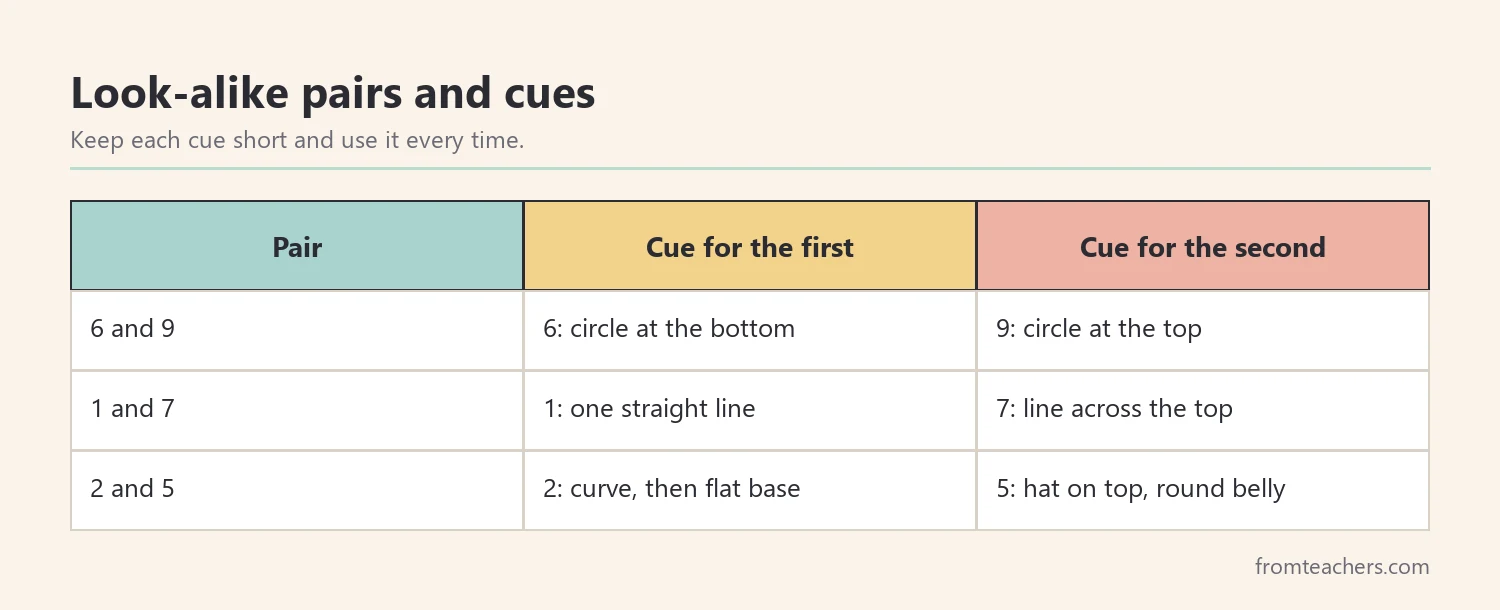
Also, avoid teaching both numbers of a confusing pair on the same day for the very first time. Instead, secure one, then add the other and contrast them. Similarly, use real objects to show the difference in amount: six blocks look clearly different from nine blocks.
Worked example. Lena’s teacher teaches 6 first, with the cue “circle at the bottom.” The next week, she adds 9 with “circle at the top.” Lena then completes the number recognition worksheets for 6 and 9 on different days. By the end of that week, she sorts a mixed pile of 6 and 9 cards correctly.
In addition, praise careful looking, not just speed. Saying “You checked where the circle is” teaches the child what to pay attention to next time.
Over time, you can raise the challenge by choosing number recognition worksheets where the look-alike number appears more often in the rows. As a result, the child gets more chances to stop, check the shape, and decide.
5. Track progress and connect numerals to quantity
The final step makes sure the learning lasts. Repeat the card check from step 1 about once a week, using the same nine cards. Then, record how many numerals the child names quickly and correctly.
At the same time, connect each numeral to a real amount. Number recognition worksheets build recognition, but recognition alone is not number sense. Therefore, ask the child to show the number with fingers, put that many counters on a plate, or match a numeral card to a picture with the same number of objects.
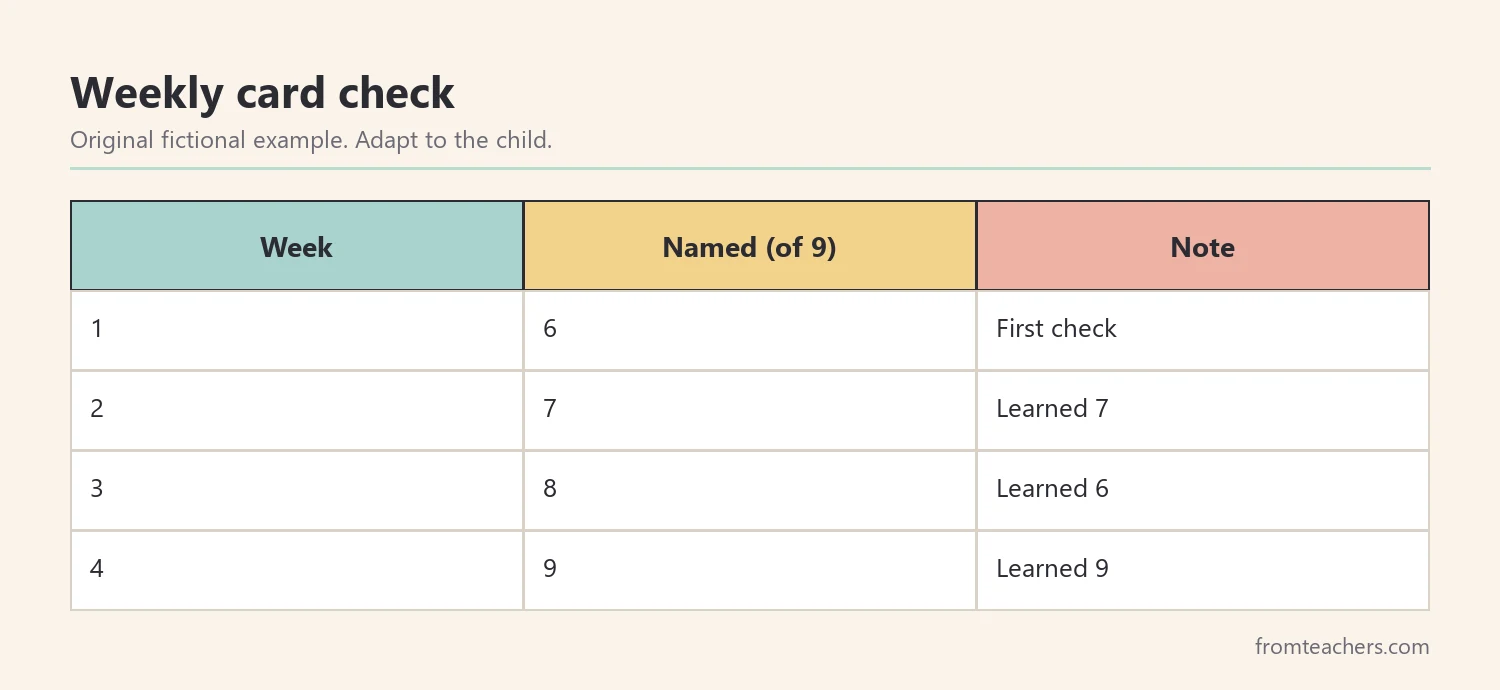
Worked example. Lena’s checks show steady growth. In week 1, she names 6 of 9 numerals. By week 2, she names 7 of 9 after learning 7. In week 3, she names 8 of 9 after learning 6, and in week 4 she names all 9, including 9. Throughout, she also counts out matching amounts of blocks for each new numeral.
Similarly, share a quick note with families or colleagues each week. For instance, “Lena now knows 7. Next we practice 6.” This keeps everyone using the same target, and it means number recognition worksheets sent home match what happens in class.
Once a child knows 1 to 9, move to new challenges. For example, ask them to put numeral cards in order, find a number in a book or on a calendar, or match numerals to dot patterns. These tasks build on recognition and keep practice fresh.
Common mistakes and how to avoid them
Most problems with number recognition worksheets come from how they are used, not from the pages themselves. Each mistake below has an easy fix.
- Using worksheets to introduce a number. Fix: teach with objects and movement first, then practice on paper.
- Silent coloring. Fix: have the child say the number each time they color it.
- Practicing known numbers only. Fix: use your card check to choose target numerals.
- Teaching look-alike pairs on the same first day. Fix: secure one, then contrast it with the other.
- Long sessions. Fix: keep practice to about five to ten minutes and stop on success.
- No link to quantity. Fix: count out real objects for every numeral.
Questions teachers and parents ask about number recognition worksheets
At what age should children use number recognition worksheets?
Many preschool and kindergarten children are ready once they show interest in written numbers and can hold a crayon. However, readiness varies widely. Start with hands-on activities and add worksheets when the child can focus on a short page.
How many number recognition worksheets should a child do in a day?
One short page is usually enough for a young child. Quality matters more than quantity. A focused page with the child saying each number is more useful than several rushed ones.
What if my child keeps mixing up 6 and 9?
This is very common in early learners. Teach a short, consistent cue for each, practice them on different days first, and then contrast them side by side. If confusion continues for a long time, mention it to the child’s teacher.
Are search-and-find pages better than tracing pages?
They practice different skills. Tracing supports writing the numeral, while search-and-find pages build recognition and careful looking. Many children benefit from both, at different points in learning.
How do I keep number practice fun?
Use themes, short sessions, and lots of movement. Hunt for numbers around the house or classroom, turn cards into a matching game, and celebrate careful looking. When the practice is brief and successful, children usually ask for more.
Related reading: Learning Styles and Student Success, 5 Practical Teaching Tips to Boost Classroom Focus and Learning, and Homeschooling vs Public Schooling.
A companion resource for number recognition worksheets:
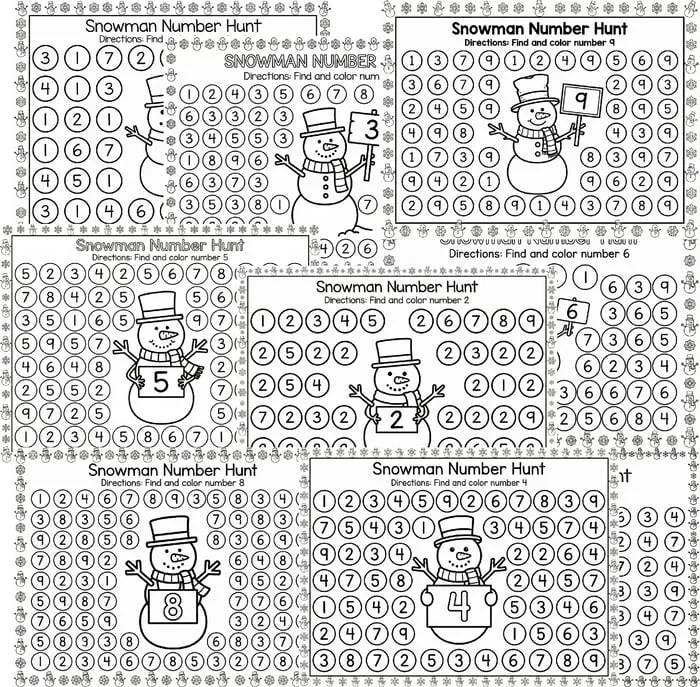
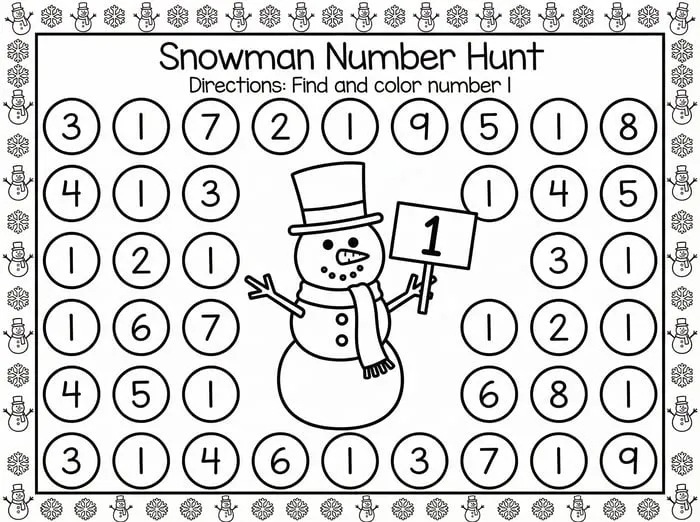
Snowman Number Hunt: Black and White Number Recognition Worksheets: nine winter-themed search-and-find pages, one for each number from 1 to 9, with a snowman holding the target number and “Find and color” directions, in ink-friendly, print-ready PDF files.
Sources and scope
- NAEYC: the National Association for the Education of Young Children, with resources on early learning and developmentally appropriate practice.
- NCTM: the National Council of Teachers of Mathematics, with guidance and resources for teaching math from the early years.
- What Works Clearinghouse: reviews of education research, including practice guides on early math instruction.
This guide covers everyday practice for recognizing numerals 1 to 9 at home and in early classrooms. It does not cover formal math assessment or learning difficulties, which belong to the child’s teacher and school team.
Key takeaways
- Check first, so number recognition worksheets target unknown numerals.
- Teach one numeral at a time: see, say, trace, count, and find.
- Have children say each number as they color it.
- Contrast look-alike pairs with short, consistent cues.
- Track weekly and always connect numerals to real quantities.






Leave a Comment