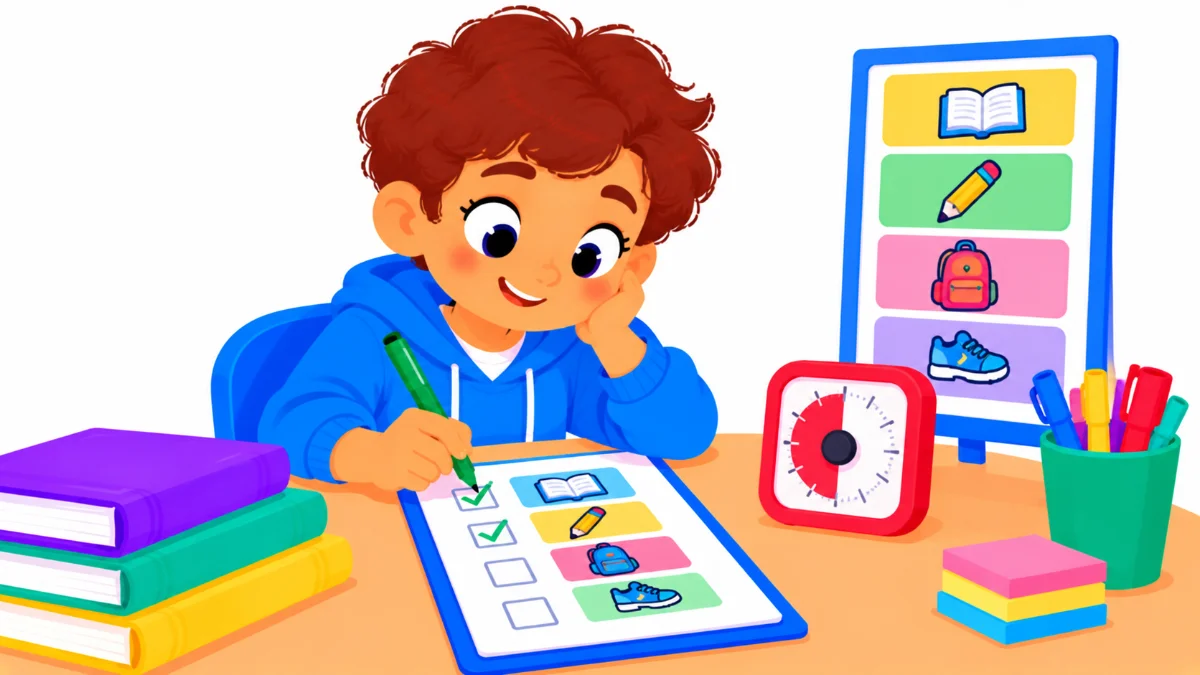

Executive function reminders give students a quiet, visible answer to the question “What do I do now?” Picture a fifth grader who knows the math, yet sits with a blank page for ten minutes because he cannot decide where to start. Nothing is wrong with his effort. The skills that plan, start, organize, and finish work simply need more support.
This guide shows you how to teach and use executive function reminders in six steps: choose the right reminders, teach visual supports and small steps, use timers and movement, keep materials organized, build self-check-ins and help-seeking, and review what works. By the end, you will have a simple routine that helps students work more independently.
Examples are fictional. Adapt to the student’s goals and agreed supports. This is guidance, not a diagnosis.
At a glance
- Executive function covers planning, starting, organizing, and finishing tasks.
- Visible reminders take pressure off working memory.
- Teach each strategy directly before you expect students to use it.
- Small steps, short timers, and movement help students get started.
- Review often, and fade prompts as independence grows.
1. Choose the executive function reminders your students need
First, notice where tasks break down. Some students struggle to begin. Others start well but lose track halfway, or finish the work and then lose the paper. Each of these moments points to a different skill, so the right reminder depends on what you see.
Next, group the trouble spots into four simple stages: planning, starting, staying organized, and finishing. Then match one or two strategies to each stage. For example, a checklist supports planning, a short timer supports starting, and a tidy workspace supports staying organized.
Also, keep the list short at first. A wall full of advice becomes background noise. Two or three executive function reminders that students actually use are worth more than ten they ignore.
In addition, involve the student when you can. Ask, “When do you feel most stuck?” Older students often know the answer, and their buy-in makes the reminders feel like tools rather than rules.
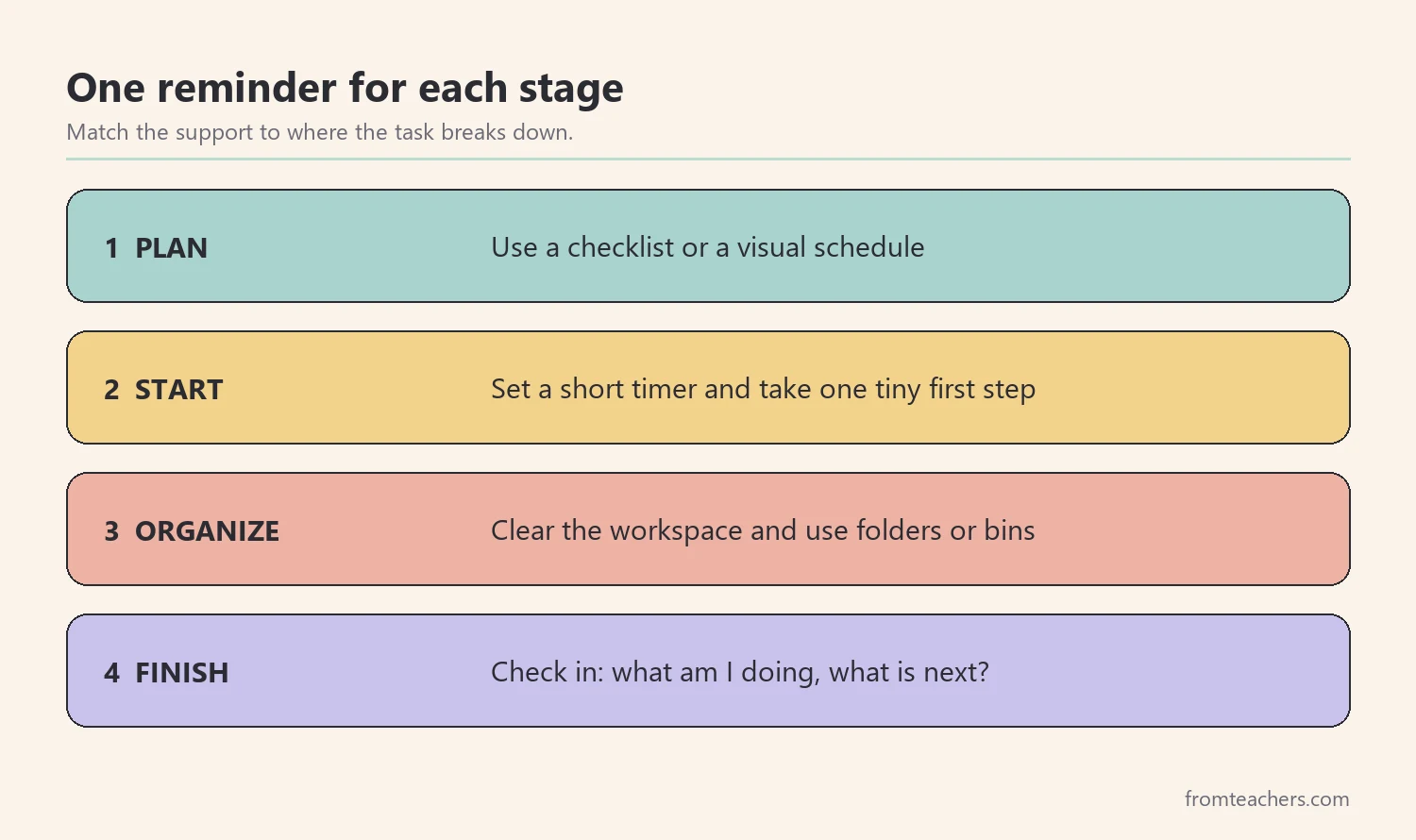
Worked example. Leo is a fictional student in grade 5. His teacher, Ms. Ortiz, notices that he rarely starts written work on his own, and that his desk is often covered in loose papers. She chooses two first targets: getting started and keeping materials organized. She leaves planning and finishing for later, so Leo is not overwhelmed.
2. Teach visual supports and small steps
Visual supports are often the first executive function reminders to try, because they hold information so the student does not have to. Checklists, schedules, first-then boards, and step-by-step directions all work this way. The student looks, instead of trying to remember.
Then, teach students to break tasks into small steps. A worksheet becomes “write my name, read question one, answer question one.” Each piece feels possible. Also, encourage students to notice and celebrate each finished step, even quietly, because small wins keep motivation going.
Importantly, model the strategy before you expect it. Think aloud while you break a task into steps on the board. Next, do one together. After that, let students try with support. This gradual release is how executive function reminders turn into habits.
For a ready-made classroom visual, the executive function reminders poster for planning and task strategies lists practical tools for planning, starting, staying organized, and finishing, with a short “why it helps” note for each one.
| Task | Small steps |
|---|---|
| Write a paragraph | Topic sentence, two details, closing line |
| Solve 6 problems | Do 2, check, do 2, check, do 2 |
| Clean up | Papers, then pencils, then books |
Worked example. Ms. Ortiz tapes a three-step strip to Leo’s desk for writing tasks. She models it twice with the whole class. By the end of the week, Leo points to the first step on his own before he starts.
3. Use timers and movement to start and keep going
Getting started is often the hardest part. A timer or countdown lowers the barrier. Ask the student to work for just two to five minutes, pause for a short break, and then repeat the cycle. A short, clear window feels much easier than “finish the whole page.”
Meanwhile, movement can help attention and self-regulation. Simple options include standing to work, stretching between tasks, or doing chair push-downs or wall push-ups. Agree on these options in advance, so movement looks like a strategy and not like leaving the task.
Also, teach students how to use the timer themselves. At first, you set it. Later, the student chooses the time and starts it. This shift matters, because executive function reminders work best when students control them.
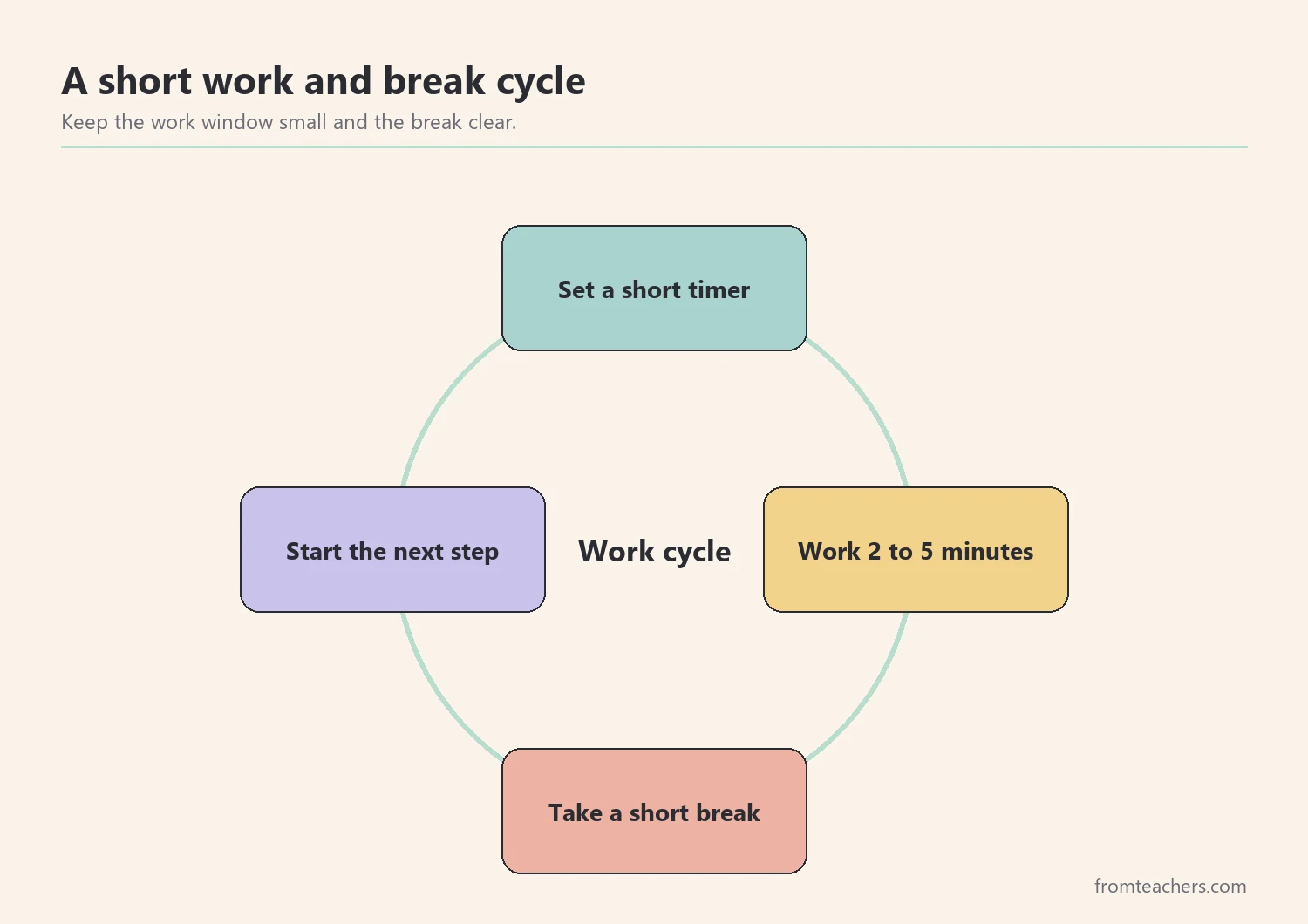
In addition, keep the break short and clear. A break that turns into ten minutes of play makes the next start harder. One stretch, one sip of water, then back to the next small step.
Then, pair the timer with a clear first step. “Set the timer and write your name and the date” is easier than “Set the timer and begin.” The first action should take seconds, because once a student has started, keeping going is usually much easier.
Worked example. Ms. Ortiz gives Leo a small sand timer. He works for four minutes, then stands and stretches for one. On Monday he completes 2 work cycles in a 15-minute block. By Friday he completes 3 cycles, and he starts the first one without a prompt.
4. Keep materials organized with executive function reminders
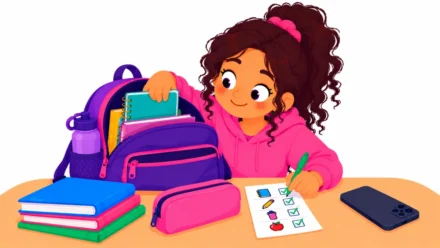
Clutter competes for attention. So, teach a simple routine: clear your workspace, use bins, folders, or color-coding, and put items back where they belong. Less clutter means fewer distractions and easier thinking.
First, set up the system with the student, not for them. Let them choose the folder color for each subject or the bin for supplies. Next, practice the routine at the same time each day, such as before lunch and at the end of the day.
Also, make the routine visible. A short picture list on the desk or inside the folder acts as one of the most practical executive function reminders, because it shows exactly what “organized” looks like.
Then, check the system briefly once a week. Empty the folder together, sort loose papers, and throw away what is not needed. A five-minute weekly reset prevents a full desk clean-out later.
| Item | Home |
|---|---|
| Unfinished work | Red folder |
| Finished work | Green folder |
| Pencils and erasers | Desk bin |
Worked example. Leo chooses a red folder for unfinished work and a green one for finished work. Every day before lunch, he spends two minutes putting papers in the right folder. After two weeks, his desk has no loose papers at the end of the day on 4 of 5 days.
5. Build self-check-ins, self-talk, and help-seeking
Next, teach students to monitor themselves. Three short questions work well: “What am I doing now? What do I need next? How much time do I have?” Self-monitoring boosts independence and problem-solving, because students stop waiting for an adult to notice.
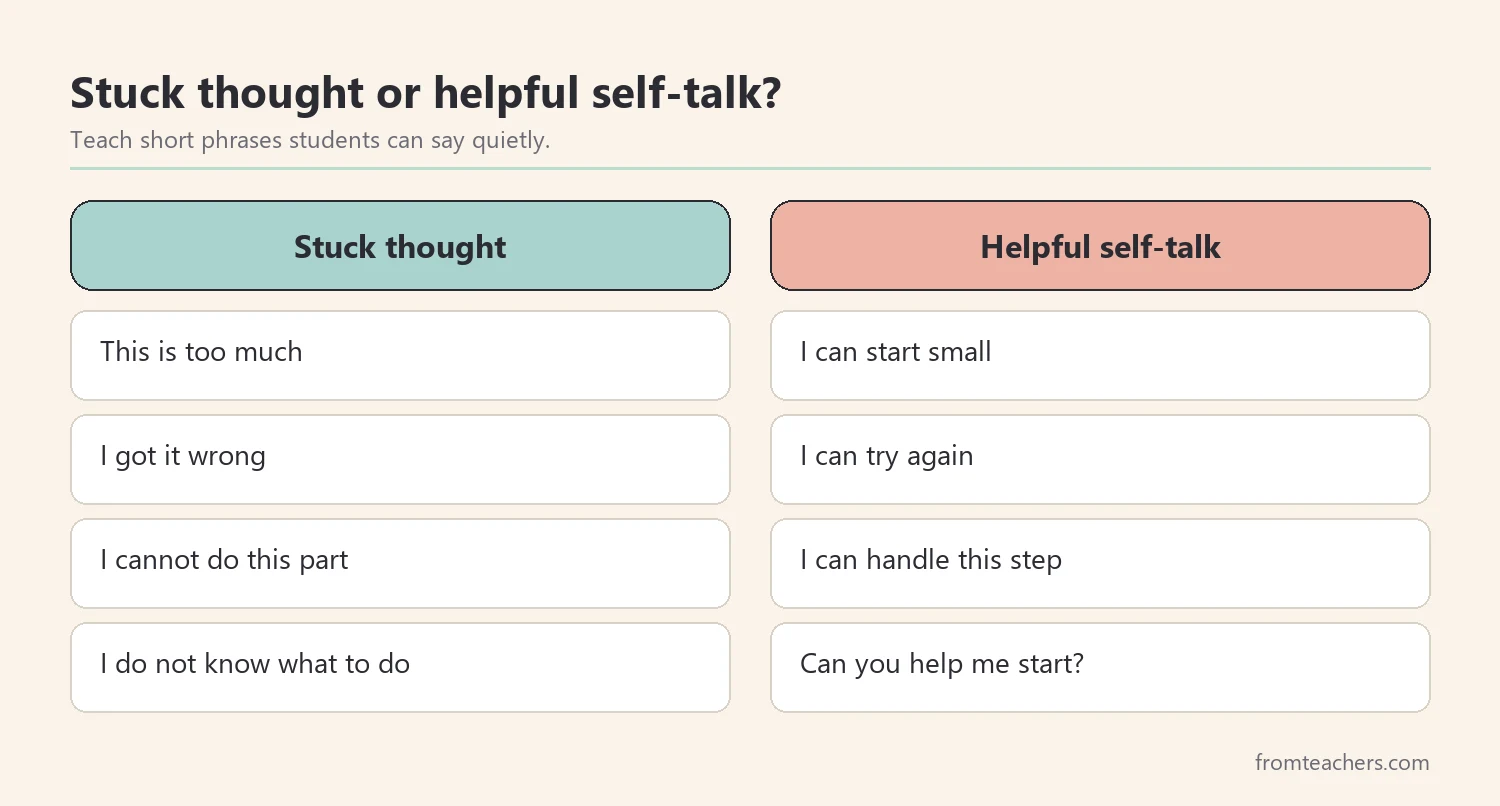
Also, teach positive self-talk. Phrases such as “I can start small,” “I can try again,” and “I can handle this step” keep motivation steady when work feels hard. Practice them out loud first, then encourage students to say them quietly.
In addition, teach students how to ask for help early. Give them exact words: “Can you help me start?” “Which step comes next?” “I’m stuck and need support.” A quick check-in can prevent frustration and shutdown, so asking should feel normal and safe.
Meanwhile, link these strategies to your executive function reminders on the wall. When a student looks stuck, point to the poster rather than giving the answer. This builds the habit of looking for a tool first.
Worked example. When Leo freezes on a reading question, Ms. Ortiz points to the check-in questions. Leo reads them, then says, “Which step comes next?” She answers briefly, and he continues on his own.
6. Review and fade the executive function reminders
Finally, check what is working. Keep a simple record for two or three weeks: Did the student start on time? Did they finish? Did they use a strategy without a prompt? This shows which executive function reminders help and which ones need changing.
Then, fade support step by step. Move from a verbal prompt to a gesture, from a gesture to a glance at the poster, and finally to no prompt at all. Fading too fast can cause setbacks, so move on only when the student is steady.
Also, remember that executive function skills take time to grow. The goal is progress, not perfection. Celebrate the strategies a student now uses alone, and add a new target only when the first ones feel easy.
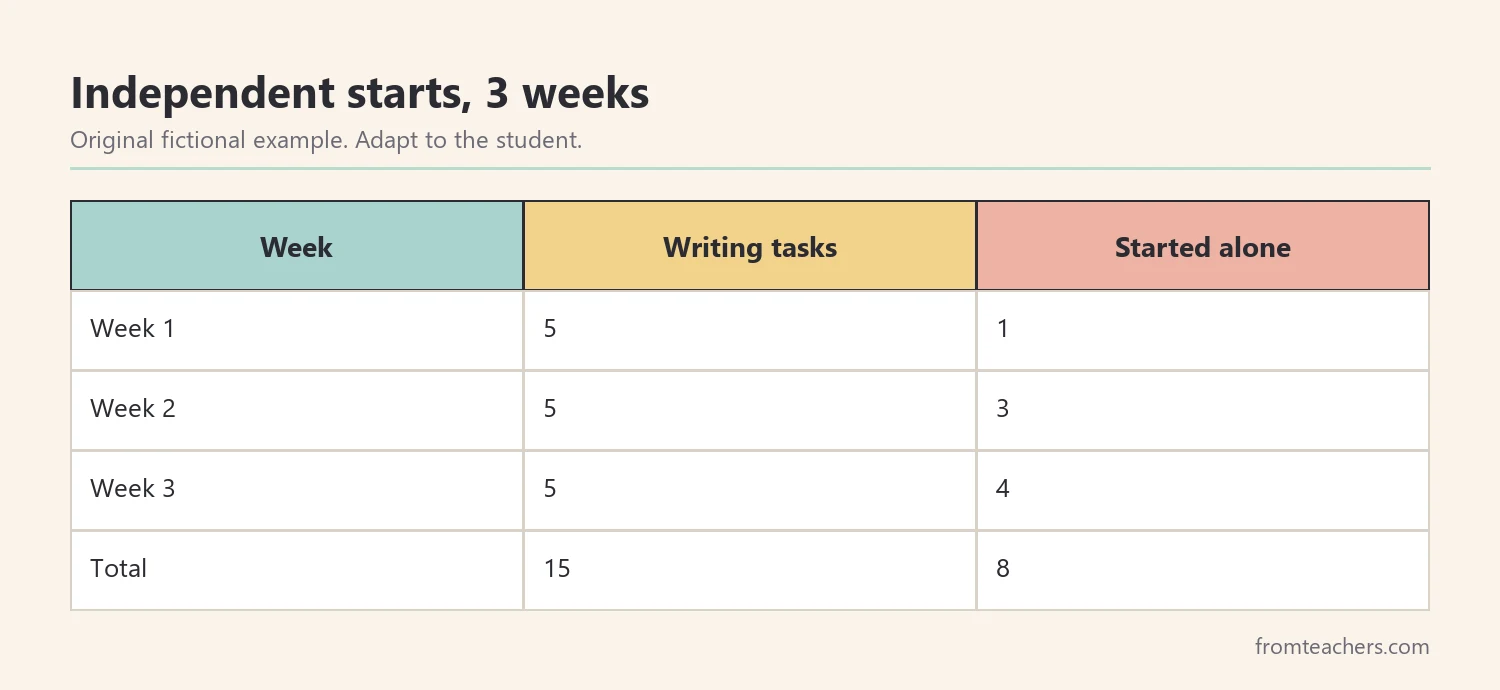
Worked example. Ms. Ortiz tracks 5 writing tasks each week. In week 1, Leo starts 1 of 5 on his own. In week 2, he starts 3 of 5. In week 3, he starts 4 of 5. Across the three weeks, that is 8 of 15 independent starts. She moves from verbal prompts to pointing at the poster.
Bringing the reminders home
Homework often brings the same struggles back. So, share the strategies with families in plain language. A short note that lists the two or three executive function reminders the student uses at school is usually enough.
Next, suggest one simple home routine. For example, the family can set a timer for a short homework block, keep a small checklist on the table, and store finished work in the same folder each night. Using the same words at home and school helps the habits stick.
Also, ask families what they notice. Parents often see patterns that teachers miss, such as a child who starts easily after a snack but not before. Those details can shape the next set of targets.
Finally, keep the tone positive. Families respond better to “Here is what is helping Leo” than to a list of problems. Shared executive function reminders then become a bridge between school and home rather than another task.
Common mistakes and how to avoid them
- Too many reminders at once. Students tune them out. Fix: start with two or three targets.
- Posting without teaching. A poster alone rarely changes habits. Fix: model, practice together, then let students try.
- Breaks with no end. Long breaks make restarting harder. Fix: keep breaks short and clear.
- Adults doing the organizing. The system stays the adult’s. Fix: build it with the student.
- Never fading prompts. Students rely on adults. Fix: track progress and step prompts down slowly.
Questions teachers and parents ask about executive function reminders
Who benefits from executive function reminders?
Many students do, including those with ADHD, learning differences, or simply a busy mind. Clear visual tools support the whole class. Students who need more help can also get personal versions on their desks.
Are these reminders only for students with ADHD?
No. Executive function skills develop over time in all children. Reminders help any student who struggles with planning, starting, or finishing, whether or not they have a diagnosis.
Can I use the same strategies at home?
Yes. Timers, checklists, and a clear homework space work well at home. Using the same words at school and home helps the student practice in both places.
How long before I see progress?
It varies by student. Track a few weeks of simple data, such as on-time starts. Small, steady changes are a good sign, even if the student still needs some prompts.
What if a strategy does not work?
Try it consistently for a week or two first. If there is still no change, swap it for another strategy that targets the same stage, and ask the student what feels hard.
Related reading: Effective ADHD Classroom Strategies to Support Student Success, ADHD in Children: A Guide to Effective Classroom and Home Support, and 5 Practical Teaching Tips to Boost Classroom Focus and Learning.
A companion resource for executive function reminders:
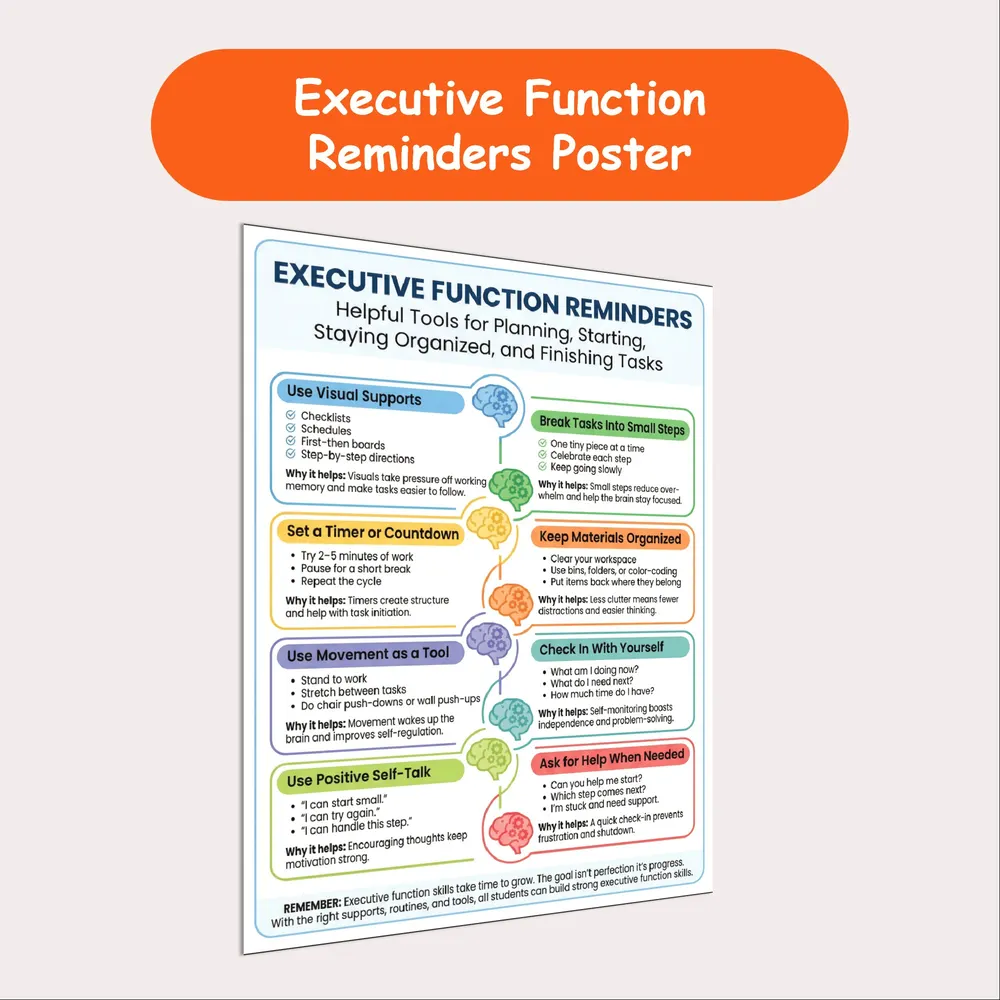
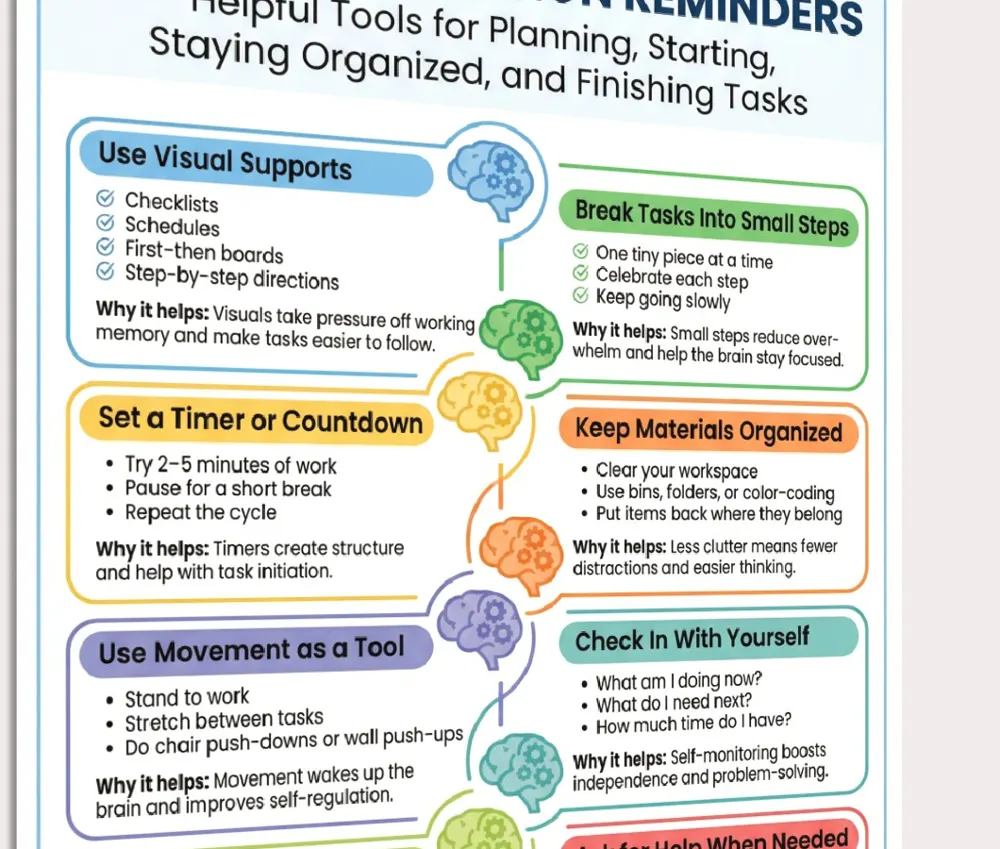
Executive Function Reminders Poster: a printable classroom poster with practical tools for planning, starting, staying organized, and finishing tasks. Every strategy includes a short “why it helps” note.
Sources and scope
- Center on the Developing Child, Harvard University: research-based explanations of executive function and how it develops.
- CHADD: a national organization with information on ADHD for families and educators.
- Understood.org: family-friendly guidance on learning and thinking differences, including executive function.
- IRIS Center, Vanderbilt University: free modules on classroom supports and evidence-based practices.
This guide covers practical classroom routines for planning, starting, organizing, and finishing tasks. It does not replace evaluation, diagnosis, or the decisions of a student’s support team.
Key takeaways
- Executive function reminders work best when they target where tasks break down.
- Visual supports and small steps reduce the load on memory.
- Short timers and planned movement make starting easier.
- Self-check-ins and early help-seeking build independence.
- Track a few weeks of data, then fade prompts slowly.


Leave a Comment