

Knowing what to do when frustrated is a skill children can learn, just like reading or math. Picture a third grader whose puzzle piece will not fit. Her face turns red, she shoves the box, and the pieces scatter across the floor. She is not trying to be difficult. In that moment, she simply does not know another way out of the feeling.
This guide shows you how to teach what to do when frustrated in six steps: spot the early signs, pause the body and name the feeling, use calming breaks and self-talk, ask for help, try again or switch strategies, and practice until the routine sticks. By the end, you will have a clear, calm plan you can use in class or at home.
Examples are fictional. Adapt to the student’s goals and agreed supports. This is guidance, not a diagnosis.
At a glance
- Frustration is normal. What matters is having tools to handle it.
- Teach the steps when the child is calm, not in the middle of a hard moment.
- Stopping and naming the feeling come before problem-solving.
- Give children exact words for self-talk and asking for help.
- Practice often, and expect progress to be gradual.
1. Spot the early signs before frustration grows
First, learn what frustration looks like for each child. Common early signs include tight muscles, fast breathing, clenched fists, a raised voice, or pushing work away. Many children show the same two or three signs every time.
Next, notice the situations that tend to trigger it. Hard tasks, waiting, losing a game, or a sudden change are frequent examples. Write down a few recent moments, including what happened just before. Patterns usually appear within a week or two.
Also, help the child notice their own signs. Use simple language: “When your hands get tight and your voice gets loud, that is frustration starting.” Children who can spot the early signs have more time to choose a strategy. That early warning is the first part of learning what to do when frustrated.
In addition, remember that teaching what to do when frustrated starts long before the hard moment. A calm conversation at the start of the day is far more effective than a lecture during a meltdown.
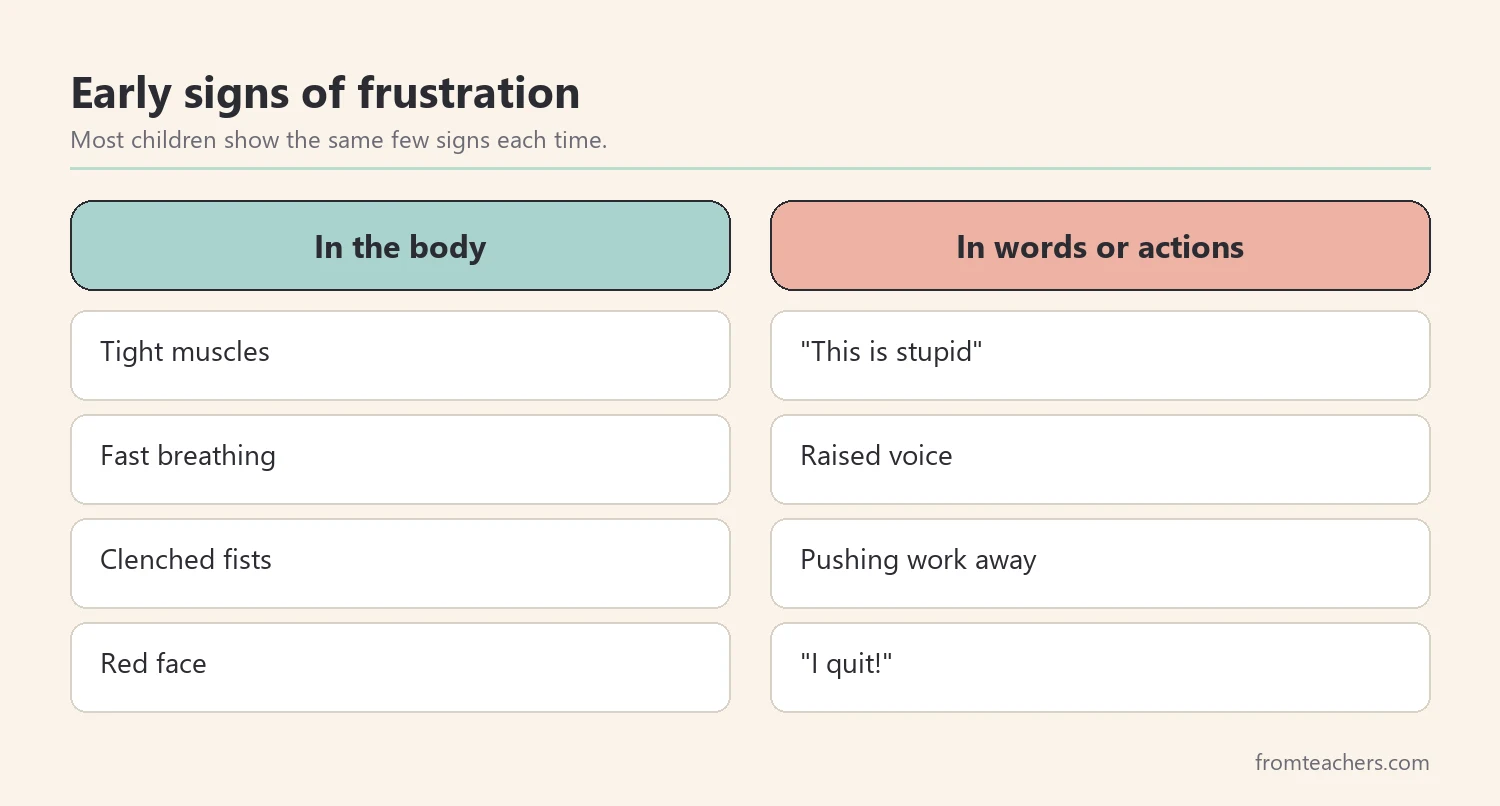
Worked example. Maya is a fictional student in grade 3. Her teacher, Mr. Banks, notices that Maya clenches her fists and says “This is stupid” just before she pushes her work away. It happens most during new math tasks. He decides to teach her a frustration routine during calm morning time.
2. Teach children to pause and notice the feeling
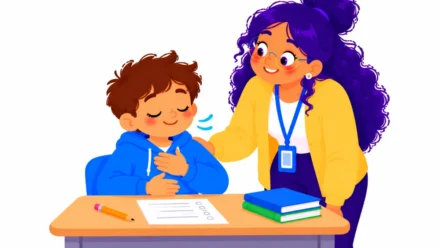
The first move in any plan for what to do when frustrated is to stop. Teach the child to pause the body: stop what they are doing, place hands in the lap or on the table, and take one slow breath. Stopping helps prevent frustration from growing.
Then, teach them to notice and name the feeling. The child can say “I am frustrated,” point to a feelings chart, or notice tight muscles and fast breathing. Naming the feeling helps the brain understand what is needed next.
Importantly, practice both steps when the child is calm. Role-play a small, safe problem, such as a pencil that keeps breaking. Model the pause yourself, say your feeling out loud, and then let the child try. Repetition makes the response automatic.
A ready-made visual makes this easier to remember. The frustration management poster with what-to-do steps for kids walks children through seven calm steps, and each step includes a short “why this helps” note.
Also, keep your own voice calm and low when you prompt. A quiet “Pause your body” works better than a loud “Calm down!” Children borrow calm from the adults around them.
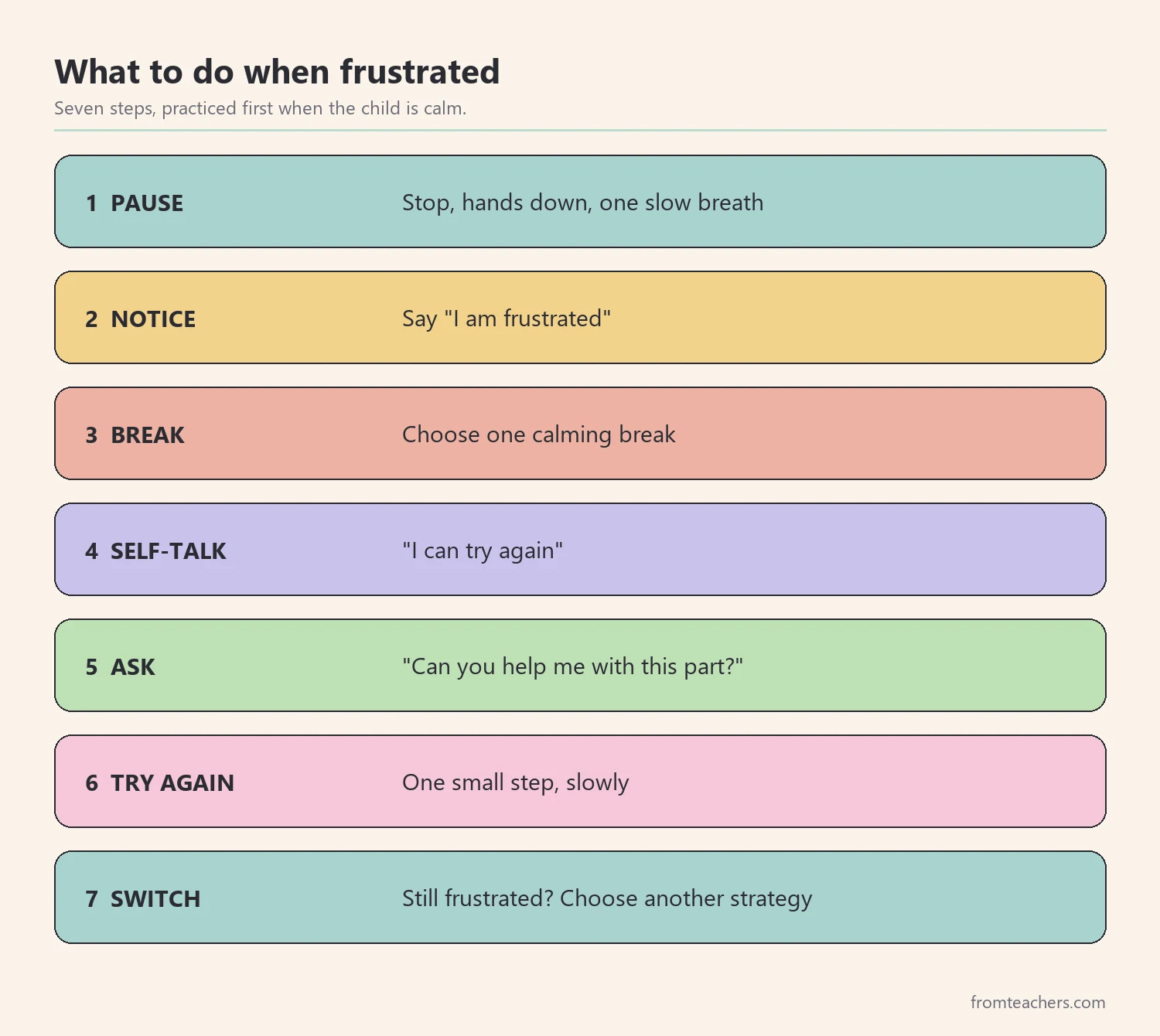
Worked example. Each morning for a week, Mr. Banks and Maya practice with a tricky jar lid. Maya pauses, puts her hands on the table, breathes once, and says, “I am frustrated.” By Friday she does it without a reminder during practice. Mr. Banks then adds the first two steps of what to do when frustrated to a small card on her desk.
3. Add calming breaks and self-talk to what to do when frustrated
Next, give the child a short list of calming choices. Options can include deep breaths, stretching or shaking out hands, counting slowly to 10, getting a drink of water, using a fidget, or sitting in a calm corner. A short break resets the body and helps the child think clearly again.
Then, let the child choose one or two favorites. Choice gives a sense of control, which frustrated children often feel they have lost. A personal list of what to do when frustrated feels more like the child’s own plan. Keep the options visible, so the child does not have to remember them in a hard moment.
Meanwhile, teach positive self-talk. Phrases such as “I can try again,” “It’s okay to make mistakes,” “I can do this one step at a time,” and “I just need a moment” replace negative thoughts. Practice the phrases out loud, then encourage the child to say them quietly.
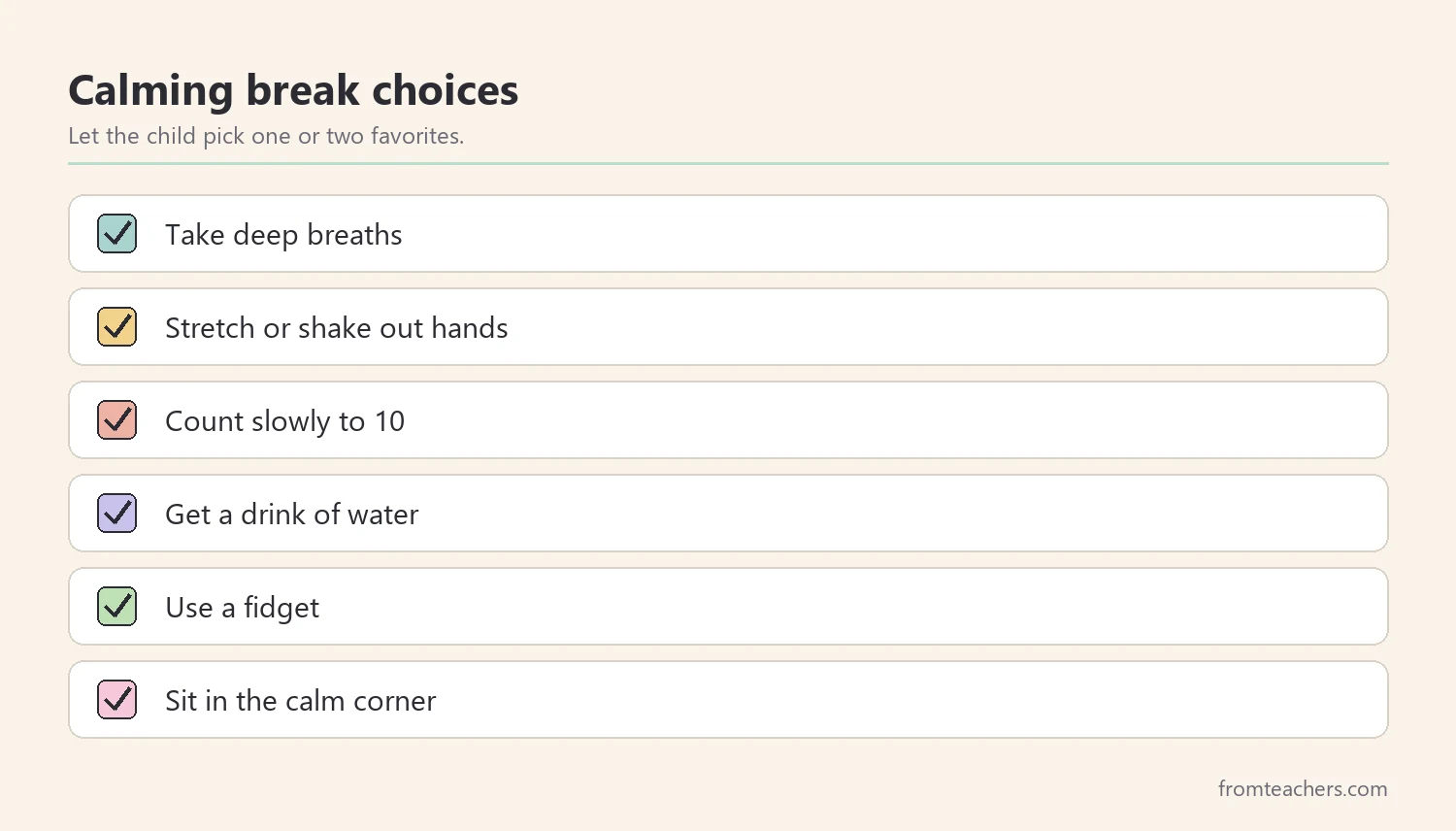
Also, set clear limits on the break. A calming break should be a few minutes, followed by a return to the task. Use a simple timer if needed. That way, a break is part of the plan for what to do when frustrated, not a way to escape work.
Worked example. Maya chooses two calming options: shaking out her hands and counting slowly to 10. She also picks one phrase: “I can do this one step at a time.” Mr. Banks writes all three on a small card for her desk.
4. Teach asking for help as part of what to do when frustrated
Sometimes the problem itself is the barrier. So, teach children that asking for help is a smart strategy, not a sign of failure. Asking for help is one of the most useful answers to the question of what to do when frustrated. A little guidance can remove the barrier that caused the frustration.
First, give exact words. “Can you help me with this part?” “I’m stuck. What should I do next?” “Can you show me one step?” Short, clear scripts are easier to use when emotions are high.
Next, agree on a signal for times when speaking feels hard. A hand raised with two fingers, a card placed on the desk, or a quiet tap on a help sign can all work. The child then knows they can get support without a big announcement.
In addition, respond quickly and calmly when the child asks. If help comes late or with a sigh, the child learns that asking does not work. A fast, kind response teaches that the steps for what to do when frustrated really pay off.
| Instead of | Try saying |
|---|---|
| Throwing the pencil | “Can you show me one step?” |
| “I quit!” | “I’m stuck. What should I do next?” |
| Crying silently | Placing the help card on the desk |
Worked example. Mr. Banks gives Maya a small help card. During a new math page, she places it on her desk instead of pushing the page away. He comes over, shows her one step, and she continues.
5. Try again slowly, or choose another strategy
After calming down, the child returns to the task. Teach them to try again slowly: do one small step, take their time, and celebrate progress. Moving slowly reduces mistakes and builds confidence.
However, sometimes the first strategy is not enough. Teach a backup plan: if you are still frustrated, choose another strategy. The child might switch to a different task for a while, use a sensory tool, take a longer break, or talk to a trusted adult. Different strategies work for different moments.
Also, make “try again” small and specific. “Do just the first problem” is easier than “finish the page.” Once the first step goes well, the next one feels possible.
In addition, write the backup options on the same card as the calming choices. When the plan for what to do when frustrated fits on one small card, the child can check it quickly without waiting for an adult.
Meanwhile, praise the process, not just the result. Say, “You paused, took a break, and came back. That was hard, and you did it.” Specific praise shows the child that learning what to do when frustrated is something to be proud of.
Worked example. After her counting break, Maya tries just the first math problem. It works. When the third problem frustrates her again, she uses her backup strategy and switches to her reading book for five minutes, then returns.
6. Practice what to do when frustrated and review progress
Finally, practice regularly. Short daily rehearsals, role-plays, and reminders at the start of hard tasks keep the routine fresh. Children often need many calm practice runs before they can use the steps in a real moment.
Next, track a few simple numbers for two or three weeks. Count the frustration moments and how many times the child used a step from the routine. This shows progress that is easy to miss day to day.
Also, share the routine with the family. When home and school use the same words for what to do when frustrated, children practice in more places and learn faster. A short note with the steps and the child’s favorite strategies is enough.
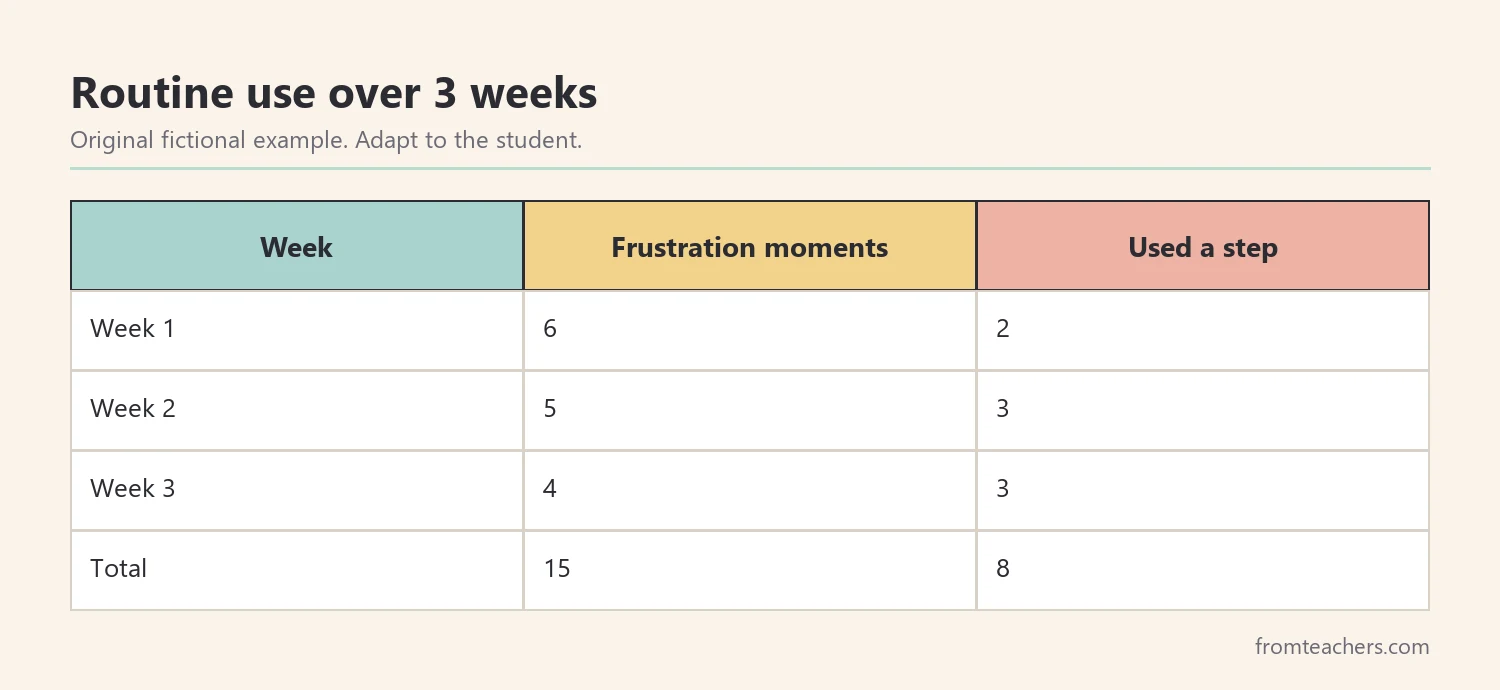
Then, adjust the plan. If a calming choice is never used, replace it. If frustration often appears at the same time of day, plan a check-in just before it.
Worked example. Mr. Banks records Maya’s frustration moments for three weeks. In week 1 there are 6, and she uses a step from the routine in 2. In week 2 there are 5, and she uses it in 3. In week 3 there are 4, and she uses it in 3. Across the three weeks, that is 8 of 15 moments.
Using the routine at home
Homework, siblings, and screen-time limits can all bring frustration at home. Parents can use the same steps: pause, name the feeling, take a calming break, use kind self-talk, ask for help, and try again. Keeping a copy of the steps on the fridge makes them easy to point to. A shared picture of what to do when frustrated also means the child hears the same calm message in both places.
Also, adults can model the routine out loud. “I am frustrated that the printer is jammed. I am going to take a slow breath and try again.” Children learn a lot by watching adults handle their own frustration calmly.
Common mistakes and how to avoid them
- Teaching during the meltdown. A child in distress cannot learn new skills. Fix: practice when calm.
- Too many choices. Long lists overwhelm. Fix: offer two or three calming options.
- Breaks with no return. The task never gets finished. Fix: keep breaks short and plan the return.
- Slow help. The child learns asking does not work. Fix: respond quickly and kindly.
- Only praising results. Effort goes unnoticed. Fix: praise each step the child used.
Questions teachers and parents ask about what to do when frustrated
At what age can children learn these steps?
Young children can start with simple steps, such as pausing and taking a breath. Older children can use the full routine, including self-talk and backup strategies. Adjust the words and the number of steps to the child’s age and language. Even preschoolers can start learning what to do when frustrated with one simple step.
Is frustration a bad thing?
No. Feeling frustrated is normal. What matters is having tools to calm the body, solve the problem, and keep moving forward.
What if the child refuses to use the steps?
Stay calm and keep practicing when things are quiet. Let the child choose their favorite strategies. Over time, steps they picked themselves are more likely to be used.
How long should a calming break last?
Usually a few minutes is enough. The goal is to reset, not to avoid the task. A visual timer can help the child know when to return.
When should I seek more support?
If frustration leads to frequent unsafe behavior, or does not improve with consistent practice, talk with the school team or a qualified professional. They can help look at the bigger picture.
Related reading: Meltdowns vs Tantrums: A Guide to Understanding and Responding, Moving Beyond Shame and Behavior Charts: Positive Alternatives for Effective Classroom Management, and Managing Sensory Overload: Practical Strategies for Autism and ADHD.
A companion resource for what to do when frustrated:
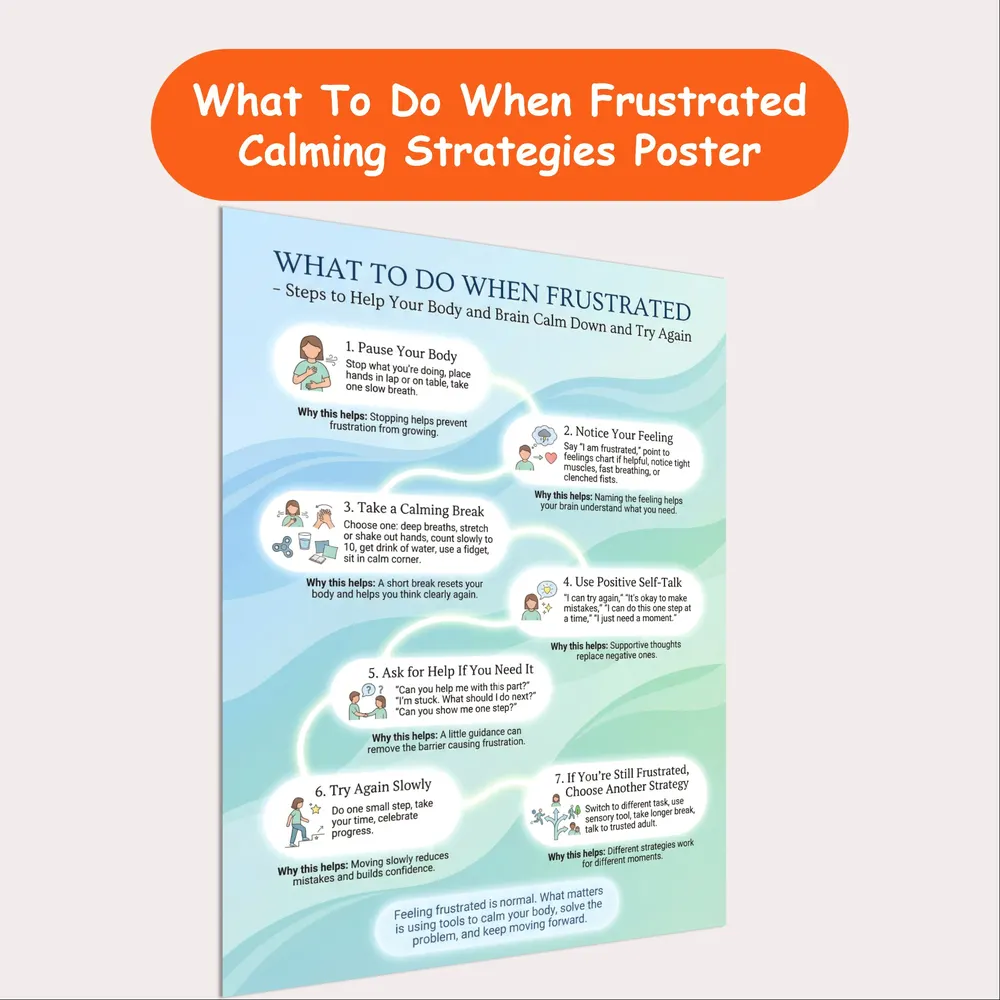
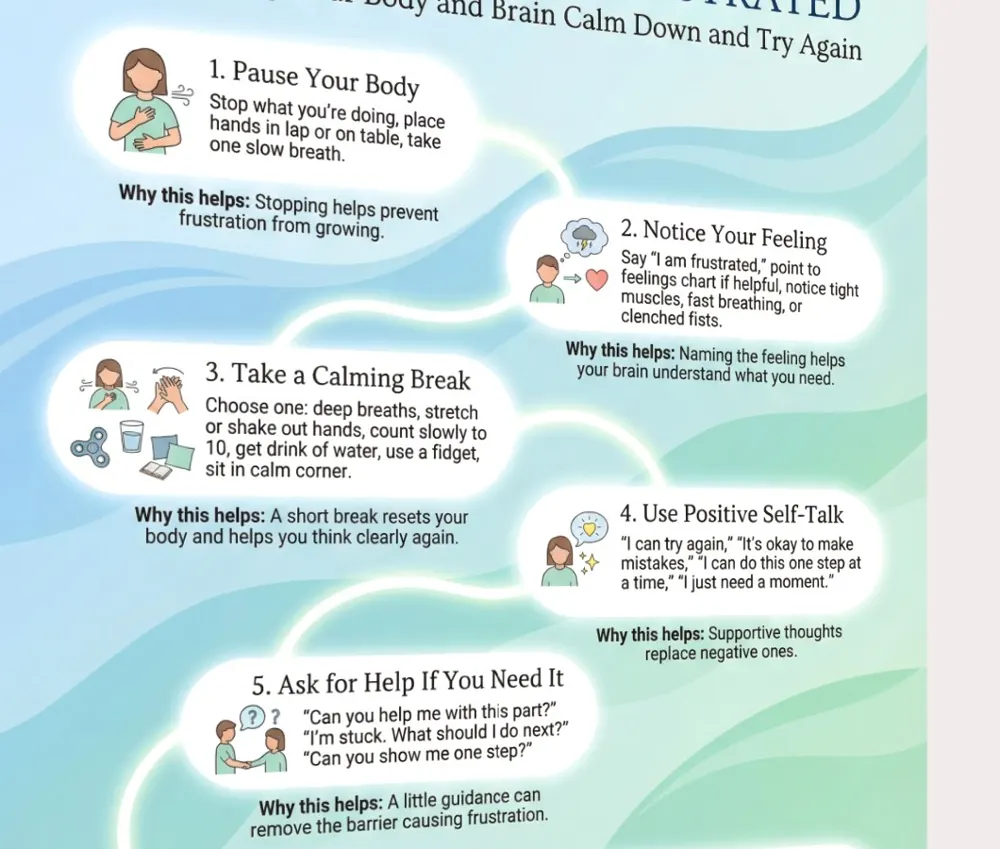
Frustration Management Poster: a printable poster that walks students through seven calm, clear steps for what to do when frustrated. Each step includes a short “why this helps” note.
Sources and scope
- CASEL: a leading organization for social and emotional learning, including self-management skills.
- Understood.org: family-friendly information on emotions, learning, and thinking differences.
- HealthyChildren.org, American Academy of Pediatrics: parenting information on child development and emotions.
- IRIS Center, Vanderbilt University: free modules on behavior and classroom supports.
This guide covers teaching everyday coping steps for frustration at school and home. It does not replace mental health assessment, diagnosis, or professional treatment.
Key takeaways
- Teach what to do when frustrated during calm times.
- Pause the body and name the feeling first.
- Offer a few calming choices and simple self-talk phrases.
- Make asking for help quick, easy, and safe.
- Track progress and share the routine with families.







Leave a Comment