
Focus activities for kids work best when they treat attention as a skill to build, not a trait some children simply lack. Picture a third grader who starts a reading page, looks at the window, sharpens a pencil twice, and then asks to get water. Ten minutes later, he has read two lines, and both he and his teacher feel frustrated.
This guide shows you how to change that pattern step by step. You will learn how to see when attention drops, set up a calmer space, use short activities and chunked work, add movement on purpose, and build daily habits you can track. By the end, you will have a small, practical plan for home or class.
Examples are fictional. Adapt to the child’s goals and agreed supports. This is guidance, not a diagnosis.
At a glance
- Watch when and where attention drops before choosing strategies.
- Reduce distractions in the space before asking the child to try harder.
- Use short, game-like activities and chunked work with clear finish lines.
- Plan movement and sensory breaks so they do not happen by accident.
- Build small daily habits and track one simple measure.
1. Find out when attention drops before choosing focus activities for kids
Before you pick any activity, notice the pattern. Attention is not the same all day. Most children focus better at some times, in some places, and on some tasks than others. Therefore, the first step is to watch, not to fix.
For a week, jot down a quick note whenever focus slips. Write the time, the task, where the child was sitting, and what happened just before. Keep each note to one line. In addition, note the moments when the child focused well, because those are just as useful. Good moments show which focus activities for kids already work, even if nobody planned them.
Meet Sam, a fictional third grader. His teacher’s notes showed that Sam focused well during hands-on science and short math games. However, he struggled during long independent reading after lunch, especially when he sat near the classroom door. He usually lasted about five minutes before drifting.
That pattern gave the team a clear starting point. Sam did not need a long list of focus activities for kids. Instead, he needed help with one specific moment: independent reading after lunch, near a busy door.
Also, remember that every brain works differently. Some children with ADHD, anxiety, or learning differences need more support with attention. Others are simply tired, hungry, or bored. If attention concerns are strong or persistent, talk with the family and the school team, who can decide whether further evaluation makes sense.
2. Set up a focus-friendly space
Changing the environment is often the fastest win. It asks nothing extra of the child, and it reduces the number of distractions competing for their attention. As a result, the child can spend more energy on the task itself.
Start with the basics. Where does the child sit? What can they see and hear? What is on the desk? Small changes can make a big difference:
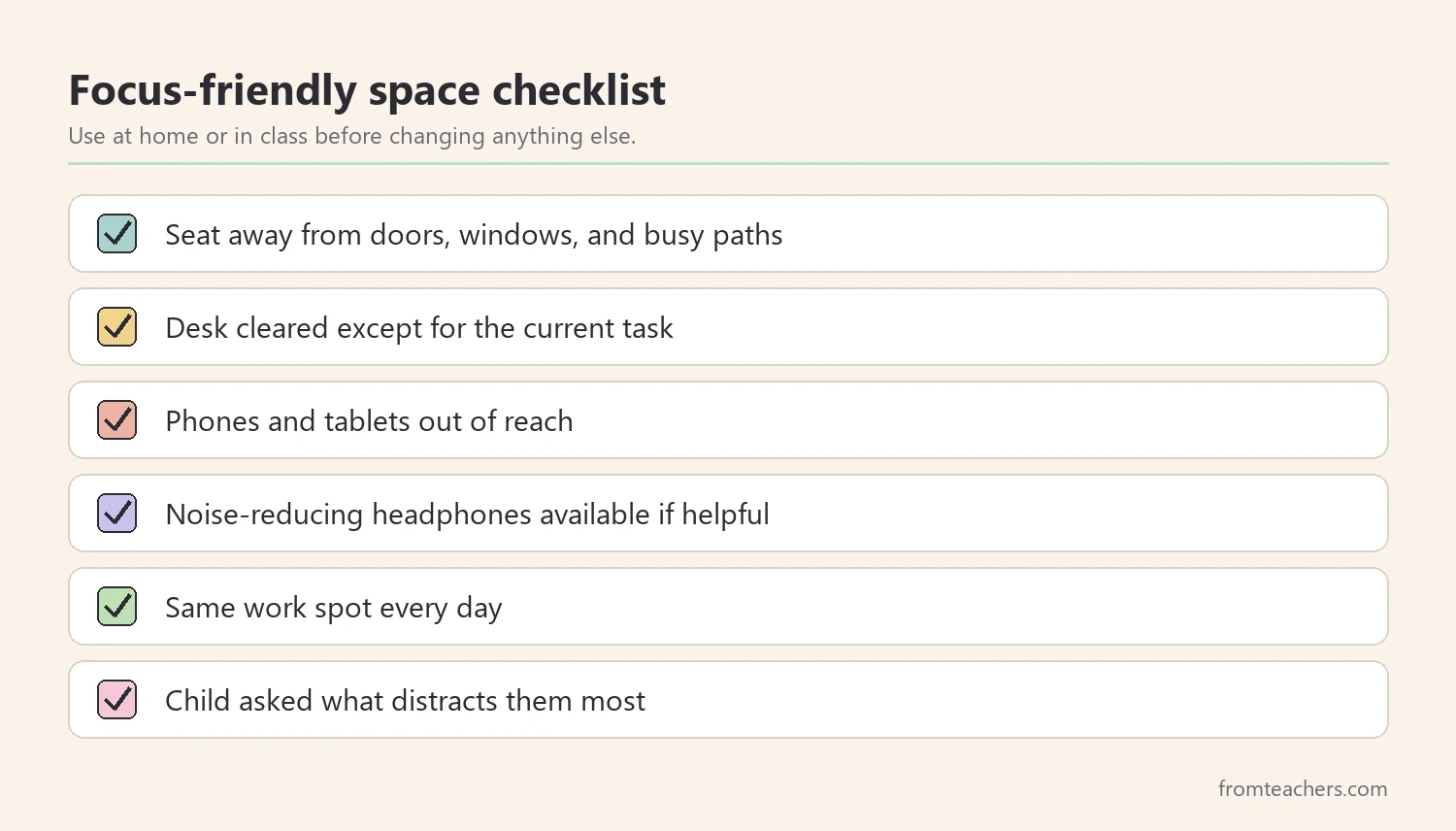
For Sam, the teacher moved his seat away from the door and closer to her desk. She cleared his desk except for the book and a bookmark. During reading, she offered a pair of noise-reducing headphones, which Sam chose to use most days.
At home, the same ideas apply. A consistent homework spot, a cleared table, and a phone or tablet out of reach help many children settle faster. Notably, the space does not need to be silent or perfect. It just needs fewer things pulling attention away.
Similarly, check the basics that affect attention for everyone: sleep, a snack, and water. A hungry or tired child will struggle no matter how good the setup is, so these simple checks come before any focus activities for kids.
Finally, involve the child. Ask, “What makes it hard to focus here?” Children often know exactly what distracts them, such as a noisy fan or a sibling’s video. Their answers make the setup more likely to work.
3. Use short focus activities for kids and chunked work
Attention grows with practice, and practice is easier when it feels like a game. Short focus activities for kids give children a chance to practice paying attention in a low-pressure way. Then you can carry that same skill into schoolwork by breaking tasks into chunks.
Try one or two of these for a few minutes a day:
| Activity | How it works | Skill practiced |
|---|---|---|
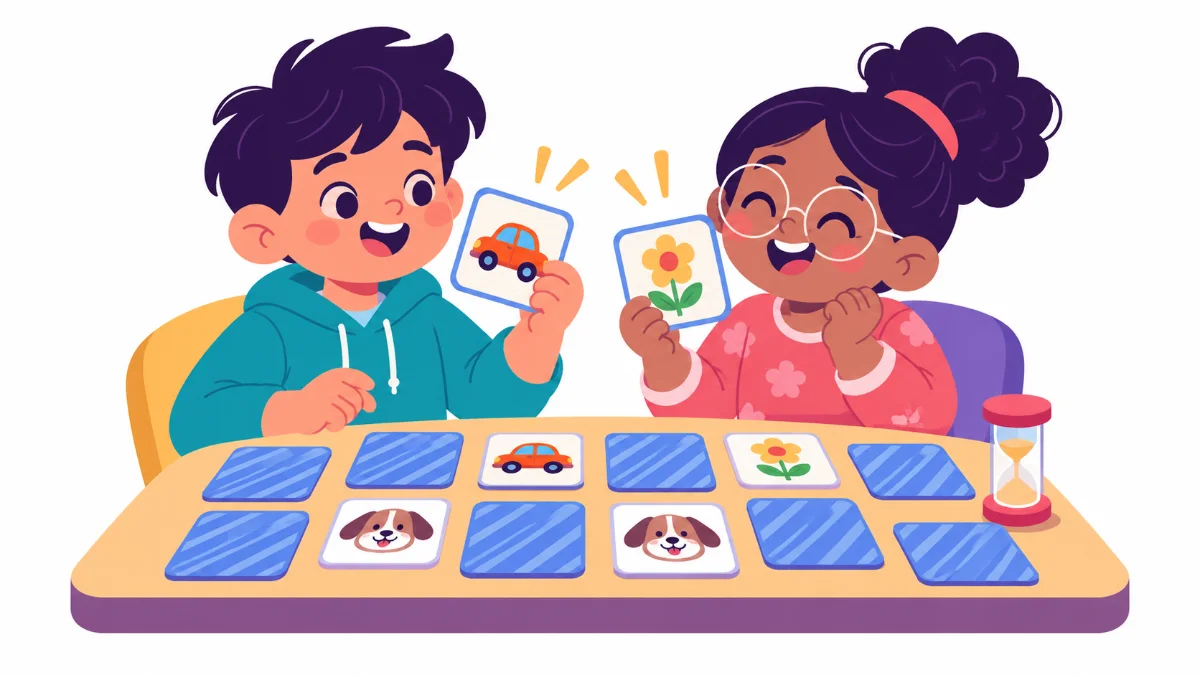
| Memory match | Turn over cards to find pairs | Holding information in mind |
| Simon says | Follow only commands that start with “Simon says” | Listening and self-control |
| Spot the difference | Find changes between two pictures | Visual attention to detail |
| Listening walk | Walk quietly and name every sound you hear | Sustained listening |
Keep these games short, about three to five minutes. Stop while the child is still having fun, so they want to play again. Over time, you can make the games slightly longer or harder.
In addition, choose focus activities for kids that match the attention the real task needs. For instance, a child who struggles to follow spoken directions may benefit most from Simon says, while a child who skips details on worksheets may get more from spot the difference. Matching the game to the challenge makes practice more useful.
For Sam, the team chose memory match and the listening walk. He played memory match for three minutes before reading, and the class took a short listening walk on Fridays. Both quickly became favorite focus activities for kids in his room.
Next, apply the same idea to real work. Long tasks feel endless to a child who struggles with attention. Breaking them into small chunks, each with a clear finish line, makes the work feel possible.
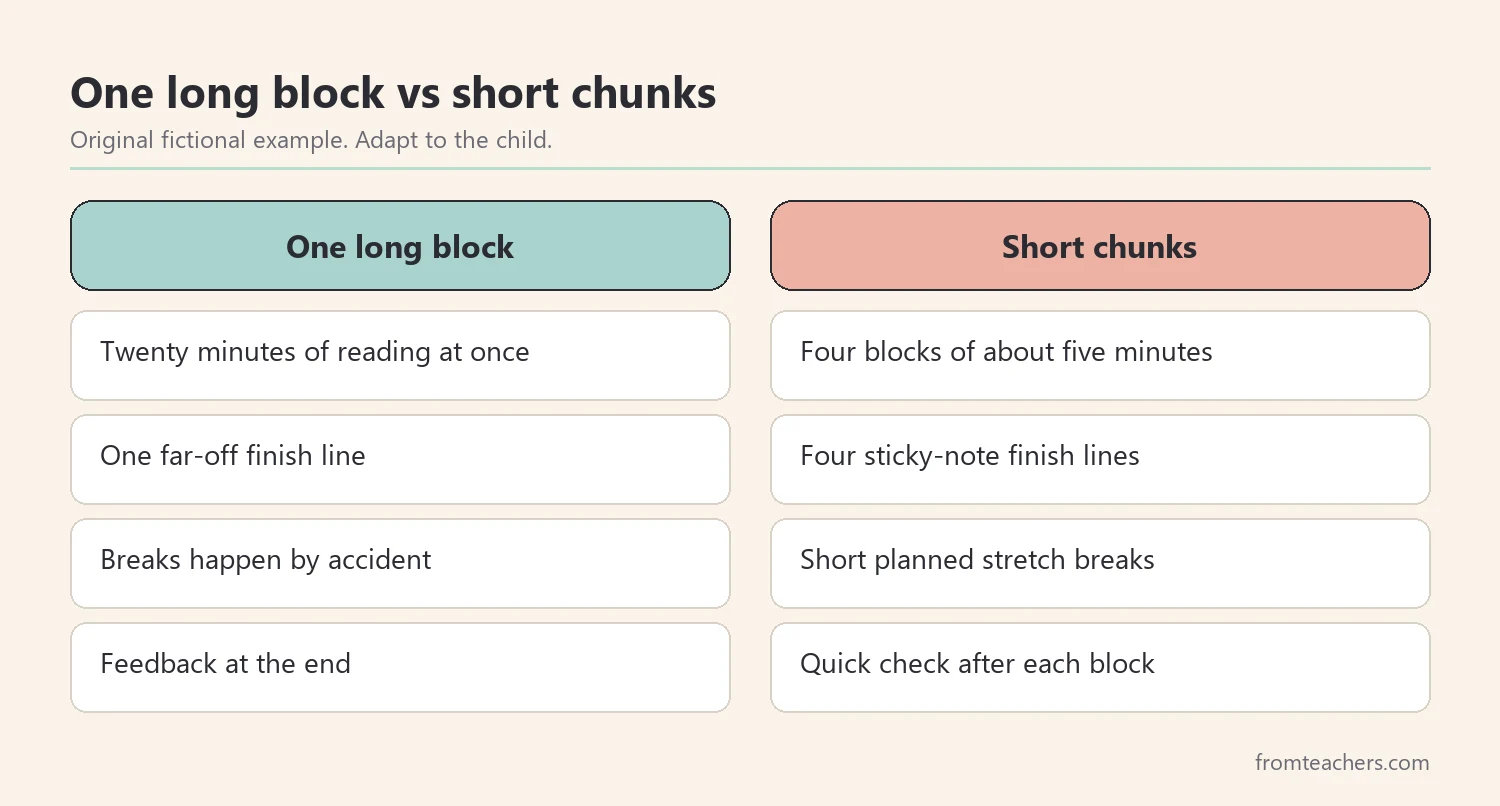
For Sam, the teacher split twenty minutes of reading into four short blocks of about five minutes each. After each block, Sam put a sticky note on the page to mark his progress. This small change gave him four finish lines instead of one far-off goal.
If you want ready-made ideas, this focus and attention activities guide for kids is organized into modules on attention, the focus environment, time and chunking, movement and sensory needs, organization, motivation, and daily habits.
4. Add movement and sensory breaks to focus activities for kids
Many children focus better after they move. Movement can help reset attention, and for some children, small sensory input helps them stay settled. So plan movement on purpose, rather than waiting for it to happen at the wrong moment.
Build short breaks between work chunks. A break might be two minutes of stretching, a walk to deliver a note, wall push-ups, or a quick song with actions. Keep the break short and the return clear. For example, use a timer and a simple cue, such as “Break is over, back to block two.”
Some children also focus better with a quiet fidget, a wobble cushion, or the option to stand. These tools should help the child work, not distract the class. Therefore, set simple rules together, such as “The fidget stays in your hand and stays quiet.”
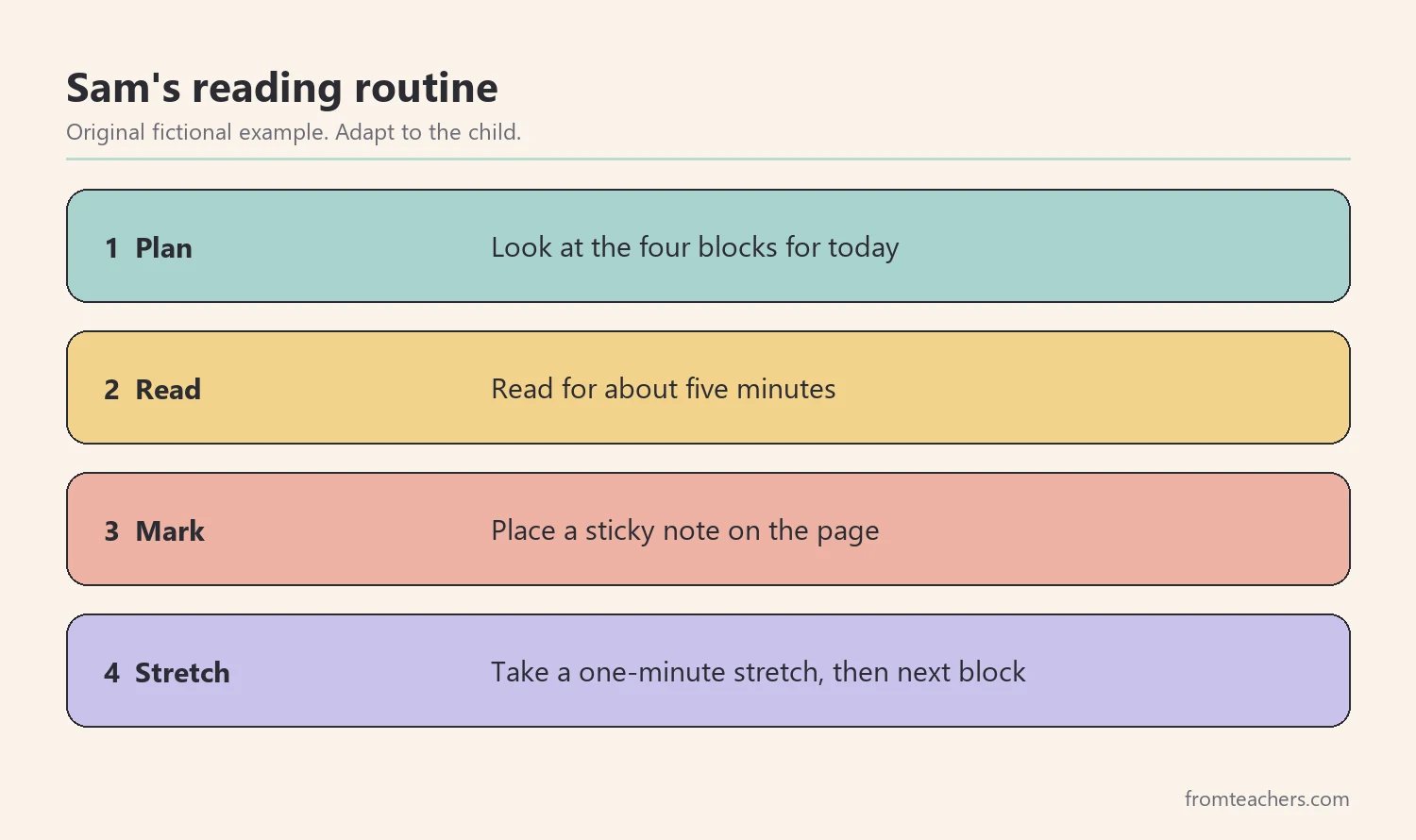
Sam’s routine combined chunked reading and movement. He read for about five minutes, placed his sticky note, took a one-minute stretch break, and then started the next block. Because the breaks were planned, he no longer needed to invent reasons to leave his seat.
In addition, think about the whole day. Recess, physical education, and active play at home all support attention. Taking away recess as a consequence can backfire for children who need movement most. Instead, these movement-based focus activities for kids work best as a regular part of the day, not a reward to be earned.
5. Build daily habits and track progress
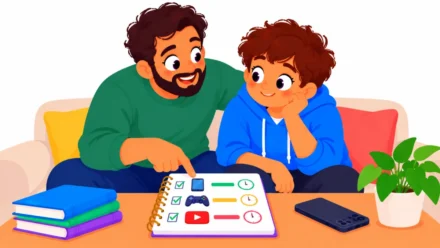
Finally, turn what works into habits. Habits reduce the number of decisions a child must make, and fewer decisions leave more energy for focus. Choose two or three simple routines and keep them the same every day.
Consistency matters more than variety here. A few familiar focus activities for kids, repeated daily, usually help more than a new game every week. Helpful habits include a short planning moment before work (“What are my three steps?”), a consistent start signal, and a quick check at the end (“What did I finish?”). Also, praise effort and strategy, not just results: “You used your sticky notes and finished all four blocks.”
Then track one or two measures. Keep it simple enough to fill in within a minute. Sam’s teacher tracked how many of the four reading blocks he finished each day, and how many reminders he needed. Here is his weekly average over four weeks:
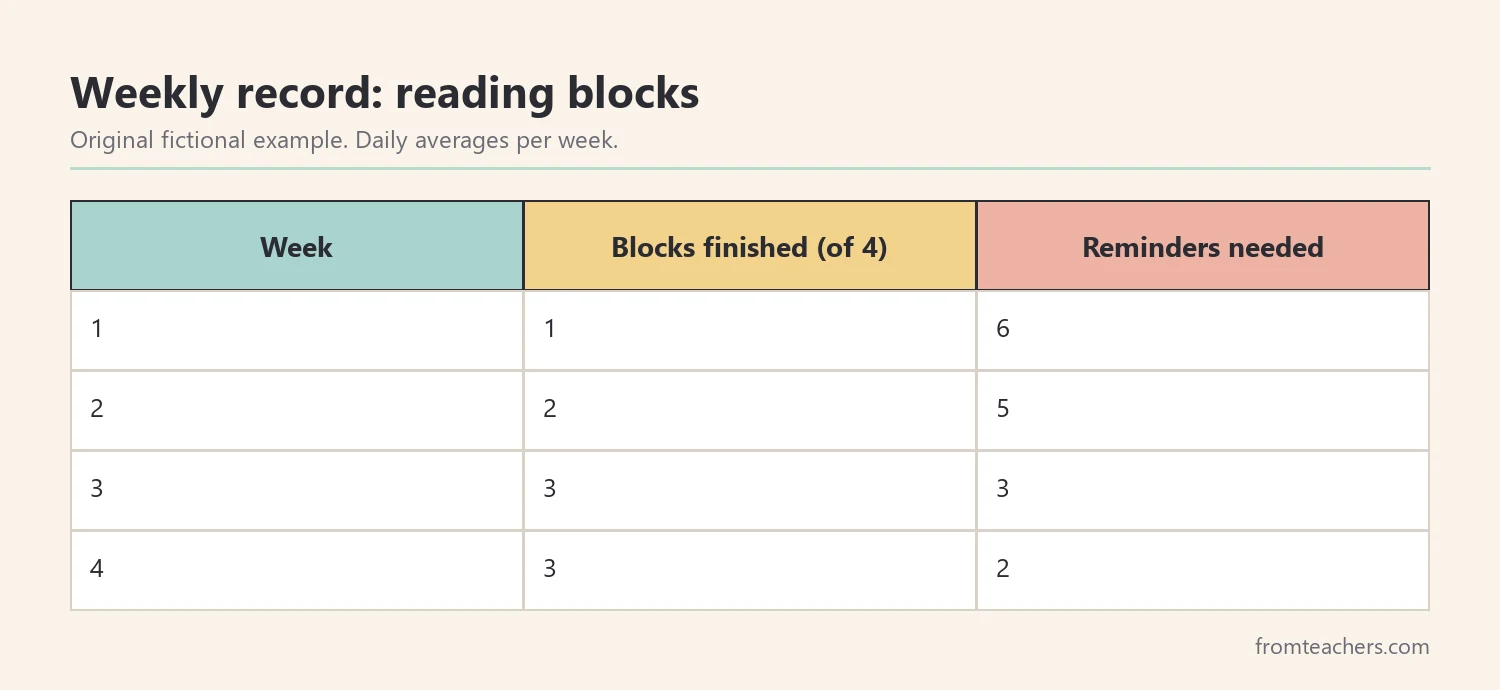
In week 1, Sam finished about 1 of 4 blocks a day and needed about 6 reminders. By week 4, he finished about 3 of 4 blocks and needed about 2 reminders. He was not perfect, but he was clearly building the skill, and the record showed it. Sharing the record with Sam also mattered, because he could see his own progress and felt proud of it. Children who can see their growth are often more willing to keep trying.
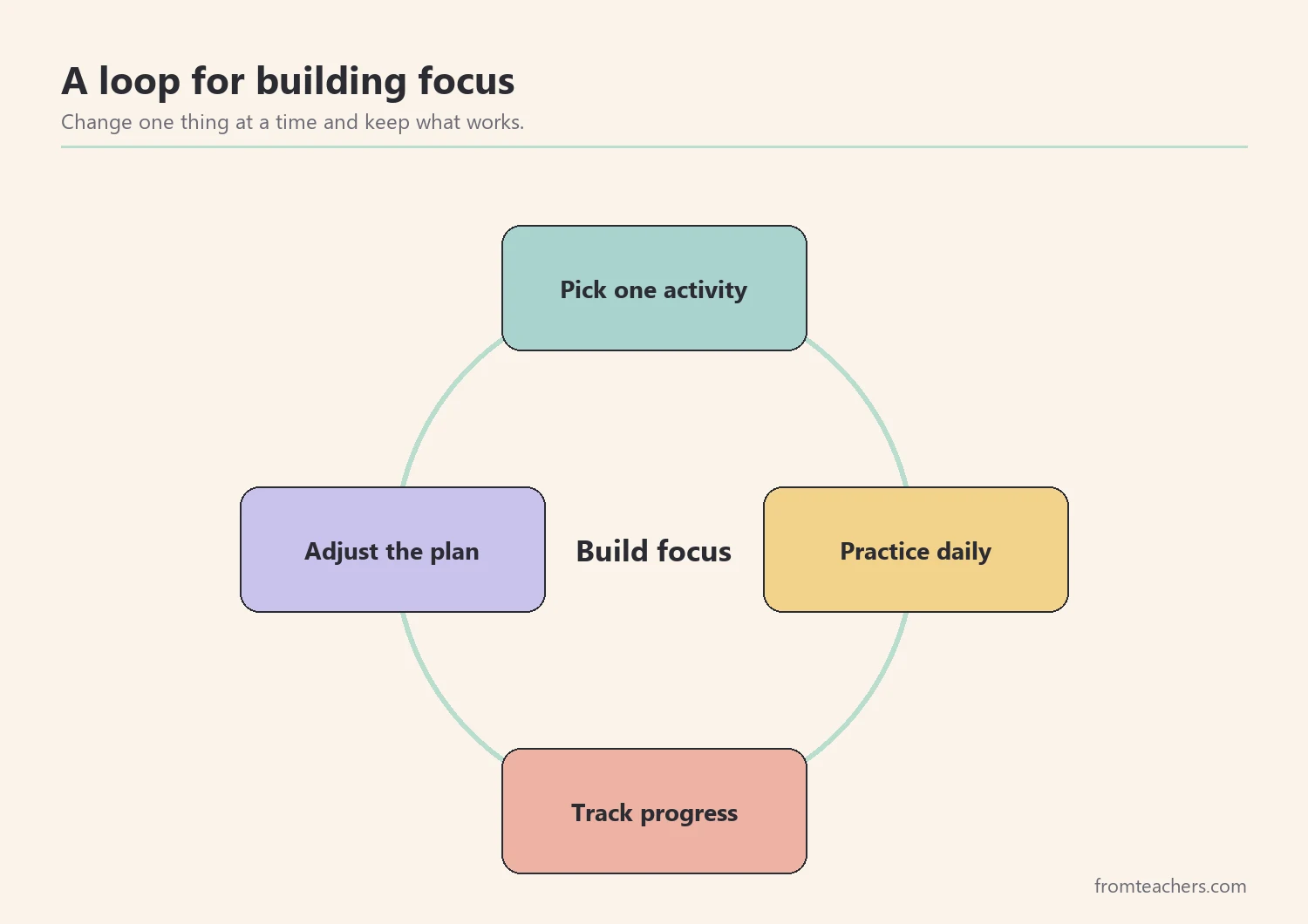
Review the record with the family every few weeks. Decide what to keep, what to change, and which one new idea to try. Over time, you can lengthen work blocks, fade reminders, and let the child choose their own focus activities for kids.
Common mistakes and how to avoid them
- Telling the child to “pay attention.” Fix: teach a specific strategy, such as chunking or a planning question.
- Making activities too long. Fix: start with three to five minutes and stop while it is still fun.
- Ignoring the environment. Fix: change the seat, clear the desk, and reduce noise first.
- Using movement only as a reward. Fix: plan movement breaks into the routine.
- Changing too much at once. Fix: try one change, track it, then add the next.
- Focusing only on what goes wrong. Fix: praise effort and the strategies the child uses.
Questions teachers and parents ask about focus activities for kids
How long should focus activities for kids last?
Start with about three to five minutes. Short, successful practice builds confidence. Gradually lengthen the activities as the child’s attention grows.
Do these activities help children with ADHD?
Many children with ADHD benefit from structured activities, a calmer environment, chunked work, and planned movement. However, these strategies are not a treatment for ADHD. Families should work with their child’s doctor and school team for evaluation and care decisions.
Can I use these activities at home?
Yes. Games like memory match, Simon says, and a listening walk work well at home. A consistent homework spot and short work blocks also help.
What if the child refuses the activities?
Offer choices, keep the activities short, and make them playful. Some children respond better when they can teach the game to someone else. If refusal continues, look for the reason, such as fatigue, frustration, or a task that feels too hard.
How do I know if the plan is working?
Track one simple measure, such as tasks finished or reminders needed. Look for gradual change over several weeks. Small improvements are a good sign, even if focus is not perfect. If nothing changes after several weeks of consistent focus activities for kids, talk with the school team about next steps.
Related reading: 5 Practical Teaching Tips to Boost Classroom Focus and Learning, Effective ADHD Classroom Strategies to Support Student Success, and ADHD in Children: A Guide to Effective Classroom and Home Support.
A companion resource for focus activities for kids:
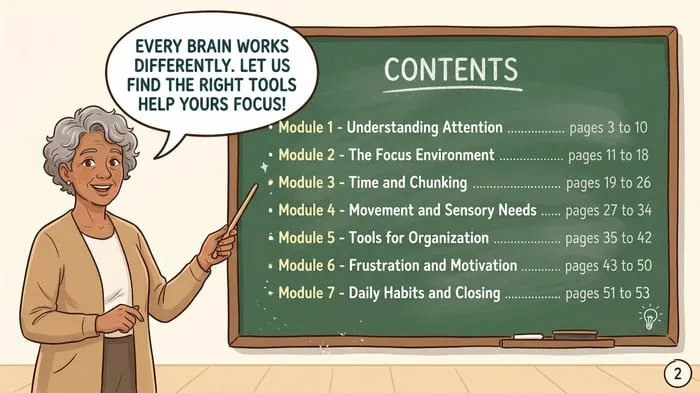
Focus and Attention: Activities to Help Kids Stay on Task: a 53-page guide in 7 modules covering attention, the focus environment, time and chunking, movement and sensory needs, organization tools, frustration and motivation, and daily habits.
Sources and scope
- CDC ADHD information: general background on ADHD in children, including school and home support.
- Understood.org: practical articles for families and teachers on attention and learning differences.
- CHADD: information and support for families and educators of children with ADHD.
- IRIS Center, Vanderbilt University: free modules on classroom environment, behavior, and evidence-based practices.
This guide covers everyday activities and routines that support attention at home and in class. It does not cover diagnosis, medication, or formal evaluation, which belong to qualified professionals and the child’s team.
Key takeaways
- Notice when and where attention drops before choosing strategies.
- Make the space calmer before asking the child to try harder.
- Use short, playful focus activities for kids and break work into chunks.
- Plan movement and sensory breaks as part of the routine.
- Build simple daily habits, track one measure, and review together.




Leave a Comment