

An AAC communication plan is often the difference between a device that sits in a backpack and a device that a student actually uses all day. Picture Maya, a second grader who uses a speech-generating app on a tablet. In speech therapy she requests, comments, and says “my turn” with ease. Back in class, however, the tablet stays closed during morning meeting, and at lunch nobody remembers to bring it.
This guide shows you how to fix that gap with a short, shared plan. You will learn how to set clear objectives with the team, map communication chances across the day, pick target words for each activity, teach through modeling, and track progress with a simple rating. By the end, you will have a one-page AAC communication plan that any adult can follow.
Examples are fictional. Adapt to the student’s goals and agreed supports. This is guidance, not a diagnosis.
At a glance
- A written plan protects communication time when the school day gets busy.
- Write two or three objectives in plain language that every adult understands.
- Schedule real communication chances in daily activities, not only in therapy.
- Model target words on the device yourself before you expect the student to use them.
- Track a few numbers and a comfort rating, then review with the family.
1. Set the objectives of the AAC communication plan
First, bring the right people together. The core team usually includes the classroom teacher, the speech-language pathologist, any paraprofessional who works with the student, and the family. When possible, include the student too, because their preferences matter.
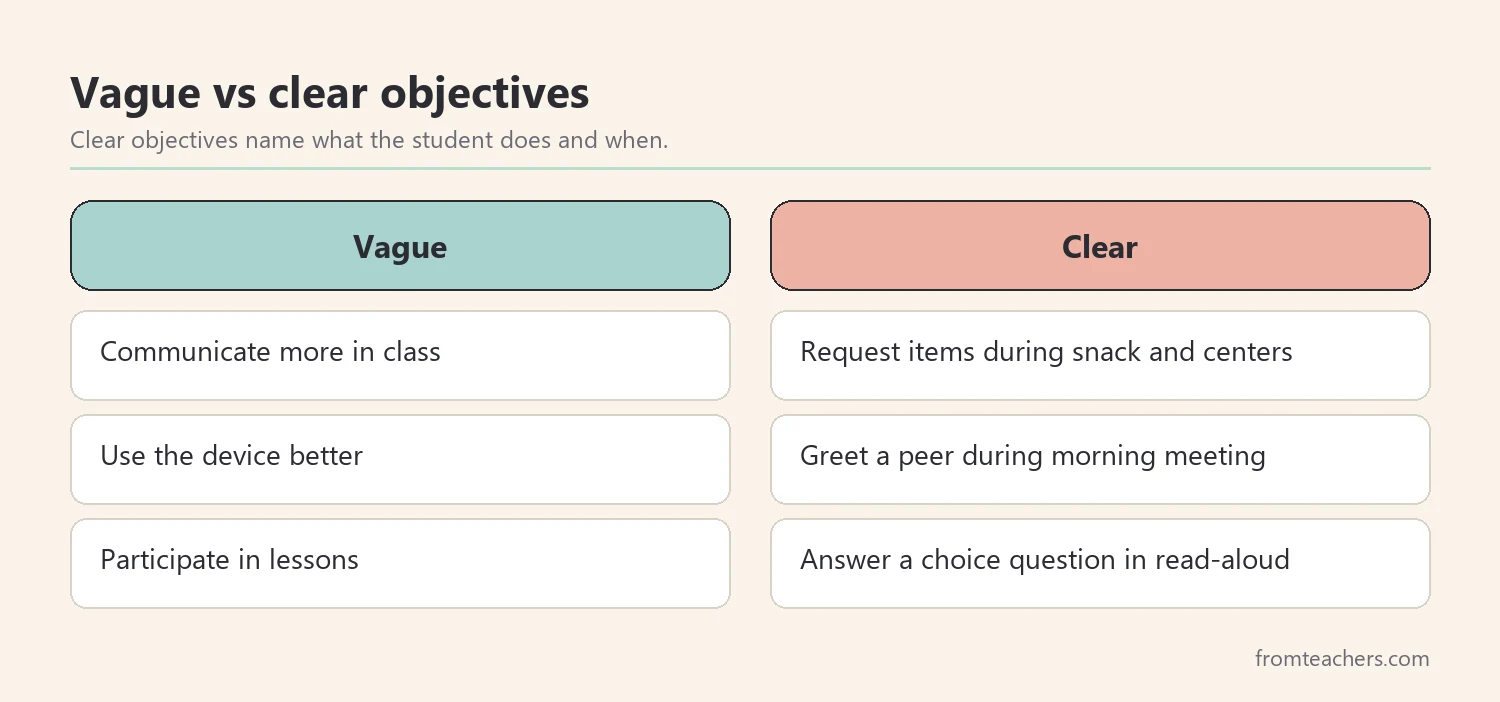
Next, agree on two or three objectives. Keep them short and observable, so a substitute could read them and know what success looks like. Avoid vague phrases like “improve communication.” Instead, name what the student will do and when.
| Vague objective | Clear objective |
|---|---|
| Communicate more in class | Request items during snack and centers |
| Use the device better | Greet a peer during morning meeting |
| Participate in lessons | Answer a choice question in read-aloud |
Also, connect your objectives to the student’s IEP goals. The AAC communication plan does not replace the IEP. Rather, it turns IEP goals into daily actions that every adult can carry out.
For example, Maya’s team chose three objectives: request items at snack, greet a peer at morning meeting, and answer choice questions during read-aloud. Her SLP wrote them at the top of her AAC communication plan in plain language. As a result, her paraprofessional and her teacher could explain the goals in one sentence each.
Before you move on, check each objective with one question: could a new adult see this happen in a single school day? If not, make it smaller. In practice, a good AAC communication plan starts small and grows as the student succeeds.
2. Map daily activities in the AAC communication plan
Then, look at the student’s schedule and find natural chances to communicate. Many AAC users have a device but few real opportunities to use it. A written map turns those chances from accidental into planned.
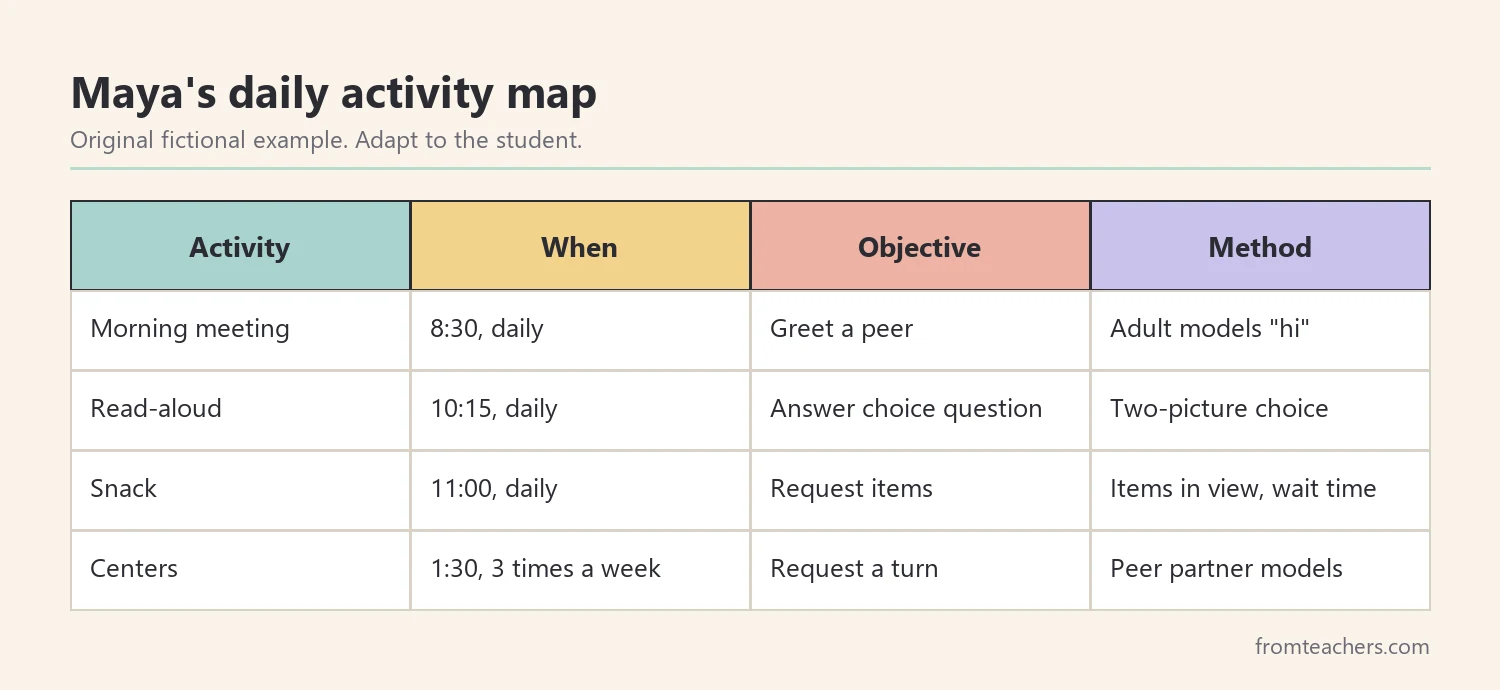
For each activity, note when it happens, how often, what the objective is, and the method of support. For instance, the method could be adult modeling, a peer partner, or a visual prompt on the table. Start with three or four activities you can run every day, not ten you will forget.
| Activity | When | Objective | Method |
|---|---|---|---|
| Morning meeting | 8:30, daily | Greet a peer | Adult models “hi” |
| Read-aloud | 10:15, daily | Answer choice question | Two-picture choice on device |
| Snack | 11:00, daily | Request items | Items in view, wait time |
| Centers | 1:30, three times a week | Request a turn | Peer partner models |
In addition, decide where the device lives during each activity. A device that is across the room is not available. A simple rule such as “the device stays within reach at all times” belongs in every AAC communication plan.
For Maya, her team mapped four activities, matching the table above. Her teacher also taped a small copy of the schedule inside the tablet case. Consequently, a substitute on Friday knew exactly when Maya would greet peers and when she would request snack.
Also, notice moments that are not on the schedule. Hallway transitions, recess, and arrival time are full of chances to greet, ask, and comment. Once the core activities run smoothly, add one of these moments to the AAC communication plan and treat it the same way: one activity, one objective, one method.
3. Choose AAC targets for each activity
Next, pick the words or messages the student will practice in each activity. A strong AAC communication plan names the exact target word, the activity where it fits, and how the student will access it on their system.
Start with useful, flexible words. Core words such as “more,” “stop,” “go,” “my turn,” and “help” work across many activities. Meanwhile, fringe words like “crackers” or “puzzle” are specific to one setting. Most plans use a mix, with a strong base of core vocabulary.
Access is the third piece. Some students tap a single button, some navigate a folder first, and some use a switch or eye gaze. Write down the path, for example “Home, then People, then Hi,” so every adult models it the same way. If you want a ready-made format with fields for targets, scheduled activities, and access, the Individual Student Communication Plan for AAC learners puts these sections on one printable page.
| Activity | Target message | Access path |
|---|---|---|
| Morning meeting | “Hi” | Home, then Hi |
| Read-aloud | Choice of two pictures | Choice page |
| Snack | “More” | Home, then More |
| Centers | “My turn” | Home, then My turn |
For Maya, the SLP kept all four targets one or two taps away. She also made sure “more” and “my turn” stayed in the same place on the screen, because moving buttons can make learning harder.
In addition, think about what the student wants to say, not only what adults want to hear. Maya loves animals, so her team added “dog” and “cat” to the read-aloud page. Because of this, she started commenting on pictures without being asked. An AAC communication plan that includes the student’s interests usually gets more spontaneous use.
4. Teach targets through modeling in the AAC communication plan
After choosing targets, teach them the way children learn spoken language: by hearing and seeing them used. Modeling means the adult taps the word on the student’s device or a matching board while speaking. It is sometimes called aided language input, and it is a core part of most AAC teaching.
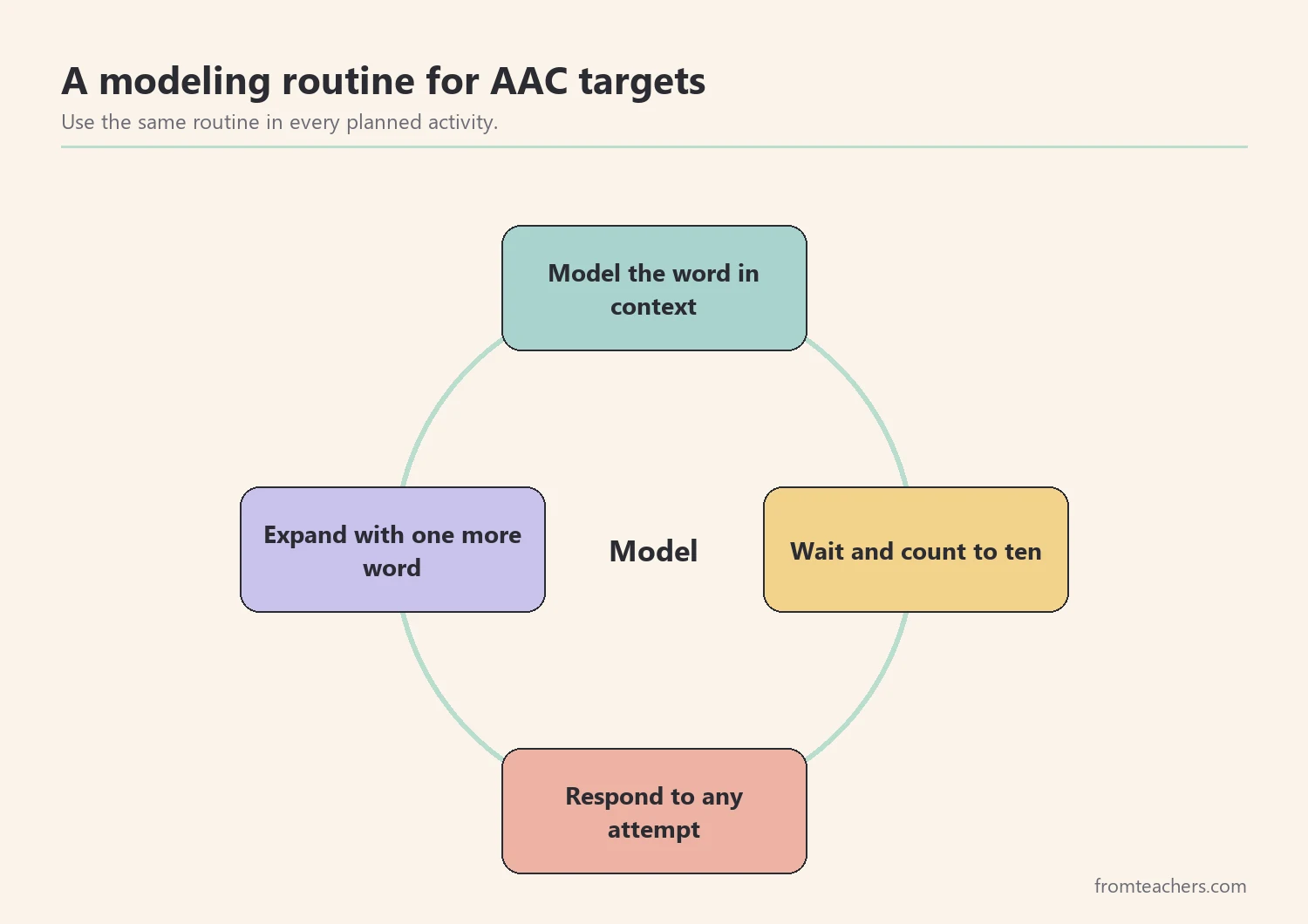
Keep a simple routine. First, model the target in context. Next, pause and wait with an expectant look. Then, respond to any attempt, even a partial one. Finally, expand by modeling one more word, such as “more crackers.”
Wait time matters more than many adults expect. Navigating a device takes longer than speaking. Therefore, count silently to ten before you prompt again. Also, never require a student to use the device before getting a basic need met; the goal is communication, not compliance.
Your AAC communication plan should name who models and when. For example, the paraprofessional models at snack, the teacher models at morning meeting, and a trained peer models at centers. Everyone uses the same path on the screen.
Short training helps. Spend five minutes showing each adult the targets, the access path, and the routine. Then, watch them model once and give one tip. This small step makes the AAC communication plan real for the people who use it most.
In Maya’s class, the paraprofessional modeled “more” at snack and then waited. On the first day, Maya tapped “more” twice. By the end of the second week, she was combining “more” with “crackers” on her own.
5. Track progress and reflect as a team
Finally, collect just enough data to see change. A simple count works well: how many chances the student had, and how many times they used the device to communicate. Record it during the activity on a sticky note or a tally box, not from memory at the end of the day.
Also, add a comfort rating. Many plans use a scale from 1 to 4, where 1 means the student needs full support and 4 means the student uses the target independently. A rating captures confidence that raw counts can miss.
Keep the data light so it actually happens. One activity per objective is enough to start, and a weekly total is easier to compare than daily scores. Moreover, write a short note when something unusual happens, such as a substitute, a new seat, or a device that ran out of battery. Those notes often explain a sudden drop better than any number.
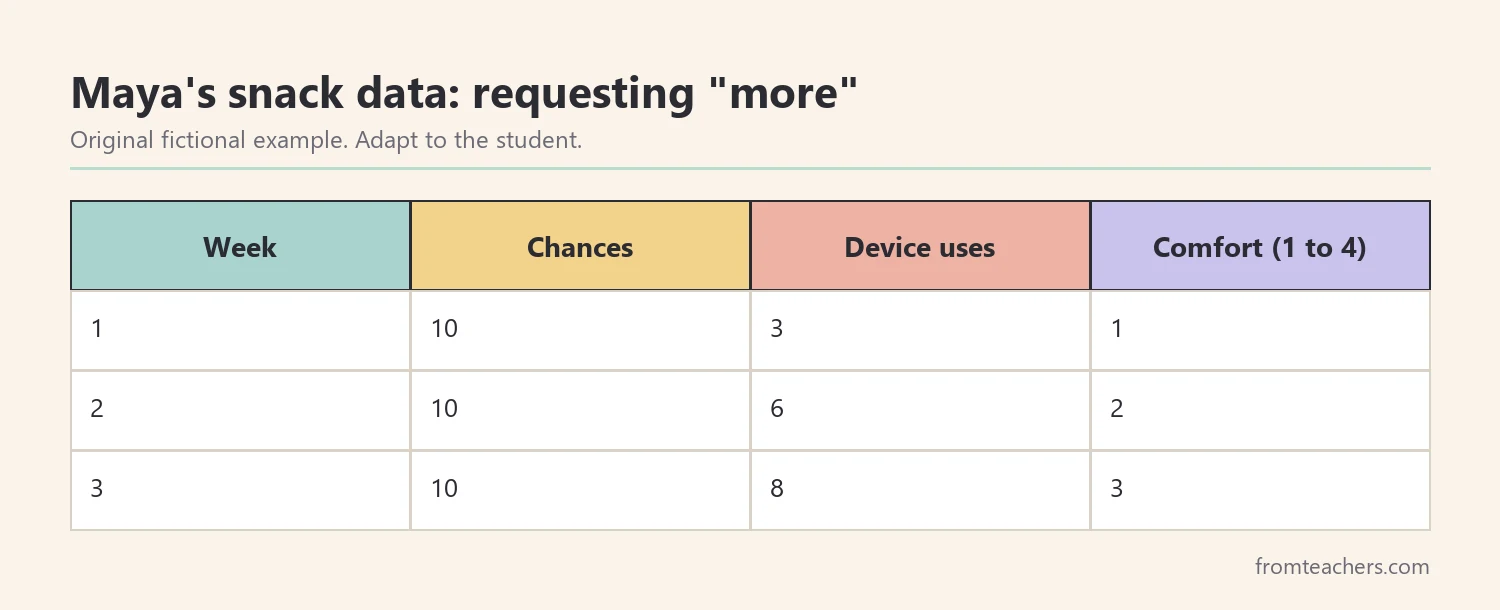
For Maya, the team tracked snack requests for three weeks. In week 1, she had 10 chances and used “more” 3 times, a comfort rating of 1. By week 2, she had 10 chances and used it 6 times, a rating of 2. In week 3, she had 10 chances and used it 8 times, a rating of 3. Clearly, the routine was working, so the team kept it and added “help” as a new target.
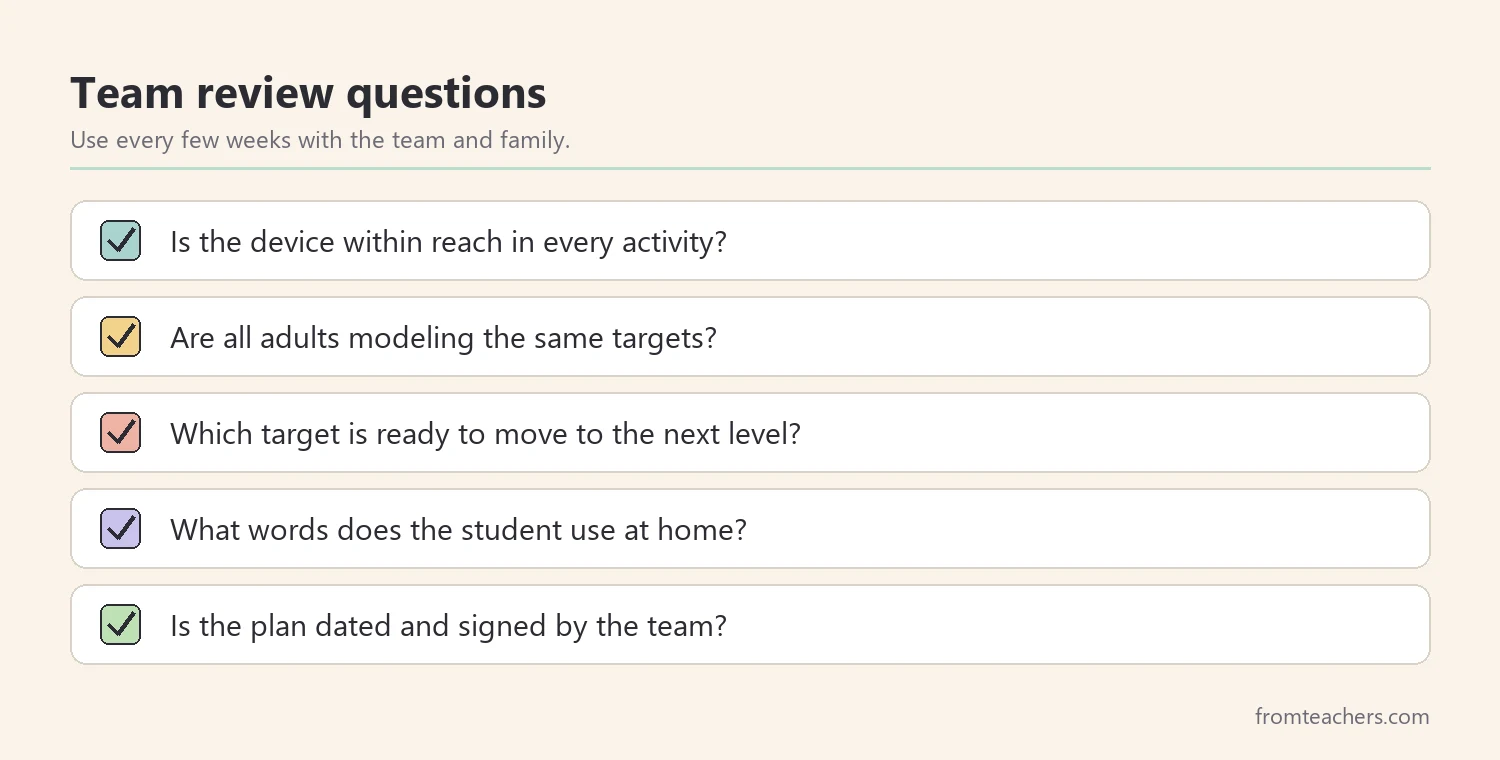
Then, review the AAC communication plan with the family every few weeks. Share one success, one current focus, and one question. Ask what the student says at home, because home words can become new school targets. Finally, sign and date the update so everyone knows which version is current.
Common mistakes and how to avoid them
- Keeping the device out of reach. Fix: write “device within reach” into the plan and check it at every transition.
- Testing instead of modeling. Fix: model the word several times before you expect the student to use it.
- Too many new targets at once. Fix: choose one target per activity and add more only when the rating improves.
- Moving buttons often. Fix: keep core words in stable places so motor patterns can build.
- Data from memory. Fix: tally during the activity with a sticky note or a simple log.
- Leaving the family out. Fix: share the one-page plan and ask for words used at home.
Questions teachers and parents ask about an AAC communication plan
Who should write the AAC communication plan?
Usually the speech-language pathologist leads, with input from the teacher, paraprofessional, and family. However, the plan belongs to the whole team. Everyone who works with the student should be able to read it and follow it.
How long should the plan be?
One page is ideal. A short plan gets read and used, while a long one often stays in a folder. Put details such as full vocabulary lists in a separate document.
Does using AAC stop a child from learning to talk?
Professional organizations such as ASHA describe AAC as a support for communication, not a barrier to speech. If you have questions about a specific child, talk with the student’s speech-language pathologist.
How often should we update the plan?
Review it every few weeks and update it when a target is mastered or a routine changes. Also, update it after any change to the device or its layout. Date each version so adults use the current one.
What can parents do at home?
Parents can keep the device nearby, model one or two target words during daily routines, and wait for a response. In addition, they can share new interests so the team can add useful words.
Related reading: Best Assistive Technology for Special Education Classrooms, Boost Access and Independence: An Assistive Technology Toolkit for Special Education, and How Teachers Communicate With Parents in Special Education.
A companion resource for your AAC communication plan:
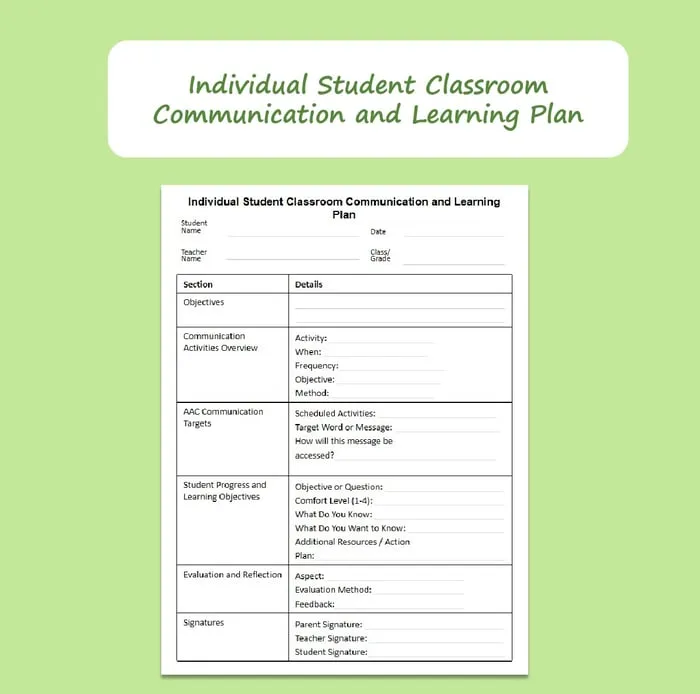
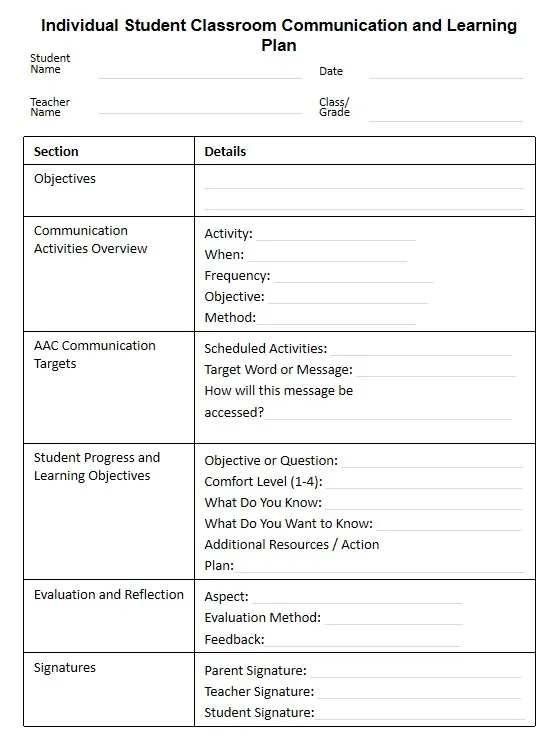
Individual Student Communication Plan: AAC Learning Plan for Classrooms: a one-page, ready-to-fill plan with sections for objectives, a communication activities overview, AAC communication targets and access, progress with a 1 to 4 comfort rating, evaluation and reflection, and signature lines for parent, teacher, and student.
Sources and scope
- American Speech-Language-Hearing Association (ASHA): professional information on augmentative and alternative communication and the role of speech-language pathologists.
- IRIS Center, Vanderbilt University: free modules on assistive technology and supporting students with disabilities.
- IDEA, U.S. Department of Education: the law that requires IEP teams to consider a student’s communication and assistive technology needs.
- Understood.org: plain-language articles for families and teachers on school supports.
This guide covers how classroom teams can organize daily AAC support with a shared plan. It does not cover device selection, formal AAC evaluation, or therapy decisions, which belong to the speech-language pathologist and the student’s team.
Key takeaways
- An AAC communication plan keeps every adult consistent across the school day.
- Write a few clear objectives and map real chances to communicate in daily activities.
- Name one target word and one access path for each activity.
- Model, wait, respond, and expand, and keep the device within reach.
- Track simple counts and a comfort rating, then review with the family.










Leave a Comment