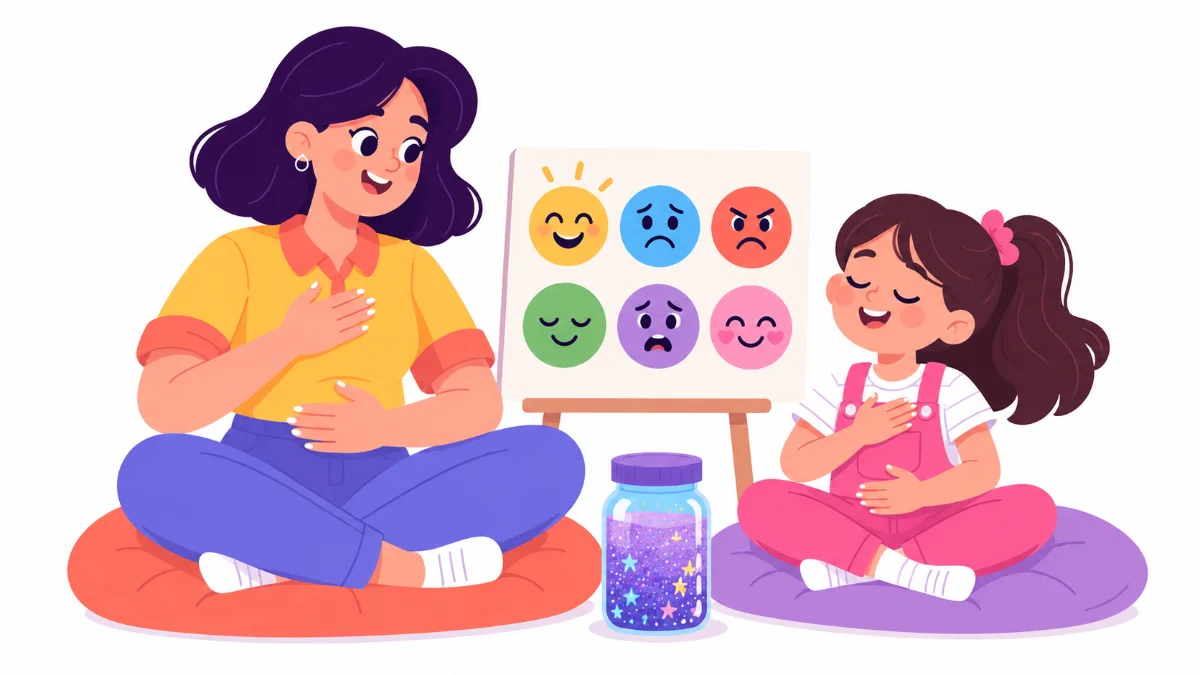

Emotional regulation activities work best when they are taught before the storm, not during it. Picture a sixth grader who gets a math page back covered in corrections. Within seconds she shoves the desk, says something sharp, and leaves the room. Later she is quiet and embarrassed, and nobody, including her, can explain what happened in that moment.
This guide gives you a five-step process for students with big feelings, including students identified with emotional disturbance. You will learn how to spot patterns, teach feeling words, practice calming tools when the student is calm, build a personal plan, and track whether it helps. By the end, you will have a short, realistic plan instead of a pile of ideas.
Examples are fictional. Adapt to the student’s goals and agreed supports. This is guidance, not a diagnosis.
At a glance
- Behavior is information: look for when and where the big feelings start.
- Students need words for feelings before they can use calming tools.
- Practice calming activities when the student is calm, not mid-crisis.
- A short personal plan and a calm space make the tools usable.
- Track one or two simple measures and review them with the team.
1. Notice patterns before choosing emotional regulation activities
Before you pick any tool, find out when the big feelings happen. Many outbursts look sudden, but they usually follow a pattern. Certain tasks, times of day, transitions, or social moments tend to set them off.
For one or two weeks, keep a brief log. After each hard moment, write down four things: the time, the activity, what happened just before, and what helped the student settle. Keep each entry to one line. In addition, note the early signs you saw, such as a clenched jaw, a hood pulled up, or a sudden silence.
Meet Maya, a fictional sixth grader with an IEP that includes social and emotional goals. Her teacher’s log showed that most of Maya’s hard moments came during independent math, usually right after she received written feedback. The early signs were consistent: she put her head down, tapped her pencil hard, and stopped answering.
That pattern changes everything. Instead of choosing emotional regulation activities at random, the team now knows when Maya needs them and which warning signs to watch. As a result, adults can step in early with a calm prompt, rather than waiting for the desk to move.
Also, remember that many students with emotional disturbance have lived through stress or trauma. Their reactions often make sense as protection, even when they look out of proportion. Therefore, the goal is not to stop feelings. Instead, it is to help the student notice them, name them, and come back to learning safely.
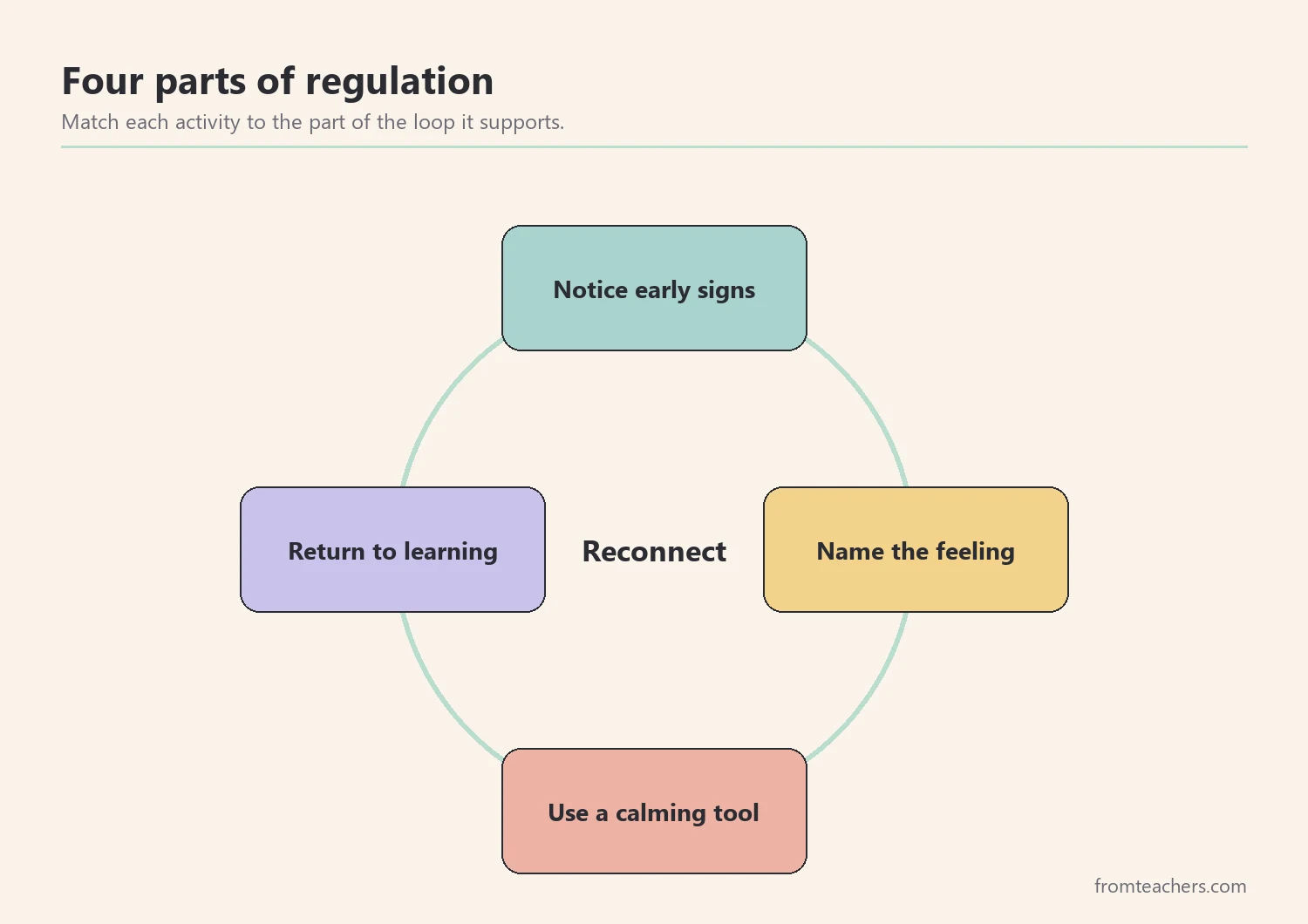
2. Teach students to name their feelings
A student cannot use a calming tool for a feeling they cannot recognize. For that reason, the first emotional regulation activities should build feeling vocabulary and body awareness. These activities are short, low pressure, and easy to repeat.
Three activities work well for many students:
- Emotion thermometer. A simple scale from 1 (calm) to 5 (overwhelmed). The student points to a number at set check-in times.
- Body scan check-in. The student notices where a feeling shows up: tight shoulders, a hot face, a fast heartbeat.
- Emotion journal. A few sentences or a quick drawing about one feeling from the day, with a prompt like “Today I felt ___ when ___.”
Start with check-ins at calm times, such as morning arrival and after lunch. Keep them brief and private. A student who feels watched may refuse, so a small card on the desk often works better than a class discussion.
For Maya, the team chose the emotion thermometer. Each morning and before math, she points to a number on a card taped inside her folder. On the first day she only chose 1 or 5. Over time, she began to use 2, 3, and 4, which gave adults a much clearer picture of when she was starting to struggle.
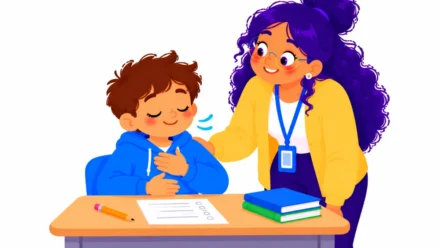
Similarly, the body scan helps students who say “I don’t know” when asked how they feel. Instead of a word, they can point to a place on a simple body outline. Later, adults help connect that spot to a feeling word, such as “tight chest” and “worried.” These quiet emotional regulation activities build a bridge between body signals and language.
Notably, adults can model this skill out loud: “I’m at a 3 right now because the projector isn’t working. I’m going to take a breath.” This shows that feelings are normal and manageable.
3. Practice calming emotional regulation activities while calm
Calming tools are skills, and skills need practice. A student who has never tried slow breathing will not discover it in the middle of an outburst. So teach these emotional regulation activities during calm moments, then practice them often.
Choose two or three tools that match the student. Some students prefer breathing, others prefer movement, and some need something to look at or hold. Common options include:
| Activity | How it works | Good for |
|---|---|---|
| 4-7-8 breathing | Breathe in for 4, hold for 7, out for 8 | Students who like counting |
| 5-4-3-2-1 grounding | Name things you can see, touch, hear, smell, taste | Students who feel scattered |
| Movement break | Wall push-ups, a walk, carrying books | Students who need to move |
| Calm object | A stress ball or textured card | Students who need to fidget |
Keep each practice short, about two minutes. Practice at the same time each day so it becomes routine. Also, let the student rate how useful each tool felt, because their opinion predicts whether they will use it later.
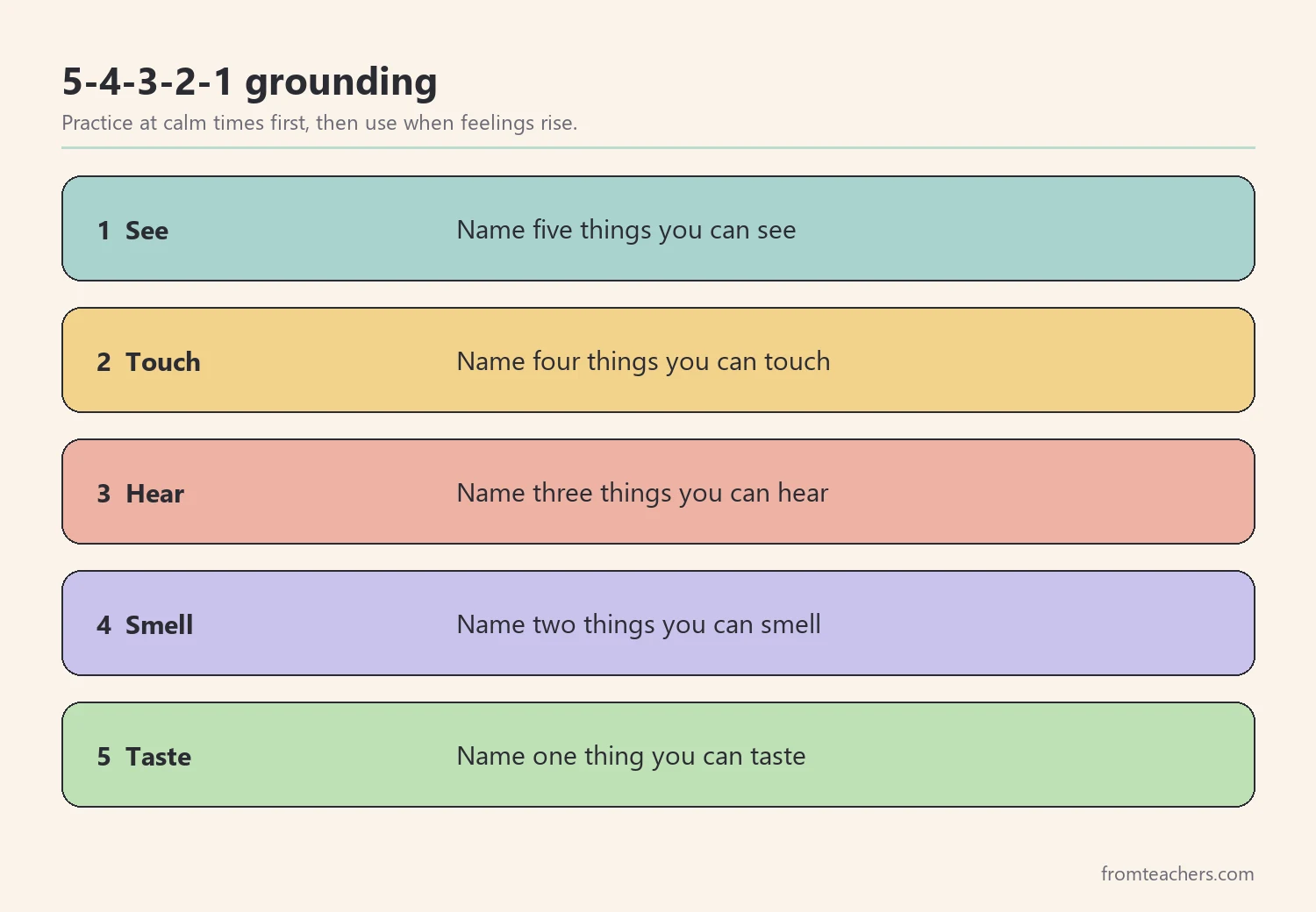
Maya tried all four options over two weeks. She disliked counted breathing but liked 5-4-3-2-1 grounding and a short walk to deliver a note to the office. Those became her two main tools.
A structured guide can save planning time here. For example, this emotional regulation activities guide for students with emotional disturbance includes calming and grounding activities, emotion identification tools, and a framework for reading where a student is before you respond.
4. Build a personal plan and a calm space
Tools only help if the student knows when to use them and how to come back. A personal regulation plan pulls everything together on one page. In addition, it gives every adult the same script, which matters for students who react strongly to mixed messages.
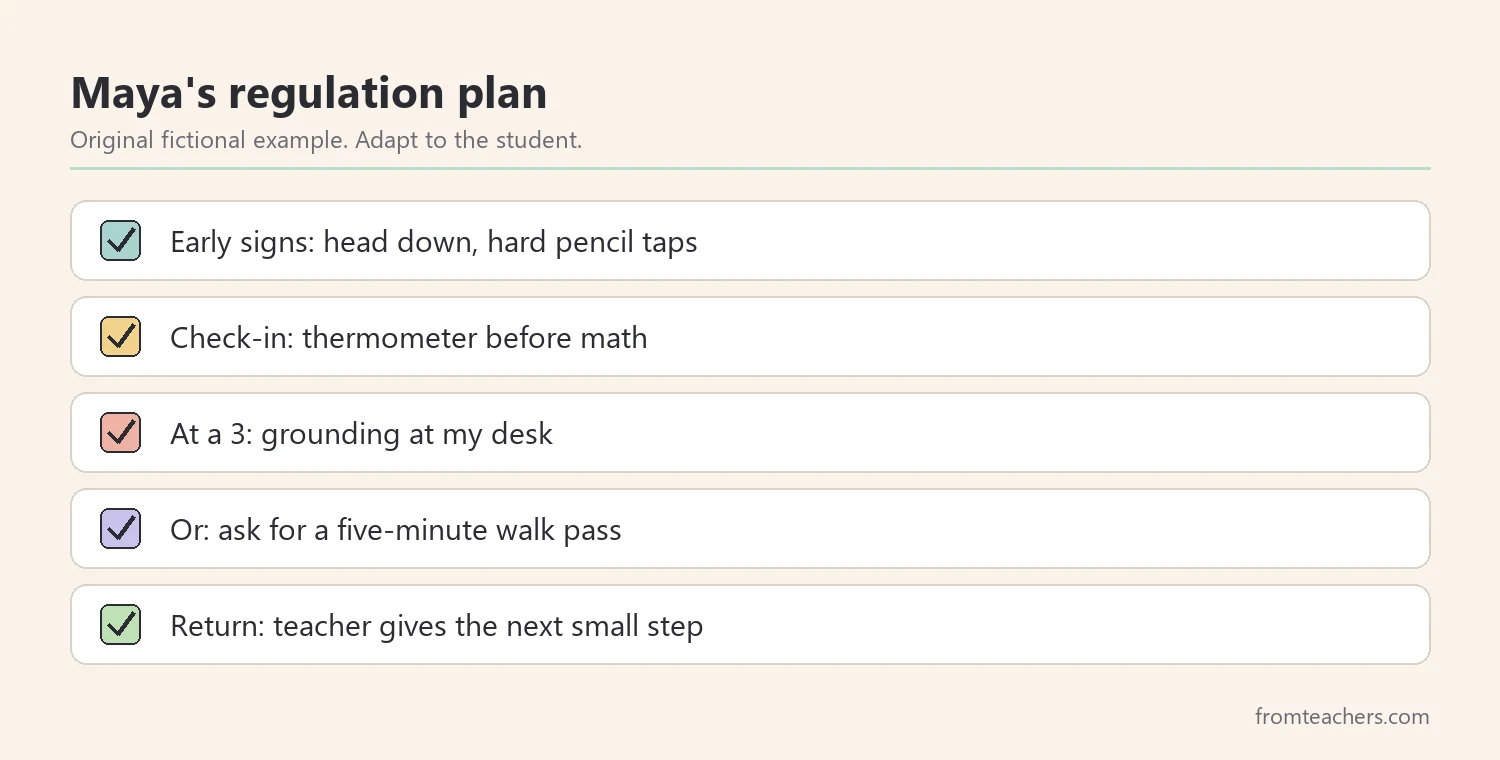
Keep the plan short. It should answer four questions: What are my early signs? What can I use? Where can I go? How do I return? Write it with the student, using their words where possible.
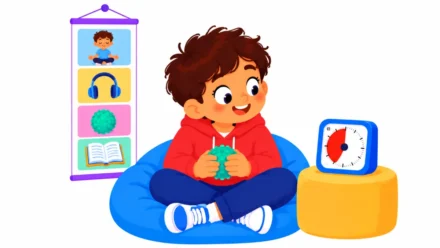
Next, set up a calm space if the room allows. It does not need to be fancy. A corner with a chair, a visual of the student’s tools, a timer, and a few calming objects is enough. Importantly, the calm space is not a punishment. Students should go there to reset, then return within an agreed time.
Maya’s plan said that when she reached a 3 on her thermometer, she could use grounding at her desk or ask for a five-minute walk pass. When she returned, the teacher greeted her quietly and gave her the next small step of the task, with no lecture. As a result, returning felt safe instead of shameful.
In addition, plan for the days that go wrong. A substitute teacher, a fire drill, or a bad morning at home can make the plan harder to use. Write one backup step, such as “If the walk pass is not possible, sit in the calm chair with the timer.” Then share the plan with specialists, paraprofessionals, and lunch staff so everyone knows it. Consistent emotional regulation activities across adults help students trust the routine.
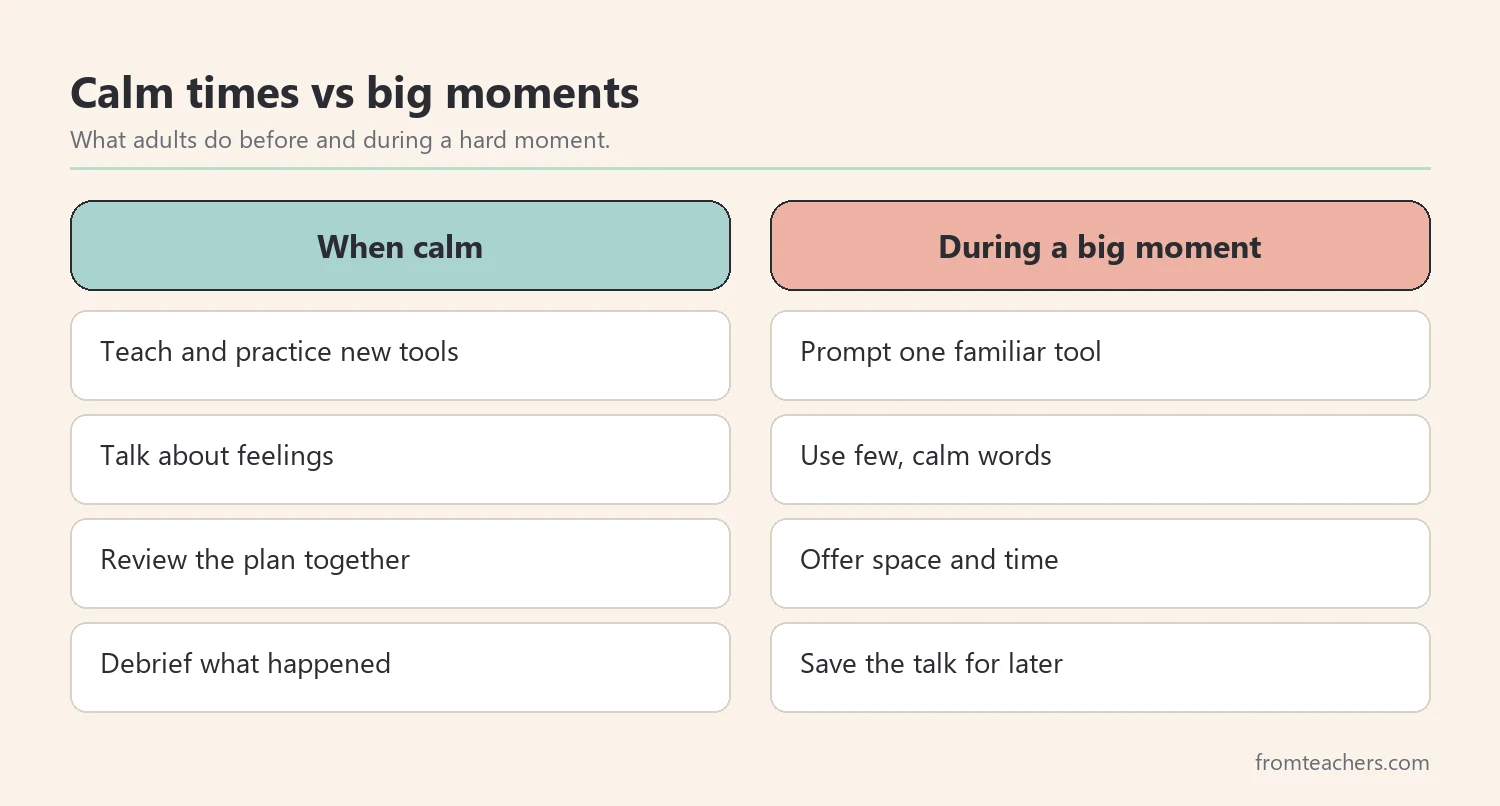
Also, plan the adult response. During a big moment, use few words, a calm voice, and space. Talk about what happened later, when the student is settled. These emotional regulation activities work far better when adults stay regulated too.
5. Track and review emotional regulation activities with the team
Finally, check whether the plan helps. Pick one or two simple measures and record them every day. Good options include the number of hard moments, how often the student used the plan, and how long it took to return to work.
Maya’s team recorded these measures for four weeks:
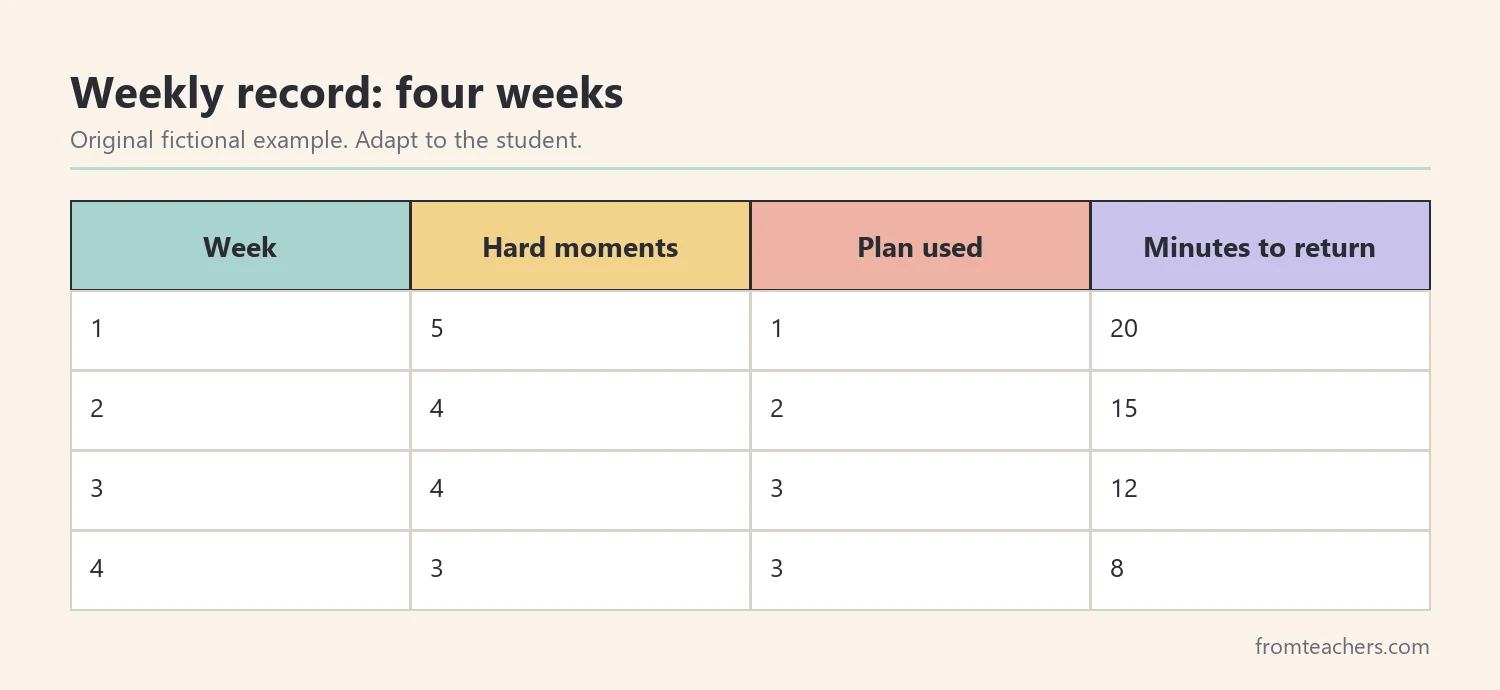
In week 1, Maya had 5 hard moments and used her plan once, and she took about 20 minutes on average to return to work. By week 4, she had 3 hard moments, used her plan in all 3, and returned in about 8 minutes. The hard moments did not disappear, but she was using her tools and recovering much faster.
Review the record with the student, the family, and the IEP team every few weeks. Ask what is working, what feels hard, and which one change to try next. Then adjust the plan and keep going. Over time, the student takes more ownership of their emotional regulation activities, and adults step back.
If you notice signs of serious distress, safety concerns, or no progress despite consistent support, involve the school counselor, psychologist, or other qualified professionals. Classroom activities are one part of support, not a replacement for mental health services.
Common mistakes and how to avoid them
- Teaching a tool during a crisis. Fix: introduce and practice new tools only when the student is calm.
- Using the calm space as a consequence. Fix: frame it as a place to reset, with a clear and welcoming way back.
- Talking too much in the moment. Fix: use a few calm words, then debrief later.
- Choosing tools for the student. Fix: let the student try several and keep the ones they find useful.
- Expecting outbursts to stop quickly. Fix: measure recovery time and plan use, not only the number of incidents.
- Working alone. Fix: share the plan with every adult and the family so the language stays the same.
Questions teachers and parents ask about emotional regulation activities
How long does it take for emotional regulation activities to help?
It varies widely from student to student. Some students use a new tool within a few weeks, while others need months of steady practice. Look for small signs of progress, such as using the thermometer or returning faster, rather than expecting fewer outbursts right away.
What if the student refuses to try the activities?
Refusal is common, especially when a student feels singled out. Try practicing with the whole class, offer choices, and keep sessions very short. Building trust with the student often matters more than the specific activity.
Can these activities be used at home?
Yes. Many of these activities, such as grounding, a feelings scale, or a short walk, work well at home. Sharing the student’s plan with the family helps everyone use the same words and tools.
Are emotional regulation activities only for students with emotional disturbance?
No. Many students benefit from learning to name and manage feelings. However, students with emotional disturbance often need more practice, more consistency, and a more individualized plan.
When should we involve other professionals?
Involve the counselor, school psychologist, or family’s care providers if there are safety concerns, signs of serious distress, or little change after consistent support. These professionals can help with assessment and more intensive services.
Related reading: Essential Trauma-Informed Teaching Strategies for Modern Classrooms, Meltdowns vs Tantrums: A Guide to Understanding and Responding, and Moving Beyond Shame and Behavior Charts: Positive Alternatives for Effective Classroom Management.
A companion resource for emotional regulation activities:
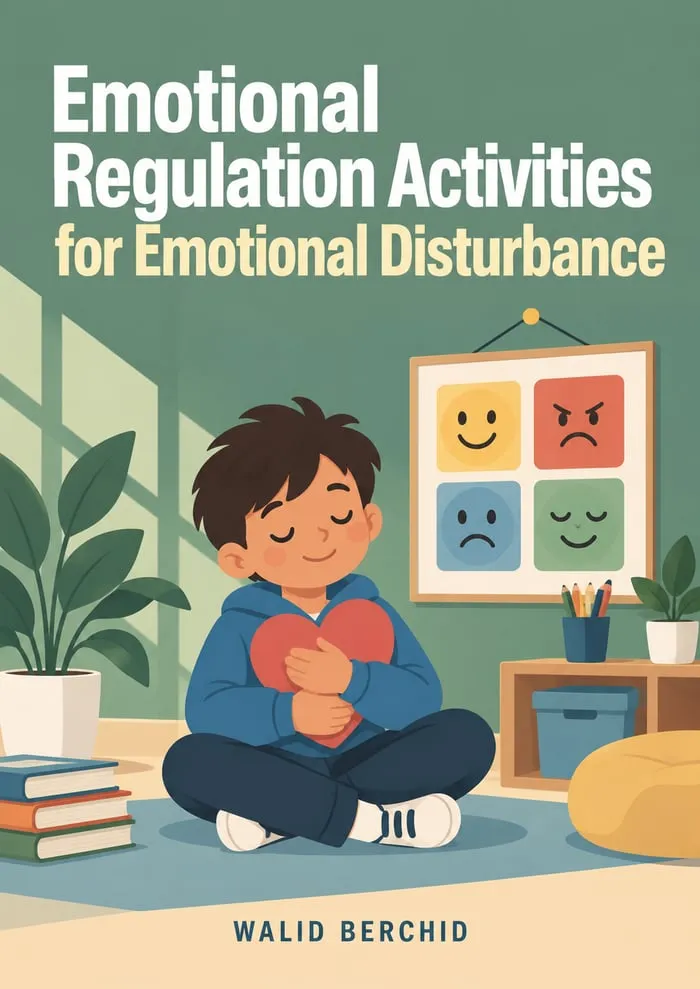
Emotional Regulation Activities for Students with Emotional Disturbance: a 42-page guide with an explanation of emotional disturbance under IDEA, a three-window framework for reading where a student is, calming and grounding activities, and emotion identification tools such as a body scan check-in, emotion thermometer, and guided journaling.
Sources and scope
- IDEA, U.S. Department of Education: the law that defines emotional disturbance as a disability category and governs IEPs.
- IRIS Center, Vanderbilt University: free modules on behavior, classroom management, and supporting students with emotional needs.
- CASEL: information on social and emotional learning, including self-management.
- National Child Traumatic Stress Network: resources for educators on trauma and its effects on children.
This guide covers everyday classroom activities for teaching emotional regulation. It does not cover diagnosis, therapy, crisis intervention, or medication, which belong to qualified professionals and the student’s team.
Key takeaways
- Log hard moments to find patterns and early signs before choosing tools.
- Teach feeling words and body awareness first, with short calm check-ins.
- Practice emotional regulation activities at calm times so they are ready when needed.
- Write a short personal plan with the student and share it with every adult.
- Track hard moments, plan use, and recovery time, then review as a team.






Leave a Comment