

DLD classroom strategies start with noticing what a student understands, not just what they say. Picture a fourth grader who nods at a three-part direction, opens the wrong book, and then sits quietly until a classmate points. She is not careless. Instead, the words moved faster than she could process them.
This guide walks you through five practical steps: recognize the signs, simplify the language you use, pre-teach key words with visuals, support students as they speak and write, and repair communication breakdowns while tracking progress with the speech-language pathologist (SLP) and family. By the end, you will have a small set of habits you can use in any subject.
Examples are fictional. Adapt to the student’s goals and agreed supports. This is guidance, not a diagnosis.
At a glance
- Developmental language disorder (DLD) affects understanding and using language, and it often looks like something else.
- Short, ordered directions with visuals help the whole class.
- Pre-teach a few key words before each lesson and revisit them often.
- Give wait time, sentence frames, and word-finding support when students speak.
- When communication breaks down, take responsibility, rephrase, and check understanding.
1. Recognize the signs before choosing DLD classroom strategies
First, learn what DLD can look like in class. DLD is a long-term difficulty with learning and using language that is not explained by another condition such as hearing loss. It is common, yet it is often missed, because the signs can look like inattention, shyness, or poor effort.
Next, watch for patterns across several days. A single confused moment means little. However, repeated difficulty following spoken directions, finding words, or explaining ideas in order is worth noting and sharing with the SLP.
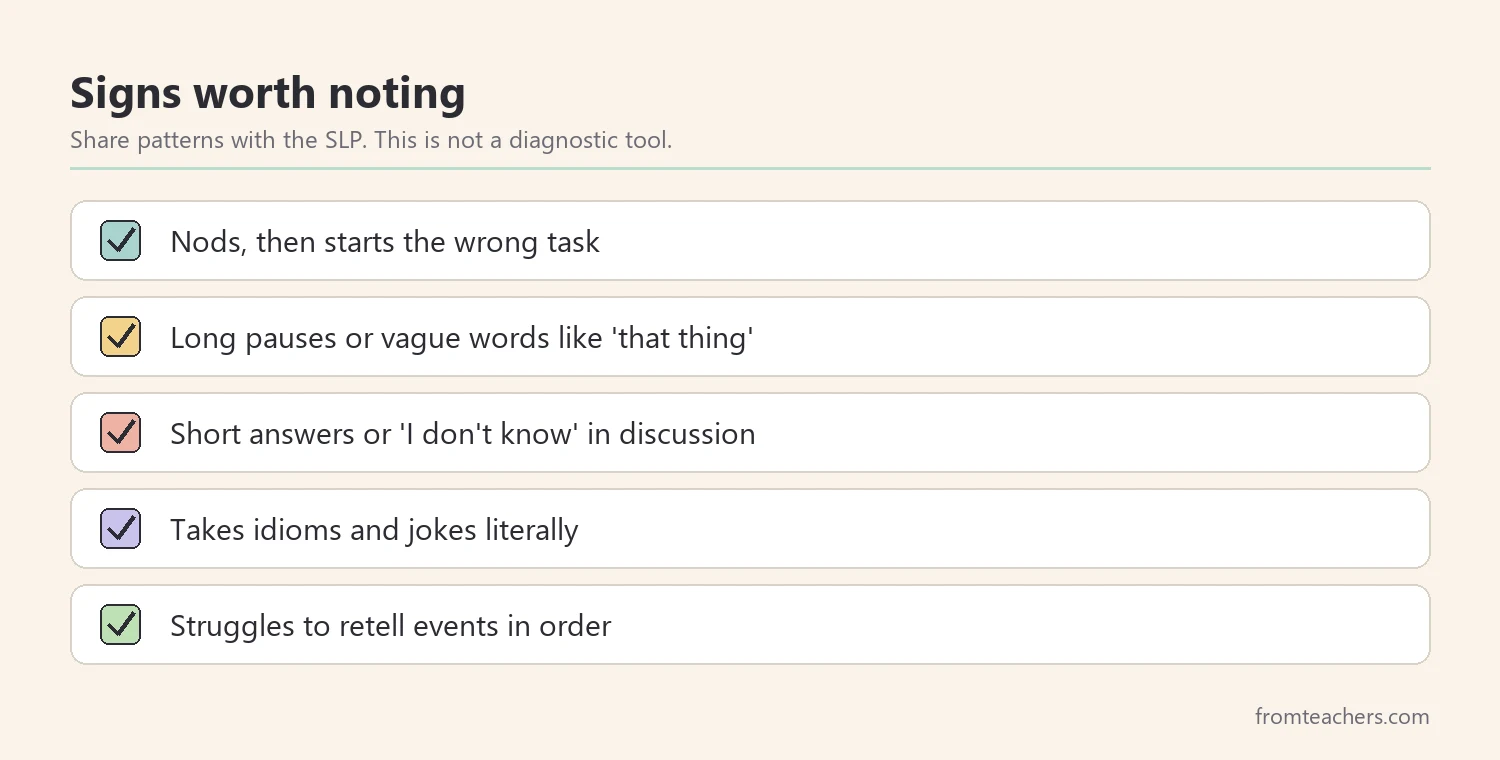
Then, separate what you see from what you assume. “Does not follow directions” is an observation. “Is not listening” is a guess. DLD classroom strategies work best when they target the language demand, not the student’s character.
| What you might see | What may be happening |
|---|---|
| Nods, then does the wrong task | Long direction was not fully processed |
| Long pauses or “that thing” | Word-finding difficulty |
| Short, vague answers | Hard to organize ideas into sentences |
| Takes idioms literally | Figurative language is hard to decode |
Worked example. Nia is a fictional student in grade 4. Her teacher notices that Nia often starts tasks late, answers with “I don’t know” in discussions, and took “hit the books” literally last week. In science labs with visual steps, however, she does well. The teacher writes down three examples and shares them with the school SLP.
In short, careful notes lead to better support and a better conversation with the team. Moreover, you do not need to wait for a formal label to begin. Most DLD classroom strategies are simple, low-risk supports that help any student who finds language hard.
Also, notice strengths. Many students with language difficulties are strong visual thinkers, careful observers, or skilled with their hands. Building on those strengths makes the rest of the plan easier.
2. Simplify the language you use
Many DLD classroom strategies begin with the teacher’s own talk. Long, complex directions place a heavy load on working memory and language processing. Therefore, shorten them and give them in the order students will act.
Use one step per sentence, and put the action first. For example, say “Open your math book. Turn to page 42. Do problems 1 to 5.” instead of “Before you start the problems on page 42 in your math book, make sure you have your pencil.” Also, pause briefly between steps.
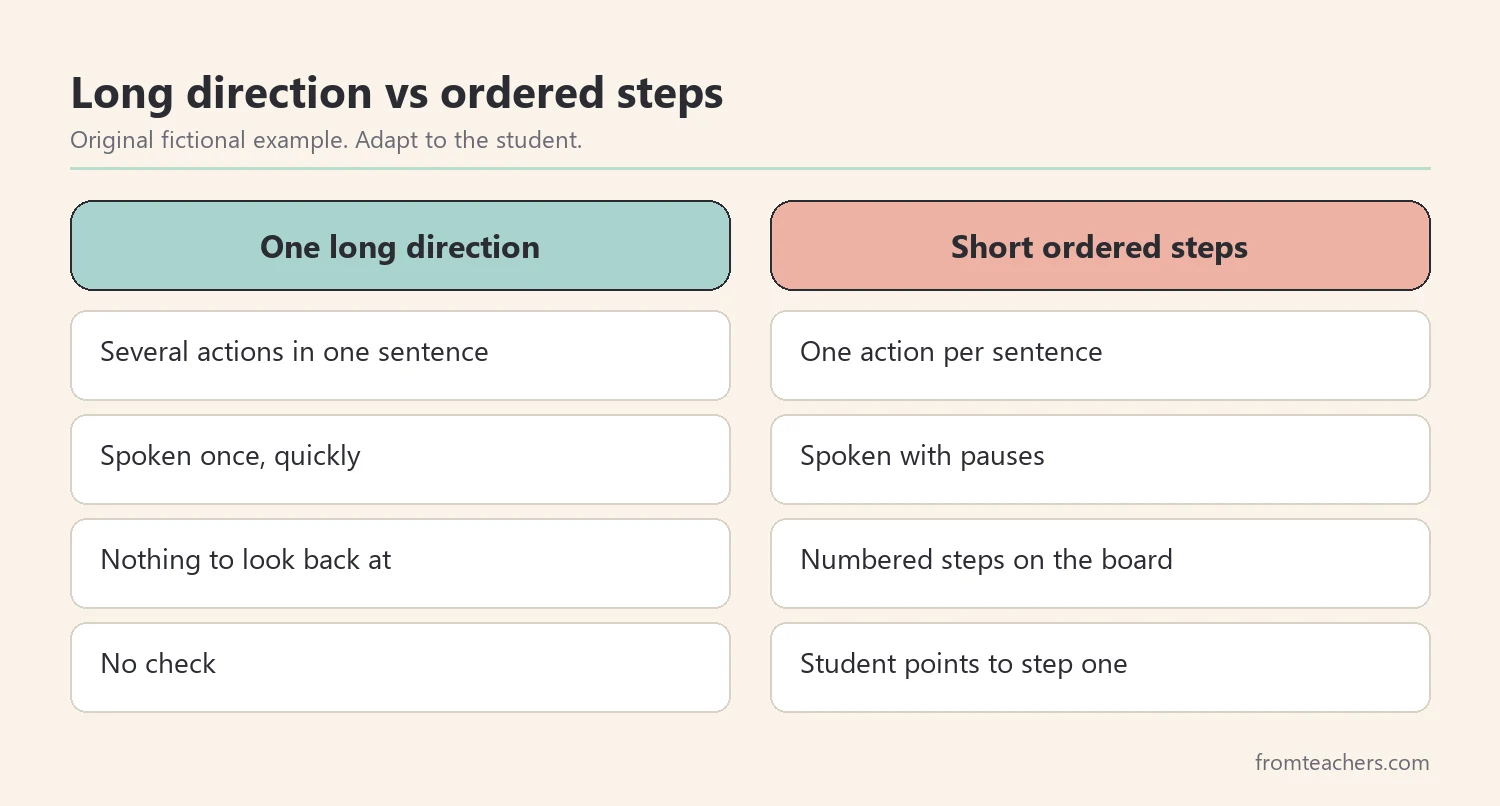
Next, back up speech with visuals. Write steps on the board, number them, and add simple icons where possible. Meanwhile, model the first step so students can see what “done” looks like. Visual support helps students with DLD and many of their classmates too, which is why DLD classroom strategies often improve the whole room.
- One step per sentence, in the order of action.
- Familiar words, with new terms introduced on purpose.
- Numbered steps written on the board.
- A model of the first step.
- A quick check: “Show me step one.”
If you want ready-made examples, the DLD Classroom Strategies resource uses Situation, Strategy, and Result tables to show how to close comprehension gaps and correct misunderstood instructions in everyday moments.
Worked example. Nia’s teacher starts giving directions in short, numbered steps and writes them on the board with small icons. After the directions, she asks Nia to point to step one. As a result, Nia starts most tasks on time, with no extra adult help.
3. Pre-teach key words with visuals
Vocabulary is often a major barrier for students with DLD. New words need more exposures to stick. So, choose a few key words for each lesson and teach them before the lesson starts, rather than hoping students pick them up along the way.
Pick three to five words that students need to understand the lesson. For each word, use a short routine: show a picture, say the word, give a student-friendly definition, and use it in a sentence. Then, ask the student to say it and use it once.
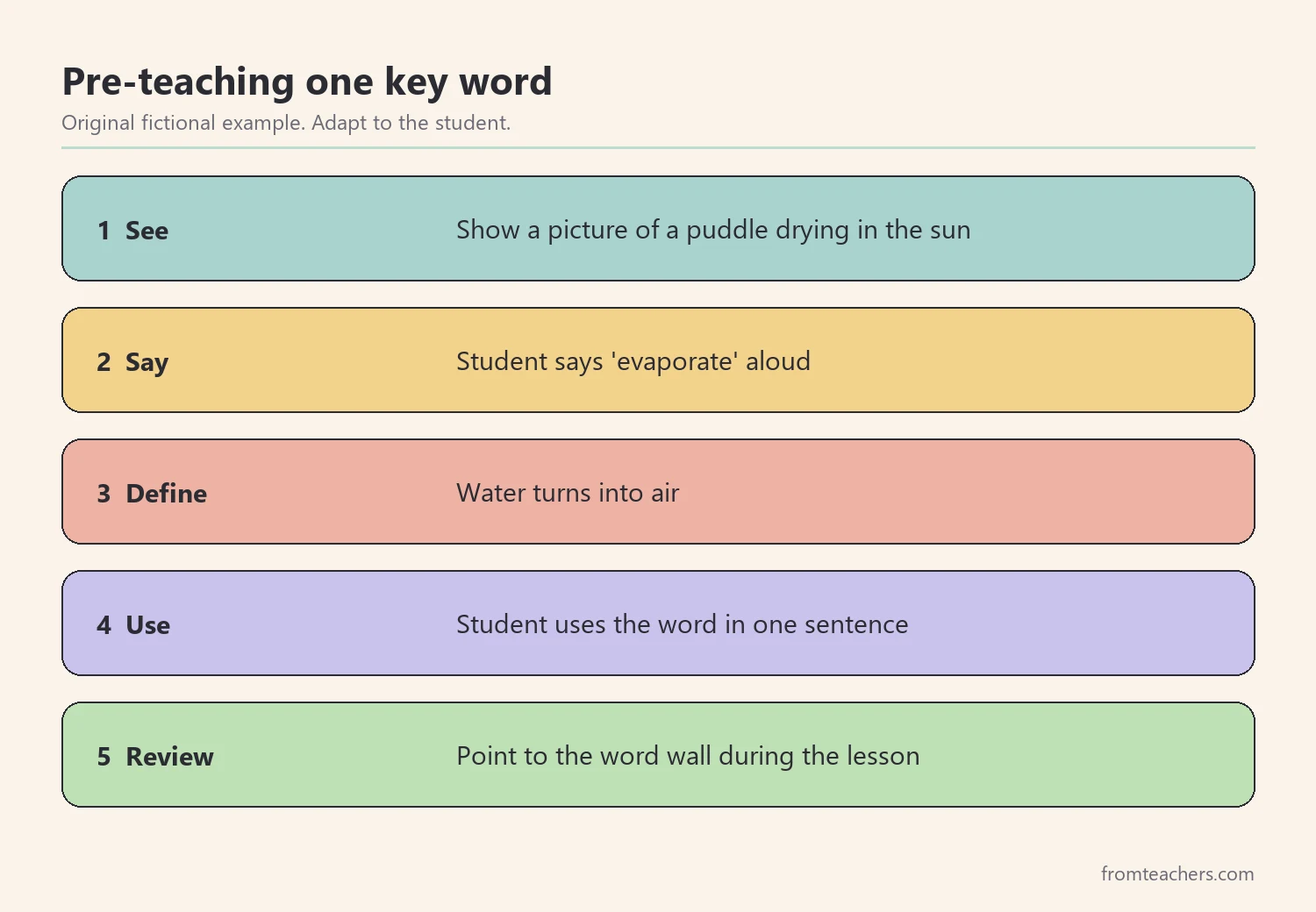
Next, revisit the words often. Post them on a word wall with pictures, use them in your own talk, and point to them during the lesson. In addition, connect new words to ones students already know, such as “evaporate is like water disappearing into the air.”
| Word | Picture | Student-friendly meaning |
|---|---|---|
| Evaporate | Puddle drying in sun | Water turns into air |
| Condense | Drops on a cold glass | Air turns back into water |
| Cycle | Circle of arrows | Something that repeats |
Finally, keep the definitions short and concrete. A dictionary definition often contains harder words than the word itself. Instead, write meanings the student could say back in their own words.
These DLD classroom strategies take only a few minutes. Yet they can change how much of the lesson a student can follow.
Worked example. Before a science lesson on the water cycle, Nia works with the teacher for five minutes on three words. The next day, during the lesson, she points to “evaporate” on the word wall and says, “The water goes up.”
4. Support speaking and writing with DLD classroom strategies
Expressing ideas can be just as hard as understanding them. Students with DLD may know the answer but struggle to find the words or put them in order. Therefore, build in support that lowers the language load without lowering the thinking.
Start with wait time. After you ask a question, wait several seconds before calling on anyone. For some students, it helps to tell them the question ahead of time, so they can prepare an answer.
Next, offer sentence frames. Frames such as “I think ___ because ___” or “First ___, then ___” give students a structure to fill. In addition, for word-finding pauses, give a cue rather than the answer, such as the first sound or a category: “It’s an animal that lives in water.”
- Wait time of several seconds after each question.
- Questions shared ahead of time when possible.
- Sentence frames on cards or the board.
- Word-finding cues: first sound, category, or gesture.
- Graphic organizers for writing in order.
For writing, use graphic organizers that show order, such as first, next, then, last. Also, accept drawings or oral answers as a first draft, then help the student turn them into sentences.
Meanwhile, think about how you correct errors. Instead of saying “No, that’s wrong,” repeat the sentence back correctly and naturally. For example, if a student says “He goed to the store,” you might reply, “Yes, he went to the store. What did he buy?” This kind of recasting is one of the gentlest DLD classroom strategies, because it models correct language without stopping the conversation.
Worked example. During discussion, Nia’s teacher gives her the question one minute early and a card with “I think ___ because ___.” Nia answers, “I think the puddle got smaller because the sun made it evaporate.” Instead of “I don’t know,” she now joins most discussions.
5. Repair breakdowns and track progress with the team
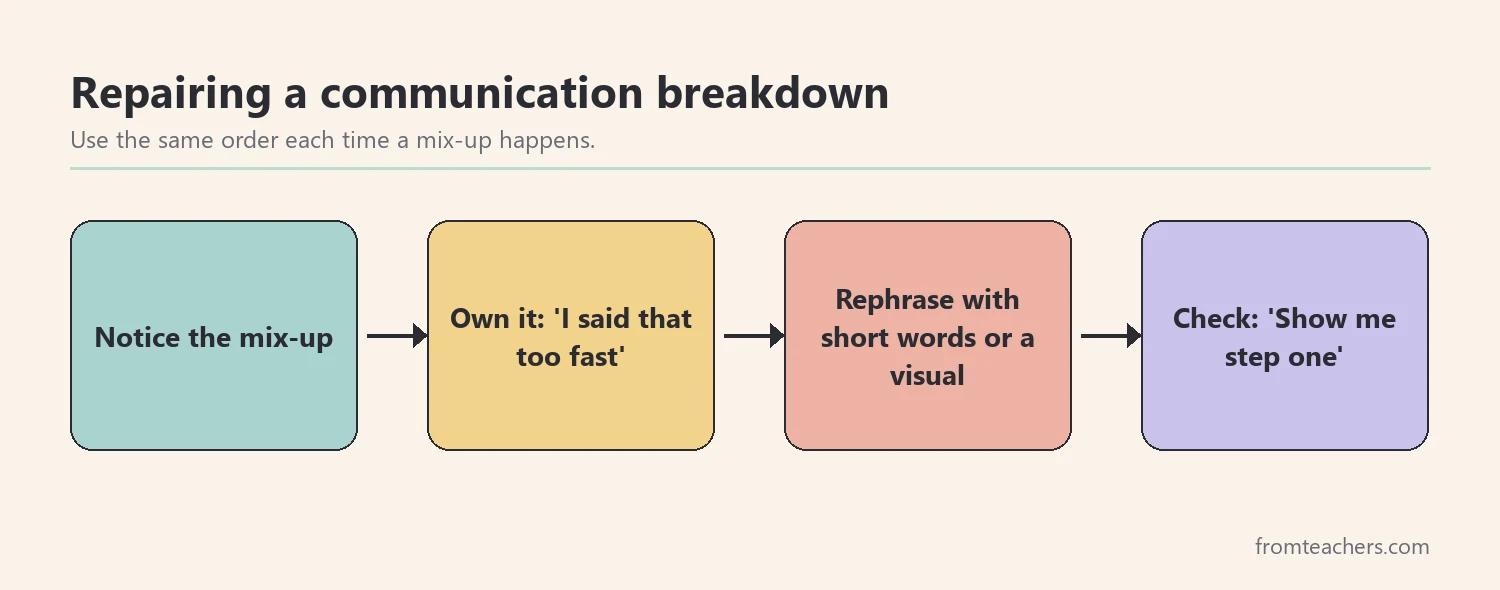
Even with good DLD classroom strategies, communication will sometimes break down. When it does, take responsibility for the mix-up. A simple script such as “I said that too fast. Let me try again.” keeps the student’s dignity and keeps the conversation going.
A good repair follows a clear order. First, notice the breakdown. Next, own it. Then, rephrase with shorter words or a visual, and finally check understanding by asking the student to show or tell you the next step.
Meanwhile, work closely with the SLP. The SLP can suggest targets, share strategies used in therapy, and help you choose what to measure. Likewise, share what works with the family, so similar language supports can be used at home.
Track one simple measure that matches your main goal. For example, count how many directions out of ten the student follows without extra help. Record it on the same days each week. In addition, write a short note when something unusual happens, such as a substitute, an assembly, or a new topic with many unfamiliar words. Tracking keeps DLD classroom strategies honest, because it shows what is really changing.
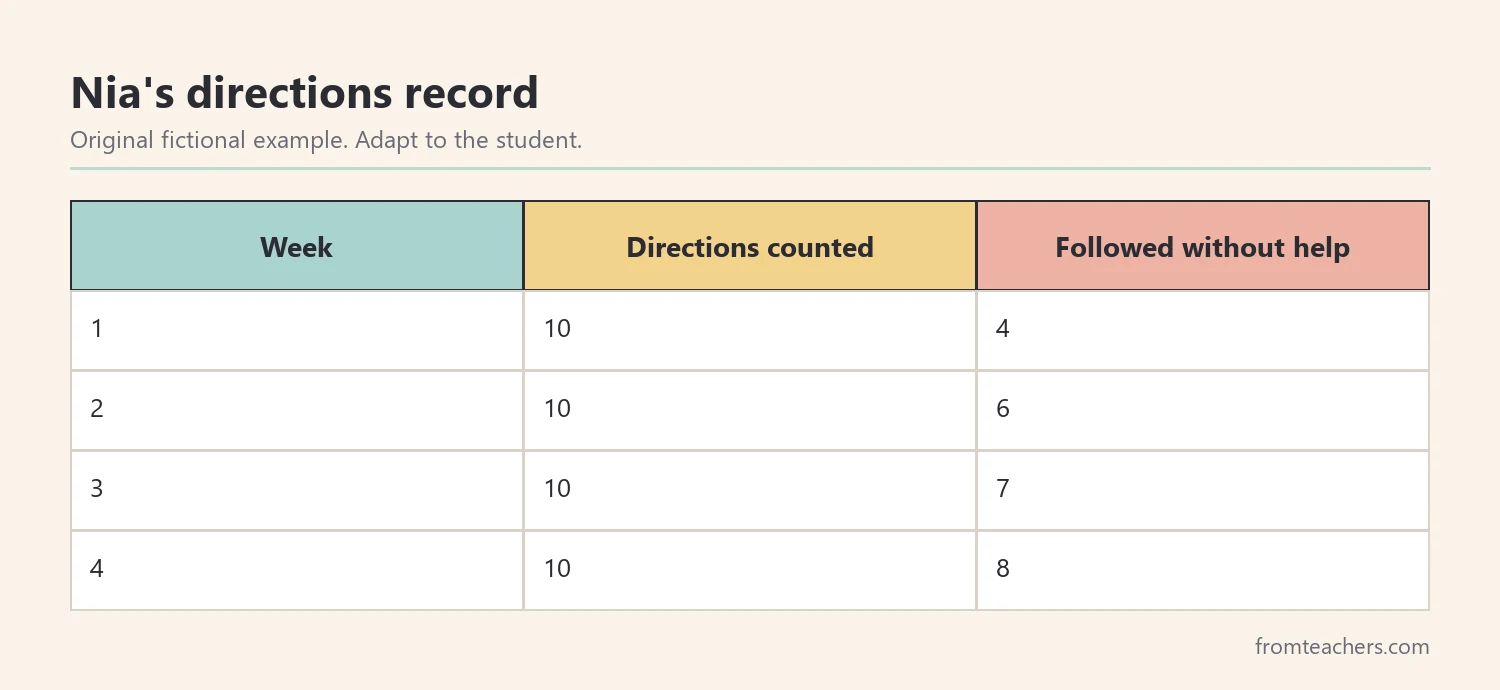
Worked example. Nia’s teacher counts ten class directions each Friday. Over four weeks, the number Nia follows without extra help rises from 4 to 8. The teacher shares the record with the SLP and Nia’s parents, who start using short, numbered steps for morning routines at home.
Above all, keep the routines steady. Students with DLD benefit from predictable language, so use the same phrases for directions, the same repair script, and the same word wall routine across the year. Consistency lets DLD classroom strategies work quietly in the background of every lesson.
Common mistakes and how to avoid them
- Mistaking DLD for low effort. Silence or vague answers can hide a language difficulty. Fix: note patterns and talk with the SLP.
- Repeating the same long direction louder. Repeating does not make it easier to process. Fix: rephrase in short, ordered steps with a visual.
- Teaching too many new words at once. A long list does not stick. Fix: pre-teach three to five key words and revisit them.
- Answering for the student. It ends the chance to practice. Fix: give wait time, a frame, or a word cue instead.
- Blaming the student for a breakdown. It harms trust. Fix: own the mix-up and rephrase.
- Working alone. The SLP and family have useful insight. Fix: share notes and agree on one shared goal.
Questions teachers and parents ask about DLD classroom strategies
Is DLD the same as a speech delay?
No. Speech usually refers to producing sounds, while language refers to understanding and using words and sentences. DLD is a language difficulty, and it typically continues over time rather than being outgrown.
Can students with DLD succeed in general education?
Many students with DLD learn in general education classrooms with the right supports. Decisions about services are made by the student’s team. DLD classroom strategies like the ones in this guide work in most settings.
Do these strategies help other students too?
Yes. Short directions, visuals, and pre-taught vocabulary often help English learners and many other students. Because of that, you can use them with the whole class.
How do I know if DLD classroom strategies are working?
Choose one simple measure, such as directions followed without help, and record it weekly. If the number rises, keep going. If it does not, adjust one thing with the SLP.
Where should I start with DLD classroom strategies?
Start with your own directions. Shortening and ordering them is quick, free, and helps right away. Then, add pre-teaching and sentence frames.
Related reading: Accommodations vs Modifications in Special Education: The Difference Explained, Dyslexia Solutions in the Classroom: Evidence-Based Strategies for Success, and How Teachers Communicate With Parents in Special Education: Building a Strong Partnership.
A companion resource for DLD classroom strategies:
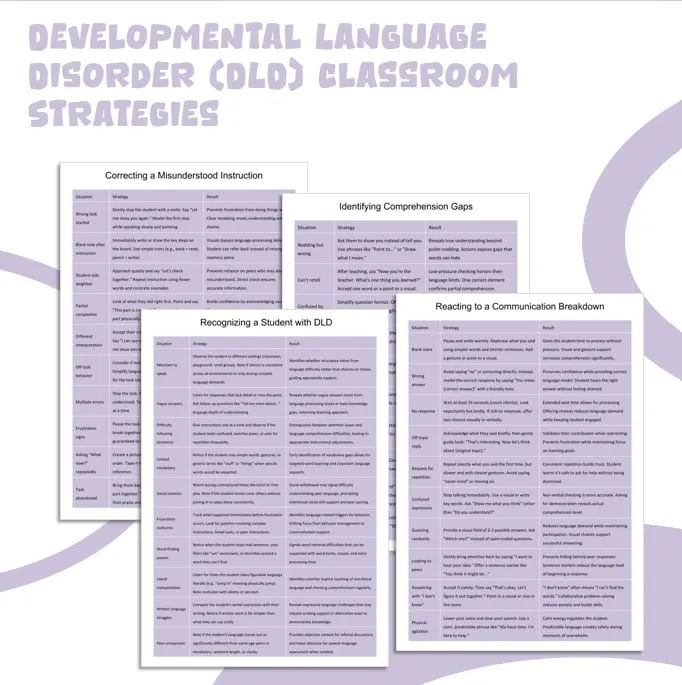
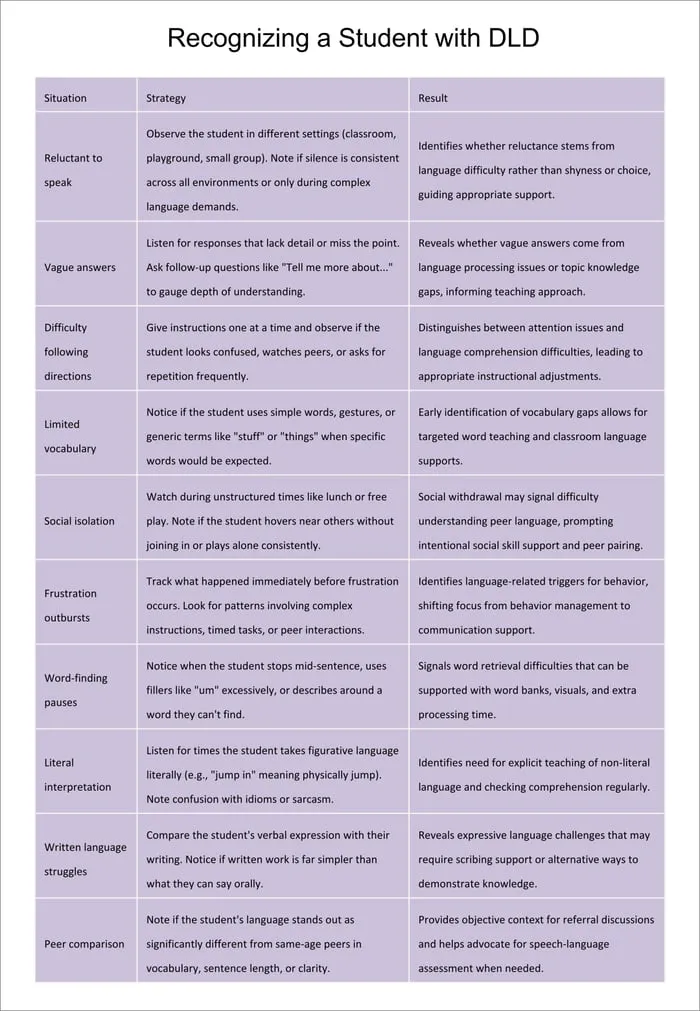
Developmental Language Disorder (DLD): Classroom Strategies: 12 pages of Situation, Strategy, and Result tables covering how to recognize DLD, identify comprehension gaps, correct misunderstood instructions, and handle communication breakdowns with simple, honest scripts.
Sources and scope
- American Speech-Language-Hearing Association (ASHA): information on language disorders and the role of speech-language pathologists.
- National Institute on Deafness and Other Communication Disorders (NIDCD): general health information on speech and language.
- IRIS Center, Vanderbilt University: free modules on instruction and supports for students with disabilities.
- IDEA, U.S. Department of Education: the law behind special education services and IEPs.
This guide covers everyday classroom habits that support students with language difficulties. It does not cover diagnosis or therapy, which belong to speech-language pathologists and the student’s team.
Key takeaways
- DLD classroom strategies start with noticing patterns and sharing them with the SLP.
- Give short, ordered directions backed by visuals.
- Pre-teach a few key words and revisit them often.
- Support speaking and writing with wait time, frames, and cues.
- Own communication breakdowns, rephrase, and track one simple measure.








Leave a Comment