

Severe working memory deficits can make ordinary classroom moments feel impossible. Picture a sixth grader who hears three directions: take out your science notebook, turn to page 42, and answer questions one through five. He takes out his notebook, then looks around, unsure what comes next. Ten minutes later, he has answered question one and moved on to something else. He is not ignoring you. The directions simply did not stay in mind long enough to use.
This guide gives you five practical steps for supporting students with significant working memory challenges. By the end, you will be able to recognize the signs, give directions in a memory-friendly way, set up external memory aids, teach step-by-step routines with a clear purpose, and track what helps.
Examples are fictional. Adapt to the student’s goals and agreed supports. This is guidance, not a diagnosis.
At a glance
- Working memory holds information in mind while we use it.
- Common signs include forgotten instructions, skipped steps, and unfinished tasks.
- Reduce how much the student must hold in mind at once.
- Move memory out of the head and onto paper, cards, and checklists.
- Teach each routine step with its purpose, then track progress.
1. Recognize the signs of severe working memory deficits
First, learn what to look for. Working memory is the ability to hold information in mind for a short time while using it, such as remembering directions while following them or keeping a number in mind while solving a problem. Serious difficulties show up when this mental workspace fills up very quickly.
Common signs include forgetting directions partway through, skipping steps in a familiar process, losing track of what they were doing, leaving tasks unfinished, and needing directions repeated often. In math, the student may lose a carried number. In writing, they may forget the sentence they planned before they finish writing it.
Then, look at when the signs appear. Working memory struggles are often worse with long spoken directions, multistep tasks, new material, and noisy settings. They are often better with short, written, or visual steps.
Meet Ben, a fictional sixth grader with a learning disability. His teacher, Ms. Alvarez, notices that Ben does well when a task has one step at a time. However, in tasks with three or more spoken directions, he usually completes only the first step. He finishes about one in four independent assignments. His family says homework is a nightly struggle.
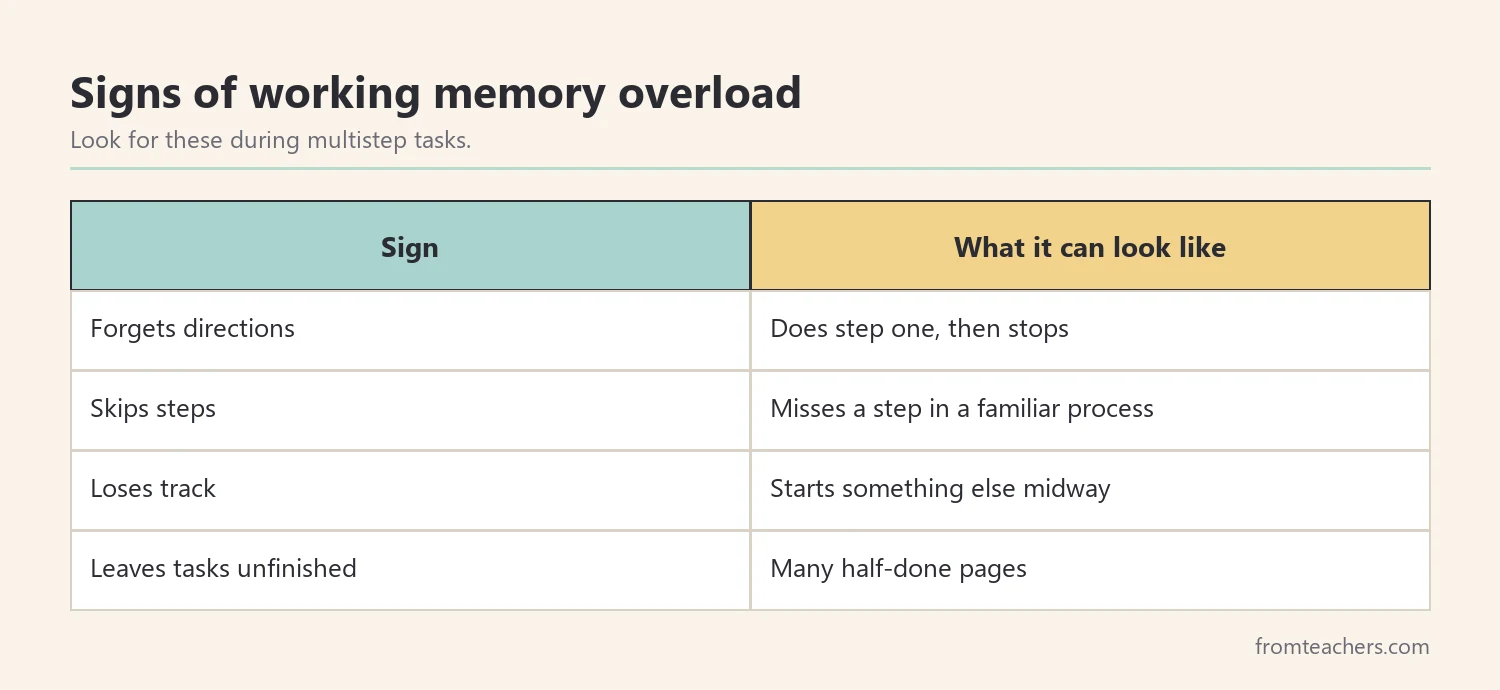
Finally, remember that working memory is different from intelligence or effort. A student can understand a concept well and still struggle to hold the steps in mind. That is why supports focus on reducing the memory load, not on simplifying the thinking.
Also, check with the team. A school psychologist or special education teacher may already have assessment information about the student’s working memory. That information can help you understand the size of the challenge and choose supports.
2. Give directions in a memory-friendly way
Now, change how directions are delivered. For students with severe working memory deficits, the way you give directions often matters as much as the directions themselves. The goal is to reduce how much the student must hold in mind at one time.
Start by giving one or two steps at a time. Wait until the student completes them, then give the next. Keep wording short and specific: “Open your notebook to page 42” instead of “Let’s get ready for science and find where we left off.” Then, put the steps in writing or show them visually, so the student can look back instead of trying to remember.
| Instead of | Try |
|---|---|
| Five spoken steps at once | Two steps, then the next two |
| Directions only spoken | Spoken plus written on the board |
| Long, wordy directions | Short phrases with key words |
| Asking “Do you understand?” | Asking “What will you do first?” |
Next, check understanding in a useful way. Asking “Do you understand?” usually gets a yes. Instead, ask the student to tell you the first step. If they can, they are ready to start. If not, repeat or show it again.
For Ben, Ms. Alvarez starts writing the steps of each task on the board in a numbered list. She also gives Ben a small copy on a sticky note. Before he starts, she asks, “What is step one?” Ben’s completion of independent assignments begins to rise within the first week.
Also, pair words with visuals when you can. A quick sketch, an icon, or pointing to the materials gives the student a second way to hold the direction. Many students remember a picture of the notebook and the page number more easily than a sentence they heard once.
Moreover, reduce competing demands while directions are given. Ask students to stop writing and look up. Noise, movement, and side conversations all take up working memory space.
3. Set up external memory aids for severe working memory deficits
Next, move memory out of the head and into the environment. External memory aids are tools that hold information so the student does not have to. They are among the most practical supports for these students, because they help in every subject.
Useful aids include task checklists, step cards, visual schedules, reference sheets with formulas or spelling patterns, number lines, word banks, and graphic organizers. For homework, a planner or a checklist on the folder can help the student remember what to bring home and what to bring back.
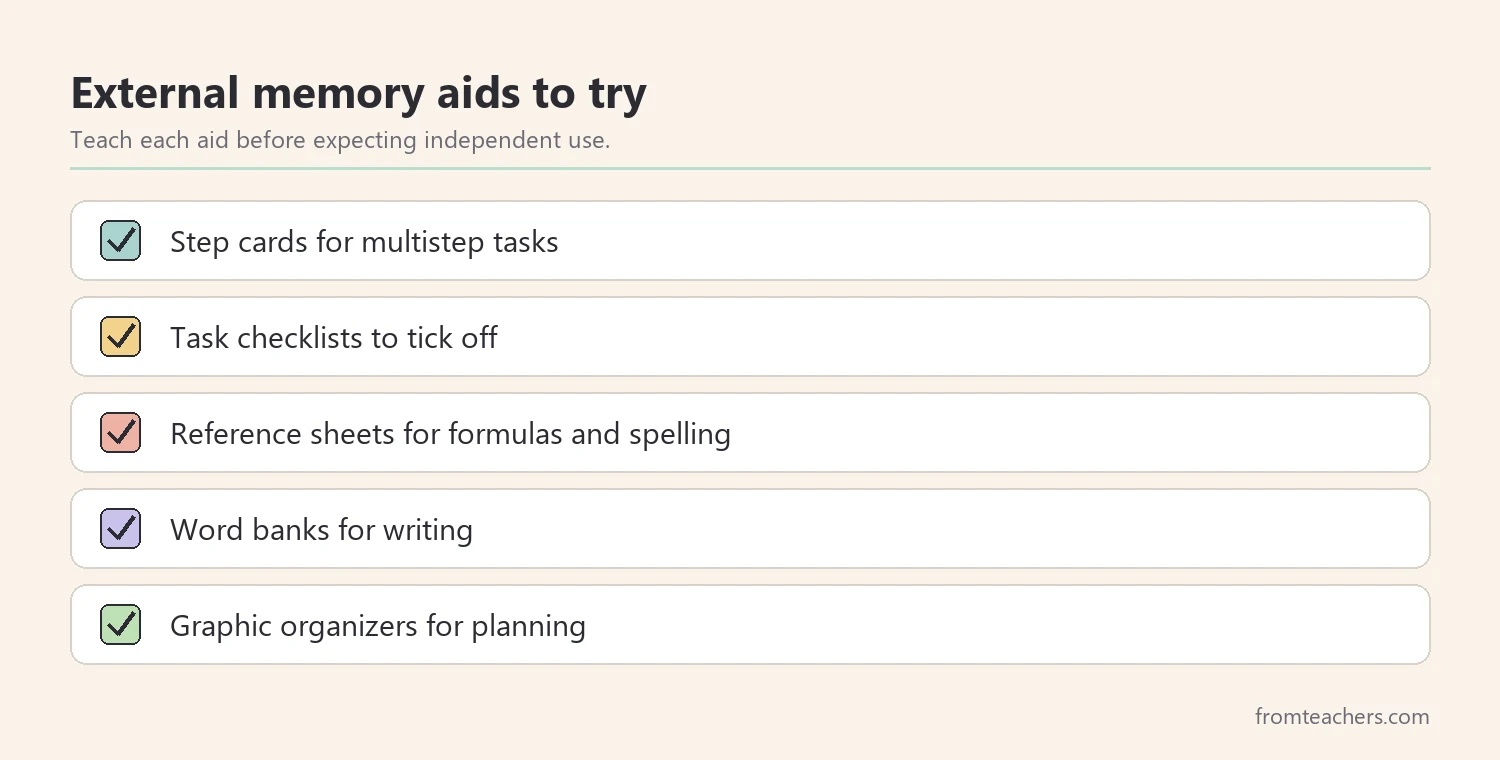
Next, place aids where the work happens. A reference sheet in a folder across the room will not help in the moment. Tape the step card to the desk, clip the checklist to the worksheet, or keep the word bank inside the writing notebook. The closer the aid is to the task, the more likely the student is to use it.
Then, teach the student to use each aid. Simply handing out a checklist is rarely enough. Model how to use it, practice together, and give feedback. Over time, the student learns to reach for the aid on their own.
For Ben, the team creates a short checklist for multistep math problems and a word bank for writing. Ms. Alvarez models the math checklist with two problems, then watches Ben use it on the third. He checks off each step as he goes.
If you want a ready-made set of supports, the memory support strategy tables from berchid.com describe common issues such as forgotten instructions and skipped steps, each with a clear step and the purpose behind it.
4. Teach routines step by step, with a purpose
Then, turn common tasks into routines. When a task is done the same way every time, it slowly moves from working memory into habit. That frees up mental space for the actual learning.
Choose a few tasks that happen often, such as starting independent work, packing up at the end of the day, or checking a math answer. Break each into a small number of steps. For each step, explain why it matters. Knowing the purpose helps the student remember the step and use it in new situations.
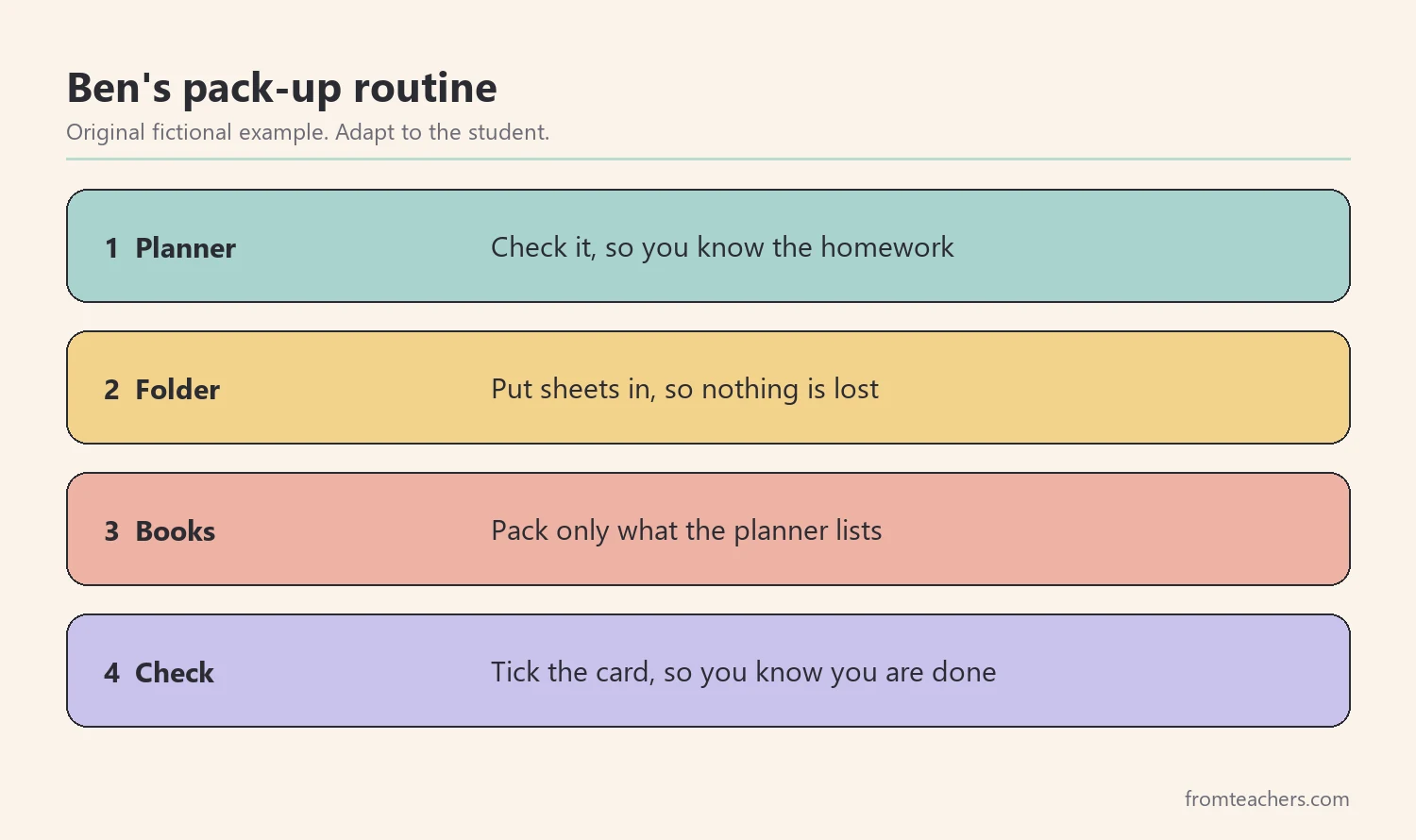
Next, practice the routine many times. Repetition is what turns a list of steps into a habit. At first, the student follows a card. Later, they may only glance at it. Eventually, the routine may run with little or no support.
For Ben, Ms. Alvarez teaches a four-step pack-up routine. Each step has a short reason, such as “Check the planner, so you know what homework you have.” After three weeks, Ben completes the routine with only a quick look at the card. His family reports fewer forgotten homework sheets.
Also, keep the number of routines manageable. Teaching too many at once overloads the very system you are trying to support. Start with one or two, and add more once the first ones are steady.
In addition, use the same words for each routine across settings. If the resource room, the general classroom, and home all use the same step names, the student does not need to translate. That consistency saves working memory, too.
5. Track progress and adjust the plan
Finally, measure whether the supports are working. Tracking keeps the plan focused and shows when to fade a support or try something new.
Keep the record simple. Each week, note how many independent tasks the student completed and how many times directions had to be repeated. Compare the numbers across several weeks, using similar tasks so the comparison is fair.
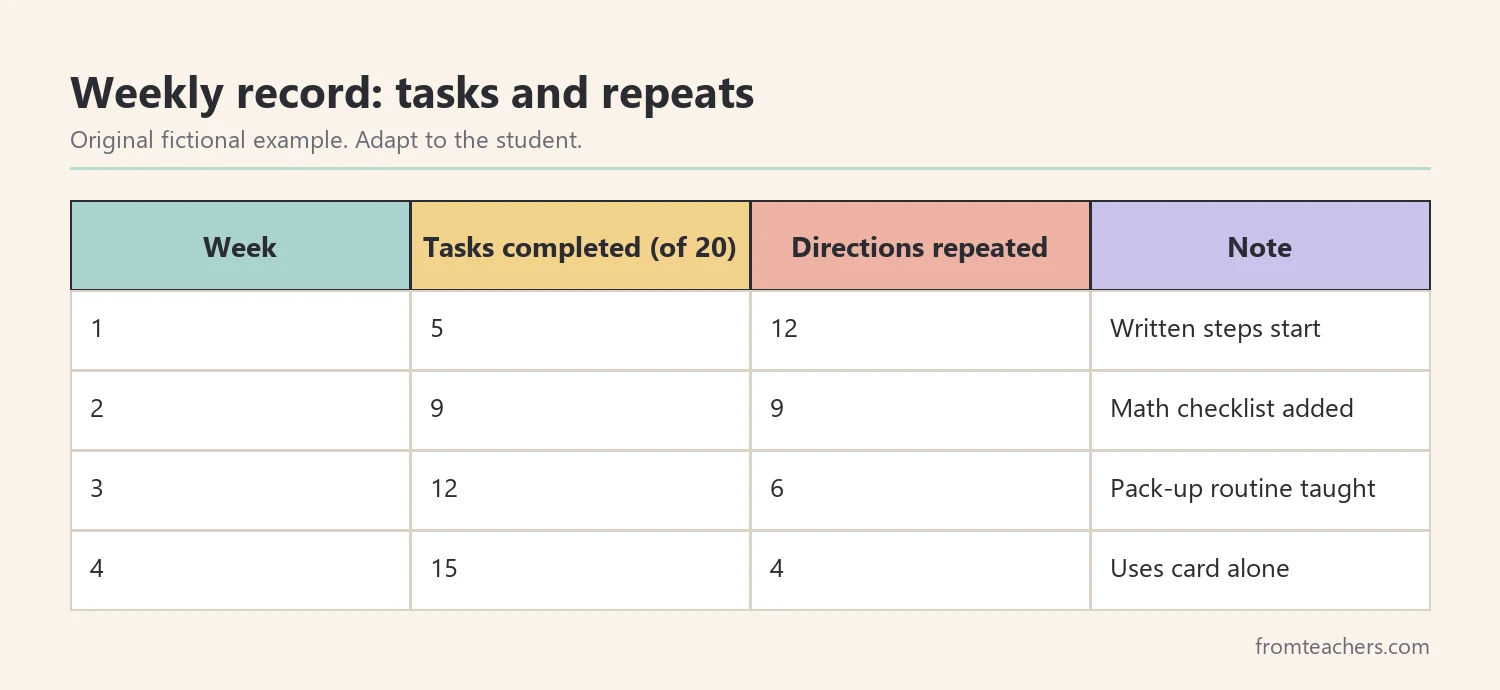
For Ben, completed independent tasks rise from five of twenty in week one to fifteen of twenty in week four. Repeated directions drop from twelve times a week to four. Those changes suggest that written steps, checklists, and routines are helping.
Then, review the plan every few weeks with the student, the family, and the team. Ask which aids the student uses most, which ones feel like extra work, and where the student still gets stuck. Adjust as needed.
In addition, look for patterns in the hard moments. If most repeated directions happen in one class or at one time of day, that setting may need extra support, such as more written steps or a quieter seat. Small adjustments in the right place often matter more than adding new tools everywhere.
Moreover, keep in mind that the goal is not to remove all supports. Many people with significant working memory challenges use external aids throughout their lives, and that is a strength, not a weakness. The aim is a student who knows which tools help and uses them independently.
Common mistakes and how to avoid them
- Repeating the same spoken directions louder. Fix: give one or two steps at a time, in writing.
- Asking “Do you understand?” Fix: ask the student to tell you the first step.
- Handing out checklists without teaching them. Fix: model, practice, and give feedback.
- Teaching too many routines at once. Fix: start with one or two and add more slowly.
- Removing all aids as soon as things improve. Fix: fade gradually and keep the tools that help.
Questions teachers and parents ask about severe working memory deficits
Is a working memory deficit the same as a learning disability?
Not exactly. Working memory difficulties are common in learning disabilities and ADHD, but they can also appear on their own or with other conditions. Only a qualified evaluation can describe a student’s profile.
Can working memory be trained?
Research on working memory training programs is mixed, especially about whether gains carry over to schoolwork. Most classroom support focuses on reducing memory load and teaching students to use aids.
How can families help with homework?
Families can break homework into small steps, use a checklist, and keep reference sheets nearby. Using the same aids at home and at school keeps support consistent. A short, quiet homework spot with the checklist and reference sheets already in place also helps the student start without searching for materials.
Will my child always need these supports?
Many students become more independent with routines and aids over time. Some will continue to use tools such as checklists and planners as adults, which is a healthy, practical strategy.
Should these supports be written into an IEP or 504 plan?
If working memory difficulties affect learning across settings, the team may discuss accommodations such as written directions, checklists, and reference sheets. Bring your data and examples of the aids that already help to that conversation.
Related reading: Accommodations vs Modifications in Special Education: The Difference Explained, Boost Access and Independence: An Assistive Technology Toolkit for Special Education, and ADHD in Children: A Guide to Effective Classroom and Home Support.
A companion resource for severe working memory deficits:
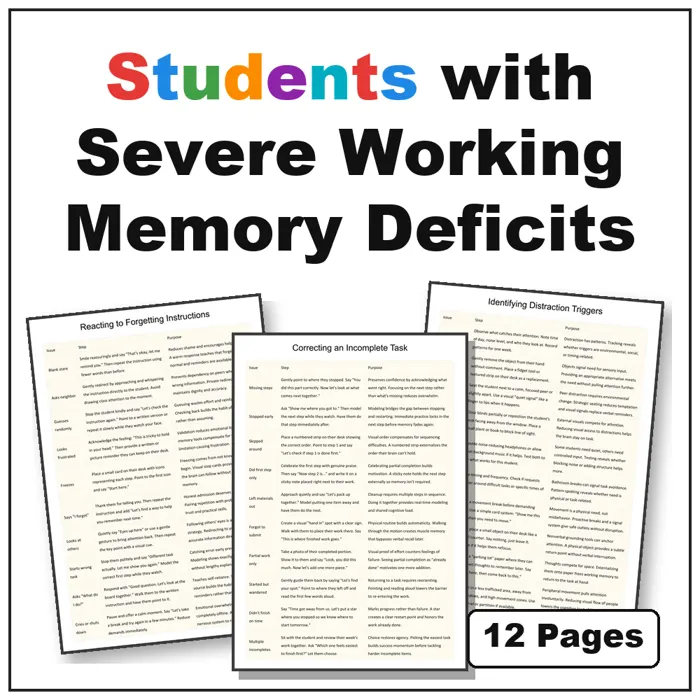
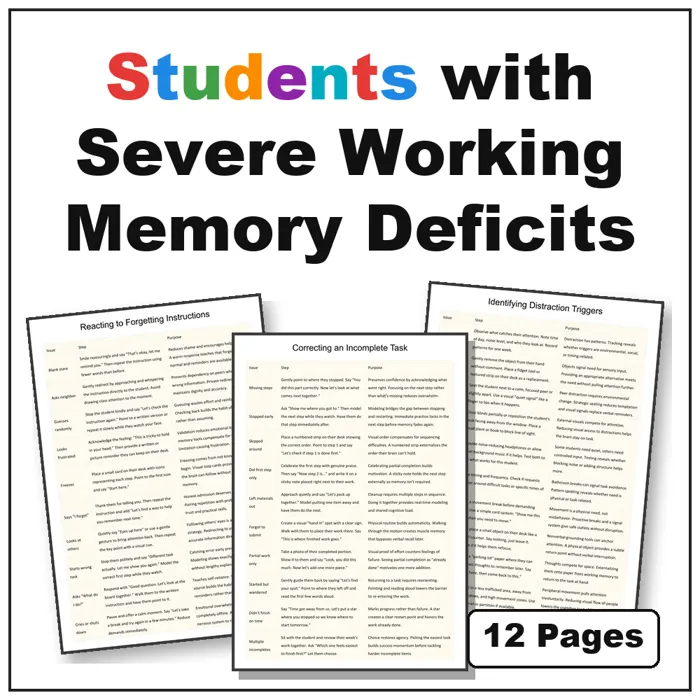
Students with Severe Working Memory Deficits: Memory Support Strategies: 12 strategy tables that describe each issue, such as forgotten instructions or skipped steps, with a clear step and the purpose behind it.
Sources and scope
- Understood.org: plain-language information on working memory and learning differences for families and teachers.
- Center on the Developing Child at Harvard University: background on executive function, including working memory.
- IRIS Center, Vanderbilt University: free modules on instruction and evidence-based practices.
- IDEA, U.S. Department of Education: the law behind special education services and IEPs.
This guide covers practical classroom and home supports for students with significant working memory challenges. It does not replace an evaluation or individualized guidance from the student’s team.
Key takeaways
- Learn the signs: forgotten directions, skipped steps, and unfinished tasks.
- Give one or two steps at a time, in writing.
- Use external memory aids and teach the student how to use them.
- Turn common tasks into routines, with a purpose for each step.
- Track completed tasks and repeated directions, and adjust with the team.










Leave a Comment