

Tiered assignments solve a problem every teacher knows well. You give one worksheet to the whole class, and within five minutes a few students are finished and bored, most are working, and a small group has not written a word. The lesson goal was fine. The single path to it was the problem.
This guide walks you through a five-step process for planning tiered assignments: set one clear goal, check readiness, design the tiers, run the lesson, and assess everyone against the same goal. By the end, you will be able to build a tiered task for your next lesson in under an hour, without writing three separate lesson plans.
Examples are fictional. Adapt to the student’s goals and agreed supports. This is guidance, not a diagnosis.
At a glance
- Keep one learning goal for everyone and change only the path to it.
- Use a short pre-check, not a guess, to decide who starts where.
- Three tiers are usually enough, and each one should be equally interesting.
- Groups are flexible: they change from lesson to lesson based on evidence.
- Assess every student against the same goal with the same simple criteria.
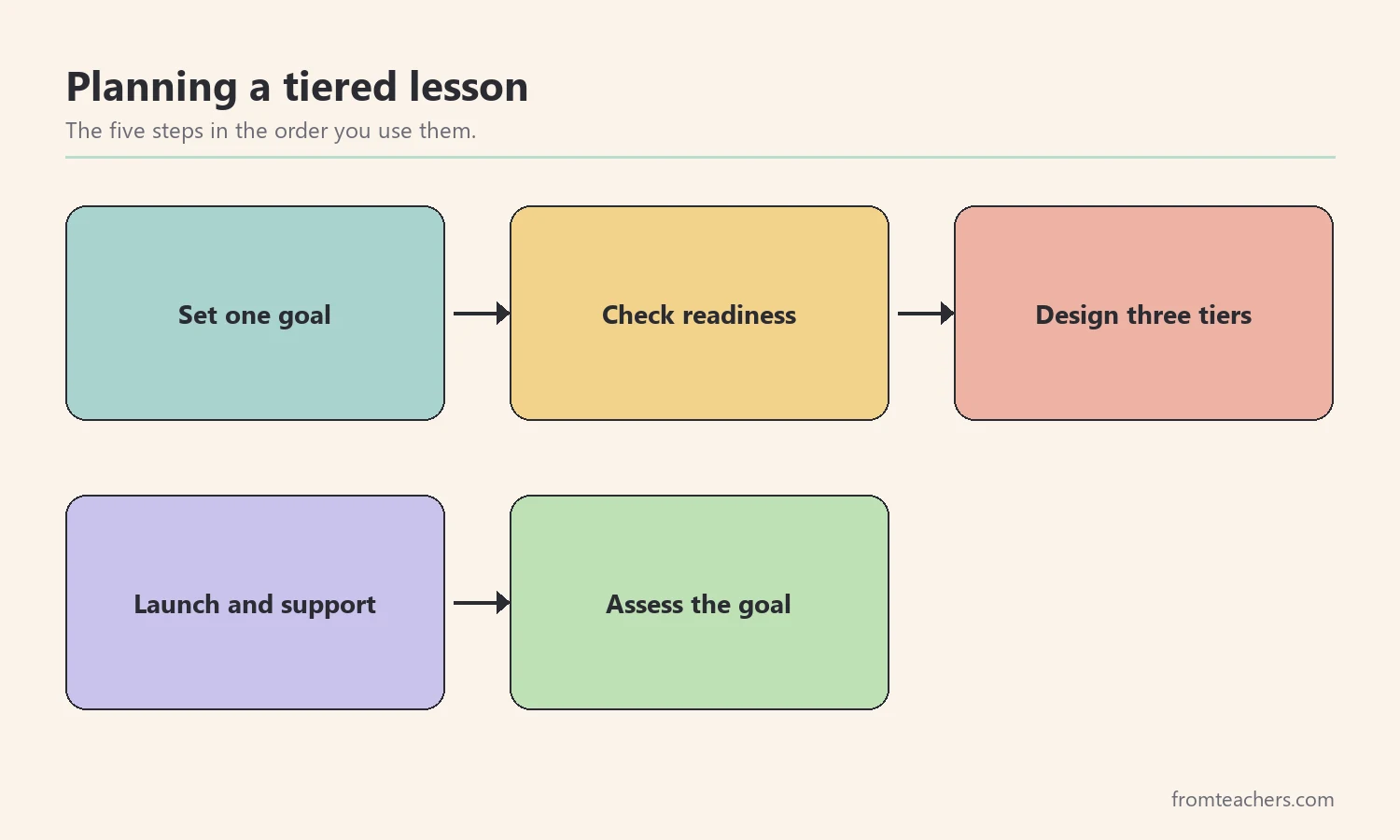
1. Start tiered assignments with one clear learning goal
Every set of tiered assignments begins with a single goal that all students work toward. If the goals differ, you are no longer tiering. Instead, you are running separate lessons, which is harder to manage and easy to lower expectations by accident.
First, write the goal as something students will be able to do, not something they will cover. “Learn about fractions” is a topic. In contrast, “Compare two fractions with different denominators and explain the reasoning” is a goal you can see and check. Next, name the essential understanding underneath it. For fractions, that might be: “A fraction’s size depends on both the numerator and the denominator.”
Then, separate what must stay the same from what can change. The goal, the key vocabulary, and the success criteria stay fixed. Meanwhile, the amount of support, the complexity of the numbers, the materials, and the way students show their thinking can all change between tiers.
| Stays the same | Can change by tier |
|---|---|
| Learning goal | Number of scaffolds |
| Key vocabulary | Complexity of examples |
| Success criteria | Materials and models |
| Time for the task | How students show thinking |
Worked example. Ms. Rivera teaches a fourth grade inclusion class of 24 students, co-taught with a special education teacher. Her goal for Tuesday is the fraction goal above. One of her students, Amir, has an IEP goal in math reasoning and uses fraction strips during independent work. Because the goal is shared, Amir will work on the same comparison skill as everyone else, just with more support built into his task.
Finally, write the goal on the board in student-friendly words. When students see that every group is working toward the same sentence, the tiers feel like different routes, not different ranks.
2. Check readiness before you build tiered assignments
Good tiered assignments depend on evidence. A quick pre-check tells you where each student is starting today, on this skill. It is not a test grade, and it does not label students for the year.
Keep the pre-check short: three to five questions that move from basic to more complex. For example, use one item that asks students to compare fractions with the same denominator, one with different denominators and a model, and one that asks them to explain their choice in words. Students can complete it as an exit ticket the day before.
Next, sort the results into three rough piles. Do not overthink the cut points. You only need enough information to choose a starting tier, and you will adjust as you watch students work.
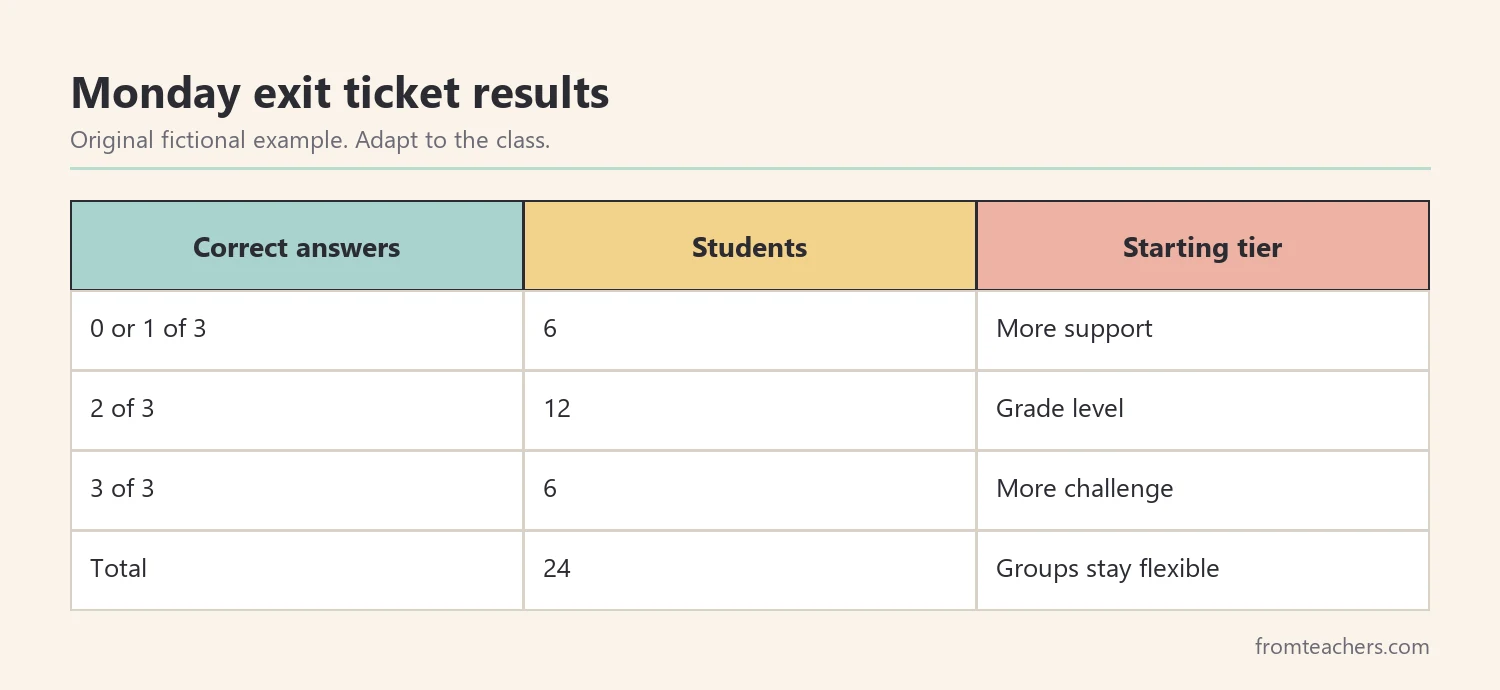
Worked example. Ms. Rivera gives a three-question exit ticket on Monday. Out of 24 students, 6 answer none or one question correctly, 12 answer two correctly, and 6 answer all three correctly. That gives her three starting groups of 6, 12, and 6, which adds up to her full class of 24. Amir answers the first question correctly with his fraction strips and starts in the group with more support.
Also, check the pre-check against IEP information. If a student has a reading accommodation, read the items aloud so you measure math, not decoding. The difference between accommodations and modifications matters here, because an accommodation changes access while the goal stays the same.
3. Design three tiers around the same goal
Now you are ready to build the tiered assignments themselves. Most teachers find that three tiers are enough. More than three becomes hard to prepare and hard to supervise, especially without a second adult in the room.
Start with the middle tier. Write the task you would give to a typical student who is ready for grade-level work. Then, adjust it in two directions. For the tier with more support, add scaffolds such as models, sentence frames, worked examples, or fewer steps at a time. For the tier with more challenge, increase complexity, abstraction, or the need to explain and justify, rather than simply adding more problems.
Importantly, each tier should be equally engaging. If one group gets a game and another gets a plain worksheet, students notice. Similarly, avoid giving the advanced group “extra” work: more of the same is not a higher tier.
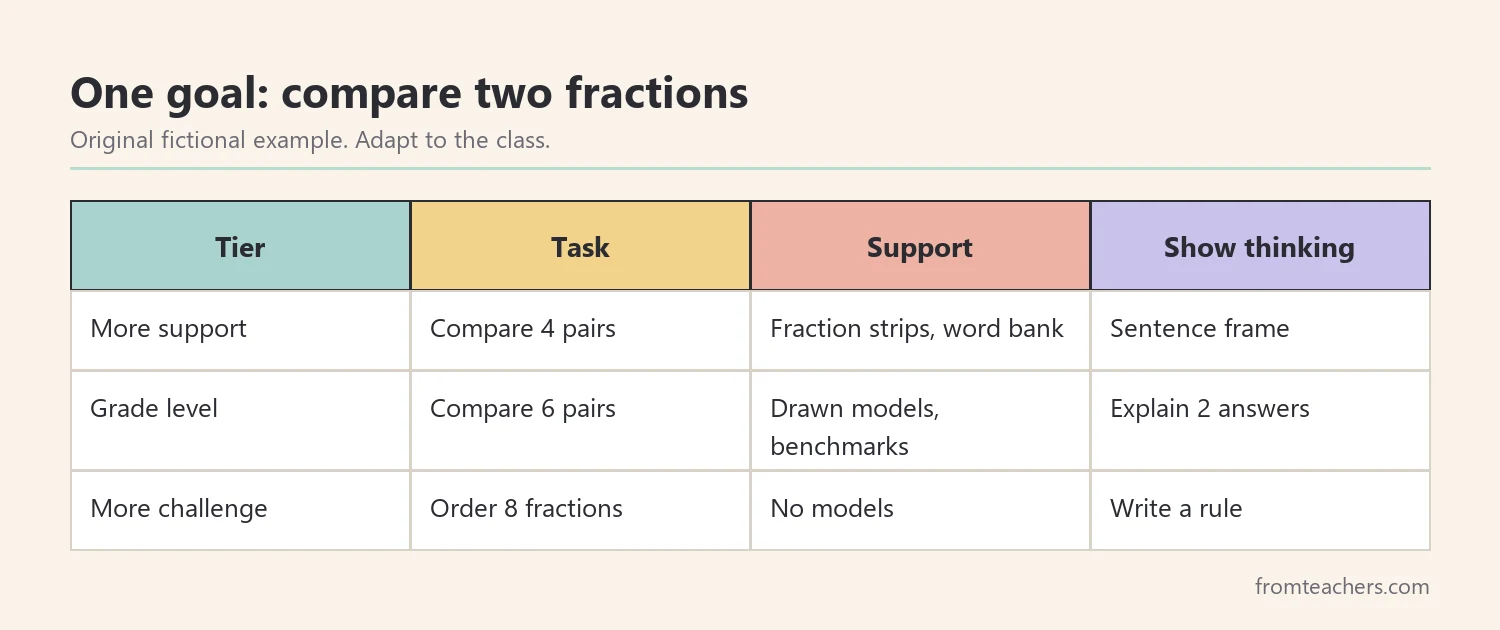
Worked example. Here are Ms. Rivera’s three tasks, all aimed at comparing fractions and explaining the reasoning:
- More support: Students compare four pairs of fractions using fraction strips, then complete the frame “___ is greater because ___.” Amir works here with his strips and a word bank.
- Grade level: Students compare six pairs using drawn models or benchmark fractions, then explain two of their answers in full sentences.
- More challenge: Students sort eight fractions from least to greatest without models, then write a rule a younger student could use.
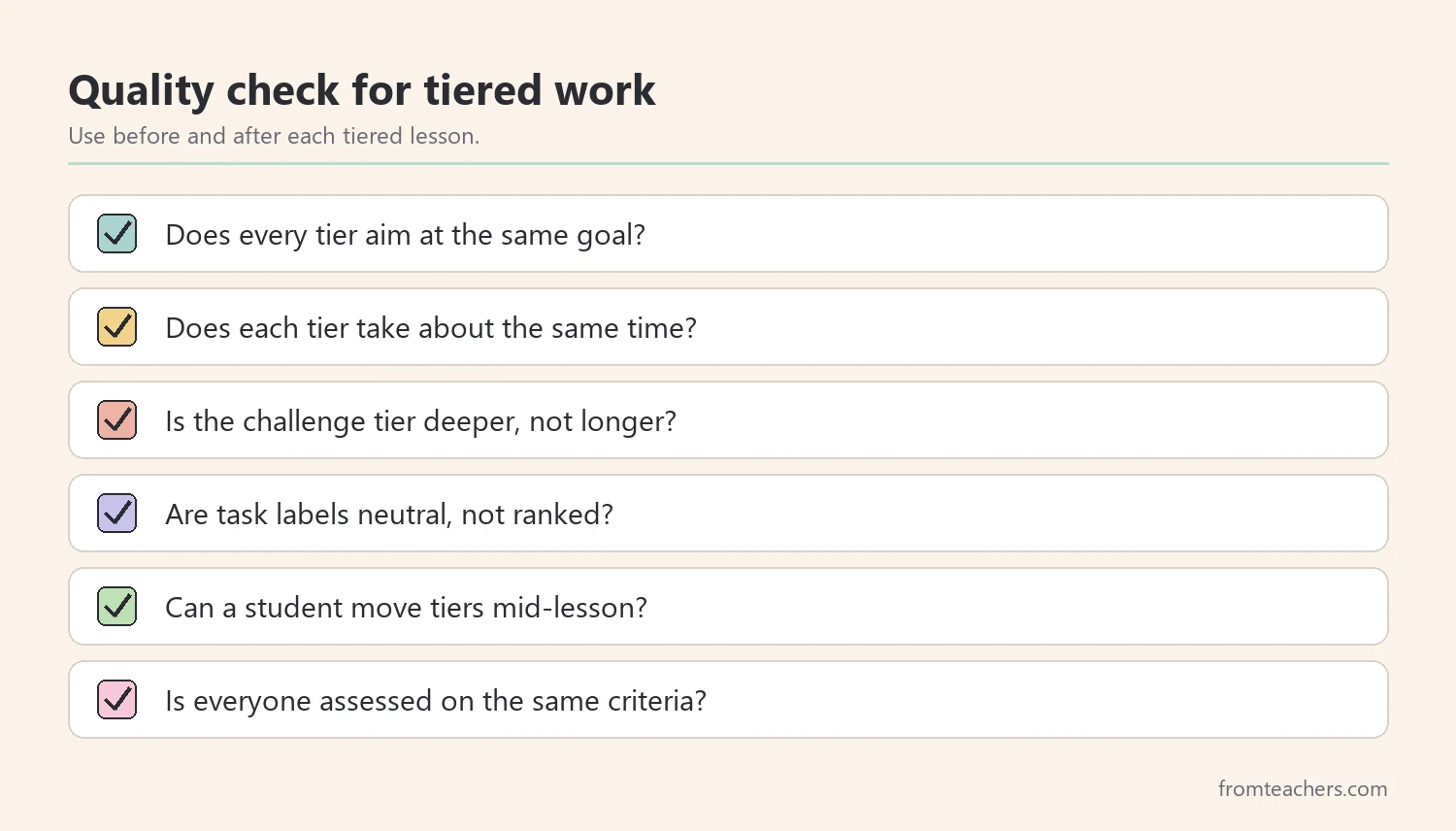
Before you print any tiered assignments, run a quick quality check. Ask whether every tier hits the goal, whether each tier takes roughly the same time, and whether a student could move up or down mid-lesson without starting over. If you want ready-made planning forms for this stage, the One Goal, Many Paths differentiation strategies guide includes templates and checklists in its appendix, along with chapters on differentiating reading, writing, and math.
4. Launch the lesson and manage the groups
Even well-designed tiered assignments can fall apart in the first five minutes if the launch is unclear. Therefore, plan the launch as carefully as the tasks themselves.
Begin with a whole-class mini-lesson of about ten minutes. Teach the shared goal, model one example, and show the success criteria. Next, hand out the tasks with neutral labels, such as shapes, task names, or table numbers. Avoid labels that rank students, and never describe the tiers as easy, medium, and hard.
Then, decide where each adult will be while students work on their tiered assignments. In a co-taught room, one teacher can sit with the group that needs the most support while the other circulates. If you are alone, start with the supported group for the first few minutes, then move to the challenge group to check their reasoning.
Worked example. Ms. Rivera calls her tasks “Strips,” “Sketch,” and “Rule.” Her co-teacher starts at the Strips table with Amir’s group. After eight minutes, Ms. Rivera notices that two students in Sketch are stuck, so she hands them a set of fraction strips. Meanwhile, one student in Strips is explaining comparisons confidently, so she invites him to try two Sketch problems.
That movement is the point of tiered assignments. Groups based on a pre-check are only a starting guess. Moreover, students should expect to move between tiers depending on the skill and the day. Over a unit, Amir might work in all three tiers at different times.
In addition, give students a quiet way to ask for help that does not stop the whole room. A help card on the desk or a short list of “ask three before me” options works well. As a result, you spend your time teaching rather than answering the same question at every table.
Finally, build in one routine for finishing early. A short “next step” card at each table, connected to the same goal, keeps fast finishers learning without inventing busywork on the spot.
5. Assess every student against the same goal
The last step closes the loop. Because tiered assignments share one goal, you can assess all students with the same success criteria, even if their tasks looked different.
First, use a short exit task that every student completes. For example, ask everyone to compare one pair of fractions and explain the answer in one sentence. Students may still use the tools listed in their IEP, such as Amir’s fraction strips, because accommodations support access without changing the goal.
Next, score each response against two or three criteria: correct comparison, a reason that matches the math, and correct vocabulary. Then, look at the results by student, not just by group. This tells you who is ready to move tiers next time and who needs a reteach.
Worked example. On Tuesday’s exit task, 20 of 24 students meet both criteria. The other 4 compare correctly but cannot yet explain why. Ms. Rivera plans a ten-minute small group for those 4 on Wednesday. Amir meets both criteria with his strips, which she records as progress toward his IEP math reasoning goal.
Over time, tiered assignments also make your records more useful. Keep them simple. A one-line note per lesson is enough: date, goal, tier, and whether the student met the criteria. After a few weeks of tiered assignments, patterns across several lessons are much more useful than a single score, and they give you something concrete to share with families and the IEP team.
Common mistakes and how to avoid them
Most problems with tiered assignments come from planning shortcuts rather than from the idea itself. Fortunately, each one has a simple fix you can apply in your next lesson.
- Different goals for different groups. Fix: write one goal first and test every tier against it.
- More work instead of deeper work. Fix: raise complexity or reasoning in the challenge tier, not the number of problems.
- Fixed groups all year. Fix: use fresh evidence for each skill and expect students to move.
- Labels that rank students. Fix: use neutral names, shapes, or table numbers for each task.
- Too many tiers. Fix: start with three, and only add a fourth for a clear reason.
- A dull supported tier. Fix: give every tier the same quality of materials and thinking.
Questions teachers and parents ask about tiered assignments
Are tiered assignments fair to students who work at grade level?
Yes, when every tier aims at the same goal and every task is meaningful. Fairness means each student gets what they need to reach the goal. It does not mean everyone gets the identical worksheet.
How often should I use tiered assignments?
Start with tiered assignments once a week, ideally on a skill where your pre-checks show a wide spread. Once the routines feel natural, you can use them more often. Many teachers reserve them for key skills rather than every lesson.
Do tiered assignments work without a co-teacher?
They do, though planning matters more. Teach a short launch, start with the supported group, and use clear written directions and early-finisher cards. Paraprofessionals can also help if they know the goal and the success criteria.
How do tiered assignments fit with an IEP?
Tiering is a classroom planning strategy, not a replacement for IEP services. However, it can help you deliver accommodations and work toward IEP goals inside the general lesson. Share your tier notes with the IEP team so decisions stay consistent.
What should I tell parents about tiered work?
Explain that all students are learning the same skill and that groups change often. Then, share what support their child used and whether they met the goal. Families usually respond well when they see clear criteria and real progress.
Related reading: Special Education Strategies, Learning Styles and Student Success, and The Power of Data Tracking in Special Education.
A companion resource for tiered assignments:
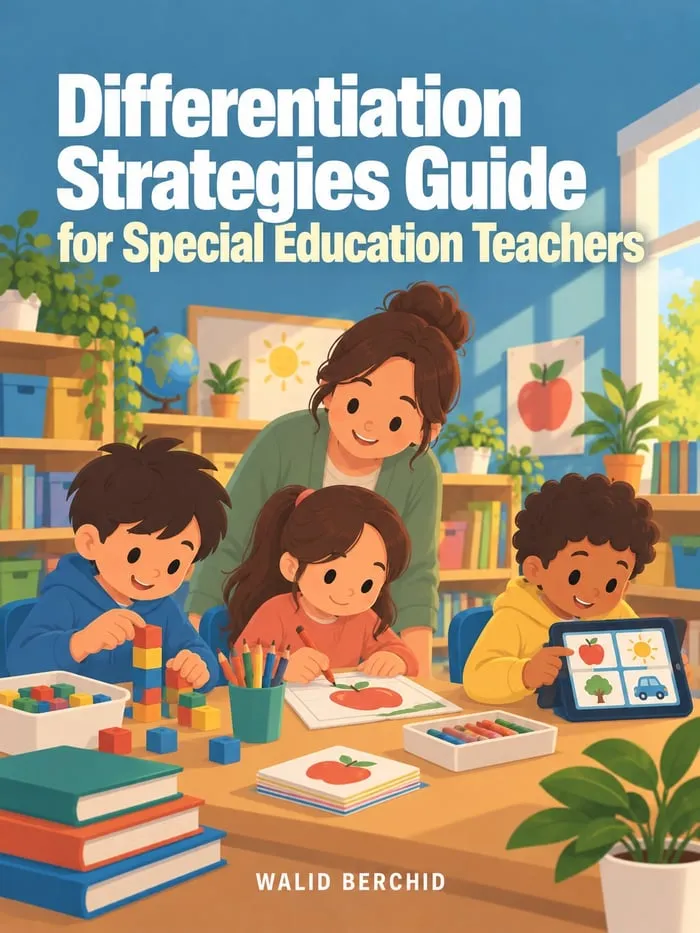
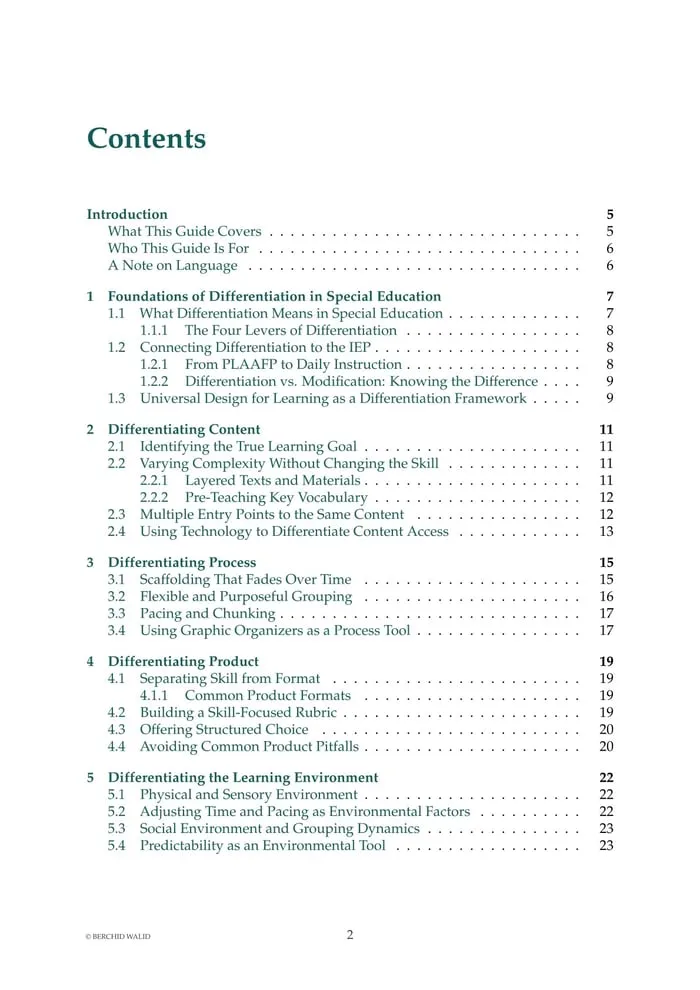
Differentiation Strategies Guide for Special Education Teachers: One Goal, Many Paths: a 61-page guide covering the foundations of differentiation, differentiating content, process, product, and environment, reading, writing, and math instruction, co-teaching, and building a sustainable system, with printable templates and checklists.
Sources and scope
- IRIS Center, Vanderbilt University: free modules on differentiated instruction and evidence-based practices.
- CAST: the organization behind Universal Design for Learning, with resources on flexible paths to shared goals.
- What Works Clearinghouse: reviews of education research, including practice guides for math instruction.
- IDEA, U.S. Department of Education: the law behind special education services and IEPs.
This guide covers planning and running tiered lessons in general and inclusion classrooms. It does not replace IEP decisions, which belong to the student’s team.
Key takeaways
- Tiered assignments keep one goal and change the path to it.
- A short pre-check decides starting tiers, and groups stay flexible.
- Build the middle tier first, then adjust support and challenge.
- Plan the launch, adult roles, and an early-finisher routine.
- Assess everyone with the same criteria and keep simple records.










Leave a Comment