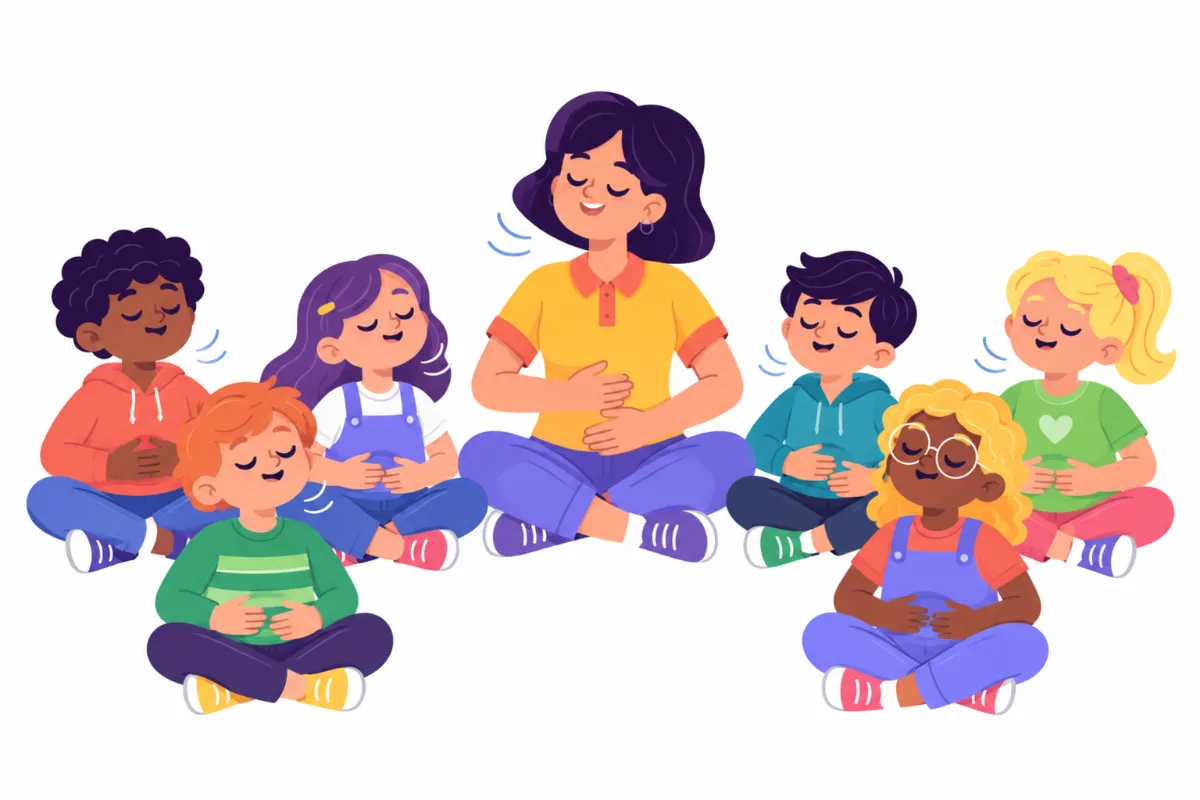

Breathing exercises for kids are one of the simplest tools a teacher or parent can use to help a child calm down and get back to learning. Picture a third grade class coming in from a loud, exciting recess: chairs scrape, voices stay high, and the math lesson cannot begin. Two minutes of slow, guided breathing can bring the room back to a calmer place.
This guide walks you through six practical steps. By the end, you will be able to explain mindful breathing in kid-friendly words, set up the space, teach belly breathing, add box and star breathing, build a daily routine, and set goals that help children use these skills on their own.
Examples are fictional. Adapt to the student’s goals and agreed supports. This is guidance, not a diagnosis or medical advice.
At a glance
- Explain breathing in simple words: slowing down your breath can help your body feel calmer.
- Teach one technique at a time, starting with belly breathing.
- Use shapes, such as a box or a star, to make each technique easy to remember.
- Practice daily during calm moments, so children can use it when they are upset.
- Set a simple goal and review it, so children learn to choose a breath on their own.
1. Explain why breathing exercises for kids help
First, give children a simple reason. Breathing exercises for kids work best when children understand what they are doing and why. Keep the explanation short and concrete: “When we feel upset, our breathing often gets fast. When we slow it down, our body can start to feel calmer.”
Next, connect it to their own experience. Ask, “How does your body feel after you run fast?” Children often notice a fast heartbeat and quick breaths. Then ask, “What helps you slow down?” This makes the idea personal rather than abstract.
| Feeling | What a child might notice |
|---|---|
| Excited or wiggly | Fast breathing, hard to sit still |
| Worried | Tight chest or tummy, short breaths |
| Angry | Hot face, clenched hands |
| Calm | Slow breaths, relaxed shoulders |
Also, avoid big promises. Breathing does not make every feeling disappear. Instead, describe it as a tool that can help children feel a bit calmer and think more clearly before they choose what to do next.
In addition, use words children already know. Instead of “regulate,” say “calm your body.” Instead of “inhale,” say “breathe in.” Simple language makes breathing exercises for kids feel friendly rather than like another school task.
Moreover, frame mindfulness simply. For young children, mindfulness can mean “paying attention to right now,” such as noticing your breath, your feet on the floor, or the sounds in the room.
Worked example. Ms. Patel teaches a fictional third grade class. Leo, age eight, often comes back from recess with lots of energy and finds it hard to start work. Ms. Patel asks the class to notice their breathing after recess. Leo says, “Mine is super fast.”
2. Prepare the space and the body
Next, set up for success. Breathing exercises for kids are easier when children feel comfortable and safe. You do not need special equipment, but a few small choices help.
Preparation checklist
- Choose a calm moment to teach a new technique, not a moment of upset.
- Invite children to sit tall in their chairs or cross-legged on the floor.
- Offer the choice to close their eyes or look softly at the floor.
- Dim the lights or lower your voice if that suits your class.
- Model every step yourself, slowly and calmly.
Also, keep it optional and inviting. Some children feel uncomfortable closing their eyes or focusing on their body. Let them watch first, or simply breathe along with you with eyes open. Never force participation.
Similarly, think about timing. Teaching breathing exercises for kids right after lunch or at the start of a calm morning gives children the best chance to focus on something new.
Then, use a visual. A picture, a poster, or a shape drawn on the board gives children something to follow. Visual guides help children remember each step and make the practice feel less abstract.
For a full set of visuals, the Mindful Minutes guide to breathing exercises for the classroom covers what mindfulness is, why mindful breathing works, how to prepare, and techniques such as belly, box, and star breathing, with goals and a review.
Worked example. Ms. Patel dims the lights after recess and asks children to sit tall with feet flat on the floor. She models first while children watch. Leo chooses to keep his eyes open and look at the board.
3. Teach belly breathing first
Then, start with belly breathing. It is simple, it needs no counting, and it helps children notice their breath. Many teachers use it as the foundation for other breathing exercises for kids.
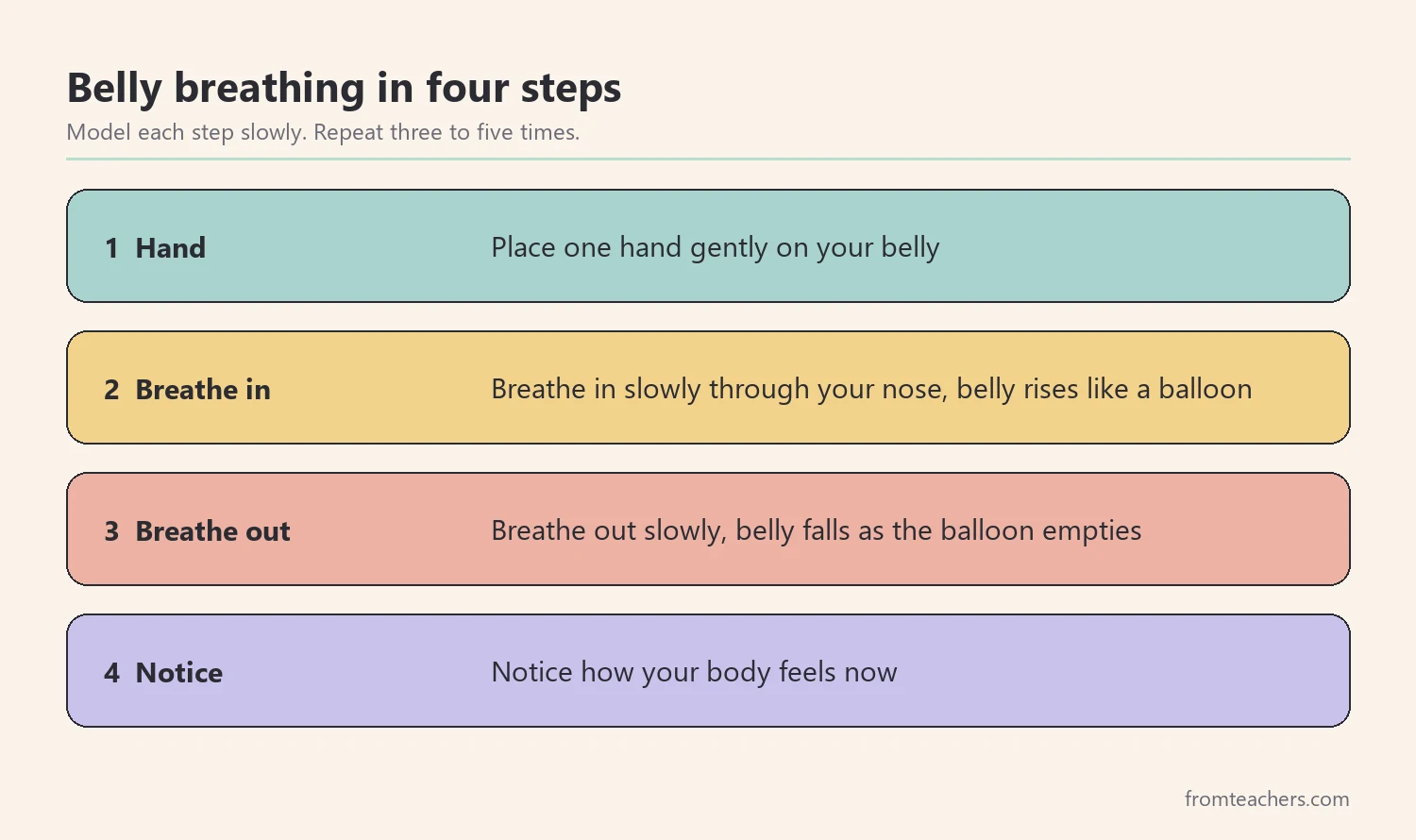
Ask children to place one hand on their belly. As they breathe in slowly through the nose, their belly gently rises, like a balloon filling up. As they breathe out slowly, the belly falls, like the balloon letting air out. Repeat three to five times.
Also, add a playful image. For younger children, place a small stuffed animal on the belly while lying down, and watch it rise and fall. For older children, imagine smelling a flower on the in-breath and blowing out a candle on the out-breath.
However, keep it slow and gentle. If a child feels dizzy, they should stop and breathe normally. Remind children that the goal is calm breathing, not big, forceful breaths.
Worked example. Ms. Patel calls belly breathing “balloon breathing.” Leo places his hand on his belly and watches it rise and fall. After three breaths, he says his body feels “a little slower.”
4. Add box and star breathing
Next, add techniques with a shape. Shapes give children a clear, memorable path to follow, which makes breathing exercises for kids easier to use on their own later.
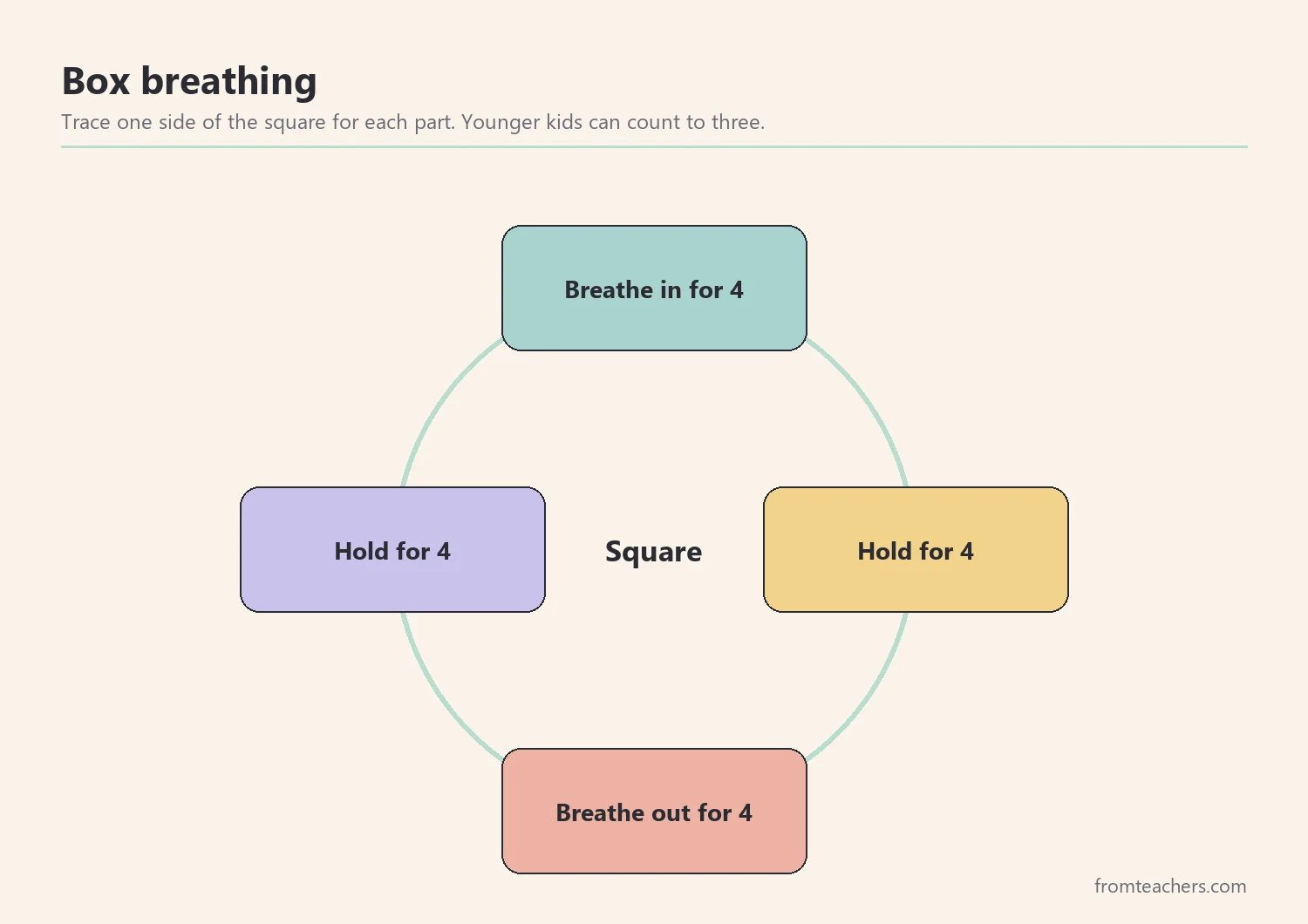
Box breathing follows the four sides of a square. Children trace one side for each part of the breath: breathe in for four counts, hold for four, breathe out for four, and hold for four. Younger children can use a count of three instead.
Star breathing uses a five-pointed star. Children trace up one side of a point while breathing in, then down the other side while breathing out. By the time they go around the whole star, they have taken five slow breaths.
Also, let children trace with a finger in the air, on a desk, or on a printed card. This adds movement, which helps many children stay focused. In addition, you can try other ideas such as “bunny breaths” with quick sniffs or “snake breaths” with a long hiss on the out-breath.
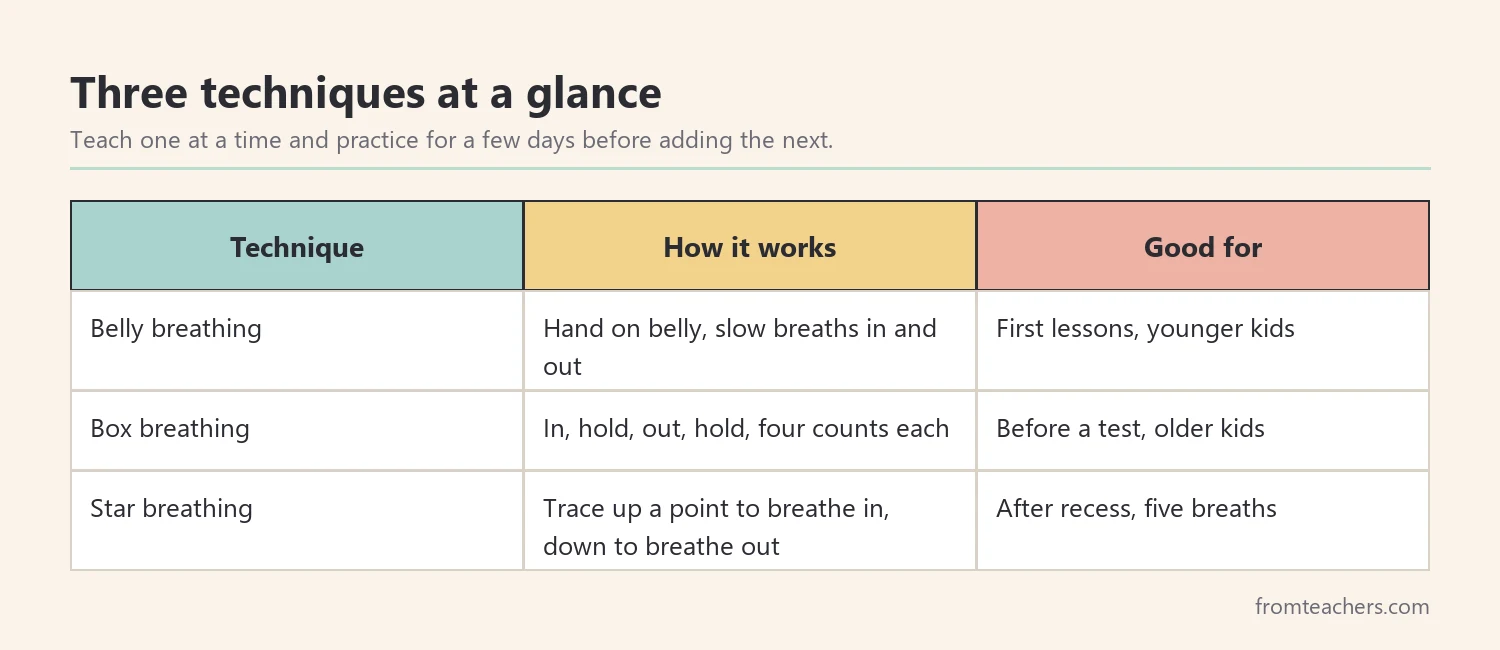
Teach one technique at a time, and practice it for a few days before adding the next. Breathing exercises for kids stick better when each one feels familiar before a new one arrives. Too many options at once can be confusing.
Worked example. In week 2, Ms. Patel introduces star breathing. Each child gets a small star card taped to the desk. Leo traces all five points and says it is his favorite because “you know when you’re done.”
5. Build a daily routine for breathing exercises for kids
Then, make breathing part of the day. Breathing exercises for kids work best when they are practiced often in calm moments, so the skill is ready when strong feelings show up. A routine also helps the whole class reset at predictable times.
| Time | Practice | Length |
|---|---|---|
| Morning meeting | Belly breathing | 1 minute |
| After recess | Star breathing | 1 to 2 minutes |
| Before a test | Box breathing | 1 minute |
| End of day | Child’s choice | 1 minute |
Keep each session short. One or two minutes is enough. Furthermore, use a consistent signal, such as a chime, a hand gesture, or a phrase like “Let’s take a mindful minute.”
Also, add a calm corner with breathing cards. Children can visit the corner when they need a break and choose a technique on their own. Teach the corner routine during calm times first, so children know how to use it.
Over time, children may start to ask for breathing exercises for kids by name, such as “Can we do star breathing?” That is a good sign the routine has become their own.
Share the routine with families, too. A short note with the names of the techniques lets parents use the same words at bedtime or before a busy morning.
Worked example. Ms. Patel rings a soft chime after every recess, and the class does one round of star breathing. A calm corner holds belly, box, and star breathing cards. Leo now visits the corner once or twice a week on his own.
6. Set goals and review progress
Finally, help children own the skill. The long-term aim is for children to notice when they need a break and choose a breathing technique themselves. Simple goals make this visible.
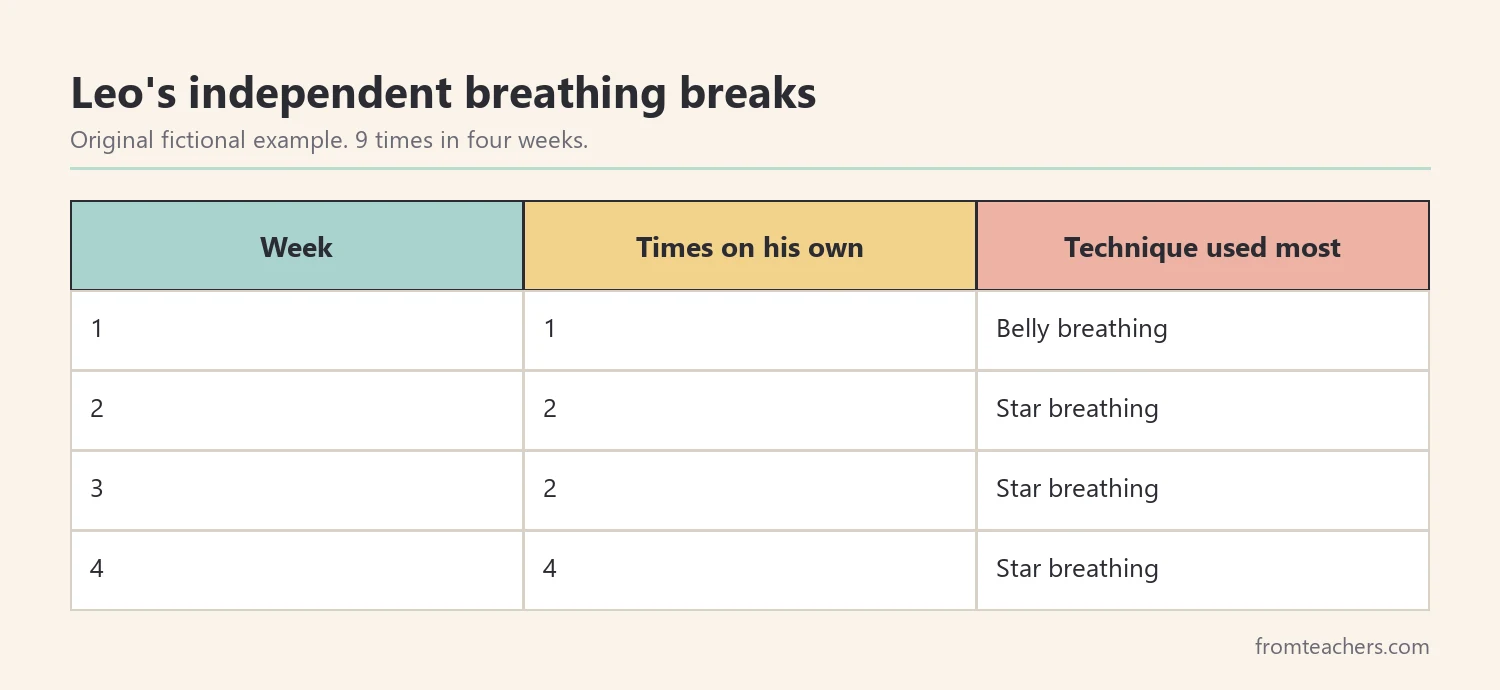
Start with a class goal, such as “We will practice star breathing after every recess this week.” Then, for individual children, choose one small goal, such as “I will use a breathing card when I feel upset.” Track it with a simple tally.
Review progress with breathing exercises for kids every week or two. Ask children which technique they like best and when it helps. In addition, celebrate effort: “You noticed you were upset and chose to breathe. That is a great skill.”
However, know when to seek more help. If a child seems very anxious, has frequent strong outbursts, or has breathing or health concerns, talk with the family, the school counselor, and the school nurse. Breathing exercises support calm, but they do not replace individual support.
Worked example. Leo’s goal is to use a breathing card on his own when he feels frustrated. Ms. Patel tallies his independent uses: 1 in week 1, 2 in week 2, 2 in week 3, and 4 in week 4. That is 9 times in four weeks, and Leo picks star breathing most often.
Common mistakes and how to avoid them
Breathing exercises for kids are simple, but a few habits can get in the way.
- Teaching a new technique during a meltdown. Fix: teach in calm moments, then use it when needed.
- Making breaths too big or fast. Fix: model slow, gentle breathing and stop if a child feels dizzy.
- Introducing too many techniques at once. Fix: teach one, practice for a few days, then add another.
- Forcing participation. Fix: invite, model, and let children watch first.
- Only using breathing as a consequence. Fix: practice daily as a positive routine.
Questions teachers and parents ask about breathing exercises for kids
What age are breathing exercises for kids suitable for?
Simple techniques can work from early elementary through middle school. Younger children often like playful images, such as balloons or stuffed animals, while older students may prefer box breathing and a quiet count.
How long should a breathing break last?
One or two minutes is usually enough. Short, regular practice is easier to keep up than long sessions, and it builds a habit over time.
What if a child laughs or refuses?
That is common at first. Keep it light, model calmly, and let them watch. Many children join in once the routine feels familiar.
Can parents use breathing exercises for kids at home?
Yes. Bedtime, the morning rush, and homework time are good moments to try. Using the same names as school, such as star breathing, helps children connect both places.
Is breathing a replacement for counseling or medical care?
No. Breathing is a helpful everyday tool, but it does not replace support from a counselor, doctor, or mental health professional when a child needs it.
Related reading: Managing Sensory Overload: Practical Strategies for Autism and ADHD, 5 Practical Teaching Tips to Boost Classroom Focus and Learning, and Essential Trauma-Informed Teaching Strategies for Modern Classrooms.
A companion resource for teaching breathing exercises for kids:
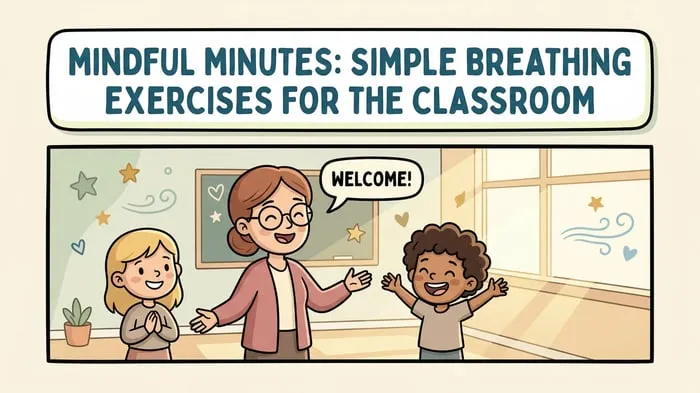
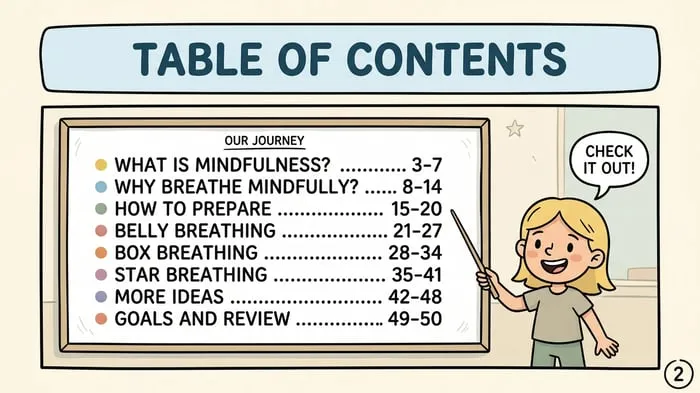
Mindful Minutes: Breathing Exercises for the Classroom: a 50-page visual guide covering mindfulness, why mindful breathing works, how to prepare, belly, box, and star breathing, more breathing ideas, and goals with a review.
Sources and scope
- CASEL: guidance on social and emotional learning, including self-management skills.
- HealthyChildren.org, American Academy of Pediatrics: parent information on children’s emotional health and wellbeing.
- Child Mind Institute: articles for families and educators on anxiety, stress, and coping skills.
- Greater Good Science Center, UC Berkeley: practical resources on mindfulness and wellbeing for educators.
This guide covers simple breathing routines that teachers and parents can use for everyday calm and focus. It does not replace medical, counseling, or mental health care for a child with ongoing needs.
Key takeaways
- Explain breathing exercises for kids in simple, concrete words.
- Start with belly breathing, then add box and star breathing one at a time.
- Use shapes and visuals so children can follow each technique on their own.
- Practice breathing exercises for kids briefly every day in calm moments.
- Set a small goal, track it, and celebrate independent use.

Leave a Comment