

Special education law basics can feel like a foreign language the first time you sit in a school meeting. Picture a parent hearing “FAPE,” “LRE,” “prior written notice,” and “procedural safeguards” in the first ten minutes, while trying to follow what the team is saying about her child. She nods along, but she leaves with more questions than answers.
This guide explains the core ideas in six plain steps: the main laws, referral and evaluation, eligibility and the IEP, placement and inclusion, parent rights, and what to do when you disagree. By the end, you will know the vocabulary, the usual order of events, and the questions to ask at each stage.
Examples are fictional. Adapt to the student’s goals and agreed supports. This is guidance, not a diagnosis, and it is not legal advice.
At a glance
- IDEA, Section 504, and the ADA are the three federal laws you will hear about most.
- An evaluation needs parent consent and follows set timelines.
- Eligibility under IDEA leads to an IEP written by a team that includes the parents.
- Students are educated with peers without disabilities to the maximum extent appropriate.
- Parents have specific rights, and there are clear options when the team disagrees.
1. Learn the three main laws: special education law basics
First, know which law is being discussed. Three federal laws come up again and again, and each one does a different job. Mixing them up is one of the most common sources of confusion in meetings, so this is where special education law basics begin.
The Individuals with Disabilities Education Act, or IDEA, is the main special education law. It requires public schools to provide eligible children with a free appropriate public education, known as FAPE. Under IDEA, eligible students receive an Individualized Education Program, or IEP, with specially designed instruction and related services. Part B of IDEA covers children and youth ages 3 through 21, while Part C covers early intervention for infants and toddlers.
Section 504 of the Rehabilitation Act is a civil rights law. It prohibits discrimination on the basis of disability in programs that receive federal funds, including public schools. Students who qualify under Section 504 often have a 504 plan with accommodations, such as extra time or preferential seating.
The Americans with Disabilities Act, or ADA, is a broader civil rights law. It applies to many public and private settings beyond school, and it supports access and equal opportunity.
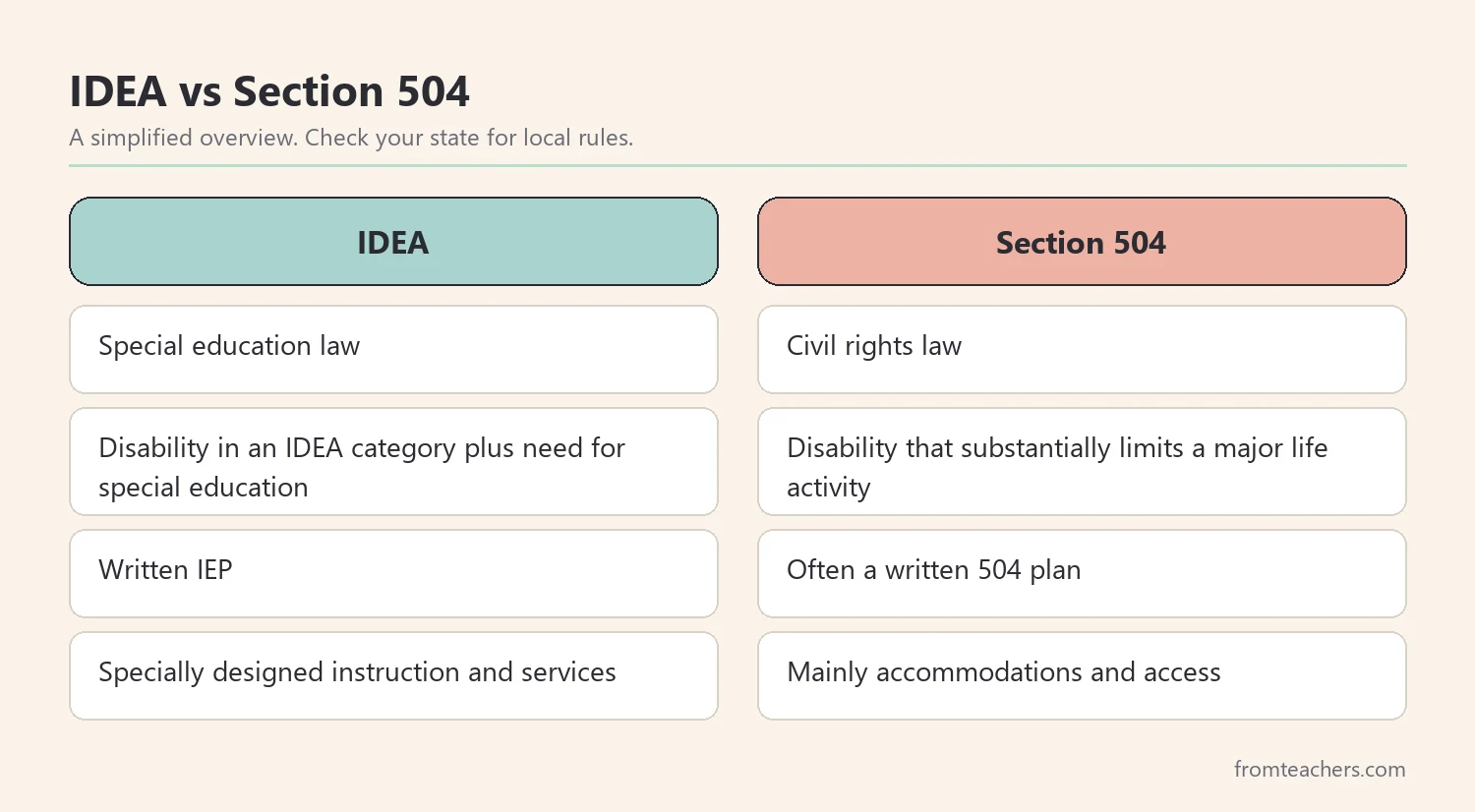
Worked example. Priya is the fictional mother of Sam, a second grader who struggles with reading. Sam’s teacher, Mr. Cole, mentions a “504” and an “IEP” in the same conversation. Priya now understands the difference: an IEP comes from IDEA and includes specially designed instruction, while a 504 plan usually provides accommodations under a civil rights law.
In short, special education law basics start with naming the right law. Once you know which one applies, the rest of the process makes more sense.
2. Special education law basics for referral and evaluation
Next, learn how the process begins, because special education law basics follow a fixed order. Under IDEA, schools have a duty often called Child Find: they must identify, locate, and evaluate children who may have disabilities and need special education. A referral for evaluation can come from the school or from a parent.
Before an initial evaluation, the school must get the parent’s informed written consent. Then, the evaluation must be completed within 60 days of receiving consent, or within the timeline your state sets if it has its own. The evaluation should look at all areas related to the suspected disability, and it should use a variety of tools, not a single test.
As a parent, you can request an evaluation in writing at any time. A written, dated request creates a clear record. Keep a copy, and note the date the school receives it.
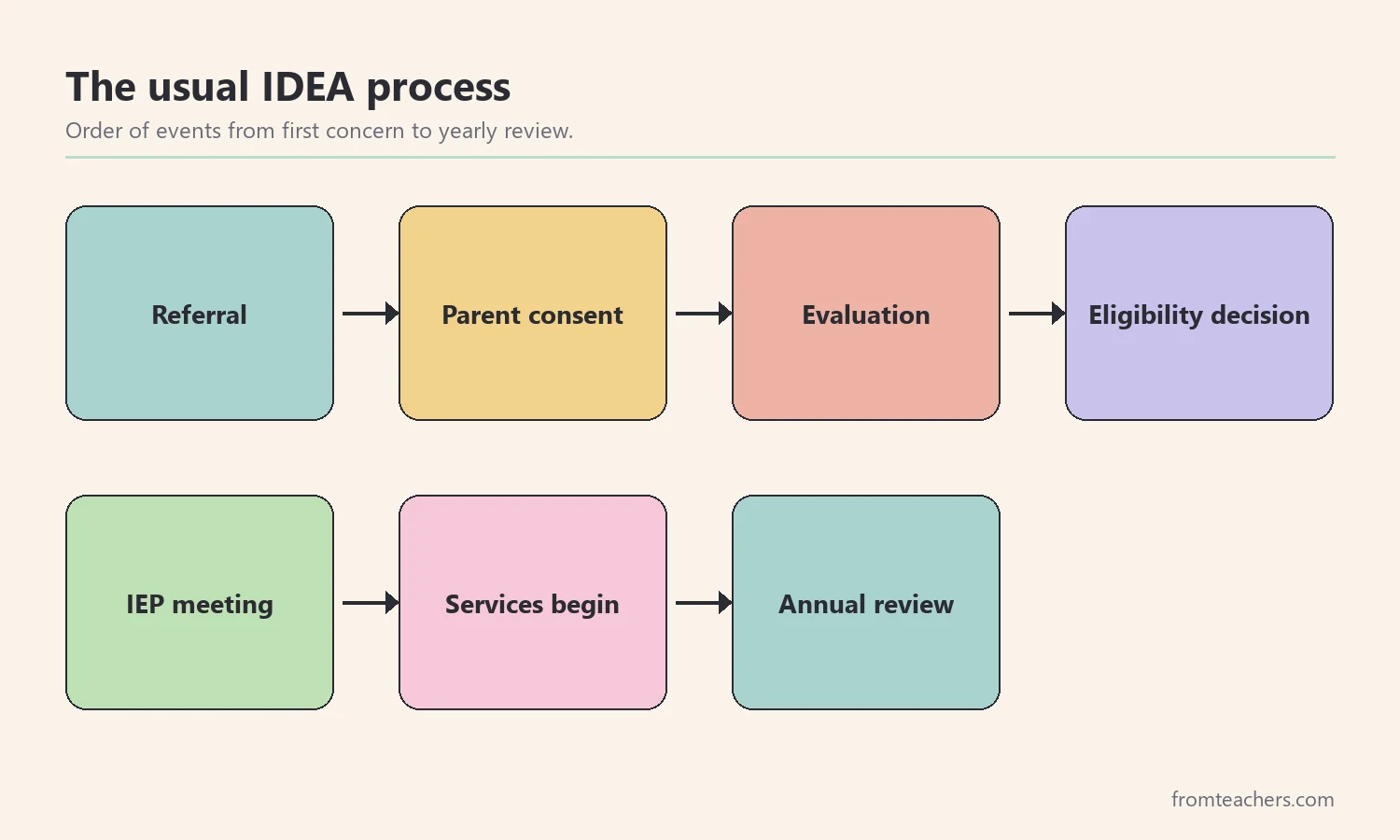
Worked example. Priya sends a dated letter to the principal asking for a full evaluation of Sam’s reading. The school sends a consent form, and Priya signs it on October 1. The evaluation is finished on November 20, which is 50 days after consent. That fits within the 60-day federal timeline.
In other words, the dates matter. Writing them down is one of the most practical special education law basics a parent can learn.
3. Know how eligibility and the IEP work
After the evaluation, the next of the special education law basics is eligibility. A team that includes the parents decides whether the child is eligible. Under IDEA, two questions must both be answered yes. Does the child have a disability in one of the categories IDEA lists? And, because of that disability, does the child need special education?
If the answer is yes, the team must hold a meeting to develop the IEP within 30 days of determining eligibility. The IEP is a written plan. Among other parts, it describes the child’s present levels of performance, measurable annual goals, how progress will be measured and reported, the services and supports the school will provide, and how much the child will take part in general education.
| IEP part | What it answers |
|---|---|
| Present levels | Where is the child now? |
| Annual goals | What should the child learn this year? |
| Progress reporting | How and when will we know? |
| Services and supports | What will the school provide? |
| Participation | How much time with general education peers? |
The IEP team includes the parents, at least one general education teacher if the child is or may be in general education, at least one special education teacher, a school representative, and someone who can interpret evaluation results. Furthermore, the student may attend when appropriate. The IEP is reviewed at least once a year, and the child is reevaluated at least every three years unless the parent and school agree it is not needed.
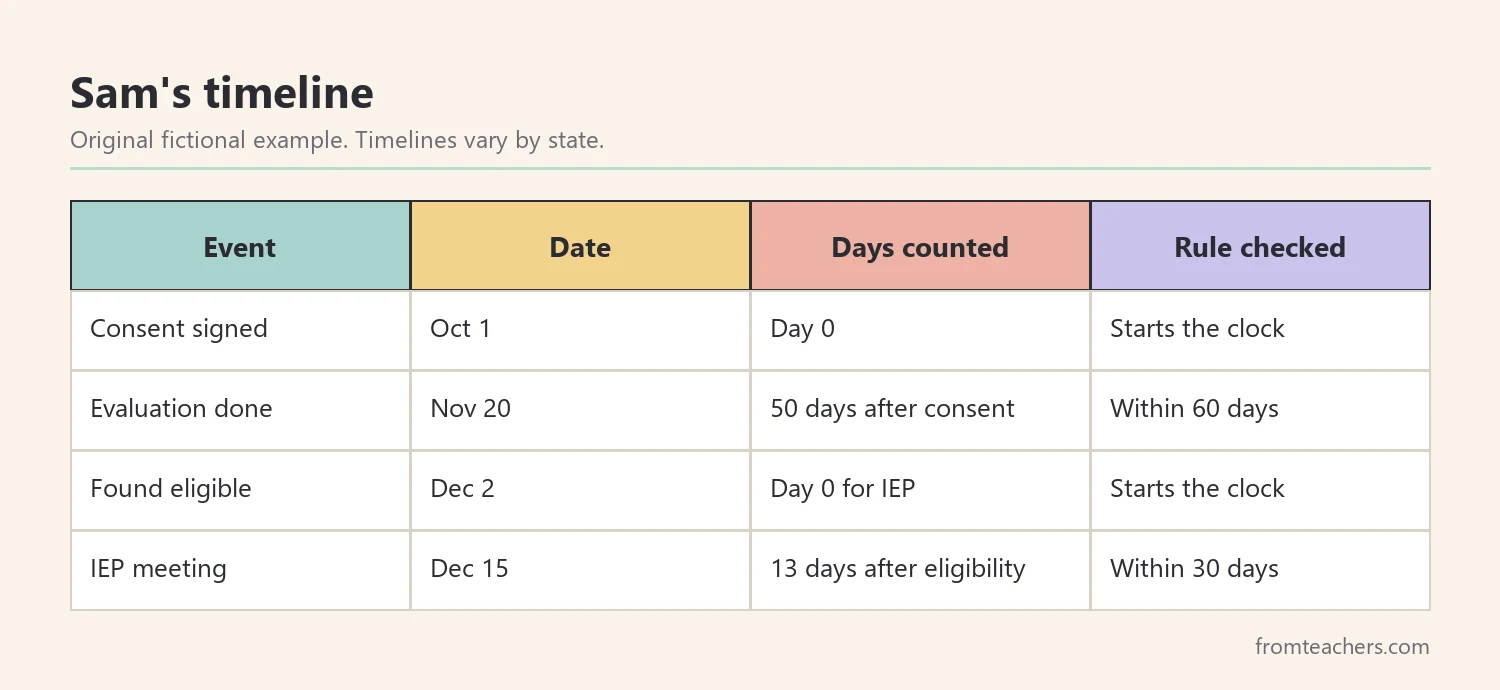
Worked example. Sam’s team meets on December 2 and finds him eligible under the category of specific learning disability. The IEP meeting is held on December 15, which is 13 days later and inside the 30-day limit. His IEP includes a reading fluency goal and small-group reading instruction several times a week.
If you want one reference that connects these pieces, the Special Education Complete Guide on IDEA, IEPs, assessment, and inclusion explains IEP components, the development process, team roles, and parental rights in one place.
4. Understand placement and the least restrictive environment
Another of the core special education law basics is the least restrictive environment, or LRE. Under IDEA, children with disabilities are educated with children who do not have disabilities to the maximum extent appropriate. Removal from the general education class should happen only when the child cannot be educated there satisfactorily, even with supplementary aids and services.
Under special education law basics, placement is decided by a group that includes the parents, and it is based on the IEP, not on the label or on which programs happen to have open seats. Schools must also have a range of placement options available. The figure below shows that range, from the most inclusive setting at the base to the most separate at the top.
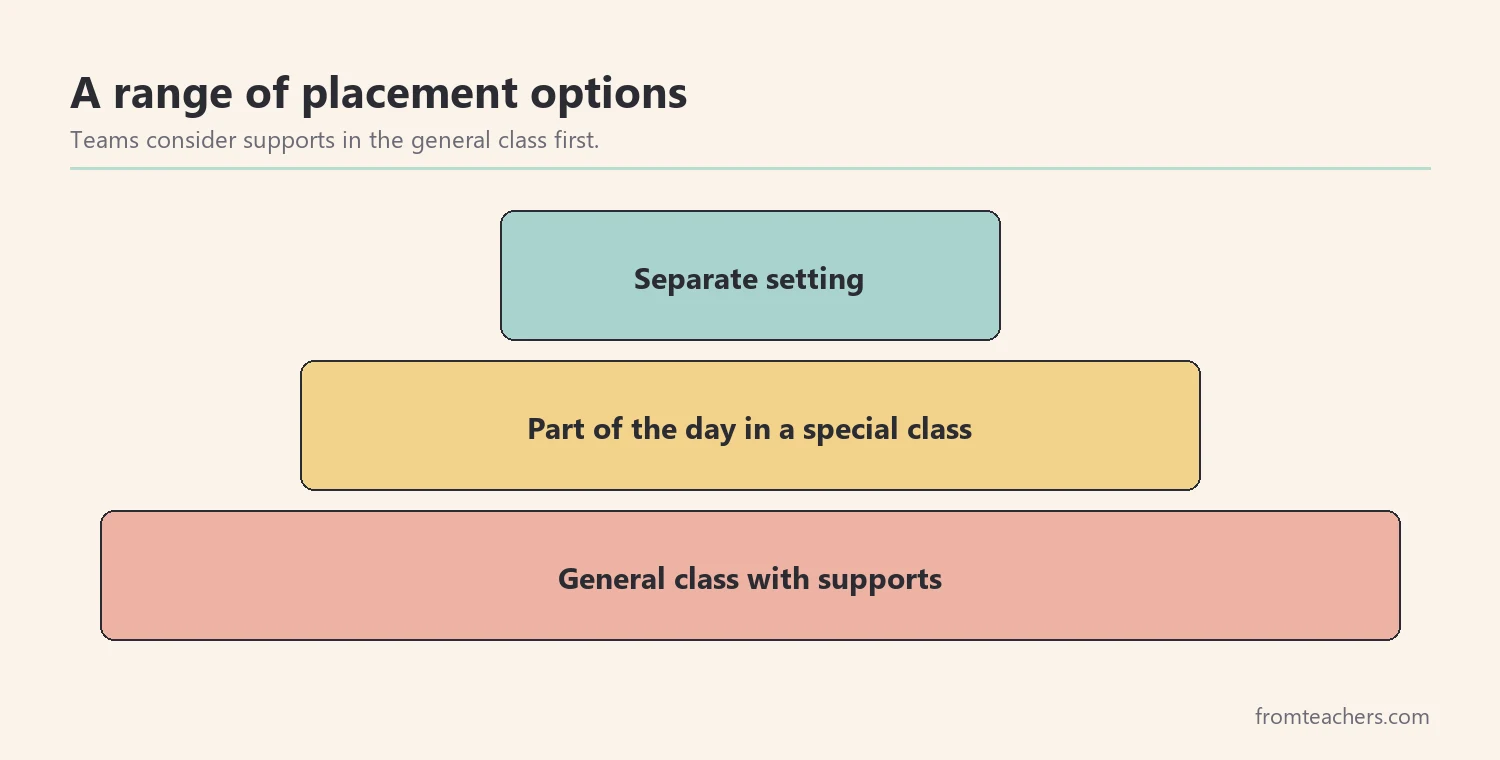
In practice, the first question is always what supports would help the child succeed in the general class. Those supports can include co-teaching, accommodations, assistive technology, or a paraprofessional for part of the day. Only after that question is answered honestly should the team consider more time outside the class.
Worked example. The team discusses whether Sam should leave the class for all of reading. Instead, they agree he will stay in the general class for most of the day, with accommodations such as audio books, and receive small-group reading instruction outside the class for part of the literacy block. Priya asks how they will know if this is working, and the team adds a progress check every six weeks.
5. Know parent rights: special education law basics for families
Next, learn the rights that protect families. IDEA gives parents a set of procedural safeguards, and the school must give parents a written notice explaining them at certain times, including at least once a year. Reading that notice is one of the most useful special education law basics you can practice.
Some key rights include the right to take part in meetings about your child, the right to give or refuse consent for the initial evaluation and the first provision of services, and the right to review your child’s education records. In addition, the school must give prior written notice when it proposes or refuses to change your child’s identification, evaluation, placement, or services. That notice explains what the school wants to do or refuses to do and why.
If you disagree with the school’s evaluation, you can ask for an independent educational evaluation, or IEE, at public expense. The school must then either pay for it or start a due process hearing to show that its own evaluation was appropriate.
- Right to participate in IEP and placement meetings.
- Right to consent before the initial evaluation and initial services.
- Right to review education records.
- Right to prior written notice of proposed or refused changes.
- Right to request an independent educational evaluation.
Worked example. Later in the year, the school proposes reducing Sam’s small-group time. Priya receives prior written notice explaining the proposal and the data behind it. Because she understands the notice, she asks for a meeting to look at the progress data together before anything changes.
6. Resolve disagreements step by step
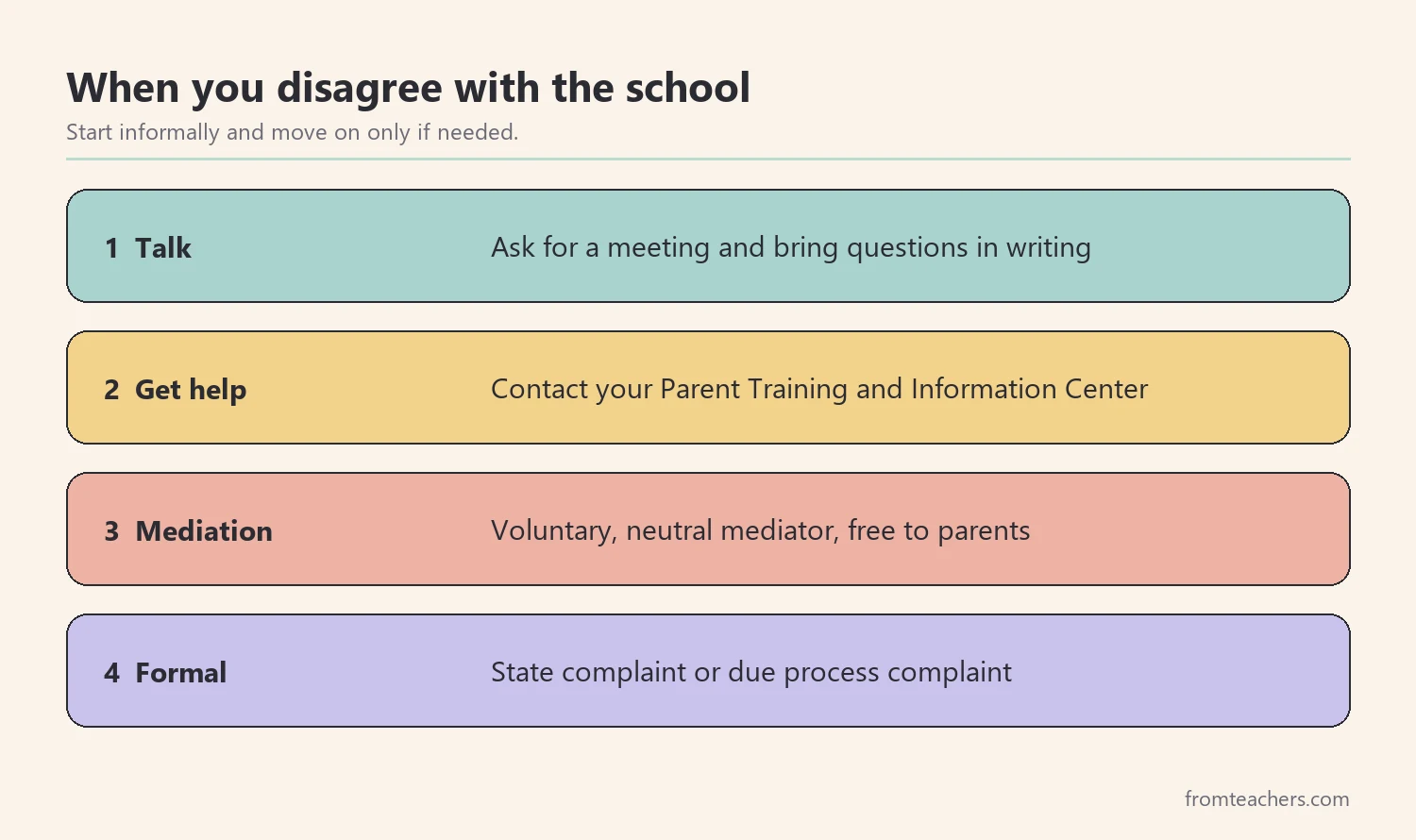
Finally, special education law basics include knowing what to do when you and the school do not agree. Most disagreements are solved by talking, so start there. Using special education law basics calmly, with facts and dates, keeps the focus on the child. Ask for a meeting, bring your questions in writing, and focus on the data and the child’s needs.
If talking does not work, IDEA offers formal options. Mediation is a voluntary process with a neutral mediator, and it is free to parents. A state complaint can be filed with the state education agency when you believe the school has not followed IDEA. A due process complaint leads to a hearing before an impartial hearing officer and is the most formal option. In addition, families often contact their state’s Parent Training and Information Center for free guidance.
Worked example. At the meeting, Priya and the team look at Sam’s progress checks together. The data show growth, but not enough to reduce his small-group time yet. The team agrees to keep the current services and review again in eight weeks. No formal step is needed, but Priya knows her options if the issue returns.
As a result, understanding special education law basics helps both sides. Families ask clearer questions, and schools can explain their decisions with confidence.
Common mistakes and how to avoid them
- Confusing a 504 plan with an IEP. This is the most common gap in special education law basics. They come from different laws and do different jobs. Fix: ask which law applies and what the plan will provide.
- Asking for an evaluation only out loud. Verbal requests are easy to lose. Fix: put the request in writing, date it, and keep a copy.
- Skipping the procedural safeguards notice. Families miss rights they did not know they had. Fix: read it once with a highlighter and keep it in your records.
- Starting with placement instead of supports. Teams jump to a separate setting too fast. Fix: ask first what supports would help in the general class.
- Going straight to a formal complaint. Relationships suffer when talking is skipped. Fix: request a meeting first, unless the situation is urgent.
Questions teachers and parents ask about special education law basics
Does every child with a disability get an IEP?
No. A child must have a disability in an IDEA category and need special education because of it. Some children who do not qualify under IDEA may qualify for a 504 plan instead.
Can a parent request an evaluation even if the school has not suggested one?
Yes. Parents can request an evaluation at any time, ideally in writing. The school must respond, and if it refuses, it must give prior written notice explaining why.
How often is the IEP reviewed under special education law basics?
The IEP must be reviewed at least once a year. Parents or the school can request a meeting sooner if something changes. A reevaluation happens at least every three years unless both sides agree it is not needed.
Are special education law basics the same in every state?
Federal law sets the floor, and every state must meet it. However, states can add their own rules, such as different evaluation timelines. Check your state education agency for local details.
Where can I get free help with special education law basics?
Every state has at least one Parent Training and Information Center funded to help families of children with disabilities. The Center for Parent Information and Resources lists them. Your school must also give you the procedural safeguards notice.
Related reading: Special Education: A Complete Guide for Parents and Educators, Accommodations vs Modifications in Special Education, and How Parents and Teachers Can Team Up for Special Education Success.
A companion resource for special education law basics:
Special Education Complete Guide: IDEA, IEP, Assessment, and Inclusion: one reference covering IDEA, Section 504, and the ADA, IEP components and parental rights, evaluation and RTI, and inclusive classroom strategies.
Sources and scope
- IDEA, U.S. Department of Education: the statute, regulations, and guidance behind special education services and IEPs.
- Center for Parent Information and Resources: plain-language information on IDEA and a directory of Parent Training and Information Centers.
- ADA.gov, U.S. Department of Justice: official information about the Americans with Disabilities Act.
- IRIS Center, Vanderbilt University: free modules on IEPs, evaluation, and inclusive practice.
This guide gives a plain-language overview of federal special education law in the United States. It is not legal advice and does not cover every state rule; for a specific situation, contact your state education agency, a Parent Training and Information Center, or a qualified attorney.
Key takeaways
- Special education law basics start with knowing IDEA, Section 504, and the ADA.
- An initial evaluation needs written consent and follows a 60-day or state timeline.
- Eligible students get an IEP, reviewed at least once a year.
- In special education law basics, placement starts with the general class and the supports that make it work.
- Parents have clear rights and several options for resolving disagreements.









Leave a Comment