

Special education parent rights matter most in the quiet weeks before school starts. Picture a parent at the kitchen table in late August, holding last year’s IEP, a new class list, and a feeling that something important might slip through the cracks. She knows her child has supports on paper. She is less sure what to do if those supports do not show up in September.
This guide turns that worry into a plan. You will learn the core rights families have under federal law, how to prepare for the IEP, how to build a working relationship with school staff, how to set up home routines, and how to follow a simple month-by-month plan for the whole year. By the end, you will know what to ask, what to keep, and when to speak up.
Examples are fictional. Adapt to the student’s goals and agreed supports. This is guidance, not a diagnosis or legal advice.
At a glance
- Know a handful of core rights well instead of trying to memorize the whole law.
- Read the current IEP before school starts and mark the services and accommodations.
- Put important requests in writing and keep a simple family record.
- Build calm home routines so your child arrives ready to learn.
- Use a short monthly check-in to catch problems early, not in May.
1. Learn the core special education parent rights
First, take a breath. You do not need to become a lawyer to use your rights well. Most families get far by understanding a few ideas from the Individuals with Disabilities Education Act (IDEA), the federal law behind special education in the United States. Your state adds its own rules, so your district’s procedural safeguards notice is the document that spells out the details where you live.
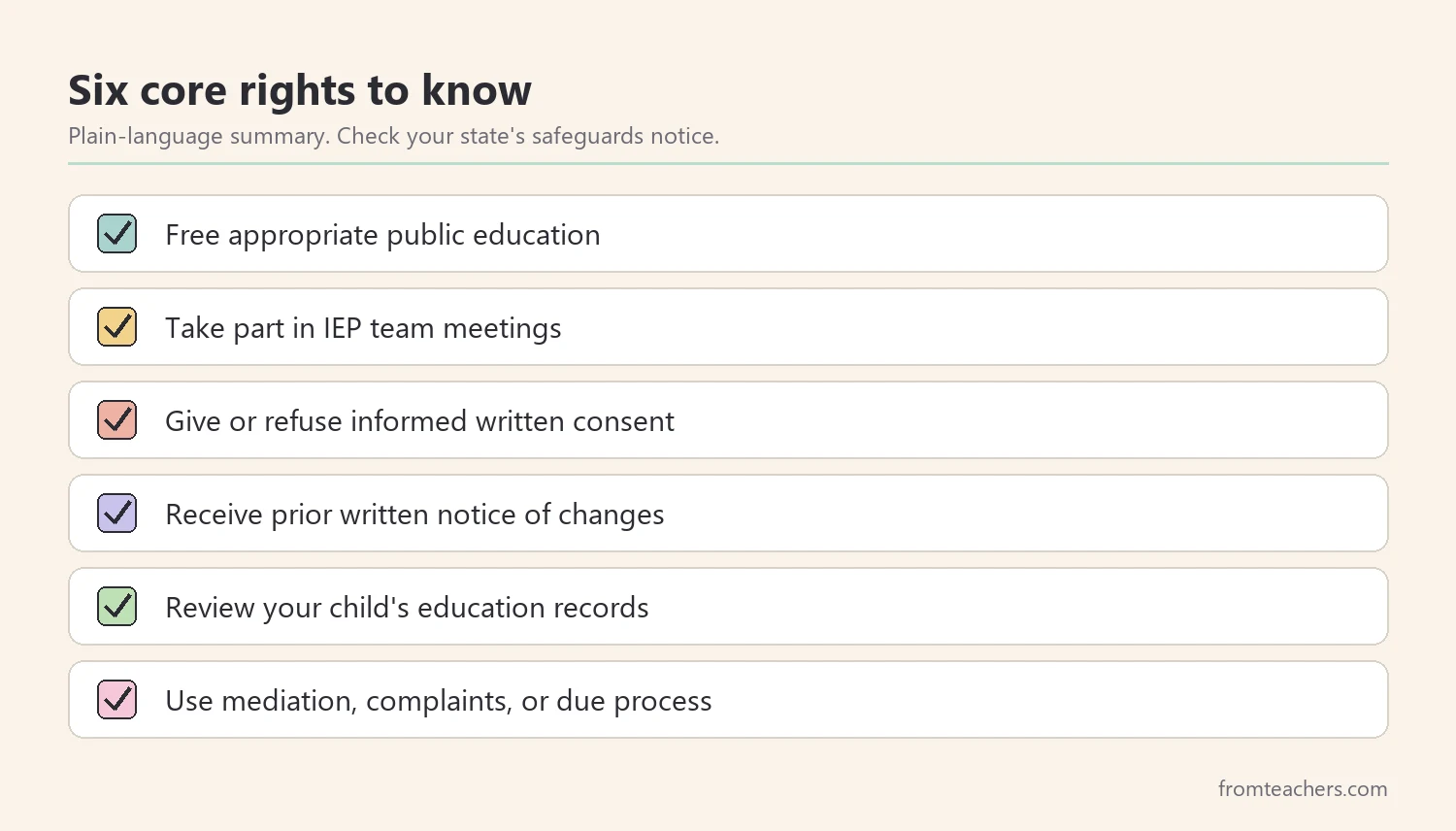
Next, focus on the rights you will actually use this year. In plain language, special education parent rights usually include the following:
- A free appropriate public education: your child is entitled to special education and related services that meet their individual needs, at no cost to the family.
- Participation: you are a member of the IEP team and can take part in meetings about identification, evaluation, placement, and services.
- Consent: the school needs your informed written consent before the first evaluation and before services first begin.
- Prior written notice: the school must tell you in writing when it proposes or refuses a change to identification, evaluation, placement, or services, and explain why.
- Access to records: you can review your child’s education records.
- Ways to resolve disagreements: options such as mediation, state complaints, and due process are described in your procedural safeguards notice.
Remember that special education parent rights are meant to make you a real partner, not a spectator. They give you a voice in decisions and a way to ask questions when something is unclear.
Then, find your copy of the procedural safeguards notice. Schools give it to families at set times, and you can ask for another copy whenever you want one. Keep it in the front of your binder.
For example, Lina is a fictional third grader with an IEP for reading and attention. Her mother, Sara, spent one evening reading the safeguards notice with a highlighter. She marked three things: how to request a meeting, how to ask for records, and who to contact at the district. That was enough to feel prepared.
2. Prepare the IEP before the first day
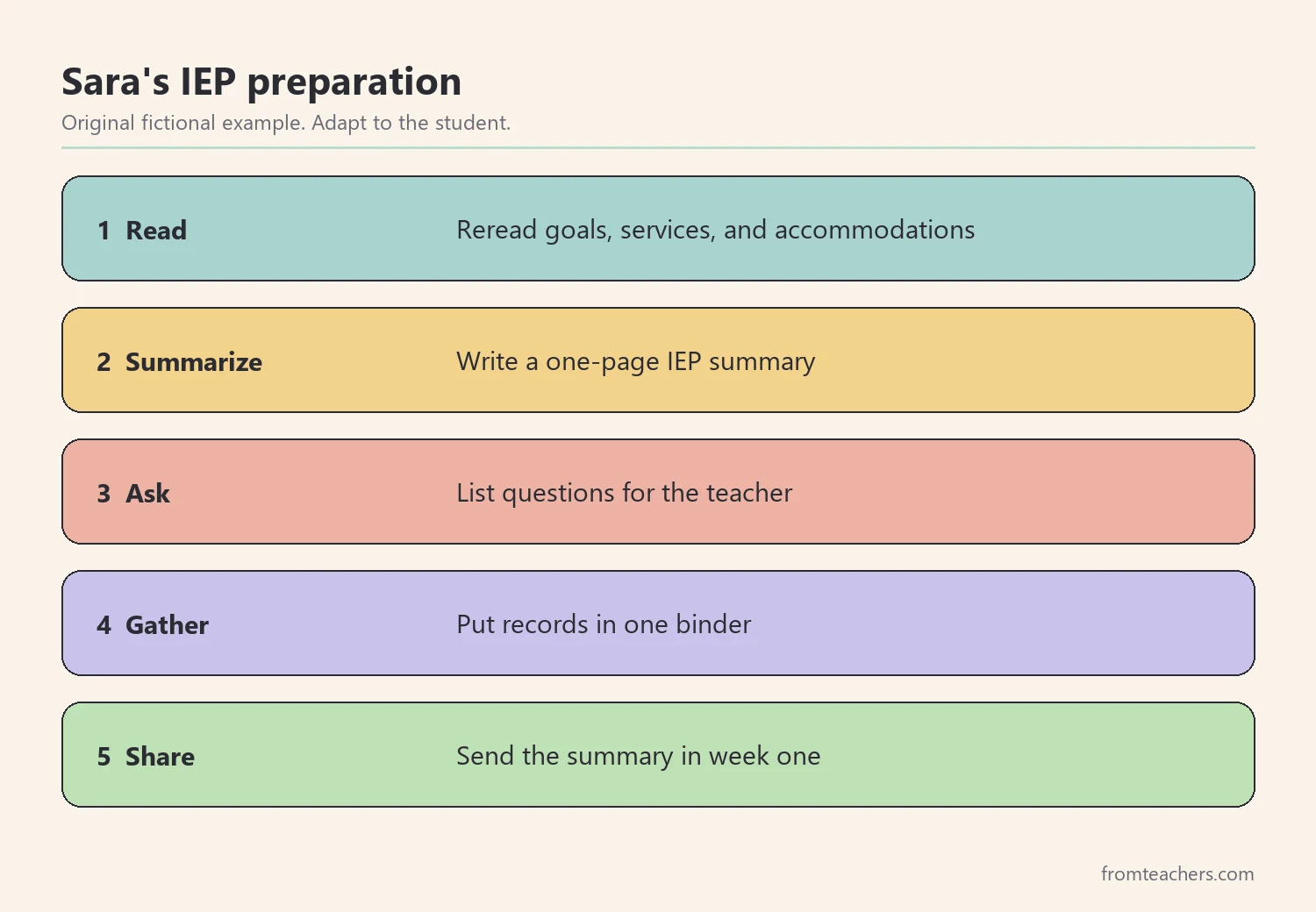
An IEP only helps when the people working with your child know what is in it. Teachers change, schedules change, and summer is long. Knowing your special education parent rights is helpful, but the IEP is where those rights turn into daily supports. So, before the first day, read the current IEP again with fresh eyes.
Start with four sections. Look at the annual goals, the services (what, how often, and where), the accommodations, and any behavior or health plans. Then, write a one-page summary in your own words. Keep it short enough that a new teacher could read it in two minutes.
After that, list your questions. Some families ask whether services will start in the first week. Others ask how accommodations will be shared with specials teachers, such as art or physical education. If a goal no longer fits, you can ask for an IEP meeting to review it. This is one of the most practical special education parent rights you have: you do not need to wait for the annual review to raise a concern.
For example, Sara’s summary for Lina looked like this:
| Area | What the IEP says | Question for school |
|---|---|---|
| Reading goal | Decode two-syllable words | When will progress reports go home? |
| Service | Small-group reading support | Which days and with whom? |
| Accommodation | Directions read aloud on tests | Do all teachers know this? |
| Accommodation | Short movement break | How will Lina ask for it? |
Finally, gather your records in one place. A simple binder or folder with the IEP, the latest evaluation, progress reports, and a contact list saves hours later. If you would like a ready-made structure, the special education family handbook for the new school year includes templates, letters, and printable tools for exactly this kind of preparation.
3. Use special education parent rights inside a good relationship
Rights work best inside a good relationship. Most teachers want your child to succeed, and they are often meeting dozens of new students at once. A short, friendly introduction helps your child stand out for the right reasons.
First, send a brief note in the first week. Introduce your child, name two strengths, name one or two things that help, and attach your one-page summary. Keep the tone warm and specific.
Next, agree on how you will communicate. Some teachers prefer email, others a notebook or an app. Ask which works best and how often you can expect updates. Clear communication is not a legal requirement in every detail, yet it is often the easiest way to put special education parent rights into practice. A short weekly note is often more useful than a long report each quarter.
Then, put important requests in writing. Using special education parent rights well often means having a clear paper trail. If you ask for a meeting, records, or a change in services, send an email and keep a copy. A written request is easy to find and hard to misunderstand.
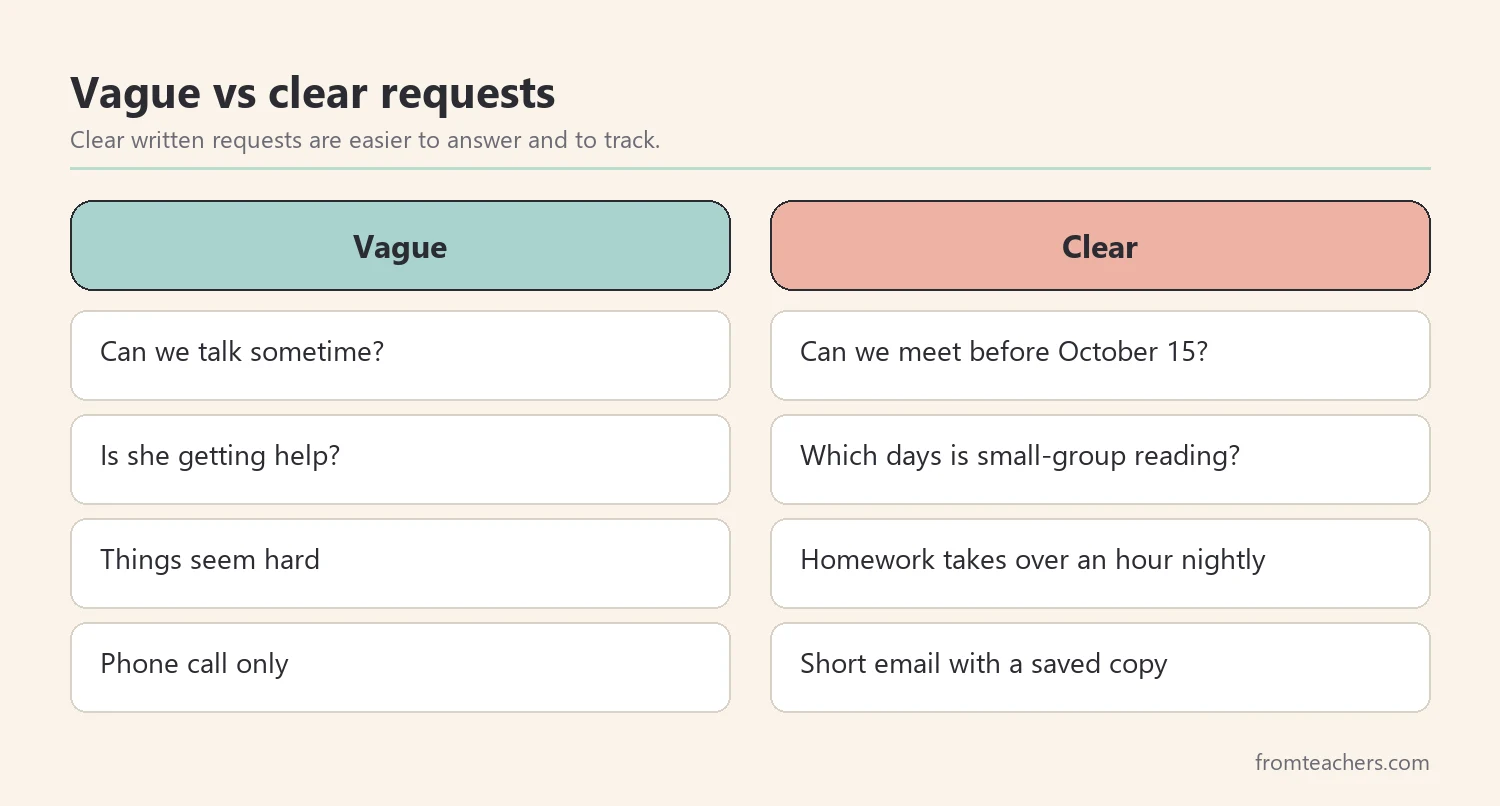
For example, Sara’s first note to Lina’s teacher said: “Lina loves drawing and helping classmates. She reads best with a ruler under the line and short movement breaks. Her IEP summary is attached. Could we check in by email on Fridays for the first month?” The teacher replied the same day.
4. Set up home routines that support school
Special education parent rights protect access to learning. Routines help your child use that access. The first weeks of school are tiring for many children, and a predictable evening and morning can make a real difference.
Start by practicing the new schedule a week or two before school begins. Move bedtime and wake time slowly toward school times. Then, walk or drive the route to school, and if possible visit the building or look at photos of the classroom.
Next, build a short visual routine for mornings and evenings. Keep it to four or five steps. For many children, pictures or a checklist on the fridge reduce reminders and arguments.
Also, plan for feelings. Talk about what will be new and what will stay the same. Name one adult at school your child can go to when something feels hard. If your child has a transition, such as a new school or a new grade level, ask whether a short visit before the first day is possible.
For example, Lina’s evening routine had four steps: pack the bag, choose clothes, read for ten minutes with a parent, and lights out at 8:00. Sara added a small calm-down corner with a pillow and headphones for hard afternoons. After two weeks, Lina was packing her bag without reminders most nights.
| Time | Routine step | Support |
|---|---|---|
| Morning | Dress, breakfast, bag check | Picture checklist |
| After school | Snack and quiet time | Calm-down corner |
| Evening | Homework, then reading | Timer and parent nearby |
| Bedtime | Pack bag, choose clothes | Same order every night |
5. Follow special education parent rights through the year
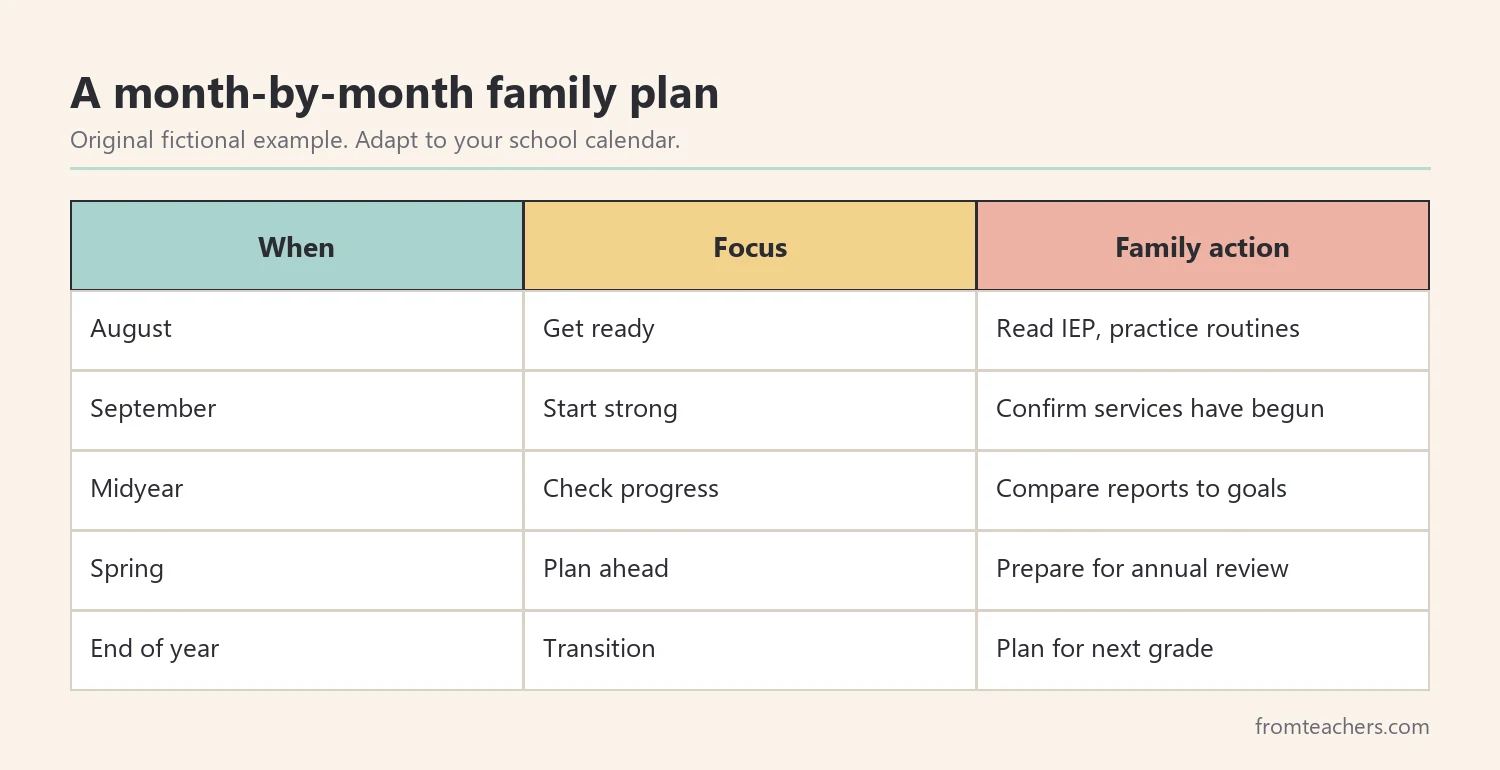
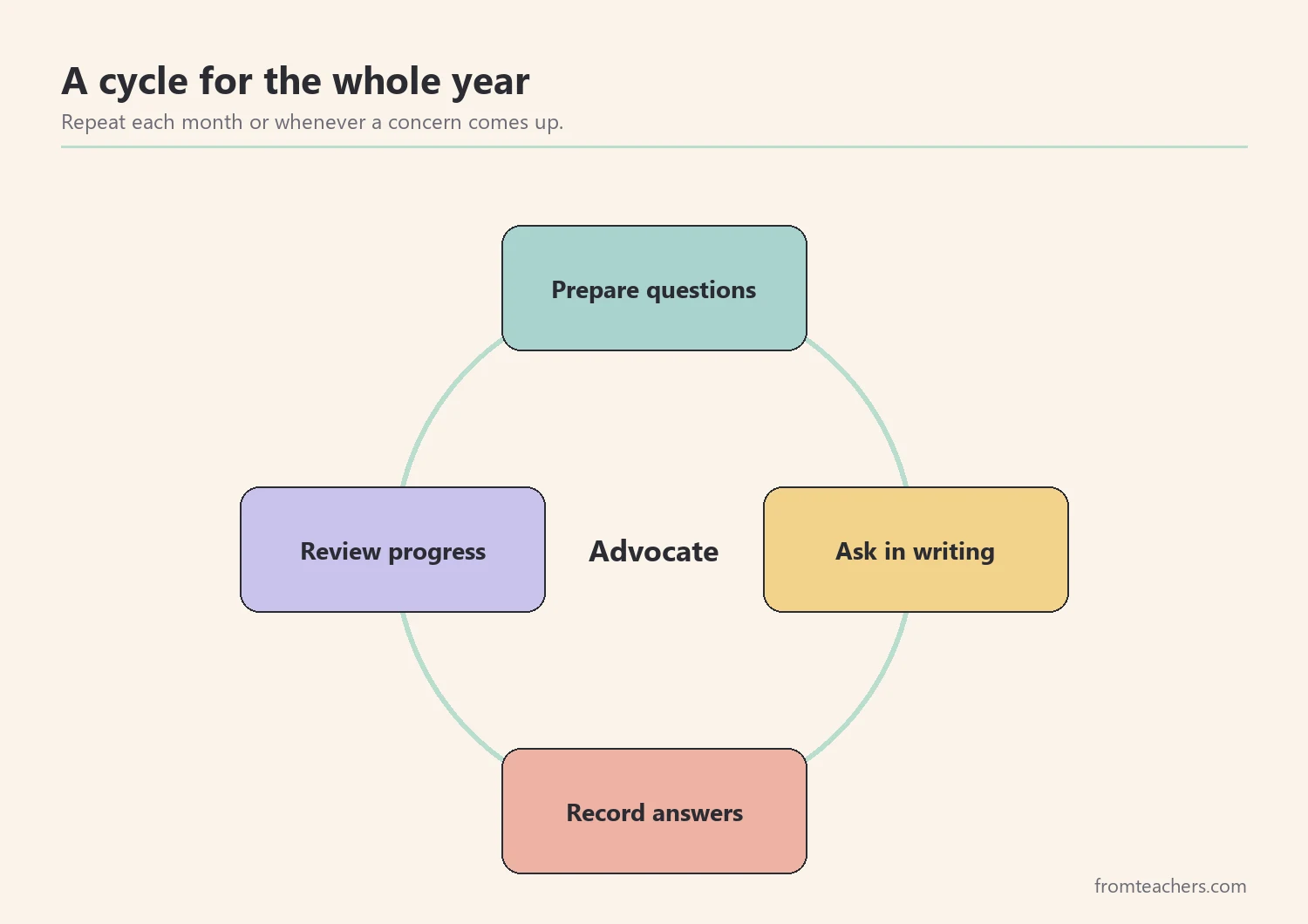
Many families feel prepared in September and lost by February. A light monthly plan keeps things on track without becoming a second job. The goal is to notice small problems while they are still small.
First, pick one short check-in each month. Read the latest notes or progress report, ask your child how school feels, and look at one goal. Then, write two lines in your record: what is going well, and what you want to ask about.
Also, keep the record short and dated. When you need to use special education parent rights later, such as asking for a meeting or reviewing records, dated notes help you describe exactly what happened and when.
Next, match your check-ins to the school calendar. Early in the year, confirm that services and accommodations have started. Midyear, compare progress reports to the IEP goals. Later in the year, prepare for the annual review and any transition planning.
Then, teach self-advocacy in small steps. Special education parent rights belong to the family, but your child can learn to speak up too. A young child might practice saying, “Can you read that again, please?” An older student might attend part of the IEP meeting and share what helps.
Finally, if you disagree with the school, remember that special education parent rights include ways to resolve the disagreement.
In most cases, start with a conversation and a written summary of your concern. If that does not solve it, your procedural safeguards notice explains the next options, and your state’s parent training and information center can help you understand them.
Common mistakes and how to avoid them
- Waiting for the annual review to raise a concern. Fix: you can ask for an IEP meeting at any time. Send the request in writing.
- Relying only on phone calls. Fix: follow every important conversation with a short email that summarizes what was agreed.
- Assuming every teacher has read the IEP. Fix: share your one-page summary with each teacher who works with your child.
- Trying to learn every rule at once. Fix: learn a few core special education parent rights well, and look up the rest when you need them.
- Treating the school as an opponent. Fix: start with curiosity and specific questions. Stay firm on your child’s needs while staying friendly with the people.
Questions teachers and parents ask about special education parent rights
Where can I find a full list of special education parent rights?
Your district’s procedural safeguards notice lists them for your state. You can ask the school for a copy at any time. The U.S. Department of Education’s IDEA website also explains the federal law in general terms.
Can I bring someone with me to an IEP meeting?
Yes. Families can invite people who have knowledge or special expertise about the child, such as a relative, an advocate, or a therapist. It helps to let the school know ahead of time so the meeting runs smoothly.
What if services do not start on time?
First, ask the teacher or case manager in writing when services will begin. Keep a copy of your message and the reply. If the delay continues, ask for a meeting and use your procedural safeguards notice to understand the next steps.
Do special education parent rights change when my child moves schools?
The core federal rights stay the same, but details can change if you move to a new state. When a child with an IEP transfers, the new school generally provides services comparable to the existing IEP while it reviews or develops a new one. Ask the new school in writing how this will work for your child.
How can teachers help families use their rights?
Teachers can share the IEP summary, explain services in plain language, and invite questions early. A friendly first contact and regular short updates make it easier for families to raise concerns before they grow.
Related reading: How Parents and Teachers Can Team Up for Special Education Success, Accommodations vs Modifications in Special Education: The Difference Explained, and Special Education: A Complete Guide for Parents and Educators.
A companion resource for special education parent rights:

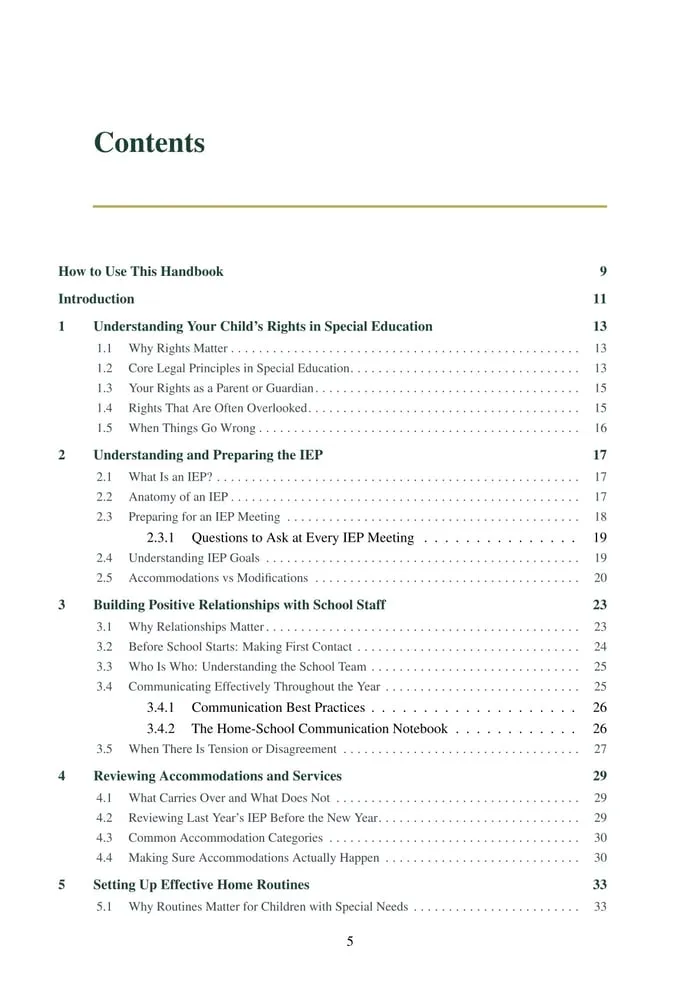
Preparing for a New School Year: Special Education Family Handbook: a 77-page PDF covering your child’s rights, IEP preparation, working with school staff, accommodations, home routines, transitions, self-advocacy, and a month-by-month family action guide, with printable templates and letters.
Sources and scope
- IDEA, U.S. Department of Education: the federal law behind special education, IEPs, and procedural safeguards.
- Center for Parent Information and Resources: information for families and a way to find your state’s parent center.
- Understood.org: plain-language articles for families on IEPs and learning differences.
- IRIS Center, Vanderbilt University: free modules on IEPs and family partnership for educators.
This guide gives a general overview of special education parent rights and practical planning for families in the United States. It does not replace legal advice, your state’s rules, or your district’s procedural safeguards notice.
Key takeaways
- Learn a few core special education parent rights well and keep your safeguards notice handy.
- Read the IEP before school starts and share a one-page summary with every teacher.
- Put important requests in writing and keep a simple family record.
- Build short, predictable home routines for mornings and evenings.
- Check in monthly so small problems get solved early.









Leave a Comment