

Running an IEP meeting well is a skill, and most teachers learn it on the job. Picture a case manager with eight people around a small table, a parent who has waited weeks to share a worry, and a speech therapist who has to leave in forty minutes. The meeting starts late, the conversation drifts back to one topic, and at the end, nobody is sure what was decided about testing accommodations.
This guide shows you a five-step way to prepare, schedule, facilitate, and close the meeting so every required topic gets its turn. By the end, you will have a timed agenda, clear roles, a few phrases for keeping order kindly, and a simple follow-up routine that families can trust.
Examples are fictional. Adapt to the student’s goals and agreed supports. This is guidance, not a diagnosis.
At a glance
- Most of the work happens before the meeting: invitations, data, and draft ideas.
- A timed agenda protects each required topic and the family’s time to speak.
- Clear roles, such as facilitator and note-taker, keep the meeting calm.
- Track each topic’s status during the meeting so nothing is skipped.
- Close with a spoken summary and send written next steps soon after.
1. Prepare before running an IEP meeting
First, remember that running an IEP meeting smoothly starts days or weeks earlier. Confirm a date and time that works for the family, and send the invitation in the way your school requires. Then, check who must attend and who is invited, and ask each person how long they can stay.
Next, gather the information the team will need. This usually includes recent assessment results, progress data on current goals, teacher input, and any notes from related service providers. In addition, ask the family ahead of time what they most want to talk about. A short phone call or a few written questions can bring important concerns to the surface early.
Preparation checklist
- Date, time, and room confirmed with the family.
- Required team members invited and available.
- Assessment results and goal progress data ready.
- Family questions or concerns collected in advance.
- Draft ideas for goals and supports shared as drafts, not decisions.
- Interpreter or other access needs arranged if requested.
Also, think about the room. Enough chairs, a table where everyone can see each other, water, and printed copies of the agenda all send a quiet message: this meeting matters, and everyone has a place in it.
Worked example. Sofia is a fictional student in grade 6 with an IEP for reading and written expression. Her case manager, Ms. Reyes, calls Sofia’s father two weeks before the annual meeting. He says his main concern is how Sofia will manage state testing this spring. Ms. Reyes writes this down and plans to give it its own time on the agenda.
Finally, prepare yourself. Read the current IEP again, note which goals were met, and write two or three questions you want the team to answer. Running an IEP meeting is much easier when the facilitator already knows where the hard conversations might be.
In short, good preparation means fewer surprises and more time for real decisions.
2. Build a timed agenda for running an IEP meeting
Once you know the topics, turn them into a schedule. A timed agenda is the single most useful tool for running an IEP meeting, because it shows everyone what will be covered and when. It also makes it easier to move on gently when one topic runs long.
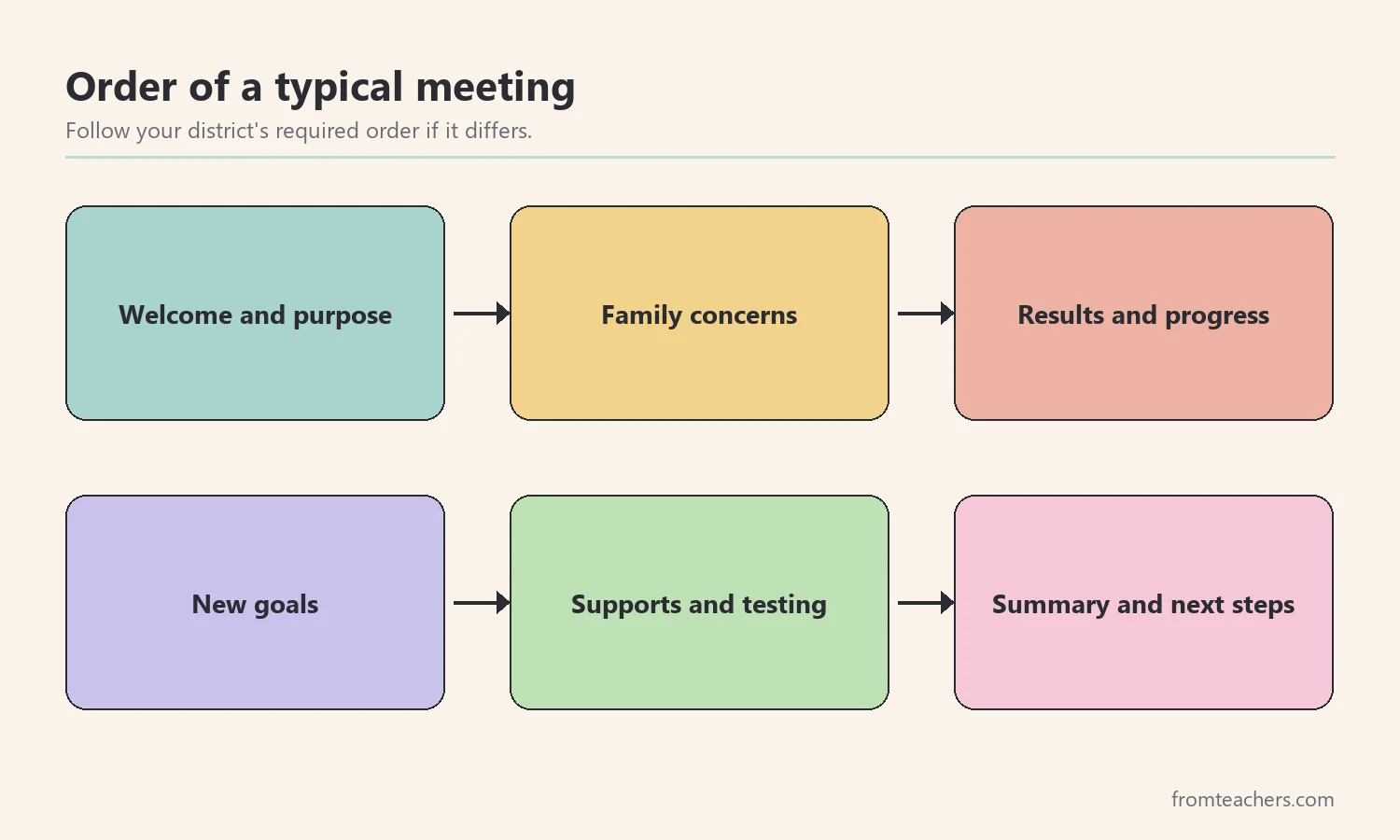
Start with the total time you have, then divide it into blocks. Follow the order your school or district uses. A common sequence moves from introductions and purpose, to current performance and assessment results, to progress on previous goals, then new goals, accommodations, state testing, placement and services, and finally a summary.
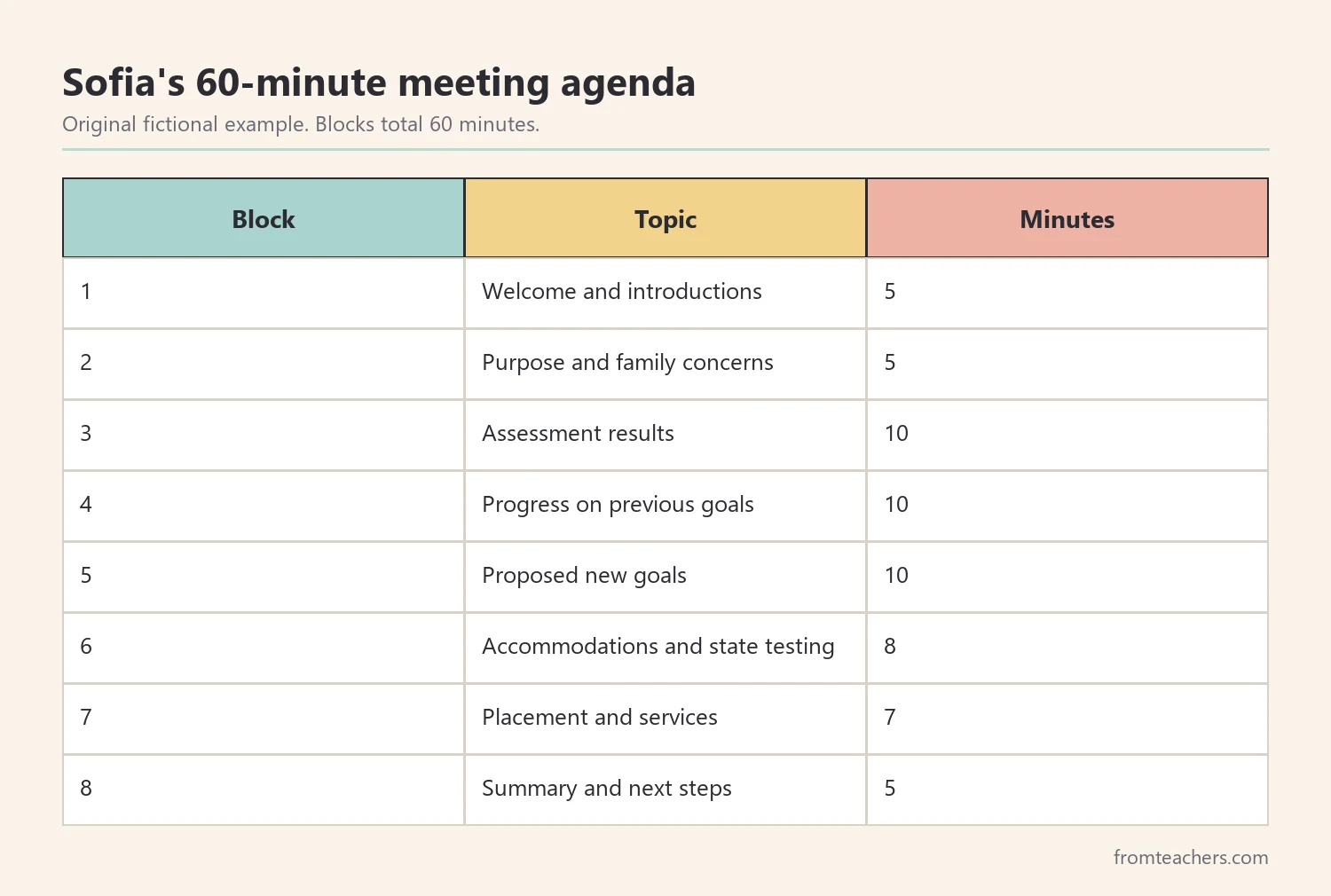
Then, check the math, because running an IEP meeting on a schedule that does not add up leads to rushed decisions. The blocks must add up to the time you actually have. If they do not, shorten the blocks where the team already agrees, not the time for family input. Furthermore, add a Details and Status column so you can mark each topic as covered, in progress, or carried over.
A fillable form saves you from building this from scratch. The fillable IEP planning meeting schedule lists nine key topics in order, from introductions to summarizing outcomes, with Details and Status columns and student, date, and time fields at the top.
Worked example. Sofia’s meeting has 60 minutes. Ms. Reyes plans 5 minutes for welcome and introductions, 5 for purpose and family concerns, 10 for assessment results, 10 for progress on previous goals, 10 for proposed new goals, 8 for accommodations and state testing, 7 for placement and services, and 5 for the summary. Together, these blocks fill exactly 60 minutes.
3. Assign clear roles
Next, decide who does what when running an IEP meeting. Running an IEP meeting alone, while also presenting data and taking notes, is very hard. Shared roles spread the load and help the meeting stay calm and on time.
The facilitator, often the case manager, guides the agenda and invites each person to speak. A timekeeper gives a quiet signal when a block has a few minutes left. A note-taker records key points, decisions, and open questions. Each presenter knows in advance which block is theirs and how long they have.
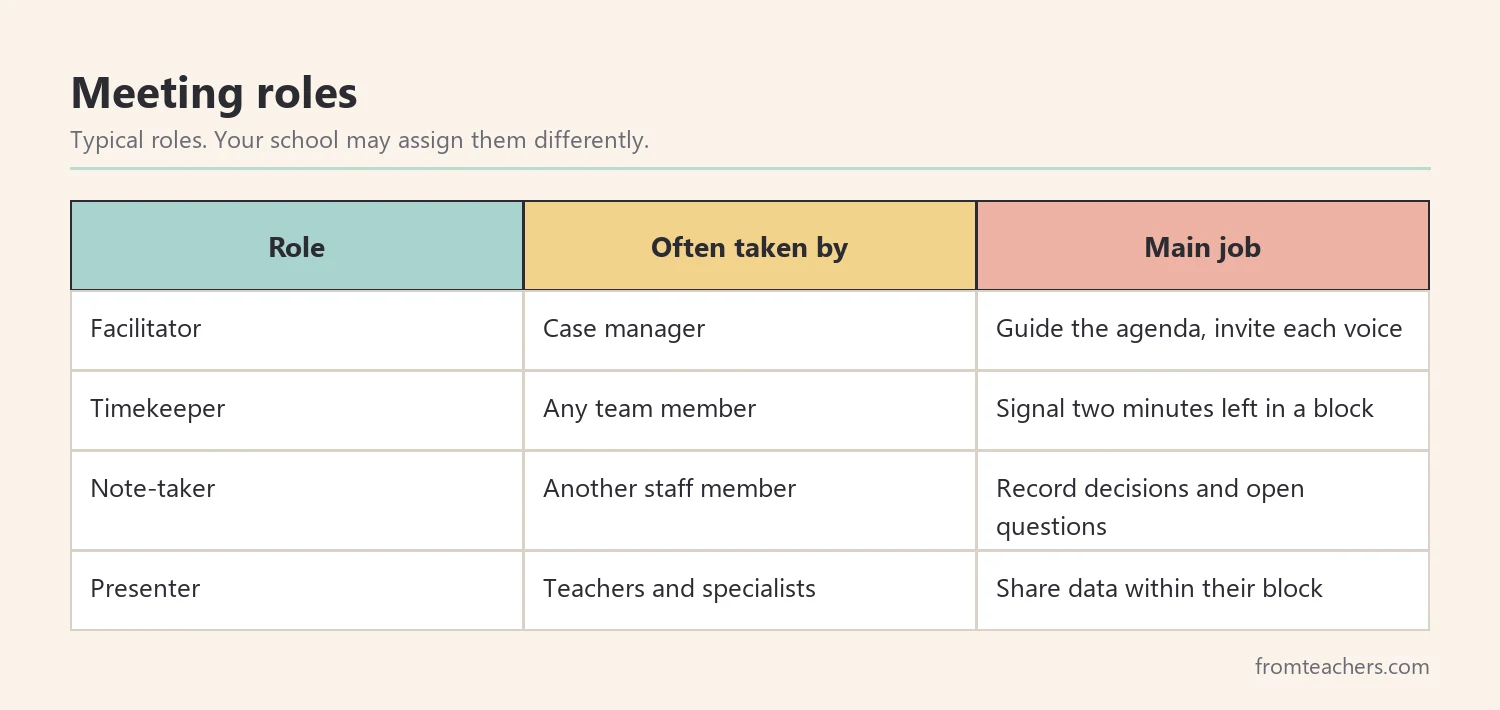
In addition, think about the family’s role. Parents are full members of the team, not an audience. Tell them where their input fits on the agenda, and make it clear they can ask questions at any point. If the student will attend, plan how and when they will share their views.
| Role | Signal or tool |
|---|---|
| Facilitator | Printed agenda and transition phrases |
| Timekeeper | Quiet card at two minutes left |
| Note-taker | Status column and decisions list |
| Presenter | One-page summary of their data |
Worked example. For Sofia’s meeting, Ms. Reyes facilitates. The general education teacher agrees to keep time with a small card. The school psychologist takes notes on a shared screen. Sofia, who is in grade 6, will join for the first ten minutes to share what helps her in class, using a short list she wrote with Ms. Reyes.
Also, share the roles in the invitation or a short email the day before. When people know their part in running an IEP meeting, they prepare their data in the right format and arrive ready to keep to their block.
As a result, each adult knows their job before anyone sits down.
4. Facilitate the conversation and keep order
Now, the meeting begins. When running an IEP meeting, open with a warm welcome, introductions, and a clear statement of purpose. Then, walk through the agenda out loud so everyone knows what to expect. This takes about a minute and saves many later interruptions.
Keep the family’s voice early. Many teams find this is where running an IEP meeting either builds trust or loses it. After the purpose, invite parents to share their concerns and hopes. When those concerns come up again later, connect them to the topic at hand: “This connects to what you said about testing. Let’s look at it in that section.”
Phrases that keep order kindly
- “That is an important point. Let’s note it and come back to it in the goals section.”
- “We have two minutes left in this part. Is there anything we must decide now?”
- “Before we move on, does anyone have a question about these results?”
- “Let me check that I heard you correctly.”
However, do not let the clock silence real concerns. If a topic needs more time, say so openly and agree as a team: shorten another block, schedule a follow-up, or continue later. Mark the topic’s status so it is not lost.
Worked example. During Sofia’s meeting, the assessment discussion runs three minutes over. Ms. Reyes says, “We are a little behind. Since we already agree on her placement, can we take three minutes from that block?” The team agrees, so the placement block becomes 4 minutes and the meeting still ends at 60 minutes. Her father’s testing question gets its full 8-minute block.
In other words, the agenda is a guide that the team adjusts together, out loud. Running an IEP meeting this way shows the family that time is shared fairly, not controlled by one person.
5. Close the meeting and follow up
Finally, save time to close well. The last part of running an IEP meeting is a spoken summary. Go through each topic on the agenda, read its status, and name the decisions made. Then, list the next steps with a person and a date for each.
Next, check understanding. Ask the family, “Is there anything that is unclear or that you want to look at again?” Also, explain how and when they will receive the written documents, and who to contact with questions. Follow your school’s procedures for signatures and for sharing the final IEP.
After running an IEP meeting, send a short follow-up within a few days. Thank the family, restate the next steps, and attach or describe any documents they will receive. In addition, add any carried-over topics to a calendar so the team returns to them.
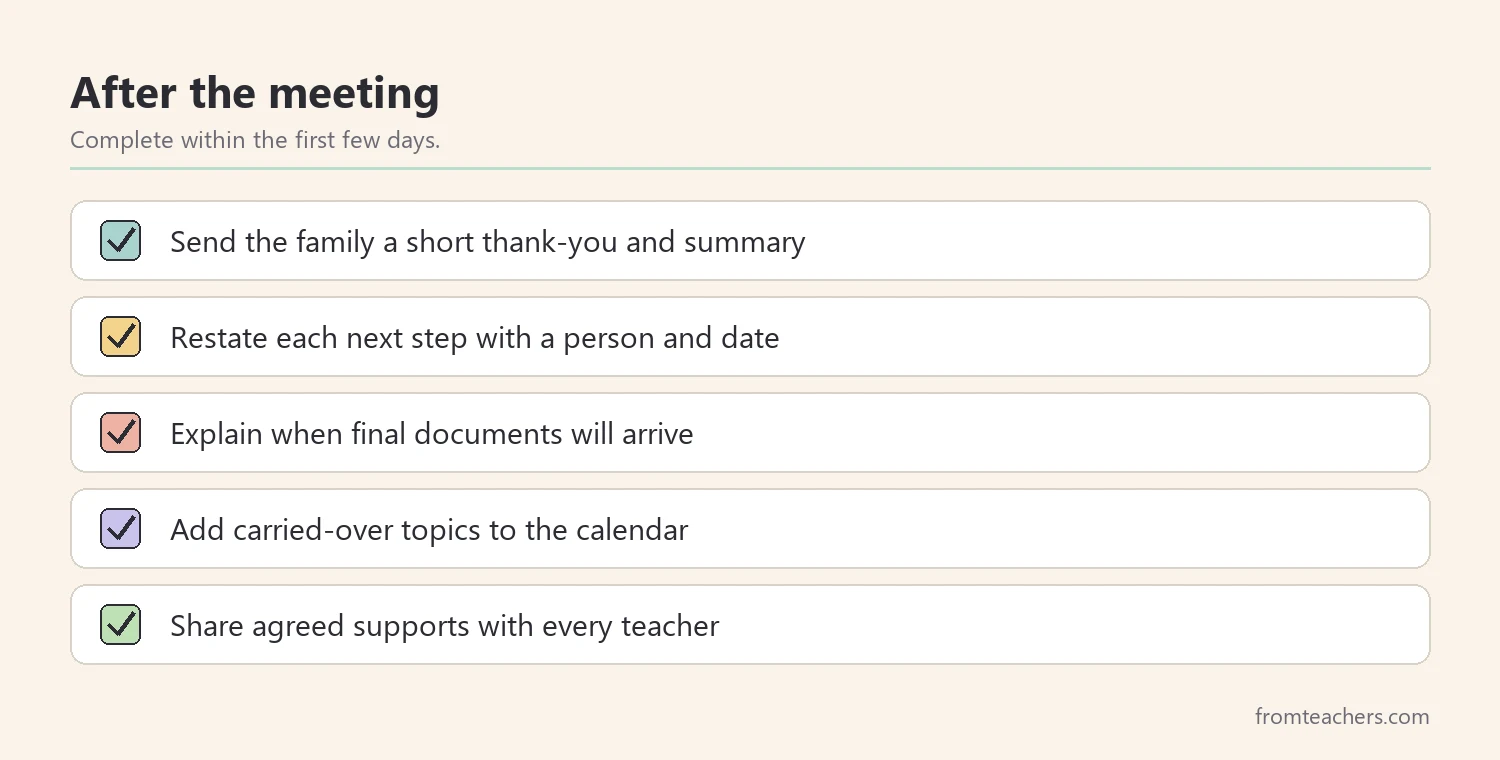
Worked example. In the final 5 minutes, Ms. Reyes reads each topic’s status. All eight blocks are marked covered, and one open question, about a reading software trial, is carried over. She names three next steps with dates. Two days later, she emails Sofia’s father a short summary and schedules a 15-minute follow-up call about the software.
Common mistakes and how to avoid them
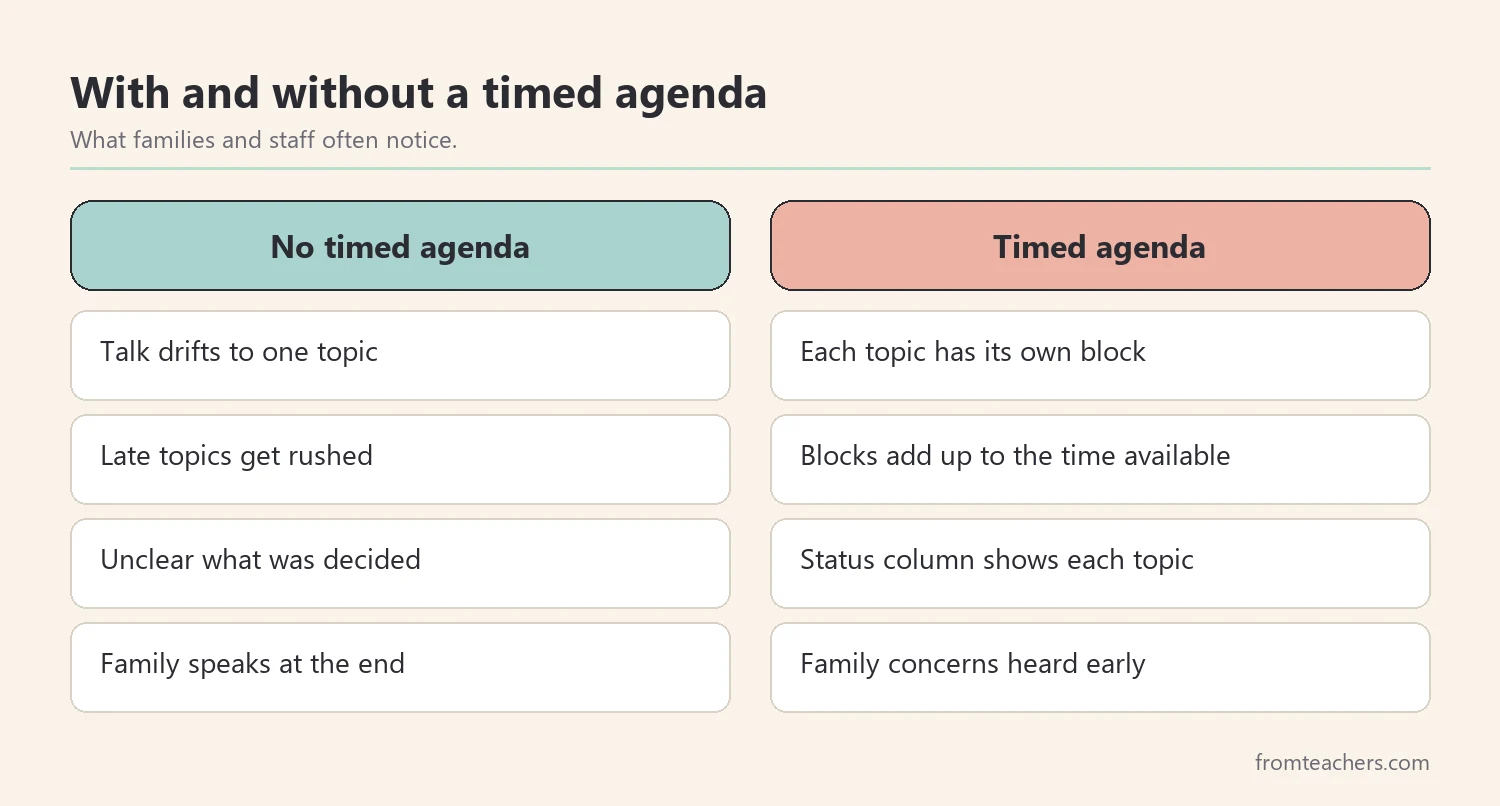
- Starting without an agenda. Conversations drift, and late topics get rushed. Fix: share a timed agenda at the start and refer to it often.
- Blocks that do not add up. A plan for 75 minutes in a 60-minute slot fails before it starts. Fix: total your blocks before the meeting.
- Family input only at the end. Parents feel like an audience. Fix: invite their concerns right after the purpose statement.
- Running an IEP meeting alone. One person cannot facilitate, present, and take notes well. Fix: assign a timekeeper and a note-taker.
- Presenting drafts as final. Families feel decisions were made without them. Fix: label draft ideas clearly and invite discussion.
- No written follow-up. People remember the meeting differently. Fix: send a short summary of decisions and next steps soon after.
Questions teachers and parents ask about running an IEP meeting
How long should an IEP meeting take?
It depends on the student, the type of meeting, and the topics. Many annual meetings are planned for about an hour, but some need more time. The key is to plan blocks that fit the time you have and to schedule a follow-up if needed.
Who should lead the meeting?
Often the case manager or special education teacher facilitates, but schools set their own practices. What matters most is that one person is clearly responsible for guiding the agenda and inviting everyone to speak.
Can parents ask for topics to be added?
Yes. Parents are members of the IEP team and can raise concerns and questions. Asking families before the meeting what they want to discuss is the easiest way to make sure their topics are on the agenda.
What if we run out of time when running an IEP meeting?
Say so openly and agree as a team on what to do. You might continue another day, schedule a short follow-up, or handle a smaller question by phone. Mark the topic as carried over so it is not forgotten.
Should the student attend?
Student participation can be valuable, especially as students get older and begin transition planning. Talk with the family and the student about how they would like to take part. Some students attend the whole meeting, while others join for one part.
Related reading: How Teachers Communicate With Parents in Special Education: Building a Strong Partnership, Accommodations vs Modifications in Special Education: The Difference Explained, and Special Education: A Complete Guide for Parents and Educators.
A companion resource for running an IEP meeting:
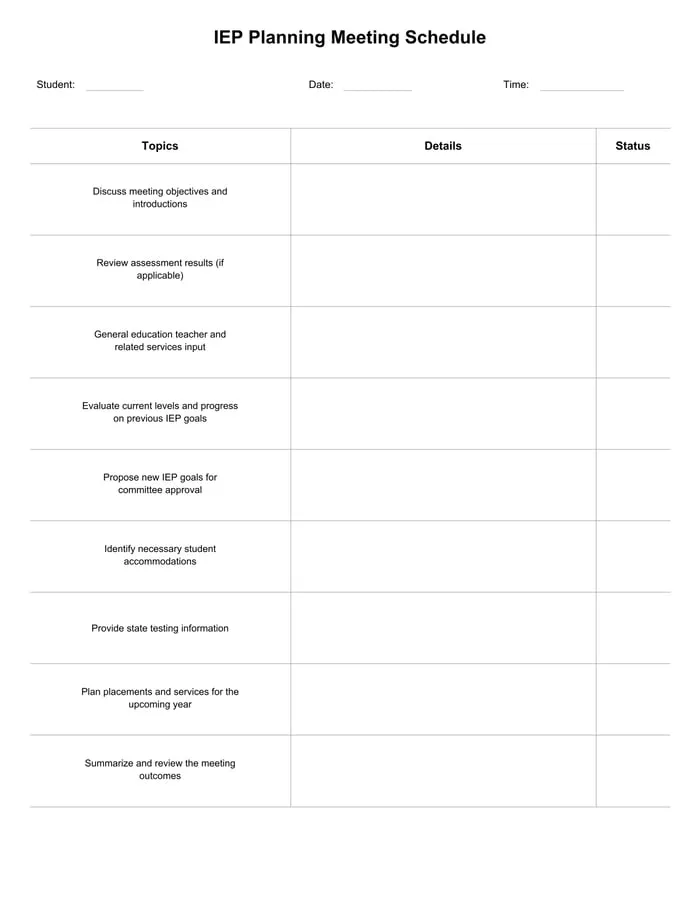
IEP Planning Meeting Schedule: a fillable PDF agenda with nine key meeting topics in order, including assessment results, progress on previous goals, new goals, accommodations, state testing, and placement and services, plus Details and Status columns and student, date, and time fields.
Sources and scope
- IDEA, U.S. Department of Education: the law behind IEPs, the IEP team, and parent participation.
- IRIS Center, Vanderbilt University: free modules on the IEP process and collaborating with families.
- Center for Parent Information and Resources: information for families on IEP meetings and parent rights.
- Understood.org: practical articles for families and teachers preparing for IEP meetings.
This guide covers practical ways to plan, schedule, and facilitate an IEP meeting. It does not give legal advice or replace your state, district, or school procedures for IEP meetings, notices, and documents.
Key takeaways
- Running an IEP meeting well starts with preparation and family input before the day.
- A timed agenda with blocks that add up protects every required topic.
- Clear roles, such as facilitator, timekeeper, and note-taker, keep things calm.
- Adjust the agenda openly as a team when a topic needs more time.
- Close with a spoken summary and send written next steps soon after.










Leave a Comment