

A parent contact log template saves you at the exact moment you need it most. Picture a Tuesday afternoon: a parent calls to ask why her son’s reading grade dropped, and you are sure you emailed her about it in October. Now you are scrolling through two inboxes, a sticky note, and a planner, trying to remember what you said and when.
This guide gives you five steps to keep every family conversation organized: set up the log, decide what to record and when, write short factual summaries, use categories to spot patterns, and plan follow-ups that build trust. By the end, you will have a simple routine that takes about two minutes per contact.
Examples are fictional. Adapt to the student’s goals and agreed supports. This is guidance, not a diagnosis.
At a glance
- Keep contact details and conversation history on the same page for each student.
- Log every meaningful contact within the same day, including positive ones.
- Write short, neutral summaries that anyone could read without surprise.
- Use simple categories to see what most conversations are about.
- Record the next step, and check your follow-ups each week.
1. Set up your parent contact log template
Start with one page per student. At the top, record the basics: student name, grade, teacher, and school. Below that, add a contact information table for up to two parents or guardians, with a work number, a personal number, and an email for each.
Why bother with a parent contact log template at all? Because memory is unreliable during a busy term, and a written record protects both you and the family. Collecting contact details at the start of the year saves time later. Many teachers send a short form home in the first week, or gather details at back-to-school night. Then copy the answers into the parent contact log template, so you are not searching the office system when you need a number quickly.
Also note any preferences families share. For instance, one parent may prefer texts after 5 p.m., while another works nights and is easier to reach by email. Respecting these preferences shows families you are listening.
Consider Maya, a fictional third grader in Mr. Ruiz’s class. Her page starts like this.
| Guardian | Best way to reach | Notes |
|---|---|---|
| Mother | Works days, replies in the evening | |
| Grandfather | Personal phone | Picks Maya up on Wednesdays |
If a family speaks a language other than English at home, record that as well, along with whether they would like an interpreter for calls or meetings. Your school may have interpreter services you can request ahead of time.
Check that you have permission to contact each adult listed. Your school office will know who is an authorized contact, and that matters for privacy. When in doubt, ask before you call.
Finally, decide where the logs will live. A binder with one tab per student works well for paper. For digital copies, use a folder your school approves for student records. Either way, keeping each parent contact log template in one predictable place means you can reach it the moment the phone rings.
2. Decide what your parent contact log template should record
Before you start, agree with yourself on what belongs in the parent contact log template. Not every hallway “hello” needs an entry. However, any contact where information is shared, a concern is raised, or a decision is made should be logged. That includes phone calls, emails, notes home, conferences, and quick conversations at pickup that cover something important.
Above all, log positive contacts too. A two-line note about a great day is part of the relationship, and it balances the record. Later, when you need to discuss a concern, the log shows that you also share good news.
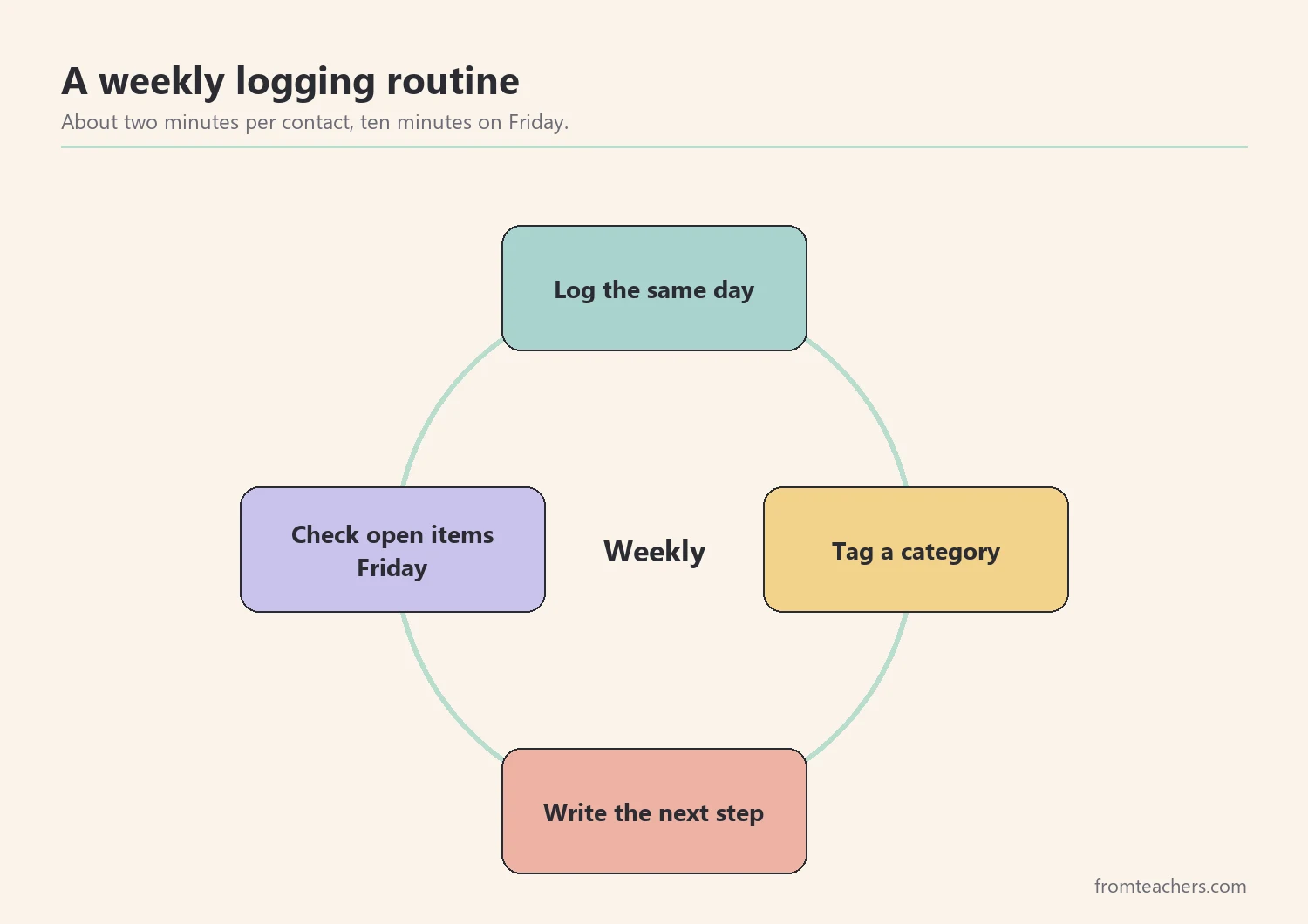
Timing matters. Write the entry the same day, ideally right after the conversation. Details fade fast, and an entry written a week later is much less reliable. In practice, keeping the parent contact log template on a clipboard or binder near your desk makes this a one-minute habit.
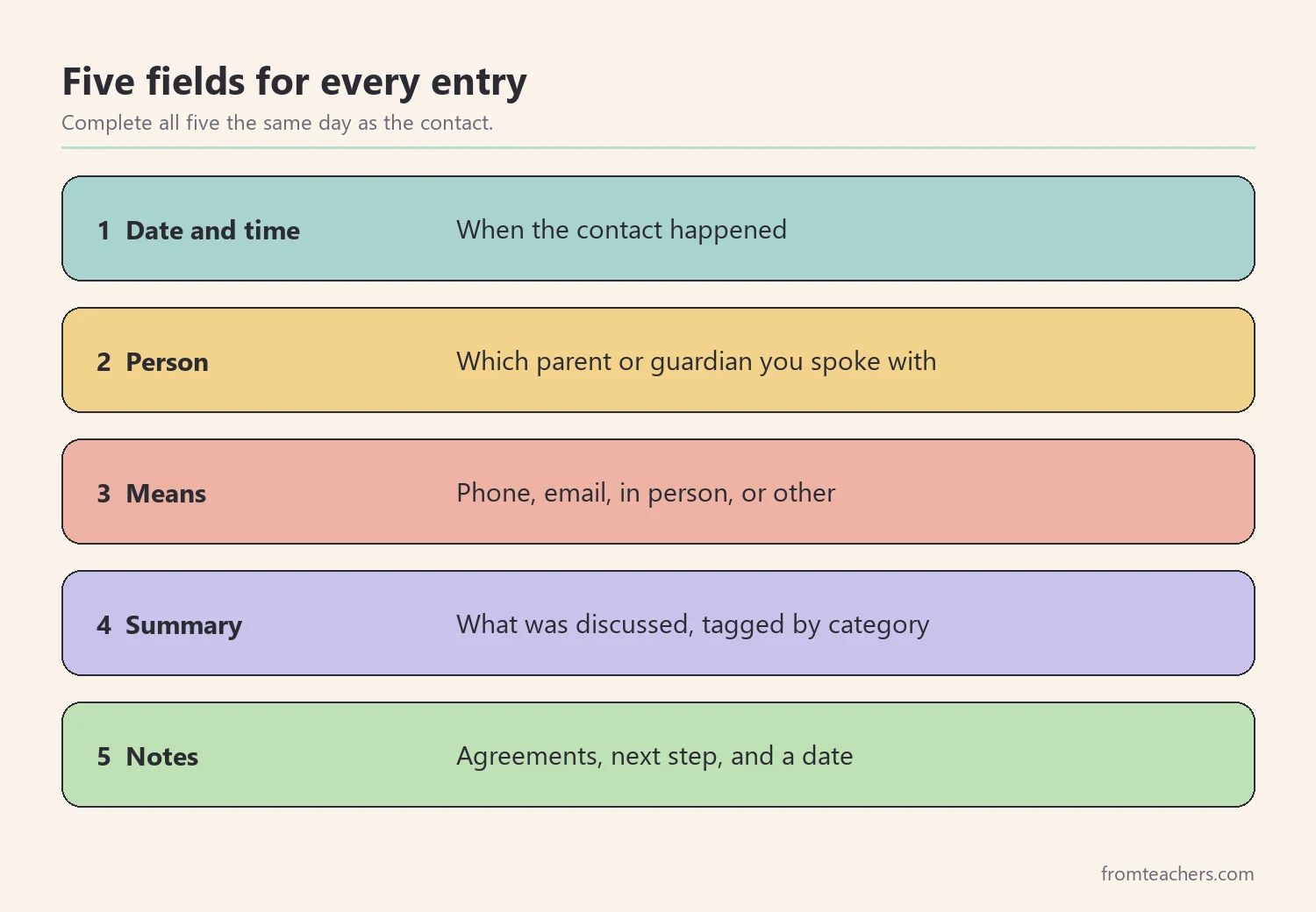
Each entry should include five things: date and time, the person you spoke with, the means of communication (phone, email, in person, or other), a short summary, and notes such as next steps.
For Maya, Mr. Ruiz logged an in-person conversation with her grandfather on a Wednesday at pickup. They talked about Maya forgetting her reading folder, and agreed to try a checklist in her backpack. The entry took less than two minutes to write.
If you want this layout ready to use, a parent communication log with contact info and call log puts both guardians’ details and seven logged conversations on one page.
3. Write short, factual summaries in your parent contact log template
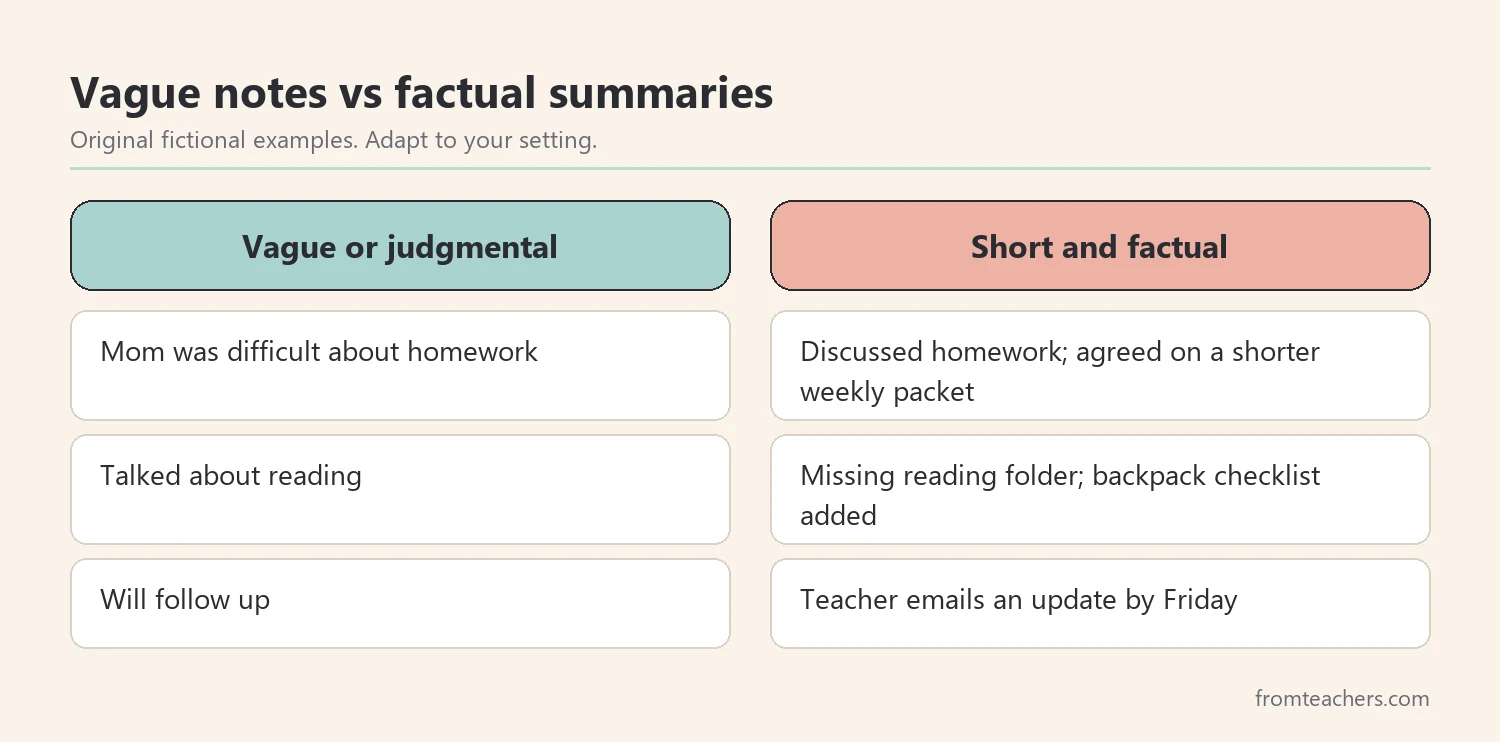
The summary is the heart of the entry. Keep it brief, neutral, and specific. Write what was discussed and agreed, not your opinions about the family. A good test: would you be comfortable if the parent read the entry? If not, rewrite it.
Use plain, objective language. Instead of “Mom was difficult about homework,” write “Discussed homework completion. Parent shared that evenings are busy; agreed to try a shorter weekly packet.” The second version records the facts and the plan, and it stays respectful.
Next, include any agreements and who is responsible in the parent contact log template entry. For example, “Teacher will send a reading list Friday. Parent will check the folder nightly.” Clear responsibilities make follow-up easy and prevent misunderstandings later.
Also note how the family wants to hear back. If a parent asks for an update in two weeks, write that down with a date. Then put the date on your calendar too, so the follow-up actually happens.
For example, Mr. Ruiz wrote this after a call with Maya’s mother: “Phone, 4:15 p.m. Discussed Maya’s reading folder. Mother will check the backpack each evening. Teacher will email a short update in two weeks.” It is three sentences long, yet anyone on the team could pick it up and know exactly where things stand.
Similarly, when a conversation is tense, keep the summary even more careful. Note the concern the family raised in their own words where possible, what you explained, and what both sides agreed. Stay calm on paper, even if the call was not.
In addition, avoid writing sensitive information that does not need to be there. Health details, family circumstances, or private matters should only be recorded if they are relevant and your school policy allows it. When unsure, check with an administrator or counselor.
4. Use parent contact log template categories to spot patterns
Categories turn a list of entries into useful information. Tag each summary with a simple category, such as Behaviour, Academic, Routines, or Other. Then, every few weeks, look back across the page.
Patterns often appear quickly. Maybe most contacts with one family are about behavior, and none about academic progress. Or maybe a student’s routine issues, like a forgotten folder, come up again and again. Seeing this helps you plan your next conversation with purpose.
For Maya, Mr. Ruiz reviewed seven entries after the first two months.
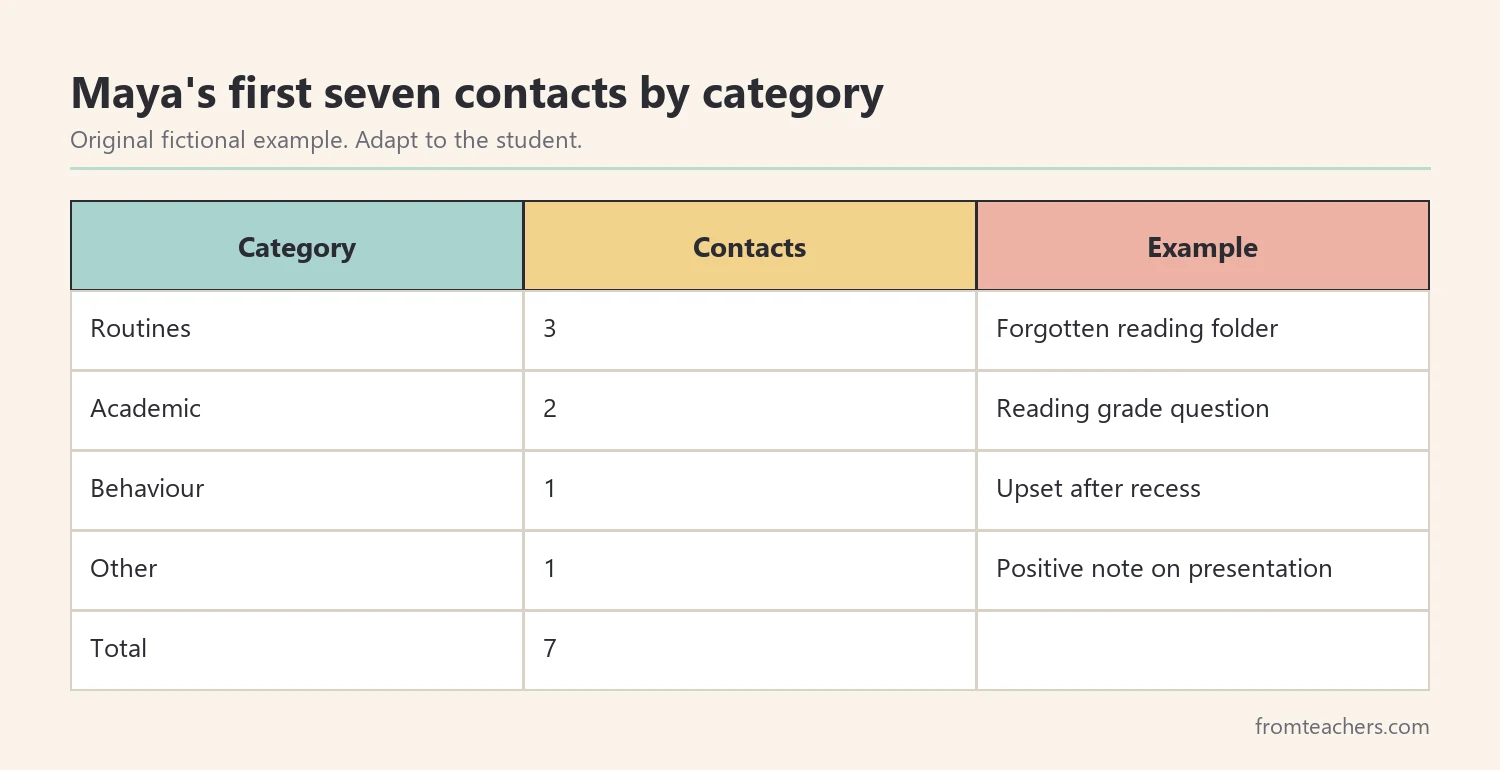
Out of 7 contacts, 3 were about Routines, 2 about Academic progress, 1 about Behaviour, and 1 was Other, a positive note about a class presentation. Since routines came up most, Mr. Ruiz planned a short meeting with Maya’s mother and grandfather to agree on one consistent backpack routine.
Categories also help you check balance. If a family has heard only about problems, plan a positive contact soon. The parent contact log template makes that gap easy to see at a glance.
It also helps to compare means of communication. If emails to one family go unanswered while phone calls get a quick reply, switch to calls. The parent contact log template already records the means for each entry, so this check takes only a moment and often solves a long run of missed messages.
Moreover, patterns across a whole class can guide your planning. If many families ask about the same homework assignment, the directions may need to be clearer. In this way, the log helps you improve your teaching, not only your record keeping.
5. Plan follow-ups with your parent contact log template
A log is most useful when it leads to action. Use the notes column to write the next step and a date. Then, once a week, scan your pages for open items. A ten-minute Friday check is usually enough to keep follow-ups from slipping.
When you follow up, refer back to the last entry. For example, “Last time we agreed to try the backpack checklist. How has it been at home?” Families notice when you remember, and that builds trust over time.
Treat each parent contact log template as a confidential school record. Keep the logs secure. Store paper copies in a locked drawer or cabinet, and keep digital copies in a school-approved location. Follow your district’s rules for how long to keep records and who can see them.
In addition, use the parent contact log template before meetings. Before a conference or an IEP or 504 meeting, read back through the page for that student. Within a minute, you can recall what the family raised last time, what you agreed, and whether you kept your side of the plan. Families notice that preparation, and the meeting starts on firmer ground.
Share the log with colleagues only when there is a clear reason, such as a team meeting or a handover to a new teacher. Even then, share what is needed, not the whole page by default.
At the end of the year, review each page one more time. Note anything the next teacher should know, such as the best way to reach a family. That small step helps the student start the new year with a team that already knows how to communicate with home.
Over a full year, a well-kept parent contact log template becomes more than a record. It is a short history of a partnership: what worried the family, what helped, and how the student grew. For many teachers, that history is the most useful document they hand to next year’s team.
Common mistakes and how to avoid them
- Logging days later. Details fade. Fix: write the entry the same day, right after the conversation.
- Only recording problems. The record becomes one-sided. Fix: log positive contacts too.
- Writing opinions instead of facts. Fix: record what was discussed and agreed, in neutral language.
- Missing next steps. Promises get forgotten. Fix: write a next step and date for every concern.
- Storing logs carelessly. Fix: keep paper locked away and digital copies in an approved place.
Questions teachers and parents ask about a parent contact log template
Do I need to log every email?
Log any email that shares information, raises a concern, or records a decision. Quick scheduling replies can be skipped, or noted briefly in the same entry as the related conversation.
Can I track two guardians for one student?
Yes. A good template includes rows for two parents or guardians, each with separate phone numbers and email. For separated families, log which adult you spoke with in each entry.
Should I use paper or digital?
Either works if you use it consistently and store it securely. Many teachers keep a printed copy on a clipboard for quick notes, then file it in a binder.
Can parents ask to see the log?
Policies vary, so check with your school. In any case, write every entry as if the family might read it someday: factual, respectful, and brief.
How long should each entry be?
Two to four short lines is usually enough. Record the main topic, any agreement, and the next step.
Related reading: How Teachers Communicate With Parents in Special Education: Building a Strong Partnership, How Parents and Teachers Can Team Up for Special Education Success, and Reflect and Plan: A Teacher’s New Year Guide for 2025.
A companion resource for your parent contact log template:
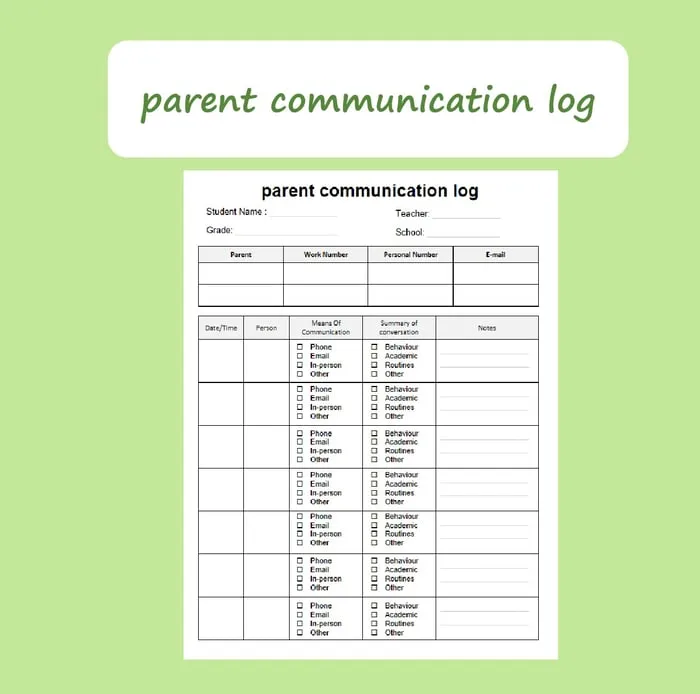
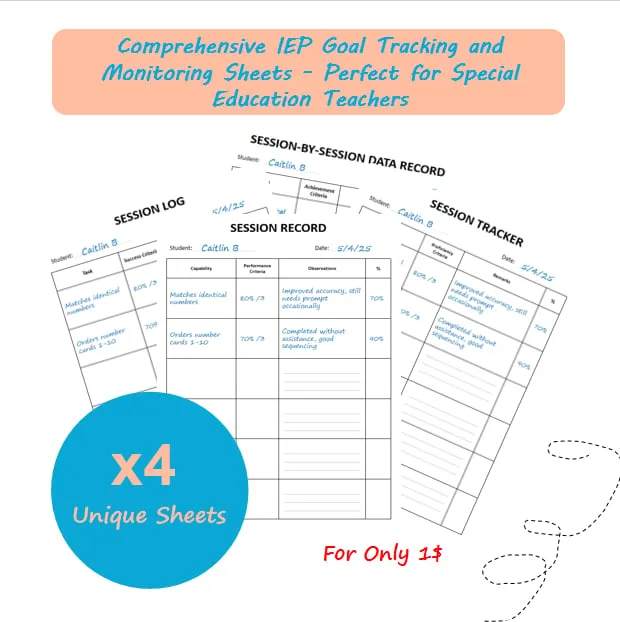
Parent Communication Log: Student Contact Info and Call Log Template: a one-page log, editable or print-ready, with student details, a contact table for two parents or guardians, and a communication log with date and time, person, means of communication, categorized summary, and notes for seven conversations.
Sources and scope
- National PTA: resources on family engagement and partnerships between families and schools.
- U.S. Department of Education: Protecting Student Privacy: guidance on student records and FERPA.
- Global Family Research Project: research and tools on family engagement in learning.
- Edutopia (George Lucas Educational Foundation): practical articles from educators on communicating with families.
Scope: this guide covers organizing and recording teacher communication with families. It does not provide legal advice on student records, so follow your school and district policies.
Key takeaways
- Keep contact details and conversation history together for each student.
- Log every meaningful contact the same day, including good news.
- Write short, neutral summaries with clear agreements.
- Use categories to spot patterns and balance your contacts.
- Check follow-ups weekly and keep the logs secure.






Leave a Comment