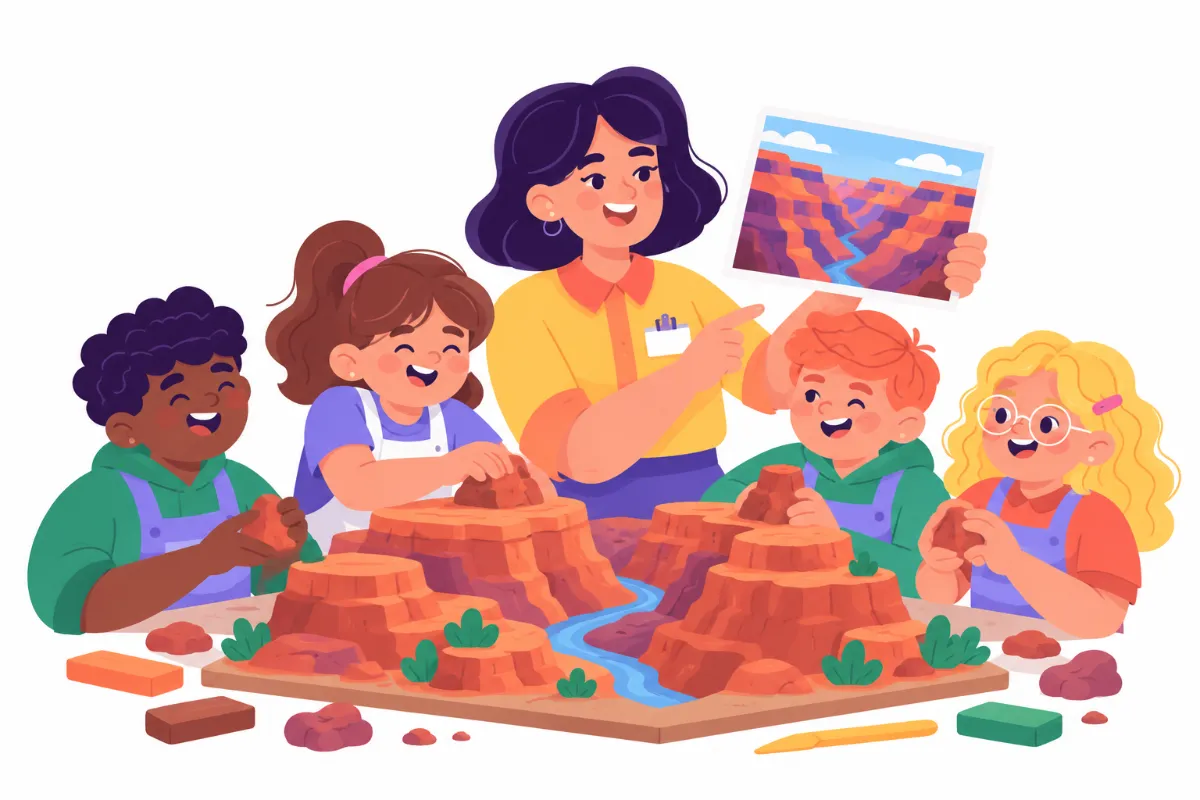

Arizona facts for kids are a natural way to bring geography, science, and history into one lively unit. Picture a third grade class staring at a photo of the Grand Canyon: someone asks how deep it is, someone else asks who lives there, and suddenly a quiet social studies block turns into a room full of questions.
This guide shows you how to turn that curiosity into a clear, five-day state study built around Arizona facts for kids. By the end, you will be able to introduce Arizona’s capital and nickname, teach its state symbols, explore famous landmarks, connect the unit to desert science, and check what students remember. Examples are fictional. Adapt them to your students and your curriculum.
At a glance
- Start with a map, the capital, and the nickname before adding details.
- Teach state symbols with short memory hooks so they stick.
- Use landmarks like the Grand Canyon and Sedona to connect geography and science.
- Add hands-on work, such as a clay canyon model, to deepen understanding.
- Finish with a review that asks students to explain, not just repeat.
1. Start With the Big Picture: Arizona Facts for Kids
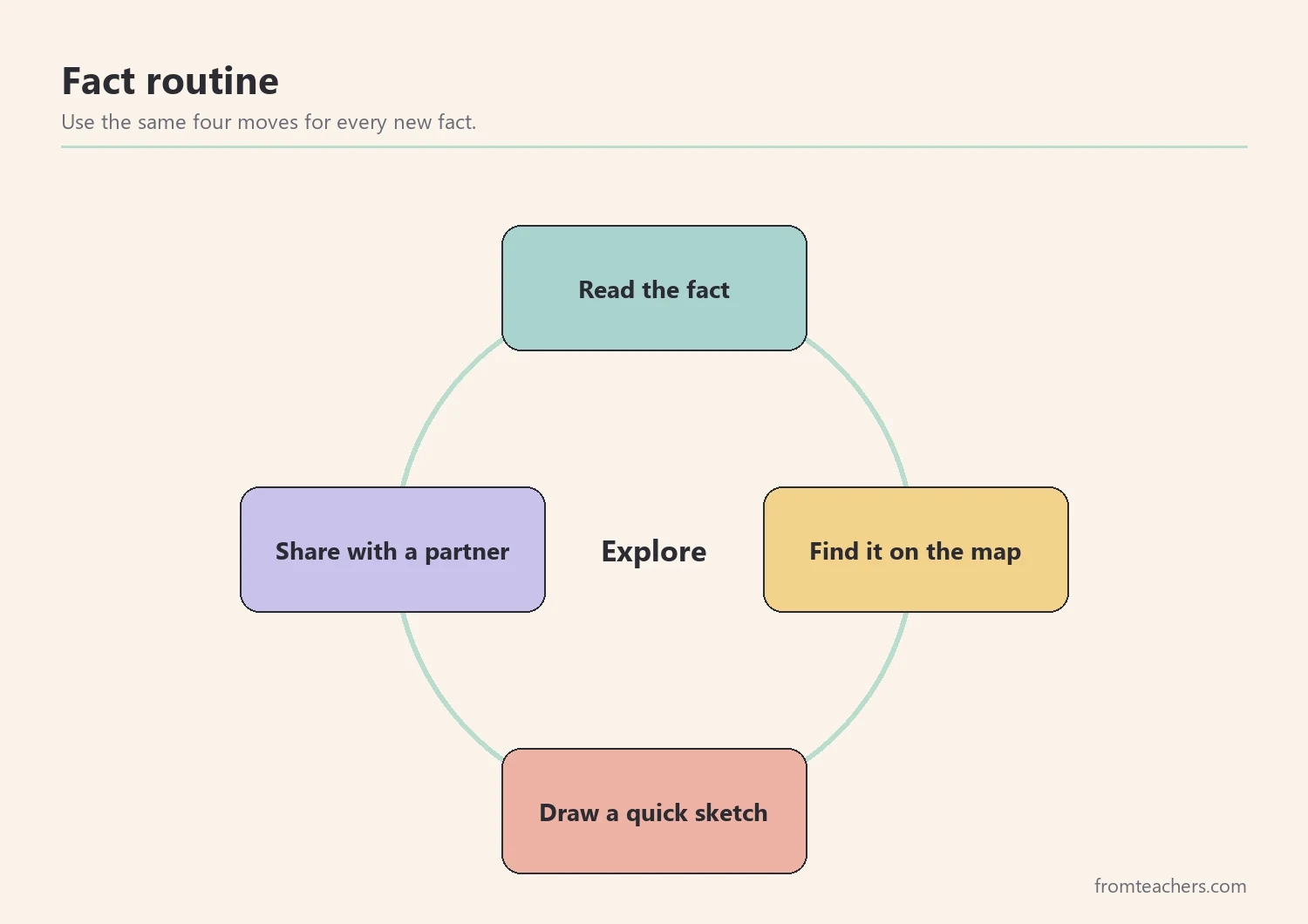
Students remember details better when they first know where a place is. Therefore, open the unit with a map. Show the United States, then zoom in on the Southwest. Ask students to find Arizona and name the states around it.
Next, introduce three anchor facts. Phoenix is the capital. Arizona’s nickname is “The Grand Canyon State.” In addition, Arizona became the 48th state on February 14, 1912. Post these on the wall, because every later lesson will connect back to them.
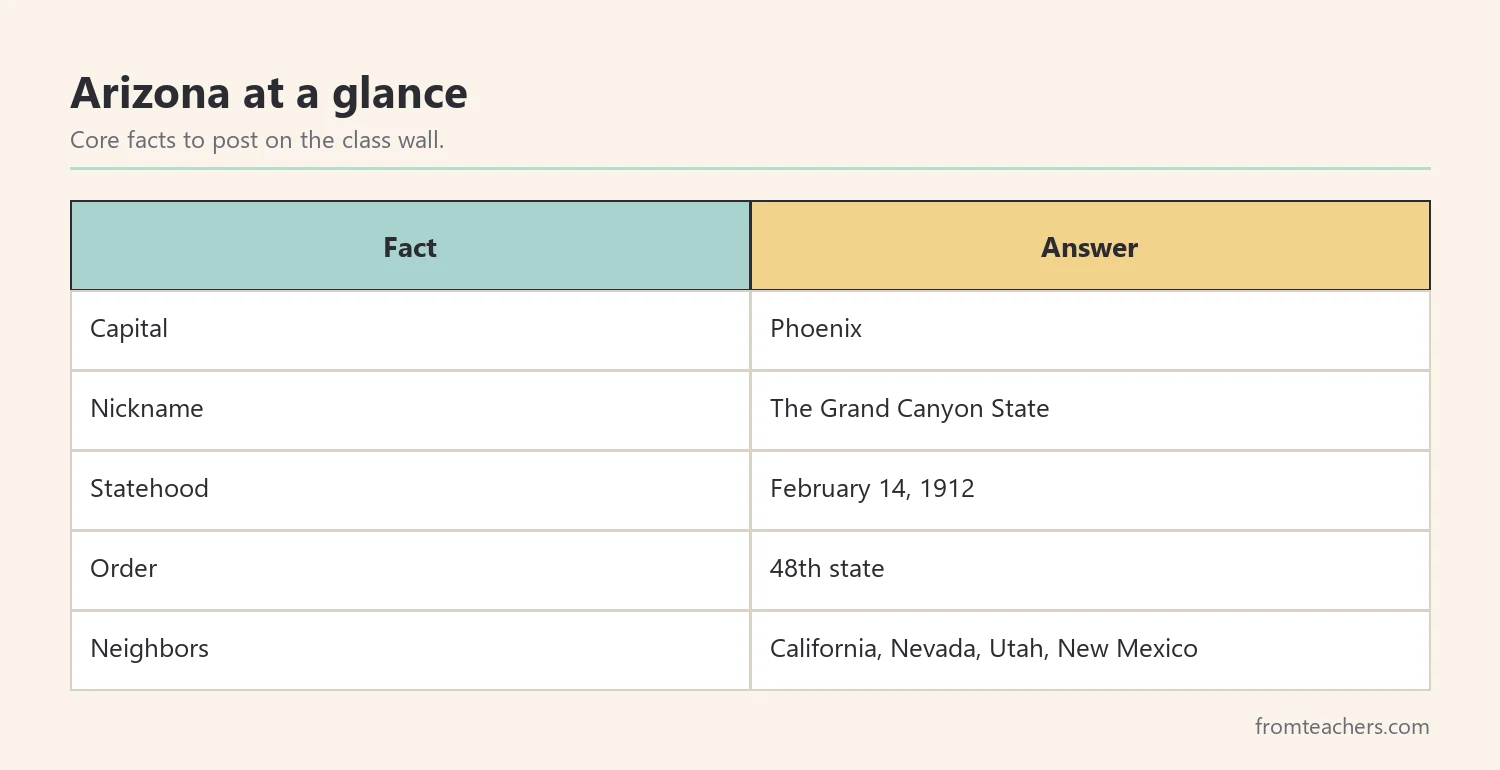
For example, in Ms. Rivera’s fictional third grade class, students start with a blank outline map. They color Arizona, write “Phoenix” with a star, and draw an arrow toward the Grand Canyon in the north. Then they label the four neighboring states and Mexico to the south.
Also, mention the Four Corners. This is the one place in the United States where four states meet: Arizona, Utah, Colorado, and New Mexico. Students love the idea that you could stand in four states at once, and it makes the map memorable. In fact, many teachers find that this first day sets the tone for all the Arizona facts for kids that follow.
Finally, ask a question that will run through the unit: “What makes Arizona different from where we live?” Write students’ first ideas on chart paper. As a result, you will have a simple way to show how their thinking grows by the last day.
Keep this first lesson short and visual. Arizona facts for kids work best when each new detail has a clear place on the map and a clear link to the big question.
2. Teach Arizona State Symbols With Memory Hooks
State symbols are a favorite part of any state study. However, a list of six symbols can blur together quickly. A memory hook for each one makes the difference between “I heard that” and “I remember that.”
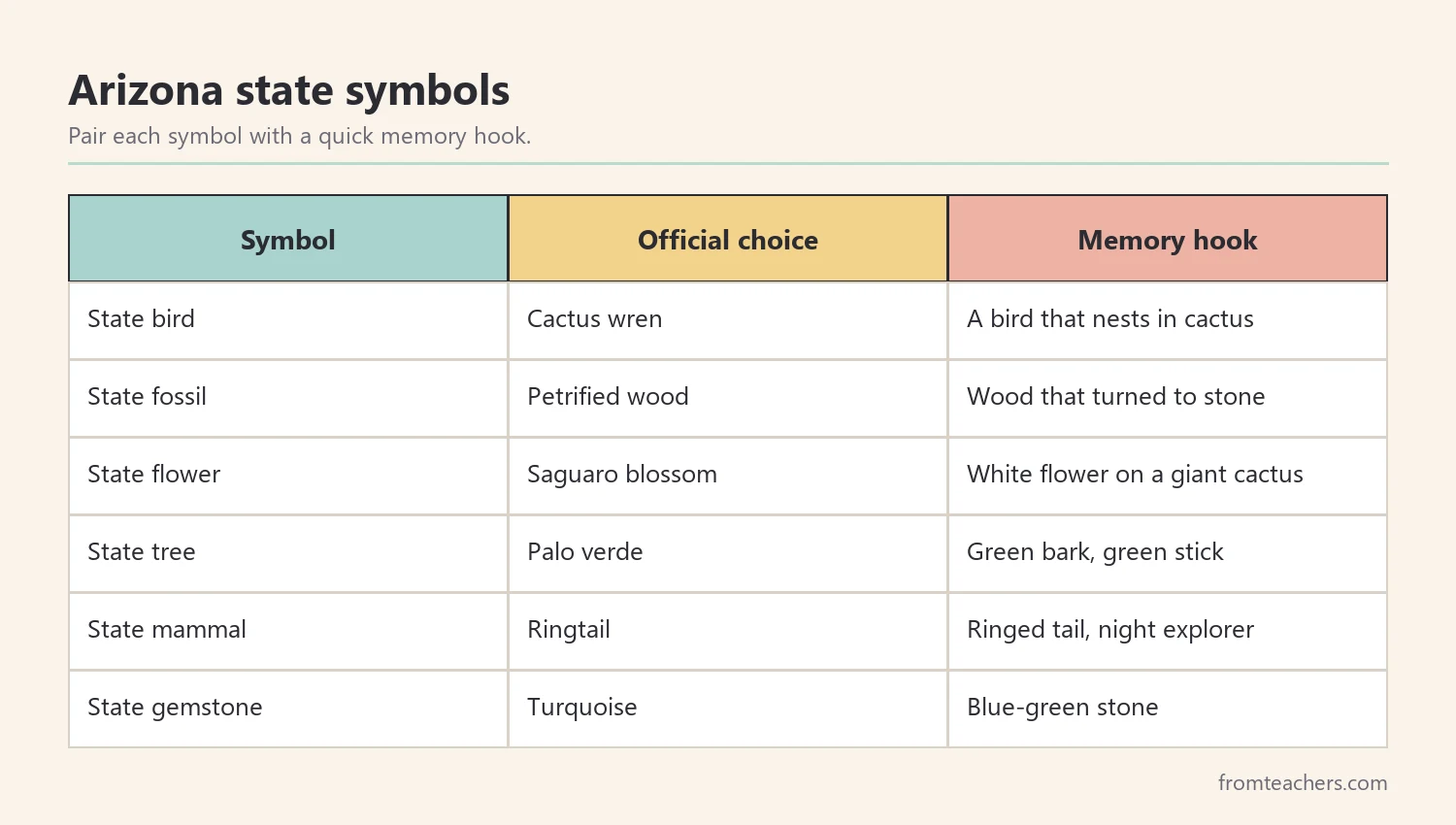
First, introduce two symbols at a time. The cactus wren is the state bird, and it often builds its nest in cactus. Petrified wood is the state fossil: ancient wood that slowly turned to stone. Next, add the saguaro blossom, the state flower, and the palo verde, the state tree, whose name means “green stick” in Spanish because of its green bark.
Then, finish with the ringtail, the state mammal, and turquoise, the state gemstone. A quick photo of each helps, especially for the ringtail, which many students have never seen. Symbols are often the Arizona facts for kids that students repeat at home, so give them enough practice to say each one with confidence.
For example, Ms. Rivera’s class makes a “symbol gallery.” Her 24 students work in six groups of four. Each group takes one symbol, draws it, and writes one sentence with its memory hook. After ten minutes, the groups walk the gallery and read every poster.
Moreover, connect symbols to the land. Several Arizona symbols come from the desert, and petrified wood links to Petrified Forest National Park. This prepares students for the landmark and science lessons that follow. If you want ready-made slides for this step, the Arizona state study slides on facts, symbols, and landmarks include symbol slides for the state bird and state fossil, plus other emblems such as the saguaro blossom, palo verde, ringtail, and turquoise.
3. Explore Famous Arizona Landmarks
Landmarks turn Arizona facts for kids into real places students can picture. Three stand out for younger learners: the Grand Canyon, Sedona’s red rocks, and Monument Valley.
First, the Grand Canyon. It was carved over a very long time, mostly by the Colorado River, and its walls show many layers of rock. Show a photo and ask students to describe what they see. Many will notice the stripes in the canyon walls, which leads naturally to a short talk about rock layers.
Next, Sedona. Its red rock formations are famous for their color, which comes from iron-rich minerals in the rock. Students can compare a photo of Sedona with the Grand Canyon and list what is the same and what is different.
Then, Monument Valley. Its tall sandstone buttes rise from a flat desert floor near the Arizona and Utah border. It lies within the Navajo Nation, which is a good moment to mention that Arizona is home to many Native American nations with their own histories and cultures.
For example, Ms. Rivera gives each group three photo cards, one per landmark. Groups sort clues such as “red rocks,” “river at the bottom,” and “tall flat-topped rocks” onto the right card. Afterward, each group explains one choice to the class.
| Landmark | What to notice | Big idea |
|---|---|---|
| Grand Canyon | Layered rock walls | Rivers can shape land |
| Sedona | Red rock color | Minerals affect color |
| Monument Valley | Tall buttes | Wind and water wear rock |
Finally, keep landmark lessons short. One photo, one question, and one big idea per landmark is enough. Arizona facts for kids become lasting knowledge when students can explain why a place looks the way it does, not just name it.
4. Bring Desert Life Into Arizona Facts for Kids
Much of southern Arizona is part of the Sonoran Desert. As a result, a state study is a great moment to add simple life science. Students can explore how plants and animals survive heat and little rain.
Start with the saguaro. It is a tall cactus with arms, and it stores water in its thick stem. Its flower is the state flower you met earlier. Next, return to the cactus wren and ask why a cactus might be a safe place for a nest. Students usually suggest the spines, which is a good observation.
Then, add a hands-on activity. A clay model of the Grand Canyon helps students see how layers form and how a river cuts through them. It takes about 30 minutes and works well in groups of four.
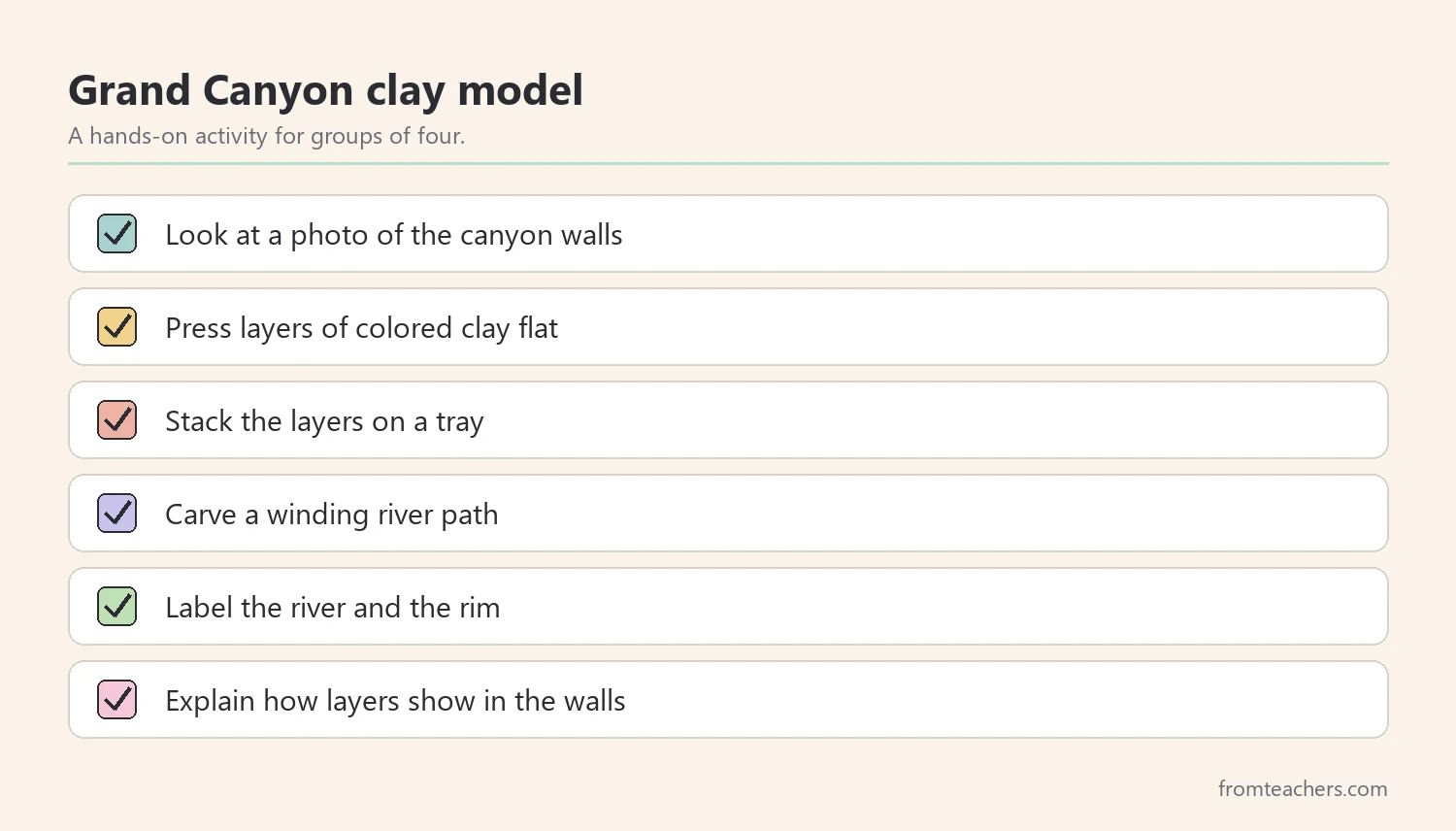
For example, Ms. Rivera’s six groups each build a model on a paper tray. They press three colors of clay into flat layers, stack them, and carve a winding river path with a craft stick. Then they label the river and the rim, and one student explains how the layers show in the walls.
In addition, invite students to compare the desert with their own region. What would a saguaro need if it lived in your town? Questions like this push students to think, not just recall, and they make Arizona facts for kids more meaningful.
- Use photos before facts, so students observe first.
- Keep science claims simple and accurate.
- Link each living thing back to the map.
5. Add Food, Culture, and Daily Life With Care
Students often ask, “What do people eat there?” A short look at food and daily life makes the state feel real. In many classes, these are the Arizona facts for kids that spark the best conversations at home. However, approach culture with care and respect, and avoid presenting any group as a costume or a single story.
For example, you can introduce a few foods connected with Arizona, such as Navajo fry bread, chimichangas, and cactus jelly. Explain that food often connects to history, land, and the people who live there. Then invite students to share a food that is special in their own family or region.
Next, keep the focus on real people today. Arizona is home to large cities like Phoenix, small towns, and many Native American nations. Moreover, it is a place where people work, go to school, and spend time outdoors, just like your students.
In Ms. Rivera’s class, students make a two-column chart: “Same as us” and “Different from us.” By the end of the lesson, they list several ideas in each column. This simple chart becomes part of the final review.
Also, check your sources. Use official state and national park sites for facts, and choose books and videos that show people respectfully and accurately.
6. Review and Check Arizona Facts for Kids
A good review asks students to explain, not just repeat. Therefore, plan the last day around sharing and short checks. Students should be able to name the capital and nickname, describe at least two symbols, and explain one landmark.
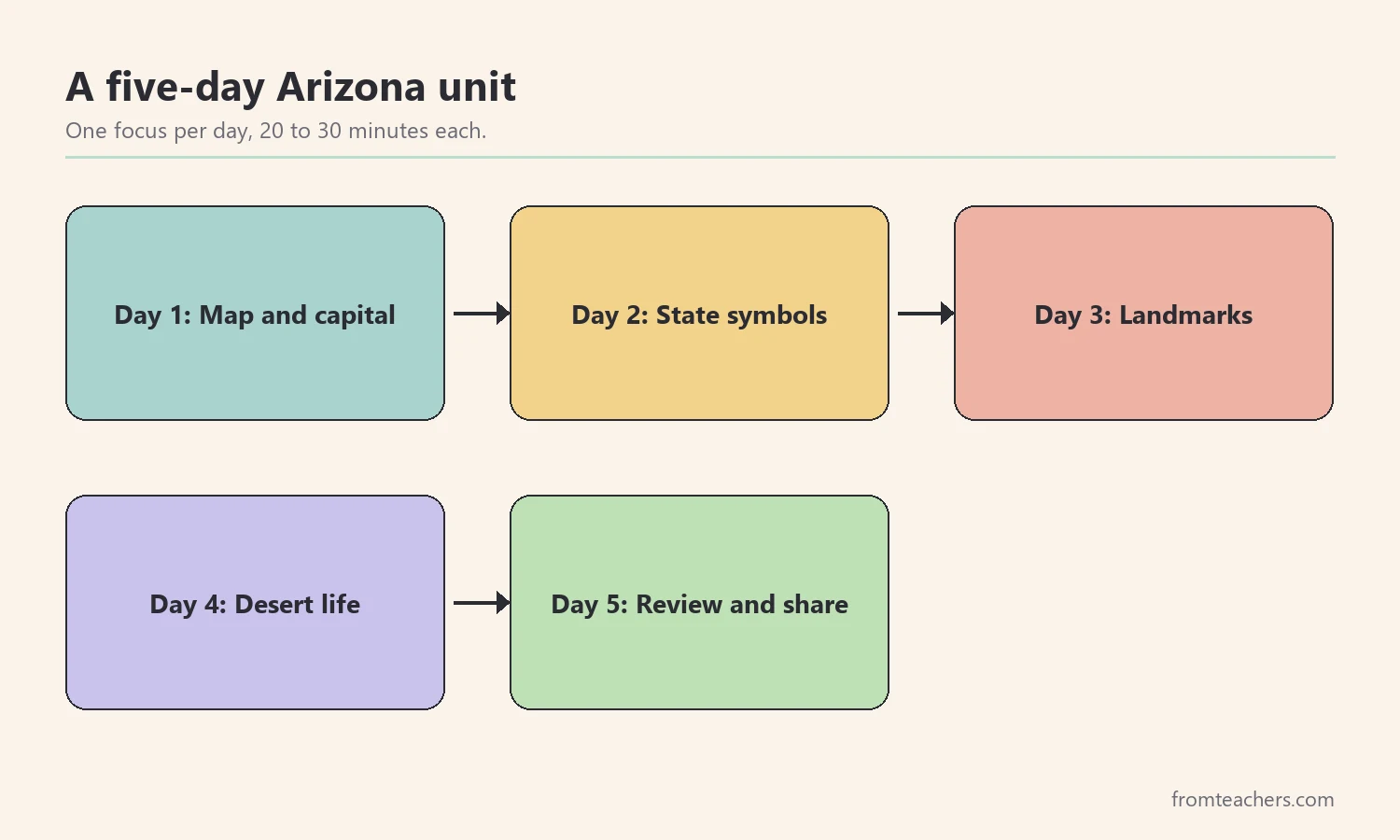
First, return to the big question from day one: “What makes Arizona different from where we live?” Compare the new answers with the first ideas on chart paper. Students are often surprised by how much they have learned.
Next, use a quick five-question check. For example, Ms. Rivera asks students to name the capital, the nickname, the state bird, one landmark, and one way desert plants save water. In her fictional class, 18 of 24 students answer all five correctly, and the other 6 miss one question each. As a result, she reteaches the two most-missed items in a short small group. A week later, she uses the same check to see which Arizona facts for kids students still remember.
Finally, celebrate. A short gallery walk of clay models and symbol posters lets students show their work. In addition, a “postcard from Arizona” writing task lets each student pick one favorite fact and explain why it matters.
Common mistakes and how to avoid them
- Starting with a long fact list: begin with the map, the capital, and the nickname.
- Teaching all symbols at once: add two at a time with a memory hook.
- Using landmarks only as pretty pictures: connect each one to a science idea.
- Presenting culture as a costume: focus on real people, history, and daily life.
- Reviewing by repetition only: ask students to explain and compare.
Questions teachers and parents ask about Arizona facts for kids
What are the most important Arizona facts for kids to learn first?
Start with the capital, Phoenix, the nickname, “The Grand Canyon State,” and where Arizona is on the map. Then add the year it became a state, 1912. These anchor facts make later details easier to remember.
What grade level fits an Arizona state study?
Elementary grades are a common fit, especially during state studies or geography units. Younger students can focus on symbols and pictures. Older students can research landmarks and write short reports.
How can I make Arizona facts for kids hands-on?
Try a Grand Canyon clay model, a symbol gallery, or a landmark sorting game. Each activity takes 10 to 30 minutes and works in small groups.
How do I teach Native American culture respectfully?
Present nations as living communities with their own histories, not as part of the past. Use accurate, respectful sources and avoid costumes or stereotypes.
Can parents use these ideas at home?
Yes. A map, a few photos, and a simple model or drawing are enough. Families can also compare Arizona with places they have visited.
Related reading: Learning Styles Student Success Guide and 5 Practical Teaching Tips to Boost Classroom Focus and Learning.
A companion resource for Arizona facts for kids
Ready-to-use resource:
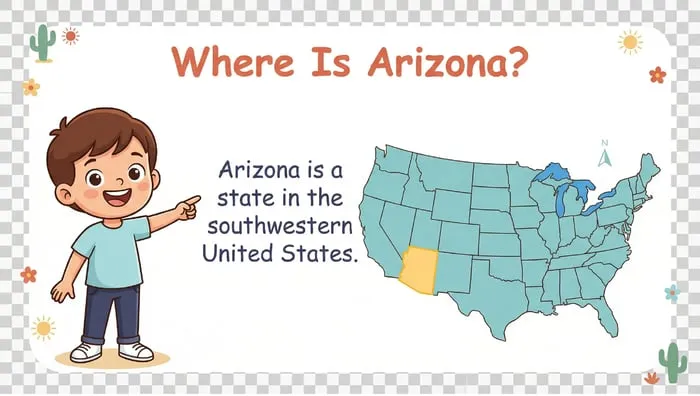
Arizona State Study: Facts, Symbols, and Famous Landmarks: a 32-slide, kid-friendly introduction to Arizona covering the capital, nickname, state symbols, famous places, foods, and a review slide.
Sources and scope
- Grand Canyon National Park (National Park Service): the official park site with information on the canyon’s geology and history.
- Petrified Forest National Park (National Park Service): the official park site about petrified wood and the surrounding landscape.
- Arizona state government portal: the official website of the State of Arizona.
- National Geographic Kids: kid-friendly articles and photos on geography and nature.
Scope: this guide offers teaching ideas for an elementary Arizona state study. It does not replace your state standards or a full history curriculum.
Key takeaways
- Open Arizona facts for kids with the map, the capital, and the nickname.
- Teach symbols two at a time with memory hooks.
- Connect landmarks to simple geology and desert science.
- Present people and cultures with care and accuracy.
- Review by asking students to explain and compare.

Leave a Comment