

Social stories for students help with the small, everyday moments that can turn a calm morning into a hard one. Picture a first grader who sees a classmate at the class computer, rushes over, and pulls the mouse away, because waiting feels impossible and nobody has shown her what waiting actually looks like. A short, friendly story read before that moment can change how it goes.
After reading this guide, you will be able to choose the right moment for a story, write one in clear first-person language, add visuals, practice it, and track whether it helps. You will also see how to build a small library that covers emotions, safety, and friendship. Examples are fictional. Adapt to the student’s goals and agreed supports. This is guidance, not a diagnosis.
At a glance
- A social story describes one situation in simple, positive, first-person language.
- Pick one specific moment that is hard for the student right now.
- Read the story before the moment, when the student is calm, not as a consequence.
- Count a few tries each week to see whether the story is helping.
- Build a small library so stories are ready when new moments come up.
1. Choose the moment your social stories for students will target
First, pick one specific situation. Social stories work best when they describe a single, concrete moment, such as waiting for a turn, lining up after recess, or hearing the fire alarm. A story about “being good at school” is too broad to help.
Next, watch the moment closely for a few days. Note when it happens, what the student does, and what the student might not understand. Often the problem is missing information: the student does not know how long the wait will be, or what to do while waiting.
Consider Ava, a fictional six-year-old in first grade. During center time, the class has one computer, and Ava often grabs the mouse from classmates. Her teacher watched for one week and counted 8 times Ava needed to wait for the computer. Ava waited calmly only 2 of those 8 times.
The teacher also noticed what Ava might be missing. She did not know how long each turn lasted, and she had nothing to do while she waited. That gave the story a clear job: explain the turn timer and give Ava a waiting activity.
Choosing one target keeps social stories for students focused and easy to evaluate. In addition, it helps the student, because one clear message is easier to remember than several at once. Later, once one story is working, you can add another.
| Good target | Too broad |
|---|---|
| Waiting for a turn at the computer | Being nice to friends |
| Lining up after recess | Following all the rules |
| When the fire alarm rings | Being safe at school |
2. Write social stories for students in clear first-person language
Now write the story. Keep it short, usually five to eight simple sentences, one idea per page. Use first-person words like “I” and “I can,” so the student sees the story as their own.
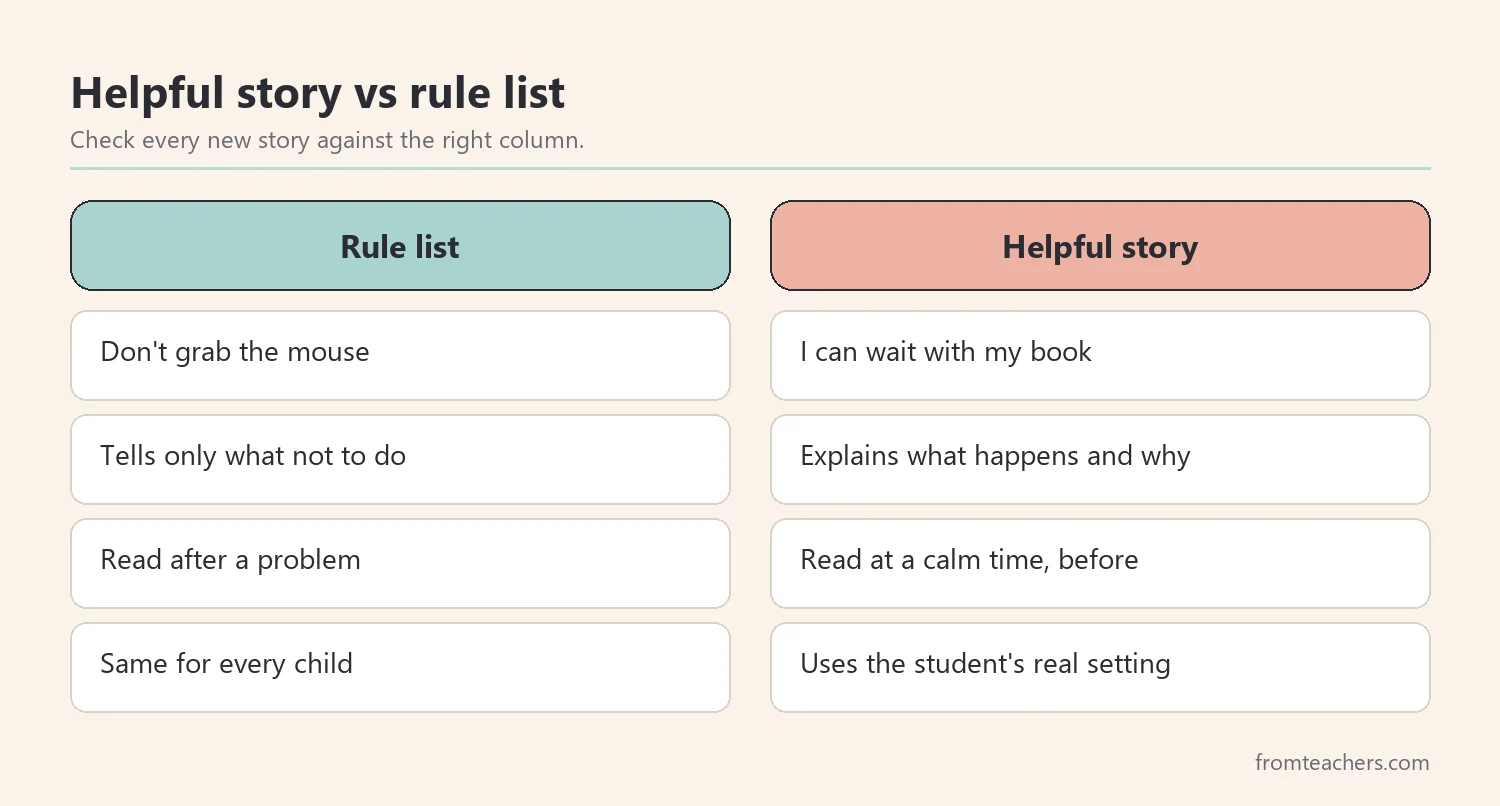
Also, describe more than you direct. Explain what happens and why, then offer a few things the student can do. Positive phrasing matters: “I can wait with my hands in my lap” works better than “Don’t grab the mouse.”
A simple structure keeps social stories for students consistent:
- Setting: where and when the moment happens.
- What happens: what others are doing and why.
- How I might feel: name the feeling without judgment.
- What I can do: two or three clear, doable actions.
- Positive ending: how things go well.
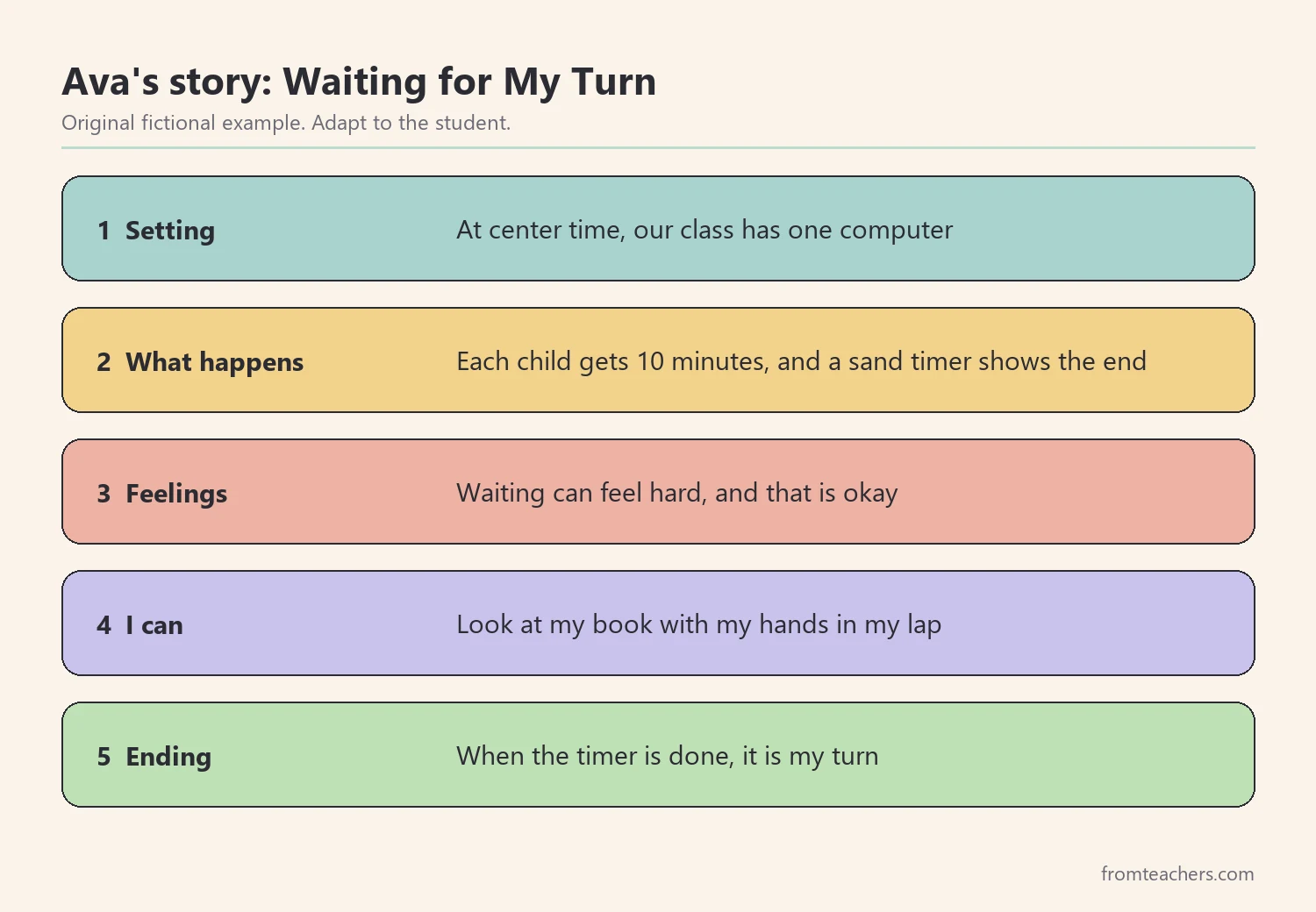
Ava’s teacher wrote a five-page story called “Waiting for My Turn.” It explained that each child gets 10 minutes on the computer, that the sand timer shows when the turn ends, and that Ava can look at a book while she waits. The last page said, “When the timer is done, it is my turn. I feel proud that I waited.”
Finally, read the story aloud to yourself. If any sentence sounds like a scolding, rewrite it in calmer, more descriptive words.
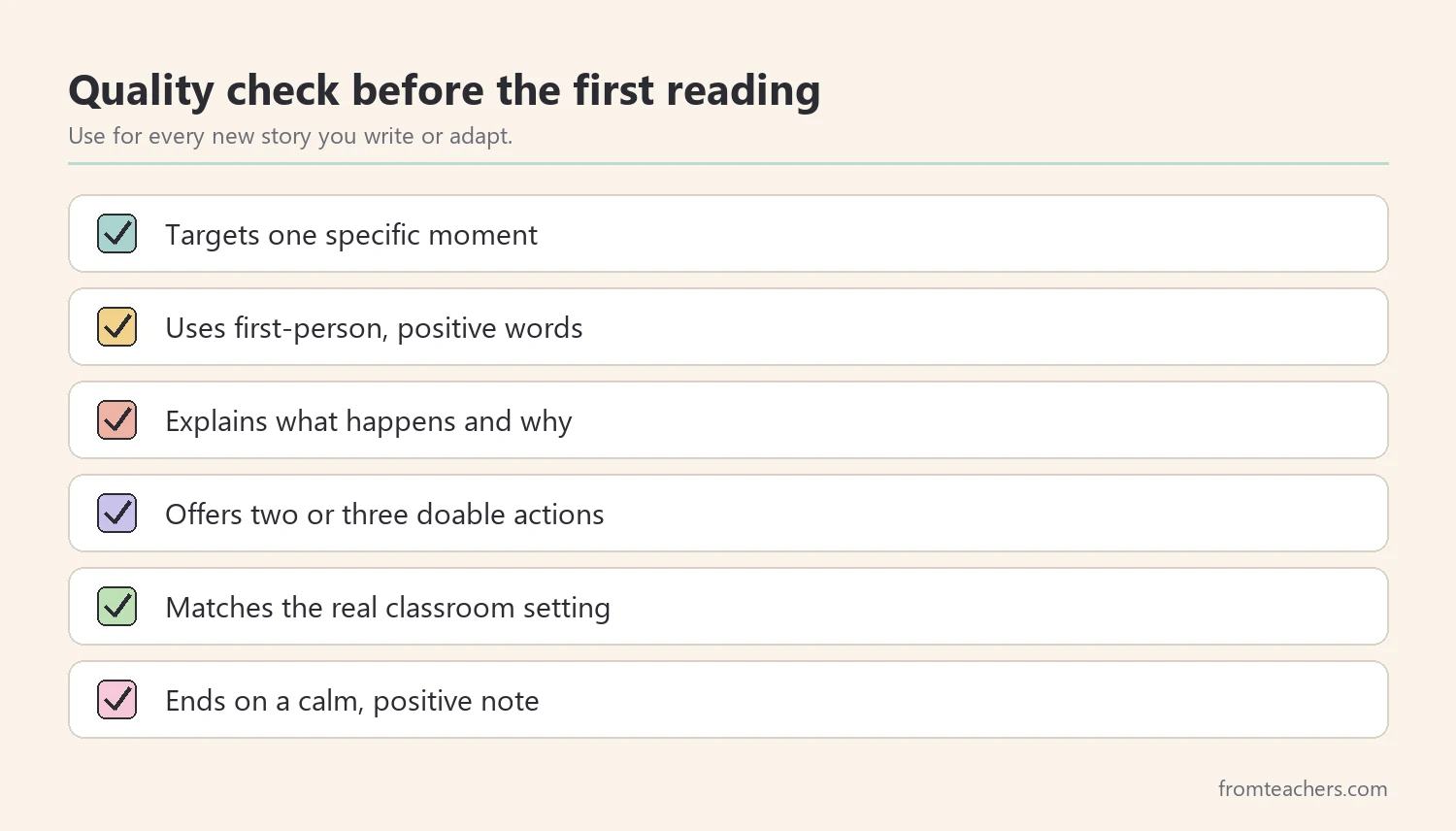
Before you print it, run a quick quality check. Well-written social stories for students are short, true to the real setting, and focused on what the student can do. If a sentence fails one of the checks below, adjust it now rather than after the first reading.
3. Add visuals and read the story before the moment
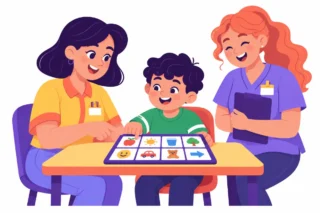
Visuals turn social stories for students into something a child can return to on their own. Pictures make the story easier to understand and remember. Use photos of the real classroom, simple drawings, or symbols, whichever the student understands best. One picture per page is usually enough.
For Ava, her teacher used a photo of the class computer, a photo of the sand timer, and a picture of Ava’s favorite book. As a result, every page matched something Ava could actually see in the room.
Then, read the story at a calm time, before the moment happens. Timing is one of the biggest factors in how well social stories for students work. Many teachers read it at the start of the day or just before centers. Reading it right after a problem can feel like a punishment, so save it for calm times.
If you want ready-made stories to start from, the collection of 30 first-person social stories for special education includes titles such as “Waiting My Turn,” “How to Stay Calm,” and “I Can Ask for Help,” each with five simple, numbered strategies. You can read one as is or use it as a model for a personalized version.
Also, keep the story where the student can find it. A copy on the desk, in a binder, or near the place where the moment happens makes it easy to revisit.
4. Practice and prompt in the real moment
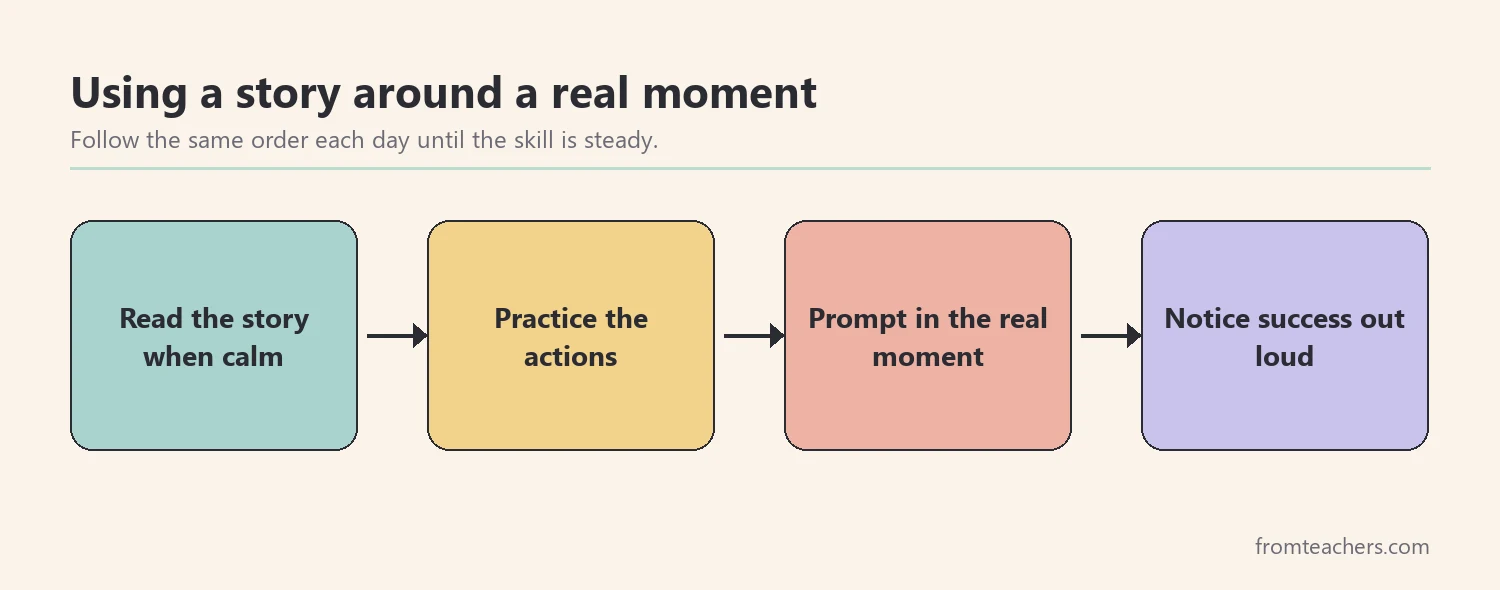
Reading the story is only the start. Next, practice the actions when nothing is at stake. For example, Ava and her teacher took turns with the sand timer during a quiet moment, and Ava practiced picking up her book while she waited.
Then, prompt gently during the real moment. A short reminder works well: point to the timer and say, “Book while you wait.” Keep prompts brief and calm, using the same words as the story.
Also, notice success out loud. When Ava waited, her teacher said, “You waited with your book, just like your story.” Specific praise links the story to the behavior and helps it stick.
Remember that social stories for students describe and guide; they are not meant to be used as a threat or a reward chart. The tone of your prompts should match the calm tone of the story.
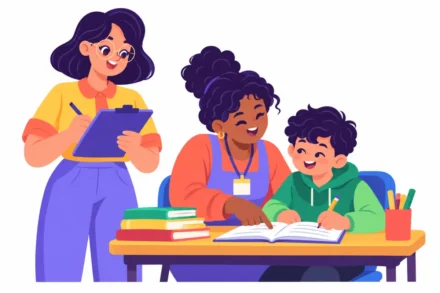
Finally, involve other adults. Share the story with the paraprofessional, the specials teachers, and the family, so everyone uses the same words. Social stories for students work best when the student hears one consistent message across the day.
5. Record whether the story is helping
Simple data shows whether the story is working. Choose one clear behavior from the story and count it a few times each week.
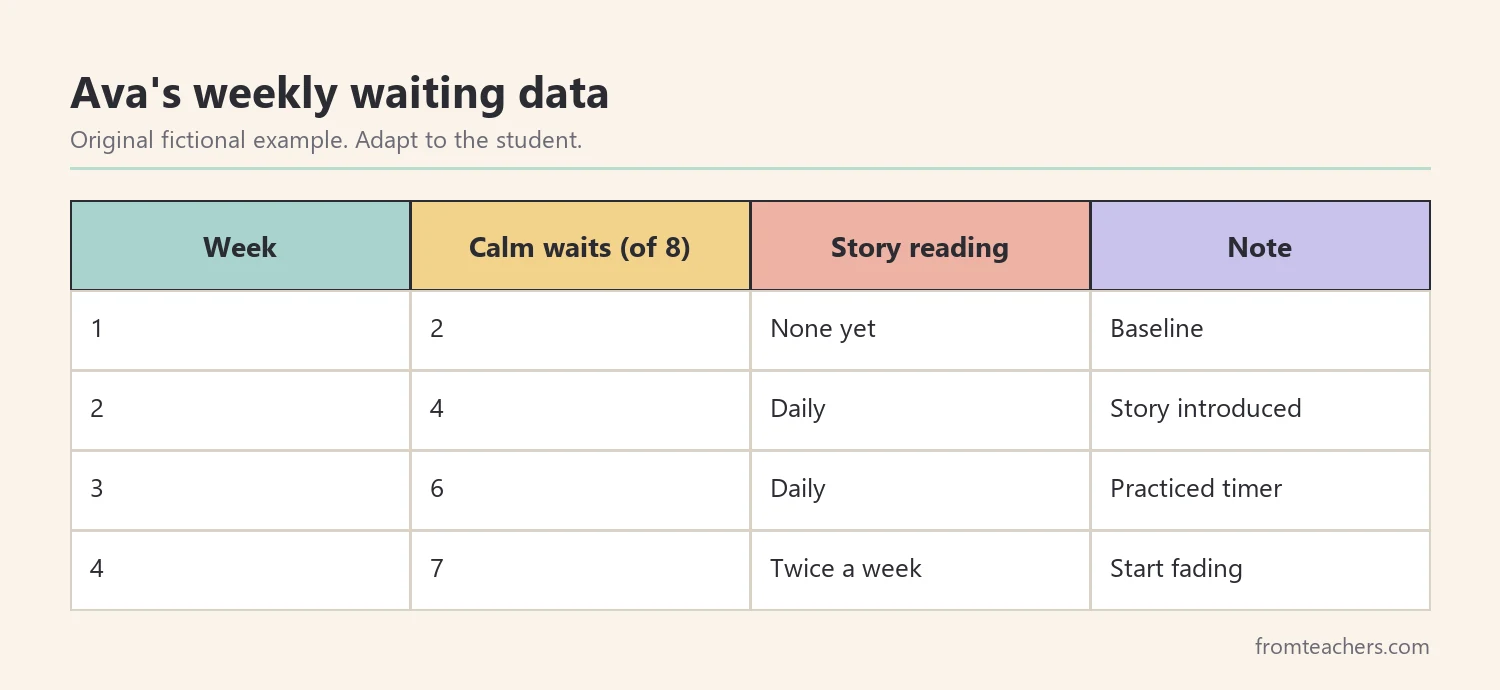
Ava’s teacher counted how many times Ava waited calmly out of 8 computer turns each week. In week 1, before the story, Ava waited 2 of 8 times. After the story, she waited 4 of 8 times in week 2, 6 of 8 in week 3, and 7 of 8 in week 4.
Also, add a short note each week, such as “practiced timer” or “new student joined centers.” These notes help explain changes later.
When the numbers stay high for a few weeks, read the story less often. For example, Ava’s teacher moved from daily reading to twice a week, and then to “as needed.” Fading the story gradually keeps progress steady while the skill becomes routine.
However, if the numbers stop rising, do not simply read the story more often. Instead, look again at the moment itself. Perhaps the waiting activity is not interesting, or the turn is too long. Small changes to the story or the setting usually help more than repetition. Tracking social stories for students in this way keeps decisions based on what actually happens, not on guesses.
6. Build a library of social stories for students
Once one story works, plan for the next moment. A small library means you are ready when new challenges come up, such as a new routine, a field trip, or a change in staff.
Organize the library by theme. That way, you can quickly find a story when you need it, and students can return to favorites on their own.
| Theme | Example story | When to read |
|---|---|---|
| Emotions | When I Feel Mad | Morning check-in |
| Friendship | Being a Good Friend | Before recess |
| Communication | I Can Ask for Help | Before independent work |
| Safety | Personal Space Is Important | Before group activities |
| Classroom | Time to Clean Up | Before transitions |
Also, plan ahead for predictable changes. Social stories for students are especially useful before a field trip, a new seating chart, a substitute teacher, or the first day back after a break, because they give the student the missing information in advance.
Moreover, use some stories with the whole class. Stories about waiting, sharing, or asking for help are useful for many children, and whole-class reading avoids singling anyone out.
Over time, invite students to help write new stories. Choosing the photos or suggesting “what I can do” ideas gives them ownership. In this way, social stories for students become a shared classroom tool rather than something done to one child.
Common mistakes and how to avoid them
A few common habits can make social stories for students less effective. Here they are, with a simple fix for each.
- Mistake: reading the story as a consequence. Fix: read it at calm times, before the moment.
- Mistake: writing a list of rules. Fix: describe what happens and why, then offer a few actions.
- Mistake: covering too much in one story. Fix: one story, one moment.
- Mistake: using different words across adults. Fix: share the story and its key phrases with the whole team.
- Mistake: stopping the story suddenly. Fix: fade it gradually when data stays high.
Questions teachers and parents ask about social stories for students
Are social stories only for autistic students?
No. They were first developed for autistic children, but many students benefit from a clear, friendly description of a hard moment. Whole-class stories about routines can help everyone.
How long should a story be?
For young children, five to eight short sentences with one picture per page is usually enough. Older students may handle a little more text, but shorter is generally easier to remember.
How often should we read the story?
Many teachers start with once a day, just before the moment. When the student handles the moment well for a few weeks, read it less often and keep it available.
Can parents use social stories for students at home?
Yes. Families can read the same story at home, or write their own for home moments such as bedtime or haircuts. Using the same words at school and home makes the message stronger. Social stories for students also give families a calm way to talk about hard moments together.
What if the story does not seem to help?
First, check whether the target is specific enough and whether the story is read before the moment. Then, look for missing information or an action that is too hard. If concerns continue, talk with the student’s team.
Related reading: Autism Social Skills Development: Practical Strategies for Growth, Meltdowns vs Tantrums: A Guide to Understanding and Responding, and Moving Beyond Shame and Behavior Charts: Positive Alternatives for Effective Classroom Management.
A companion resource for social stories for students:
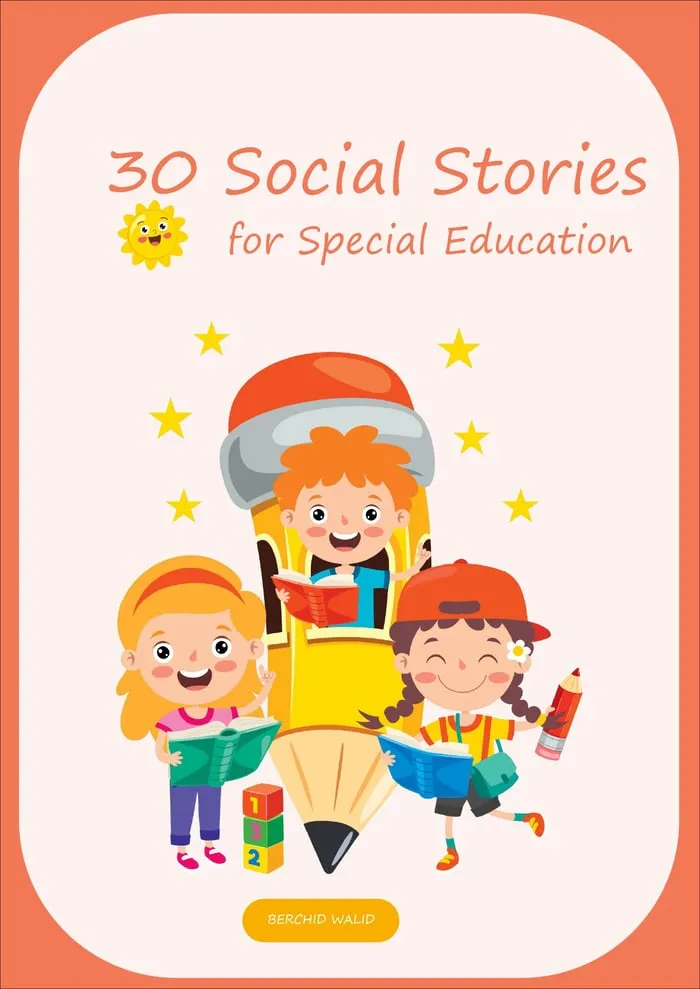
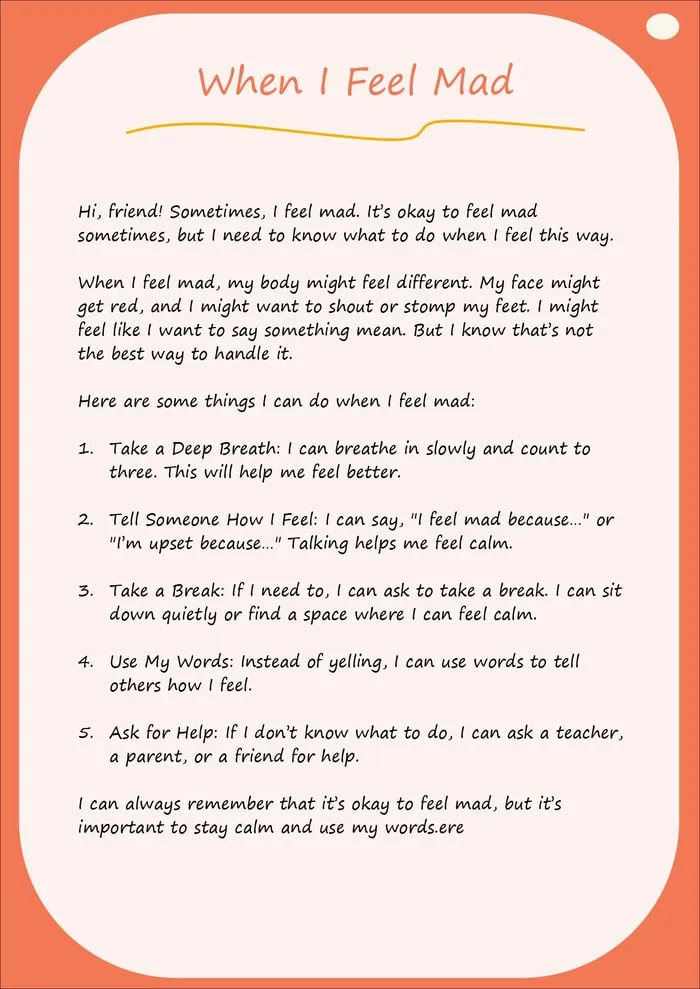
30 Social Stories: Special Education Bundle: 30 first-person stories covering emotional regulation, social skills, communication, respect and safety, classroom routines, and empathy. Each story uses “I can” language with five simple, numbered strategies, for children ages 4 to 10.
Sources and scope
- IRIS Center, Vanderbilt University: free modules on evidence-based practices for students with disabilities.
- AFIRM, UNC Frank Porter Graham Child Development Institute: free learning modules on evidence-based practices for autistic learners.
- CDC autism information: general background on autism spectrum disorder.
- IDEA, U.S. Department of Education: the law behind special education services and IEPs.
This guide covers practical ways to write, use, and track social stories in classrooms and at home. It does not cover diagnosis, formal behavior assessment, or therapy, which belong to qualified professionals and the student’s team.
Key takeaways
- Target one specific, observable moment per story.
- Write in short, positive, first-person sentences with one picture per page.
- Read the story at calm times, then practice and prompt with the same words.
- Count a few tries each week and fade the story gradually.
- Build a themed library and invite students to help write new stories.




Leave a Comment