

A Big Five personality test for students can turn a quiet counseling session into a real conversation about who a student is and where they want to go. Picture a tenth grader who shrugs at every career question, then lights up when a short self-rating shows that she scores high on curiosity and lower on outgoing energy.
After reading this guide, you will be able to plan a session around the Big Five, introduce it without labels, score it accurately, talk through results in a strengths-first way, and connect what students learn to goals and career exploration. Examples are fictional. Adapt to the student’s goals and agreed supports. This is guidance, not a diagnosis.
At a glance
- The Big Five describes five broad traits: Extraversion, Agreeableness, Conscientiousness, Emotional Stability, and Openness to Experience.
- A school self-assessment is a reflection tool, not a clinical test or a label.
- Clear purpose, private scoring, and strengths-first language make students trust the process.
- Results become useful when they lead to one goal or one career question to explore.
- Traits describe tendencies, and students can still build any skill they choose.
1. Set a clear purpose for the Big Five personality test for students
Before you hand out a single sheet, decide why you are using it. A Big Five personality test for students works best when it serves one clear goal, such as building self-awareness in advisory, opening a career readiness unit, or helping a new student feel known in a first counseling meeting.
First, write the purpose in one sentence you could say to a student. For example: “This helps you notice how you usually think and act, so we can plan goals that fit you.” Next, decide what the results will be used for, and just as important, what they will not be used for. Results should never decide grades, class placement, or discipline.
For example, meet Maya, a fictional tenth grader. Her counselor wants to start a career exploration conversation, because Maya says she has “no idea” what she likes. The counselor plans one 30-minute session: ten minutes to complete the sheet, five minutes to score it, and fifteen minutes to talk.
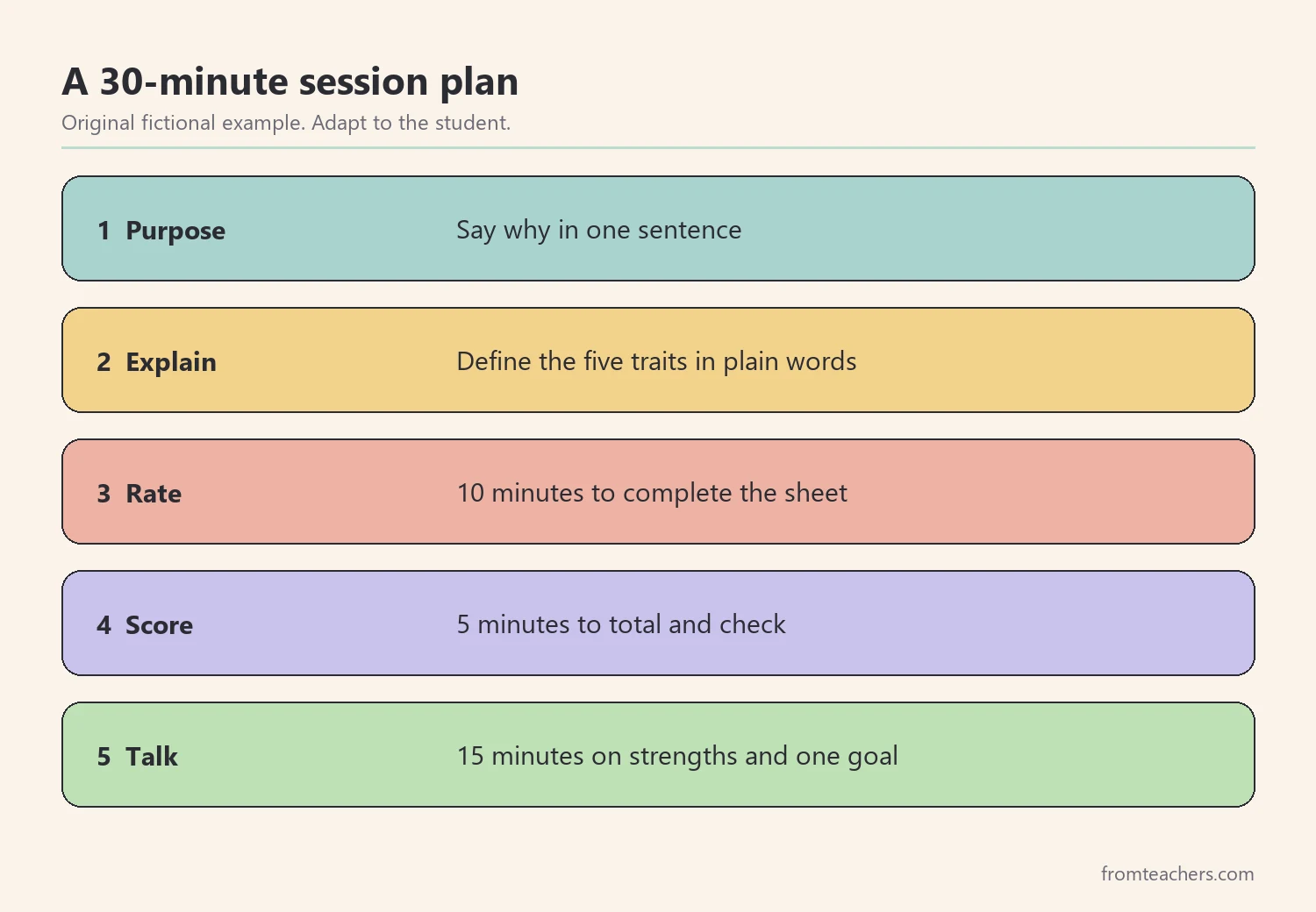
Also, think about timing. A Big Five personality test for students fits well at the start of a semester, before course selection, or at the beginning of a career unit, because students can act on what they learn right away. Avoid testing weeks or stressful days, since mood can color how students rate themselves.
Also, check your setting. In a group, students may compare scores, so decide in advance whether sharing is optional. In one-on-one counseling, you can go deeper. Either way, the purpose sentence keeps the activity focused on growth rather than judgment.
2. Introduce the five traits in plain, neutral words
Students take a Big Five personality test for students more honestly when they understand the words. Therefore, spend two or three minutes explaining each trait in everyday language before they begin.
| Trait | Plain description | Sounds like |
|---|---|---|
| Extraversion | Energy from people and activity | “I like group projects.” |
| Agreeableness | Warmth and cooperation | “I try to help others.” |
| Conscientiousness | Organization and follow-through | “I finish what I start.” |
| Emotional Stability | Staying steady under stress | “I calm down fairly fast.” |
| Openness to Experience | Curiosity and new ideas | “I like trying new things.” |
Most importantly, tell students there are no good or bad scores. A lower Extraversion score is not “shy” in a negative sense; it often means a student recharges with quiet time. Likewise, a high Agreeableness score is a strength, yet it can also mean a student finds it hard to say no.
In Maya’s session, the counselor says: “Every trait has strengths. We are just noticing your usual patterns, and patterns can shift as you grow.” Maya relaxes, because nothing about the sheet feels like a test she could fail.
In addition, remind students to answer for how they usually are, not how they wish they were. Honest answers make the Big Five personality test for students more useful, and they make the later conversation more real.
3. Give and score the Big Five personality test for students
Keep the administration of the Big Five personality test for students calm and private. Seat students so they cannot easily see each other’s sheets, and read the directions aloud. For younger students or students who need support with reading, read each statement aloud too.
Many school-friendly sheets use a simple format: a set of statements for each trait, each rated from 1 to 5. For instance, the Big Five personality self-assessment screening sheet uses twenty statements, four per trait, with a 1 to 5 scale. Each trait total therefore ranges from 4 to 20 points.
Show students how to add their own scores. They total the four ratings for each trait and write the sum in the scoring box. Then they check the interpretation guide to see whether each total falls in a strong, moderate, or lower tendency range.
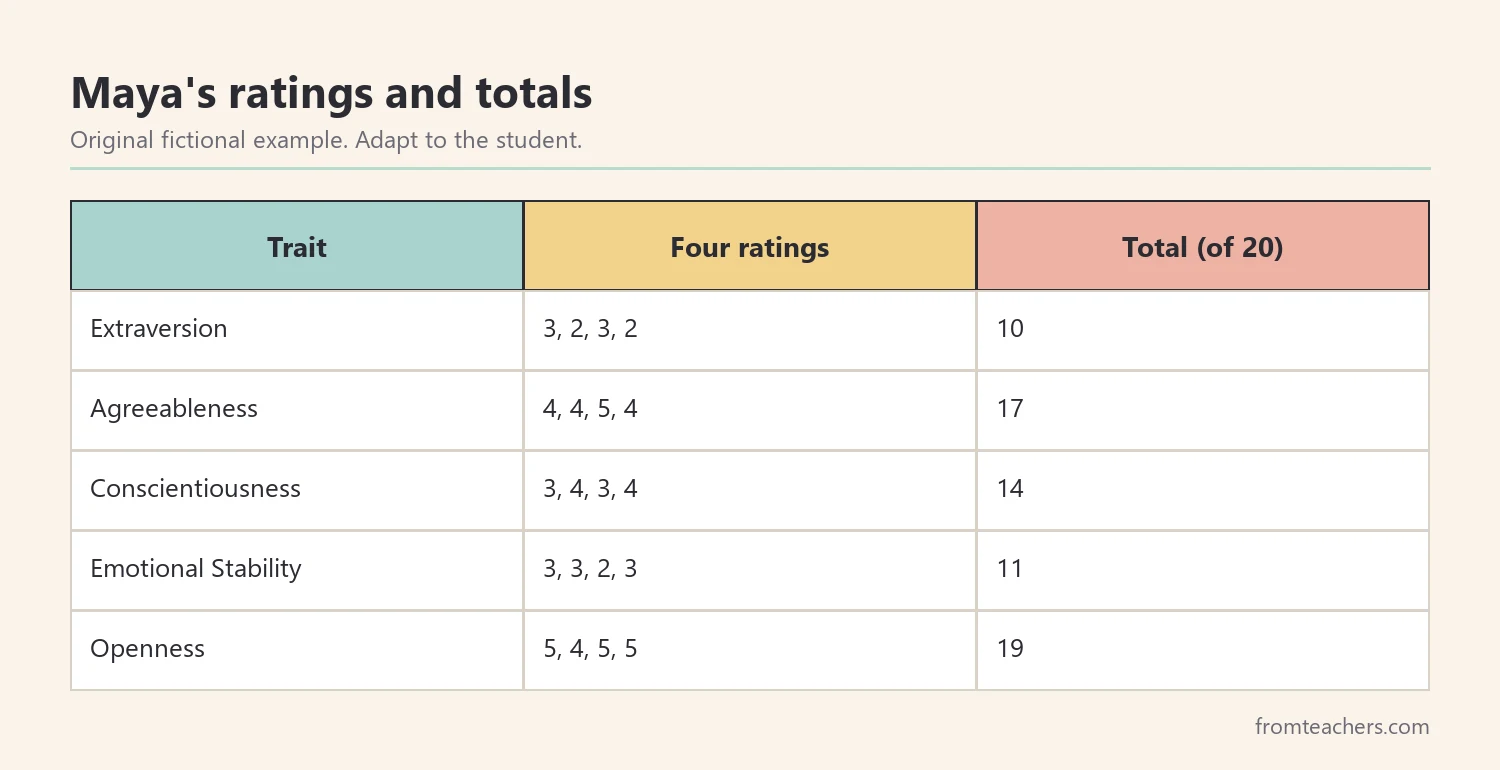
Here is Maya’s scoring. Her Extraversion ratings were 3, 2, 3, and 2, for a total of 10. Agreeableness came to 4, 4, 5, and 4, which is 17. Conscientiousness was 3, 4, 3, and 4, totaling 14. Emotional Stability was 3, 3, 2, and 3, which is 11. Finally, Openness was 5, 4, 5, and 5, for 19.
Before moving on, double-check the math with the student. Students with attention or math difficulties may benefit from a calculator or from adding aloud with you. Adding mistakes are common, and a wrong total can lead to a confusing conversation. A quick “let’s check together” also models care and accuracy.
4. Talk through results with a strengths-first approach
The conversation is where the real value of a Big Five personality test for students lives. Start with the highest score, because it is usually the easiest place for a student to recognize themselves. Ask: “Does this sound like you? Can you give me an example?”
For Maya, that is Openness at 19. She says she loves sketching new characters and reading about space. Next, the counselor looks at Agreeableness at 17, and Maya says friends often come to her for advice. These two strengths give the conversation a positive base.
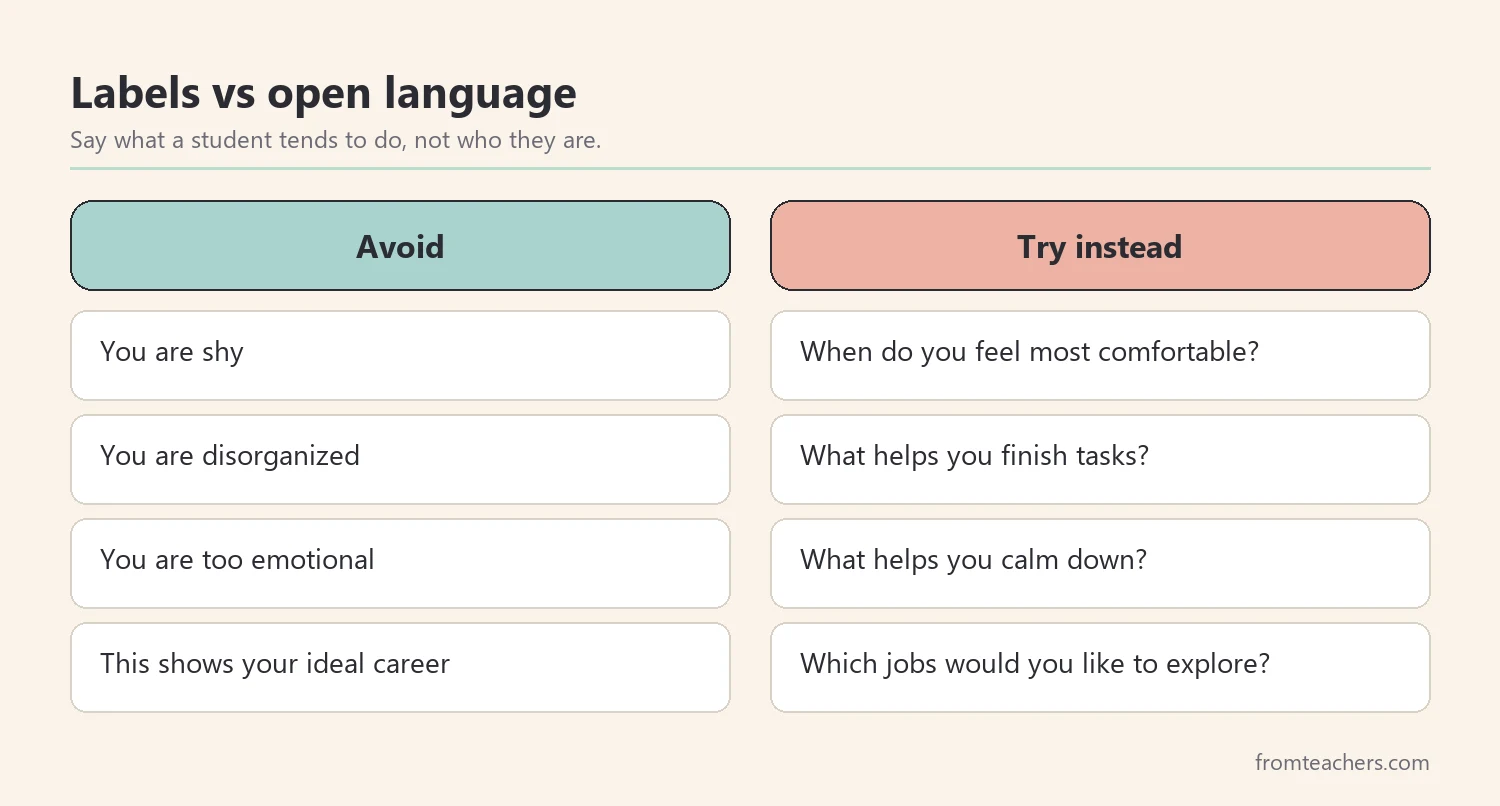
Then move to lower scores gently. Maya’s Extraversion total of 10 and Emotional Stability total of 11 are her lowest scores. Instead of “you are not very social,” the counselor asks: “What kinds of social situations feel comfortable for you? When do you feel stressed, and what helps?” Maya mentions that big presentations make her nervous, but small groups feel fine.
Use these prompts with any student:
- “Which result surprised you?”
- “Where does this trait help you at school or at home?”
- “Is there a situation where you would like to act differently?”
- “Who in your life sees this strength in you?”
Above all, let the student lead. A Big Five personality test for students is a mirror, and the student is the expert on their own life. If a student disagrees with a result, take that seriously; their insight is more important than the number.
5. Connect the Big Five personality test for students to goals and careers
Self-awareness becomes powerful when it points toward action. In fact, the best use of a Big Five personality test for students is as a starting point for planning, not as an end result. After the discussion, help the student choose one goal and one career question to explore. Keep both small and specific.
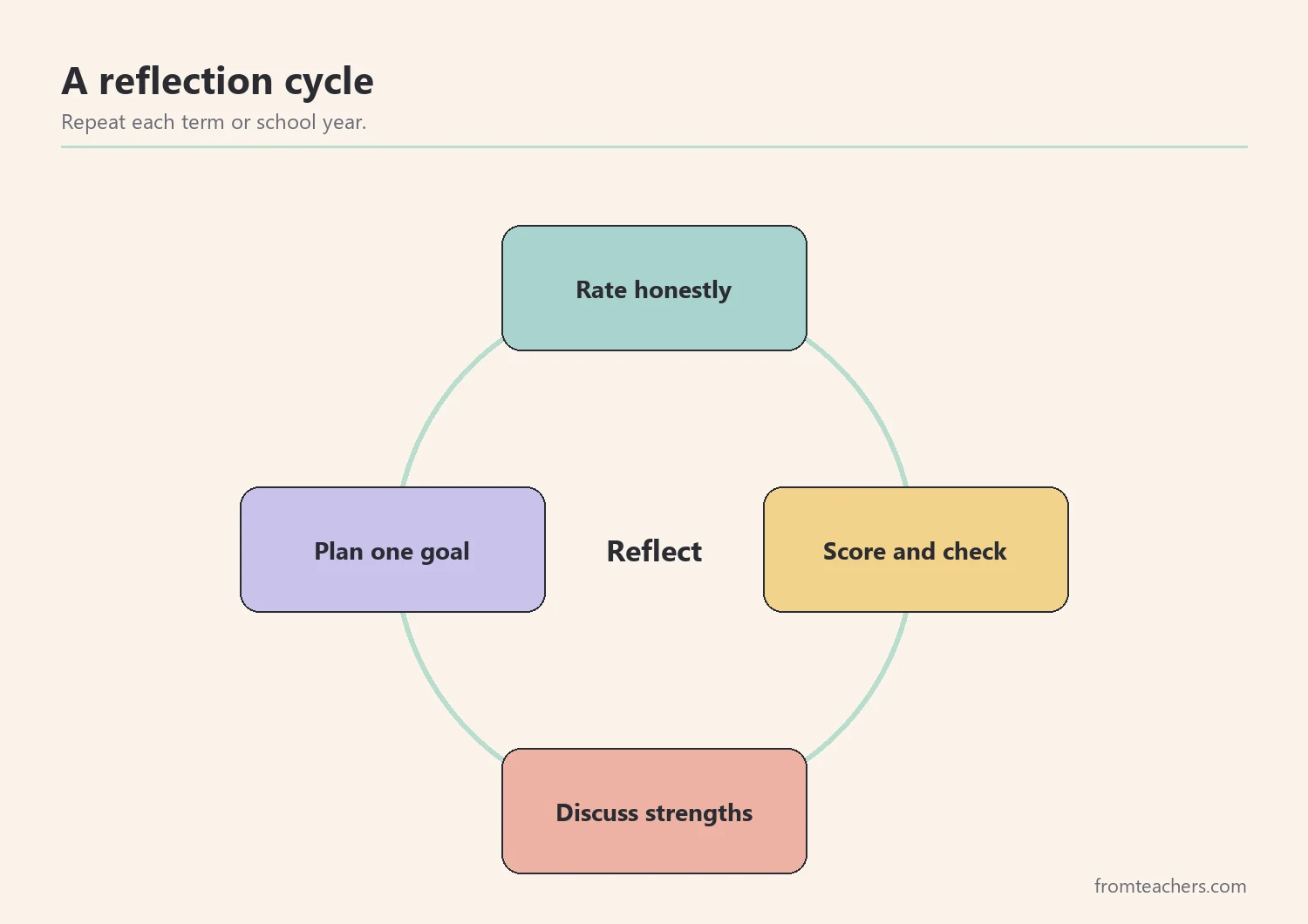
For Maya, the goal comes from her Emotional Stability score: “Before my next class presentation, I will practice twice with a friend and use one calming breath strategy.” Her career question comes from her Openness and Agreeableness strengths: “What jobs combine creativity with helping people?” Together, they look at a free career exploration site and list three options to research: illustrator, art teacher, and user experience designer.
Be careful not to steer students into or away from careers based on scores alone. Traits describe tendencies, not limits. An introverted student can become a strong teacher or salesperson, and a highly organized student can choose a creative field. The point is to start a conversation, not to make a match.
| Strength noticed | Goal idea | Career question |
|---|---|---|
| High Openness | Join one new club or elective | Which jobs reward new ideas? |
| High Conscientiousness | Use a weekly planner | Which roles value reliability? |
| High Agreeableness | Practice saying no kindly | Which careers involve helping? |
Write the goal and question down, and give the student a copy. That simple step makes follow-up much easier.
For group settings such as advisory, you can adapt this step. After students privately review their own Big Five personality test for students results, ask each one to write a single goal on an index card. Collect the cards, and use them to plan short check-ins over the next month. Students who prefer privacy can fold the card so only you see it.
6. Follow up, store results, and involve families
A single session can spark insight, but follow-up makes it last. Schedule a short check-in two to four weeks later. Ask how the goal went, what the student learned from their career research, and whether anything about their self-view has changed.
For Maya, the check-in shows that she practiced her presentation twice and felt calmer than usual. She also found that user experience design interests her most, so the counselor connects her with an elective in digital design. As a result, the Big Five personality test for students has led to two concrete steps, not just a score sheet.
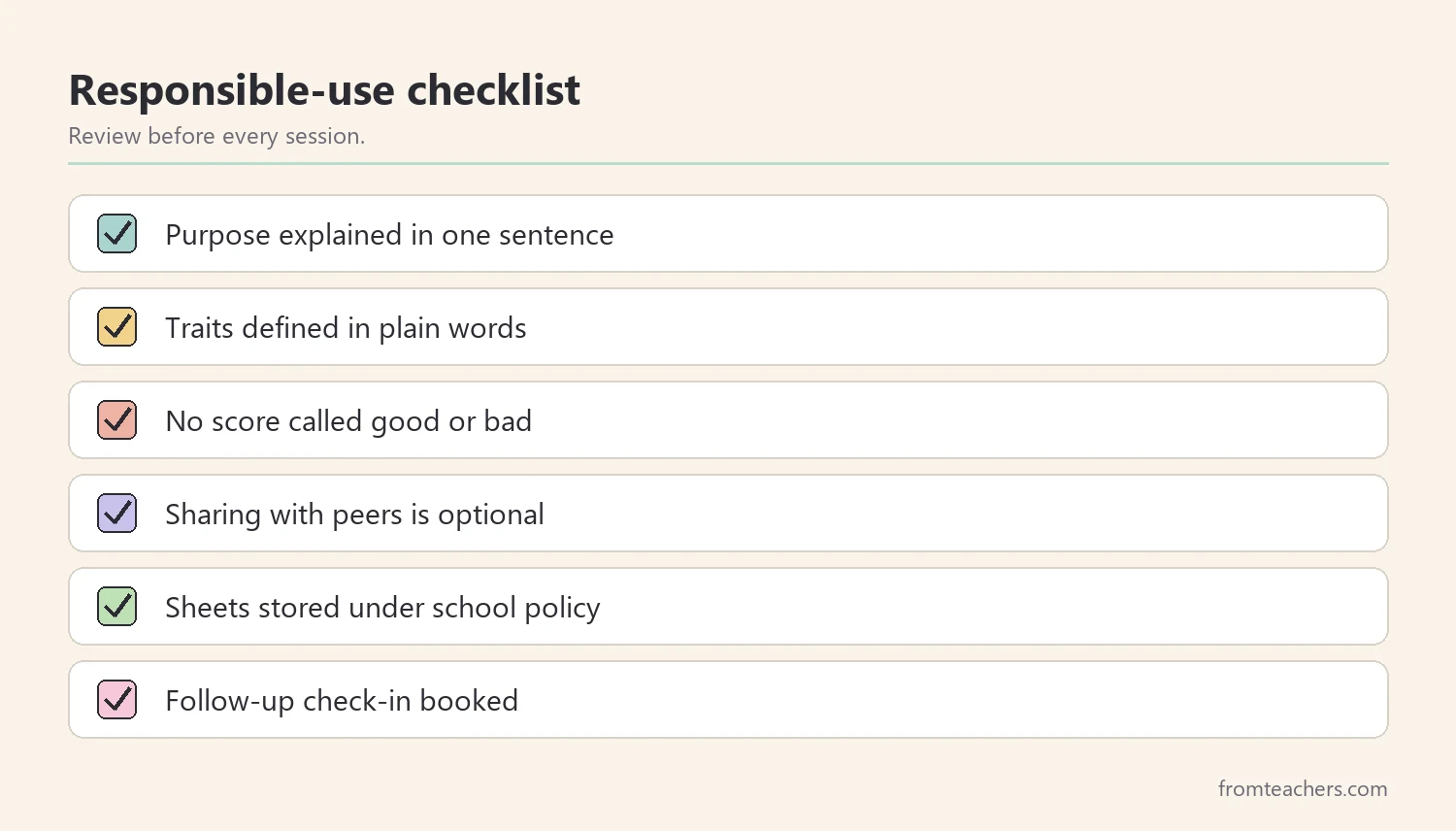
Next, think about privacy, because results from a Big Five personality test for students are personal information. Store completed sheets according to your school’s records policy, and share results only with the student’s permission and only with people who need them. Avoid posting results or comparing students publicly.
Finally, families can be helpful partners. With the student’s agreement, share the strengths and the goal, and invite families to notice those strengths at home. A short note such as “Maya showed strong curiosity and kindness, and she is working on presentation confidence” keeps the message positive and practical.
Common mistakes and how to avoid them
- Treating results as a diagnosis. Fix: call it a self-reflection activity and avoid clinical language.
- Labeling students by trait. Fix: say “you tend to” rather than “you are,” and focus on situations.
- Skipping the explanation. Fix: define each trait in plain words before students start.
- Making career matches from scores. Fix: use results to generate questions, not answers.
- No follow-up. Fix: set one goal and book a check-in before the session ends.
Questions teachers and parents ask about the Big Five personality test for students
What age is the Big Five personality test for students suitable for?
Plain-language self-assessments like this are commonly used with middle and high school students. Younger students may need statements read aloud and explained. Choose a version whose wording matches the student’s reading level.
Is a school self-assessment the same as a psychological test?
No. A classroom or counseling sheet is a reflection tool. It does not diagnose anything, and formal psychological assessment belongs to qualified professionals.
Can personality change over time?
Traits tend to be fairly stable, but people also grow and act differently in different settings. Encourage students to see results as a snapshot of now. Retaking the sheet later can start a useful conversation about change.
Should students share results with classmates?
Only if they want to. A Big Five personality test for students should feel safe, not competitive. Make sharing optional, and set ground rules about respect if you use results in a group activity. Private reflection is often more honest.
How can parents use the results at home?
Parents can notice and name the strengths their child identified. They can also support the goal, such as helping practice a presentation. Keep conversations curious and avoid using traits as criticism.
Related reading: Building Stronger School Counseling Programs: A Framework for Student Success, Building Workplace Readiness: Essential Skills for Career Success, and School Counseling Strategies: Empowering Students to Dream Big.
A companion resource for the Big Five personality test for students:
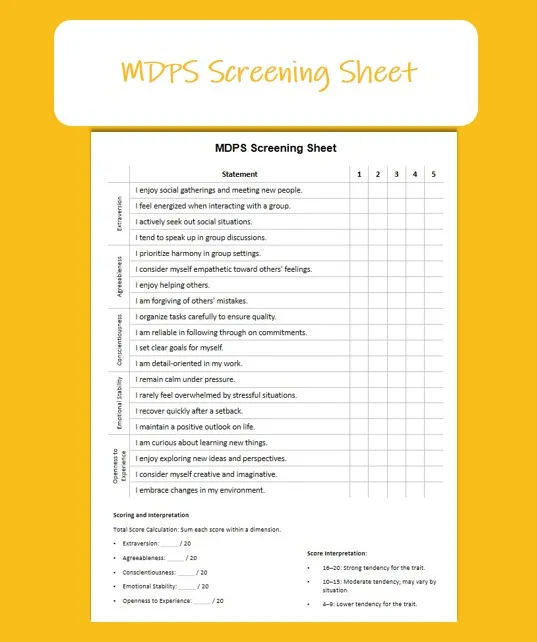
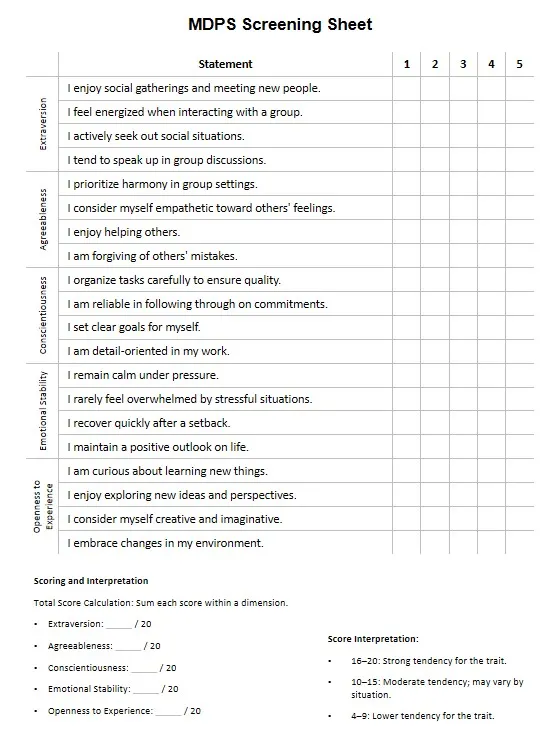
Big Five Personality Self-Assessment: MDPS Screening Sheet for Counseling: a one-page sheet with twenty plain-language statements across five traits, a 1 to 5 rating scale, built-in scoring out of 20 per trait, and a clear interpretation guide.
Sources and scope
- American School Counselor Association (ASCA): standards and guidance for school counseling programs, including career and social-emotional development.
- American Psychological Association: general background on personality psychology.
- CASEL: a framework for social and emotional learning, including self-awareness.
- My Next Move: a free career exploration site from the U.S. Department of Labor.
This guide covers using a plain-language Big Five self-assessment for reflection, goal setting, and career conversations in schools. It does not cover clinical personality testing, diagnosis, or mental health treatment, which belong to qualified professionals.
Key takeaways
- Use a Big Five personality test for students with one clear, growth-focused purpose.
- Explain the five traits in plain words and stress that no score is bad.
- Score carefully, check the math, and start the talk with strengths.
- Turn insights into one small goal and one career question.
- Follow up within a few weeks and protect students’ privacy.










Leave a Comment