

Accommodation documentation mistakes are easy to make when you are a paraprofessional supporting several students in a busy classroom. You read a test aloud, hand over a calculator and offer a movement break, all before lunch. By Friday, the details blur. Picture Mr. Daniels, a paraprofessional in a sixth grade inclusion class, supporting Ava, age 11, whose IEP lists read aloud, extended time, a graphic organizer and frequent breaks. At the IEP meeting, the team asks, “Which supports actually helped?” Without notes, nobody can say.
This list is for paraprofessionals, aides and new support staff. It covers eight accommodation documentation mistakes, ordered from the quickest to fix to the habits that need teacher coordination. Each item explains the mistake, why it matters and a simple fix, with Ava and Mr. Daniels as the example.
Examples are fictional. Adapt to the student’s goals and agreed supports. This is guidance, not a diagnosis.
At a glance
- If a support is not written down, the team cannot tell whether it helped.
- Record supports in real time, or as close to it as possible.
- Note how well the support worked, not only that it was offered.
- Keep accommodations and modifications clearly separate.
- Share notes with the teacher on a set schedule.
Why documentation matters for paraprofessionals
Paraprofessionals often deliver more accommodations than anyone else in the room. As a result, your notes may be the best evidence the IEP team has about what works. Good records help the teacher plan, help families understand progress and help the team decide whether to keep, change or remove a support.
We ordered the eight accommodation documentation mistakes by how quickly you can fix them. The first three take minutes. The middle three need a simple system. Also, the last two need a conversation with your supervising teacher. Figure 1 shows the list.
None of these mistakes mean you are doing a poor job. In fact, they are signs of a busy, caring adult with too many tasks and no simple system. Once the system is in place, good records become part of the routine rather than extra work at the end of a long day.
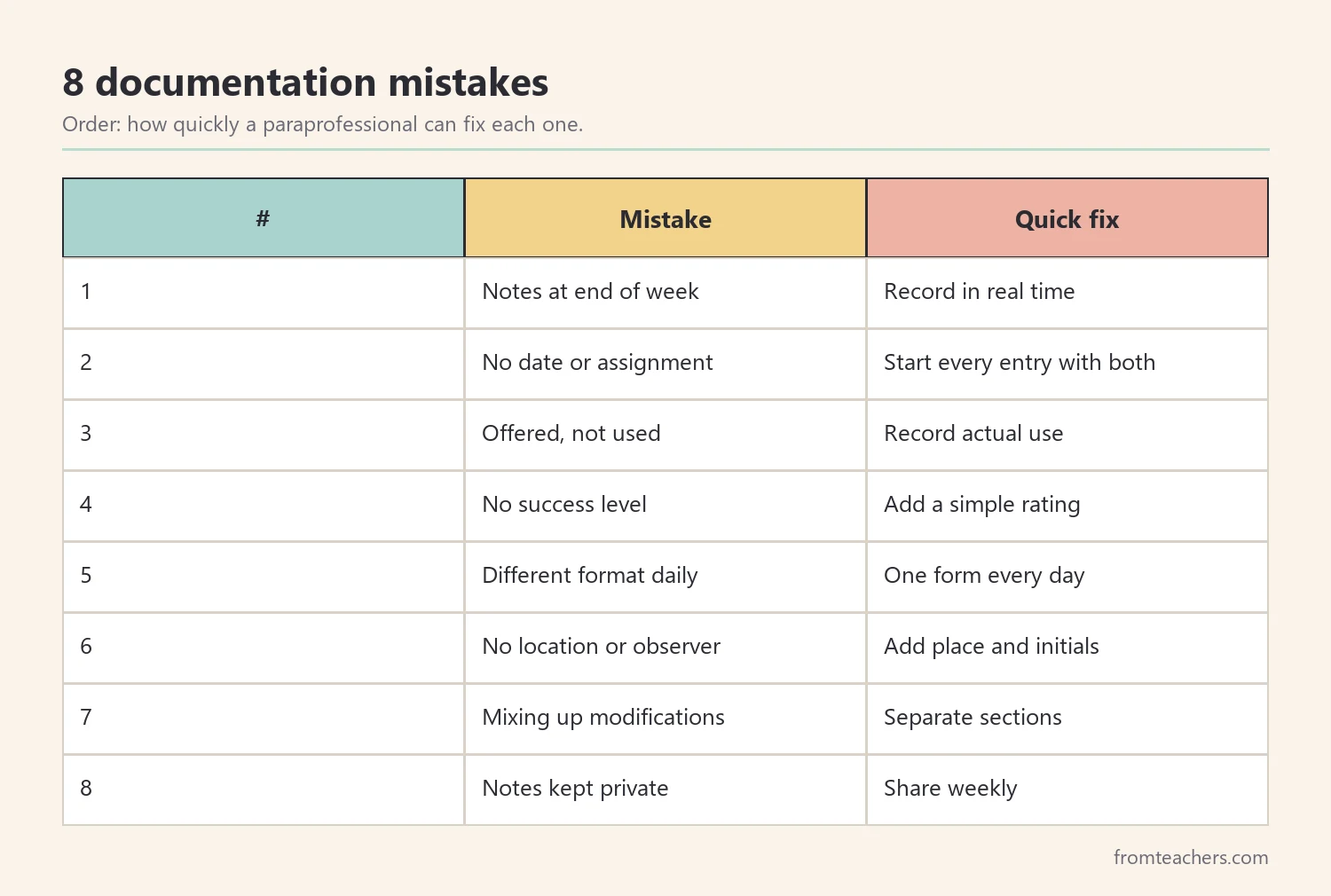
1. Writing notes at the end of the week
The mistake: waiting until Friday to remember what happened on Monday.
Why it matters: memory fades fast in a busy week. Details such as which assignment, how long and how well it went disappear.
The fix: record supports during or right after each task. Quick check boxes make this possible in under a minute.
Example: Mr. Daniels now ticks boxes on a form as soon as Ava finishes each assignment. It takes him about thirty seconds.
2. Leaving out the date and assignment
The mistake: notes like “read aloud, went well” with no date, subject or task.
Why it matters: the team cannot connect a support to a type of work or spot patterns over time.
The fix: every entry starts with date, assignment and type of task, such as quiz, reading or writing.
Example: Mr. Daniels’ notes now read “Oct 14, science quiz, read aloud.” Later, the team could see that read aloud mattered most on science and social studies quizzes.
3. Recording that a support was offered, not used
The mistake: checking “extended time” when the student was offered it but finished early.
Why it matters: offered and used are different data. Mixing them makes supports look more needed than they are, or less.
The fix: record what the student actually used. If you want to track refusals or non-use, add a note.
Example: Ava was offered extended time on four quizzes but used it on only one. That was useful information for the team.
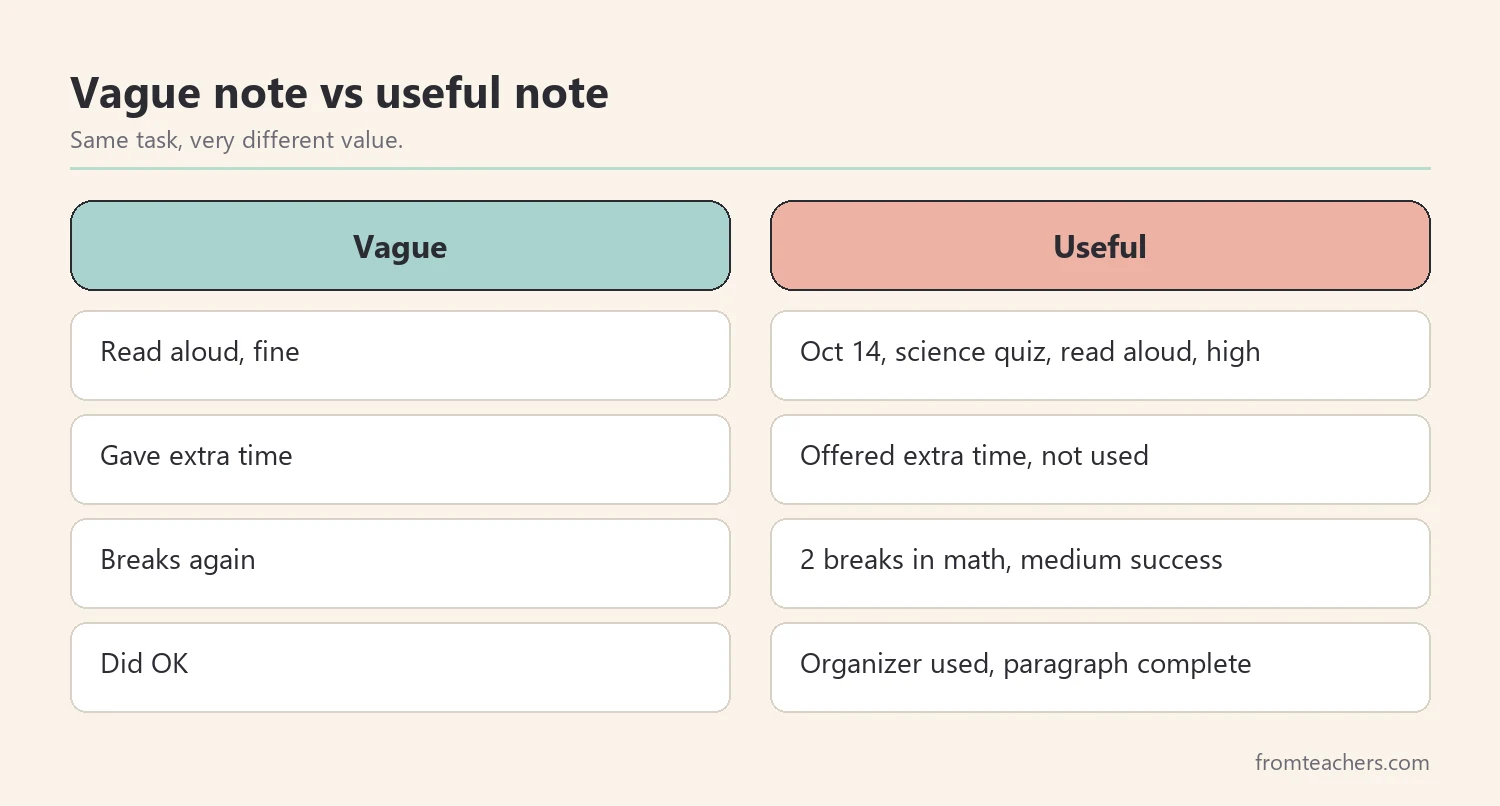
4. Skipping the level of success
The mistake: listing supports without saying whether they helped.
Why it matters: the key question at any IEP review is whether a support is working. A list alone cannot answer it.
The fix: add a simple rating for each task, such as a three or five point level of success, and a short note.
Example: Ava’s graphic organizer was rated high on four writing tasks out of five. Frequent breaks were rated mixed, which led to a useful conversation.
5. Using a different format every day
The mistake: notes on sticky notes one day, in a notebook the next and in an email after that.
Why it matters: scattered notes are hard to combine and easy to lose.
The fix: use one form for every entry. A grid works well for a quick overview across many assignments, and a detailed form works for important tasks.
Example: Mr. Daniels uses a grid for daily work and a detailed form for tests. An editable accommodations and modifications tracker with both forms keeps the format the same every day.
6. Forgetting location and observer
The mistake: no record of where the task happened or who supported it.
Why it matters: a support may work in a quiet room and not in a busy classroom. Different adults may also deliver supports differently.
The fix: note the location, such as general education class, resource room or testing room, and your initials.
Example: Ava’s read aloud worked better in the small testing room than in the classroom. The location column made that pattern visible.
7. Mixing up accommodations and modifications
The mistake: recording “shorter assignment” as an accommodation when it changes what the student is expected to learn.
Why it matters: accommodations change how a student learns or shows learning. Modifications change what is expected. The difference matters for grading, reporting and the IEP.
The fix: keep them in separate sections, and ask your supervising teacher when unsure.
Example: Mr. Daniels asked whether reducing Ava’s math problems from 20 to 10 was allowed. The teacher checked the IEP: it was not listed, so he stopped and documented the question.
8. Keeping notes to yourself
The mistake: collecting good data that the teacher never sees until the meeting.
Why it matters: the teacher and case manager need data in time to adjust supports, not just to report them.
The fix: agree on a time to hand over or share notes, such as every Friday, and flag anything urgent the same day.
Example: Mr. Daniels and Ava’s teacher spend ten minutes each Friday reviewing the week. They spotted the breaks issue in week two instead of at the annual review.
What a week of good notes looks like
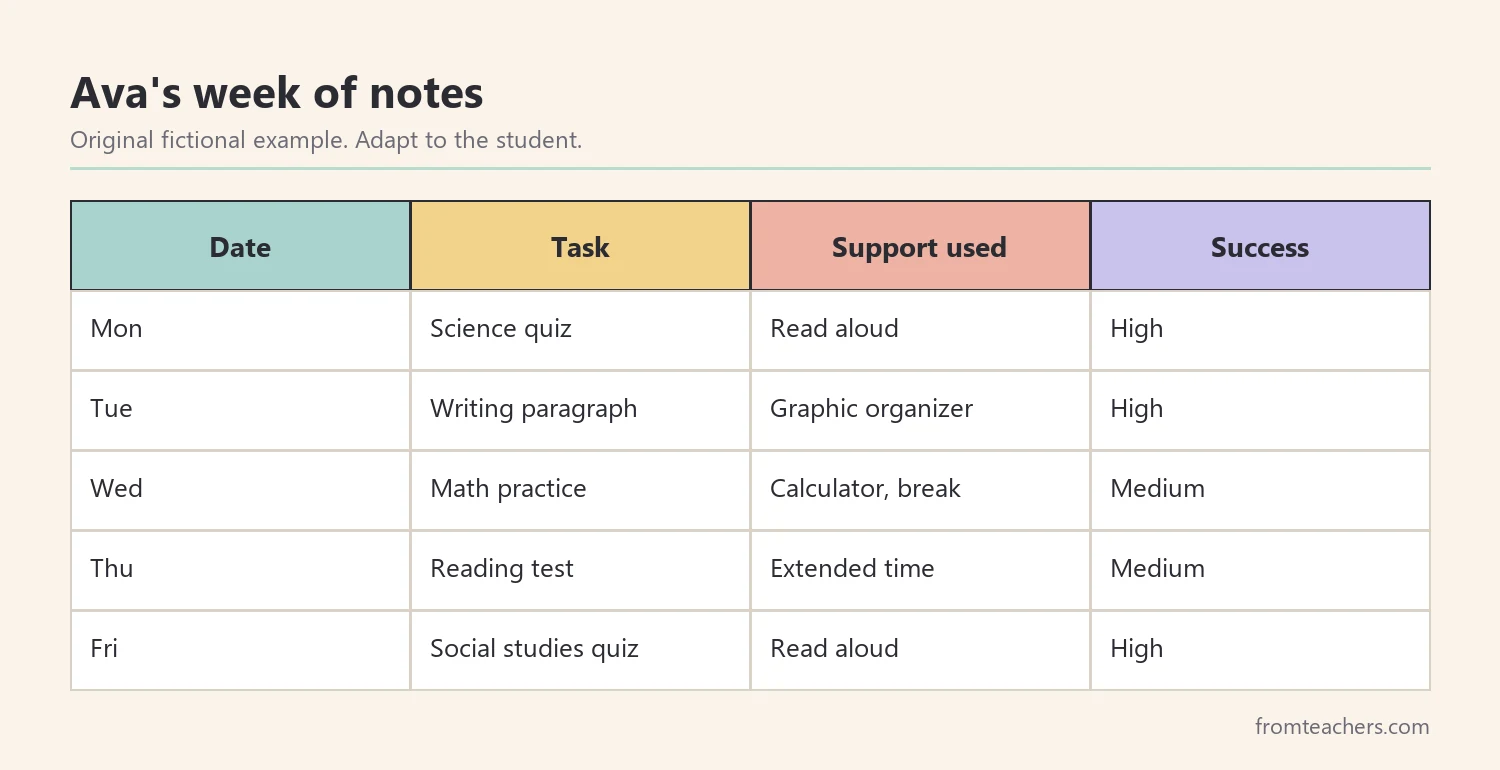
The table below shows a fictional week of Mr. Daniels’ notes for Ava. It avoids the accommodation documentation mistakes above: each row has a date, a task, the support actually used and a level of success.
| Date | Task | Support used | Success |
|---|---|---|---|
| Mon | Science quiz | Read aloud | High |
| Tue | Writing paragraph | Graphic organizer | High |
| Wed | Math practice | Calculator, break | Medium |
| Thu | Reading test | Extended time | Medium |
| Fri | Social studies quiz | Read aloud | High |
Even this short log tells a story: read aloud works well on content quizzes, while breaks in math may need adjusting.
A simple documentation routine
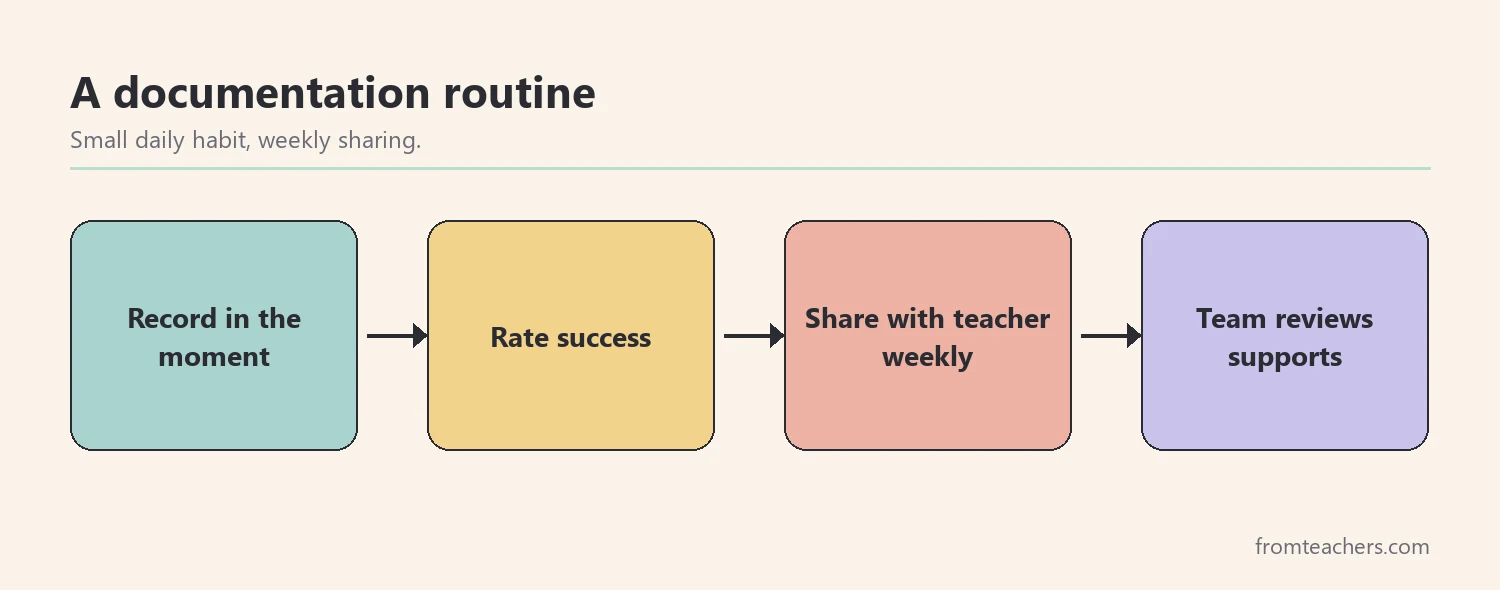
Figure 4 shows a routine many support staff use: record in the moment, rate success, share weekly and review with the team.
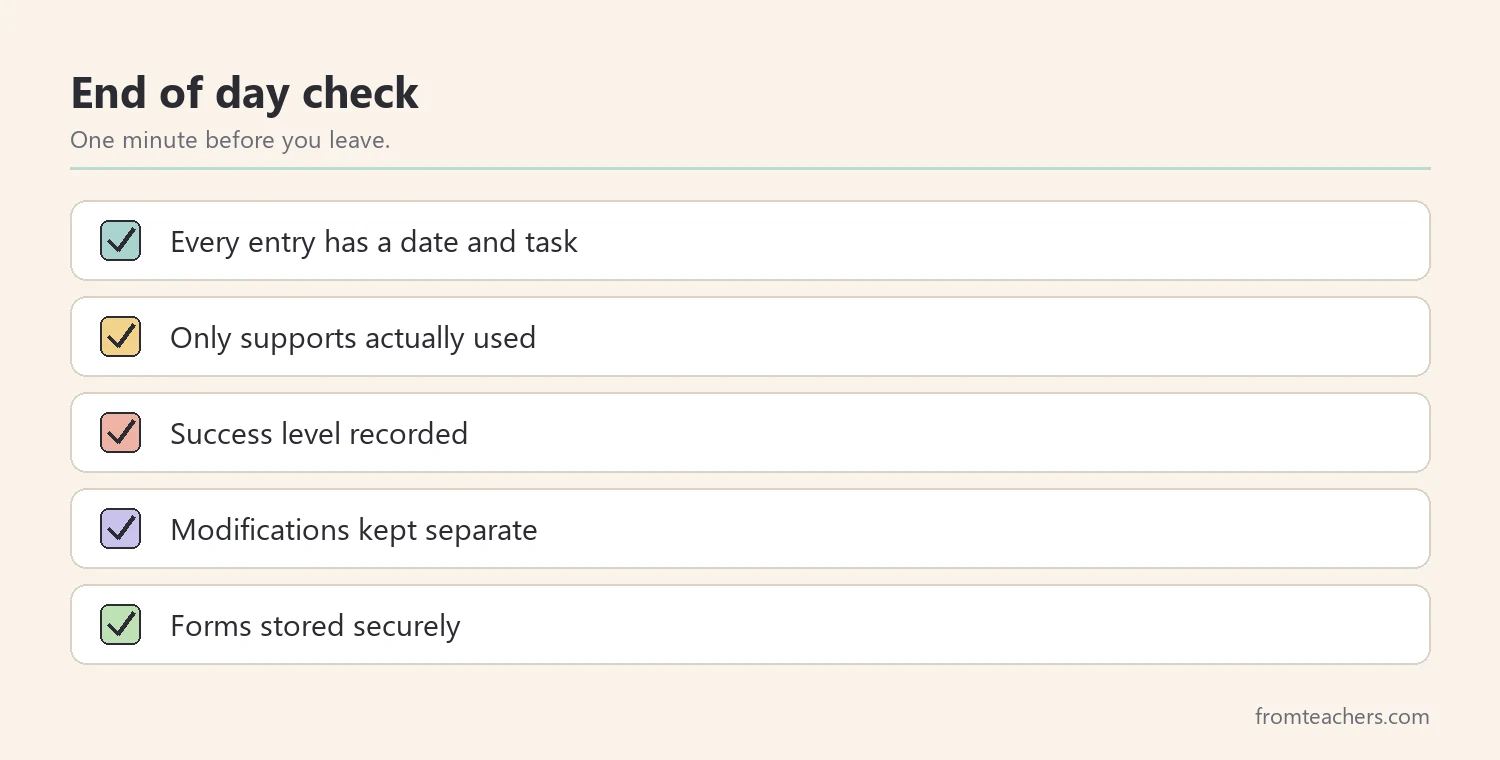
Also, protect privacy. Keep forms in a secure folder, use initials when your district requires it and never leave notes where other students can read them. Your district may have specific rules for student records, so ask your supervisor.
Figure 5 is a quick check you can run at the end of each day.
How supervising teachers can help
Paraprofessionals cannot fix every documentation problem alone. Teachers and case managers play a big part. First, share the exact accommodations list from each IEP or 504 plan, in plain words, at the start of the year. Second, show one completed example form, so everyone knows what “good” looks like. Third, protect a short weekly meeting, even ten minutes, to look at the notes together.
Also, tell paraprofessionals what happens with their data. When Mr. Daniels learned that his notes were shown at Ava’s IEP meeting and helped the team keep read aloud for quizzes, he felt his work mattered. That feeling kept the habit going through the busiest months.
Small mistakes when starting a new tracker
- Tracking every student at once. Fix: start with one or two students, then add more.
- Too many categories. Fix: track only the supports listed in the plan.
- No place to keep forms. Fix: use one labeled, secure folder or a shared digital file approved by your district.
- Giving up after a busy week. Fix: restart on Monday; gaps happen, and consistent weeks still add up.
- Writing opinions instead of facts. Fix: describe what the student did and which support was used.
Questions paraprofessionals ask about accommodation documentation mistakes
Am I allowed to decide which accommodations to use?
Accommodations come from the IEP or 504 plan. Your supervising teacher directs how you deliver them. If something seems unclear, ask before changing anything.
How detailed should my notes be?
Short and consistent is better than long and occasional. A checkbox, a success rating and one sentence is usually enough.
What if a student refuses an accommodation?
Record it as not used, with a brief note. Refusals are useful information for the team.
Can families see my notes?
Records may be shared under your district’s policies. Write notes that are factual and respectful, as if a family member will read them.
Should I document supports that are not in the IEP?
Talk with your teacher first. Informal supports can be noted separately, since the team may want to consider them.
Related reading: Accommodations vs Modifications in Special Education, The Power of Data Tracking in Special Education, and Teacher-Parent Communication in Special Education.
You may also need: Classroom Accommodation Feedback Form: IEP and 504 Effectiveness Tracker.
A companion resource for avoiding accommodation documentation mistakes:
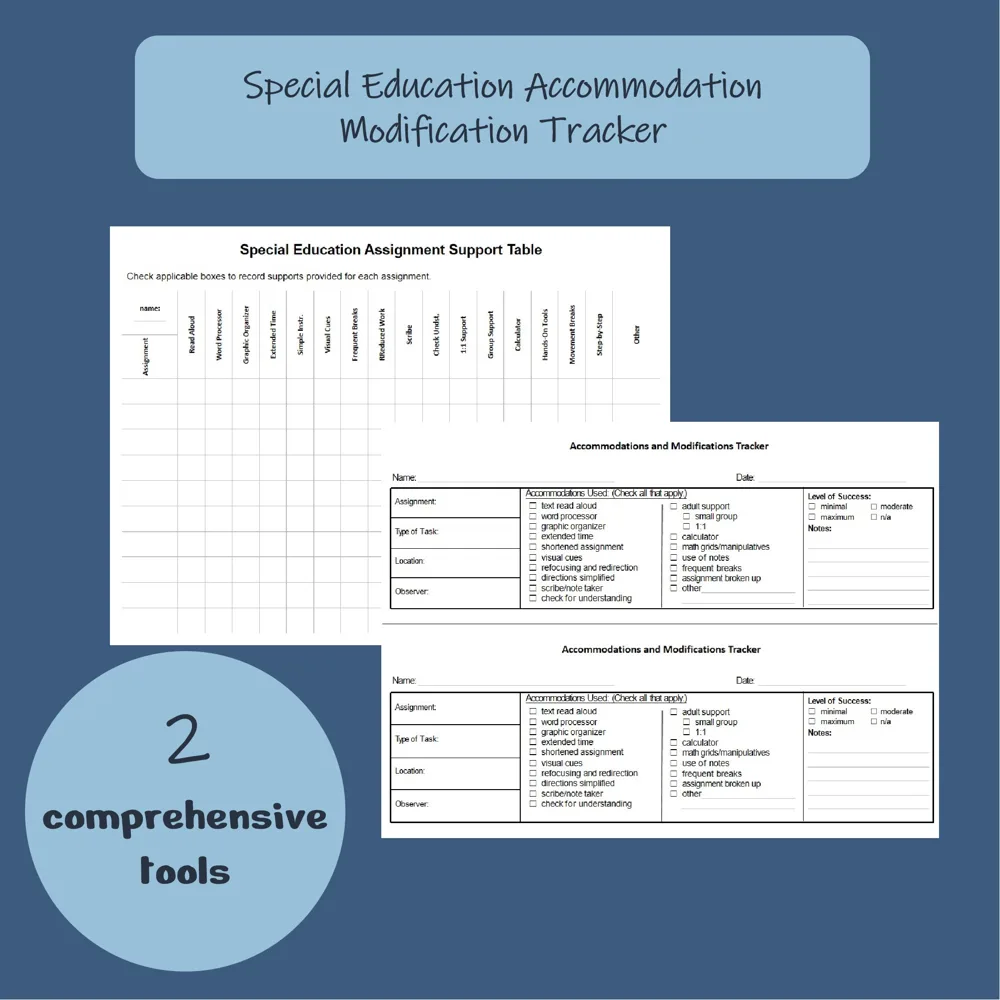
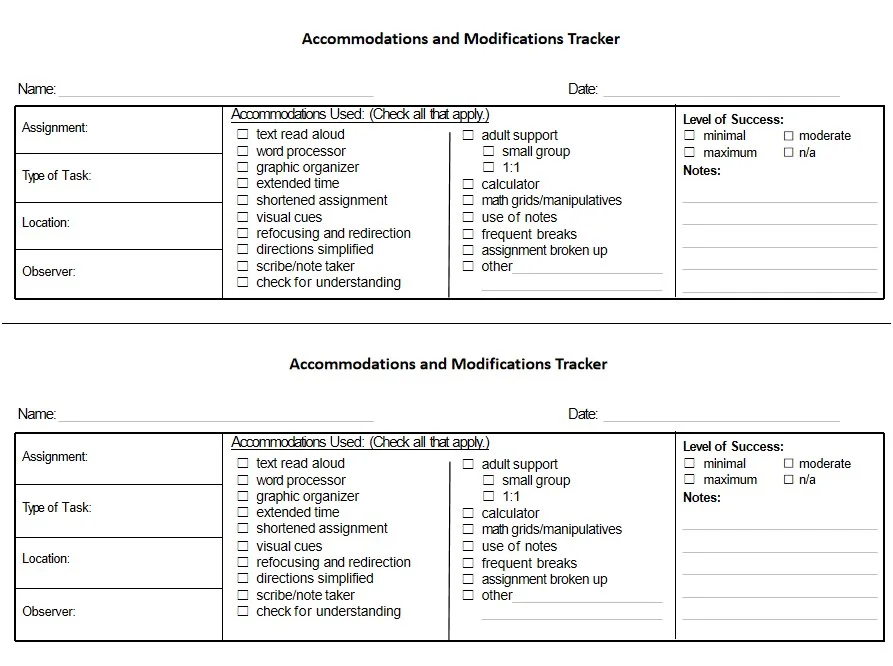
Accommodations & Modifications Tracker: Editable IEP Forms: two editable forms: a grid style Special Education Assignment Support Table to check off supports across many assignments, and a detailed Accommodations and Modifications Tracker with name, date, assignment, task type, location, observer, a full accommodations checklist, a level of success rating and notes.
Sources and scope
- Center for Parent Information and Resources: plain-language information on IEPs, accommodations and the special education process.
- Understood.org: articles explaining the difference between accommodations and modifications.
- CAST: resources on Universal Design for Learning and flexible supports for all learners.
- American Speech-Language-Hearing Association (ASHA): guidance on communication supports, including assistive technology.
This list covers everyday documentation by paraprofessionals and aides under a teacher’s direction. It does not replace your district’s data policies, privacy rules or the decisions of the IEP team.
Key takeaways
- Most accommodation documentation mistakes come from writing notes too late.
- Record date, task, support used and level of success.
- Use one consistent form every day.
- Keep accommodations and modifications separate.
- Share notes weekly so the team can adjust supports in time.










Leave a Comment