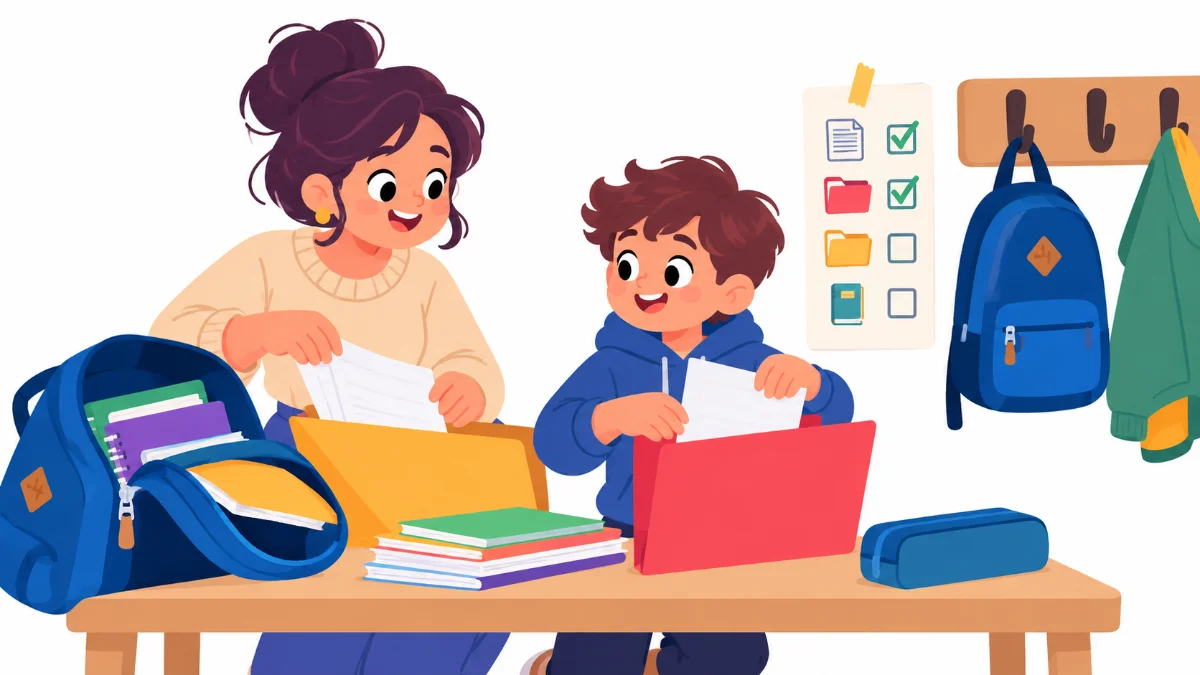

These backpack organization tips for kids came from a very familiar scene. It is 7:52 a.m., the bus comes at 7:55, and your ten-year-old is digging through a backpack full of crumpled worksheets, a broken pencil and yesterday’s banana. The permission slip is somewhere in there. Everyone is stressed, and the day has barely started.
Organization is a skill, not a personality trait. Children are not born knowing how to manage papers and supplies; they learn it in small, repeated steps. This list gives parents ten practical tips, ranked from the easiest to set up to those that take a little more time. You will follow Theo, a fictional ten-year-old, and his dad, Andre.
Examples are fictional. Adapt the ideas to your child’s age, needs and any supports agreed with school. This is guidance, not a diagnosis.
At a glance
- Fewer places for papers means fewer lost papers: start with two folders.
- A five-minute nightly pack-up beats a frantic morning search.
- A picture checklist by the door does the reminding for you.
- Teach one habit at a time and practice it, do not just say clean up.
- Do a weekly clean-out together until your child can do it alone.
How we ranked these tips
There is no research ranking of backpack habits, so we did not invent one. Instead, we ranked the tips by setup effort for a busy family: the first tips need almost nothing, and the later ones need a few weeks of practice. Each tip also shows the ages where it usually fits.
Organization is part of what experts call executive function, the set of skills that help us plan, remember and manage tasks. These skills develop gradually through childhood and the teen years, and some children, including many with ADHD, need more explicit teaching and practice.
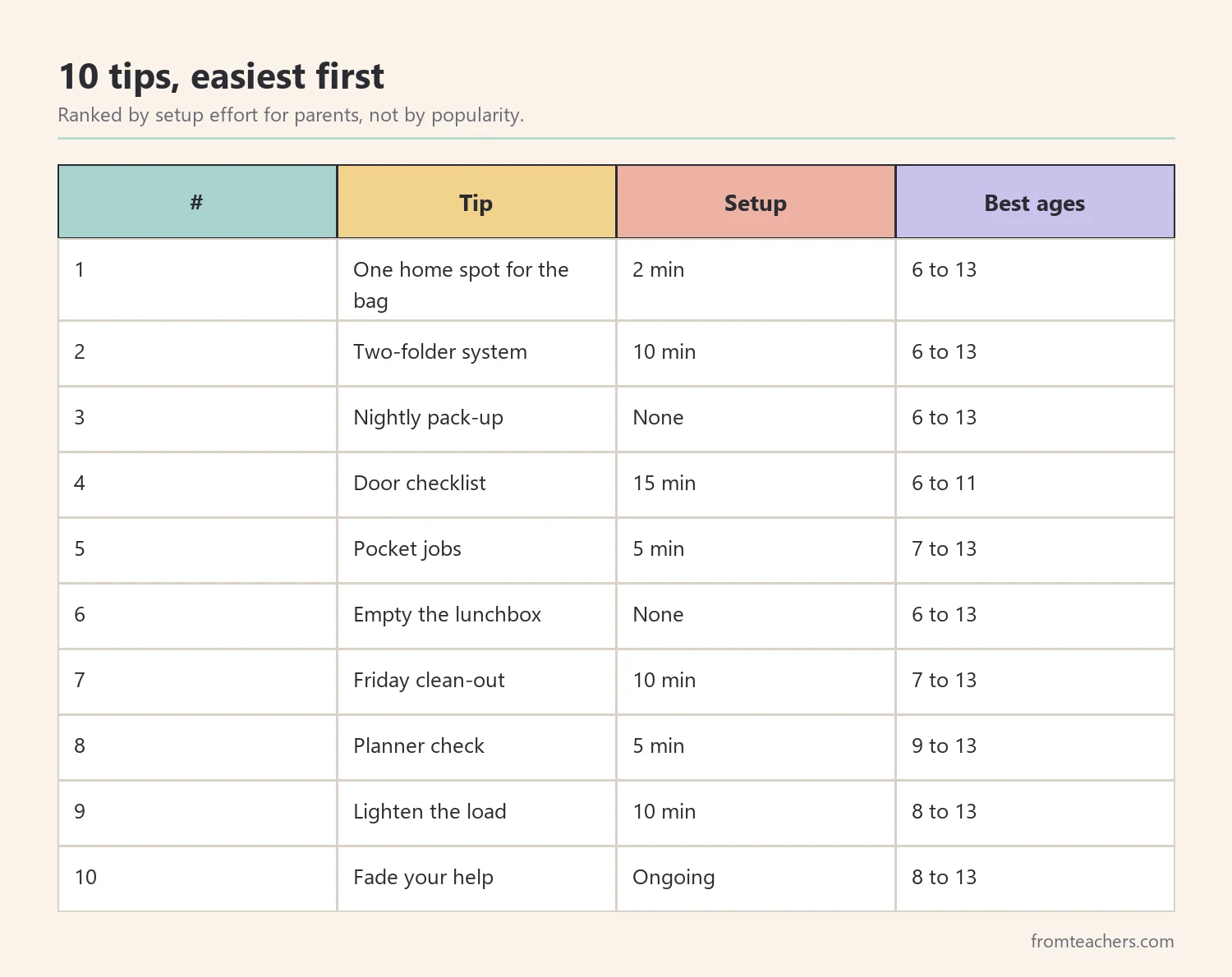
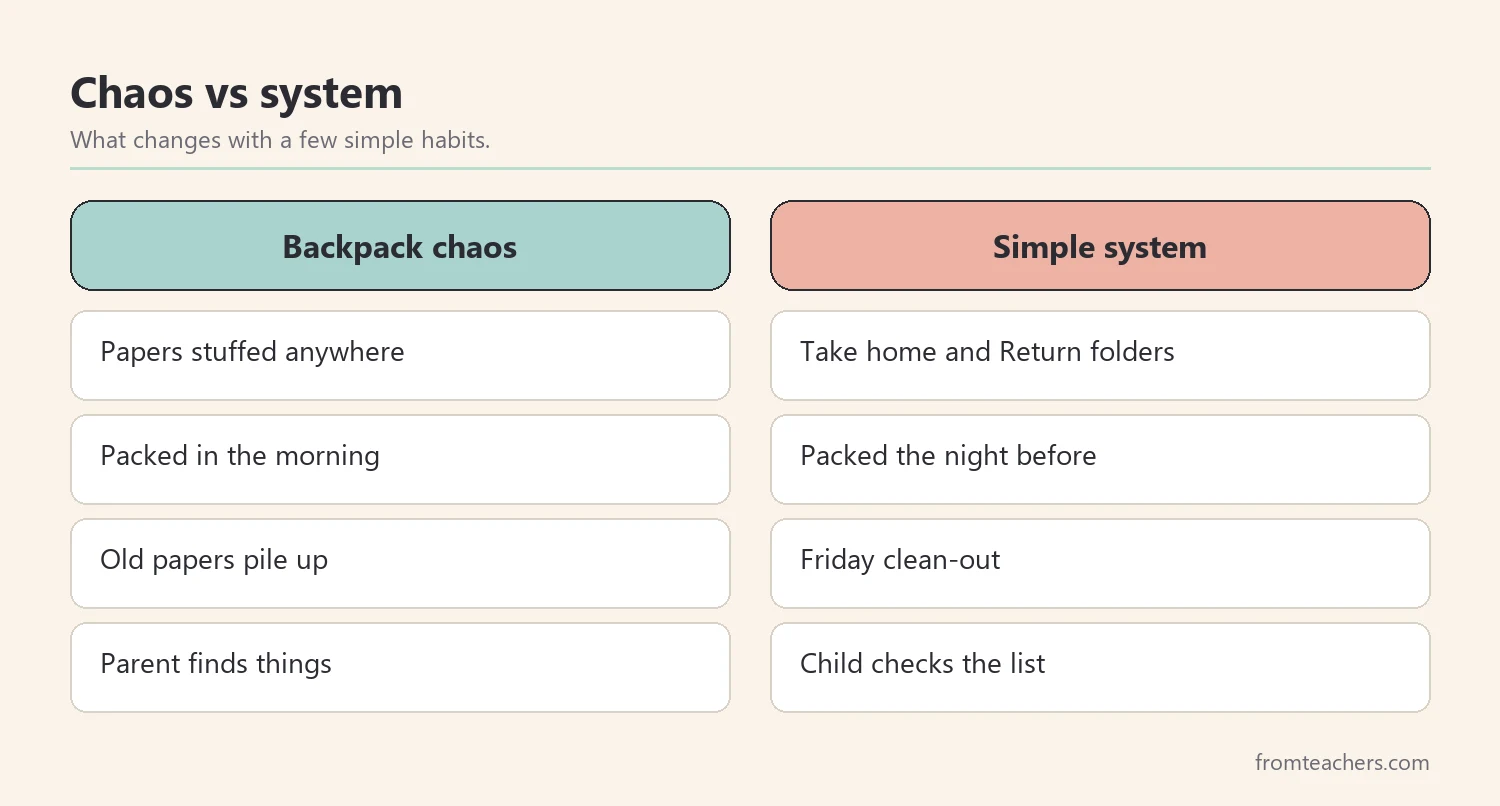
1. Give the backpack one home spot
What it is: a single hook, shelf or corner where the backpack always lives at home.
Why it works: a lot of morning panic starts with “Where is my bag?” One fixed spot removes that question entirely.
How to use it: choose a place near the door, at your child’s height. Practice “bag on the hook” right after school for a week.
Example: Andre put a hook by the front door. Within a few days, Theo was hanging the bag without reminders most afternoons.
2. Use a two-folder system
What it is: two clearly labeled folders: “Take Home” for papers that stay home and “Return to School” for signed forms and finished homework.
Why it works: fewer places for papers means fewer lost papers. Children only have to make one choice: home or school.
How to use it: use two bright colors and label them in large letters. Ask your child’s teacher whether the class already uses folders, so you can match them.
Example: Theo’s red folder was “Return” and his blue folder was “Home.” His permission slips stopped disappearing.
3. Pack up the night before
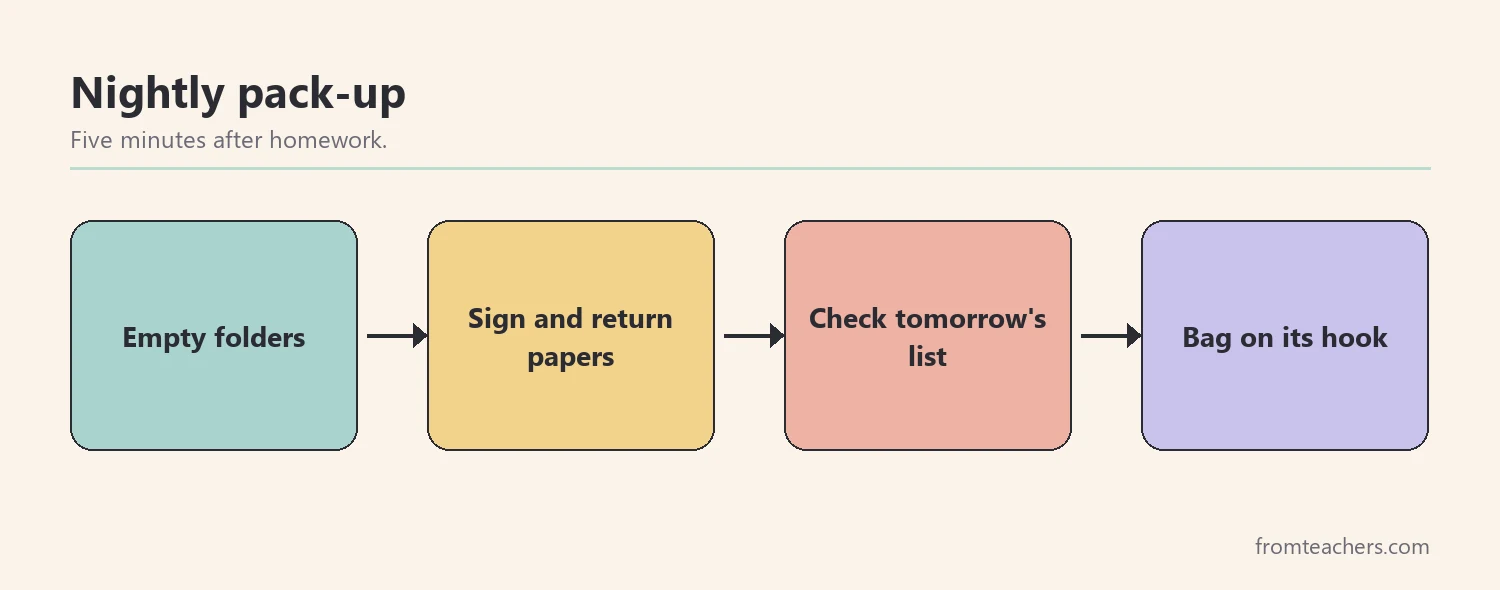
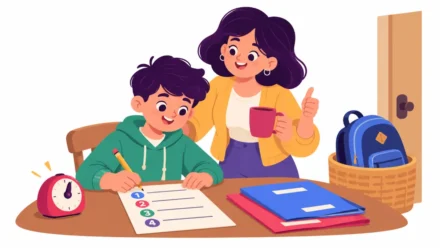
What it is: a five-minute routine each evening to get the bag ready for tomorrow.
Why it works: evenings are usually calmer than mornings. Problems, such as a missing book, can be solved without a bus waiting.
How to use it: attach the pack-up to something that already happens, like right after homework or before screen time.
If you want a structured way to teach this, the desk and backpack organization skills workbook for students breaks backpack, desk and paper habits into small comic-style lessons that children can work through on their own or with you.
4. Put a picture checklist by the door
What it is: a short list of what goes in the bag each day, with pictures for younger children.
Why it works: the list does the reminding, so you do not have to. It also builds independence, because your child checks it, not you.
How to use it: include daily items, such as folders, water bottle and lunch, plus a line for special days like “Tuesday: library book” or “Thursday: gym shoes.”
Example: Theo kept forgetting his gym shoes. After Andre added a picture of shoes next to “Thursday,” Theo remembered three Thursdays in a row.
5. Give every pocket a job
Among all backpack organization tips for kids, this one makes the bag feel less like a black hole.
What it is: a simple rule for each pocket: folders in the big pocket, pencil case in the front, water bottle on the side.
Why it works: when every item has a home, children can find things quickly and notice what is missing.
How to use it: lay the bag open on the table and decide the jobs together. Draw a quick map if your child likes visuals.
Example: Theo drew his backpack with arrows: “folders here, pencil case here, snack here.” He taped the drawing inside the front flap, and for the first week he checked it every evening during pack-up.
6. Empty the lunchbox every day
What it is: taking out the lunchbox and food wrappers as soon as your child gets home.
Why it works: forgotten food creates mess, smells and sticky papers. It is also an easy daily win.
How to use it: make it part of “bag on the hook”: hang bag, lunchbox to the kitchen.
Example: Andre noticed that Theo’s worksheets were often stained. Once the lunchbox came out every afternoon, the sticky papers disappeared, and Theo was proud to hand in clean homework.
7. Do a Friday clean-out
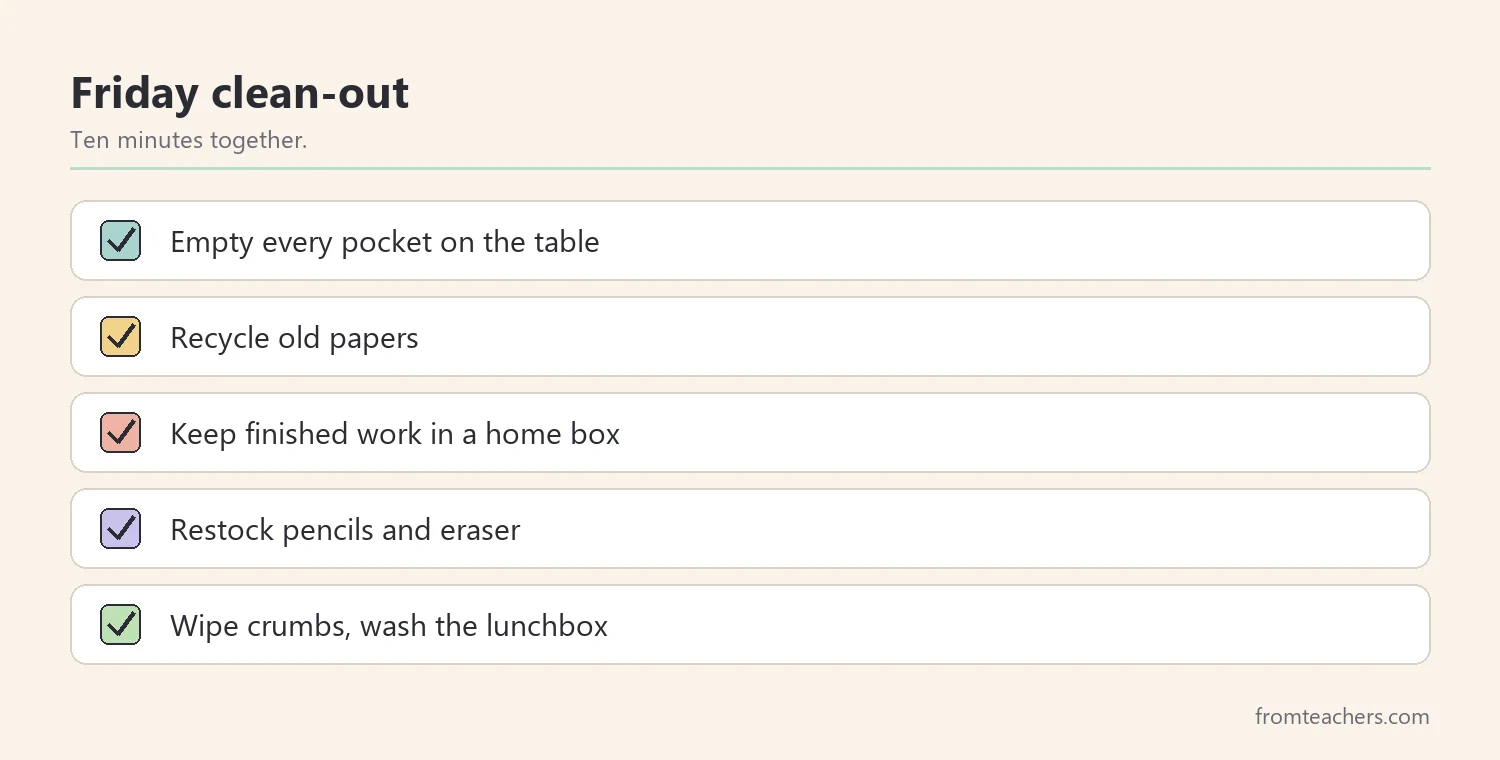
What it is: a ten-minute weekly session to empty the whole bag, sort papers and restock supplies.
Why it works: even good systems get messy. A weekly reset stops small piles from becoming big ones.
How to use it: empty everything onto the table. Recycle old papers, put finished work in a “keep” box at home, and refill pencils.
Example: during the first clean-out, Andre and Theo found three old worksheets, two broken pencils and a missing library book. By week four, the clean-out took less than five minutes.
8. Check the planner together
What it is: a short daily look at your child’s planner or assignment list.
Why it works: the planner connects school tasks with the bag. If math homework is listed, the math book should be packed.
How to use it: ask your child to read the planner to you and point to what they need. Keep it quick and friendly.
Example: Theo read, “Science: bring a leaf.” Without being asked, he went outside, found a leaf and put it in his Return folder. Small moments like this show the habit is becoming his own.
9. Lighten the load
What it is: removing items that do not need to travel every day.
Why it works: a heavy, overstuffed bag is harder to organize and less comfortable to carry. Pediatric groups such as the American Academy of Pediatrics suggest backpacks should not be too heavy for a child and should be worn on both shoulders.
How to use it: ask the teacher which books can stay at school, and keep only today’s items in the bag.
Also, check the bag’s fit. Straps adjusted so the bag sits close to the back make it easier to carry and less likely to be dropped and dumped out on the floor.
10. Fade your help step by step
What it is: gradually handing each part of the routine to your child.
Why it works: the goal of all these backpack organization tips for kids is independence. If a parent always packs the bag, the child never learns the skill.
How to use it: first do the routine together, then watch while your child does it, then check only at the end. Finally, check once a week.
Example: by the end of the month, Andre only checked Theo’s bag on Fridays.
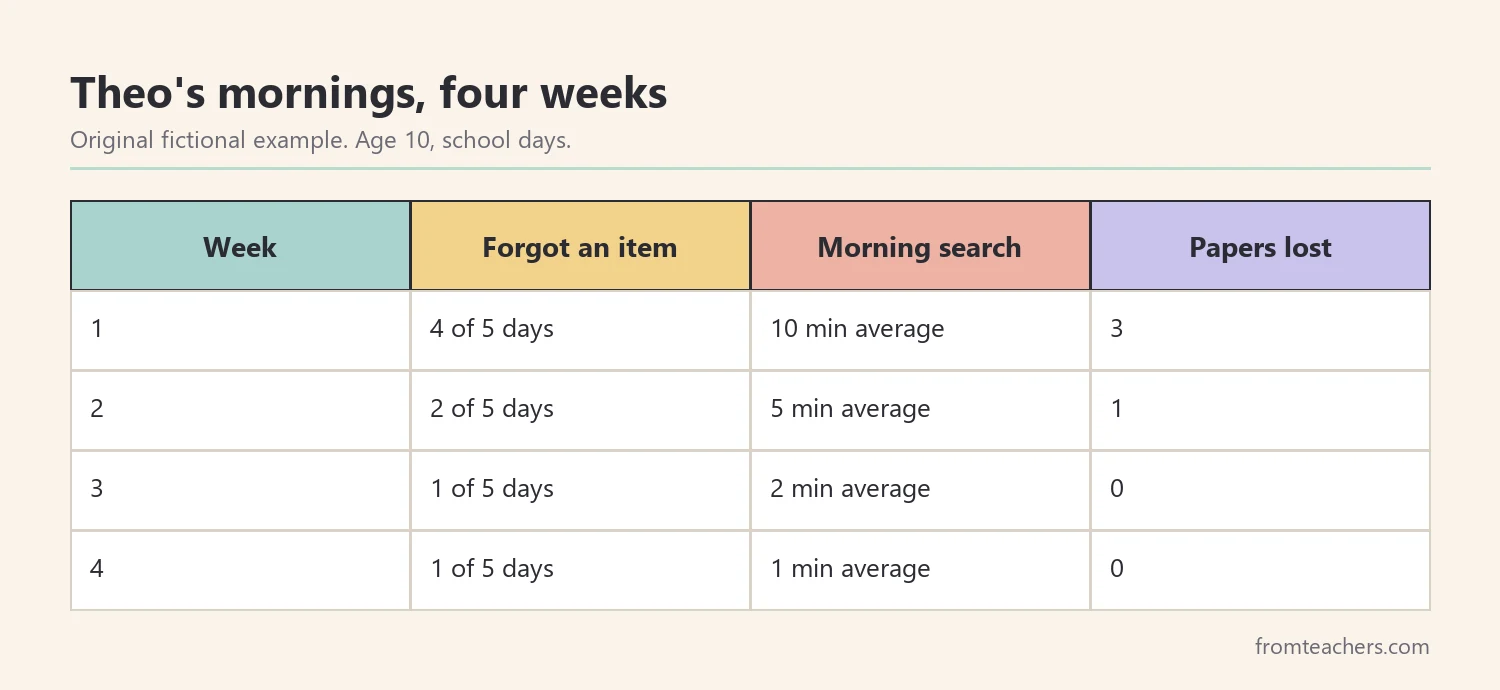
What changed for Theo’s family
Andre started with three tips: the hook, the two folders and the nightly pack-up. In week two, he added the checklist by the door. In week three, they began Friday clean-outs.
After four weeks, Theo forgot an item only about once a week instead of almost daily. Morning searching dropped from about ten minutes to one. Mornings were still busy. However, they were no longer a daily crisis.
Making it stick: praise the process
New habits fade quickly if the only feedback a child hears is about what went wrong. Instead, notice the steps: “You hung your bag right away,” or “You checked your list before bed.” Specific praise tells your child exactly what to repeat.
In addition, keep the system visible for a few months, even after it seems to work. Children often slip when routines change, such as after holidays or at the start of a new term. A quick restart week with extra reminders usually brings the habits back.
Tips by age
| Age | Focus on |
|---|---|
| 6 to 8 | Hook, two folders, picture checklist, lunchbox |
| 9 to 11 | Nightly pack-up, pocket jobs, Friday clean-out |
| 12 to 13 | Planner check, lighter load, full independence |
Moreover, if your child has an IEP or 504 plan with organization supports, ask the teacher how to use the same system at home.
Common mistakes and how to avoid them
- Saying “get organized” without teaching how: show each step and practice it.
- Starting too many habits at once: add one new habit per week.
- Packing the bag for your child: guide, then step back.
- Skipping the weekly clean-out: even good systems need a reset.
- Reacting with anger to forgotten items: stay calm and adjust the checklist.
Questions parents ask about backpack organization tips for kids
At what age can kids organize their own backpack?
Many children can handle simple steps, like the two-folder system, in early elementary school. Full independence often comes later, around middle school, and some children need support longer.
My child has ADHD. Will these tips work?
Many families find that visual checklists, fixed routines and weekly clean-outs help children with ADHD. Expect to provide support for longer, and celebrate progress rather than perfection.
Should I bring forgotten items to school?
Occasionally is fine. However, if it happens often, use it as a reason to update the checklist or evening routine together.
How do I get my child to do the nightly pack-up?
Attach it to an existing routine and keep it short. A small reward, such as choosing the bedtime story, can help at first.
What about desk organization at school?
Ask the teacher what system they use. Matching folder colors and labels between home and school makes the habits easier to transfer.
Related reading: ADHD classroom strategies for student success, practical tips to boost classroom focus.
A companion resource for backpack organization tips for kids:
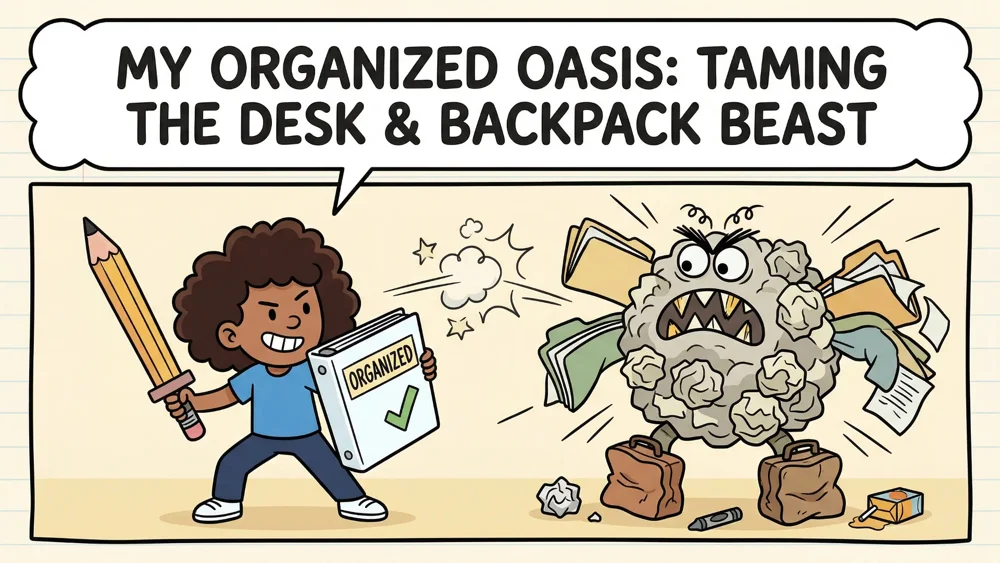
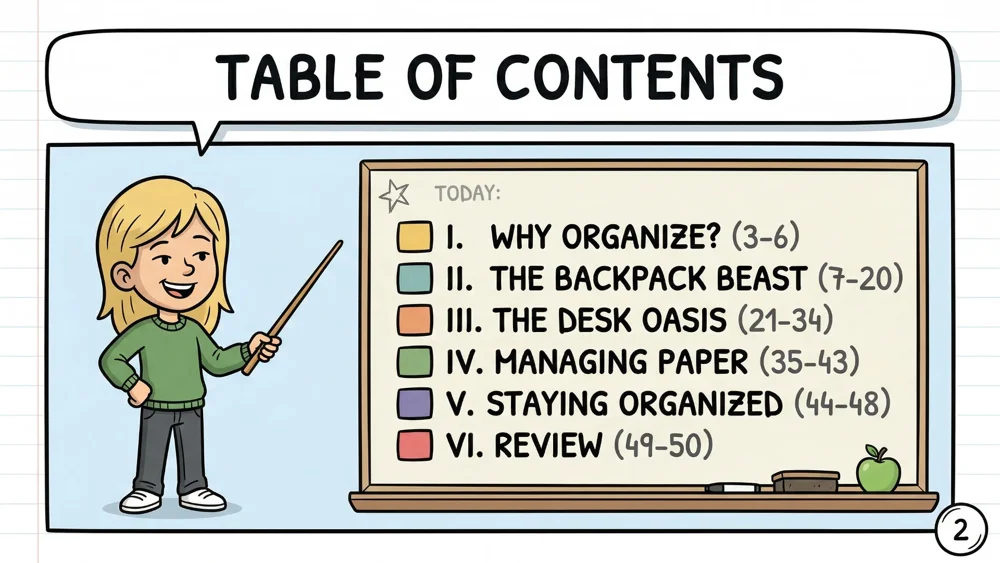
Desk and Backpack Organization Skills for Students Workbook: a 50-page printable workbook in a fun comic style with a Why Organize? introduction, a Backpack Beast section for taming backpack chaos, a Desk Oasis section, a Managing Paper section for handouts and homework, a Staying Organized section for lasting habits and a review, for elementary and middle school students.
You may also need: Organization Skills Training Worksheets.
Sources and scope
- Understood.org: family articles on executive function and organization skills.
- Center on the Developing Child at Harvard University: background on how executive function skills develop.
- HealthyChildren.org (American Academy of Pediatrics): parent information, including backpack safety.
- CHADD: resources for families of children with ADHD.
This list covers simple home routines for backpack organization for children ages 6 to 13. It is not a diagnostic guide; talk with your child’s teacher or doctor if organization problems strongly affect school life.
Key takeaways
- The best backpack organization tips for kids are simple, visual and repeated.
- Start with a fixed spot for the bag and a two-folder system.
- Pack up the night before and use a checklist by the door.
- Do a weekly clean-out together.
- Fade your help step by step until your child manages alone.




Leave a Comment