

Social communication skills at home often look very different from what a speech therapist sees in a quiet therapy room. Picture a seven-year-old who chats easily with his grandmother but freezes when a cousin asks to join his game, or who talks about trains through an entire family dinner. Parents notice these moments every day, yet they rarely have a clear way to describe them.
This guide shows parents and caregivers how to observe social communication skills at home in a calm, structured way, how to rate what they see, and how to share it with the school team or speech-language pathologist. By the end, you will be able to bring clear, specific examples to the next meeting instead of a general feeling.
Examples are fictional. Adapt to your child’s goals and agreed supports. This is guidance, not a diagnosis.
At a glance
- Home shows skills that school may not see, and the reverse.
- Choose a few everyday moments and observe them on purpose.
- Rate how often a skill happens, not whether your child is “good” at it.
- Write short, specific examples next to each rating.
- Share your notes with the school team as one piece of the picture.
1. Understand social communication skills at home
Social communication, also called pragmatic language, is how we use language with other people. It includes greeting, taking turns, staying on topic, asking for help, reading faces, and understanding unwritten social rules. Importantly, a child can have a large vocabulary and still find these skills hard.
Home is a special setting for these skills. Your child is usually relaxed, the people are familiar, and routines are predictable. As a result, social communication skills at home may look stronger than at school. On the other hand, some children hold it together all day at school and show more difficulty at home in the evening.
Both patterns are useful information. Speech-language pathologists and teachers see your child in a limited set of situations. Your observations fill in the rest: siblings, relatives, neighbors, shops, and play dates.
Sami (fictional, age 7, grade 2) receives speech therapy at school for social communication. His therapist asked his parents for input before his review. His father, Mr. Haddad, wanted to help but did not know what to look for beyond “he talks a lot about trains.”
Here are ten skill areas many pragmatic checklists include:
- Eye contact and facial expressions.
- Back-and-forth conversation and turn-taking.
- Staying on topic and changing topics smoothly.
- Requesting and greeting.
- Expressing needs and wants.
- Understanding social norms, such as personal space or polite interruptions.
2. Pick everyday moments to observe
Next, choose three or four moments that happen often at home. Observing social communication skills at home works best when you watch the same moments repeatedly, rather than trying to notice everything all day.
Good moments are short and predictable. For example, family dinner, a board game, greeting a visitor, a car ride, or asking a sibling for a toy. Each one shows different skills. Dinner shows topic maintenance and turn-taking; greetings show eye contact and social norms; asking for a toy shows requesting.
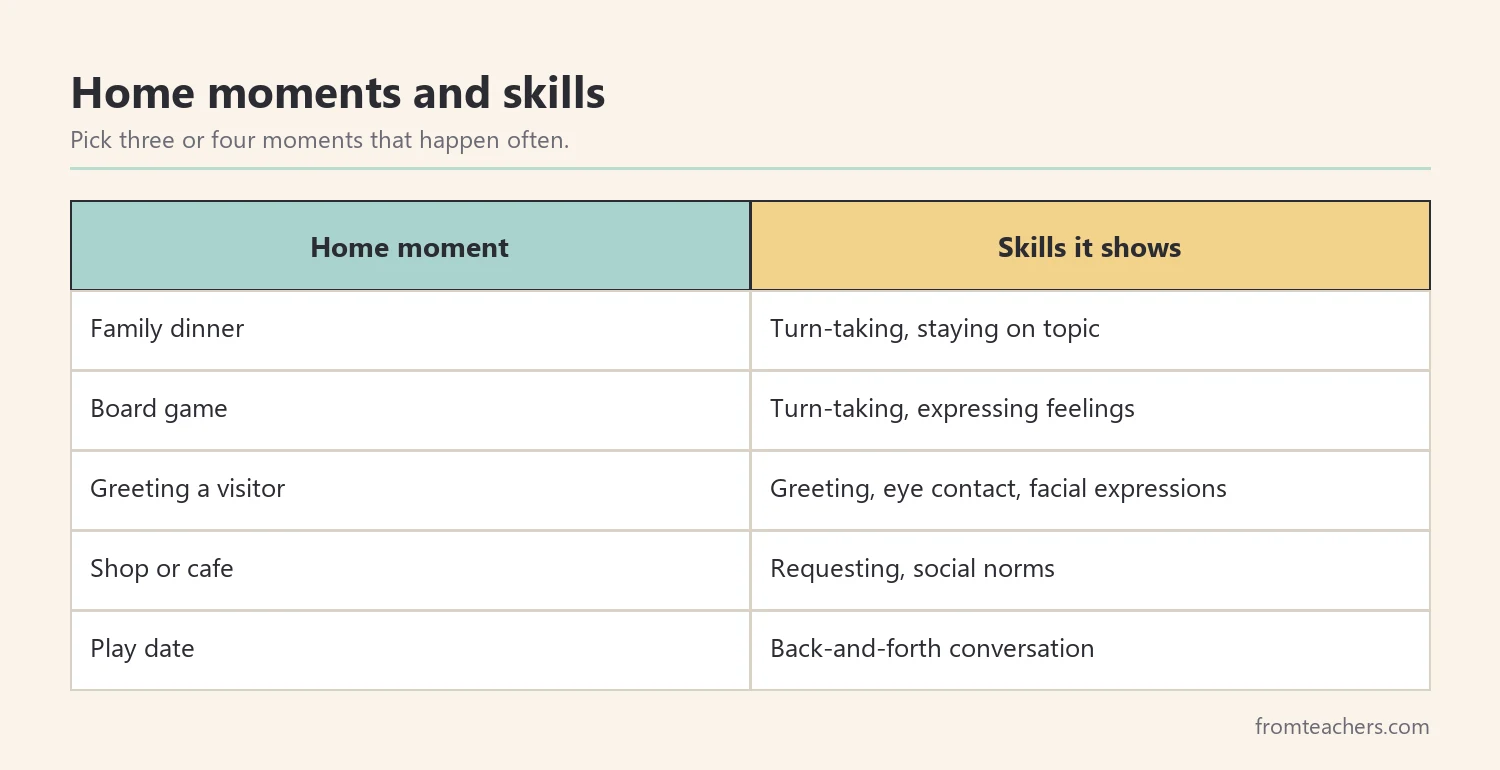
Also, include one less familiar situation if you can, such as a play date or a visit from a relative your child sees rarely. Skills often look different with less familiar people, and therapists value that contrast.
Mr. Haddad chose four moments: dinner, a weekly board game with his older sister, greeting guests, and the Saturday trip to the shop. He wrote them on a sticky note on the fridge so he would remember to watch.
Moreover, plan to observe each moment several times over two or three weeks. One evening can be unusual because of tiredness or excitement. Repeated observations show what is typical.
| Moment | How often | Skills to watch |
|---|---|---|
| Family dinner | 3 times a week | Turn-taking, staying on topic |
| Board game | Once a week | Turn-taking, expressing feelings |
| Greeting guests | When it happens | Greeting, eye contact |
| Shop trip | Once a week | Requesting, social norms |
Adjusting what you watch for your child’s age
Expectations change as children grow, so watch skills that fit your child’s age. For a preschooler, greeting, requesting, and simple turn-taking are good starting points. For a school-age child like Sami, staying on topic and joining in conversation become more important.
With preteens and teens, social communication skills at home often show up in subtler ways. For example, notice whether your child reads tone of voice, understands a joke, or knows when a sibling wants to end a conversation. Older children may also be able to rate themselves, which adds a valuable third view next to yours and the teacher’s.
If you are unsure what is typical for your child’s age, ask the speech-language pathologist. They can tell you which skills matter most right now and which can wait.
3. Rate social communication skills at home with a frequency scale
A frequency scale makes your notes consistent. Instead of asking “Is he good at greetings?”, you ask “How often does he greet people?” The answer is one of five words: always, often, sometimes, rarely, or never.
Frequency ratings are fair because they describe what happens, not a judgment about your child. In addition, they are easy to compare over time and with ratings from school. If the teacher marks “sometimes” and you mark “often,” that difference starts a useful conversation.
Mr. Haddad used a pragmatic skills checklist with ten skill areas and a five-point frequency scale. Each skill came with a short behavior description, so he knew exactly what “staying on topic” or “transitioning topics” meant before he rated it.
Then, rate only after several observations. A rating made after one dinner reflects one dinner. A rating made after two weeks reflects a pattern. Keep a scrap of paper or a phone note for quick examples during the week, then complete the ratings at the end.
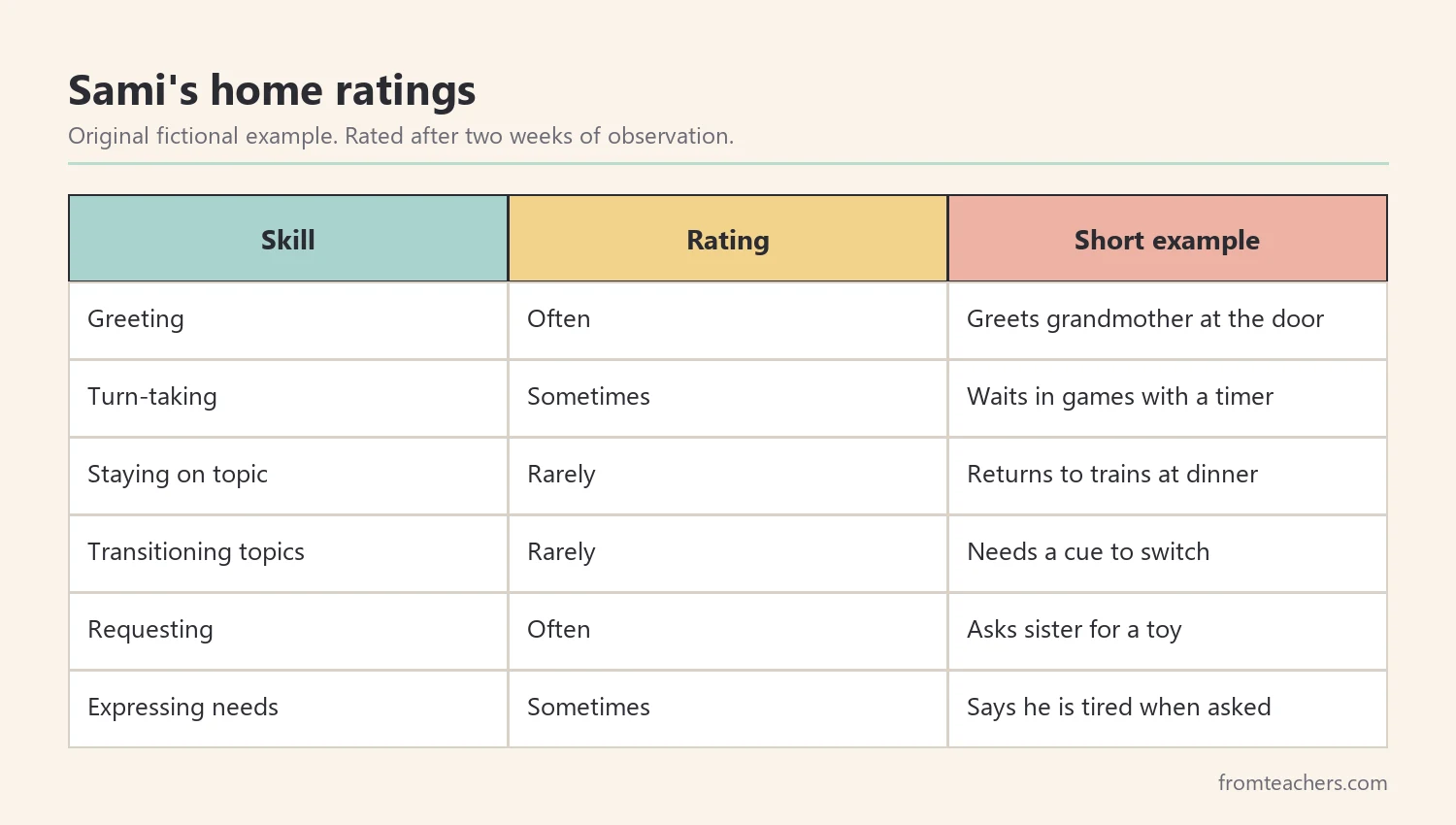
Finally, rate each skill separately. Children are rarely equally strong or weak across all ten areas. Sami, for example, greeted guests warmly most of the time but rarely changed topics smoothly.
4. Write short, specific examples
A rating tells the team how often. An example tells them what it looks like. Together, they make your observations of social communication skills at home far more useful than either alone.
Keep examples short and factual. Describe what your child said or did, where, and with whom. For instance, “At dinner, Sami talked about train engines for about ten minutes. When his sister mentioned her school trip, he said ‘Trains can go on trips’ and continued about trains.”
In contrast, avoid labels or guesses about motives. “He’s rude” or “he doesn’t care about others” will not help the therapist plan support. Describing the exact behavior lets professionals interpret it with their training.
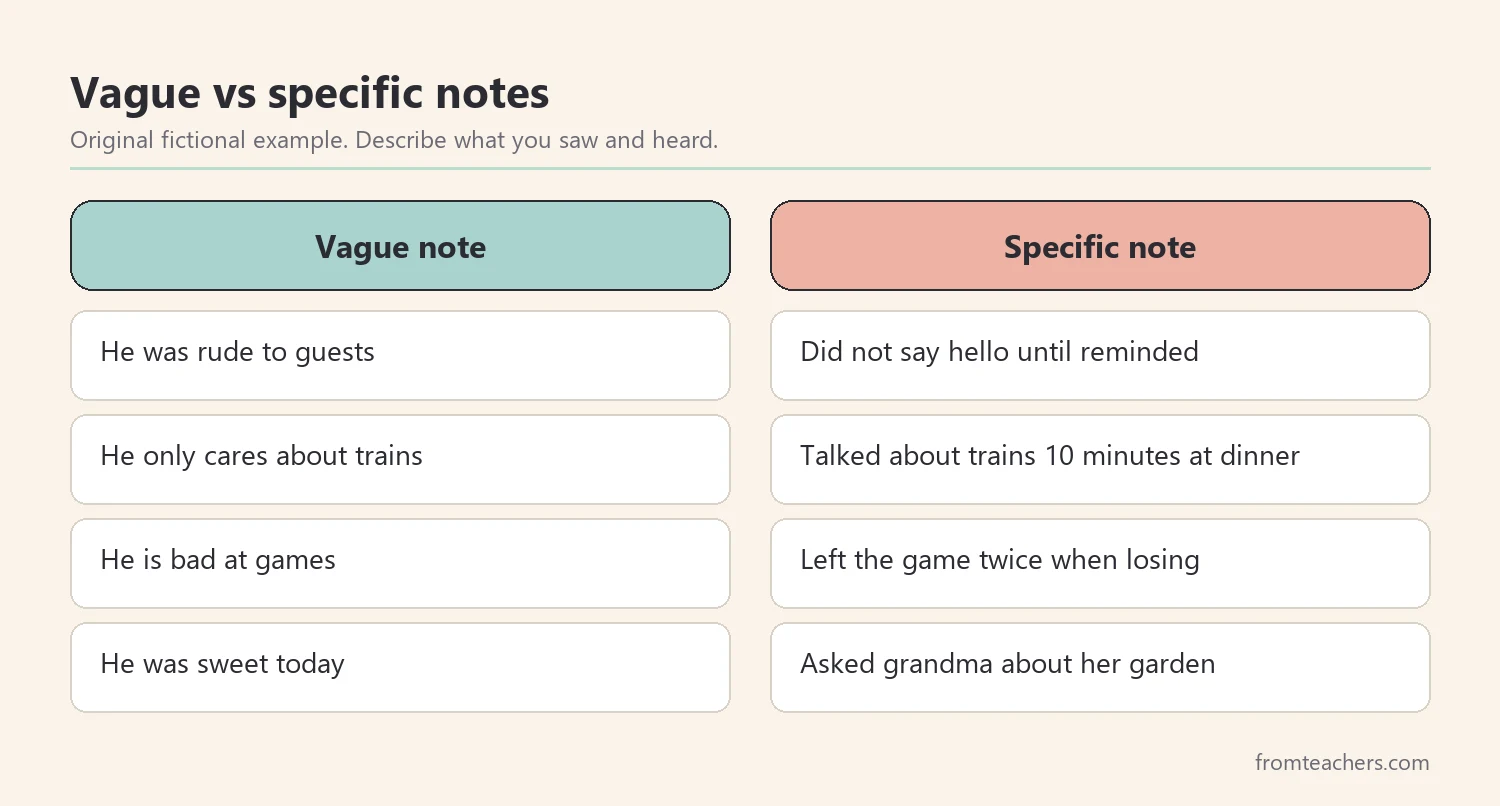
Also, note what helped. If a visual timer made turn-taking easier during the board game, write it down. If Sami greeted his aunt after a reminder in the car, record the reminder. Supports that work at home may also help at school.
Moreover, include strengths. Sami asked his grandmother how her garden was doing, without prompting. That small moment shows an emerging skill, and it deserves a place in your notes as much as the challenges do.
Use the “Overall notes and recommendations” space on your checklist, or a separate page, for two or three key examples per skill area that stands out.
Keeping observation light and natural
Children quickly notice when they are being watched. Therefore, keep your observations low-key. Avoid holding a clipboard at the dinner table; instead, jot a quick note afterward or on your phone.
In addition, resist the urge to correct every moment while you are observing. If you step in each time your child changes topic suddenly, you will see your prompts rather than your child’s typical pattern. Observe first, then decide later which skill to practice.
Finally, remember that observing social communication skills at home is also a chance to enjoy your child. Many parents find that watching on purpose helps them notice small successes they used to miss, such as a question asked, a shared smile, or a turn given without a reminder.
5. Share your notes and practice at home
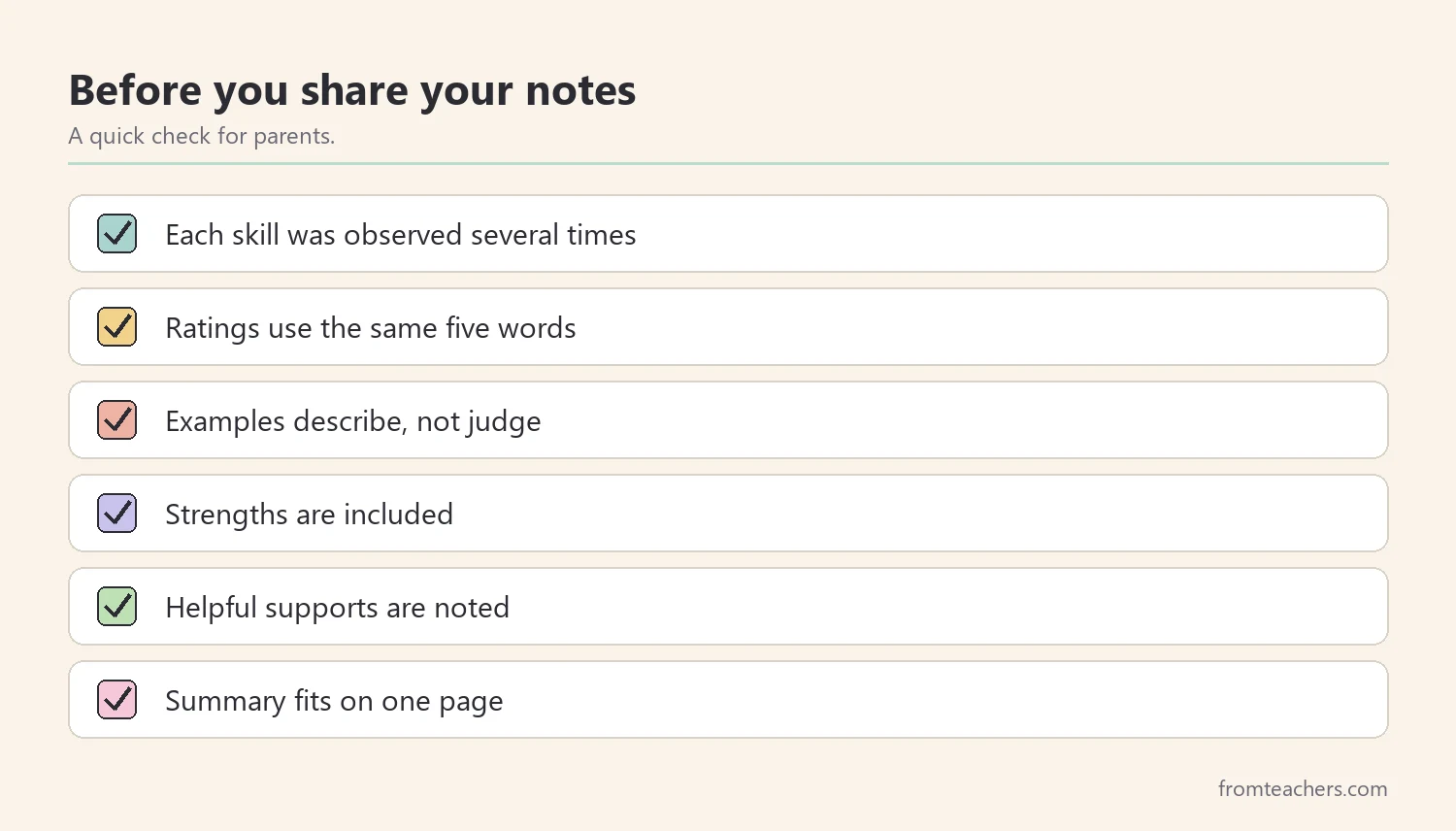
Next, bring your ratings and examples to the speech therapist or school meeting. A short summary works best: two strengths, two areas that are hard, and one or two supports that helped at home. Offer the full checklist if the team would like it.
Ask the team to compare your ratings with theirs. Differences are normal and informative. If Sami stays on topic more often at school, perhaps structured lessons help. If he greets more often at home, familiar people may make it easier.
Then, agree on one or two skills to practice at home. Ask the therapist for simple strategies that match what they use in sessions, so your child hears the same language everywhere. For example, a “two comments, then switch” rule at dinner can support topic changes.
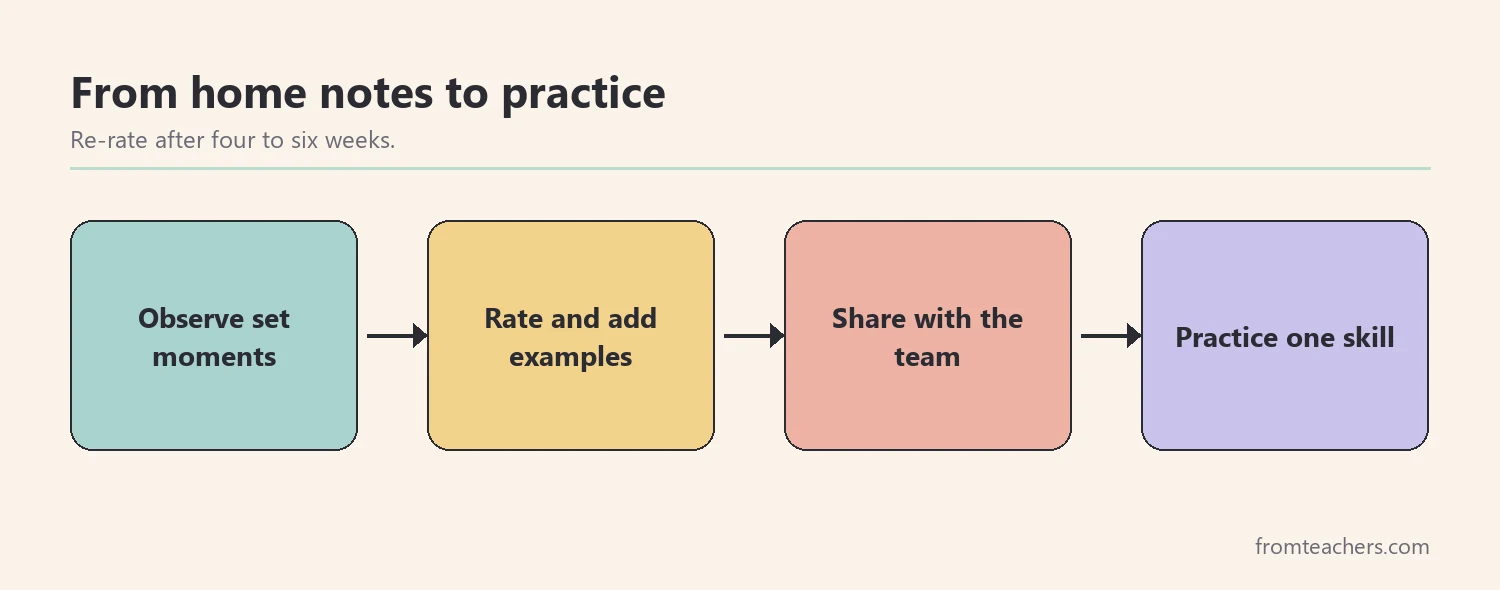
After four to six weeks, rate the same moments again with the same scale. Comparing the two sets of ratings shows whether the practice is helping. In Sami’s case, “transitioning topics” moved from rarely to sometimes, and the family kept the dinner rule going.
In addition, tell your child what you are working on in simple words. For example, “This week we are practicing switching topics at dinner. I will hold up two fingers when it is time to let someone else choose.” Children usually cooperate more when the goal is clear, short, and shared, and the same cue can be passed on to the teacher so it works in both places.
Finally, keep the practice playful. Social communication skills at home grow best in relaxed moments, such as games, cooking together, or chatting in the car. Short, positive practice beats long lessons at the kitchen table.
Common mistakes and how to avoid them
- Rating after one observation. One evening can be unusual. Fix: observe the same moments several times before you rate.
- Judging instead of describing. Words like “rude” or “shy” do not show what happened. Fix: write what your child said and did.
- Only noting problems. A list of difficulties gives an unfair picture. Fix: record strengths and emerging skills too.
- Turning every moment into a test. Constant correction makes conversation stressful. Fix: observe quietly, then practice one skill at a time.
- Keeping notes to yourself. Observations of social communication skills at home only help if the team sees them. Fix: share a short summary before the meeting.
Questions parents ask about social communication skills at home
Do I need training to observe social communication skills at home?
No. You are not diagnosing or scoring a test. You are describing what you see in everyday life, and clear skill descriptions on a checklist make that much easier.
What if my child behaves very differently at home and at school?
That is common and useful to know. Different settings place different demands on a child. Share both pictures so the team can plan supports that fit each setting.
Should siblings or grandparents add their observations?
Yes, if it is easy for them. Other family members see different moments and relationships. Ask them to use the same skill descriptions so their notes match yours.
Is a checklist the same as an evaluation?
No. A checklist is an informal screening and observation tool. Formal evaluation of communication is done by qualified professionals, such as a speech-language pathologist.
How often should I re-rate?
Every four to six weeks is usually enough to see change without making the process tiring. Use the same moments and the same scale each time.
Related reading: Autism Social Skills Development, How Parents and Teachers Can Team Up for Special Education Success, and How Teachers Communicate With Parents in Special Education.
You may also need: Conversation Skills for Kids: Friendship Foundations.
A companion resource for social communication skills at home:
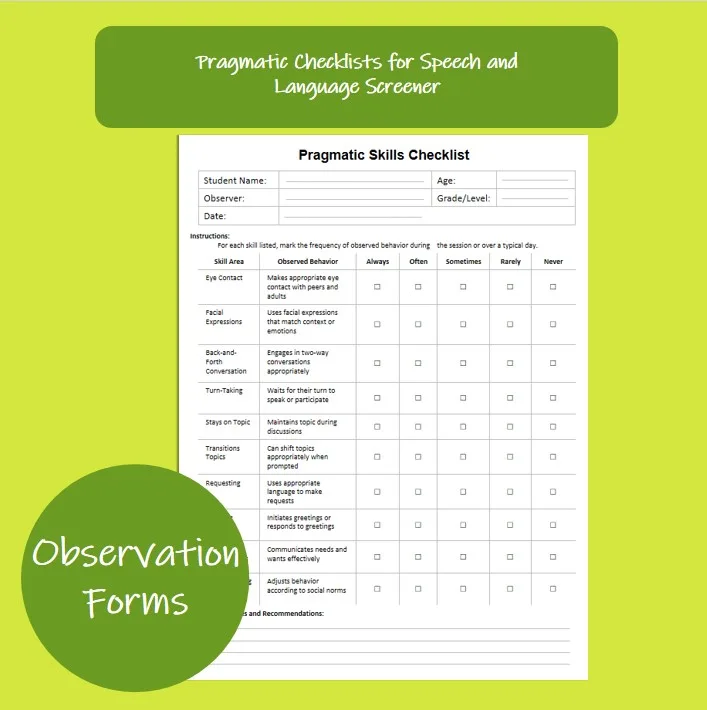
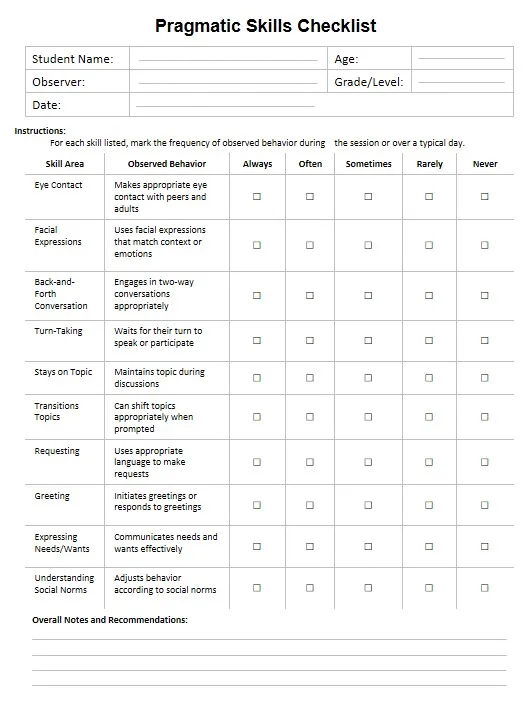
Pragmatic Skills Checklist: Social Communication Screener for Speech Therapy: a one-page editable checklist covering ten pragmatic skills, each with a behavior description, a five-point frequency scale, and space for overall notes and recommendations.
Sources and scope
- American Speech-Language-Hearing Association (ASHA): information on social communication and the role of speech-language pathologists.
- IRIS Center, Vanderbilt University: free modules on family partnerships and supporting students with disabilities.
- Understood.org: parent-friendly articles on social skills and communication.
- Individuals with Disabilities Education Act (IDEA): federal information on parent participation in special education.
This guide covers informal home observation to support conversations with the school team. It does not replace a speech and language evaluation or professional advice.
Key takeaways
- Social communication skills at home add a view that school cannot see.
- Watching the same everyday moments makes observation manageable.
- A frequency scale keeps ratings fair and comparable.
- Short, specific examples explain what each rating means.
- Shared notes lead to agreed practice and a clear re-check later.








Leave a Comment