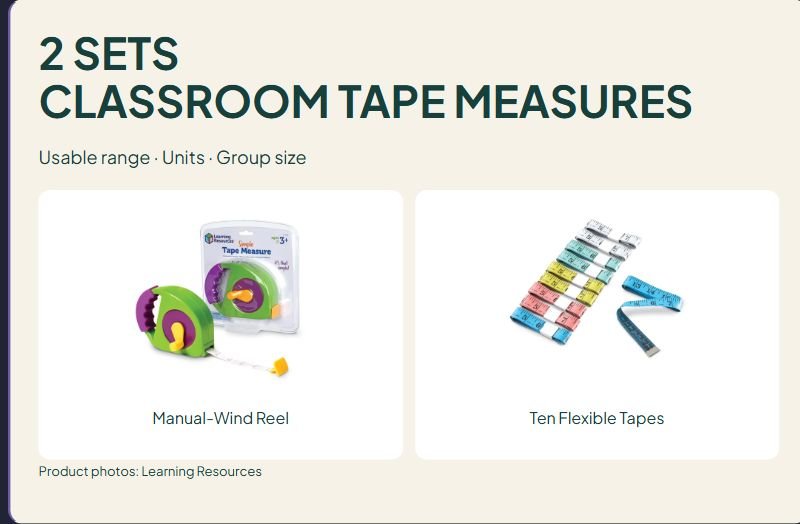

2 SETS
CLASSROOM TAPE MEASURES
Usable range · Units · Group size

Manual-Wind Reel

Ten Flexible Tapes
Product photos: Learning Resources
Affiliate disclosure: As an Amazon Associate I earn from qualifying purchases. Purchases through our links may earn a commission at no additional cost to you.
Classroom tape measures are easier to choose when you know who will use them at the same time and what they will measure. A short tape stored in a manual-wind reel and a pack of loose flexible tapes solve different setup problems. The longest advertised range is only one part of the decision.
This guide compares Learning Resources Simple Tape Measure LER9153 with Customary/Metric Tape Measures LER0363. We have not tested their calibration, winding durability or long-term classroom performance. The worked examples below are original lesson-planning suggestions, not measured product results.
Quick comparison of classroom tape measures
| Detail | Simple Tape Measure LER9153 | Customary/Metric LER0363 |
|---|---|---|
| Manufacturer quantity | One tape measure | Ten tapes |
| Format | Vinyl tape in manual-wind reel | Flexible plastic tapes |
| Advertised range | Up to four feet / 48 inches | 60 inches per tape |
| Units described | Inches and feet; centimeters and meters | Inches on one side, centimeters on the other |
| Manufacturer age guidance | 3+ with small-parts warning | 5+ |
| Main buying question | Does one reel suit a demonstration or shared activity? | How many students or pairs need a tape simultaneously? |
Package dimensions are different from usable tape length. Check the actual scale, zero position and smallest marked interval needed for your lesson. This guide does not establish a professional accuracy tolerance or suitability for construction work.
1. Simple Tape Measure: one manual-wind reel
LER9153 is a child-oriented manual-wind tape measure. Learning Resources describes a vinyl tape extending to four feet, or forty-eight inches, with customary and metric scales on opposite sides. The manufacturer lists ages three and older and warns that small parts are not suitable for children under three.
Why consider it: A reel gives one tool a clear storage format and makes winding part of the handling routine. It may fit an adult demonstration or a turn-taking activity when several independent tapes are unnecessary.
Limitation: One tool creates a sharing requirement when several students need to measure at once. Forty-eight inches also does not cover every classroom object in one uninterrupted measurement. We have not tested its markings or mechanism, and the child-oriented design does not remove the need for suitable supervision.
Choose it when: You want one short-range manual-wind tool and have planned how students will share it.
2. Customary/Metric Tape Measures: ten flexible tapes
LER0363 supplies ten flexible plastic tapes in five colors. Learning Resources describes a sixty-inch range with inches on one side and centimeters on the other and lists ages five and older. This is the ten-tape manufacturer set; retail bundles using the same base code can have different quantities.
Why consider it: Several tapes let students measure in parallel rather than waiting for one reel. The flexible format can be laid along an object when the activity and handling directions are appropriate. Plan how tapes will be distributed, returned and checked after use.
Limitation: Loose tapes require their own storage routine and can bend, twist or shift during a measurement. A larger pack does not establish more accurate measurements. The manufacturer's sixty-inch and 152-centimeter descriptions are rounded paired range labels, not a claim that those values are mathematically identical.
Choose it when: Multiple students or pairs need a tape at the same time and you can manage the loose pieces between activities.
Three original measurement checks to teach
Start at zero rather than assuming the edge is zero
Demonstrate where zero is actually marked on the tool. Align it with one end of the object and keep the tape along the intended dimension. If students begin from another marking, make the calculation explicit rather than reading the endpoint as the object's length.
For an illustrative scale that starts at the two-inch mark and ends at the nine-inch mark, the measured interval is 9 – 2 = 7 inches. This example does not describe a product test or establish the accuracy of either tape.
Keep the unit with the number
Ask students to write both a value and its unit. A result written only as 12 is incomplete without knowing whether it means inches, centimeters or another unit. When students turn a tape over, make sure they identify the new scale before reading it.
One inch is exactly 2.54 centimeters, so twelve inches equals 30.48 centimeters. This mathematical conversion is different from rounding a tool's advertised range. Use the scale markings appropriate to the task and avoid inventing extra measurement precision.
Decide what length or circumference means for the task
Measuring a straight side and measuring around an object are different activities. Explain which path students should follow, avoid slack or unintended diagonal placement, and record what was measured. Do not use a flexible tape's ability to bend as proof that every surface can be measured precisely.
Plan quantities and working space
For a hypothetical class of twenty students working in pairs, ten tapes can provide one per pair. One reel can support a demonstration or a rotating station, but it cannot give all ten pairs an independent tape simultaneously. Choose the arrangement around the learning activity rather than equating a single-item price with a multi-tape pack.
Choose objects within the intended measuring range and suitable for the students' handling skills. Keep the activity on clear working surfaces and follow the actual product directions. This guide does not recommend wrapping tapes around people or animals, pulling tapes tightly or treating a tape as a toy cord.
Questions before buying
Is a longer tape always better?
Choose a range that fits the objects and setting. A longer loose tape may add handling demands, while a shorter reel may require a different task or method. Extra range alone does not establish better readability or measurement accuracy.
Can these replace a professional measuring tool?
These products are described for learning activities. We have not verified professional accuracy specifications, certification or suitability for construction or another precision-dependent task. Use a tool with the required documented specification for that work.
Are customer reviews included?
No authorized customer excerpts have been verified for these exact offers. We do not invent ratings, calibration tests or durability results. The comparison focuses on manufacturer-described format, quantity and classroom planning questions.
For comparing mass using a different kind of measuring tool, see our classroom balance scale comparison. Keep the measured attribute and units explicit when switching activities.








Leave a Comment