

Functional reading activities help students read the information they meet every day, such as a café menu, a bus timetable, or a store receipt. Picture a fifteen-year-old who can decode a list of sight words in class but freezes at the counter of a sandwich shop. The words are not the problem. The problem is finding the right detail on a busy page, at the right moment, and acting on it.
This guide shows you how to plan, teach, and track functional reading activities in five practical steps. By the end, you will be able to choose real texts, build questions at the right level, teach a simple reading routine, record support, and move the skill into real places.
Examples are fictional. Adapt to the student’s goals and agreed supports. This is guidance, not a diagnosis.
At a glance
- Functional reading means reading to get something done in daily life.
- Start with texts the student will really use: menus, hours, timetables, appointments, notices, and receipts.
- Match the response format to the student: two choices, three choices, or an open answer.
- Teach one short routine: look, find the key word, find the answer, check.
- Record the level of support, then practice in real places.
1. Choose real texts for functional reading activities
First, start with the student’s life, not with a worksheet. Functional reading activities work best when the text is something the student will actually see this week. Ask the student and the family where the student goes, what they buy, and what they need to know to get there on time.
Next, group texts into a few everyday contexts. Six contexts cover a lot of daily reading: menus, opening hours, transport timetables, appointments, notices, and receipts. Each one asks for a different kind of reading. A menu asks the reader to compare items and prices. A timetable asks the reader to find a time in a grid. A notice asks the reader to find the one sentence that matters.
Also, keep the real layout, because functional reading activities should look like the world the student will read. Real texts are busy, with logos, small print, and extra details. Simplify the amount of information if needed, but keep the structure, because the goal is to read the real thing later. A menu with six items in a clear table is still a menu.
In addition, link each text to a goal. If the student’s plan includes ordering lunch independently, menus and receipts come first. If the student is learning to travel to a work placement, timetables and opening hours come first. Functional reading activities should always serve a goal the team already agreed on.
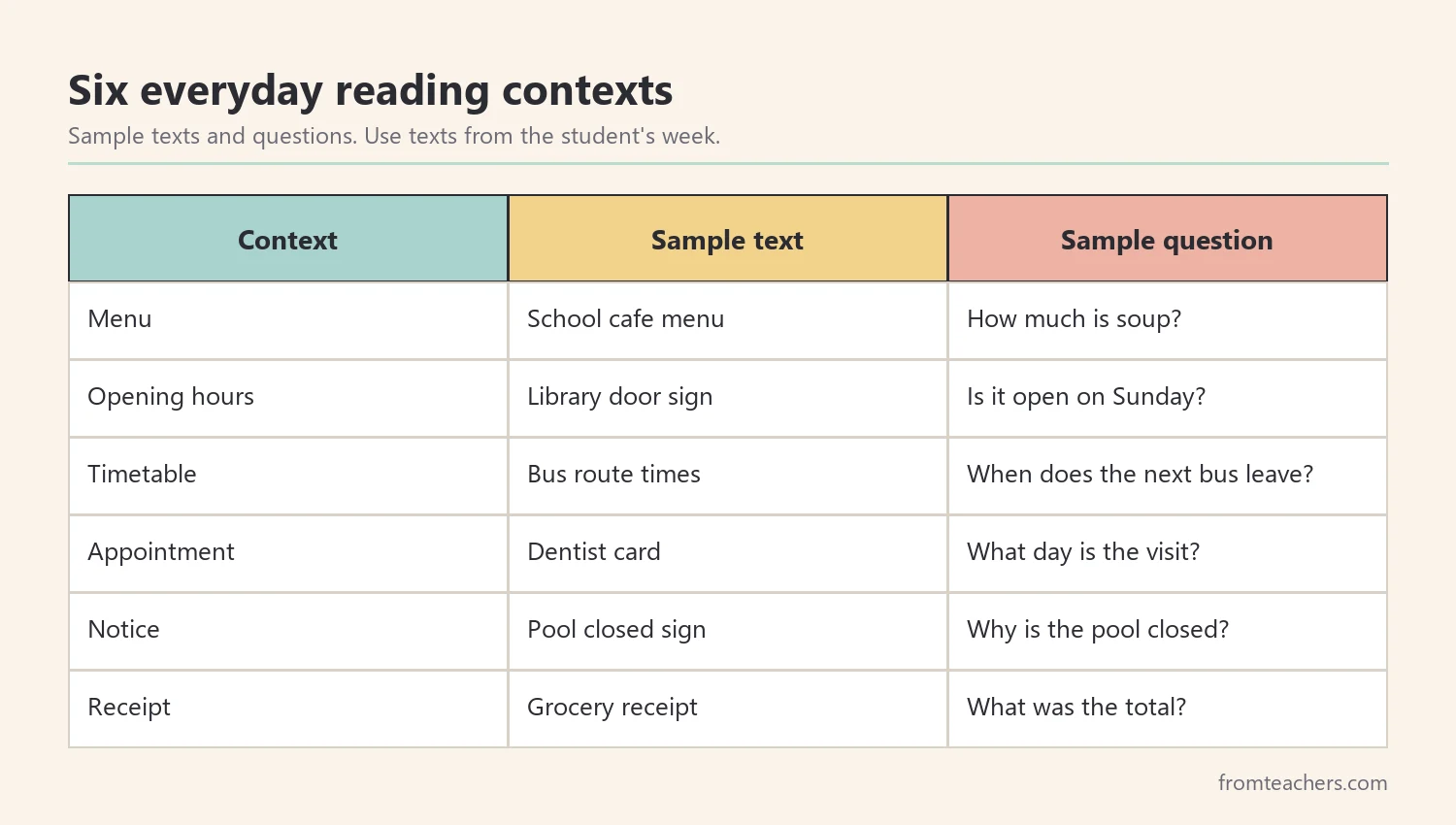
Worked example. Maya is a fictional fifteen-year-old in a life skills class. Her plan includes buying lunch at the school café and taking the city bus to a weekly work placement. So, her teacher, Mr. Okafor, chooses two contexts to start: the café menu and the bus timetable for her route.
2. Build functional reading activities at the right level
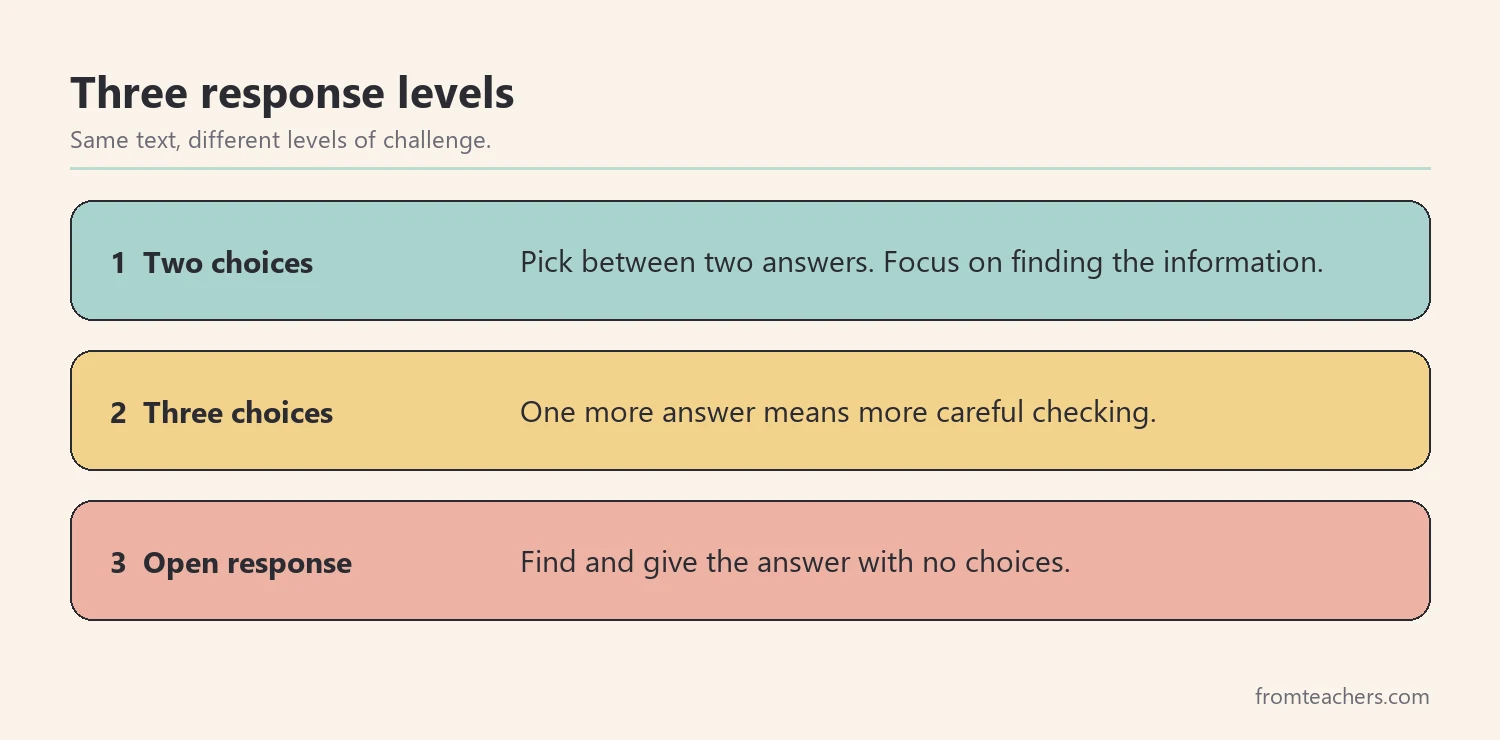
Next, decide how the student will answer. The same text can be read at very different levels of support, and the response format changes the challenge more than the text itself. Three formats work well for most functional reading activities, and each one can use the same text.
First, two-choice questions. The student picks between two answers, such as “$4.50” or “$6.00.” This is a good starting point, because the student can focus on locating information. Then, three-choice questions add one more answer and a little more careful checking. Finally, open-response questions ask the student to find and give the answer without choices.
Also, accept many ways to answer. A student can point, mark, speak, type, or use AAC. The reading skill is finding and understanding the information, so the way the student shows the answer should fit the student, not the worksheet.
In addition, write questions that match real decisions. Instead of “What is the third item?”, ask “How much is a cheese sandwich?” or “Can you buy a sandwich and a juice with $8?” Real questions show why the reading matters.
To save planning time, the editable functional reading activity templates include 18 templates across six everyday contexts, each in two-choice, three-choice, and open-response versions. You add your own menus, times, prices, questions, and answers, so the content fits your learners.
Worked example. Mr. Okafor types the real café menu into a two-choice template. He writes five questions, such as “Which costs less: soup or salad?” Maya points to her answers. After a week, he moves the same menu to the three-choice version.
3. Teach a short reading routine
Next, teach the student how to read a functional text, not only what to answer. Busy pages can feel overwhelming. A short, repeated routine gives the student a way in, and it can be used with any text.
For example, use four steps. Look at the whole text and say what it is: “This is a menu.” Find the key word from the question, such as “sandwich.” Follow the row or column to the answer. Then check by reading the answer back in a short sentence.
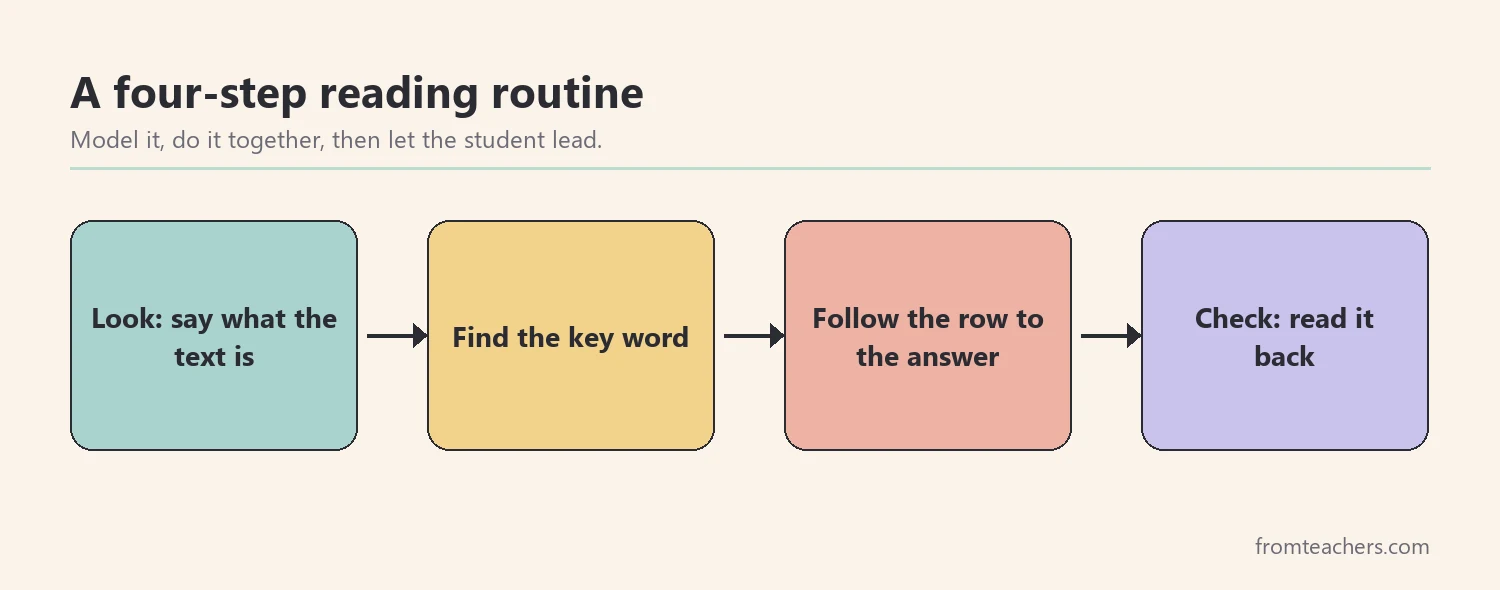
Also, model the routine aloud. Say each step as you do it: “I am looking for juice. My finger is on juice. I move across. It says $2.00.” Then do it together, and then let the student lead. This simple “I do, we do, you do” pattern is common in explicit instruction.
In addition, teach the vocabulary of each context. Menus use words like “small,” “large,” and “add.” Timetables use “departs,” “arrives,” and “weekdays.” Receipts use “total” and “change.” Pre-teach a few of these words before each new context so that functional reading activities stay focused on finding information.
Meanwhile, use visual supports where they help. In functional reading activities, a cluttered page is often the main barrier. A finger guide, a highlighter, or a reading window can reduce visual clutter. Fade these supports once the student can track rows and columns on their own.
Worked example. Mr. Okafor teaches Maya the four-step routine with the bus timetable. At first, he points to each step on a small card. Within two weeks, Maya says “Look, find, follow, check” to herself and uses a highlighter to mark the departure time.
4. Record support during functional reading activities
Next, record more than right and wrong answers. In functional reading activities, the level of support is often the most useful information. A correct answer with a full model tells a different story than a correct answer with no help.
First, decide on a few simple support codes. For example: I for independent, G for gesture, V for verbal prompt, and M for model. Then, note the code next to each question. This takes seconds and shows the team exactly where help was needed.
Also, note the context and the format. A student may be independent with menus but need prompts with timetables. A student may succeed with two choices and struggle with open responses. These patterns help you plan the next step.
In addition, keep the record light. A short observation form at the end of each session is enough. You want data you will actually collect, not a complex system that stops after a week.
Then, share the results in plain language, so everyone knows how functional reading activities are going. “Maya answered 8 of 10 menu questions independently this week” is clear for families and helpful for progress reports.
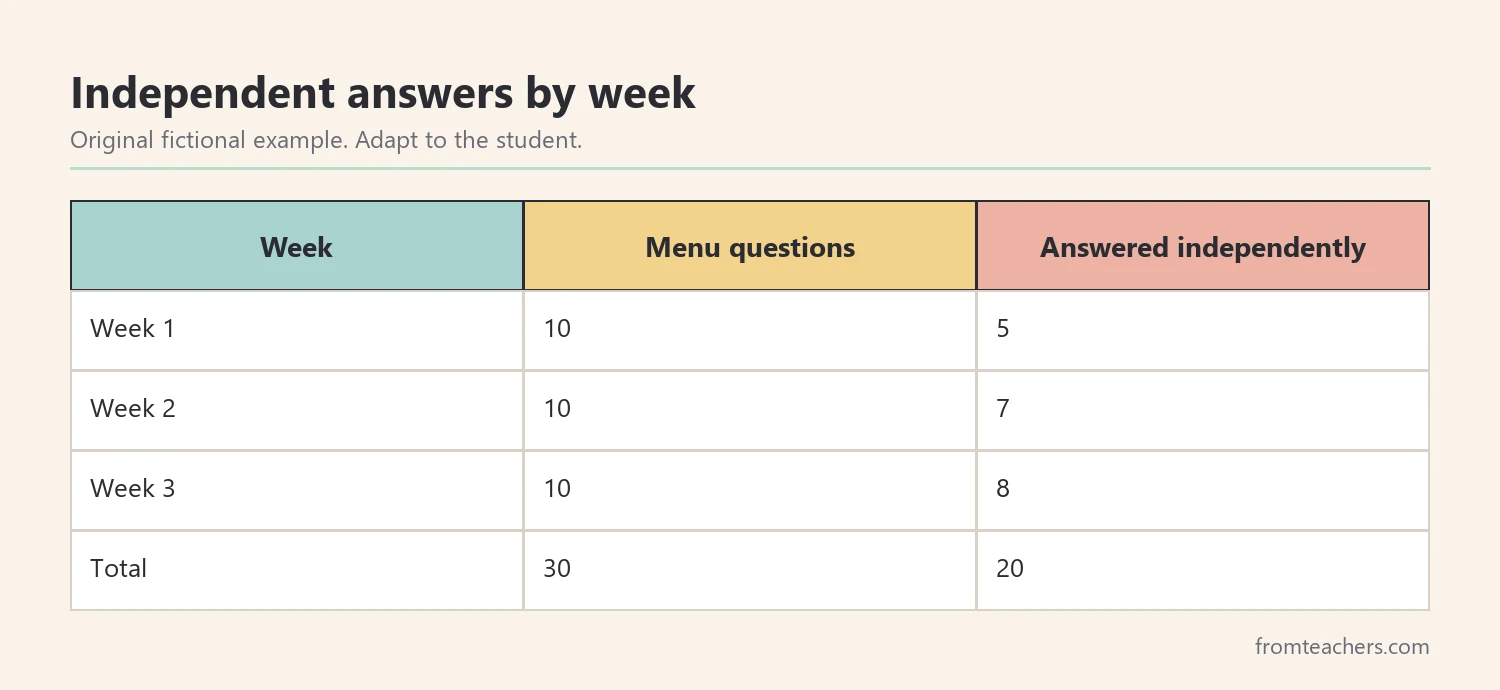
Worked example. Mr. Okafor gives Maya 10 menu questions each week. In week 1, she answers 5 independently. In week 2, she answers 7. In week 3, she answers 8. Across three weeks, that is 20 independent answers out of 30 questions. He also notes that her remaining prompts are mostly about prices with cents.
5. Review, fade support, and generalize
Finally, plan for real life. The purpose of functional reading activities is to read in the real world, so the last step is moving the skill out of the classroom. Practice in class builds the routine. Practice in real places makes it useful.
First, review the data every two to four weeks. If the student is mostly independent with one format, move to the next format. If the student is stuck, check the text, the vocabulary, and the routine before adding more practice.
Next, fade support step by step. Move from two choices to three choices to open response. Move from a simplified text to the real text. Then, move from the classroom to the real place, such as the café counter or the bus stop.
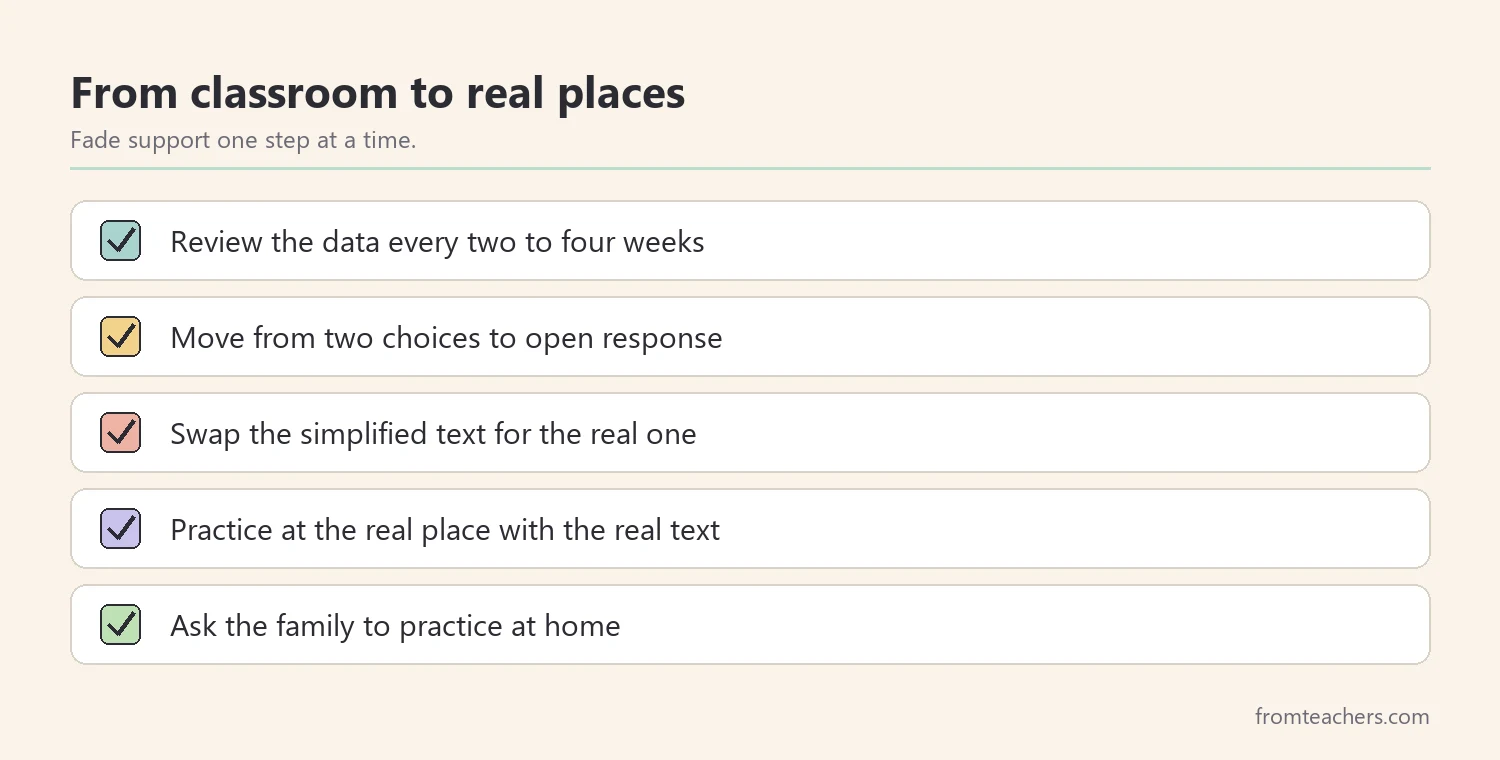
Also, involve the family. Functional reading activities at home can be very short and still useful. A family can ask the student to read a takeout menu, check opening hours online, or find a time on an appointment card. Short, real practice at home strengthens what you teach at school.
In addition, rotate contexts. Once menus are going well, add receipts, which use many of the same words. Then add notices and appointments. Each new context builds on the same routine, so functional reading activities feel familiar even when the text changes.
Worked example. After three weeks, Mr. Okafor moves Maya to open-response menu questions. He also takes her to the school café with a printed copy of the menu. She reads the real board, finds the price of soup, and pays. Next month, the team plans the same steps for the bus timetable.
Making functional reading accessible for every learner
Every student can take part in functional reading activities at some level. For some students, reading means matching a logo to a store. For others, it means reading a full receipt and checking the change. So, start where the student is and build from there.
Also, use the student’s communication system. Functional reading activities should never depend on speech alone. If a student uses AAC, make sure the answer words are available. If a student uses pictures, add symbols next to key words at first, then fade them.
Finally, follow the student’s plan and the team’s guidance. Your role is to make reading useful in daily life, in line with the goals the team has agreed on.
Common mistakes and how to avoid them
- Using texts the student never sees. Practice feels pointless. Fix: choose texts from the student’s real week.
- Jumping straight to open questions. The student gets stuck. Fix: start with two choices and build up.
- Recording only right or wrong. You miss how much help was needed. Fix: use simple support codes.
- Skipping vocabulary. Words like “departs” block the answer. Fix: pre-teach a few context words.
- Staying in the classroom. The skill does not transfer. Fix: practice with the real text in the real place.
Questions teachers and parents ask about functional reading activities
Who are functional reading activities for?
They suit any learner who needs to read for daily life, including students in life skills, transition, and resource programs. They also help younger students who are learning to use print around them. The level of challenge changes with the response format.
Do students need to read fluently first?
No. Many students can locate a price or a time before they can read a full paragraph. Functional reading can run alongside other reading instruction, as the team decides.
How often should we practice?
Short, frequent sessions usually work better than long ones. Ten to fifteen minutes a few times a week, plus real-world practice, is a practical starting point. Adjust to the student’s needs and schedule.
Can students answer without speaking?
Yes. Pointing, marking, typing, and AAC are all valid ways to answer. The goal is to show understanding of the text, not to show speech.
How do I write good questions?
Base each question on a real decision, such as what to buy, when to leave, or where to go. Keep the wording short and use the same words that appear in the text.
Related reading: Navigating the Path to Adulthood: Building Essential Life Skills, Building Workplace Readiness: Essential Skills for Career Success, and The Power of Data Tracking in Special Education.
A companion resource for functional reading activities:
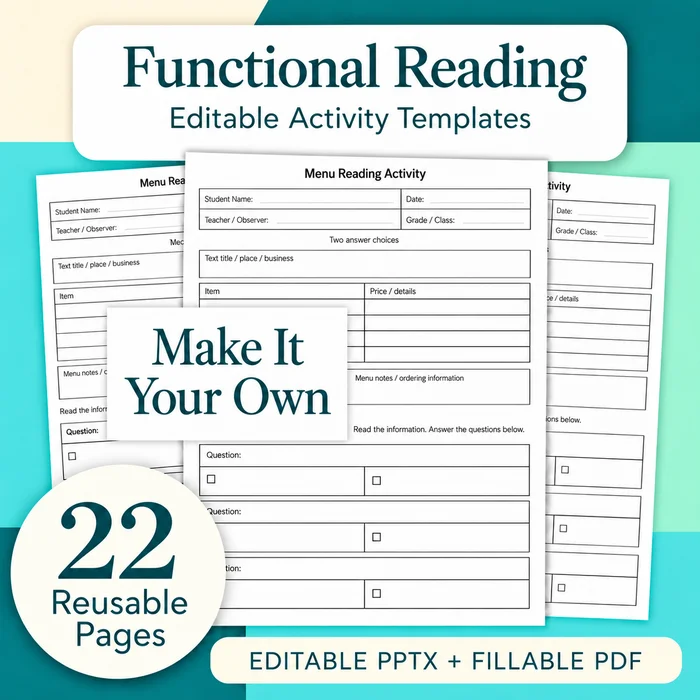
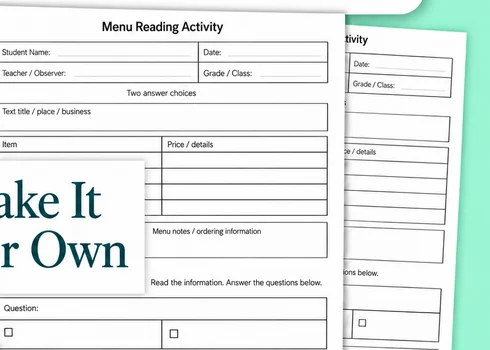
Functional Reading: 22 Editable Activity Templates: 18 activity templates across six everyday contexts, plus a teacher guide, a blank answer-key form, a lesson planner, and an observation form, as an editable PowerPoint and a fillable PDF.
Sources and scope
- IRIS Center, Vanderbilt University: free modules on reading instruction, explicit teaching, and progress monitoring.
- LD OnLine: articles for educators and families on reading and learning disabilities.
- Understood.org: family-friendly information on reading challenges and supports.
- CAST: information on Universal Design for Learning and flexible ways for students to respond.
This guide covers everyday classroom and home practice in reading real-world texts. It does not replace reading assessment, specialist instruction, or the decisions of the student’s support team.
Key takeaways
- Functional reading activities use texts from the student’s real week.
- Two-choice, three-choice, and open questions set the level of challenge.
- A four-step routine helps students read any busy text.
- Record the level of support, not only the answer.
- Finish in real places, with the real text and family practice.







Leave a Comment