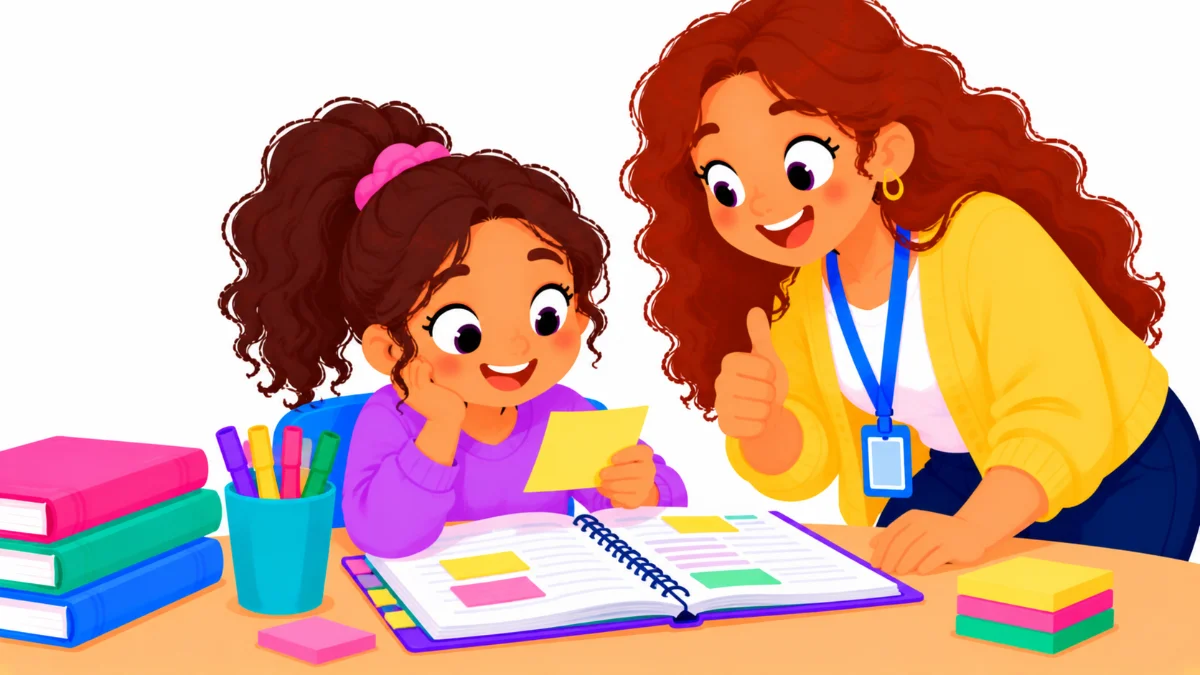

Positive affirmations for kids are short, encouraging sentences that children say to themselves to build confidence and steady their feelings. Picture a third grader who freezes at the start of every math test and whispers, “I’m stupid at this.” Now imagine she has a different sentence ready: “My best effort is enough. I can keep going even when it’s hard.” The task is the same, but the voice in her head has changed.
This guide gives you five steps to make positive affirmations for kids work in a real classroom or home: choose statements that feel true, teach what they mean, build a daily routine, connect them to hard moments, and notice growth over time. By the end, you will have a simple plan you can start tomorrow morning.
Examples are fictional. Adapt to the student’s goals and agreed supports. This is guidance, not a diagnosis.
At a glance
- Affirmations work best when they are short, specific, and believable.
- Group statements by theme, such as capable, kind, or growing.
- A daily routine of one to three minutes is enough to build the habit.
- The real payoff comes when a child uses a statement in a hard moment.
- Affirmations support, but never replace, real help and connection.
1. Choose positive affirmations for kids that feel true
First, pick statements a child can actually believe. “I am the best reader in the world” falls apart the first time reading feels hard. By contrast, “I can learn new things” stays true on a bad day. Believable sentences are the foundation of positive affirmations for kids.
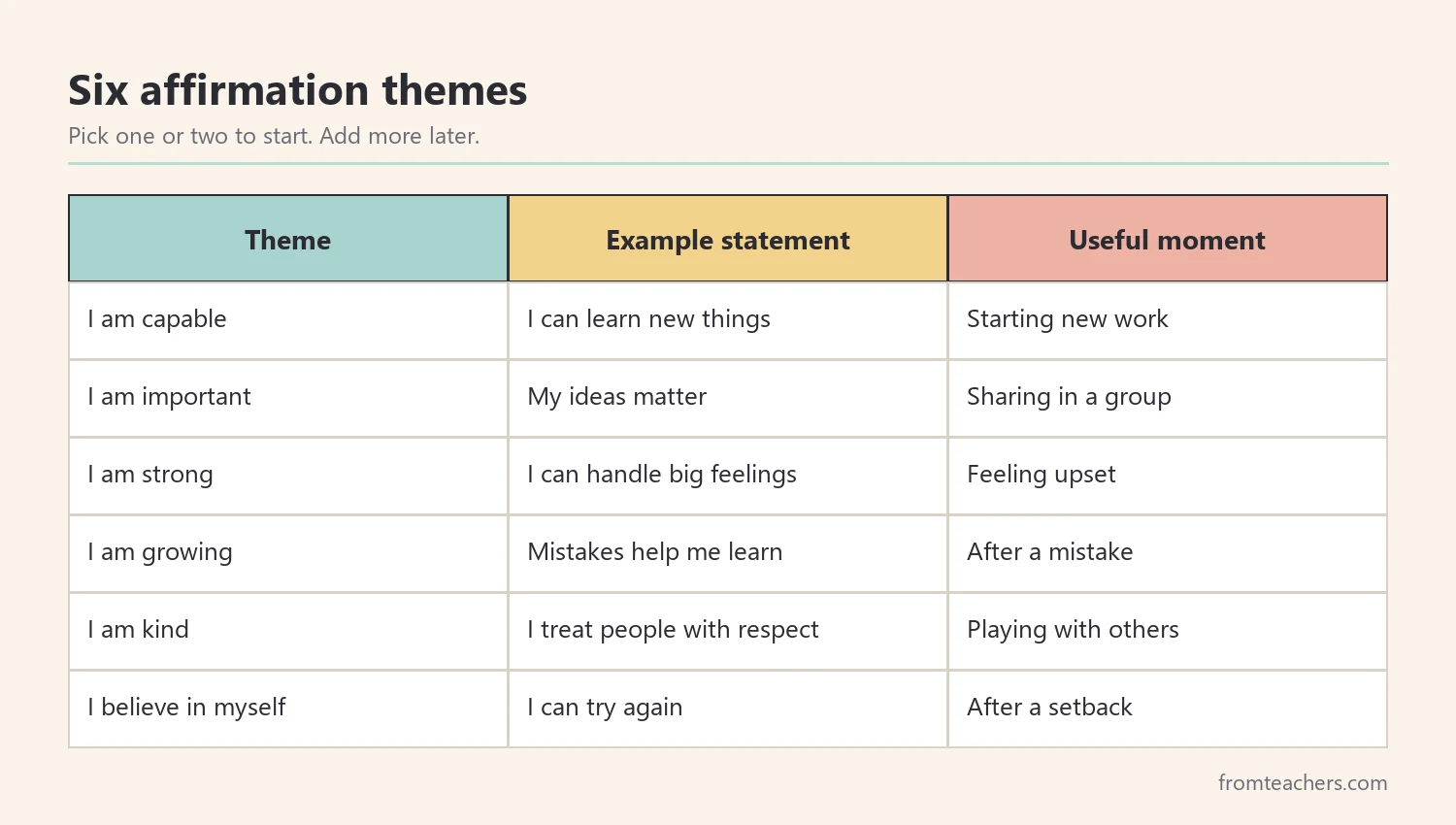
Next, group the statements by theme. Themes help children find the right words for the right moment. A useful set of six groups looks like this:
- I am capable: I can learn new things. I can try my best.
- I am important: My ideas matter. People care about me.
- I am strong: I can handle big feelings. I can calm my body and my mind.
- I am growing: Mistakes help me learn. I can improve with practice.
- I am kind: I choose to be gentle with myself and others.
- I believe in myself: I can try again. I can speak up for what I need.
Also, keep the language simple. Use “I can” and “I am” sentences of five to eight words. For children who use pictures or devices to communicate, pair each statement with an image or add it to their system.
Meet Maya
Consider Maya, a fictional student in grade 3. Maya is bright but anxious, and she shuts down when work looks long. Her teacher, Mr. Hale, did not start with all six groups. He chose two: “I am capable” and “I am strong,” because those matched the moments when Maya struggled most.
Finally, invite children to help. Ask, “Which sentence sounds most like something you would say?” When children choose their own words, they are far more likely to use them.
2. Teach what each affirmation means
A sentence repeated without meaning quickly turns into noise. Therefore, teach each statement like a small vocabulary lesson. Explain it, connect it to an example, and let children put it in their own words.
Start with a short story or a moment from class. “Yesterday, Sam tried the puzzle three times. On the third try, he got it. That is what ‘I can keep going even when it’s hard’ looks like.” Concrete examples make positive affirmations for kids feel real instead of abstract.
Then, check understanding. Ask children to show, draw, or act out what a statement means. A child might draw herself trying a hard puzzle. Another might act out taking a deep breath. These responses tell you whether the meaning landed.
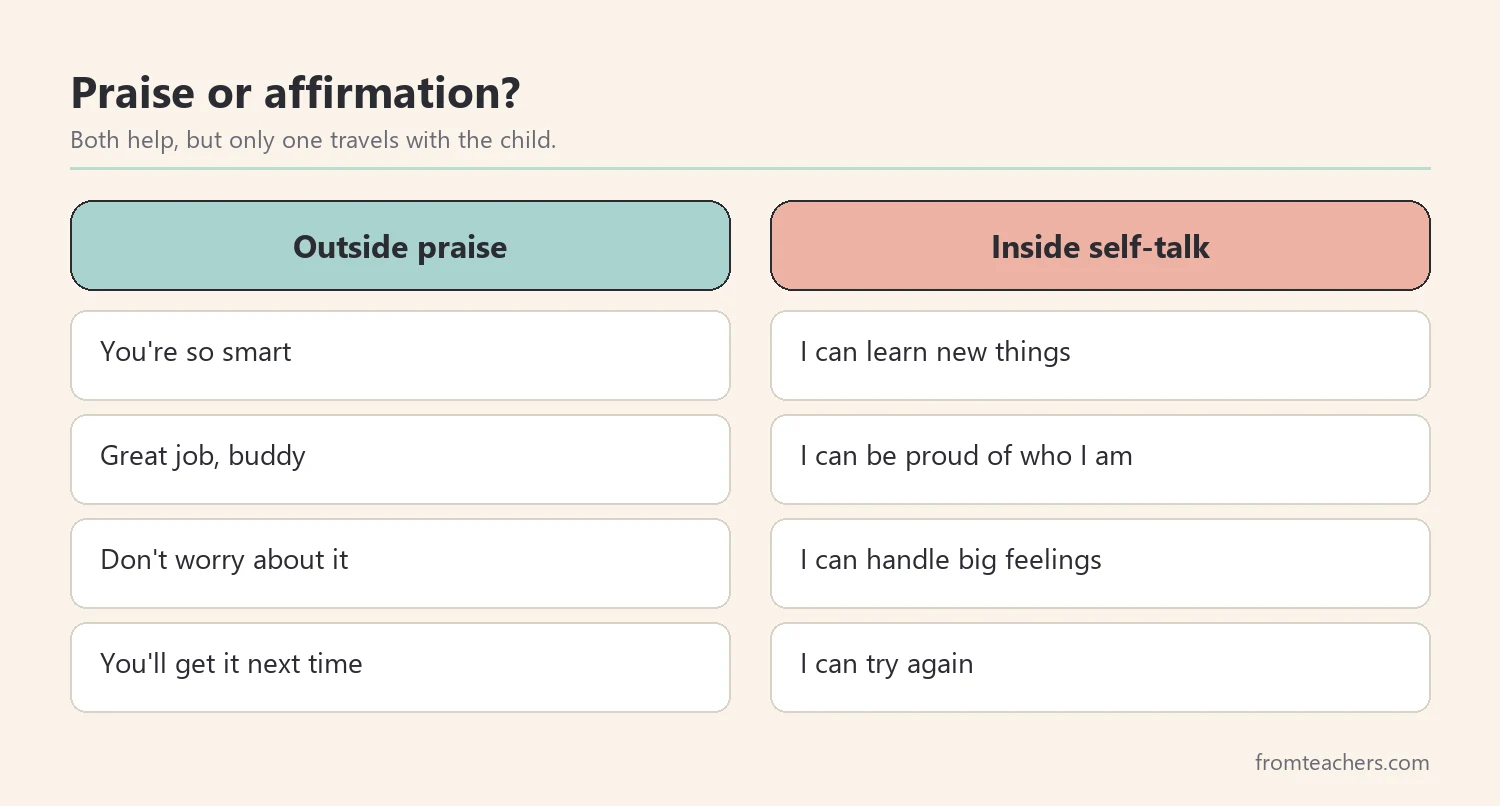
Also, separate affirmations from empty praise. Praise comes from outside: “You’re so smart.” An affirmation comes from inside: “I can learn new things.” The second one is a tool the child can carry into any room, even when no adult is watching.
Maya’s first affirmation
For Maya, Mr. Hale spent one morning on “I can handle big feelings.” He asked, “What is a big feeling?” Maya said, “When my tummy gets tight before a test.” Together they agreed that handling a feeling does not mean making it disappear. It means getting through it with a plan.
Moreover, adapt the teaching for different learners. Some children benefit from a picture beside each statement. Others need a sign, a gesture, or a voice output button. Older students may prefer quieter wording, such as “I can figure this out,” instead of sentences that sound young. Positive affirmations for kids should fit the child in front of you, not a single script. When you adapt the format, the meaning stays the same, and every child in the group gets access to the same kind words. In short, flexible teaching makes positive affirmations for kids inclusive.
In addition, revisit meaning regularly. Children grow, and so does their understanding. A statement that felt hollow in September may feel powerful in January once a child has a few real successes behind it.
3. Build a daily routine with positive affirmations for kids
Habits grow from repetition, and positive affirmations for kids are no exception. So, give affirmations a short, predictable place in the day. One to three minutes is plenty. Morning meeting, the start of a lesson, or the walk to the bus are all natural moments.
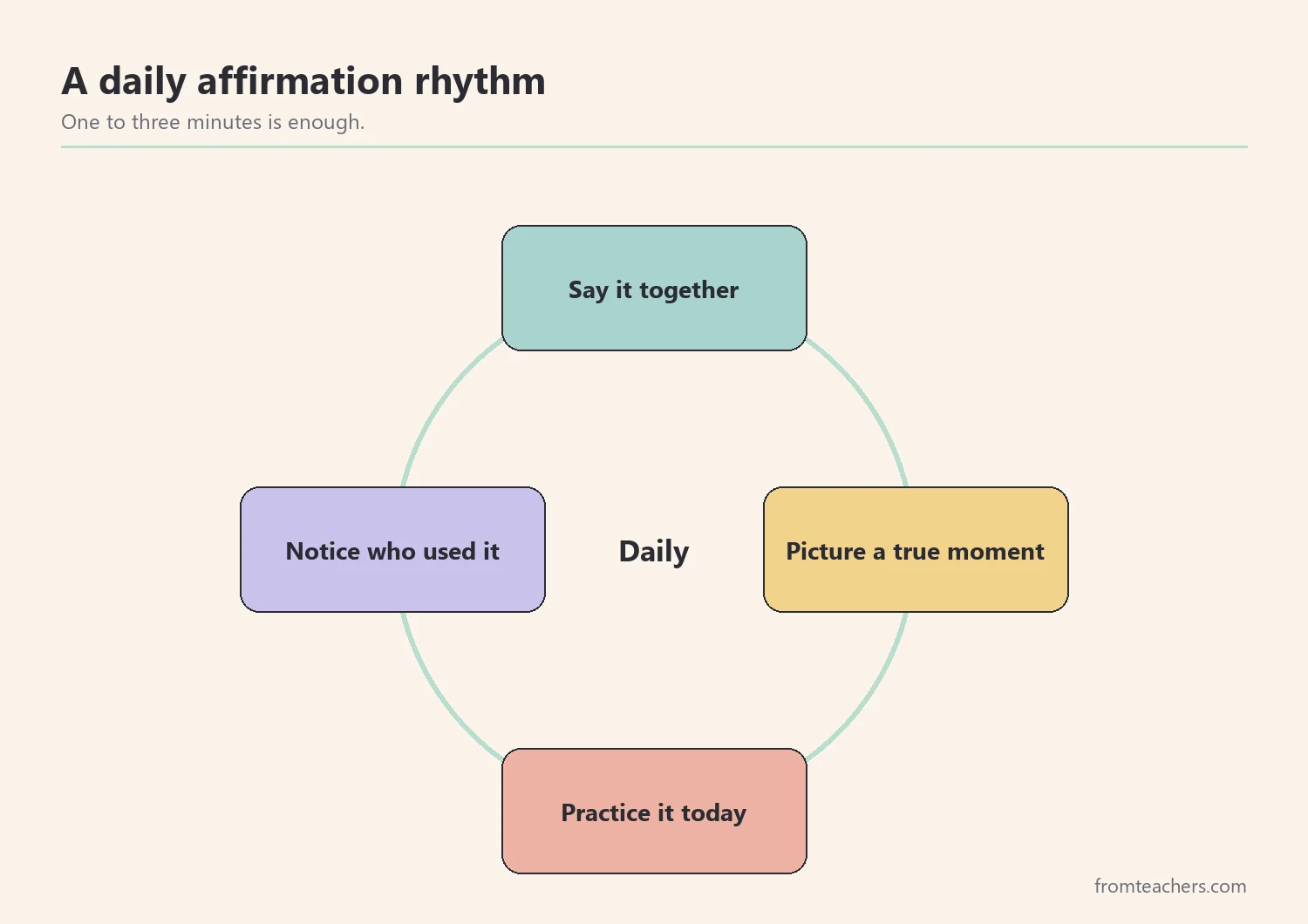
Use a simple four-part rhythm: say it, picture it, practice it, and notice it. First, say the statement aloud together. Then, picture a time it was true. Next, practice it during the day. Finally, notice when someone used it.
Moreover, rotate the themes across the week. Children stay interested when the focus changes, and they get to practice a range of statements. For instance, Monday might be “I am capable,” Tuesday “I am kind,” and so on.
| Day | Theme | Quick activity |
|---|---|---|
| Monday | I am capable | Name one new thing you learned |
| Tuesday | I am kind | Plan one kind act for today |
| Wednesday | I am strong | Practice one calm breath |
| Thursday | I am growing | Share a mistake that taught you something |
| Friday | I believe in myself | Choose a goal for next week |
Keep the words in view
Also, make the words visible. A wall display lets children glance at the statements throughout the day. A colorful positive affirmations poster for kids with six themed groups is a quick way to set this up in a classroom, calm corner, or bedroom.
For Maya, the routine was simple. Each morning, the class read the day’s theme together. Maya chose one sentence and wrote it on a sticky note for her desk. By the second week, she was choosing her sentence before Mr. Hale asked.
4. Connect positive affirmations for kids to hard moments
Here is where the routine pays off. The goal of positive affirmations for kids is not a pleasant morning chant. It is a sentence the child can reach for when work feels hard, a friendship goes wrong, or a big feeling arrives.
First, match statements to common hard moments. When a task looks too big, “I can try my best” fits. After a mistake, “Mistakes help me learn” fits. When a child feels left out, “People care about me” fits. Mapping these ahead of time makes them easier to use under stress.
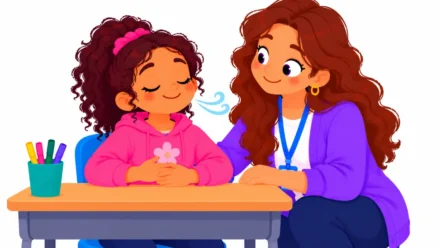
Next, prompt gently in the moment. A quiet “What can you tell yourself?” or a point to the poster is often enough. Avoid forcing a child to say a statement while upset. Instead, help them calm down first, then offer the words.
Model it yourself
In addition, model it yourself. Say your own affirmations out loud when you make a mistake. “Oops, I wrote the wrong date. Mistakes help me learn. Let me fix it.” Children learn self-talk by hearing adults use it naturally.
For Maya, the big test came during a timed math check. Mr. Hale saw her shoulders rise. He walked by and pointed to her sticky note. Maya took a breath, mouthed “I can keep going,” and started the first problem. She did not finish every question, but she did not shut down either.
Next, write a simple hard-moment plan with the child. List two or three situations that usually feel tough, and next to each one, write the statement the child picked. Keep the plan on a small card in a desk, pencil case, or backpack. Many teachers find that positive affirmations for kids work far better when the child helped write the card, because the words already feel familiar. Review the card together once a week and swap any sentence that is not being used. Over time, the card becomes a personal toolkit the child trusts.
Also, remember that affirmations are one tool among many. A child who is very distressed may need a break, a calm space, or adult support first. Affirmations work best alongside regulation strategies, not instead of them.
5. Notice and celebrate growth
Finally, watch for signs that the words are becoming the child’s own. The clearest sign is a child using an affirmation without a prompt. Others include calmer recoveries after mistakes, more willingness to start hard tasks, and kinder words about themselves.
Keep a light record. A tally of unprompted affirmations once or twice a week is enough. You are not grading feelings. You are simply checking whether the habit is taking root.
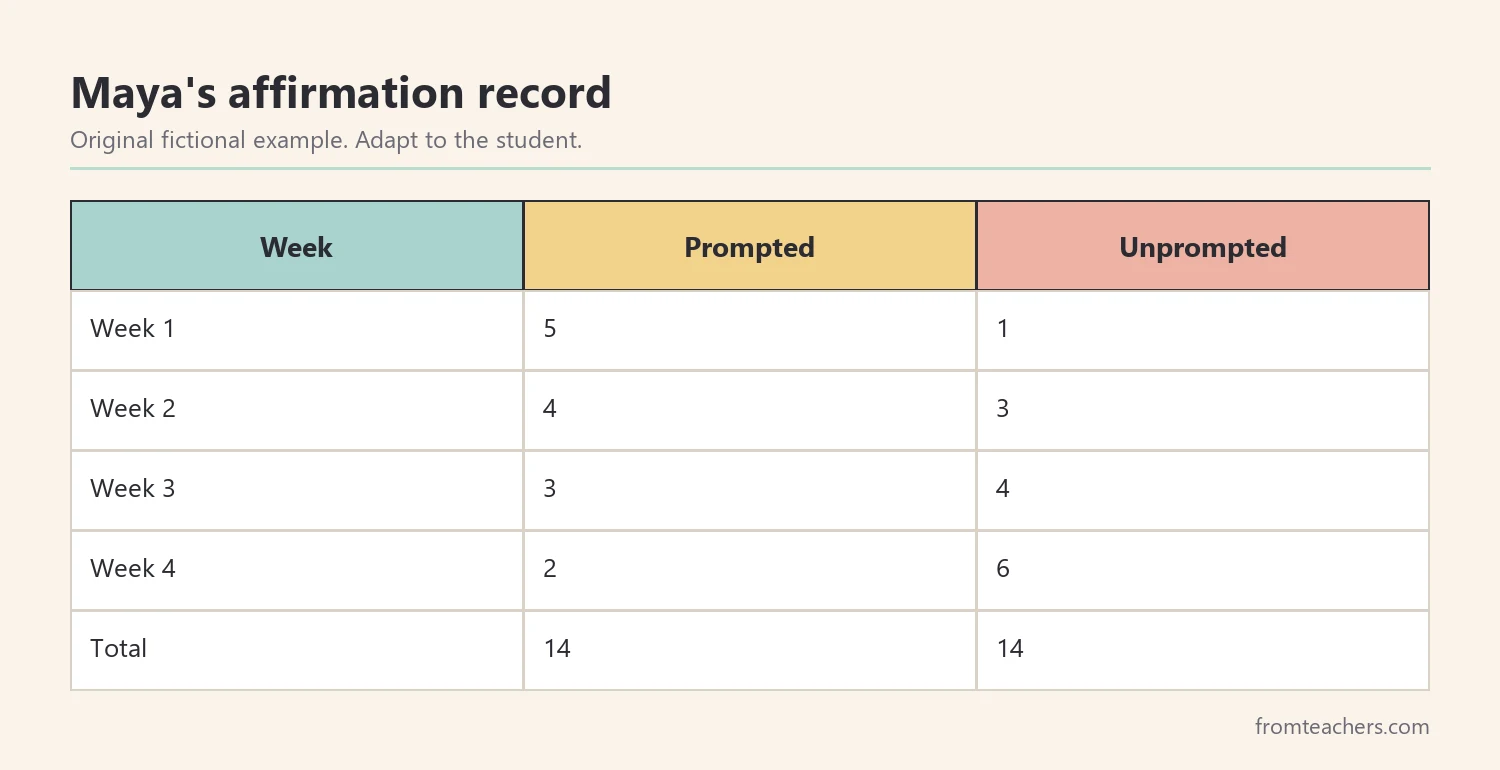
In Maya’s fictional record, unprompted affirmations grew from 1 in week one to 6 in week four, for a total of 14. Meanwhile, prompted ones fell from 5 to 2, a total of 14 as well. Together, that is 28 moments of practice in a single month.
Also, look at quality, not only quantity. A child who says one affirmation at exactly the right moment has made more progress than a child who repeats ten without thinking. So, note the situation when you hear a statement. Over a month, those notes show you which positive affirmations for kids are truly helping and which ones need to be retaught or replaced.
Then, celebrate specifically. “I heard you say ‘I can try again’ after the spelling test. That was brave.” Specific recognition shows the child exactly what worked.
Moreover, share progress with families. A short note home helps parents use the same words. When positive affirmations for kids sound the same at school and home, children transfer them more easily.
Common mistakes and how to avoid them
- Choosing statements that feel false. Children reject them. Fix: use “I can” sentences that stay true on hard days.
- Repeating without meaning. Words become noise. Fix: teach each statement with a real example.
- Forcing affirmations during meltdowns. Stress blocks language. Fix: help the child calm down first.
- Using affirmations instead of help. Real problems remain. Fix: pair self-talk with practical support.
- Too many statements at once. Children forget them. Fix: start with one or two themes.
Questions teachers and parents ask about positive affirmations for kids
At what age can children use affirmations?
Even preschoolers can repeat short, simple statements with pictures. Older children can choose and write their own. Adjust the length and vocabulary to the child’s language level.
What if a child says the affirmation is not true?
That is useful feedback. Try a softer version, such as “I am learning to…” or “I can try.” Believability matters more than how positive the sentence sounds.
How many positive affirmations for kids should I teach at once?
Start with one or two themes. Add more once children can use the first ones without help. A small, well-used set beats a long list nobody remembers.
Can affirmations help with anxiety?
They can be a helpful part of everyday coping. However, persistent anxiety needs support from a counselor, psychologist, or other qualified professional.
Do positive affirmations for kids work for students with special needs?
Many students with disabilities benefit from short, visual statements, especially when they are paired with pictures and practiced often. Work with the child’s team to choose words and formats that match their communication and learning needs.
Should affirmations be said aloud or silently?
Both work. Saying them aloud helps during learning. Later, children can whisper or think them, which is more practical during tests or social moments.
Related reading: School Counseling Strategies: Empowering Students to Dream Big and Achieve Success, Essential Trauma-Informed Teaching Strategies for Modern Classrooms, and How Parents and Teachers Can Team Up for Special Education Success.
A companion resource for positive affirmations for kids:
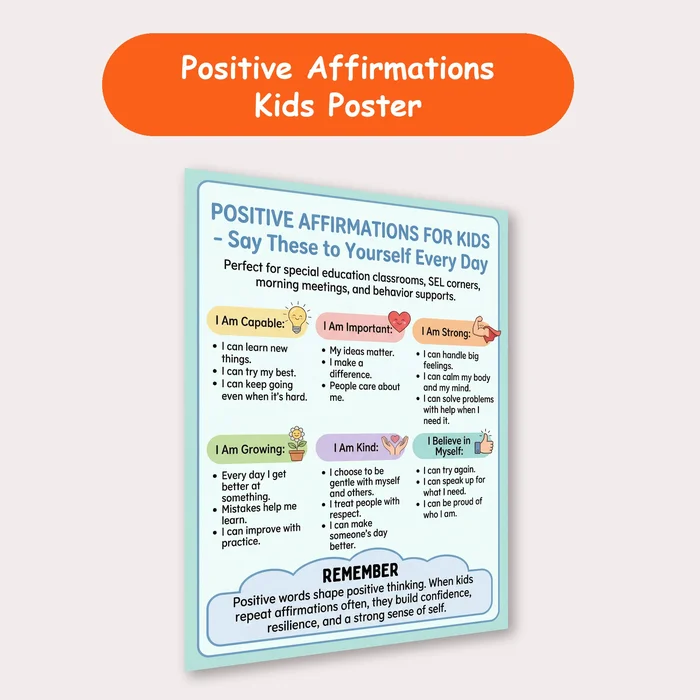
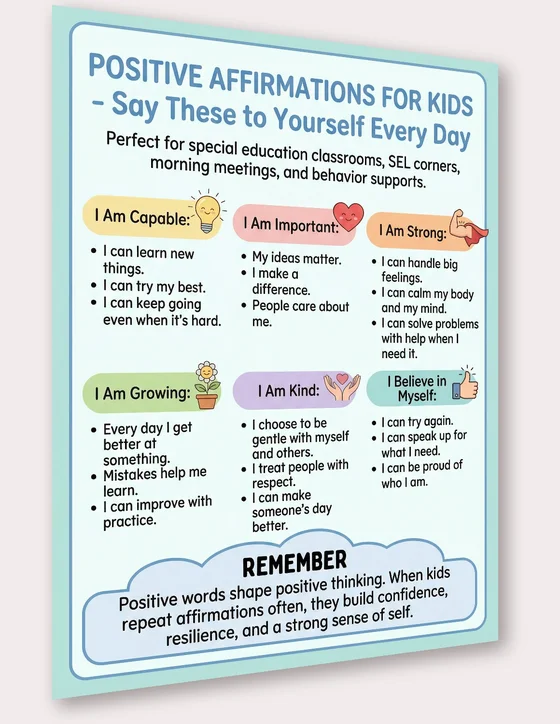
Positive Affirmations for Kids Poster: daily self-talk statements in six affirmation groups, made as a confidence-building SEL poster for special education classrooms, morning meetings, and behavior supports.
Sources and scope
- CASEL: a widely used framework for social and emotional learning, including self-awareness.
- Understood.org: family-friendly information on learning and thinking differences and self-esteem.
- American School Counselor Association: information on the role of school counselors in student well-being.
- Centers for Disease Control and Prevention: general information on children’s mental health.
This guide covers everyday use of self-talk statements at school and home. It does not replace counseling, mental health treatment, or the decisions of the child’s support team.
Key takeaways
- Choose short, believable “I can” and “I am” statements.
- Teach the meaning of each affirmation with real examples.
- Build a one to three minute daily routine.
- Match statements to hard moments and prompt gently.
- Track unprompted use and share progress with families.




Leave a Comment